

Archive | On Screen RSS feed for this section
The Essential Prisoner: Checkmate
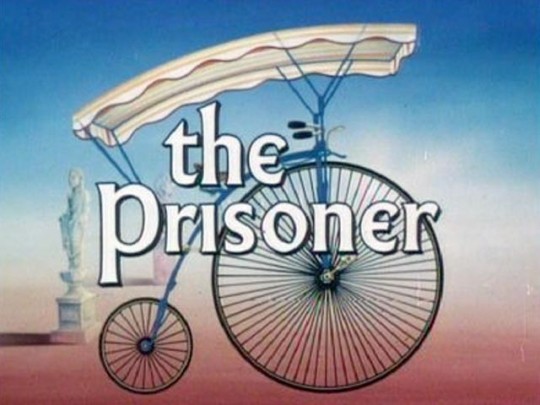
Adam Clarke sees the Village as a Choose Your Own Adventure. Yes, kiddies. This is a chess match where you are both player and pawn.
Since his arrival, Number Six has been declared dead to the outside world, run for office and attacked by evil balloons on a number of occasions. Last time, Six promised to sort out which Villagers were prisoners and which ones were warders. Tonight, he’ll learn how to do that.
Tonight’s Plot (In Six Words Or Less): Number Six is bad at chess.
Checkmate
Written by Gerald Kelsey
Directed by Don Chaffey.
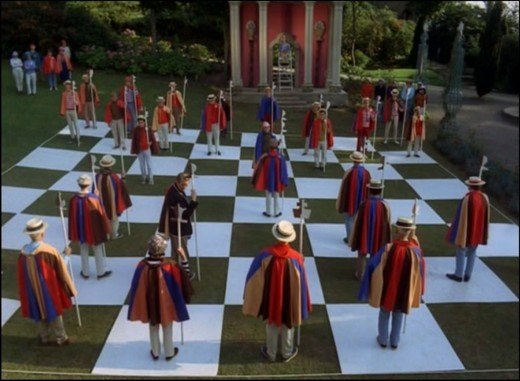
Chess is taken quite seriously in the Village, using prisoners as pawns on a giant outdoor board. Six gets a sense of the human chess game from its Queen (Rosalie Crutchley): the prisoners are corresponding chess pieces while two Villagers control the game. Six keeps her at a distance and focuses on the Rook (Ronald Radd), who suddenly refuses to play. This minor act of defiance results in a trip to the Village hospital courtesy of Number Two’s goons.
The match cancelled, Six has a few words with Number Fourteen (George Coulouris), one of the Villagers controlling the chess game. Fourteen tells Six that the key to identifying whether a Villager is a fellow prisoner or one of Two’s conspirators is in the way they react to him. If Six approaches a covert Village authority as if to study them, that person’s reaction will be defensive or aggressive. If Six approaches a prisoner the same way, that person will react in fear.
Forming another escape plot, Six is suddenly being followed by one of the chess pieces. The Queen has made many past escape attempts and, taking Six’s backstory at face value, she’s eager to help him with any plan he’s devised. Six politely declines her advice on escaping and tries to put Number Fourteen’s idea to work. The next morning, Six begins hovering over a sample of Villagers who either react to him with defiance or fear. Using this method, he forms a small gang including the shopkeep from Arrival and, of course, the Rook.
The Rook is an electronics expert who tells Six he could easily rig up a radio to alert the outside world to the Village. Rescue would be imminent, but the Rook needs the right equipment. Then it would simply be a matter of rowing out to meet their saviors. Soon, Six and his group of budding escapees are gathering materials to make a raft and a radio.
Noting Queen’s interest in Six, an eager psychiatrist (Patricia Jessel) has her brought in and conditioned. Reporting to the new Number Two (Peter Wyngarde in his glam phase), the psychiatrist shows that the Queen has now been brainwashed into falling in love with Six and has been given a locket with his picture. The locket is actually a tracking device. This tactic might prove useful in breaking Six down. If he could love or even pity the Queen, she’ll be far more useful to the Village than his observer was in “Dance of the Dead”.
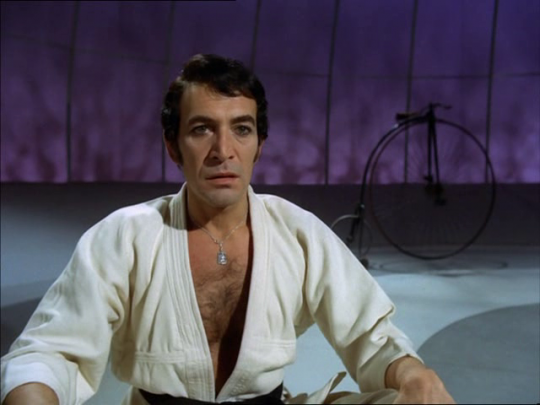
Whose Side Are You On? “Checkmate” suffers from Twist Ending Syndrome. Where many The Twilight Zones could be enjoyed equally between the first and second viewing, “Checkmate” is not as fun once you know the twist.
Unlike the previous three episodes, “Checkmate” wouldn’t make a list of my personal favourites of the series. Nonetheless, it is an essential episode of The Prisoner. More than Rover, more than “I AM NOT A NUMBER!”, the Villagers on the giant chess board has become one of the most enduring icons of a series full of great visuals. Odd, considering that human chess features in only one episode.
Where “Free For All” compensated for its story failings with a wickedly funny script, a strong guest cast and McGoohan’s trademark oddball visuals, “Checkmate” is a small step down in quality hindered by a childlike performance from Rosalie Crutchley. Despite her pantomiming, the majority of the episode is interesting, well-paced and does pick up on the forward momentum of these earlier episodes. The Village is still quite menacing, particularly the scenes in its psych ward, and the sequence where Six sorts out who his fellow prisoners are is terrific. Ronald Radd is excellent as the Rook and the human chess scene is a memorable oddity. Foreknowledge of the ending robs “Checkmate” of some of its re-watch value, as it’s little more than a rehash of the climax of “Arrival” (“we’re all pawns”).
Next time: Doubles, psychic powers, moustaches and death-by-bouncy-ball!
Miami Connection (1987)
Sun, Sep 15, 2013
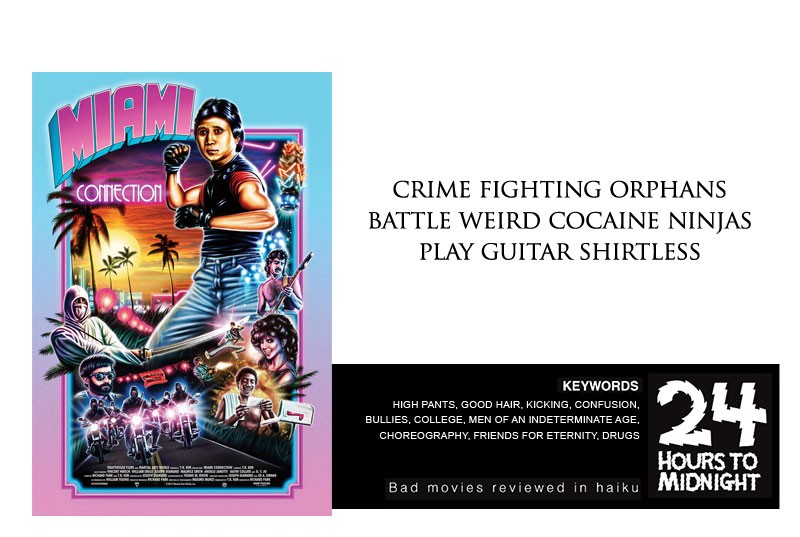
In this 1987 classic, recently rereleased by Drafthouse films, our ragtag bunch of heroes sing, kick and karate chop their way to victory against an evil motorcycle ninja clan who also deal drugs. Dragon Sound, a “multi-national martial arts rock band”, along with new addition tambourine girl and vocalist Jane, have had enough of the ninja scumbags harassing them and decide to seek vengeance. The fight scenes are weird but somehow good, the clothing and hairstyles are amazing, there are a couple of great moustaches and the acting is terrible. But you can totally tell that writer/producer/director/actor Y.K. Kim put his heart and soul into this thing, because it’s totally worth watching a dozen times. It’s an absolutely ridiculous and awesome piece of work — also, it’s available on VHS in a clamshell case, complete with “be kind, please rewind” stickers. Try watching the trailer and see if you can resist.
BONUS:
The Essential Prisoner: Free For All
Thu, Sep 12, 2013

Following the advice of noted political pundit Marblehead Johnson, Adam Clarke thinks the puppet on the left is more to his liking.
When we last left Number Six, he’d been declared dead to the outside world and seen one of his colleagues lobotomized by the Village. Of course, he had been warned about escaping in an enigmatic conversation with Mary Morris’ chilling Number Two…
2: This is your world. I am your world. If you insist on living a dream, you may be taken for mad.
6: I like my dream.
2: Then you are mad.
Now he’ll take on Number Two’s world literally by becoming the new Number Two.
Tonight’s Plot (In Six Words Or Less): Unlike reality, Village elections are farcical.
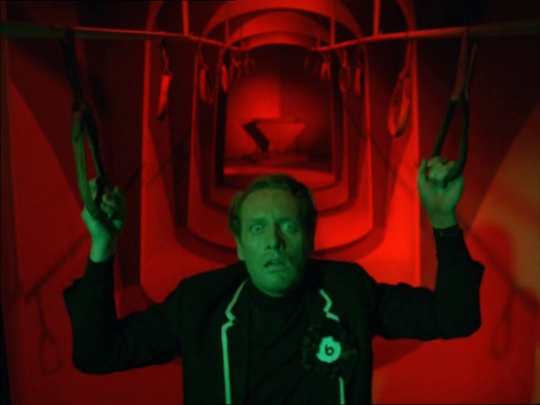
Free For All
Written & Directed by Patrick McGoohan (credited as Paddy Fitz)
“I am in command. Obey me and be free!”
-Number Six
During a morning visit to Number Six, the new Number Two (Eric Portman) explains that the Village routinely runs elections for a variety of offices including Two’s. Interested in escaping and meeting the elusive Number One, Six becomes a candidate for the position of Number Two, much to the current Two’s delight. Without a drastically different opponent to polarize the masses, Two fears the Villagers have grown complacent and lost their respect for democracy.
On the campaign trail, Number Fifty-eight (Rachel Herbert) has volunteered to be Six’s publicist/campaign manager. Of course, Six treats Fifty-eight with trademark rudeness, but she doesn’t mind. Fifty-eight doesn’t seem to speak English (though she understands it) and responds to Six’s abuse with cheerful and borderline manic enthusiasm. Building up to the election, Six will be drugged and conditioned by Two’s henchmen so many times that he’ll barely remember his intended goal of escape.
Where am I? Produced directly after “Arrival”, edited well after “The Chimes Of Big Ben” and aired fourth, “Free For All” should be slated third in the episode order. Just as “Dance of the Dead” is the most logical episode to follow “Arrival”, “Free For All” seems to follow “Dance”. In “Dance”, Mary Morris’ Number Two remarks that the Village is democratic (“in some ways”) and here we see what she means.
I would place “Free For All” third because, as with “Dance” and “Checkmate”, Six doesn’t know anything about the Village and is more trusting than he would be in later episodes. Speaking of later episodes, one of Six’s campaign promises to distinguish between prisoners and warders, meaning this episode’s events occur just before “Checkmate”.
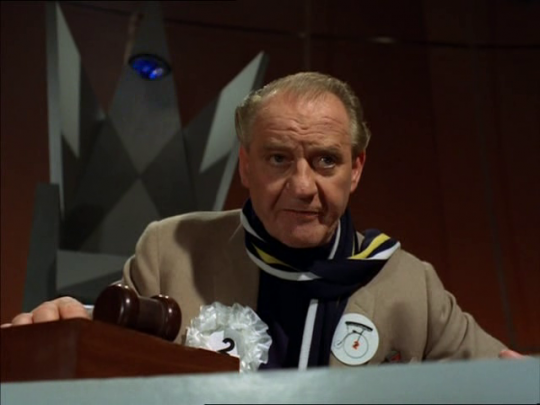
“If you win, Number One will no longer be a mystery to you. If you know what I mean.”
-Number Two
Whose Side Are You On? Script-wise, the repeated drugging of Six hurts “Free For All”. As entertaining as the episode is, “guy is drugged into doing something he doesn’t believe in, then snaps out of it after accomplishing nothing” isn’t much of a story. There’s no real stakes in the episode. McGoohan’s script is purely intellectual writing, favouring symbols and satire over drama.
“Free For All” sets the tone for the other scripts penned by the series’ creator-producer-star. Patrick McGoohan was more interested in allegory and surrealism than developing a story between the Village and Six. Here we have an election in the Village where the citizens are bored of the current Number Two, but the Village people (er…) aren’t interested in backing a revolutionary. They’re just happy to cheer whenever 6 belts out the usual slogans (which the Village conditions him to utter), reinvigorated by the illusion of change.
The whole charade doesn’t do Six any good. His escape attempt fails and he learns nothing about the Village or his captors. He’s just a man who ran for office to free himself and others only to have his plans diluted by those who are really in power, discovering too late that democracy is a myth and policies only change in the most superficial ways. He is ejected from power immediately and returns home savagely beaten, not that any of his fellow Villagers care anyway.
Subtle it’s not, but I wouldn’t call it any less accurate a satire than it was in 1967. Kudos must be given to Patrick McGoohan for presenting these ideas in a fresh way; the scene where Number Six’s interviewed by the Tally Ho reporter is particularly funny. The episode’s weird directorial touches, like the split-second shot of a bursting balloon marked “VOTE”, communicate the script’s ideas with surrealist glee. Like “Dance Of The Dead”, “Free For All” is one of the best directed episodes of the series.
What it lacks in a strong story is made up for with some of the wittiest dialogue of the series. The Village is already starting to lose the menace it possessed in “Arrival” and “Dance”, but McGoohan’s script is wickedly funny. There are times when the script reminds me of William Peter Blatty at his finest, as Two and Six act less like characters so much as walking dispensers of clever banter.
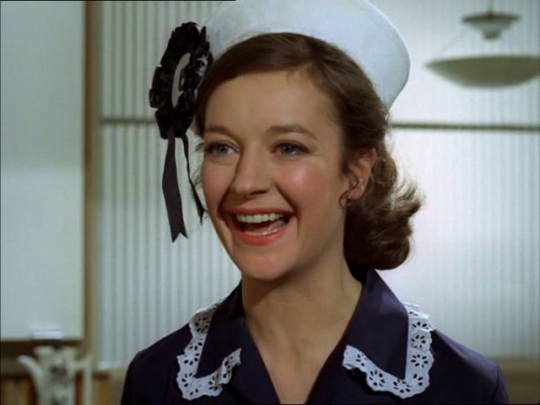
Clever though it is, a script like McGoohan’s would be nothing without a strong guest cast. While Portman and McGoohan have great chemistry, Rachel Herbert’s 58 steals the show from them. Herbert is less like a Village regular than some charming refugee from a Kate Bush video. Herbert’s 58 is one of The Prisoner‘s most likable guest spots and I wish we could have seen more of her in the series, especially in light of the ending of “Free For All”.
Ah, but how could I forget the cave scene? In a brief WTF moment late in the episode, we see Six enter a cave filled with Number Two’s goons. The goons are just sitting and watching Rover, apparently mesmerized. It’s a scene that fans have debated for decades, but the original script shines some light on this cryptic sequence. The original Rover wasn’t a growling, homicidal ball, but a vehicle. In Patrick McGoohan’s earlier drafts, Six ran into mechanics who were giving Rover a tune-up (in a typically McGoohan touch of weirdness, the mechanics were all wearing boxing gloves for no reason). While the new Rover would need no such tune-ups, the scene was kept in a slightly altered fashion, adding to the mystery of Rover.
Additional weirdness comes from a callback to the scene where Six runs into a couple of identical workers in “Arrival”. This time, it’s a different set of twins working for the Tally Ho. I’d always assumed this was meant to imply that the Village has done cloning experiments as opposed to coincidentally housing a handful of identical twins. Of course, the series never really deals with this, so that aspect of The Prisoner remains little more than a weird touch.
“Free For All” doesn’t delve too heavily into the espionage elements of the show, but it has all of the humour, allegory and surrealism that would become hallmarks of The Prisoner. Though the episode doesn’t have the clearest story, it’s visually striking and has some of the show’s most quotable dialogue. “Free For All” is one of the few episodes of the series that can be described as light and funny. It’s a great comedy. This being The Prisoner, the comedic episode still ends with our hero failing and getting the shit kicked out of him by lunks and goons.
Next time: In the Village, chess is played with people instead of pieces.
The Essential Prisoner: Dance of the Dead
Mon, Sep 2, 2013
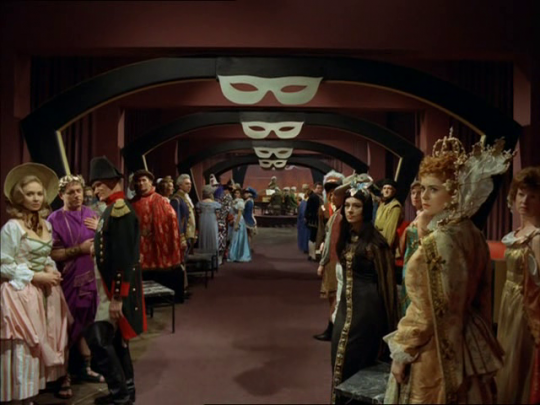
Adam Clarke thinks episode 8 is episode 2 for Number 6
The Story In Six Words (Or Less): Six attends a fancy carnival, dies.
When we last left Number Six, he’d been kidnapped and placed in the Village, met Number Two (both of them) and had his escape attempt thwarted by a howling, membranous thing (which we’ll call “Rover”). A trend for the series starts with its second episode in the form of an extended title sequence. After the title credit, most episodes from this point on begin with a version of this exchange* between Number Six and the Number Two of the week:
6: Where am I?
2: In the Village.
6: What do you want?
2: Information.
6: Whose side are you on?
2: That would be telling. We want information. Information. Information.
6: You won’t get it.
2: By hook or by crook, we will.
6: Who are you?
2: The new Number Two.
6: Who is Number One?
2: You are Number Six.
6: I am not a number! I am a free man!
2: (Laughs)
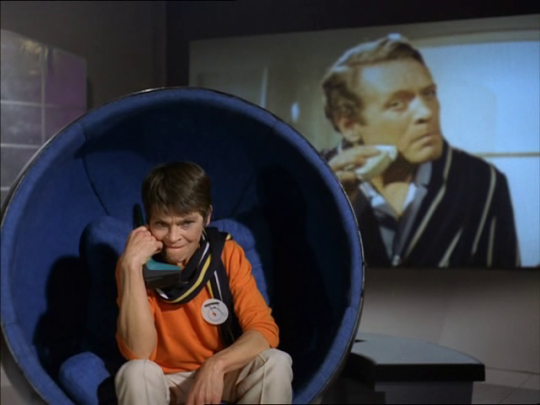
Dance Of The Dead
Written by Anthony Skene
Directed by Don Chaffey
“Dance of the Dead” begins at night, not long after “Arrival”. His sleep interrupted by a mind-control device, Number Six (Patrick McGoohan) is hypnotized into taking a call from Number 42 aka Roland Walter Dutton (Alan White). An apparent colleague of Six’s, Dutton asks about Six’s recent resignation and claims the late night call is at the request of their former bosses (“the committee”). In reality, a doctor aka Number 40 (Duncan MacRae) feeds questions to Dutton at Village HQ. Dutton’s been broken so badly by the Village that he’s manipulated with ease. The ever-paranoid Six hears 40 whispering in the background and the unauthorized experiment is immediately canceled by the arrival of the latest Number Two (Mary Morris). This Two is adamant that Six can’t be broken like Dutton and needs to be won over. Six’s cooperation is vital to the Village succeeding in its aims, whatever they may be.
Number 6 awakens with no memory of Dutton’s call the previous night and finds he’s been invited to Carnival, a costume dance held in the Village town hall. During a chat with Number 2, 6 learns that special prisoners are assigned observers and that his is a striking blonde, Number 240 (Norma West). Number 6 tries to get some answers out of his observer, but is told “questions are a burden to others. Answers a burden to one’s self”. When 240 heads backs to Village HQ, 6 tails her but is blocked by Rover, the bouncy menace. Avoiding the homicidal sphere, 6 follows 240 over to the town hall, but is blocked again. Not by Rover, but by some invisible barrier that knocks the wind out of him. A fellow prisoner sees this and shrugs it off, noting that the town hall’s “fussy about who it lets in”.
Avoiding the drugged food/drink provided by Village maids, as well as the hidden transmitters trying to hypnotize him into sleep, Number 6 sneaks out of his home to explore the Village. By dawn, 6 discovers a corpse washed up on the Village’s beach. This isn’t a Village casualty, but an ordinary man who died in some accident at sea. His only tie to the outside world, Number 6 drags the body to a cave hidden from Village surveillance. There, 6 writes a note and includes a photo of himself in the dead man’s wallet, which he wraps in plastic and puts in the corpse’s jacket pocket. 6 then steals a life preserver, places it on the body and pushes the dead man out to sea.
Returning to the cave, he spots 42/Dutton whom 6 recognizes from his old life. They may have been colleagues, but 6 remains obtuse (he later describes Dutton to 2 as “a man I think I knew”). After a moment of catching up, Dutton confesses that he’s revealed everything he knows to Number 2. Dutton says that spilling secrets bought him no extra time or comforts and that he’ll soon be executed by Number 2′s cronies.
When Carnival begins later that night, 2 (dressed as Peter Pan) reveals that the dance is actually a trial for 6 (dressed in his own tuxedo, provided by the Village). He’s being charged with being a disharmonious Villager and the punishment would be death. During the Carnival-trial, 6 calls for Dutton to be his character witness, but what 2 brings out to the dance hall/trial room isn’t much good. Dutton, in a jester’s outfit, wanders into the Carnival court. He’s been lobotomized.
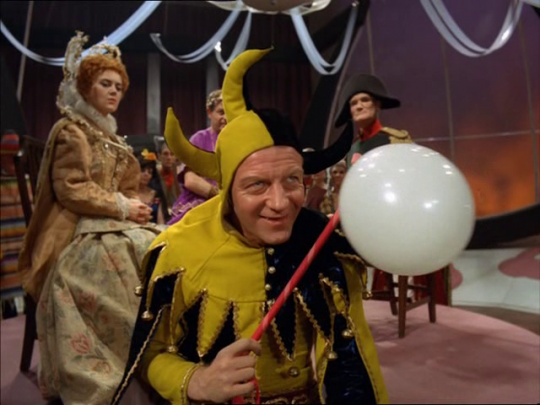
6 is pronounced guilty and the Villagers form an instant costumed mob to chase him down. 6 manages to find a hiding spot, but is quickly intercepted by 2. She tells him the meaning of her death sentence. The Villagers aren’t going to murder him, as that was just a little joke. Instead, Village security fished out the dead body and “amended” both it and the contents of its wallet. It’s 6 who’ll be reported as having died in an accident, confirming his lifetime sentence in the Village.
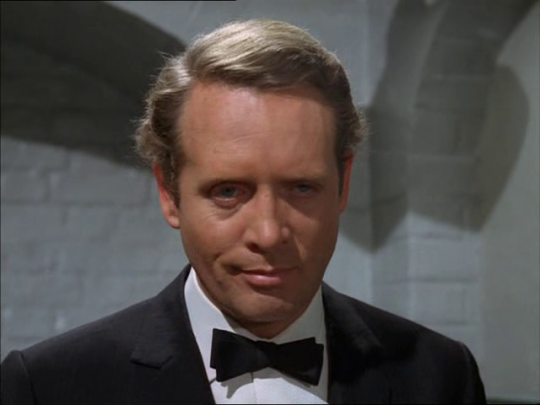
Episode placement: Though screened eighth when the series originally aired back in ’67, I’m not the only one to consider this the proper second episode of The Prisoner. During the chaotic production of the series, several writers were commissioned to come up with a good second episode, resulting in “Dance”, “Checkmate” (screened ninth) and the McGoohan-scripted “Free For All” (screened fourth). These episodes share references to Six’s recent arrival in the Village, depict Six as less hostile/paranoid and show Six to be unaware of common Village rules. Another tell-tale sign that this was produced early is that Rover doesn’t make its trademark howl and emits only the high-pitched whistling and off-rhythm heartbeat heard in the unaired alternate cut of “Arrival”.
I place it earlier than the other “second episodes” because of Six’s aforementioned unfamiliarity (“I’m new here”/”I haven’t seen a night”) and that most of “Dance” is devoted to world-building. There’s also a few seeds planted for later stories, foreshadowing “Chimes of Big Ben”/”Many Happy Returns” (Dutton: “You, me, Arthur, the Colonel…”), “Free For All” (Number Two’s assertion that the Village is democratic) and the series finale (“This man has a future with us”.)
Why was “Dance” screened eighth? Though it would have likely aired shortly after “Arrival”, the episode proved a nightmare to edit with its many story threads (Dutton, the dance, the body, the observer, etc). So, this episode was shelved until it could be edited into a coherent hour.
Whose side are you on? “Dance of the Dead” is one of the greatest episodes of The Prisoner. The script is somewhat complicated and doesn’t have a plot so much as a series of sub-plots, which gives it a vibe more common to the AMC/HBO storytelling of today than episodic 60′s TV. That script is given considerable weight by one of the series best guest casts and taut direction care of Don Chaffey.
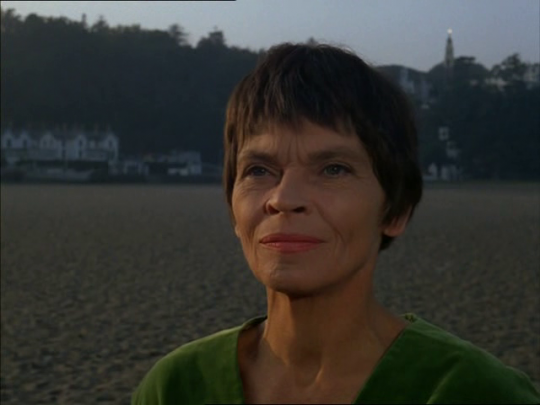
Chaffey, who directed four episodes of the series including “Dance” and “Arrival”, provides some terrific visuals. While this series is often praised for its cinematic look, this episode boasts some especially striking sequences, like the gorgeous, dusk-shot beach confrontation between 6 and 2 containing this unforgettable exchange:
2: This is your world. I am your world. If you insist on living a dream, you may be taken for mad.
6: I like my dream.
6: Then you are mad.
Of all the Number Twos, Mary Morris is my favourite tied with Leo McKern (whose episodes we’ll get to later). Unlike the other Twos, there’s no warmth or vulnerability to her performance. Instead, an indomitable confidence is present in her every scene. She’s the Number 2 who most relishes being in control and seems to be smiling because she enjoys not only the Village and its power, but the cruelty she so casually inflicts. Morris invests real menace in the part, playing 2 as if she’s certain she’ll beat 6 in the end. It’s eerie the way she savors the moment when presenting jester-Dutton in his newly-reduced state. Morris is almost never seen without that horrible smile carved along her face. She’s less like a villain than a demon in a woman’s skin.
Like the wonkily-animated, low-key first season of The Simpsons, “Dance” presents a Prisoner that might’ve been. A Prisoner far darker than the series would become. As we’ll see later in the series, McGoohan’s increased creative control betrayed how silly he thought the Village was, resulting in a steady decay of the menace it possessed. While I love The Prisoner, I can’t help but wonder how things would have turned out had the tone of the show always been so bleak and the rotating Twos always been as ruthless as Morris. While the weaknesses 6 exploits in later episodes are arguably dramatic necessities, it’s unfortunate that the Village and Number 2 will never again be this frightening or powerful.
Easily the show’s grimmest hour, “Dance of the Dead” is a great way to follow up the promise of “Arrival” and is one of the series’ top three episodes.
Next time: Elections, Village-style.
*Mary Morris only repeats “information” once after “we want information” and returning Number Twos respond with “I am Number Two” instead of “The new Number Two”. Minor variations aside, that exchange will play out at the beginning of all but four episodes of The Prisoner.
The World’s End (2013) and It’s A Disaster (2012)
Thu, Aug 29, 2013
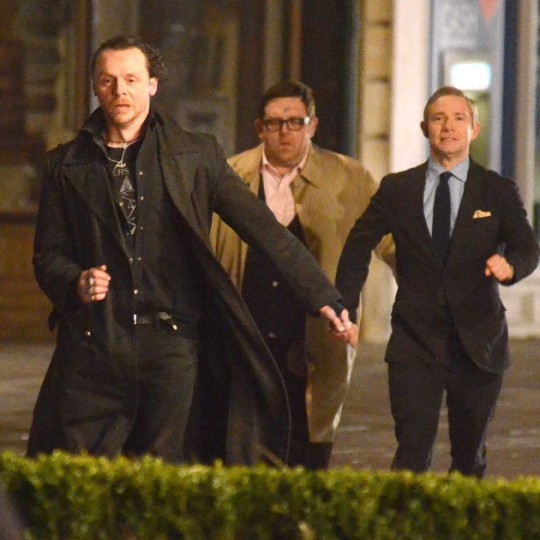
Fear not, David Cross. Adam Clarke gets a little touchy when people bring up Alvin & The Chipmunks, too.
Best friends in high school, Andy (Nick Frost), Steven (Paddy Considine), Oliver (Martin Freeman) and Paul (Eddie Marsan) are reunited by Gary King (Simon Pegg) to finally complete the golden mile. The golden mile was their failed attempt to visit 12 pubs in their hometown of Newhaven during one hazy summer night in the early 90′s. Slobby, perpetually-drunk stoner Gary thinks 20 years is enough time to give it another go and, after falling out with virtually everyone he’s ever known, is determined to get “the band back together”. Since the other four have moved on with careers, marriage, divorce, children, etc., man-child Gary gets what he wants with the only skills he’s acquired in 40 years: lies and low cunning.
It almost works, too. Despite considerable tension between the reckless, stuck-in-the-90′s Gary and the reserved, tea-totaling Andy, they almost succeed in having a good time. There’s only one problem: Newhaven’s been invaded by something that isn’t human.
The World’s End is the latest treatise on extended adolescence/genre-bending comedy from the team of Nick Frost, Edgar Wright and Simon Pegg, whose previous collaborations produced two of the funniest comedies of the past decade, as well as the likable-but-overrated Spaced.
Discounting the trio’s brief reunion for the Grindhouse trailer, Don’t, Wright, Frost and Pegg split off for other projects after Fuzz. The films that resulted? The underrated, Wright-helmed Scott Pilgrim Vs The World, the occasionally hilarious Frost-Pegg comedy Paul, and the okay solo Pegg venture Run, Fatboy, Run. It’d been 5 years since the team got back together and, impressively, World’s End matches their best efforts.
Wright and co. have crafted another tightly-scripted, absurd comedy that pays homage to their pop obsessions. There are many in-jokes littered throughout the film, my favourite being when a co-conspirator is handed a somewhat crescent-shaped telephone and told to report to a supervisor. If the shape of the phone wasn’t enough of a nod to The Prisoner, all of this occurs at bar number six of the golden mile.
While it’s not as funny as Hot Fuzz or as fresh as Shaun Of The Dead, The World’s End is a worthwhile third go-round of violent, yet sentimental comedy. Wright has always owed just as much to John Hughes as he has to The Evil Dead. His work is equal parts Peter Jackson at his funniest and Judd Apatow at his least cloying. The mix is given an added ingredient of bitterness through the failure of Gary King.
Pegg’s King is a wonderful surprise for a couple of reasons. One, Pegg and Frost effectively swap their standard roles of Dim-witted Slob and Voice of Reason and such comic actor reversals have proven disastrous in the past (let us take a moment to shudder over the unwatchable Belushi-Aykroyd comedy, Neighbours). More importantly, Gary King’s years of failure give the film an unexpected bit of melancholy. Instead of being seen as an okay guy like most man-child comedies would depict him, World’s End doesn’t shy away from making King an asshole. He’s everything that’s unbearable about your teenage self with an extra dose of resentment. The film doesn’t need to soften him and, thankfully, doesn’t try. He gets all the film’s best lines by being such a clueless, irredeemable twit (the best of which is simply him saying “No” in a late scene I dare not spoil).
The finale may be a little derivative of Shaun Of The Dead and it doesn’t reach the heights of Hot Fuzz, but The World’s End is a terrific reunion of (and last hurrah for?) the Wright-Frost-Pegg team. Of their efforts, together and otherwise, I’d rank them…
1. Hot Fuzz
2. Shaun Of The Dead
3. Don’t
4. The World’s End
5. Scott Pilgrim Vs The World
6. Spaced
7. Paul
8. Run, Fatboy, Run
9. Asylum
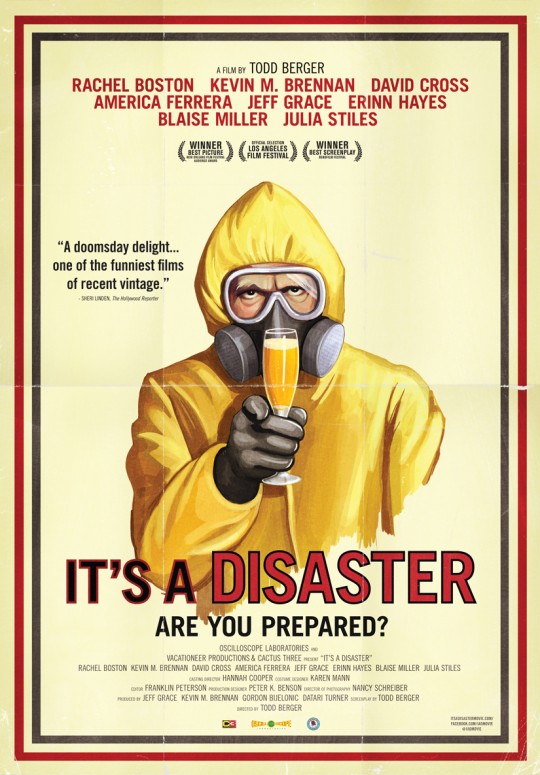
Married couple Emma and Pete (Erinn Hayes and Blaise Miller) have been organizing couples brunches over the years for their eclectic set of friends. Regulars include Heddy (America Ferrera) the schoolteacher and her pop culture obsessive fiance Shane (Jeff Grace), perpetually single Tracy (Julia Stiles), perpetually late Gordon and Jenny (Rob McGillivray and Jesse Draper), as well as permanently flaky Lexi and Buck (Rachel Boston and Kevin M. Brennan).
This particular brunch is tense. Heddy and Shane have been engaged for six years with no marriage date in sight, Emma and Pete have a bombshell to drop on their guests while Buck and Lexi make everyone uncomfortable with their airhead antics. To make things more awkward, Tracy’s brought Glen (David Cross), a guy she met online (but she’s telling everyone they had a meet cute at a grocery store).
Suffice it to say, today’s destined to be the Hidenburg of brunches. Yet the disaster becomes a very literal one when a chemical weapon is set off in the area, trapping most of the brunch crew (plus Glen) in Emma and Pete’s house. Toxic gases are expected to slowly leak into the house, killing them all. Of course, none of our couples take notice until a neighbor walks in with a hazmat suit on. Sure enough, ol’ hazmat is sad he didn’t get a brunch invite, too.
It’s A Disaster, recently added to Netflix, is a superb comedy. Not to be buried by recent apocalypse comedies This Is The End and The World’s End, Disaster stands out with its perfect dissection of not-yet-middle-aged malaise. For those who’ve never attained traditional happiness or purposefully avoided it, this potentially fatal scenario would be a wake-up call. Not so for our brunch-goers. They’re not Don McKellar and this isn’t Last Night. Here, you have self-absorbed people coming to grips with their mortality in the shallowest of ways. One of many highlights is this exchange between Tracy and Glen:
“You know I’ve never been to Europe. Not once. I’ve never been to Montreal, which I hear is very European. I never went scuba diving. I never went to the ballet. I’ve never been in love. I’ve never even watched The Wire”
“All of those things are overrated. Except for The Wire. It’s really good. The last season’s not very good…”
It’s A Disaster is full of clever dialogue, spouted ably by a strong cast. A particular highlight is David Cross who delivers one of the best performances of his career in a relatively straight role. It’s not a perfect film, mostly due to a disappointing last-minute twist that rewrites an entire character, but I’m still inclined to give the film a strong recommendation. Writer-director Todd Berger has crafted a smart, memorable comedy about modern day self-absorption and the odd things we do to make life seem important.
What’re you waiting for? Go watch It’s A Disaster. And The World’s End. But see The Wire first. Not because you need to see it to understand Disaster. It’s just that you really should’ve seen The Wire by now. Come on, jeez.
Rules For Life I Learned From Movies
Wed, Aug 28, 2013
Adam Clarke learned about adulthood from the movies. He presents this excerpt from his upcoming self-help book, “Soul Cleanse: An Emotional Ipecac”, to help you lead a better life.
Two young people busy violating the rules of nature.
Looking back on my days at St. Jesus’ Post-Secondary School for Wayward Turnips, I know there are many potholes students must avoid on the road to adulthood. Young people need guidance, and who better to give them life lessons than I? My knowledge comes strictly from movies and I now pass this bounty of wisdom unto you, my possums…
Never Rise Above Your Station
In James Cameron’s Titanic, lower-class Leo DiCaprio tries to romance wealthy socialite Kate Winslet aboard a ship that was deemed unsinkable. When he successfully woos Winslet, the Titanic sinks in what can only be described as an act of God. The lesson is simple: class-mixing is in defiance of God and you must never rise above your station.
Love Can Be Yours Through Trickery
“I can’t put up with your lies so I’m going to lie to you again.”
Love is the exchange of two fantasies, so don’t feel bad about repressing your awful nature or making crap up to get what you want (as long as you’re not poor. See above). In Silver Linings Playbook, Bradley Cooper and Jennifer Lawrence built a relationship on a loving foundation of lies and lived happily ever after. The same is true of the couples in such all-time classics as Roman Holiday, Roxanne, Maid In Manhattan and many others.
Sex is fueled by dishonesty. Numerous comedies (Loose Screws) from cinema’s (Revenge of the Nerds) most romantic period—the 80’s—show that (Joysticks) people like being lied to, taken advantage of or spied on (Porky’s) if the intended goal is sex.
If lying troubles you, think of yourself as an internet entrepreneur pretending to be the exiled king of Freedonia: though some will see through your act, you’re bound to get someone’s credit card and SIN numbers if you just lie hard enough.
Honour Thy mother & Thy Father
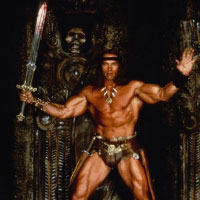
Conan the Barbarian: archetypal dad
I was raised by a VCR, but that’s not to say I didn’t have parents. Their nurturing was also heavily influenced by movies. Pep-pep Clarke believed the rules for being a man were buried in Conan The Barbarian. This proved problematic when Pep-pep was arrested for assaulting a camel on six separate occasions. Mother Clarke learned how to care for children through repeat viewings of Mommy Dearest and Whatever Happened To Baby Jane, resulting in my brother and I getting the same gift for our birthdays each year: post-traumatic stress disorder.
Tough love aside, all parents care about their children. Was it not sweetly tragic when the hero of Braveheart, King Edward I, died trying protect the crown to secure his son’s future? Was it not heartwarming to see that Vera Cosgrove’s dying wish was to be reunited with her son at the end of Peter Jackson’s Dead-Alive? The love parents have for their young cabbages is heartwarming.
Just Say No To No
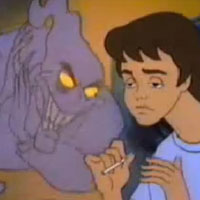
“Drugs aren’t bad, mmmkay?”
In 1990, ABC aired a George H.W. Bush approved animated special Cartoon All-Stars To The Rescue. The special, after a brief intro by the then-President, depicted a schoolboy who is harassed constantly by the biggest cartoon characters of the 80’s due to his occasional pot smoking. It made a huge impression on me as a youngster and I’m happy to let the 41st President of the United States know I received his message loud and clear: friends, family and even cartoons get in the way of your vices, so just say no to anyone telling you to say no to drugs. Rest assured, I will resort to peyote-laced moonshine if it means sparing me a lecture from Alf and Papa Smurf.
Drugs have done good things. If it weren’t for the life-altering power of drugs, Marion Silver (Jennifer Connelly) wouldn’t have discovered her passion for performing at the end of Requiem For A Dream. Would the Kramer-esque piano player in Reefer Madness still tinkle the ivories with fevered imagination if not for tender, loving drugs? I think not.
There are no consequences to basing your life on Beyond the Valley of the Dolls. Sure, I was once charged on a drunk and disorderly outside Totally Tubular in ‘93, but you have to take that in context. I was on the Grape Triaminic when I tried to convince the manager that, in light of Totally Tubular having more ball pits than tubes, they should rename the place Totally Balls. Whatever. You can’t judge me.
The Essential Prisoner: Arrival
Thu, Aug 22, 2013
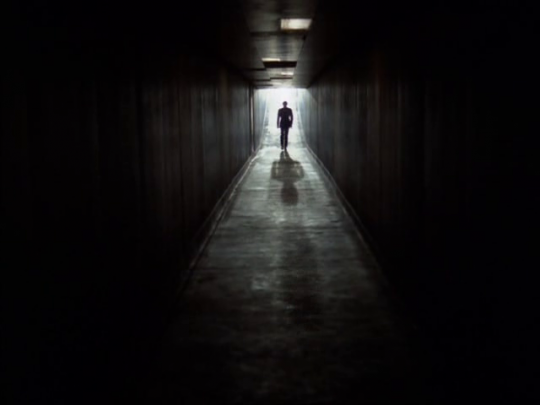
Adam Clarke once spent 17 weeks trapped in the Village Mall.
An enraged man (Patrick McGoohan, Braveheart) checks into a highly secure building in London, England. We don’t know his name, but we’ll come to know him as Number Six. He marches into an office and hands in a letter of resignation. The man returns home to pack his bags but he suddenly passes out before he can finish. He wakes up, confused, in a replica of his home. When the man opens his blinds, what’s outside is a place he’s never seen before. The area is characterized by Italianate architecture and antiquated cuteness, like big-wheel bicycles.
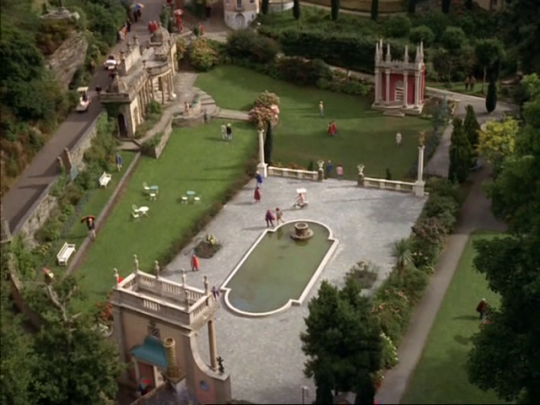
Welcome to the Village.
This is the world of The Prisoner.
I’m commemorating the 46th anniversary of this 1967 mini-series by revisiting and reviewing all 17 episodes in an order chosen by me. Confused? You won’t be after we get to the next episode. But first, let’s get back to…
Arrival
Written by George Markstein & David Tomlin.
Additional writing by Patrick McGoohan (uncredited).
We don’t know much about the man we saw resign in the opening credits. He roams around looking the Village for some way to escape or at least some information on his present whereabouts. Soon he’s paged by Number Two (Guy Doleman)…
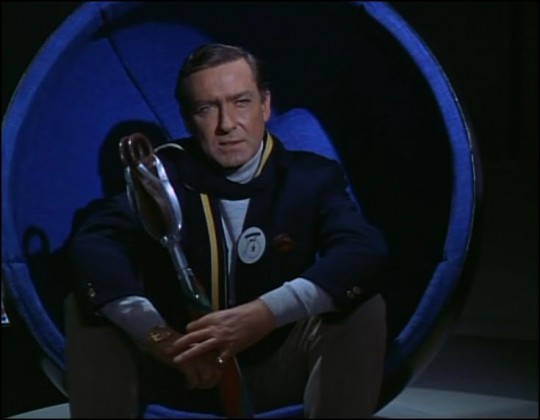
…who proceeds to tell McGoohan that he’s now a member of the Village, earning him his number; henceforth, McGoohan’s character isn’t a man, but Number Six. All numbered persons are placed in this cozy area called the Village until further notice. Those that escape always return albeit “not always alive”. Number Two just wants to ask a few questions, namely, why did Six resign from a position of top security? Is Six defecting? Is he selling secrets? It’s natural that certain parties would be interested in him.
Six, of course, won’t bargain with anyone in the Village, as he’s unsure which side runs the place. Two assures Six that there’s nowhere to run, as the Village has eyes everywhere. Two displays his power by showing Six a montage of covert photographs taken of Six on the day he resigned. Their cameras are everywhere and Two’s acquired virtually all data on Six right down to his date of birth.
Number Six won’t reveal any information. Instead of a night of torture in Big Brother’s Wonderland, Six’s given a chance to get comfortable in the Village as Number Two takes him on a tour. Six sees he’s not alone, surrounded by fellow prisoners and warders. Of course, it’s impossible to tell who’s who.
Number Two, despite his civility, shows a certain ruthlessness. The Village represents order and, arbitrary or not, order must be obeyed to survive there. So, when Number Two says “stop” the Villagers remain in place as if frozen in time. All save one unfortunate soul who cracks and runs for his life. Number Six watches to see what Number Two will do in light of this insubordination.
Two does nothing. He just waits. Seemingly out of nowhere, a giant white ball floats down into the Village grounds. The ball’s not remote-controlled, but it follows orders. It has no features, but it howls as if alive. The white ball lands on the Village’s latest would-be escapee. Number Six watches, bewildered, as the ball seemingly gobbles the man up and vanishes. Turning to Number Two for answers doesn’t do much good:
Number Six: “What was that?”
Number Two: “That would be telling.”
I guess Number Six hasn’t played Ski Free because that’s classic yeti behaviour…
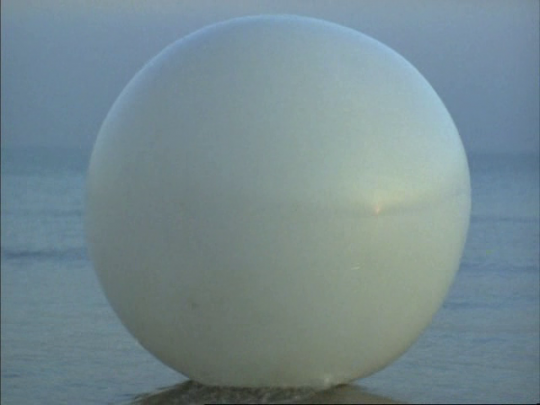
The rest of “Arrival” introduces us to a few aspects of The Prisoner that will be explored in greater detail as the series progresses. The Village has a rehabilitation clinic that brainwashes its residents and subjects them to mental and physical torture. Number Six squashes a radio in his new home only to have the music continue without explanation. A fellow prisoner dies only to be revealed as a spy for the Village who, having faked his death in the Village, is heading back to “the motherland”. Number Six tries to escape, but is no match for the Village. By the episode’s end, he’s non-fatally subdued by the white ball (affectionately known as Rover).
Of course, one of the most interesting quirks of the series is presented halfway through the episode. Shortly after the first appearance of Rover, The Ball of Screaming Ambiguity, Number Six makes his way to Number Two’s office, demanding to speak to him. The office is the same with its massive viewscreen, lava lamp imagery and oval chair. Yet, as the chair swings around, the man calling himself is not who Six had been speaking to. This begins a trend of revolving Number Twos. Some episodes have a couple of Twos and some have returning Number Twos, but there’s usually a wholly different person as the Village authority each week or, in this case, later that day.
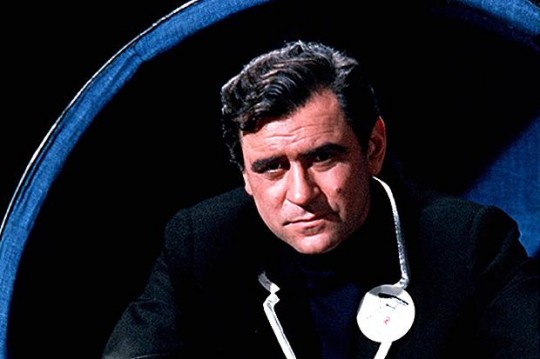
There’s no explanation. No mention is made of where the old Two went or how many Twos there are. Six meets the new Number Two who, like his predecessor, is gentlemanly in their demeanour as a means of gently coaxing Six into revealing all. Six, of course, reveals nothing, beginning a struggle for freedom that will last all the way through the series…
Of all the things we read or watch that shapes our tastes and minds, they don’t often hold up to re-watching or re-reading. Of my favourite television programs I saw in my youth, the ones that retain their power are rare. The Prisoner is rarer still, as it’s an endless source of fascination. If anything, I appreciate it more and more every time I visit it. It’s clever, creepy, surreal, imaginative and, without a doubt, the most intriguing television series ever to air.
“Arrival” is a brilliant hour of television. Equal parts witty, bizarre and suspenseful, it mixes George Orwell with Lewis Carroll while still maintaining a firm grip on its story. This is The Prisoner with half-a-foot in reality and suffers only in comparison to the more surreal episodes to follow. As great as it is in terms of script, production, direction and performance, I still like my Prisoner episodes to embrace lunacy without care for the consequences. If you prefer the espionage aspects of the show, “Arrival” will be in your top episodes. If you like the weird allegorical elements star/producer/(co?)creator Patrick McGoohan invested into the show, you ain’t seen nothing yet.
Why does this series work? Partly it’s the chaos of it. Both onscreen and off, the details of The Prisoner are variable depending on the individual. Where’s The Village located? The series offers a couple of (wildly different) answers. Is Number Six an enigmatic new character or actually Patrick McGoohan’s spy hero John Drake of Danger Man (aka Secret Agent)? Depends on who you ask. Who created the damn thing? The credit lies with script editor George Markstein (who is credited as co-writing “Arrival”) and/or producer-star Patrick McGoohan (who claimed to have come up with the core concept and a detailed history of the Village on his own, along with rewriting the Markstein-Tomblin “Arrival” script).
Hell, that’s not the half of it. Wait ’til the finale. Hoo boy. Still, that aforementioned chaos is present in the first episode. The iconic opening theme by Dr Who‘s Ron Grainer? Grainer wasn’t the first composer hired to compose a theme. The roaring Rover balloon? That was a last-minute replacement for a prop that didn’t work and new sound effects were being placed in last minute until the bouncy blob had a real presence in its scenes. Whole scenes are (noticeably) woven out of last-minute editing, particularly the scene where the panicked Villager gets eaten by Rover. He’s not wearing the same clothes when he’s running as he is when Rover’s on him (where’d the pink jacket come from?) and face pressed against Rover is obviously McGoohan’s own (seen again when Six is attacked by Rover in the episode’s climax). This was clearly assembled with re-shoots and jamming odd bits of footage until something worked. The original cut of the episode–released on DVD with the series–has the Rover scene minus the panicked man and his subsequent encounter with Rover.
Yeah, The Prisoner‘s complicated. That madness definitely worked to the show’s advantage. Unlike Lost, The X-Files and other story arc-heavy shows that lost their way, The Prisoner is the only show that’s ever kept viewers in the dark without it ever feeling like a cheat. I think the chaos of the production and the creative freedom allowed by that chaos lead to only the strongest ideas, concepts and visuals to make it into the series. It didn’t fit together into a tight, little narrative, but the project became so big that an all-encompassing, symbolic, shaggy dog story was the only way for The Prisoner to exist. That shambolic narrative is what allows The Prisoner to be truly great.
While the amount of The Prisoner that is purely his is up for debate, Patrick McGoohan is a vital part of its vision and its enduring success. As Number Six, McGoohan created one of the most unique heroes of his time. Number Six doesn’t pause to be likable. He doesn’t let the audience in. He isn’t explicitly sympathetic. He’s a man questing for total freedom and possible hermitage. As the series progresses, Six will scream, punch, con and bully his way to get closer to his elusive goals. He doesn’t take a moment to cry, fret or pick up sexy Village ladies. One thing we’re just not used to in fiction is the self-professed loner who isn’t just posturing. Six is just that and is all the more unique when compared to the last 20 years of homogenized, identikit pop culture heroes.
The Prisoner‘s intriguing premiere develops the premise, characters, setting and oddness with aplomb. McGoohan, one of the most underrated actors, is astonishingly good in this. “Arrival” alone is enough to make you realize McGoohan’s talent and why Six became his best known part. Guy Doleman’s excellent as the first Number Two, setting the bar for the Gentleman Villain most Number Twos would strive to emulate. Everything about “Arrival” works…it’s just that the show’s real greatness is yet to come.
Next time: “Dance Of The Dead”.
The Conjuring (2013)
Wed, Aug 14, 2013
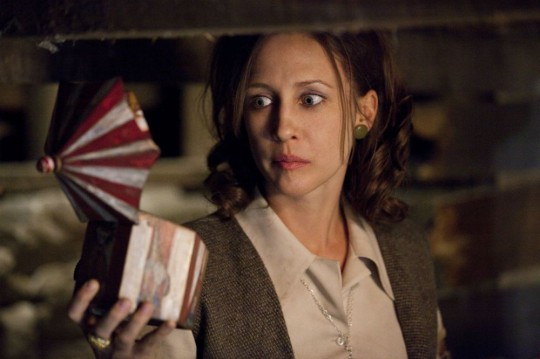
Adam Clarke is the only film critic recognized by the Vatican. He weeps for the state of the American horror film.
We live in the age where the question was asked: “wouldn’t it be scary if you were sewed face-to-butt with people and the butt in front of you dropped a hot link in your mouth?” (Answer: no). Then they made a movie out of it. Then that movie had a sequel.
To understate matters, American horror cinema is in dire straits.
It’s not all bad and it’s certainly not as bad Hollywood’s horror nadir in the 90′s. Lately, I love me some Ti West (look for a write-up of The Innkeepers later this year) and was pleasantly surprised by Mama. But we also live in an age where filmmakers are more likely to pay homage to the likes of Wes Craven, John Carpenter, Stuart Gordon, Peter Jackson, H.G. Lewis or Joe Dante than actually try to top the old guard’s past efforts. Many recent horror filmmakers are so obsessed with the films that influenced them that they almost never bring anything new to the table.
Like Ti West’s terrific House Of The Devil (set in the 80′s), The Conjuring continues the trend of horror movies set in the recent past (this time the 70s). The Conjuring is supposedly based on true events, depicting a possessed mother of five (Lili Taylor, I Shot Andy Warhol) who is brought to the attention of the only demonologists recognized by the Vatican. The ghostbusters in question are the Warrens: Lorraine (Vera Farmiga, Up In The Air) and Ed (Patrick Wilson, runner-up in this year’s “I Look Like Bob Oedenkirk” contest). As the Warrens get close to the family of the woman they’re trying to save, it looks as though Lorraine’s life could be the one that’s in danger.
I never thought I’d write this, but I actually enjoyed a film made by Saw‘s James Wan. The Conjuring is not by any means a wholly original ride, though it is an enjoyable mish-mash of familiar tropes. It’s a well-made horror film that I enjoyed all the more for being so non-cynical. Yes, we have a recent horror flick where there’s no drawn-out, unimaginative gore set pieces or contrived twist endings. Having sat through two Saw films, four Rob Zombie films, the Evil Dead remake, Tom Six’s aforementioned Human Centipedes confusing scary with gross, three Eli Roth films, Piranha 3-D and the celluloid miscarriage that was 2010′s Nightmare On Elm Street, even a derivative horror film can be exhilarating if it focuses on atmosphere instead of splattering viscera.
It’s a surprise that such a likable, competent horror film came from Wan who, along with Eli “I’m an auteur for frat douches” Roth, is largely responsible for mainstream horror’s focus on thrill-less self-mutilation and tedious gore scenes. I’m not against a good bit of grue or I wouldn’t have watched so many Lucio Fulci movies in the past year. What I am against is how the violence in these recent films is so sleek and loud. In a lot of newer horror pics, there’s no thought into crafting a sequence, you just have thoughtless close-ups of people screaming (Roth/Zombie) or murder sequences shot like it’s part of an expensive Tool video (the Saw house style). A sequence where someone cuts off their own foot should be tense and harrowing, not obnoxious.
There’s a devotion to atmosphere and build-up in The Conjuring that elevates it well above many of its competitors. The best sequences in the film are in the mid-to-late portion of the story where the Warrens and their crew search the haunted house. The nuts-and-bolts operation of trained, er, fighters of evil spirits is portrayed in a low-key way that’s reminiscent of the first half of John Carpenter’s Prince Of Darkness. We have a mix of believers and skeptics treating the affair like a job. If there’s nothing there, it’s another bogus haunting or a prank at their expense. If the Warrens do find demonic activity, they’ve got to act quickly before the bodies start piling up. There’s a potentially better movie that focuses exclusively on married demonologists on the job, but the scenes with Lili Taylor and her family do wring some nice set pieces outta familiar material. The film does deserve credit for employing effective bits of sound design and a few inspired scenarios (the “hide and clap” games gone awry).
The Conjuring is a bit sloppy in its storytelling, to be sure. There’s a creepy doll that exists only so “creepy doll” can be marked off a horror checklist. The movie opens more narrative threads than it knows what to do with and ends with something of an anti-climax. Flaws aside, even a solid B effort is worthy of praise in the age where “ass-to-mouth gone wrong” is the plot of not one, but two horror movies.
Powered By Nostalgia: Pacific Rim (2013) and Sky Captain (2004)
Thu, Aug 8, 2013
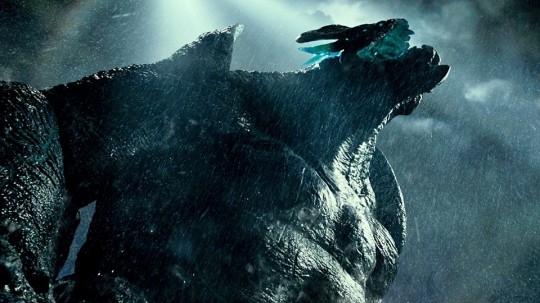
Adam Clarke‘s nickname in high school was “Monster X”
Pacific Rim is the film the entire internet has ejaculated over. I won’t recap the plot here (in short: robot suits vs. monsters), but I am a bit puzzled by all the hype. Truth is, the first time I went to see the film, I fell asleep 20 minutes in. Second time was more successful, as I only fell asleep an hour into the movie. And this is the movie fanboys and fangirls are losing their robo-shit over?
After a third viewing where I stayed awake FOR THE WHOLE THING (cue applause here), I skimmed the internet commentary for the film. It’s telling that Pacific Rim‘s fandom is based entirely on reactions to other films. On the one hand, you’ve got movie aficionados eager to praise a new film as a cult classic, resulting in a baffling “it’s the new Star Wars” comments springing on message boards and the like. Next, you’ve got people comparing it to Avatar stating Pacific Rim will be remembered because, unlike Avatar, people are still talking about it and its fandom is growing. As much as Avatar left me cold, that sort of reasoning forgets that Avatar rode a wave of popularity for months after its release. Saying Pacific Rim will outlast it is roughly on par with an eager Geffen record executive predicting that all dances will be dropped in favor of The Bartman.
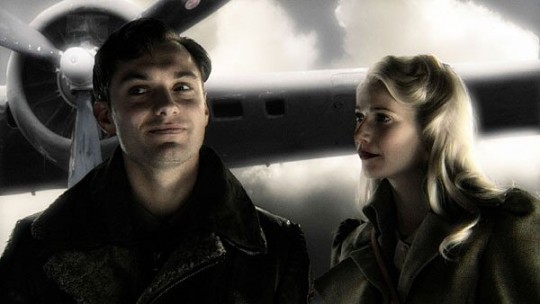
Pacific Rim wasn’t terrible, but it’s a film driven solely by nostalgia, not story or inspiration. Watching the film I was reminded of Sky Captain Of The World Of Tomorrow. Both films ooze with a passion for their source material, but had the same effect. I remember being bored in the theatre and thinking “I should be liking this”. Rim has Idris Elba and monster fights, Sky Captain has a cameo from Godzilla. These should be my favourite movies based on my movie rental choices for the last 20 years.
Except they’re both boring. Really boring.
With Sky Captain it seems that the sleek, green screen based production lead to a stiff, overtly-polished yet sterile film. It’s as boring as The Phantom Menace though it is far more inspired. Pacific Rim‘s not as bad as Captain, but I think part of the problem lies with the uninspiring designs. Look at that monster at the top of the page again. Now compare with…
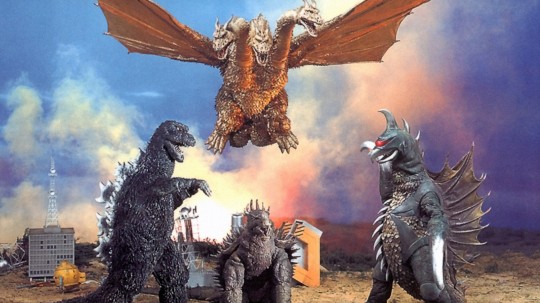
…Godzilla Vs. Gigan. Look at those monsters! Specifically, pay attention to the monster with knives for hands. He has knives for hands. How did he steal Scott Summers’ visor if he has knives for hands?
That monster’s name is Gigan. He has a buzzsaw for a belly and is his design is incredibly silly. However, like King Ghidorah (the three-headed dragon in the above pic) and the other monsters in that picture, there’s one thing his design isn’t: bland. The monsters and robots in Pacific Rim have about as much personality as a bowlful of mayonnaise. I find it impossible to find anything exciting about this film unless nostalgia and nostalgia alone gives you one helluva charge. And if you spend all your time thinking about anime-inspired mech warriors and giant monsters, you’re probably too busy updating TV Tropes to watch a movie.
Like Sky Captain, the makers of Pacific Rim clearly like most of the same things I like. They also made love letters to their inspirations. Neat-o. It’d be nice if there was something other than nostalgia at work in either film. Unlike Star Wars, films like Sky Captain and Pacific Rim never seem like more than shopping lists of pop references.
Crimewave (AKA The X,Y,Z Murders)
Sat, Aug 3, 2013
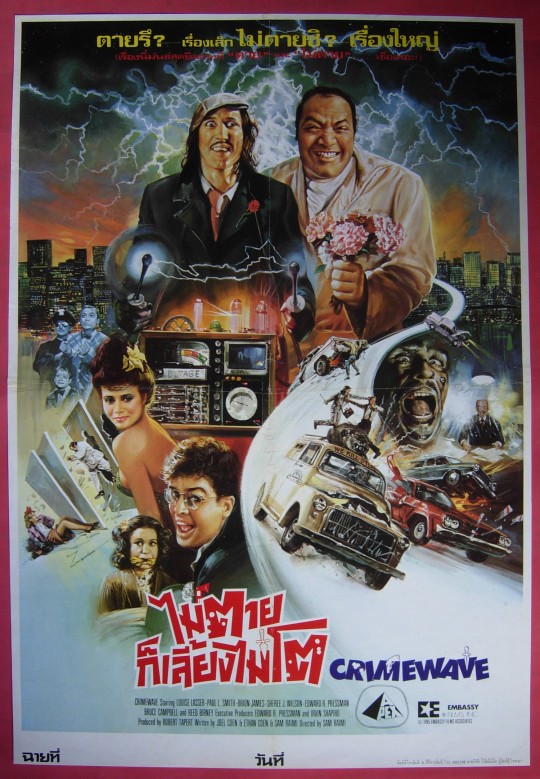
Adam Clarke attempts a second viewing of Sam Raimi’s sophomore slump.
I remember the first time I’d seen Sam Raimi’s Crimewave, I hated it. In junior high I’d been weaned on a steady diet of the original Evil Dead films, a bootleg tape of Raimi’s short films, and his uniquely manic Darkman. While later films could be brilliant (A Simple Plan) or muddled (The Gift, The Quick & The Dead), I’d always been curious about Crimewave, which had not only been disowned by the director, but was almost impossible to find at your local Red Circle. A troubled film that’s also hard to find? That’s the sort of phrase that I found downright sexy when I was but a young film cricket.
I finally tracked down a copy of the film in ’04 and I found it to be a colossal disappointment. As much as I’d read about its troubled history, the X, Y, Z version of its trailer looked worthwhile. Having been recently released on Blu-Ray and DVD earlier this year, I thought it’d be interesting to look back on Raimi’s supposed sophomore slump. After the disastrous Oz: The Great & Powerful, it couldn’t look too bad in comparison, right?
Crimewave
Starring Reed Birney and Sherry J. Wilson
Written by Joel Coen, Ethan Coen and Sam Raimi
Let’s take a ride in the cinematic TARDIS and head all the way back to the year 1985. Things should be good for Sam Raimi. His first film had earned plaudits from Stephen King and was making a name for itself in the many drive-ins across America. Reviews, while decidedly mixed, praised the new director’s inventive and energetic camerawork. Embassy Pictures took note of Raimi and hired him to direct a second film with their fancy studio dollars! No more cold-calling potential investors! No more taking four years to finish a film! Raimi and Co. finally made it.
Alas, all was not well with Raimi’s “big break” sophomore film and it’s easy to see why: he made Crimewave and there’s was nothing he could do about it.
Our Story: The ever-sweaty Ernest Trend (erstwhile producer Edward Pressman), enlists the help of a pair of “exterminators”, Arthur (Brion James of Blade Runner) and Faron (Paul L. Smith of Popeye and Pieces), in hopes of eliminating a business partner. Sadly, Arthur and Faron are not the brightest hired goons available as they not only murder Ernest Trend’s partner, but they mistakenly kill Trend in full view of his wife, Helen (Louise Lasser, the source of a very amusing anecdote in Bruce Campbell’s If Chins Could Kill). Meanwhile, Vic Ajax (Birney)–a spaz installing security cameras for Trend–is trying to woo the beautiful Nancy (Wilson) away from a womanizing heel, Renaldo (Bruce Campbell doing the schmooze routine). One dance contest and several attempts on the recently widowed Mrs. Trend’s life later, Nancy has been kidnapped by Arthur and Faron, leaving the nebbish Vic as the film’s semi-competent hero.
I really wanted to like this movie, I really did. Unfortunately, I think that’s key to understanding the problem with Crimewave. It’s a movie wants so desperately to be liked that it ultimately makes an ass of itself (and just about everyone else) in the process. But before I get into why it fails to shine, settling only to occasionally spark and wheeze, let’s go back to what got me to see this flick in the first place: the trailer.
That trailer was fantastic. It had a fast pace, a deadpan narrator and was appropriately scored with jazz music (largely on loan from Taxi Driver) to give it that pseudo-noir texture. This movie looked like it was going to have everything, eccentric camera angles, slapstick, one-liners, Bruce Campbell, a truck with a giant rat on it and, on top of all that, an extended chase through a series of collapsing backdrops. I didn’t care what the reviews said, I didn’t care what Sam and Bruce said, I knew that watching Crimewave was somehow part of gawd’s plan. Of course, if that last sentence is true, I’ve just been Punk’d by the almighty.
The film I saw was essentially the antithesis of its trailer: the pace was sluggish, the performances uneven, the score seemed determined to ape the “light moment” scoring found in comic relief sequences in the original Star Trek and the editing downright incoherent in places. This could’ve been a cult legend (look at who wrote it), but all flair for comedic time and indeed, the entire flow of the picture is completely bungled because the camera lingers on every scene for far too long, robbing most gags of their freshness.
Moving on to the acting, we fare a little better. Bruce Campbell steals every scene he’s in the minor role of Renaldo “The Heel” (who seems to work as a newscaster and a police officer on the side) and has all of the film’s best lines. Sheree Wilson is sweet in the role of Nancy but does little more than look pretty and act befuddled. The quality of Reed Birney varies from scene to scene, but he’s not terrible as a poor man’s Ted Raimi. As for Brion James and Bluto from Popeye…well, something funny happened in post-production. Not funny ha-ha, either. Something not touched in Bruce Campbell’s book.
Strangely, a decision was made by someone or someTHING to redub both Arthur and Faron with comedy voice-overs. In the trailer, their voices are left untouched, but in the film, they both sound like cartoon characters. Faron ends up sounding like Cookie Monster and Arthur sounding like Beastley from Care Bears if he were in a state of extreme arousal. It may not be Moliere, but this script deserved better than the cheap, piped-in vocal quirks of a second-rate Uncle Joey. Who decided to this remains a mystery, as is the identity (identities?) of those who did the dubbing. May they forever rot in Hell.
It’s well-known that Crimewave was the source of much studio tampering and it seems easy to blame them for the movie’s low quality, but would the film have been significantly better if Raimi had free reign? This was a guy who only made one other movie and was inexperienced with larger budgets and the results could have been much worse. Yet, despite some really funny moments peppered in a script by Raimi and the Coen brothers (who would re-team to script the underrated Hudsucker Proxy), the film isn’t really worth it unless you’re a die-hard fan of the team who brought you Evil Dead. I enjoyed it more than Oz: The Great & Powerful, but eye surgery is more enjoyable than Oz: The Great & Powerful.
“The Changing Of The Guard”: The Best Of Donald Pleasence Part 2
Fri, Jul 26, 2013
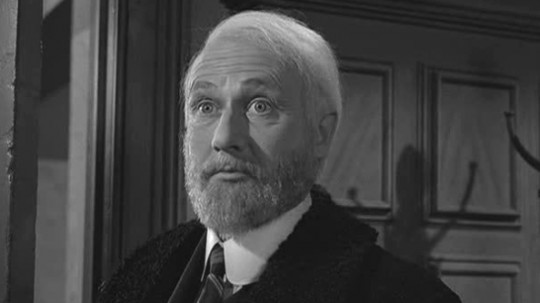
Adam Clarke investigates the true meaning of Christmas in July.
Be ashamed to die until you have won some victory for humanity.
– Horace Mann
One night in December, these words weigh on the mind of Professor Ellis Fowler (Donald Pleasence). For the elderly Professor Fowler, “a gentle, bookish guide to the young” at the Rock Springs School for Boys, these words will drive him to the breaking point and end up his salvation. It’s all a part of this heart-wrenching, but gorgeous third season episode of The Twilight Zone.
The Twilight Zone: “The Changing Of The Guard” (1962)
Having delivered his final lecture before the Christmas holiday, Professor Fowler is invited by the school’s headmaster (Liam Sullivan) to discuss a recent correspondence with the faculty board members. Fowler is a sharp but absent-minded sort and assumes he’s just been asked by the faculty to sign his contract for another year. Fowler then launches into a tangent about the odd formality of contracts which segues into how delighted he is to have taught the grandson of one of his students.
“I should like to think I’ll teach a great-grandson one of these days,” Fowler says.
The headmaster interrupts, clearly unsure what to say next. The letter that was sent to Fowler wasn’t a contract, but the beginnings of a retirement. After six (!) decades teaching literature at Rock Springs, the headmaster promises that this isn’t because the school is dissatisfied with Fowler. Quite the opposite. This is to be a changing of the guard: getting new blood to teach while the respected Fowler moves on to a deserved retirement. Fowler doesn’t see it that way.
Professor Fowler puts on a brave face and assures the headmaster he’ll go along with retirement. As the professor makes his way home, two of his students go to wish Fowler a happy Christmas. They’re shocked to see he’s crying. Later that night, Fowler returns to the empty school grounds and brushes some snow off a statue of Horace Mann, revealing that rather important quote. Intended to inspire, that Mann quote plays on Fowler’s sudden fear that his life as an educator was wasted.
“I have won no victory, so I am ashamed to die,” Fowler says. He then takes out a revolver and points it at his temple… only to be interrupted by the sound of class bells. Curious, Fowler wanders around the school in a haze, but no one is present. There’s no assembly. As he looks about the school for any signs of life, Fowler passes by the classroom he taught in for so many years. Now empty, Fowler enters and sits down at his desk one last time. When he looks up, there’s a full class of students sitting at their desks.
They all want to talk to Fowler. After a moment of disorientation, the professor recognizes the class as his former students. Students who died shortly after they graduated. Some died doing medical research. Most died during various wars. Fowler tells the spirits in his classroom that they were all immensely brave and how proud he is of them. They each remind Fowler that it was the poetry and literature he taught that inspired them and, in their times of dying, comforted them. Each of his former pupils tells Fowler that he was the one who taught them to be honourable men and, seeing that their words have caused the professor to reconsider suicide, say their goodbyes and vanish.
Back at home, Fowler waves to a group of his students out caroling by his house and wishes them a merry Christmas. As he sits down to dinner, Fowler realizes that his retirement is not a sign that he’s lost his value, but a tribute to all of his work and the many lives that he’s touched. The episode ends with the camera panning away from Fowler, safe in the knowledge that his life has mattered.
“You’ll be drinking early today.”
-Rodney Dangerfield
If I didn’t know better, I’d swear Rod Serling wrote this because he thought It’s A Wonderful Life was crap and he could do a better job in 30 minutes. But the depiction of a suicidal crisis is done too realistically and with too much heart for such a cynical possibility.
I’ve suffered from chronic depression for as long as I can remember. It’s about as fun as it sounds. This illness makes me one of the X-Men except my mutant superpower is that I cry at work. The drawbacks of this are obvious. You’re prone to nervous breakdowns. You become hyper-aware of yourself and constantly ruminate over perceived slights and failings. Days go by as you remain stuck in your bed. Thoughts of suicide are one of your only constants.
It’s quite rare to see a major depressive episode treated with any kind of accuracy or dignity. Yet, in 1962, writer Rod Serling proved that it could be done. Fowler’s suicidal crisis is a harrowing one and the experience is captured with real honesty. Every single person has, at one point, considered their lives to be meaningless or forfeit. Most people don’t have to wrestle with it constantly. Us mutants tend to struggle with it every week. Depression constantly shifts you between realities, namely the one that most people live in and the one in which your identity and self-worth are always in question. To see that recurring nightmare handled with such sensitivity is nothing short of a miracle.
In a suicidal crisis, most of us are asking for a sense of belonging or purpose. The suicidal person is flung off into a reality all its own; a place where one is constantly inadequate and any sense of community is an impossibility. If the suicidal person talks to anyone about this, it can seem rather surprising that anyone else could notice, much less care. But people do care. For the suicidal mind, it’s a difficult thing to accept, but it is true nonetheless. Just by taking part in this long, painful ramble of an existence, you matter to other people; you affect them in ways you don’t realize. So we see the same thing in the subject of this review. As Pleasence’s Fowler comes close to suicide, he’s surprised to see that he’s made such a mark on his students.
It’s not often I throw this word around, but “The Changing Of The Guard” is a masterpiece. Pleasence and writer Rod Serling convey an man’s life and a major depressive episode in about 25 minutes. Serling and Pleasence accomplish in a third season episode of a cult TV series what so many films and novels fail to accomplish. I can’t re-iterate just how fucking special “The Changing Of The Guard” is. “The Changing Of The Guard” is a beautiful piece of television. The script is the best work that Rod Serling has ever done (suck it, Requiem For A Heavyweight) and every aspect of the production, from the music to the subtle make-up on Pleasence (who was only in his forties during filming), is perfect.
Donald Pleasence offered many brilliant performances in his long and sometimes very odd career. His eyes, voice and presence held a power that few actors ever possess. Like all great stage actors, watching Pleasence could be deliriously exciting when he opted for scenery chewing. You would think Charlton Heston would be the loudest actor in any movie he starred in, but there’s Pleasence in the great Will Penny alternately firing a gun and doing a jig. I remember very little from Race For The Yankee Zephyr, but I’ll never forget the scene where a drunken Pleasence is hanging from a helicopter like he’s fucking Darkman. Same goes for his hilarious turn as profit who could only “see” with the aid of whiskey in The Hallelujah Trail. He’d deliver these memorably weird character performances in superb films like Soldier Blue (where he wore false teeth and chased Candace Bergen) or awful films like Wedding In White, Jaguar Lives!, Into The Darkness and Specters.
Even in films or mini-series where Pleasence underplays a part, he’d still end up stealing scenes from the likes of Alan Rickman (as he did in The Barchester Chronicles) or Ian Holm and Colin Firth (in the underrated The Advocate aka Hour Of The Pig). I’ll never understand how he managed to keep his dignity in a film where he gets decapitated by a magic baby, but I’ve always been a crap actor to be honest. Pleasence was an actor of incredible range and skill, which should be better remembered. He never failed to bring a dynamic quality to everything he appeared in. It’s a shame many of the films he did lacked scripts even half as good as “The Changing Of The Guard”.
Strange as it might seem, the Twilight Zone episode without the twist is the best one of the lot. There’s no aliens, heavy-handed ironies or clumsily-telegraphed endings, which are sins the original Zone often committed. Instead, we have a story that’s full of humanity, expresses empathy for a taboo subject and doesn’t have a single false note. All of it brought to life through one incredible performance. I can think of no better way to remember the talent of the late Donald Pleasence.
V/H/S/2 (2013)
Tue, Jul 23, 2013
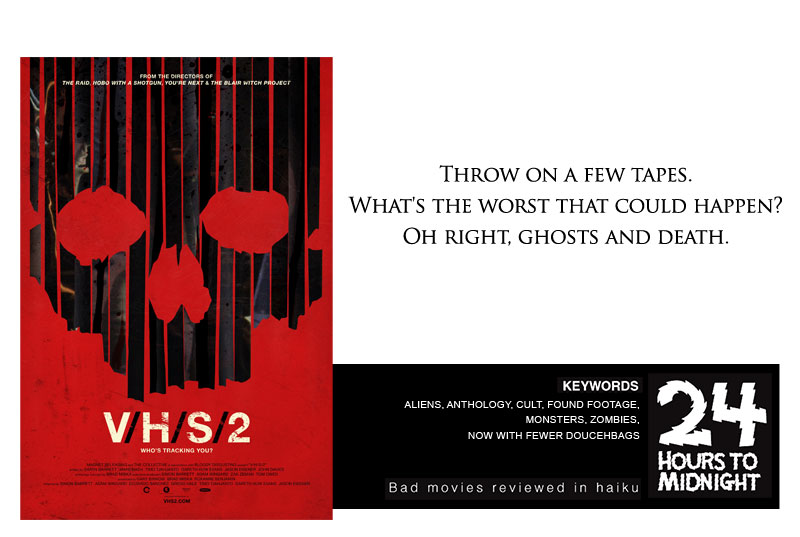
We loved the first installment of this found-footage horror anthology, and volume two was just as good — maybe even better, considering the overarching narrative was much improved.
V/H/S/2 picks up where V/H/S left off, with a couple of private investigators trying to figure out what happened to all those nasty douche bags from the last movie. They rummage through a pile of mysterious old tapes, just like we would at a yard sale or Capitol Video. Creepy crab walks ensue.
This time around, there’s a new slew of directors, including Gareth Evans (The Raid: Redemption), Jason Eisener (Hobo with a Shotgun), and masters of the found-footage format, Eduardo Sánchez and Gregg Hale (The Blair Witch Project). We did miss one of our favourites from the first collection, Ti West, who spooked us last time around with the lesbian love affair/homicide segment, “Second Honeymoon”, but Adam Wingard does return with “Phase I Clinical Trials”, a weird first-person take on seeing dead people. Look for Wingard’s You’re Next later this summer, starring, coincidentally, Ti West.
Wingard’s contribution pales in comparison to the subsequent segments, “A Ride in the Park”, “Safe Haven”, and “Slumber Party Alien Abduction”, which are a breakneck barrage of zombies, demons, aliens, and weird little girls screaming a lot. Don’t even bother trying to catch your breath in the frame segments, though, as these provide even more jumpy scares and did-you-just-see-that?? moments. We all know the douche bags died horribly last time around, and the fate of these breaking and entering investigators isn’t any better. A larger question looms in the last segment, anyway: Will that poor dog make it??
By turns eerie, funny, innovative, and always goddamned horrifying, V/H/S/2 lives up to the hype of the first movie, pushes the story ahead a little, and gives horror aficionados exactly what they want. This is horror made by and for horror fans.
The Best Of Donald Pleasence (1919-1995)
Wed, Jul 17, 2013
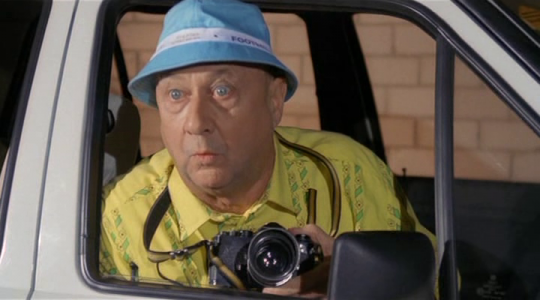
Adam Clarke loves this face.
There are certain actors I’ll watch in anything: John C. Reilly, Jeffrey Combs, Darren McGavin, Patrick McGoohan… character actors, mostly. If there was one man who’d be the patron saint of character actors, it would have to be Donald Pleasence. An actor with over 200 credits on his IMDB page, Pleasence had an incredible range that lead him to steal the scenery from even his finest co-stars (Laurence Olivier, Alan Rickman, Ian Holm, Peter Falk and countless others). Or using his talent to elevate the schlockiest of b-movies, as he did for most of the 80′s. In short, he’s my favourite.
Don’t take present-day Adam Clarke’s word for it. I’d been aware of Pleasence’s greatness from an early age, as you may gather from this excerpt of a poem I wrote in grade six…
He was a conscientious objector
To every war.
But still he had time
To star in “Halloween 4″.
As the Spirit of Dark and Lonely Water
He pushed young children into lakes.
No one knew that Donald really drowned them
between takes.
I’d intended that poem to be read aloud by the lead singer of Carnivore as he was the only one who seemed likely to do justice to its 20-page length (told you it was an epic poem). While that dream remains unfulfilled, I can at least recommend my ten favourite Pleasence roles to highlight what a quirky, inventive actor he was.
For the purpose of this list, I’ll avoid listing his work in John Carpenter’s Halloween, The Great Escape and You Only Live Twice, as they’re already deeply burrowed in pop culture muscle memory. I’d like to instead shine a light on other noteworthy, but lesser-known performances.
Columbo: Any Old Port In A Storm (1973)
My fondness for Columbo is already documented and I need not regurgitate that piece, but Pleasence is easily one of the most fun members of Columbo’s rogues gallery.
Raw Meat (1972)
Firstly, this scene between Pleasence and Christopher Lee must be watched as a master class in snark.
There’s no hero in horror cinema more fun than Pleasence’s Inspector Calhoun. Calhoun’s a cantankerous, acid-tongued, tea-obsessed middle-class police inspector Investigating a rash of disappearances in a subway station beginning with James Manfred, OBE.
It seems that James Manfred was one of the higher-ups in the Ministry of Defense and that there were two other missing persons, earlier in the year, reported to be last seen at the very same station. Nothing connects the three disappearances except location, Calhoun gives a call to Manfred’s secretary—despite his partner’s objections—and uses all his investigative cunning to get information out of her. This manipulation is transcribed below:
Calhoun (covering his lower-class accent with faux pomposity): Oh, James never stops going on about you. When do you expect him in? What? Missed the morning meeting with the minister, did he? Tsk, naughty, naughty boy. Who’s calling? Oh, uh, tell him it’s Princess Anne…(hangs up)
After this exemplary piece of detective work, we are taken to an untouched pocket of Russell Square tube station, water rhythmically dripping to murky, filth-encrusted floor—a foul mixture of soil, blood and human tissue—streaked across like broad strokes of colour on a painter’s canvas, where Manfred, our tubby little derby-man, lifelessly leans against a brown surface. By the end of this sequence he will be drained of blood by a lanky, hairy figure, feeding Manfred to his pregnant mate.
With those two sequences, the tone for Gary Sherman’s Raw Meat has been set. The film’s an well above-average horror story that astutely mixes eeriness, and comedy with strong characterization and theme. Whilst plenty humour mainly comes stems from Calhoun’s retorts, this does not take away from the film’s more unsettling scenes.
It should be noted that the cast is above-average with Donald Pleasence being the real standout. He creates a one-of-a-kind character with Calhoun. Many actors would’ve been lost in a role that relies on the performer to play both hero and comic relief. Pleasence is stellar as Calhoun, making me pine for a “Calhoun of Scotland Yard” spin-off TV series that will sadly never come to pass.
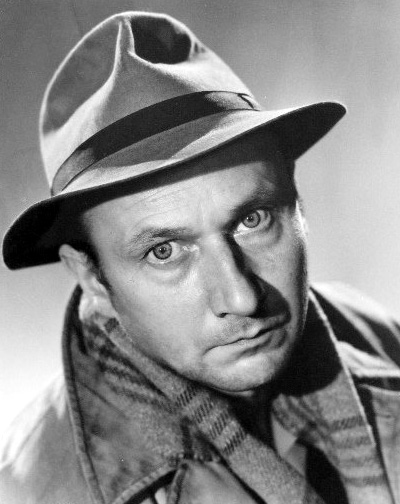
1984 (1954)
Written by Nigel Kneale and starring Peter Cushing, this live BBC teleplay of George Orwell’s influential novel is the best adaptation of the source material. Cushing is a note-perfect choice for Winston, but Pleasence devours the scenery as Syme, the develepor of NewSpeak. Pleasence savours dialogue in which Syme professes his love for perverting language, but still retains and suggests the character’s sly intelligence, sometimes with nothing but a knowing stare. Pleasence returned for the film version of 1984 released two years later, but that version lacks the tension or uncompromising ending of the BBC telemovie.
Blade on the Feather (1980)
Written by Dennis Potter (The Singing Detective), this telefilm centers on Cavendish (Pleasence), a retired Professor and children’s author, whose cozy home life is upset by Young (Tom Conti), a man intent on investigating Cavendish’s connection with the murder of a Soviet defector. Non-linear and somewhat obtuse, this Potter thriller is gripping in much the same way as Harold Pinter’s The Dumb Waiter. Things keep getting queasily uncomfortable until the final few lines of dialogue. Pleasence is delightful as a hard-drinking conservative who, were it not for the presence of Young, would be whiling away his time in self-loathing and speeches about the importance of custard.
The Caretaker (1964)
Perhaps the English actor’s most iconic stage work was written by Harold Pinter, who would ultimately deliver Pleasence’s eulogy in 1996. Pleasence was cast as Davies in the original play and became synonymous with the role; first editions of the play script used a shot of Pleasence for their covers. This adaptation of the play boasts two fine performances from co-stars Alan Bates and Robert Shaw, direction by Clive Donner and cinematography by Nicholas Roeg (The Man Who Fell To Earth, Bad Timing), but it’s completely Pleasence’s show. Coming from Pinter (who wrote the screenplay), this is purely an actor’s showcase and as the titular caretaker, Pleasence is enigmatic and intensely funny as a lost, mentally ill hobo who nonetheless warbles on about his pipe dreams.
Dark And Lonely Water (1973)
“The show-offs are easy, but the unwary ones are easier still…”
Although there are many films like The Great Escape, The Greatest Story Ever Told, Dr. Crippen and The Hallelujah Trail that display Pleasence’s inventiveness as comic or serious actor, this short British safety film shows how good he can be. Just watch it and you’ll hear how Pleasence manages to create a menacing presence using only his voice. Like Vincent Price, Pleasence was often typecast in the horror genre, but, like Price, he was proof that so few actors can so effortlessly shine in the genre.
The Black Windmill (1974)
During the less reputable lulls in his career, Pleasence could always be counted on to provide dignity in films like Paganini Horror, Fatal Frames, Pumaman and Frankenstein’s Great Aunt Tillie. Pleasence was just as likely to steal the show from his greatest co-stars. as he did to Michael Caine in The Black Windmill.
The Black Windmill was destined to succeed. The film sports a strong cast, a suitably dramatic plot (Caine’s child is kidnapped and tortured in the hopes of blackmailing British Intelligence) and was directed by the great Don Siegel. Yet, the film was pronounced a dud upon release and has since been forgotten.
Though uneven in pacing, Siegel’s film is quite good despite its reputation. As Caine searches for corruption among his fellow Intelligence officers, he casts an eye on Pleasence’s by-the-book, perpetually congested intelligence man. Pleasence is all quirks and charisma; more of an anti-James Bond than Caine’s own Harry Palmer from The Ipcress File. Like the best supporting characters, Pleasence’s Cedric Harper is the lead in his own film and one that seems far more entertaining than the ransom/revenge plot of Michael Caine’s unfortunately named “Drabble”.
THX-1138 (1971)
Imagine a version of 1984 made by George Lucas. No, before he was terrible. Since this is a sci-fi film written by a geeky young man, sex is the ultimate crime of the state. In a repressive totalitarian society (is there any other kind?), THX’s (Robert Duvall) growing malaise and secretive affairs gain the attention of security monitor SEN 5241 (Pleasence), who blackmails THX into becoming his roommate. Not long after, all three end up in prison, but THX breaks out, joined by SEN and a fellow prisoner who thinks he’s a hologram (Don Pedro Colley).
THX 1138 is an unjustly overlooked gem that combines Lucas’ once-renowned knowledge of audio-visual trickery with a surprisingly strong script and a game cast. Though he and Lucas clashed on the set, Donald Pleasence is perfect as the self-serving SEN. Not unlike the talking head editorials or the empty anarchist rhetoric from your school days, SEN speaks horseshit so fluently you’d think he had his uvula replaced with an equine anus. “We need dissent, but we need creative dissent,” he proclaims to fellow prisoners with a look of smugness unrivaled by even the most self-satisfied prat. The scene where SEN casually remarks that his previous roommate was killed for crimes against the state, is as chilling as it is charming. He boasts about his schemes and his talents, but he would be just another drone if he had no one to boast to. For all his talk of overthrowing the system, SEN would be lost without it. Pleasence makes SEN a fascinatingly weak character, dangerous and pitiful in his unending quest for comfort and praise.
Wake In Fright (1971)
John (Gary Bond) is a British teacher stationed in Tiboonda, Australia and hates it. However, not filling his contract means paying out a $1k bond. So, John ends up holidaying near the Outback (Yabba), gambling to get the required cash for his bond. When he loses everything, he ends up staying with a former doctor (Pleasence) as they eke out a paltry existence on nothing but poached kangaroo meat and whatever beer they can scrounge.
I caught Wake In Fright for the first time a few years back after getting my hands on the Australian DVD. I’d known it by reputation and was pleased by just how well it lived up to it. Beyond its gritty, nightmarish story is a delightful pairing of Bond and Pleasence (“What do you do around here?” “I drink”) Pleasence makes a meal of cynical dialogue and unusual backstory; a gleam in his eye to suggest that even Doc can’t believe how much of life he’s left for the drink. Wake In Fright isn’t just a vehicle for his terrific performance, but is one of the most haunting, despairing stories ever filmed.
Next week: Out of every performance by this virtuoso actor, this last one is my favourite for rather personal reasons.
The Future Is Now
Sat, Jul 13, 2013
Stephen Spielberg and George Lucas predicted the future of movies. With the aid of a Ouija board and Kreskin’s autobiography, Adam Clarke predicts a less drastic future.
Every month I march up to my local car dealership and demand to buy a flying car. This results in the set response of “Sir, we have no flying cars” before the dealer contacts the local authorities.
I was distinctly promised a flying car and a robot butler by old movies. These things were supposed to be in our future, the movies told me so.
But look around you. We have no flying cars. We have no robot butlers.
Some people are even saying that filmmakers of the 50s and 60s got it wrong.
Fortune-telling has improved considerably since those days, however, and anyone can see into the future providing they are rich enough. That’s why Stephen Spielberg and George Lucas—once-maverick directors who became exactly what they were rebelling against in the 70s—stepped up as authorities on the future of cinema.
At the University of Southern California’s School of Cinematic Arts earlier this summer, Spielberg and Lucas dropped bombshell predictions during their panel on film. Staring at the attendees with their cold, dead, shark-like eyes, the two men promised that high-end movie theatres are the future of movies, and that cinema-going will soon resemble going to a concert or going to the opera.
“What you’re going to end up with is fewer theatres. Bigger theatres, with a lot of nice things,” Lucas said. “Going to the movies is going to cost you 50 bucks, maybe 100. Maybe 150.”
“You’re gonna have to pay $25 for the next Iron Man,” Spielberg said.
Pricey cinema, he explained, demands the huge price-gouging required for studios to recoup their budgets. Otherwise there’s no way movies like Avatar, Man Of Steel and The Avengers could see a profit, right?
The idea of film as an opera-like experience made me laugh. Never say never… but that’s never gonna happen. Lucas and Spielberg are spewing the same kind of nonsense that the movie dinosaurs of the 80s were saying when Beta, VHS and Laserdisc came on the scene. Industry types predicted radical changes after the advent of television too.
But there is no radical future for cinema culture. That future is now, and, in many respects, it’s the same as ever.
Recently I hosted the Nickel Film Festival horror night, and as I sat to watch a night of films I’d largely already seen, I found myself enjoying them much more in a darkened room with a crowd. Movie-going gives us a perfect communal experience, and that experience is something streaming services and downloading will never kill. As cinemas grow more expensive, there will always be matinees and discount nights. There’s always going to be film festivals and outdoor film screenings in the summer.
Take a look at The Alamo Drafthouse, for example, a successful speciality cinema in Texas. It caters to hardcore cinephiles with films that are mainstream, arthouse, grindhouse and everything in between. Tickets range from $10-$15. They’re not going anywhere. And neither is your standard movie theatre. That’s the power of community experience.
Film is popular entertainment and will never become a status symbol. Hollywood will continue investing money in brand-name films like Star Trek Into Darkness because they get that money back not just in ticket sales, DVDs, iTunes and Netflix licensing, but also the landfills of merchandise that follow in their wake. As film studios are snapped up as entertainment wings for huge corporations, merchandising will be part of their investment in film.
Despite the occasional high-profile losses incurred by some would-be blockbusters, it’s not going to kill film studios. It never has. Otherwise film would’ve ended after Ishtar, Waterworld, Howard The Duck and/or The Adventures Of Pluto Nash.
No one in their right minds would pay $150 to see Transformers 4: Come Fortress Maximus. We’re going to see convicts fighting for their freedom in a Thunderdome before we see this Lucas-Spielberg imaginary future.
The confusion here is not that film’s changing, but TV is changing. That’s because there’s little difference between Netflix, DVR, iTunes and network TV. As series become more lavish—like Breaking Bad and Mad Men—digital providers will become TV’s scrappier, less-polished cousin, just like TV used to be to film. Amazon’s recent funding of TV series based on pilots upvoted by the public was an excellent idea and a signal of the changes to come. The wave of shows debuting on Netflix and on YouTube indicate interesting changes as well. Film might not change much, but this is an exciting time for scripted series as they develop in a freer realm. If this results in weirder things finding audiences, I’m all for it.
But first thing’s first: Dude, where’s my flying car?
This Is The End (2013) & Youth In Revolt (2009)
Wed, Jul 10, 2013
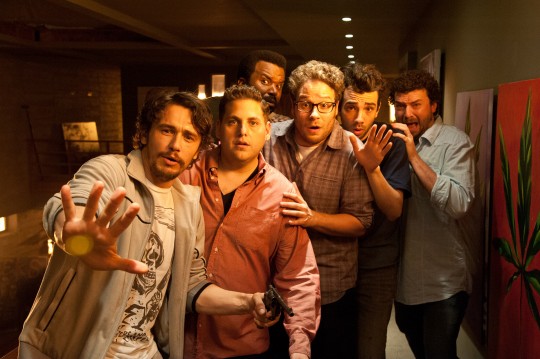
Adam Clarke something something bong hit.
Actor Jay Baruchel is up from Canada visiting Seth Rogen. Once these old friends are reunited (and it feels so good), the two get high and ignore the repeated news stories about sinkholes randomly showing up across the globe. Who’s got time for upsetting news when there’s a party at James Franco’s house?
While Rogen’s off enjoying himself, Baruchel keeps to himself. Whether it’s a giddy Craig Robinson, a touchy-feely Jonah Hill, a walking mess like Michael Cera or the predictably pretentious Franco, Baruchel’s out of his element. These Hollywood types are precisely the reason Baruchel left L.A. and returned to Canada in the first place.
Admittedly, I’d flee the country if I had to endure parties surrounded by people who enjoyed the Franco vehicle Spring Breakers, if only because I’ve yet to meet a fan of that film that isn’t an insufferable, pseudo-intellectual blowhard. But I’m getting sidetracked. Franco’s party sucks and Baruchel wants out. Fortunately, his wish is about to come true, if only because the rapture is occurring.
This Is The End is the latest raunchy, over-the-top, action-packed, stoner bromance comedy from the team of Seth Rogen and Evan Goldberg. Given that This Is The End is basically a group of friends making a movie as an excuse to hang out with each other, this should be on par with Grown Ups or Jay & Silent Bob Strike Back. It could’ve been a completely self-indulgent mess. But it’s got a lot of jokes. Good ones. And the Rogen-Baruchel friendship, while reflecting the standard Apatow-influenced arc of bromances, is still an engaging storyline. Needless to say, I was pleasantly surprised.
This Is The End is consistently funny, weird and enjoyable. Yes, it’s a stoner comedy where celebrities play douchey versions of themselves and Jonah Hill gets molested by Satan’s giant cock (yes, really). But, to play devil’s (cock) advocate, if you’re going to make a movie in which living with Danny McBride is worse than the apocalypse, Michael Cera is a coked-out asshole and Seth Rogen tastes his own pee, this was the one to make. Like the other Rogen-Goldberg films, End isn’t as funny as, say, the Edgar Wright/Nick Frost/Simon Pegg films (whose own upcoming apocalypse comedy, At World’s End looks promising), but I’d be lying if I denied laughing a lot in the theatre.
Michael Cera’s performance in This Is The End is proving to be one of the film’s most popular aspects. Maybe it’s because Cera’s role is little more than a glorified cameo, but I wonder why no one seemed to bite for the 2009 comedy, Youth In Revolt?
Cera is perfectly cast as both the intelligent, virginal Nick Twisp and his nihilist, chain-smoking alter-ego Francois. The reason for his split personality is, of course, to impress the love of his life (a charming Portia Doubleday). As this romance blossoms, two lonely intelligent teens are given a pass from their boring and repressive lives, but Francois’ hold on Twisp’s psyche further complicates matters.
With a cast that includes M. Emmet Walsh, Steve Buscemi, Zach Galiafanakis, Jean Smart, Ray Liotta and Fred Willard, Revolt has a lot going for it. Using the script’s off-beat storyline (from C.D. Payne’s novel) as a license to embrace quirkiness, director Miguel Arteta never lets the weirdness degenerate into a generic, self-indulgent “indie” quirk-fest. The film switches to animated interludes and presents the increasingly unhinged Francois with appropriate cool. That is to say, Francois is every bit as dorky and awkward as Twisp, but is a perfect version of what a teenage boy thinks a smart girl would want.
I wouldn’t rate the film as highly as the underrated Scott Pilgrim Vs. The World, Youth In Revolt boasts a lot of charm and originality and is worth a look if you like Cera’s performance in This Is The End.


Wed, Sep 18, 2013
Adam Clarke