

Adam Clarke investigates the true meaning of Christmas in July.
Be ashamed to die until you have won some victory for humanity.
– Horace Mann
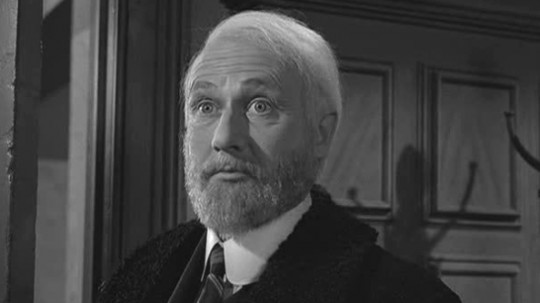
One night in December, these words weigh on the mind of Professor Ellis Fowler (Donald Pleasence). For the elderly Professor Fowler, “a gentle, bookish guide to the young” at the Rock Springs School for Boys, these words will drive him to the breaking point and end up his salvation. It’s all a part of this heart-wrenching, but gorgeous third season episode of The Twilight Zone.
The Twilight Zone: “The Changing Of The Guard” (1962)
Having delivered his final lecture before the Christmas holiday, Professor Fowler is invited by the school’s headmaster (Liam Sullivan) to discuss a recent correspondence with the faculty board members. Fowler is a sharp but absent-minded sort and assumes he’s just been asked by the faculty to sign his contract for another year. Fowler then launches into a tangent about the odd formality of contracts which segues into how delighted he is to have taught the grandson of one of his students.
“I should like to think I’ll teach a great-grandson one of these days,” Fowler says.
The headmaster interrupts, clearly unsure what to say next. The letter that was sent to Fowler wasn’t a contract, but the beginnings of a retirement. After six (!) decades teaching literature at Rock Springs, the headmaster promises that this isn’t because the school is dissatisfied with Fowler. Quite the opposite. This is to be a changing of the guard: getting new blood to teach while the respected Fowler moves on to a deserved retirement. Fowler doesn’t see it that way.
Professor Fowler puts on a brave face and assures the headmaster he’ll go along with retirement. As the professor makes his way home, two of his students go to wish Fowler a happy Christmas. They’re shocked to see he’s crying. Later that night, Fowler returns to the empty school grounds and brushes some snow off a statue of Horace Mann, revealing that rather important quote. Intended to inspire, that Mann quote plays on Fowler’s sudden fear that his life as an educator was wasted.
“I have won no victory, so I am ashamed to die,” Fowler says. He then takes out a revolver and points it at his temple… only to be interrupted by the sound of class bells. Curious, Fowler wanders around the school in a haze, but no one is present. There’s no assembly. As he looks about the school for any signs of life, Fowler passes by the classroom he taught in for so many years. Now empty, Fowler enters and sits down at his desk one last time. When he looks up, there’s a full class of students sitting at their desks.
They all want to talk to Fowler. After a moment of disorientation, the professor recognizes the class as his former students. Students who died shortly after they graduated. Some died doing medical research. Most died during various wars. Fowler tells the spirits in his classroom that they were all immensely brave and how proud he is of them. They each remind Fowler that it was the poetry and literature he taught that inspired them and, in their times of dying, comforted them. Each of his former pupils tells Fowler that he was the one who taught them to be honourable men and, seeing that their words have caused the professor to reconsider suicide, say their goodbyes and vanish.
Back at home, Fowler waves to a group of his students out caroling by his house and wishes them a merry Christmas. As he sits down to dinner, Fowler realizes that his retirement is not a sign that he’s lost his value, but a tribute to all of his work and the many lives that he’s touched. The episode ends with the camera panning away from Fowler, safe in the knowledge that his life has mattered.
“You’ll be drinking early today.”
-Rodney Dangerfield
If I didn’t know better, I’d swear Rod Serling wrote this because he thought It’s A Wonderful Life was crap and he could do a better job in 30 minutes. But the depiction of a suicidal crisis is done too realistically and with too much heart for such a cynical possibility.
I’ve suffered from chronic depression for as long as I can remember. It’s about as fun as it sounds. This illness makes me one of the X-Men except my mutant superpower is that I cry at work. The drawbacks of this are obvious. You’re prone to nervous breakdowns. You become hyper-aware of yourself and constantly ruminate over perceived slights and failings. Days go by as you remain stuck in your bed. Thoughts of suicide are one of your only constants.
It’s quite rare to see a major depressive episode treated with any kind of accuracy or dignity. Yet, in 1962, writer Rod Serling proved that it could be done. Fowler’s suicidal crisis is a harrowing one and the experience is captured with real honesty. Every single person has, at one point, considered their lives to be meaningless or forfeit. Most people don’t have to wrestle with it constantly. Us mutants tend to struggle with it every week. Depression constantly shifts you between realities, namely the one that most people live in and the one in which your identity and self-worth are always in question. To see that recurring nightmare handled with such sensitivity is nothing short of a miracle.
In a suicidal crisis, most of us are asking for a sense of belonging or purpose. The suicidal person is flung off into a reality all its own; a place where one is constantly inadequate and any sense of community is an impossibility. If the suicidal person talks to anyone about this, it can seem rather surprising that anyone else could notice, much less care. But people do care. For the suicidal mind, it’s a difficult thing to accept, but it is true nonetheless. Just by taking part in this long, painful ramble of an existence, you matter to other people; you affect them in ways you don’t realize. So we see the same thing in the subject of this review. As Pleasence’s Fowler comes close to suicide, he’s surprised to see that he’s made such a mark on his students.
It’s not often I throw this word around, but “The Changing Of The Guard” is a masterpiece. Pleasence and writer Rod Serling convey an man’s life and a major depressive episode in about 25 minutes. Serling and Pleasence accomplish in a third season episode of a cult TV series what so many films and novels fail to accomplish. I can’t re-iterate just how fucking special “The Changing Of The Guard” is. “The Changing Of The Guard” is a beautiful piece of television. The script is the best work that Rod Serling has ever done (suck it, Requiem For A Heavyweight) and every aspect of the production, from the music to the subtle make-up on Pleasence (who was only in his forties during filming), is perfect.
Donald Pleasence offered many brilliant performances in his long and sometimes very odd career. His eyes, voice and presence held a power that few actors ever possess. Like all great stage actors, watching Pleasence could be deliriously exciting when he opted for scenery chewing. You would think Charlton Heston would be the loudest actor in any movie he starred in, but there’s Pleasence in the great Will Penny alternately firing a gun and doing a jig. I remember very little from Race For The Yankee Zephyr, but I’ll never forget the scene where a drunken Pleasence is hanging from a helicopter like he’s fucking Darkman. Same goes for his hilarious turn as profit who could only “see” with the aid of whiskey in The Hallelujah Trail. He’d deliver these memorably weird character performances in superb films like Soldier Blue (where he wore false teeth and chased Candace Bergen) or awful films like Wedding In White, Jaguar Lives!, Into The Darkness and Specters.
Even in films or mini-series where Pleasence underplays a part, he’d still end up stealing scenes from the likes of Alan Rickman (as he did in The Barchester Chronicles) or Ian Holm and Colin Firth (in the underrated The Advocate aka Hour Of The Pig). I’ll never understand how he managed to keep his dignity in a film where he gets decapitated by a magic baby, but I’ve always been a crap actor to be honest. Pleasence was an actor of incredible range and skill, which should be better remembered. He never failed to bring a dynamic quality to everything he appeared in. It’s a shame many of the films he did lacked scripts even half as good as “The Changing Of The Guard”.
Strange as it might seem, the Twilight Zone episode without the twist is the best one of the lot. There’s no aliens, heavy-handed ironies or clumsily-telegraphed endings, which are sins the original Zone often committed. Instead, we have a story that’s full of humanity, expresses empathy for a taboo subject and doesn’t have a single false note. All of it brought to life through one incredible performance. I can think of no better way to remember the talent of the late Donald Pleasence.






Adam Clarke | Fri, Jul 26, 2013 |
On Screen