

Adam Clarke thinks episode 8 is episode 2 for Number 6
The Story In Six Words (Or Less): Six attends a fancy carnival, dies.
When we last left Number Six, he’d been kidnapped and placed in the Village, met Number Two (both of them) and had his escape attempt thwarted by a howling, membranous thing (which we’ll call “Rover”). A trend for the series starts with its second episode in the form of an extended title sequence. After the title credit, most episodes from this point on begin with a version of this exchange* between Number Six and the Number Two of the week:
6: Where am I?
2: In the Village.
6: What do you want?
2: Information.
6: Whose side are you on?
2: That would be telling. We want information. Information. Information.
6: You won’t get it.
2: By hook or by crook, we will.
6: Who are you?
2: The new Number Two.
6: Who is Number One?
2: You are Number Six.
6: I am not a number! I am a free man!
2: (Laughs)
Dance Of The Dead
Written by Anthony Skene
Directed by Don Chaffey
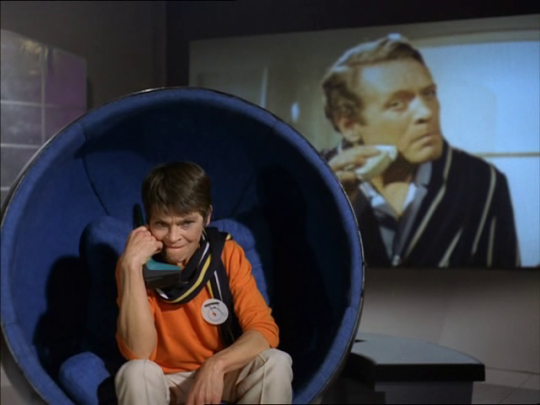
“Dance of the Dead” begins at night, not long after “Arrival”. His sleep interrupted by a mind-control device, Number Six (Patrick McGoohan) is hypnotized into taking a call from Number 42 aka Roland Walter Dutton (Alan White). An apparent colleague of Six’s, Dutton asks about Six’s recent resignation and claims the late night call is at the request of their former bosses (“the committee”). In reality, a doctor aka Number 40 (Duncan MacRae) feeds questions to Dutton at Village HQ. Dutton’s been broken so badly by the Village that he’s manipulated with ease. The ever-paranoid Six hears 40 whispering in the background and the unauthorized experiment is immediately canceled by the arrival of the latest Number Two (Mary Morris). This Two is adamant that Six can’t be broken like Dutton and needs to be won over. Six’s cooperation is vital to the Village succeeding in its aims, whatever they may be.
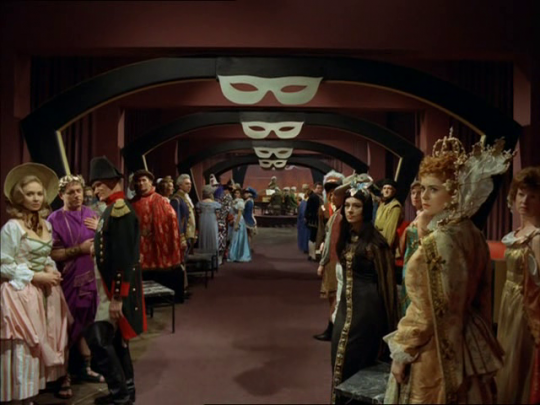
Number 6 awakens with no memory of Dutton’s call the previous night and finds he’s been invited to Carnival, a costume dance held in the Village town hall. During a chat with Number 2, 6 learns that special prisoners are assigned observers and that his is a striking blonde, Number 240 (Norma West). Number 6 tries to get some answers out of his observer, but is told “questions are a burden to others. Answers a burden to one’s self”. When 240 heads backs to Village HQ, 6 tails her but is blocked by Rover, the bouncy menace. Avoiding the homicidal sphere, 6 follows 240 over to the town hall, but is blocked again. Not by Rover, but by some invisible barrier that knocks the wind out of him. A fellow prisoner sees this and shrugs it off, noting that the town hall’s “fussy about who it lets in”.
Avoiding the drugged food/drink provided by Village maids, as well as the hidden transmitters trying to hypnotize him into sleep, Number 6 sneaks out of his home to explore the Village. By dawn, 6 discovers a corpse washed up on the Village’s beach. This isn’t a Village casualty, but an ordinary man who died in some accident at sea. His only tie to the outside world, Number 6 drags the body to a cave hidden from Village surveillance. There, 6 writes a note and includes a photo of himself in the dead man’s wallet, which he wraps in plastic and puts in the corpse’s jacket pocket. 6 then steals a life preserver, places it on the body and pushes the dead man out to sea.
Returning to the cave, he spots 42/Dutton whom 6 recognizes from his old life. They may have been colleagues, but 6 remains obtuse (he later describes Dutton to 2 as “a man I think I knew”). After a moment of catching up, Dutton confesses that he’s revealed everything he knows to Number 2. Dutton says that spilling secrets bought him no extra time or comforts and that he’ll soon be executed by Number 2′s cronies.
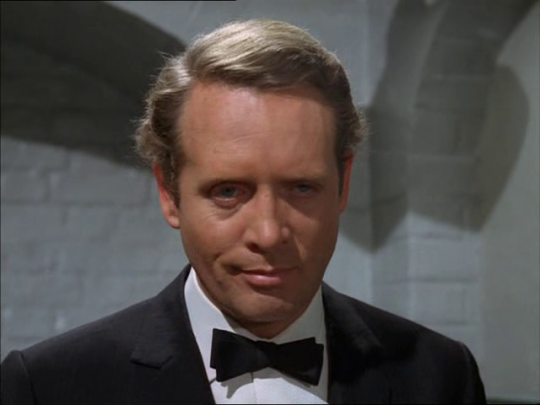
When Carnival begins later that night, 2 (dressed as Peter Pan) reveals that the dance is actually a trial for 6 (dressed in his own tuxedo, provided by the Village). He’s being charged with being a disharmonious Villager and the punishment would be death. During the Carnival-trial, 6 calls for Dutton to be his character witness, but what 2 brings out to the dance hall/trial room isn’t much good. Dutton, in a jester’s outfit, wanders into the Carnival court. He’s been lobotomized.
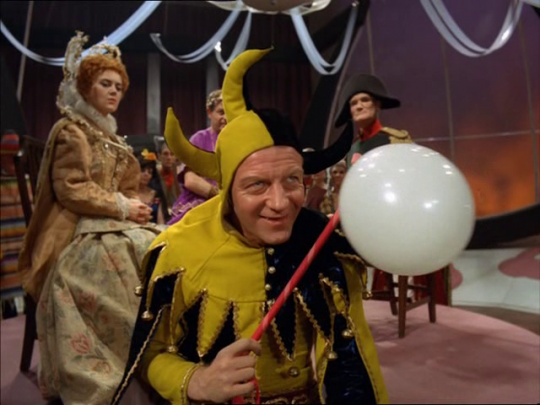
6 is pronounced guilty and the Villagers form an instant costumed mob to chase him down. 6 manages to find a hiding spot, but is quickly intercepted by 2. She tells him the meaning of her death sentence. The Villagers aren’t going to murder him, as that was just a little joke. Instead, Village security fished out the dead body and “amended” both it and the contents of its wallet. It’s 6 who’ll be reported as having died in an accident, confirming his lifetime sentence in the Village.
Episode placement: Though screened eighth when the series originally aired back in ’67, I’m not the only one to consider this the proper second episode of The Prisoner. During the chaotic production of the series, several writers were commissioned to come up with a good second episode, resulting in “Dance”, “Checkmate” (screened ninth) and the McGoohan-scripted “Free For All” (screened fourth). These episodes share references to Six’s recent arrival in the Village, depict Six as less hostile/paranoid and show Six to be unaware of common Village rules. Another tell-tale sign that this was produced early is that Rover doesn’t make its trademark howl and emits only the high-pitched whistling and off-rhythm heartbeat heard in the unaired alternate cut of “Arrival”.
I place it earlier than the other “second episodes” because of Six’s aforementioned unfamiliarity (“I’m new here”/”I haven’t seen a night”) and that most of “Dance” is devoted to world-building. There’s also a few seeds planted for later stories, foreshadowing “Chimes of Big Ben”/”Many Happy Returns” (Dutton: “You, me, Arthur, the Colonel…”), “Free For All” (Number Two’s assertion that the Village is democratic) and the series finale (“This man has a future with us”.)
Why was “Dance” screened eighth? Though it would have likely aired shortly after “Arrival”, the episode proved a nightmare to edit with its many story threads (Dutton, the dance, the body, the observer, etc). So, this episode was shelved until it could be edited into a coherent hour.
Whose side are you on? “Dance of the Dead” is one of the greatest episodes of The Prisoner. The script is somewhat complicated and doesn’t have a plot so much as a series of sub-plots, which gives it a vibe more common to the AMC/HBO storytelling of today than episodic 60′s TV. That script is given considerable weight by one of the series best guest casts and taut direction care of Don Chaffey.
Chaffey, who directed four episodes of the series including “Dance” and “Arrival”, provides some terrific visuals. While this series is often praised for its cinematic look, this episode boasts some especially striking sequences, like the gorgeous, dusk-shot beach confrontation between 6 and 2 containing this unforgettable exchange:
2: This is your world. I am your world. If you insist on living a dream, you may be taken for mad.
6: I like my dream.
6: Then you are mad.
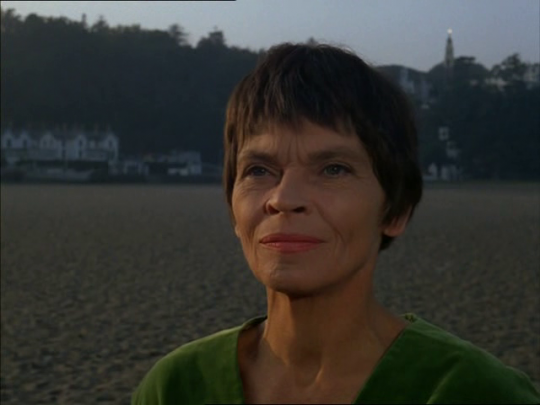
Of all the Number Twos, Mary Morris is my favourite tied with Leo McKern (whose episodes we’ll get to later). Unlike the other Twos, there’s no warmth or vulnerability to her performance. Instead, an indomitable confidence is present in her every scene. She’s the Number 2 who most relishes being in control and seems to be smiling because she enjoys not only the Village and its power, but the cruelty she so casually inflicts. Morris invests real menace in the part, playing 2 as if she’s certain she’ll beat 6 in the end. It’s eerie the way she savors the moment when presenting jester-Dutton in his newly-reduced state. Morris is almost never seen without that horrible smile carved along her face. She’s less like a villain than a demon in a woman’s skin.
Like the wonkily-animated, low-key first season of The Simpsons, “Dance” presents a Prisoner that might’ve been. A Prisoner far darker than the series would become. As we’ll see later in the series, McGoohan’s increased creative control betrayed how silly he thought the Village was, resulting in a steady decay of the menace it possessed. While I love The Prisoner, I can’t help but wonder how things would have turned out had the tone of the show always been so bleak and the rotating Twos always been as ruthless as Morris. While the weaknesses 6 exploits in later episodes are arguably dramatic necessities, it’s unfortunate that the Village and Number 2 will never again be this frightening or powerful.
Easily the show’s grimmest hour, “Dance of the Dead” is a great way to follow up the promise of “Arrival” and is one of the series’ top three episodes.
Next time: Elections, Village-style.
*Mary Morris only repeats “information” once after “we want information” and returning Number Twos respond with “I am Number Two” instead of “The new Number Two”. Minor variations aside, that exchange will play out at the beginning of all but four episodes of The Prisoner.





Adam Clarke | Mon, Sep 2, 2013 |
On Screen