

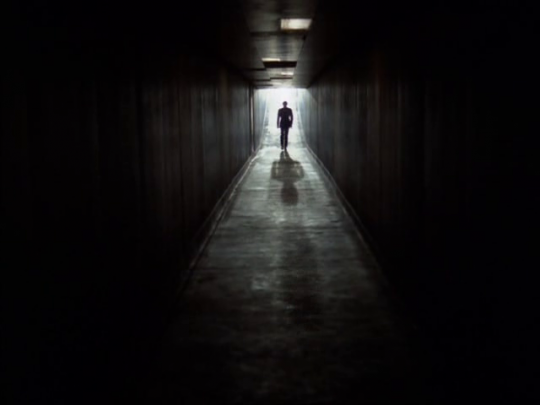
Adam Clarke once spent 17 weeks trapped in the Village Mall.
An enraged man (Patrick McGoohan, Braveheart) checks into a highly secure building in London, England. We don’t know his name, but we’ll come to know him as Number Six. He marches into an office and hands in a letter of resignation. The man returns home to pack his bags but he suddenly passes out before he can finish. He wakes up, confused, in a replica of his home. When the man opens his blinds, what’s outside is a place he’s never seen before. The area is characterized by Italianate architecture and antiquated cuteness, like big-wheel bicycles.
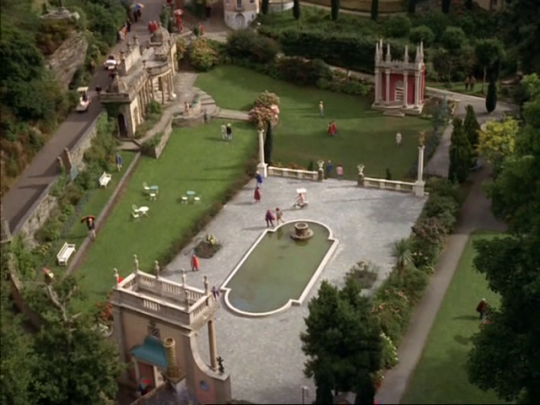
Welcome to the Village.
This is the world of The Prisoner.
I’m commemorating the 46th anniversary of this 1967 mini-series by revisiting and reviewing all 17 episodes in an order chosen by me. Confused? You won’t be after we get to the next episode. But first, let’s get back to…
Arrival
Written by George Markstein & David Tomlin.
Additional writing by Patrick McGoohan (uncredited).
We don’t know much about the man we saw resign in the opening credits. He roams around looking the Village for some way to escape or at least some information on his present whereabouts. Soon he’s paged by Number Two (Guy Doleman)…
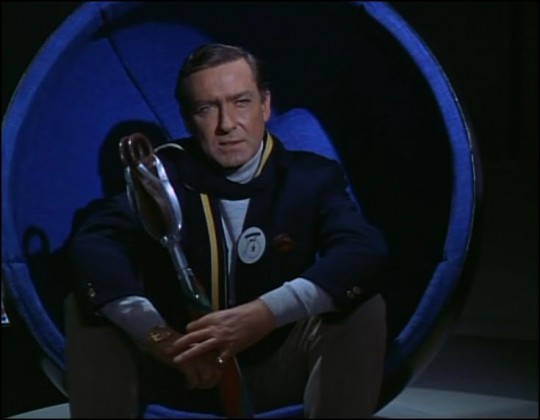
…who proceeds to tell McGoohan that he’s now a member of the Village, earning him his number; henceforth, McGoohan’s character isn’t a man, but Number Six. All numbered persons are placed in this cozy area called the Village until further notice. Those that escape always return albeit “not always alive”. Number Two just wants to ask a few questions, namely, why did Six resign from a position of top security? Is Six defecting? Is he selling secrets? It’s natural that certain parties would be interested in him.
Six, of course, won’t bargain with anyone in the Village, as he’s unsure which side runs the place. Two assures Six that there’s nowhere to run, as the Village has eyes everywhere. Two displays his power by showing Six a montage of covert photographs taken of Six on the day he resigned. Their cameras are everywhere and Two’s acquired virtually all data on Six right down to his date of birth.
Number Six won’t reveal any information. Instead of a night of torture in Big Brother’s Wonderland, Six’s given a chance to get comfortable in the Village as Number Two takes him on a tour. Six sees he’s not alone, surrounded by fellow prisoners and warders. Of course, it’s impossible to tell who’s who.
Number Two, despite his civility, shows a certain ruthlessness. The Village represents order and, arbitrary or not, order must be obeyed to survive there. So, when Number Two says “stop” the Villagers remain in place as if frozen in time. All save one unfortunate soul who cracks and runs for his life. Number Six watches to see what Number Two will do in light of this insubordination.
Two does nothing. He just waits. Seemingly out of nowhere, a giant white ball floats down into the Village grounds. The ball’s not remote-controlled, but it follows orders. It has no features, but it howls as if alive. The white ball lands on the Village’s latest would-be escapee. Number Six watches, bewildered, as the ball seemingly gobbles the man up and vanishes. Turning to Number Two for answers doesn’t do much good:
Number Six: “What was that?”
Number Two: “That would be telling.”
I guess Number Six hasn’t played Ski Free because that’s classic yeti behaviour…
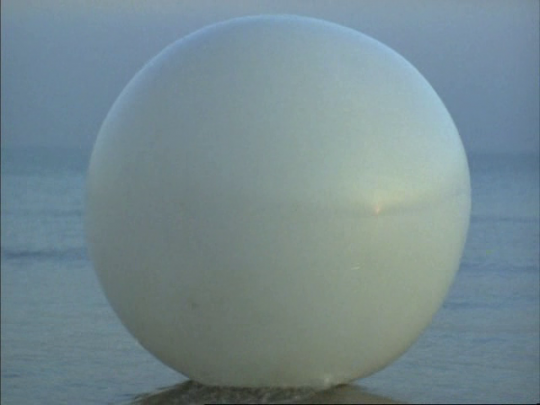
The rest of “Arrival” introduces us to a few aspects of The Prisoner that will be explored in greater detail as the series progresses. The Village has a rehabilitation clinic that brainwashes its residents and subjects them to mental and physical torture. Number Six squashes a radio in his new home only to have the music continue without explanation. A fellow prisoner dies only to be revealed as a spy for the Village who, having faked his death in the Village, is heading back to “the motherland”. Number Six tries to escape, but is no match for the Village. By the episode’s end, he’s non-fatally subdued by the white ball (affectionately known as Rover).
Of course, one of the most interesting quirks of the series is presented halfway through the episode. Shortly after the first appearance of Rover, The Ball of Screaming Ambiguity, Number Six makes his way to Number Two’s office, demanding to speak to him. The office is the same with its massive viewscreen, lava lamp imagery and oval chair. Yet, as the chair swings around, the man calling himself is not who Six had been speaking to. This begins a trend of revolving Number Twos. Some episodes have a couple of Twos and some have returning Number Twos, but there’s usually a wholly different person as the Village authority each week or, in this case, later that day.
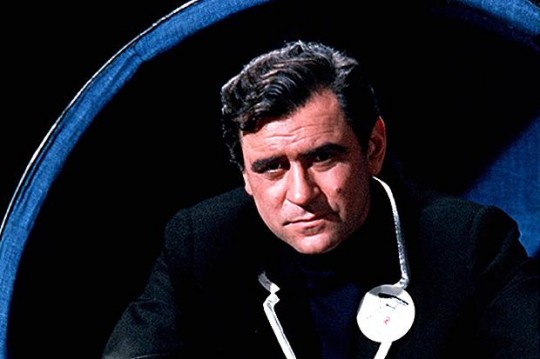
There’s no explanation. No mention is made of where the old Two went or how many Twos there are. Six meets the new Number Two who, like his predecessor, is gentlemanly in their demeanour as a means of gently coaxing Six into revealing all. Six, of course, reveals nothing, beginning a struggle for freedom that will last all the way through the series…
Of all the things we read or watch that shapes our tastes and minds, they don’t often hold up to re-watching or re-reading. Of my favourite television programs I saw in my youth, the ones that retain their power are rare. The Prisoner is rarer still, as it’s an endless source of fascination. If anything, I appreciate it more and more every time I visit it. It’s clever, creepy, surreal, imaginative and, without a doubt, the most intriguing television series ever to air.
“Arrival” is a brilliant hour of television. Equal parts witty, bizarre and suspenseful, it mixes George Orwell with Lewis Carroll while still maintaining a firm grip on its story. This is The Prisoner with half-a-foot in reality and suffers only in comparison to the more surreal episodes to follow. As great as it is in terms of script, production, direction and performance, I still like my Prisoner episodes to embrace lunacy without care for the consequences. If you prefer the espionage aspects of the show, “Arrival” will be in your top episodes. If you like the weird allegorical elements star/producer/(co?)creator Patrick McGoohan invested into the show, you ain’t seen nothing yet.
Why does this series work? Partly it’s the chaos of it. Both onscreen and off, the details of The Prisoner are variable depending on the individual. Where’s The Village located? The series offers a couple of (wildly different) answers. Is Number Six an enigmatic new character or actually Patrick McGoohan’s spy hero John Drake of Danger Man (aka Secret Agent)? Depends on who you ask. Who created the damn thing? The credit lies with script editor George Markstein (who is credited as co-writing “Arrival”) and/or producer-star Patrick McGoohan (who claimed to have come up with the core concept and a detailed history of the Village on his own, along with rewriting the Markstein-Tomblin “Arrival” script).
Hell, that’s not the half of it. Wait ’til the finale. Hoo boy. Still, that aforementioned chaos is present in the first episode. The iconic opening theme by Dr Who‘s Ron Grainer? Grainer wasn’t the first composer hired to compose a theme. The roaring Rover balloon? That was a last-minute replacement for a prop that didn’t work and new sound effects were being placed in last minute until the bouncy blob had a real presence in its scenes. Whole scenes are (noticeably) woven out of last-minute editing, particularly the scene where the panicked Villager gets eaten by Rover. He’s not wearing the same clothes when he’s running as he is when Rover’s on him (where’d the pink jacket come from?) and face pressed against Rover is obviously McGoohan’s own (seen again when Six is attacked by Rover in the episode’s climax). This was clearly assembled with re-shoots and jamming odd bits of footage until something worked. The original cut of the episode–released on DVD with the series–has the Rover scene minus the panicked man and his subsequent encounter with Rover.
Yeah, The Prisoner‘s complicated. That madness definitely worked to the show’s advantage. Unlike Lost, The X-Files and other story arc-heavy shows that lost their way, The Prisoner is the only show that’s ever kept viewers in the dark without it ever feeling like a cheat. I think the chaos of the production and the creative freedom allowed by that chaos lead to only the strongest ideas, concepts and visuals to make it into the series. It didn’t fit together into a tight, little narrative, but the project became so big that an all-encompassing, symbolic, shaggy dog story was the only way for The Prisoner to exist. That shambolic narrative is what allows The Prisoner to be truly great.
While the amount of The Prisoner that is purely his is up for debate, Patrick McGoohan is a vital part of its vision and its enduring success. As Number Six, McGoohan created one of the most unique heroes of his time. Number Six doesn’t pause to be likable. He doesn’t let the audience in. He isn’t explicitly sympathetic. He’s a man questing for total freedom and possible hermitage. As the series progresses, Six will scream, punch, con and bully his way to get closer to his elusive goals. He doesn’t take a moment to cry, fret or pick up sexy Village ladies. One thing we’re just not used to in fiction is the self-professed loner who isn’t just posturing. Six is just that and is all the more unique when compared to the last 20 years of homogenized, identikit pop culture heroes.
The Prisoner‘s intriguing premiere develops the premise, characters, setting and oddness with aplomb. McGoohan, one of the most underrated actors, is astonishingly good in this. “Arrival” alone is enough to make you realize McGoohan’s talent and why Six became his best known part. Guy Doleman’s excellent as the first Number Two, setting the bar for the Gentleman Villain most Number Twos would strive to emulate. Everything about “Arrival” works…it’s just that the show’s real greatness is yet to come.
Next time: “Dance Of The Dead”.






Adam Clarke | Thu, Aug 22, 2013 |
On Screen