

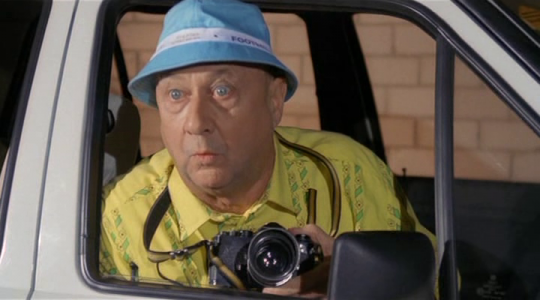
Adam Clarke loves this face.
There are certain actors I’ll watch in anything: John C. Reilly, Jeffrey Combs, Darren McGavin, Patrick McGoohan… character actors, mostly. If there was one man who’d be the patron saint of character actors, it would have to be Donald Pleasence. An actor with over 200 credits on his IMDB page, Pleasence had an incredible range that lead him to steal the scenery from even his finest co-stars (Laurence Olivier, Alan Rickman, Ian Holm, Peter Falk and countless others). Or using his talent to elevate the schlockiest of b-movies, as he did for most of the 80′s. In short, he’s my favourite.
Don’t take present-day Adam Clarke’s word for it. I’d been aware of Pleasence’s greatness from an early age, as you may gather from this excerpt of a poem I wrote in grade six…
He was a conscientious objector
To every war.
But still he had time
To star in “Halloween 4″.
As the Spirit of Dark and Lonely Water
He pushed young children into lakes.
No one knew that Donald really drowned them
between takes.
I’d intended that poem to be read aloud by the lead singer of Carnivore as he was the only one who seemed likely to do justice to its 20-page length (told you it was an epic poem). While that dream remains unfulfilled, I can at least recommend my ten favourite Pleasence roles to highlight what a quirky, inventive actor he was.
For the purpose of this list, I’ll avoid listing his work in John Carpenter’s Halloween, The Great Escape and You Only Live Twice, as they’re already deeply burrowed in pop culture muscle memory. I’d like to instead shine a light on other noteworthy, but lesser-known performances.
Columbo: Any Old Port In A Storm (1973)
My fondness for Columbo is already documented and I need not regurgitate that piece, but Pleasence is easily one of the most fun members of Columbo’s rogues gallery.
Raw Meat (1972)
Firstly, this scene between Pleasence and Christopher Lee must be watched as a master class in snark.
There’s no hero in horror cinema more fun than Pleasence’s Inspector Calhoun. Calhoun’s a cantankerous, acid-tongued, tea-obsessed middle-class police inspector Investigating a rash of disappearances in a subway station beginning with James Manfred, OBE.
It seems that James Manfred was one of the higher-ups in the Ministry of Defense and that there were two other missing persons, earlier in the year, reported to be last seen at the very same station. Nothing connects the three disappearances except location, Calhoun gives a call to Manfred’s secretary—despite his partner’s objections—and uses all his investigative cunning to get information out of her. This manipulation is transcribed below:
Calhoun (covering his lower-class accent with faux pomposity): Oh, James never stops going on about you. When do you expect him in? What? Missed the morning meeting with the minister, did he? Tsk, naughty, naughty boy. Who’s calling? Oh, uh, tell him it’s Princess Anne…(hangs up)
After this exemplary piece of detective work, we are taken to an untouched pocket of Russell Square tube station, water rhythmically dripping to murky, filth-encrusted floor—a foul mixture of soil, blood and human tissue—streaked across like broad strokes of colour on a painter’s canvas, where Manfred, our tubby little derby-man, lifelessly leans against a brown surface. By the end of this sequence he will be drained of blood by a lanky, hairy figure, feeding Manfred to his pregnant mate.
With those two sequences, the tone for Gary Sherman’s Raw Meat has been set. The film’s an well above-average horror story that astutely mixes eeriness, and comedy with strong characterization and theme. Whilst plenty humour mainly comes stems from Calhoun’s retorts, this does not take away from the film’s more unsettling scenes.
It should be noted that the cast is above-average with Donald Pleasence being the real standout. He creates a one-of-a-kind character with Calhoun. Many actors would’ve been lost in a role that relies on the performer to play both hero and comic relief. Pleasence is stellar as Calhoun, making me pine for a “Calhoun of Scotland Yard” spin-off TV series that will sadly never come to pass.
1984 (1954)
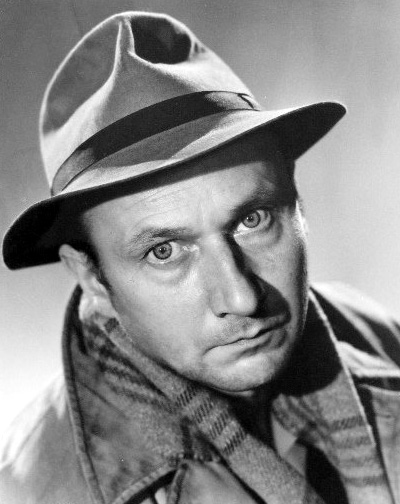
Written by Nigel Kneale and starring Peter Cushing, this live BBC teleplay of George Orwell’s influential novel is the best adaptation of the source material. Cushing is a note-perfect choice for Winston, but Pleasence devours the scenery as Syme, the develepor of NewSpeak. Pleasence savours dialogue in which Syme professes his love for perverting language, but still retains and suggests the character’s sly intelligence, sometimes with nothing but a knowing stare. Pleasence returned for the film version of 1984 released two years later, but that version lacks the tension or uncompromising ending of the BBC telemovie.
Blade on the Feather (1980)
Written by Dennis Potter (The Singing Detective), this telefilm centers on Cavendish (Pleasence), a retired Professor and children’s author, whose cozy home life is upset by Young (Tom Conti), a man intent on investigating Cavendish’s connection with the murder of a Soviet defector. Non-linear and somewhat obtuse, this Potter thriller is gripping in much the same way as Harold Pinter’s The Dumb Waiter. Things keep getting queasily uncomfortable until the final few lines of dialogue. Pleasence is delightful as a hard-drinking conservative who, were it not for the presence of Young, would be whiling away his time in self-loathing and speeches about the importance of custard.
The Caretaker (1964)
Perhaps the English actor’s most iconic stage work was written by Harold Pinter, who would ultimately deliver Pleasence’s eulogy in 1996. Pleasence was cast as Davies in the original play and became synonymous with the role; first editions of the play script used a shot of Pleasence for their covers. This adaptation of the play boasts two fine performances from co-stars Alan Bates and Robert Shaw, direction by Clive Donner and cinematography by Nicholas Roeg (The Man Who Fell To Earth, Bad Timing), but it’s completely Pleasence’s show. Coming from Pinter (who wrote the screenplay), this is purely an actor’s showcase and as the titular caretaker, Pleasence is enigmatic and intensely funny as a lost, mentally ill hobo who nonetheless warbles on about his pipe dreams.
Dark And Lonely Water (1973)
“The show-offs are easy, but the unwary ones are easier still…”
Although there are many films like The Great Escape, The Greatest Story Ever Told, Dr. Crippen and The Hallelujah Trail that display Pleasence’s inventiveness as comic or serious actor, this short British safety film shows how good he can be. Just watch it and you’ll hear how Pleasence manages to create a menacing presence using only his voice. Like Vincent Price, Pleasence was often typecast in the horror genre, but, like Price, he was proof that so few actors can so effortlessly shine in the genre.
The Black Windmill (1974)
During the less reputable lulls in his career, Pleasence could always be counted on to provide dignity in films like Paganini Horror, Fatal Frames, Pumaman and Frankenstein’s Great Aunt Tillie. Pleasence was just as likely to steal the show from his greatest co-stars. as he did to Michael Caine in The Black Windmill.
The Black Windmill was destined to succeed. The film sports a strong cast, a suitably dramatic plot (Caine’s child is kidnapped and tortured in the hopes of blackmailing British Intelligence) and was directed by the great Don Siegel. Yet, the film was pronounced a dud upon release and has since been forgotten.
Though uneven in pacing, Siegel’s film is quite good despite its reputation. As Caine searches for corruption among his fellow Intelligence officers, he casts an eye on Pleasence’s by-the-book, perpetually congested intelligence man. Pleasence is all quirks and charisma; more of an anti-James Bond than Caine’s own Harry Palmer from The Ipcress File. Like the best supporting characters, Pleasence’s Cedric Harper is the lead in his own film and one that seems far more entertaining than the ransom/revenge plot of Michael Caine’s unfortunately named “Drabble”.
THX-1138 (1971)
Imagine a version of 1984 made by George Lucas. No, before he was terrible. Since this is a sci-fi film written by a geeky young man, sex is the ultimate crime of the state. In a repressive totalitarian society (is there any other kind?), THX’s (Robert Duvall) growing malaise and secretive affairs gain the attention of security monitor SEN 5241 (Pleasence), who blackmails THX into becoming his roommate. Not long after, all three end up in prison, but THX breaks out, joined by SEN and a fellow prisoner who thinks he’s a hologram (Don Pedro Colley).
THX 1138 is an unjustly overlooked gem that combines Lucas’ once-renowned knowledge of audio-visual trickery with a surprisingly strong script and a game cast. Though he and Lucas clashed on the set, Donald Pleasence is perfect as the self-serving SEN. Not unlike the talking head editorials or the empty anarchist rhetoric from your school days, SEN speaks horseshit so fluently you’d think he had his uvula replaced with an equine anus. “We need dissent, but we need creative dissent,” he proclaims to fellow prisoners with a look of smugness unrivaled by even the most self-satisfied prat. The scene where SEN casually remarks that his previous roommate was killed for crimes against the state, is as chilling as it is charming. He boasts about his schemes and his talents, but he would be just another drone if he had no one to boast to. For all his talk of overthrowing the system, SEN would be lost without it. Pleasence makes SEN a fascinatingly weak character, dangerous and pitiful in his unending quest for comfort and praise.
Wake In Fright (1971)
John (Gary Bond) is a British teacher stationed in Tiboonda, Australia and hates it. However, not filling his contract means paying out a $1k bond. So, John ends up holidaying near the Outback (Yabba), gambling to get the required cash for his bond. When he loses everything, he ends up staying with a former doctor (Pleasence) as they eke out a paltry existence on nothing but poached kangaroo meat and whatever beer they can scrounge.
I caught Wake In Fright for the first time a few years back after getting my hands on the Australian DVD. I’d known it by reputation and was pleased by just how well it lived up to it. Beyond its gritty, nightmarish story is a delightful pairing of Bond and Pleasence (“What do you do around here?” “I drink”) Pleasence makes a meal of cynical dialogue and unusual backstory; a gleam in his eye to suggest that even Doc can’t believe how much of life he’s left for the drink. Wake In Fright isn’t just a vehicle for his terrific performance, but is one of the most haunting, despairing stories ever filmed.
Next week: Out of every performance by this virtuoso actor, this last one is my favourite for rather personal reasons.






July 26th, 2013 at 11:22 am
“Sensible children…I have no power over them!”
July 26th, 2013 at 2:20 pm
“I’ll be back-ack-ack-ack!”