

Archive | On Screen RSS feed for this section
Superman’s One Weakness: Man Of Steel (2013)
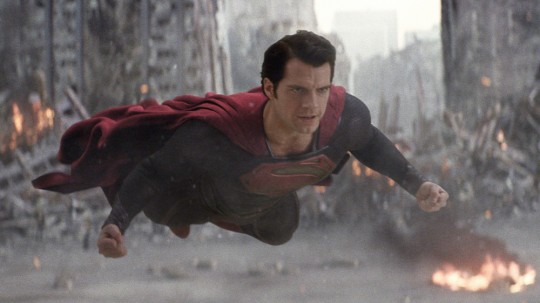
Adam Clarke was sent to Earth in a giant egg to be the people’s champion. Unfortunately, Superman IV was on TBS again and he got distracted.
Superman’s one weakness isn’t Kryptonite. It’s cinema. Try as they may, there hasn’t been an entertaining Superman movie in a very long time. As I look over the most recent Supes flick, I must ask the question on everyone’s lips: Otisburg?
Oops, wrong movie.
I love 1978’s Superman: The Motion Picture. If you’re looking for a perfect distillation of who the character is and why he works, you needn’t look any further than Christopher Reeve’s debut as the Man Of Steel. He’s intelligent, kind, powerful and empathetic. While Christopher Reeve continued to be great in all of that film’s increasingly goofy and ill-planned sequels, that first Superman film put Clark Kent/Superman/Kal-El into a story that treated the character with dignity and got the viewers to know him. It was funny, romantic, exciting and imaginative as it perfectly balanced a sober, earnest approach to Clark Kent/Kal-El/Superman’s story with action set pieces and the goofy humour of its villains.
The sequels all embody failure to varying degrees. Superman IV (Supes vs nuclear-powered wrestler) is, at best, endearingly incompetent. Superman III (Superman vs Richard Pryor and TV’s Robert Vaughn) and 2005’s Superman Returns redefine the term “excruciating boredom”. Superman II, easily the best of the lot, was once championed by Roger Ebert as being a better film than the original. That certainly was the consensus upon the film’s release, but time hasn’t been kind to Superman II. Though Terence Stamp’s iconic performance as the evil General Zod has made him one of the all-time great villains in pop culture, II‘s script is a mess of pointless sub-plots (Superman losing his powers, Lex Luthor busting outta prison). Even the alternate cut of Superman II by original director Richard Donner is every bit as flawed as the Richard Lester-helmed version released in cinemas.
Is it really that hard to make a good Superman movie?
In Man Of Steel, Superman’s origin story and his battle with General Zod are pieced together like a video game adaptation of Superman: The Motion Picture and Superman II. Much of the film’s first half has a young Clark Kent (Henry Cavill) wandering around the earth, constantly grappling between his desire to help people and his need to keep his powers a secret. Kent’s torn between his biological father and adopted father’s wishes; the former urging Clark Kent/Kal-El to become earth’s champion, while the latter urges him to keep them under wraps until the world can process the existence of, well, Superman.
This is the plot thread that cripples Man Of Steel. Why is Pa Kent (Kevin Costner) so afraid of how people will react to a super-powered person who just wants to help mankind? If Pa Kent played a major role in disciplining his adopted son to use his powers for good and to rise above the urge to kill, that’d be interesting. However, Pa Kent just arbitrarily decides that humanity’s not ready for Superman and that Clark must never use his powers until the time is right. Without going into spoiler territory, this belief results in one of the dumbest character arcs ever captured on film, climaxing in the shockingly dumb scene that writes Pa Kent out of the movie.
And, of course, all this secrecy bullshit doesn’t work anyway. Clark Kent eventually becomes Superman through the help of a hologram(?) that bears the consciousness of his Krypton father, Jor-El (Russell “Dead Ears” Crow). Within minutes, Lois Lane (Amy Adams) knows who he is, General Zod (Michael Shannon) knows where to find him, and millions of people die during a climax where Metropolis is reduced to rubble. Yes, the deaths may be off screen, but the Zod-Supes fight obliterates so much of Metropolis that a Man Of Steel sequel will need to bear the subtitle Beyond Thunderdome.
Man Of Steel’s major weakness isn’t that Superman struggles to save the day. The real problem is that this is a world in which no one seems to care. Whether it’s Clark following Pa Kent’s wishes to lay low or his drawn out fights with Zod, this Superman doesn’t seem that interested in keeping people alive, much less safe.
If Superman doesn’t care, you’ve missed the point of Superman.
Why a character this iconic can be so frequently misunderstood is beyond me. If you’ve ever said that Superman’s too powerful to be interesting or just a silly two-dimensional character, you don’t get it. Superman’s strength and other powers don’t make him boring. Those things force writers to try harder to tell compelling stories. Anyone who has seen Superman: The Motion Picture or read a classic Superman comic like “What’s So Funny About Truth, Justice & The American Way?” knows what makes this character great.
As for the second charge, I’d say Superman is one of the most relatable of all superheroes. Superman touches on very human feelings of alienation and isolation by literally making its character an alien raised by human beings. He has our vales/morals, but bears the DNA of another world. He doesn’t have to care about humanity, but he does so selflessly and as non-violently as possible. That’s what makes him an interesting hero. Clark/Kal-El has the chance to make a difference on a global scale and he chooses to do so every day. Superman’s not about a weird alien blending in with humanity, but the choice to be human. It’s a reminder of the importance of embracing community and one’s own responsibility to place the needs of others before your own. If you leave that out, you don’t have Superman.
To lavish Man Of Steel with as much praise as it deserves, it must be noted that Cavill, Adams and Antje Traue (as Zod’s left-hand woman, Faora) do invest quite a bit of personality into their characters. Man Of Steel is also one of the better Zack Snyder movies I’ve seen, if only because Zack Snyder is to filmmaking as Bizarro is to Superman.
That’s all the praise it deserves, however. The script is dumb and the majority of the cast are on auto-pilot or, in one case, actively terrible. Michael Shannon was doomed to be obscured by Terence Stamp’s shadow the moment Shannon decided Zod’s only characteristics were growling, yelling and growl-yelling.
As a summer action movie, Man Of Steel is passable, but there’s no sense of Superman in it. It owes more to Godzilla vs Mothra than Christopher Reeve flying with a smile. It seems to be destiny that all live-action Superman films after Superman: The Motion Picture will disappoint, which I doubt the inevitable Man Of Steel sequel will change.
Peter Falk Remembered: A Look Back At Columbo
Wed, Jun 26, 2013
Extra! Extra! I’ve become my dad because I’ve spent the last few weeks going to bed after marathons of Columbo. Its reruns were the staple of the A&E network before they got in the game of every other TV network to transform television into the little rectangle angry viewers turn to watch little people fail. Columbo lasted from 1968 to 2003 and the cat-and-mouse detective stories were bound to be a hit with the right actor in the lead.
And Peter Falk was Columbo. No one else could do that. Hopefully, no one else will try. In honour of Peter Falk, who died June 23, 2011, I thought I’d look back on the five best episodes the long-running series had to offer.
Murder By The Book (1971)
The mystery novel writing team of Ken Franklin and Jim Ferris are splitting up… with murder!
Sorry, I couldn’t really resist that. In all seriousness, that is the basic plot, as Jack Cassidy’s Franklin murders his partner. Book is the very first episode of the Columbo series proper. The character, as played by Falk had originally appeared in two one-off TV movies: Prescription: Murder and Ransom For A Dead Man. Of the two, Dead Man is a decent episode of the series, but is more interesting to see Falk finding the character. Prescription: Murder‘s Columbo doesn’t even seem like the same guy and its one truly memorable aspect is a fantastic, funky score by Dave Grusin.
So, after those two films to establish the formula and character of Columbo, the regular series begins with this tight story written by Steven Bochco (Cop Rock) and directed by Steven Spielberg (1941). If you ever needed a reason as to why the Columbo telemovies had such longevity, Book is all the proof you need.
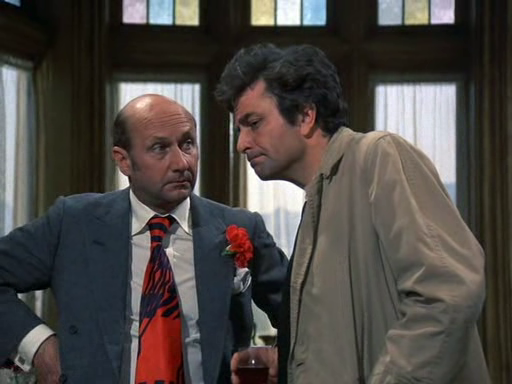
You are guilty...of looking fabulous.
Any Old Port In A Storm (1973)
Adrian Carsini (guest murderer Donald Pleasence) of the Carsini winery is perhaps the most respected man in the wine business. He has one of the most expensive wine collections in the world and produces a few expensive, but celebrated wines. When Carsini’s half-brother, Rick (Gary Conway) informs Adrian of his plans to sell the land to the makers of bargain basement wines, Adrian murders him and stages it to look like an accident. Of course, this doesn’t fool TV’s Columbo.
Port is the perfect showcase for the Columbo formula and why it works so well. Peter Falk cited this as one of the best episodes of the series and it’s easy to see why. Since the format of the series wasn’t “whodunnit” but “howcatchem”, strong actors were needed to pull off the episodes of the week. So, we have Pleasence against Falk in what would seem to be another snob-versus-slob battle that became the series’ most common dynamic. Unusually, we have a Columbo episode where the killer isn’t a total douche. Sure, Pleasence’s Carsini does come across like a lost relative of the Frasier Crane family, but there’s a child-like glee underneath all the manners. Where most Columbo guest murderers play up everything that’s dickish about their characters, Pleasence plays his scenes with Columbo with a legitimate vulnerability and, when discussing his passion for wine, a barely contained joy that seems to result in a friendship between the two. Pleasence’s giddiness seems to get the better of the detective, resulting in one of the more bittersweet endings to the series. Anything that pitted actors as powerful as Falk and Pleasence against each other was bound to be riveting and the script by Stanley Ralph Ross (a writer for the Adam West Batman) and Larry Cohen (Phone Booth, God Told Me To) is cracking stuff. Columbo was really a show to watch for the acting and Port gives Pleasence and Falk plenty of time to chew the scenery to bits.
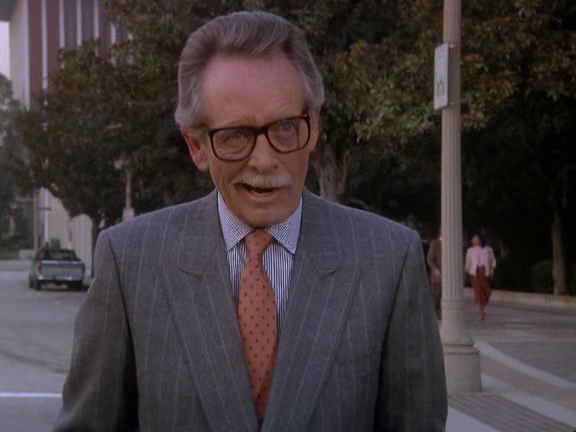
Patrick McGoohan: the man with the laughing face.
By Dawn’s Early Light (1974) and Agenda For Murder (1990)
Dawn: When its board of trustees threatens to turn a military school from all-male to a co-ed operation, this ruffles the feathers of the perpetually agitated Col. Rumford (guest murderer Patrick McGoohan). Rumford then murders the president of the trustees by rigging a cannon to fire straight at the poor bastard during a ceremony. Columbo does what any good murder police would do and takes up room in the academy dorm.
Agenda: Lawyer Oscar Finch (McGoohan) has a promising future as an aid to a Vice Presidential candidate. When a former client threatens to expose a few skeletons in Finch’s closet, Finch silences his blackmailer with a bullet. Enter Columbo who gets his first clue from a newfangled device called a fax machine.
Earlier I mentioned that the Columbo formula played heavily on the slow-burn rage of its guest stars. Unsurprisingly, the hyper-intense creator-star of The Prisoner embodies this role perfectly. McGoohan, aged up somewhat unconvincingly to play Rumford, looks like he’s minutes away from stabbing everyone around him, so Falk’s continued picking at him is especially amusing. This is also true for McGoohan’s return in Agenda, which does give McGoohan a more sympathetic character but still allows for him to be as caustic and condescending as possible.
This later Columbo makes great use of McGoohan and his obvious discomfort around the shabby detective. Unlike the raging Rumford, there’s a lot more humour between Finch and Columbo’s encounters. The scene in which Columbo tells Finch a few recent jokes he heard while Finch reacts with delayed, forced laughter is one of the highlights of the series.
What this series does best, and why it only worked when it had the right actors for its murderers of the week, is to get talented, charismatic and theatrical actors to play off each other. For Columbo to work, you need an actor who threatens to steal the show from Falk. This was seldom a problem with the original 70’s Columbo series on NBC, but the ABC revival series from 1989-2003 is a different story. The trouble with the revival episodes is that too many of the killers are played by actors as charismatic as a bowlful of mayonnaise. McGoohan had already made a return appearance in 1975’s Identity Crisis (murdering Leslie Nielsen) and would return again in 1998’s Ashes To Ashes (murdering Rue McLanahan), which more or less makes him Columbo’s Moriarity. Either that or the same poor sap getting reincarnated to be jailed by an aging, schlubby cop.
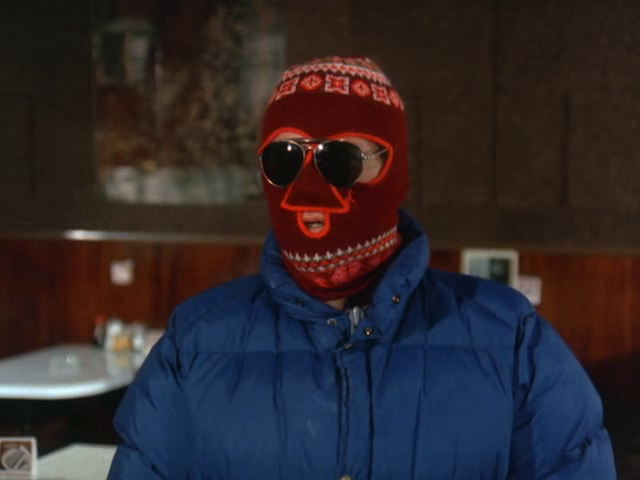
William Shatner as Bane in the Adam West "Batman"
Fade In To Murder (1976)
Columbo vs. William Shatner. No words can do it justice, but I’ll try. In this sixth season episode, Ol’ Willy Shat is playing an egocentric TV actor who currently stars in a detective series, but was once a dangerous Toronto criminal (the worst kind of criminal!). He confounds our favourite TV detective by referring to himself in third person and offering Columbo advice “in character” as his TV detective. Needless to say, the bizarre, hammy character is perfect for Shatner.
Cracker Barrel (2012): An Interview With Roger Maunder
Mon, Jun 17, 2013
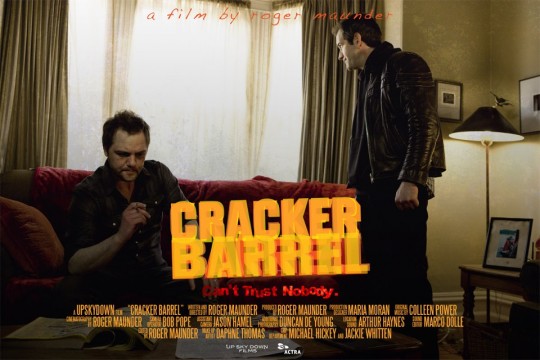
Roger Maunder is a writer, filmmaker and founder of the Nickel Film Festival. His latest film, Cracker Barrel, is the last to screen this Friday night as part of this year’s Nickel. Maunder spoke to Adam Clarke about the film.
What interested you about the hard ticket-type characters and their lives when writing this screenplay and making the film?
I’ve always been interested in these types of characters. I grew up with them and went to school with them. They have an edginess and a slice of life feel that I think everyone can relate to. It could be anywhere really. By giving them these traits and issues to deal with, at least for me, it makes it even more believable and swallow able. A down on his luck guy, dealing with a drug addiction that you really don’t see but is alluded to, you see his life spiraling out of control. Will there be redemption? Is this something that he’ll overcome? Does the audience want him to make it out of here? These are questions that I wanted to the viewer to ask when watching? More importantly, I want the audience to feel his pain, which I think everyone could relate to on some level. An emotional journey, if you will.
How long had you had the original germ of an idea for the film in your head? Was it always intended to be presented as two conversations?
A friend of mine’s awards winning film initially inspired the way I wanted to create this film. Justin Simms made a no budget film called Punch Up At A Wedding a while ago, where he had three scenes and three shots. I was thinking that I could make a film with six scenes and six shots in the same vein, but shorter. It ended up being eight shots in the end. The struggle was finding away to make these characters and their story come together in such a short timeline with limited locations. The fallout of Greg King’s character and how this guy’s paranoia gets the best of him spurred the original idea. He has his moment of conflict before we even start the film. It begins with the fallout of his actions just moments before.
What interested you in the self-destructive nature of Greg King’s character, John?
I expect that everyone has these kinds of thoughts and emotions once they have been cheated on or done wrong by. His character is trying to deal with this, especially after he has gone back to the women that he knows has cheated on him. Questioning every aspect about himself, his past, his character. In his little world he’s trapped into the unclean, non-trusting element that won’t let him go. He attempts to struggle with this tormented past, but his addiction and surroundings pull him back into another realm that continually pokes and prods at him. The sense of community comes up too. Not in the good way that a community can be, but the bad things it can bring — like everyone knowing everything about you and your business. I think everyone has a moment or two in their lives when everything feels like it’s out of control. For me, I let this character react quickly, creating an uncontrollable environment where you don’t know what’s going to happen. It was fun and revealing at the same time. Everyone has his or her way of dealing with shit. He has his and we have ours.
What’re the challenges in presenting a story with limited locations and crafting a dialogue-driven piece?
This was a one-day shoot with a crew of about eight people. Crafting the story came fairly quickly. I had the premise of what he was going to do to start things spiralling out of control. It was getting him from there and letting the audience in on what his character was all about that took the time. The story that he tells, this was the tool I used to let the audience in on his flaws and his own secrets and make him real. Casting was paramount. Telling the story with minimal characters was the key in making it work.
What are the challenges and shooting in lighting at a specific location (ie: the houses) as opposed to outdoor location shooting?
Lighting is challenging and can eat into your day especially when you only have one day to shoot and all your locations are interior. But lighting is one of the most important elements of filmmaking. You can light both exterior and interior depending on the scene or situation. We had a couple of locations, all interior, and lucky for us, we had some crew and cast that let us use their homes as locations, so that worked out perfectly. They were not overly huge rooms, so lighting was a minimum. We used as much natural daylight as we could too. Big windows, letting lots of light in.
How is Cracker Barrel different from your other work?
It’s a complete different direction compared to my other work, that’s for sure. My other films were a little more polished and full of heart. The films were also structured by straddling the timeline of past and present.
Basically, telling the story in the present while revisiting that period in the characters life. This was mostly due to being able to afford a higher production quality and, in a sense, do it well. That said, this film is gritty to the core. The characters, the theme and mood, everything about it is to give that feel of being in a place that the viewer may feel uncomfortable with. Plus, it’s all in the now. I wanted the audience to feel as if they were listening in on a conversation, a dilemma. Almost to the point where they feel that they’ve heard too much. You want to turn away but the topic pulls you in to see where it’s going to take these characters next.
Back From The Dead: 4 Ways TV Series Return From Cancellation
Tue, Jun 11, 2013
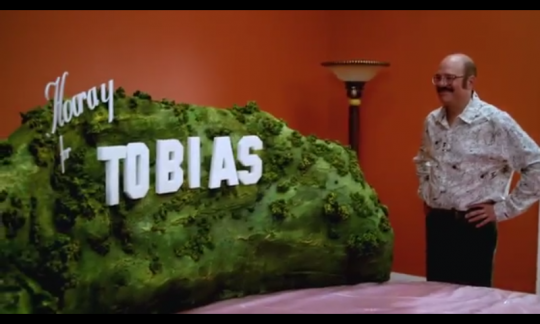
In honour of Arrested Development’s new season, Adam Clarke examines the different ways a TV series is revived from cancellation.
1. The Reunion Special
In which actors are rounded up for a one-off reunion special or a couple of telemovies that balance themselves awkwardly between acknowledging the passage of time and acting like nothing changed since the last aired episode. The results are always cozy and harmless. These are getting less and less common as series rebooting becomes more prevalent, but it has resulted in numerous specials including Mary & Rhoda, Return To Mayberry and, the TV movie with the best possible title, The Harlem Globetrotters On Gilligan’s Island.
2. The New (insert title here)
Always guaranteed to be a disaster is a series that advertises that it’s a brand new season of your old favourite, almost like it has something to hide. These disasters are best exemplified by the short-lived The New WKRP In Cincinatti. Take the most popular elements of the series–Loni Anderson’s Jennifer Marlowe and Howard Hesseman’s Dr Johnny Fever–and replace them with the likes of Tawny Kitaen and 3rd Rock From The Sun. Now, instead of starting a new spin-off with these new characters, let’s leave pre-existing characters to hang around so that the show never escapes the feeling that the only actors who signed on as regulars–in New WKRP‘s case, Frank Bonner (Herb Tarlek), Gordon Jump (Mr. Carlson) and Richard Sanders (Les Nessman)–desperately needed the money.
See also: The New Avengers or the near-disastrous Star Trek/TNG hybrid that almost aired, Phase II.
3. Now In Filmmation!
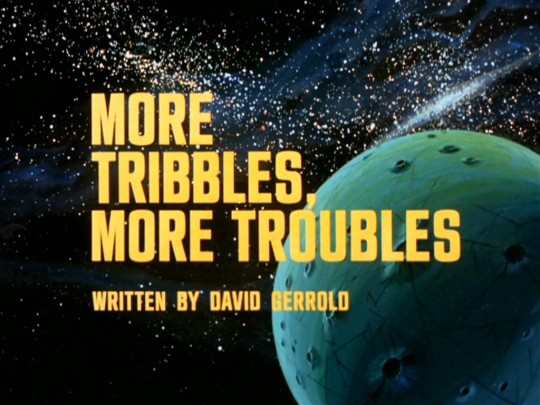
A product of a by-gone era resulted in cheapie animation studio Filmmation created terrible, stiffly-animated revivals of Star Trek and Gilligan’s Island. While we all know that Gene Roddenberry threw a fit and demanded that the Trek animated series be stricken from cannon, one can only assume that Island creator Sherwood Schwartz did the same thing for The New Adventures Of Gilligan and Gilligan’s Planet (don’t ask).
4. Simply act like nothing happened
This is a more recent phenomena and one that has a higher success rate than the other approaches. Despite some flawed non-jokes like George’s lowered testosterone, the new season of Arrested Development feels exactly the way it should: as a delayed fourth season. It’s frustratingly messy at times, but despite the challenges in getting lightning to strike twice, Mitch Hurwitz and company actually managed to do so. It’s the same show.
Admittedly, I’m confused as to what happened to Lindsay Bluth’s face, but I’m afraid to ask that question.
Evidence of this approach working is also evidenced by Seth MacFarlane. I’m no Family Guy fan, but the only difference between the earlier seasons and the later seasons of the program is the animation budget. Family Guy used to be the ugliest show on network television.
By contrast Futurama went from one of the most reliably funny and surprisingly sentimental shows to an absolute train wreck. This is the nightmare scenario for the fan of any series. Since coming back (before its second cancellation was announced this year), Futurama has devoted itself to misguided theme episodes, a Dan Brown pastiche and singing boil named Susan (geddit?)
I can only assume the Futurama writers room was renamed “Mt Flopsweat”…
One of the earlier examples of a series dusting itself off and acting like nothing happened is Columbo. Columbo was originally a series of 70-90 minute episodes as part of the wheel of series for The NBC Mystery Movie (depending on the week you tuned in, you could be watching McMillan & Wife or Quincy, instead).
After a seven year run ending in 1978, ABC brought back Columbo as a regular mystery movie series from 1989 to 1991 before airing them more sporadically from ’92 to 2003. Yes, a sexagenarian police lieutenant made no sense (Falk filmed the last few instalments in his 70′s), but the movies still have a lot of charm and see the return of former guest murderers like William Shatner and Patrick McGoohan.
Silliness be damned. Who wouldn’t want to watch an aging Columbo investigating a murder at a rave as he did in 2003′s Columbo Likes The Nightlife?
Fast Times: Furious 6 (2013)
Tue, Jun 4, 2013
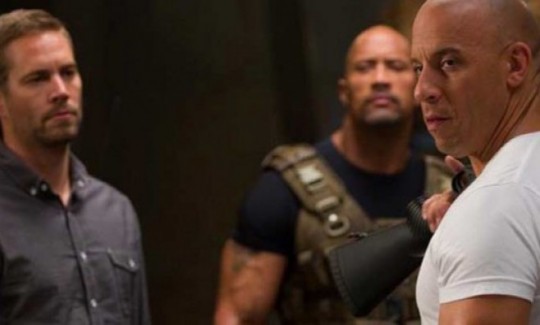
Adam Clarke has retired four times, but is always recruited for one last job.
Macho car enthusiast court is now in session.
As can be expected for any film following Fast Five, improbable vehicular chases and stuntwork are the order of the day. Not surprisingly, those are the best parts of the movie, even if the CGI stunts are so obvious and unthrilling that they’re on par with watching a friend pull off a devastating combo in an intense session of Tekken. Admittedly, I had good laugh at the scene where The Rock does a flying body slam on a poor man’s Vinnie Jones.
Or was it Vin Diesel who body slams into a poor man’s Vinnie Jones? The two of them are so ridiculously bulky that they each look like a non-CGI Hulk in the Lou Ferrigno vein. The only difference is that Vin Diesel’s baby face makes him look like a ‘roided up Adam Sandler and The R.. (sorry, Dwayne Johnson) looks, ironically enough, like the rock monster cut out of Star Trek V: The Final Frontier. The fight scenes are laughably entertaining and there’s an enjoyably absurd chase involving a tank on a highway, but there’s something off about this entry. A movie with a runwaway tank shouldn’t be so… boring.
But boring it is. Even the cars are boring, and that’s just a profound failure in a movie like this. These movies are car porn and might as well have Bob Seger’s “Like A Rock” (sorry, “Like A Dwayne Johnson”) constantly playing in the background. They are car fantasies and that’s fine. Still, the car stunt scenes are few and far between in comparison to Fast Five and the cars used are bland and ugly. The film takes the lead from its vehicles and promptly makes itself as dull as possible with only a few moderately entertaining moments.
There’s something really charming about the first few minutes of the film calling itself Furious 6. Namely, the opening credits, which play on top of a montage of sequences from past Fast & The Furious films. It was as if the film were openly admitting that you were watching a glossier update of a 90′s syndicated action TV series. You could’ve replaced the movie’s generic score with the theme from Counterstrike, Baywatch Nights or Night Man and it wouldn’t have made a difference. Hell, you could’ve replaced the score with the theme from Night Court and it wouldn’t have made a difference.
That’s where we are. Cozy, predictable and unthreatening. It’s as if The Fast & The Furious was just a standard, lazy TV show, updating itself as per budgetary demands and any cinematic trends.
That most recent trend is over a decade old as Furious 6 owes more to Ocean’s 11 than anything else. There’s many, many scenes of Vin Diesel, The Rock and whoever came back from the last movie discussing their plans to take down a generic, high-ranking crime boss who happens to be working with Michelle Rodriguez’s character from the earlier Furious films. It’s a long story that involves miraculous survival, contrivance and amnesia. In short, soap opera writing at its finest (with apologies to Passions).
It’s a plot that can barely be called adequate. Making matters worse is the film’s misguided aims to build up some sexual tension. A film coasting on the chemistry between actors as inexpressive and one-note as Vin Diesel and Michelle Rodriguez is in a heap of trouble. You’ll feel more heat between Han and Chewie in Lego Star Wars. Or between a brick and a slightly higher brick at your old middle school.
The Fast & The Furious franchise is a big, dumb dog that keeps pissing on the floor. It’s hard to believe that a film series whose basic appeal comes down to “car go vroom, fall down go boom” could last this long. This dog is now arthritic, confused and only half-present. You can’t help but wonder and even admire (in a backwards way) how it’s still around.
Admittedly, that’s exactly how I felt in the mid-90′s when I discovered that Mission To Moscow was the *seventh* Police Academy film. As there’s an audience for Vin Diesel mumbling and driving, so too was there an audience for the comedy stylings of Michael Winslow.
Man, that’s a depressing idea. You’d be better off playing Tekken.
Your Nickel’s Worth
Fri, May 31, 2013
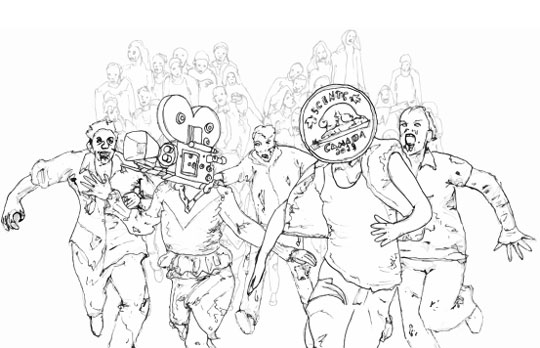
The Nickel Film Festival is fast approaching. Adam Clarke offers a few highlights from this year’s local entries.
Festival time is here.
No, put down your torches. I’m not talking about The Wicker Man, I’m talking about the Nickel Film Festival, which boasts a schedule that is perhaps more loaded than ever with local films. This year’s Nickel Film Festival is brimming with a series of filmmaker workshops, a marathon night of horror films, alongside the short films typical of the event.
Hard Light
Of the films that I previewed, one highlight would definitely be Justin Simms’ Hard Light. Rather than an adaptation of award-winning author Michael Crummey’s book of the same name, Simms’ movie consists largely of a series of interviews with Crummey.
One thing I must praise about it is its brief interludes when the talking head segments are broken up with re-enactments and visual sketches. With any kind of re-enactment during a film, you risk having the project degenerate into the awkward, amateurish and completely ropey segments that would typify shows like Heart Of Courage (with TV’s Alex Trebek), Rescue 911 (with TV’s William Shatner) and that enduring monument to gullibility, Paranormal Witness (with no one). The sequences that we do see, realized from Crummey’s work and personal remembrances are understated and evocative.
The conversations with Michael Crummey go through his life as a writer, his decision to return to Newfoundland, his failures in past relationships, his memories of his parents and his thoughts on why modern life seems so alienating. Crummey’s criticism of the current obsession with personal happiness and its relationship to the increasingly prevalent technology surrounding us is provacative. Loss and unhappiness are the two thoughts that keep bubbling up in Crummey’s interviews here, and with careful, thoughtful editing, the author’s views build onto the film as well. Even a slight slip up in the editing bay could have resulted in a messy ramble, but that definitely doesn’t happen here.
Nickel Shorts
Other highlights of this year’s festival are, unsurprisingly, the litany of shorts. One short, Last of the Snow (2012), falls under the portentous promise of being a Dogme 95 film and attempts to follow that movement’s stringent regulations. While I don’t give a damn about that movement and its “Vow of Chastity”, there’s an interesting backstory drawn out of the simple placement of a man, a woman and a child next door during a winter’s day in St. John’s. Writer-director Jonathan Watton (perhaps best known for his role on CBC’s Murdoch Mysteries) does a commendable job of telling a lot while showing as little as possible.
But the most fun night of the Nickel is guaranteed to be the horror night. This year’s night of horror features Mike Fardy’s terrifically silly Respect Your Eldritch, which won the Nickel’s 48 Hour Horror Film Challenge last November. Joining Eldritch are a few entertaining entries from last year’s challenge including such as The Date, and Trick Or Treat, as well as the award-winning Survivor Type and The Master & Me (starring Robert Joy).
Zombie illustration by Kyle Bustin.
Tender Lovin’ Xtro: How B-Movies Get Made
Tue, May 28, 2013
I was half-way in to writing up a piece on my love of the reviled monster movie/Alien rip-off Xtro when I saw that Red Letter Media beat me to it. Sorry, no review this week.
However, there are few things as fascinating to me as the creation of b-movies and, fan of them or not, you owe it to yourself to watch this immensely entertaining interview with the director of the Xtro trilogy, Harry Bromley Davenport.
Take that, Jan-Michael Vincent! He’s had it too good for too long! Thank heavens Davenport is not obsessed with the image of either himself or his films. The director knows the film was a cynical cash grab made by young people who wanted to make a movie and were excited about that, at least. Genuine ambition, creativity and talent mixed with mandated studio ideas and a grafted-on ending somehow made this gruesome, yet oddly endearing film. Xtro‘s a mess and Davenport cops to it; realizing that that’s what makes the film so watchable.
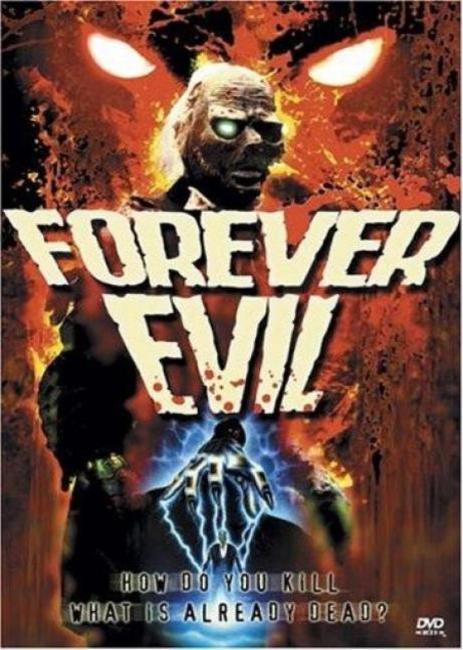
If you enjoyed that, a less snarky commentary on the b-movie process can be found over at the abandoned Bad Movie Report. Making A Bad Movie: My Personal Nightmare is an in-depth and fascinating look at the creation of the no-budget Forever Evil.
I met Evil‘s writer, Freeman Williams, back in ’06 at B-Fest (guess what grade of movie we watched for 24 hours?) in Illinois. He’s a lovely guy and a smart film critic (he currently blogs here). Dare I hope for a Platinum Dunes Forever Evil reboot?
The Tall Man (2012)
Tue, May 28, 2013
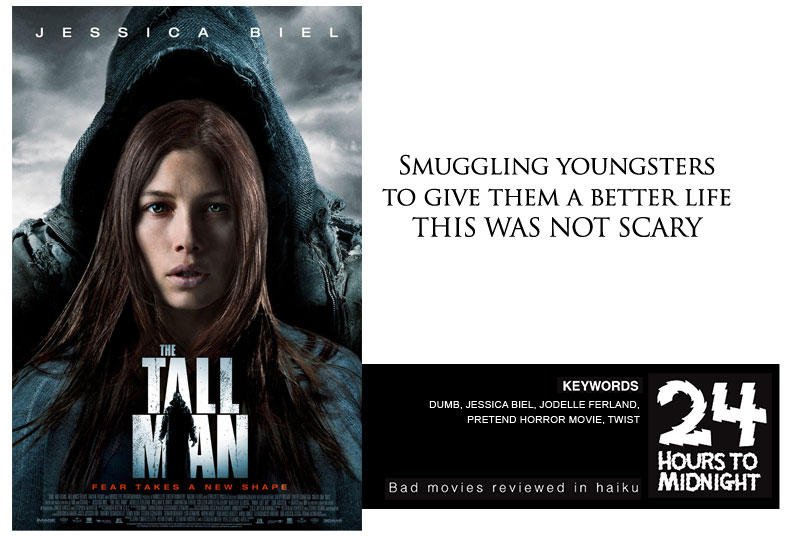
Despite being convinced by the trailer that this was a horror movie, we should have known better when Netflix described it as “mystery, thriller.” Yes, this falls into the category of Pretend Horror Movie, a la the horrible Bug or First Born: a movie that at first appears to be scary, but in fact turns out to be about weird psychological disorders or, in this case, a comment on child protection issues in the United States.
Jessica Biel begins the movie as a seemingly normal mom who desperately tries to protect her child from your typical monster urban legend, the Tall Man. This premise is pretty standard, and the viewer is subjected to all the cliches of this sort of horror flick: scary man, home invasion, suspenseful car chase, etc.
All of this would have been fine, though unsurprising, had there at least been a few good scares. But no, after several trying plot twists (Is Biel the Tall Man? Is she just crazy?), all is revealed: Biel is actually working for the Tall Man, her presumed-dead husband, a rich humanitarian who travels rural America saving kids from their skeety parents. The whole scheme is part of an underground movement of vigilante social workers to save poor kids and give them better lives with rich parents in the city.
So yeah, this is a classist piece of shit fake horror movie; not only is it vaguely offensive, but it’s also downright boring.
(We do still love Jodelle Ferland, though. Just watch Silent Hill or The Cabin in the Woods instead.)
Star Trek Into Darkness (2013)
Thu, May 23, 2013
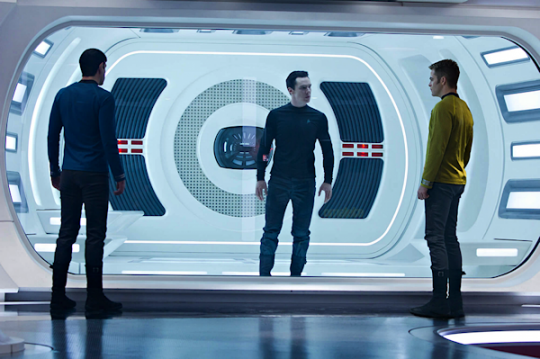
Adam Clarke remembers an age when Star Trek actually felt like Star Trek
Within the first twenty minutes of the moronically-titled Star Trek Into Darkness, a Starfleet building is blown to pieces, characters are assassinated in hails of gunfire and, to top it all off, Captain Kirk (Chris Pine) suggests that the man responsible be tracked and murdered.
Shortly thereafter, Scotty (Simon Pegg) asks “didn’t we used to be explorers?”
That one line captures much of what’s wrong with the latest Trek. Here we have another Trek film that sacrifices the spirit of the series in favour of a generic action flick, which has been happening since at least ’96. More depressingly, Scotty’s line is stolen, having been uttered by Captain Picard in Star Trek: Insurrection.
Star Trek Into Darkness is a cynical exercise in talking down to the audience. By embracing a script with no inspiration, J.J. Abrams and his writers prove that they can make a very polished looking action movie that’s superficially pleasing but bereft of ideas. 2009′s Star Trek compensated for a limp villain with a fast pace, note perfect cast, terrific score and impressive special effects.
The successful elements return in Darkness, but the problems are magnified. Thought Nero was uninteresting? Well, this film has two villains whose goals and actions are often baffling. Where the last film sacrificed the idea that these characters are exploring the unknown, it’s completely forgotten about in a film that includes foot chases through crowded city streets, universal terrorism and women who exist solely to either whine or look good in their undies.
It all could’ve been so different. In the first ten minutes, there’s a dumb but fun action sequence that offers a glimpse of an entertaining Trek sequel. The Enterprise crew have to distract an alien civilization from a volcanic eruption. While the aliens (Cinema Natives from the Planet Stereotype) chase Kirk and Bones, Spock descends into a volcano to detonate a cold fusion bomb that’ll stop the eruption somehow(?)
Then the Enterprise rescues its three main characters from furthering tinkering with their Prime Directive of non-interference and they all whisk away. How was the Enterprise hiding from the natives, you ask? In space, perhaps? No, dingus! The Enterprise was under water.
Okay, that’s stupid, but it’s the only really fun part of this film. That scene also points the way to a successful sequel with its wide-eyed adventurous tone. This film deals with terrorism and enemies attacking a hero from the inside, which is old hat after the new Batman films, Skyfall and the like. It also rips off most moments from one of Star Trek‘s most iconic stories. But instead of mixing Trek‘s greatest hits with contemporary war on terror bullshit, the Darkness should’ve turned to Raiders Of The Lost Ark if they wanted to imitate a successful blockbuster.
If this Trek turned to Raiders or even Richard Chamberlain’s King Solomon’s Mines for inspiration, it’d be a damn sight better than what ended up on screen. An adventure movie within the Spielberg-Lucas tradition is certainly in line with Abrams’ interests and would make for a Trek that would appeal to just about everybody. Bigwigs in Hollywood assume people want big action sequences with loud noises, frantic editing and spinning cameras. Trekkies want a film about exploring the unknown. By aping something like Raiders you’d have your big action scenes, but you’d at least be forced to have the characters go out, y’know, adventuring.
Now, I don’t necessarily want a Star Trek film for everybody and would be happy for a film that took a few chances and had ambition, but the creative team behind this incarnation of Trek are not only uninterested in an ambitious script, but it seems they’re incapable of creating one.
I’ll refrain from spoilers, but if you’ve read any of the guides to this film or even glanced at its Wikipedia page, I can assure you that the dumb, obvious pandering is all there.
Star Trek Into Darkness isn’t the worst film I’ve seen all year. This is the year I was subjected to Identity Thief, Spring Breakers, Oz: The Great & Powerful and Stoner FM, so that’s more or less impossible. The special effects are amazing, as are the cast (I could watch an entire film where Karl Urban’s McCoy grumbles in space) and score (Abrams regular Michael Giacchino)…again. The problem is that the film is insultingly dumb.
Without spoiling anything, let me ask you this, is a Star Trek movie that hinges on a character having magic blood really worth seeing?
Iron Man 3 (2013)
Wed, May 15, 2013
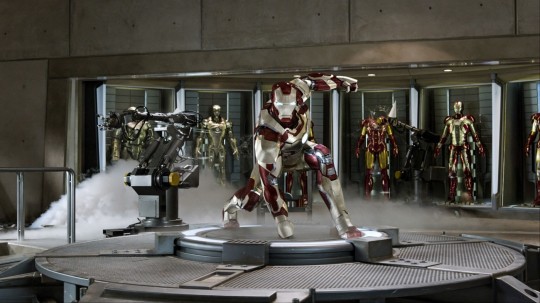
Adam Clarke is impressed that the Mandarin was somehow less goofy than Bane.
Caveat blogtor: This review contains spoilers for Iron Man 3. This is your final warning.
Having just quit smoking, Iron Man 3 earns the distinction of being the first film I saw last week in which I never once craved the sweet, tangy taste of cigarette juice. At no point did I shift uncomfortably in my seat, become depressed or rush and attack the screen in a misplaced attempt to deal with nicotine withdrawal.
That in itself is a minor miracle.
Iron Man 3 is an above-average entry in the increasingly indistinguishable genre of comic book movies. Not as introspective or unpredictable as Nolan’s Batman films, nor as cheerfully entertaining as Raimi’s Spider-Man or Whedon’s Avengers, Iron Man 3 is a largely enjoyable throwback to action films of the 80′s.
That 80′s/early 90′s action vibe is natural given that this film was co-written and directed by the creator of Lethal Weapon, Shane Black (who wrote and directed the fantastic Kiss Kiss Bang Bang, also with Robert Downey Jr). So, we have an action film with a smarmy, rich villain with slicked-back hair (Guy Pearce, looking like Val Kilmer circa Top Gun), a vaguely foreign pseudo-villain (Ben Kingsley) and two of Iron Man 3‘s many action climaxes occur at a deserted building site and a miami beach house. Hell, even Miguel Ferrer is in this movie! The only way the film could feel like more of a relic of my youth would be if Brian Tyler’s funky score was dropped in favor of a series of soundtrack cues from the late Michael Kamen.
In addition to those standard tropes of the action movies of that period, we also have the presence of a little kid semi-sidekick not unlike Robocop 3, Temple Of Doom, Last Action Hero (because in 1994 this had already descended into self-parody), etc. Harley Keener (Ty Simpkins) doesn’t add much to the proceedings save a feeling of action movie familiarity for those between the ages of 27 and 40. Unlike the previous examples I referenced, Iron Man 3 benefits from the fact that Robert Downey Jr’s Tony Stark is just as snarky to Harley as he is to everyone else.
The plot for the previous Iron Man was silly and this film doesn’t break the trend, but it’s hard to care when a movie is this fun. The movie is as silly as Ben Kingsley’s Mandarin voice and, unlike the laughable Bane from The Dark Knight Spends Most Of This Movie In A Pit, that silliness is fully intentional. Kingsley’s bungling actor seems to be channelling “Walph Bwown” from Withnail & I.
The most interesting aspect of the film was the comparative methods of its heroes and villains. It’s no secret that The Mandarin is actually a puppet for the machinations of Guy Pearce’s immoral scientist, Killian. But the film is all about the importance of figureheads and icons. The Mandarin is meant to be a powerful image; a mass-market bin Laden. Tony Stark, recovering from the events of The Avengers, keeps Iron Man as a symbol of heroism and invulnerability by using empty suits to perform some of his super-heroics. Just as the Mandarin becomes a media banner for global terrorism, Iron Man could really be everywhere at once.
Neither as over-the-top as the second film or as engaging as the first, Iron Man 3 was an enjoyably silly romp that recaptures what was so fun about action movies past.
Post-script: Adam Clarke has smoked 2 cartons of cigarettes since writing this review and its publication.
Star Trek Into The Pension Centre
Tue, May 14, 2013
With the coming Star Trek Into Darkness, Adam Clarke looks back on the U.S.S. Enterprise crew’s past adventures on video.
I’ve long held a fondness for Easter, despite growing up in an ardent atheist household. that’s what Papa Clarke raised me in, barring an unsuccessful flirtation with both Zoroastrianism and Druid quilting circles. Papa raised his two mutant children (whom he lovingly called “the cabbages”) in front of his god of choice: a Zenith™ floor model set which we’d spend the holidays gawking at and watching Star Trek marathons.
Having no religion, I assumed Easter was about the death and resurrection of Spock. For it was written (in the script) that he would die for our sins as he did in Star Trek II: The Wrath Of Khan. And lo, he did rise again in Star Trek III: The Search For Spock. A five year old Adam Clarke looked on it, and it was good.
Star Trek, like so much episodic television from TV’s golden and silver ages, had its characters in an endless cycle of syndication-ready adventures where the heroes always cheated death (death itself was reserved for extras and guest stars). That comfort zone of syndicated Groundhog Day syndrome was shattered when the original Star Trek crew took their adventures to the big screen from 1979 to 1991. The Star Trek film series proved that there was an audience for stories that showed how these characters grew older and more interesting in the process.
The Motion Picture stumbled creatively and tried to pretend as though little time had passed between the 1979 premiere and the 1969 cancellation of the original series. Wrath Of Khan dropped the facade. Khan is universally-loved, and rightly so. It’s a tightly-plotted adventure film that addresses the looming mortality of our heroes through the perfect metaphor: Captain James Tiberius Kirk cheated death in every scenario, including a simulation specifically designed by a computer to get its commanders to face that inevitably. He and his crew cheat death once more in Khan, but only after the loss of the friend he considered a brother.
But Spock returns, of course.
Sometimes called a cheat, Search For Spock is a wonderful entry in the series, overlooked because it preceded the most popular (The Voyage Home) and least popular (The Final Frontier) of the original film series. It couldn’t top the death of Spock. How could it? Instead, Search For Spock is a dark, episodic story that shows our characters struggling with death and having greater ties than just being shipmates. These characters had lives beyond the U.S.S. Enterprise now, which is why Kirk struggles to accept death in this film. By the end of the movie, Kirk loses a son, Leonard “Bones” McCoy (doctor and avid curmudgeon) and Spock are both nearly driven bonkers, and the entire ship is destroyed.
So, we have The Wrath of Khan, The Search for Spock and 1991’s The Undiscovered Country forming an exciting trilogy about heroes who get old, make mistakes, and even become as prejudiced as the baddies they used to lecture on TV each week. Faced with the extinction of the Klingon race, Kirk snarls, “let them die!” And in this brief moment he becomes a caricature of himself: a twisted former do-gooder who has to adapt to a changing universe. It might seem small scale compared to the superhero deconstruction Alan Moore popularized in Watchmen, but it’s still gripping stuff. Undiscovered Country has Kirk, Spock and the Enterprise crew outgrowing their usefulness and struggling to do the right thing despite themselves. You never got that on TV, but it’s the logical final story for these characters. Their time had come and they get to retire with their dignity intact at the centre of one of their best stories.
Re-watching the films and the original series recently, those six films are what embody the Star Trek spirit best for me. It’s nice to see the characters as old soldiers instead of superheroes, and it’s especially rewarding to see a less cantankerous Dr. McCoy. DeForest Kelley was always a highlight of the original cast, but the mellower McCoy of the films is an actual character. Instead of the sometimes venomous tension between McCoy and Spock, they’re less combative, and, in one of the best sub-plots of the film series, he admirably guards Spock’s spirit in Search for Spock.
These characters were allowed to grow and acknowledge their mistakes in the Trek film series. This has become commonplace in the age of, say, James Bond in last year’s Skyfall, but these great Trek films stood out in a time when both Roger Moore and Sean Connery played James Bond in the 80s as if nothing was weird about that.
With their balance of character development, action, humour and the occasional outlandish plotline (Kirk tells God to shove it in the fourth sequel), the original Trek sequels have aged tremendously well. I enjoyed re-watching Star Trek VI: The Undiscovered Country as much as I did seeing it on Christmas Day in 1991. Even if that holiday also wasn’t fully explained in the Clarke household.
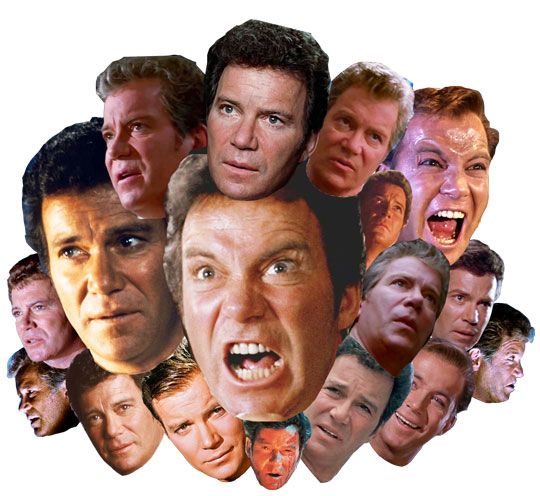
Captain Kirk Collage by Kyle Bustin.
The Paperboy (2012)
Mon, May 13, 2013
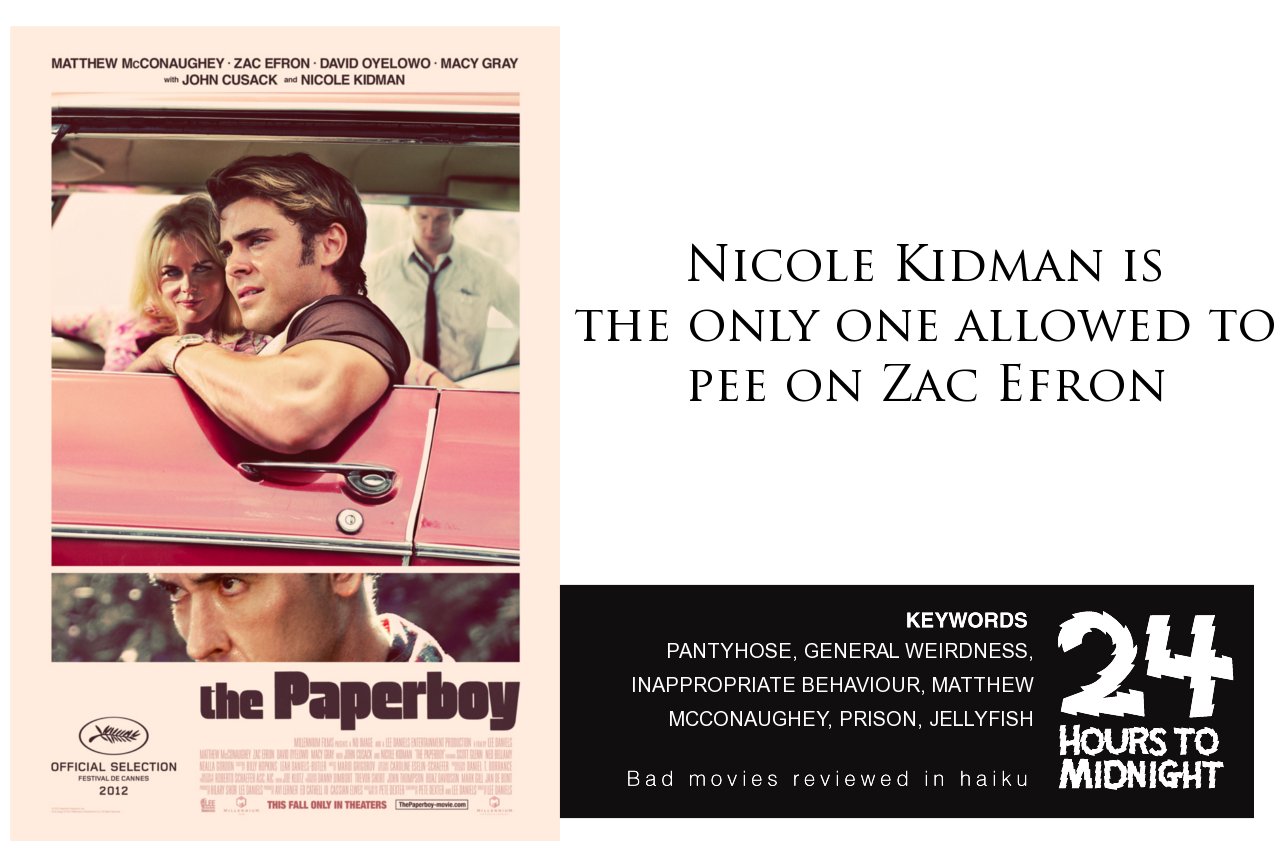
In this 2012 Lee Daniels (Precious) film narrated by Macy Gray, Nicole Kidman stars as a woman who falls in love with prisoner Hillary van Wetter (John Cusak) over a series of letters. In an attempt to clear Wetter’s name so she can marry him, she contacts journalist Ward Jansen (Matthew McConaughey) and his writing partner, Yardley, to write an investigative report on Wetter’s case. All three head down to Jansen’s hometown, where Wetter is waiting on death row, and Jansen’s little brother Jack quickly becomes involved with the case and infatuated with Kidman’s Charlotte Bless.
Kidman is great as a southern cat in heat burning with desire for Cusak’s violent and greasy van Wetter. Many pairs of pantyhose get ripped, Zac Efron gets peed on, and that is just the tip of the iceberg. While not necessarily a great movie, it is well acted, with Efron holding his own against his more respected co-stars. Worth watching at least once for general weirdness, and then once again for the jellyfish scene. WTF.
BONUS:
He’s come a long way, baby.
You Should Watch “Maron”
Tue, May 7, 2013
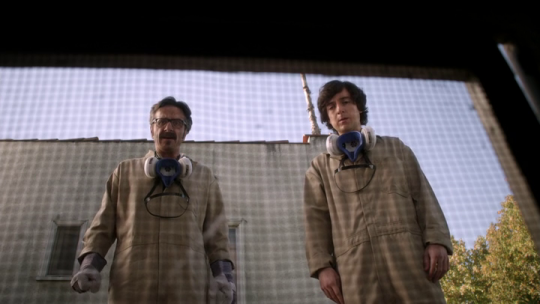
Adam Clarke‘s podcast is a thinly veiled cry for help.
You should watch Maron. The new IFC series following comedian Marc Maron’s attempts to deal with life as a podcaster approaching middle age. To paraphrase Dick Wolf, this is ripped from the headlines (albeit of Laughspin) as celebrated podcaster-comic Maron is essentially playing himself as per the grand tradition of all sitcoms starring stand-up comedians.
Premiering last Friday, two episodes of the series have been released: “Internet Troll” and “Dead Possum”. “Troll” has its moments thanks to some great turns from Dave Foley and Erik Charles Nielsen (best known as Garrett from TV’s Community; also a terrific comic), but Marc Maron is a little uncomfortable in the lead role and the script lacks any strong surprises. When Maron confronts a guy who rags him on Twitter (Nielsen), it more or less plays out as you’d expect. It’s twenty minutes of often awkward comedy that owes too great a debt to Louie.
The second episode, “Dead Possum”, was released on YouTube to promote the show and it’s a better showcase for what this series could become. In “Possum”, Maron is joined by aspiring writer and comedy nerd, Kyle (Josh Brener). Kyle is unfocused, dopey and dismissive of mainstream comedy (he likes Judd Apatow before he sold out) and is exactly the right person to play off the agitated, over-thinking Maron. The two plot to remove a rotting possum from Maron’s crawlspace and Maron (the actor) benefits from Brener’s presence. Whether it’s because “Possum” was shot later than “Troll” or that it boasts a stronger script, Marc Maron shows potential as an actor that was absent from the earlier episode. What Maron needed to succeed was a way to get Maron to comfortably act like Maron…
“Dead Possum” is definitely the funnier of the two scripts, building from an awkward conversation with Maron’s gossipy mother (Sally Kellerman) to his reluctant hiring of Kyle as his personal assistant. The episode is consistently funny and keeps getting funnier as Kyle and Marc grasp at straws to avoid dealing with the one thing they were supposed to do. The structure of this episode is far closer to a traditional sitcom than the first episodes looseness, the series benefits from placing Marc Maron in that structure. I do hope the series continues to develop the relationship between Marc and Kyle because the actors have great chemistry and Brener (an actor I’d never seen before) proves to have great comic chops (his delivery of “I’m the stupidest” in this episode is a particular highlight).
My fellow Canadians, can you watch this snappy, engaging series now that it’s debuted on IFC? OF COURSE NOT. For reasons best left to the stars, IFC Canada has no scheduled plans to air Maron. Fortunately, the aforementioned second episode is available on YouTube without any of the usual bullshit regional blocking. Canadian IFC’s bungling aside, it seems IFC wants this show to succeed. Based on “Dead Possum”, Maron can’t possibly fail.
Night Thoughts Redux: The Best Of The Night Stalker
Wed, May 1, 2013
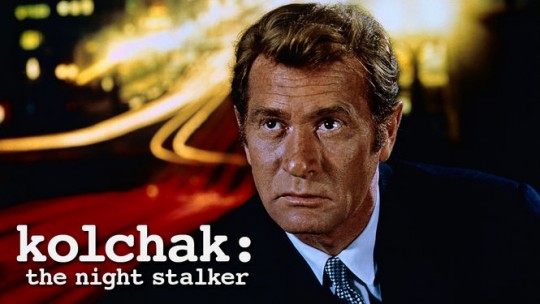
Adam Clarke‘s sartorial choices have largely been influenced by this panama hat-loving reporter.
Before there was The X-Files, Supernatural or Grimm, there was Carl Kolchak.
Carl Kolchak (A Christmas Story‘s Darren McGavin) of Kolchak: The Night Stalker was the charming irritant reporter from the hugely successful TV movies The Night Stalker and The Night Strangler. In the series, he circled around Illinois chasing down any story with a supernatural angle while abusing his boss (Simon Oakland), infuriating the police and ultimately saving the world (or at least Evanston) from supernatural evil, both mythic and new. Always without recognition or much proof.
Kolchak had a brilliant cast, a terrific premise, an memorable opening sequence and a strong assembly of writers (including Sopranos creator David Chase, Horror of Dracula‘s Jimmy Sangster) and Back To The Future‘s team of Bobs Zemeckis and Gale), but the series lasted one solitary season.
Fortunately, the entire series is on Netflix (even if the two telemovies aren’t). Fans of Supernatural and Grimm would do well to give Kolchak a try. These five episodes show just how great the series could be as a hour-long horror series that would inspire the hit horror series of the last twenty years.
The Ripper: As the title suggests, a Jack The Ripper copycat shows up in Chicago, stalking dance clubs and massage parlors, apparently to feast on the kidneys of his victims, but is it really a copycat? Were any of the subsequent Ripper-style murderers? The first episode produced of Kolchak and, sadly, the most atypical of the series proper, stylistically. Here the “monster of the week” is humanoid, the tone grim but peppered with humour, the deaths sad instead of campy. While some feel the episode is far too fast-paced and plot-heavy, I appreciated the vagueness of the ripper’s identity and his silent menace. Best scenes: The letter from an elderly woman concerned about her neighbour’s “x-ray eyes”, Carl’s arrest, the scenes with doomed Jane Plumb, Kolchak freaking out in the Ripper’s closet and Jack Grinnage’s immensely sappy turn as Ron “Uptight” Updyke in particular.
The Zombie: Another early winner finds Carl investigating a series of murders where all the victims backs are broken, ultimately leading him to a police cover-up of a murdered young man. This one’s got good atmosphere, the excellent four-way conversation Kolchak (mis)handles over the phone, a nice plot and an especially creepy climax in which our intrepid, pork pie wearing reporter has to sow the zombie’s lips shut!
Fire Fall: In one of the series’ most unique stories, a doppelganger begins haunting anyone attached to a concert symphony conductor and setting them on fire the minute they fall asleep. While it would’ve benefited from being at least twenty minutes longer and a stronger climax (Kolchak basically just scolds the creature into non-existence) the episode is eerie, tense and creative. Bonus points for a nice spin on what has already become the series formula by having the monster marking Kolchak as a potential victim early on, thus forcing the Independent News Service schlub to go over 48 hours without rest.
The Spanish Moss Murders: Carl Kolchak vs. Swamp Thing! Tightly-paced monster tale weaves disparate story elements so well, you wish the creature’s origin made more sense. Still, a nice mix of sci-fi, suspense and monster violence make this a well-above average entry in the series. Guest stars none other than Eegah/Jaws himself, Richard Kiel.
Chopper: Famous for being both the first script Robert Zemeckis sold and for being derided by Stephen King in Danse Macabre. This episode gives Kolchak a wonderful monster to fight against: a head-less, sword-wielding motorcyclist getting revenge on those knocked him off years ago. This light-hearted thriller is goofy for all the right reasons.
To Wong Foo, Thanks for Everything, Julie Newmar (1995)
Mon, Apr 29, 2013
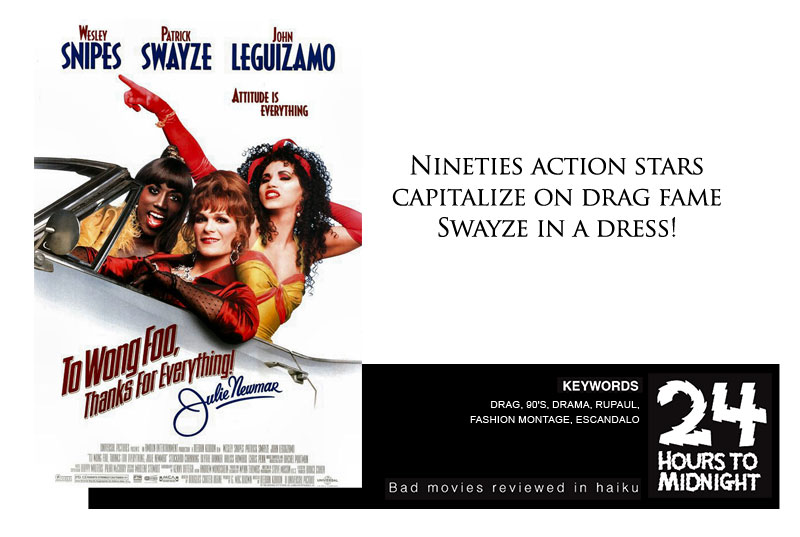
In this adorable 90’s flick, three drag queens named Vida (Patrick Swayze), Noxeema (Wesley Snipes), and Chi-Chi (John Leguizamo) take a cross-country road trip to Hollywood. On the way, their car breaks down in an isolated southern town — a place so isolated that the townsfolk believe that these lovely ladies are actually ladies. While the queens await the arrival of a car part, they make friends with the locals and stir up major drama. Vida comes between a battered wife (Stockard Channing) and her abusive husband, Noxeema helps a grief-stricken senior, and Chi-Chi becomes part of a local love triangle. Even though the film deals with some heavy themes, it’s really hilarious, and definitely worth a watch. The number one reason to watch the film: THERE’S A RUPAUL CAMEO! Oh, and Julie Newmar appears too. See also: Sean Connery in a wedding gown! We can’t hide our love of the typical male archetype in drag, can we?
Enjoy!


Wed, Jul 3, 2013
Adam Clarke