

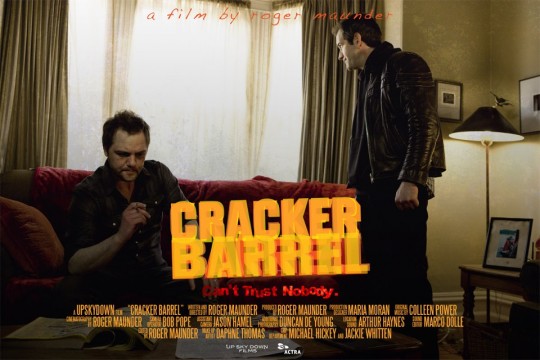
Roger Maunder is a writer, filmmaker and founder of the Nickel Film Festival. His latest film, Cracker Barrel, is the last to screen this Friday night as part of this year’s Nickel. Maunder spoke to Adam Clarke about the film.
What interested you about the hard ticket-type characters and their lives when writing this screenplay and making the film?
I’ve always been interested in these types of characters. I grew up with them and went to school with them. They have an edginess and a slice of life feel that I think everyone can relate to. It could be anywhere really. By giving them these traits and issues to deal with, at least for me, it makes it even more believable and swallow able. A down on his luck guy, dealing with a drug addiction that you really don’t see but is alluded to, you see his life spiraling out of control. Will there be redemption? Is this something that he’ll overcome? Does the audience want him to make it out of here? These are questions that I wanted to the viewer to ask when watching? More importantly, I want the audience to feel his pain, which I think everyone could relate to on some level. An emotional journey, if you will.
How long had you had the original germ of an idea for the film in your head? Was it always intended to be presented as two conversations?
A friend of mine’s awards winning film initially inspired the way I wanted to create this film. Justin Simms made a no budget film called Punch Up At A Wedding a while ago, where he had three scenes and three shots. I was thinking that I could make a film with six scenes and six shots in the same vein, but shorter. It ended up being eight shots in the end. The struggle was finding away to make these characters and their story come together in such a short timeline with limited locations. The fallout of Greg King’s character and how this guy’s paranoia gets the best of him spurred the original idea. He has his moment of conflict before we even start the film. It begins with the fallout of his actions just moments before.
What interested you in the self-destructive nature of Greg King’s character, John?
I expect that everyone has these kinds of thoughts and emotions once they have been cheated on or done wrong by. His character is trying to deal with this, especially after he has gone back to the women that he knows has cheated on him. Questioning every aspect about himself, his past, his character. In his little world he’s trapped into the unclean, non-trusting element that won’t let him go. He attempts to struggle with this tormented past, but his addiction and surroundings pull him back into another realm that continually pokes and prods at him. The sense of community comes up too. Not in the good way that a community can be, but the bad things it can bring — like everyone knowing everything about you and your business. I think everyone has a moment or two in their lives when everything feels like it’s out of control. For me, I let this character react quickly, creating an uncontrollable environment where you don’t know what’s going to happen. It was fun and revealing at the same time. Everyone has his or her way of dealing with shit. He has his and we have ours.
What’re the challenges in presenting a story with limited locations and crafting a dialogue-driven piece?
This was a one-day shoot with a crew of about eight people. Crafting the story came fairly quickly. I had the premise of what he was going to do to start things spiralling out of control. It was getting him from there and letting the audience in on what his character was all about that took the time. The story that he tells, this was the tool I used to let the audience in on his flaws and his own secrets and make him real. Casting was paramount. Telling the story with minimal characters was the key in making it work.
What are the challenges and shooting in lighting at a specific location (ie: the houses) as opposed to outdoor location shooting?
Lighting is challenging and can eat into your day especially when you only have one day to shoot and all your locations are interior. But lighting is one of the most important elements of filmmaking. You can light both exterior and interior depending on the scene or situation. We had a couple of locations, all interior, and lucky for us, we had some crew and cast that let us use their homes as locations, so that worked out perfectly. They were not overly huge rooms, so lighting was a minimum. We used as much natural daylight as we could too. Big windows, letting lots of light in.
How is Cracker Barrel different from your other work?
It’s a complete different direction compared to my other work, that’s for sure. My other films were a little more polished and full of heart. The films were also structured by straddling the timeline of past and present.
Basically, telling the story in the present while revisiting that period in the characters life. This was mostly due to being able to afford a higher production quality and, in a sense, do it well. That said, this film is gritty to the core. The characters, the theme and mood, everything about it is to give that feel of being in a place that the viewer may feel uncomfortable with. Plus, it’s all in the now. I wanted the audience to feel as if they were listening in on a conversation, a dilemma. Almost to the point where they feel that they’ve heard too much. You want to turn away but the topic pulls you in to see where it’s going to take these characters next.






Adam Clarke | Mon, Jun 17, 2013 |
On Screen