

Archive | On Screen RSS feed for this section
Star Trek Movie Beatdown – Part Three: First Contact
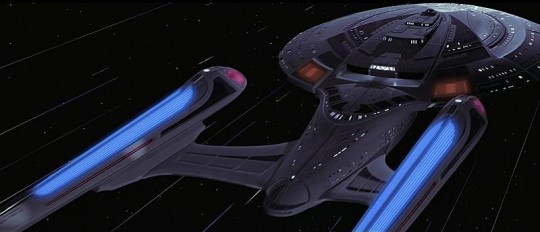
When he dies, Adam Clarke is set to be replaced by the Adam Clark-E. There will be a detatchable saucer section, ladies.
So, continuing with the reverse-chronological order, we’ve now arrived at the most beloved of all the Star Trek: The Next Generation films. Sadly, this TNG is about as exciting as an episode of E.N.G.
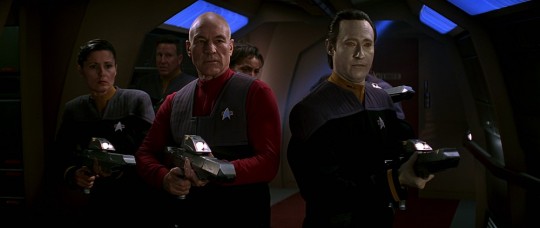
Star Trek: First Contact (1996)
I recall there being quite a bit of hoopla over First Contact. It was going to be the fast-paced, thrilling and action-packed blockbuster that got people’s attention, unlike stuffy, old Star Trek: Generations. The impression one got from the film was that it was an apology for Generations. An apology that critics, fans and moviegoers gladly accepted.
I remember seeing it in theatres and thinking that First Contact was still a very poor excuse for a Star Trek movie.
With fresh eyes, I can say that First Contact has its strengths. It’s got a larger budget than most of the preceding Treks and uses it well. Also, the film is nicely shot and edited, resulting in a pretty snappy pace and its spaceships ‘n’ ‘splosions prologue is an exciting set piece.
Of course, that prologue also highlights the film’s problems. It’s nice to see the brand new Enterprise-E blowin’ up the Borg, but it skips over something relatively major. Since Generations, Picard lost his family, the Enterprise-D was destroyed, Geordi doesn’t wear a visor anymore, Data can apparently turn off his emotion chip and Worf went to spin-off country where he moved in with his estranged father and began hosting a talk therapy show on KACL. If ever there was a time for the viewers to catch up with these characters, it’s now. Before these characters are given any room to breathe, the Borg show up and Captain Picard is told by Starfleet to stay home out of it.
The only reason Captain Picard would be left out of a Borg battle is to create conflict between him and Starfleet. There’s no story function beyond contriving a clash between him and his superiors. Well, none save for the fact that it echoes so many cop movies in which an eager detective is thrown off the case by a hot-headed chief. I’m surprised an admiral didn’t show up on the viewscreen to tell Picard that the Borg have diplomatic immunity and preventing them from assimilating all of humanity is simply not worth all the red tape.
This is especially weird given that Picard is the only one who has been assimilated by the Borg and lived to tell the tale (Voyager was all a holodeck simulation, you guys). As a result, Picard knows all the ins and outs of Borg tech even though he was assimilated over five years ago. Also, he has Borg super-hearing in this movie. Don’t ask.
Since the story was written as if Picard was Mel Gibson, we see Picard go absolutely bananas in his quest to kill the Borg. Picard beefs with Worf, screams, smashes figurines and kills anybody who got captured by the Borg. He says that saving them from assimilation is crueler than killing them, but Picard seemed to have had a lot of fun, post-assimilation. He learned to play the flute thanks to a dead culture (thanks, dead culture!). He got to talk about “Shakma when the walls fell at Tanagra”. He even got a holiday named after him. The two times he re-encountered the Borg, he didn’t go all crazy-cakes, but, since it’s in the script, he does so now.
Speaking of things that didn’t exist on the show and only serve a naked dramatic function, there’s the Borg’s queen (Alice Krige). Krige’s performance captures the movie very well, as she almost pulls off something that is illogical and contrived. See, the Borg, by their very design, are a collective (hence the “Borg collective”) and are one hive mind. Why would they need a queen? Why is she emotional and not Borg-like? What does she do exactly? Was she invented just to seduce Data? Well, that can’t be because Picard remembers her even though we’ve never seen her on the show and he never thought to mention her to anybody ever.
Dangit.
There’s a sub-plot involving mankind’s first experiment with warp speed, which time-travellers Riker, Troi, Geordi and a cameo-ing Reg Barclay (Dwight Schultz, reprising his role from the series) are assisting. Apparently the Borg chose this day to enslave mankind, but the movie kind of forgets about that and splits into two barely connected stories: the Borg threat on the Enterprise and the warp speed shenanigans. Strangely, the latter holds up better than the former in some respects. On its own, it feels like a decent episode of the series. It’s a welcome change to see the somewhat stoic Next Generation supporting cast having fun and in absolute awe of the history they’re witnessing.
Now, there are some fine action set-pieces on the Enterprise-E, but even those moments are ruined by feeling like every dumbed-down action movie of the late 90s. Picard killing potentially assimilated officers in cold blood is very un-Trek. Picard acting crazy is a disappointing use of the character. Worf saying, “assimilate this!”, before blowing up a Borg ship with a bazooka is just TERRIBLE.
Still, these scenes have a certain technical pizzazz. While some credit is due to director Jonathan Frakes for a few stylish sequences, composer Jerry Goldsmith delivers a typically brilliant score. Goldsmith, who all but saved the first and fifth films in the franchise with his compositions, returns for the first time since 1989′s The Final Frontier. Goldsmith’s music captured something lacking in two highly uneven movies; he provided the adventure and excitement when none was present on screen and provides First Contact, Insurrection and Nemesis with the coherence, style and lushness that they largely don’t have. His scores for the TNG film are their main redeeming qualities. Since Goldsmith’s march from Star Trek: The Motion Picture was adopted as the opening theme for Star Trek: The Next Generation, it seems fitting that he would score that crew’s last three films (bad as they were).
First Contact wasn’t designed to be thought about, even for a second, which is an awful standard for Star Trek. You have the Borg acting very strangely and not just because of the Queen being retconned into existence. If the Borg ever discovered time travel, it would be the most devastating thing. No other species would exist, as the Borg would’ve calmly and logically travelled back to said species’ most vulnerable points and assimilate accordingly. That they wage a war on Starfleet only to travel back to the date of First Contact and humanity’s first warp speed experiments doesn’t make a lot of sense. Especially since we never see the Borg attack anyone on Earth. Apparently the Borg are just really dumb now…
First Contact is a frustrating mix of ideas that would’ve worked had everyone just tried a little harder. While it makes no sense for the Borg to care about First Contact, it would work with certain Trek baddies. I mean, the Romulans would probably want to stop humanity from developing warp speed and contacting Vulcans given that they hate both those species. It would’ve made sense for Klingon sisters Lursa and B’etor to want to engage in time travel just to mess with the Federation. Or it would’ve if they hadn’t died pointlessly in Generations (more on that next week). Even the work of a sole Federation-hating madman would’ve made more sense than the Borg.
Worse than the misuse of the villains in the film is the misuse of the Enterprise-E crew. First Contact sets the formula that would be used subsequently in Insurrection and Nemesis: Picard the rogue badass goes up against physically repulsive villains and, ever the diplomat, solves his problems by having the biggest gun. See, the trouble isn’t with making Picard an action hero, as the TV series could bring that out of him if the situation called for it and did so without sacrificing his character. The problem is that the films do so only by changing his personality. It’s a shame, really. Generations has him shaken and grieving for his lost family, First Contact has him experiencing Post-Assimilation Stress Syndrome and Insurrection, due to the influence of a magical planet, has him experiencing “aggrassive tendencies” which he expresses through mambo-ing. The less said about Picard as written for Nemesis, the better.
If you need a TNG film to be a Summer movie epic to compete with the stupidities of Roland Emmerich and Michael Bay, then the focus of the movies shouldn’t be Picard or Data when you have the likes of Worf and Riker standing right there. Despite mellowing with age, Will Riker was still a gung-ho officer who was designed to fill Captain Kirk’s shoes, toupee and girdle. Worf is an intensely proud Klingon who lives for combat. Why is Riker exploring on Earth in First Contact while Picard, the noted historian, is shooting all Borg in the face? The film really is the worst of both worlds, if you’ll pardon the Trek pun.
Next week: the Trek marathon concludes with a crossover event that’s not as good as “A Star Is Burns”, but better than “The Jetsons Meet The Flintsones”. It’s also the closest we ever got to a good TNG movie. Yes, really.
The Children (2008)
Fri, Dec 16, 2011

The hordes of screaming children at Christmas is a consistent source of terror every holiday season. With a hard-hitting cast of big names like “Debra Messing’s love interest from The Wedding Date” and “Helena from The L Word,” this British gore-fest is really creepy and extra gruesome. Scalps flopping about, weird dolls sewn into bodies, knife wounds, eye stabbings, and even some Blair Witch tied sticks — all courtesy of a handful of evil, giggling, proper English youngsters. Genuinely scary.
But what this flick accomplishes in terror, it completely lacks in compelling storytelling. Don’t get us wrong — when it comes to horror movies, the less you see and know about the monster the better, as the worst in the genre tend to devolve into un-scary computer animation and shady, convoluted back stories. This can be hilarious, or just plain boring.
With The Children, however, the viewer is shown very early on that these Children of the Corn are sick. They gaze blankly, make strange stuttering sounds while playing, and puke everywhere. There is an extra-long, extra-close zoom on one of the kids puked-up blood, which takes us right to the level of microbiology, revealing germs and stuff. But only once, and without further explanation. One of the kids also seems to be obsessed with pregnancies and babies, but who knows what her childhood trauma is.
Anyway, if you’re looking for a good Christmas scare without all the frills and gimmicks of, you know, a well-developed narrative or something, this movie is for you.
Star Trek Movie Beatdown – Part Two: Insurrection
Tue, Dec 13, 2011
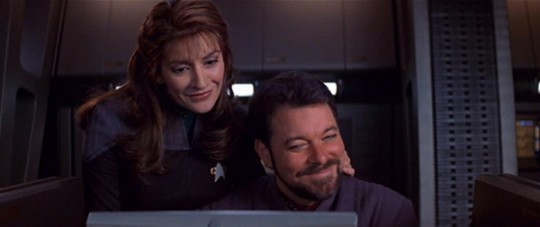
The safe word is “Imzadi”, says Adam Clarke.
I love Star Trek. Star Trek (and its first six movies), Star Trek: The Next Generation and Star Trek: Deep Space Nine raised me more than any human being ever did. You see, my parents abandoned me in Sears’ electronic section where I spent all of my childhood and teen years. There, TV took over and the various Star Treks raised me on tales of weird alien cultures that are all-too-human and omnipotent aliens that exist only to ham it up in front of starship captains.
Incidentally, I’d like all you readers to keep vigilant in my quest to find my birth parents. The police have issued this computer-rendered sketch of what my parents might look like based on my dim recollection of them…
Papa! Mama! Come back to me!
Hey, speaking of dim…
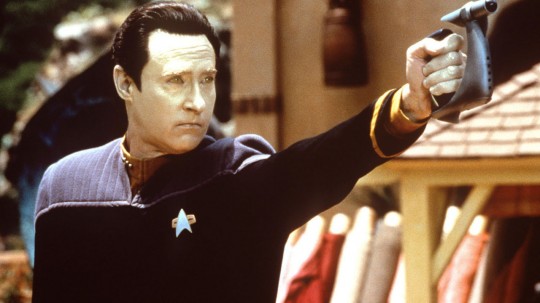
Star Trek: Insurrection (1998)
There’s trouble afoot when the evil plastic surgery enthusiasts, the Son’A, try to quietly relocate a small population of immortal space-Luddites in order to harvest some planetary rays that could result in eternal life for all!
Wait, that doesn’t sound too ba–anyway, the Enterprise crew discovers that Starfleet is working with Son’A, lead by the evil Ru’Afo (F. Murray Abraham). Time for an insurrection! Oh, and the planet causes people to regress physically and mentally (maybe) causing them to get zits, flirt or appreciate proper boob firmness.
Going through the TNG movies in reverse order makes Insurrection seem a lot better than it actually is. It is superior to Nemesis in every respect save one: the villain. Sure, Shinzon’s bald head and shoulder pads basically made him look like Skinhead Murphy Brown, but Tom Hardy was trying to rise above the material and he had Ron Perlman to play off of. F. Murray Abraham plays the lamest villain in the history of Star Trek and that includes those few weeks of TNG when the Ferengi were supposed to be scary. He whines, screams and purses his lips in every single scene, as if his sole bit of direction was “can you act like a 10 year old girl ordering a chocolate chiller at the mall? Do that.”
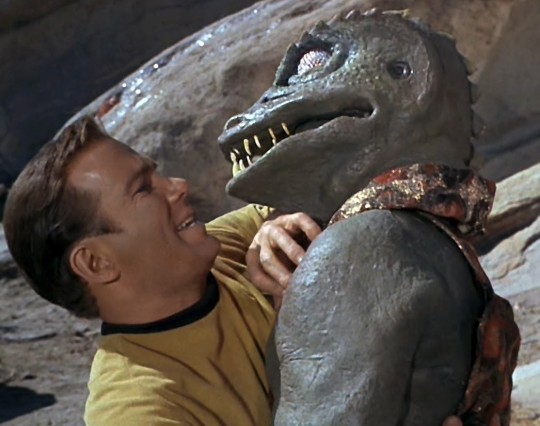
Insurrection threatens to get worse before it eventually does. The minute Worf and Picard are shown in a remarkably cheap-looking and unexciting chase scene with Data, the entire movie has already jumped the Gorn. From there, we have Worf reduced to broad comic relief (a role he is handed again in Nemesis), Troi revolted by the thought of kissing a bearded Riker (forgetting she’d already done that because no one remembers poor Thomas Riker), Picard mambo-ing, Geordi going on about sunsets (I wonder if he saw a butterfly in the sky) and Beverly Crusher trying not to blend in to the background.
That almost makes it sound as bad as Nemesis, but the movie is redeemed partially by the TNG regulars. In the cast’s final film, they’re all too tired to care about anything. In Insurrection, the Enterprise crew is finally having some fun and, for the first ten or fifteen minutes, we just get to hang out with these much-loved characters. First Contact starts with a war just after the opening credits and Generations is overshadowed by the presence of William Shatner, Insurrection gives us a chance to watch these characters interact and kibbitz with each other during a diplomatic mission they’d rather not be a part of. It’s kind of fun until the plot of the movie kicks in and the humour goes from tongue-barely-in-cheek to Joe-Piscopo-In-The-Holodeck goofy.
Insurrection is a film that awkwardly shifts in tone from a more comedic take to the stock Starfleet conspiracy plot to the action movie cliches of the film’s second half. Precious little of it works but Fade Out (an unpublished book on the writing of Insurrection, which has since leaked on the internet) inadvertently shows how these awkward tonal shifts were the result of making a movie by committee. Patrick Stewart wants a lighter storyline? Bring on the laughs. Brent Spiner thinks he’s underused and should be killed off? Put in more Data. The producer expects a villain to rival Khan and the Borg? Get F. Murray Abraham on the phone, etc.
Was there ever a good Next Gen movie?
Next week: The Trek movie marathon continues with First Contact.
The Twilight Saga: Breaking Dawn – Part 1 (2011)
Fri, Dec 9, 2011
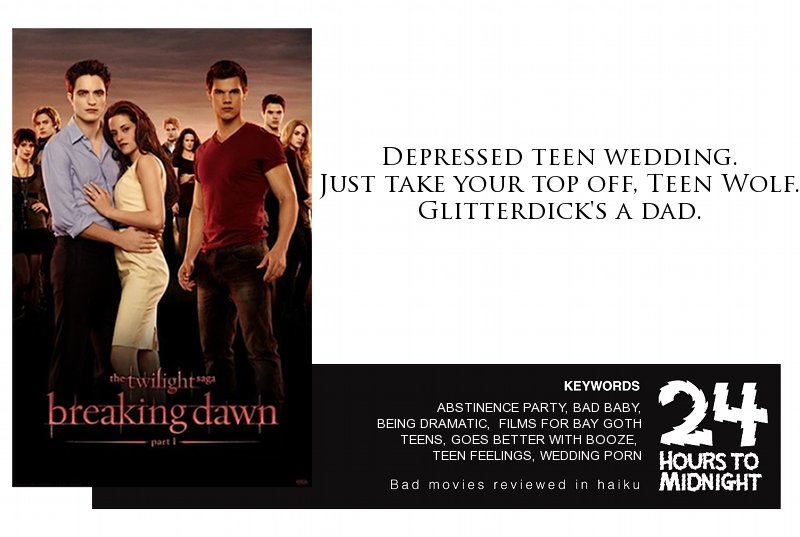
Even though we’ve never cracked the spine of a single literary installment of the Twilight series, we are always excited when a new movie enters the theatres. Not dress up in a wedding gown excited, but still pretty stoked. We recommend hitting up Fog City before you go and watching it half cut, as you will need a bit of help making it through two hours of ridiculous teens looking pouty and twinkling in the sunshine. We’ve compiled a short list of reasons why you should check this garbage out.
TOP FIVE REASONS YOU SHOULD WATCH THE TWILIGHT SAGA: BREAKING DAWN PART 1
1. Sawny mystical beings
If you had no prior knowledge of werewolves or vampires, you would assume from watching Twilight that they were just grouchy teenagers who do nothing but pout all day and turn into glitter in the sunshine. In Breaking Dawn, our favourite teen wolf runs away from home, has a telepathic wolf conversation with his pack, and then falls in love with a baby, never changing his contrary mug. Also, Edward and Bella have sex for the first time and it is mythically insane. Then then spend the rest of their honeymoon playing chess and pouting.
2. Ridiculous facial expressions
You would think that the majority of ridiculous facial expressions in these movies come from either Jacob, Edward or Bella, and although they do provide an excessive amount of sooky face, the best vampire (most ridiculous) is by far Jasper (Jackson Rathbone). He barely speaks, and just hangs out in the background looking ridiculous. HE IS THE BEST.

3. The Volturi
These bossy vampires live in Italy and are super fancy. They do not appear at all in this first half of Breaking Dawn except for a ridiculous “stinger” at the end of the credits. The real heroes of this saga, they will return (with Dakota Fanning!) in the final chapter to fuss about and attempt to destroy the Cullen family, Bella, and her terribly named baby, Renesmee.
4. Drinking
As previously mentioned, it’s really fun to go to Fog City and get a few giant pitchers of beer before going to see a terrible movie. Just avoid drinking too much so that you don’t fall down in the theatre or fall asleep during the movie, not that we’ve ever done either of those things.
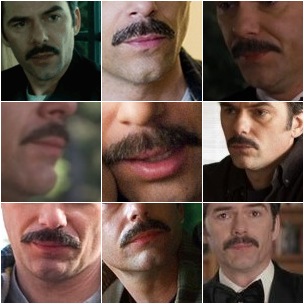
5. This moustache:
Star Trek Movie Beatdown – Part One: Nemesis
Mon, Dec 5, 2011
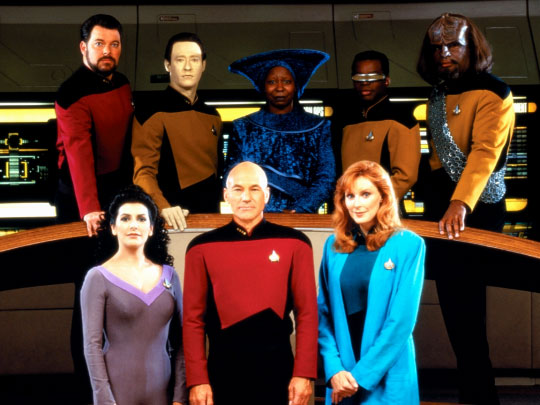
Adam Clarke looks back on the 24th century and the last Star Trek: The Next Generation movie.
When the original Star Trek crew segued from television to films, the resulting six films expanded and deepened the characters and their relationships in a way the series never did. The James Kirk of each episode of the original series is more or less the same guy, barring the occasional re-appearance of an Evil Kirk Doppelgänger. In the films, we watch these bold heroes age and, more importantly, learn to act their age. The Dr. McCoy of the films, for example, has warmed around the edges considerably from his more prickly TV self and is all the better for it. So, too, do the other characters benefit from aging thoughtfully and gracefully, barring the occasional campfire song.
The four Star Trek: The Next Generation films somehow ended up with the opposite effect. Rather than deepening or developing the characters, the films largely forgot who they were.
To start with the many problems with the TNG films, let’s work backwards with…
Star Trek: Nemesis (2002)
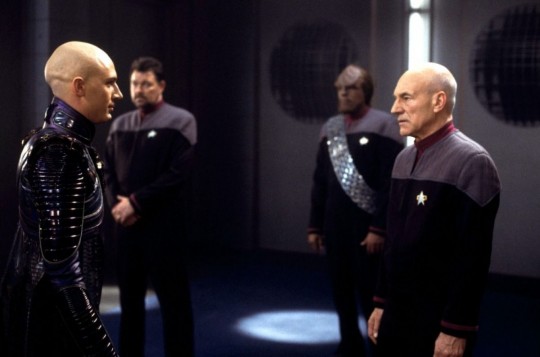
While the characters of TNG were never that intricate, you knew who they were and they each had their moments of greatness. Over the course of the TV series, Jean-Luc Picard (Patrick Stewart) went from a repressed man who behaved like some kind of school principal-in-space to a refined, contemplative, ballsy diplomat. While the underrated Gates McFadden was not well-used by the series, she brought a strength and intelligence to Beverly Crusher that was well-served whenever she was the focus of an episode (such as I, Borg). Episodes focussing on Will Riker (Jonathan Frakes), Geordi La Forge (LeVar Burton), Data (Brent Spiner) and Worf (Michael Dorn) gave them plenty of moments to shine. Even Deanna Troi (Marina Sirtis), whom the Enterprise needed about as much as a space-fish needed a star-bicycle, got that cool episode where she was disguised as a Romulan.
Star Trek: Nemesis has everything you’d come to expect from the TNG film series: the focus of the film is entirely on Picard (yay!) and Data (meh), it turns Star Trek into a bad action film (again), the characterization of the regulars is somewhat off, it mistakes Brent Spiner for a comic genius and it pits our heroes against a poorly-conceived villain.
Nemesis sees the Enterprise in a transitional phase. Riker and Troi are transferring to a brand new ship, as is Dr Crusher. Worf is back on the Enterprise for… some reason. And Commander Data has apparently won every pie-eating contest in the galaxy.
The latter two TNG films presents indisputable evidence that time has not been kind to this generation’s Enterprise crew, and none more than Brent Spiner. Observe:
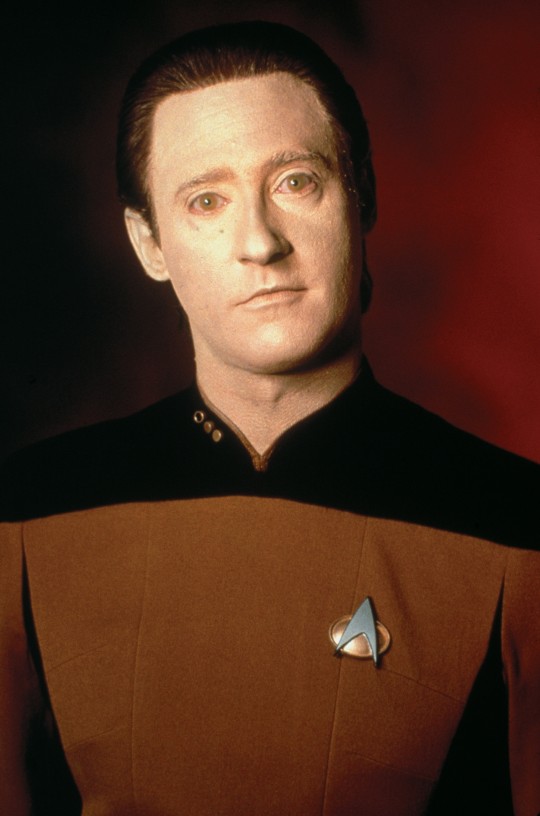
Data as seen on TV.
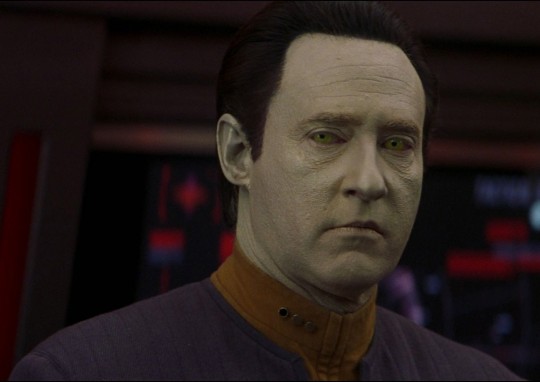
Data in Star Trek: Insurrection.
Data in Star Trek: Nemesis
The plot of the film involves doppelgänger of Data and Picard being discovered by the Enterprise crew. (Thomas Riker, Will Riker’s duplicate, was remembered by no one and not invited to join the attack of some clones.) Shinzon (Tom Hardy, Inception), a genetic clone of Picard who looks nothing like him, uses Data prototype B-4 to infiltrate the Enterprise. Shinzon wants to destroy Earth as part of his dastardly plan, which includes mind-raping Counselor Troi with the aid of his own pet Nosferatu, Vkruk (Ron Perlman)… for some reason.
There’s a reason I brought up the “classic” Trek films earlier. I’m arguing here that the TNG films failed not only to develop the characters or worlds of the series, but they also failed to create original stories for the Next Gen crew or give their film series any kind of identity. After their unusually sombre debut, the original crew’s adventures ranged from fighting a vengeful superman to raising the dead and kicking Christopher Lloyd in the face to going back in time to save the whales to Captain Kirk punching God in the face to courtroom drama, zero-gravity assassinations and Klingon diplomacy. This variety of stories, combined with the aforementioned character development, gave the original series’ crew a film series that stood on its on merits, removed from nostalgia.
The only way to enjoy Nemesis would be as a nostalgia trip. If you want to see the actors you grew up watching once more time, well, here they are. And I mean actors, not characters. As movie reviewing internet treasure Mr. Plinkett aptly put it, TV Picard and movie Picard are totally different. The intelligent diplomat has been replaced by a guy who rides around giggling in a dune buggy and laughing at his own jokes during a cheesy toast. The character’s not written like Picard, but almost like a parody of Captain Kirk. Perhaps he’s meant to be Zapp Brannigan.
Meanwhile, the movie is built around Data’s heroic sacrifice (to free Spiner, the actor, from the role) while leaving the character of B-4 around for a thankfully unrealized sequel.
Um, doesn’t that conflict with freeing the Augustus Gloop-like Spiner from Star Trek?
Nemesis‘ real problem is that it’s such a lousy end for the TNG characters, unlike its TV series finale. That television story gave a sense of closure, the perfect antagonist for Picard and afforded some nice moments for all the characters. It’s a perfect sign-off. Nemesis just feels like business as usual and is arguably worse than — gasp! — Voyager or Enterprise.
Next week: Insurrection!
The Decade’s Best Christmas Specials Ever Great Job!
Thu, Dec 1, 2011
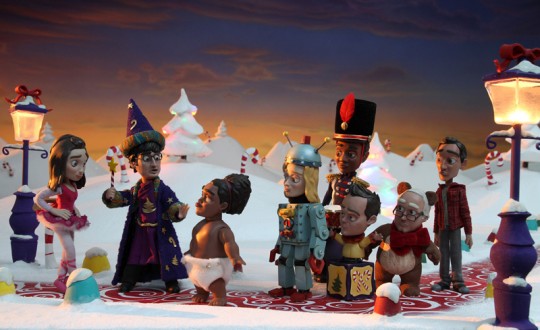
“Abed’s Uncontrollable Christmas” episode of the NBC show Community.
So, Christmas is pretty okay from what I gather.
At the Clarke household, we weren’t allowed to celebrate Christmas because of my father’s atheist views. In its place, we had ‘Crimble’, a non-denominational holiday. Every year, myself, Mom, Dad, my brother and my overweight cat, Chubbles, would gather round a picture of Wilford Brimley and exchange cards in which each of us would express all the underlying resentment we had towards each other.
My therapist tells me that this is the source of my many paranoid delusions. Then again, she would say that.
Nonetheless, Christmas specials appeal to everyone regardless of religious leanings. Yet, CBC bungled their chance to have a major Xmas event by not turning Dave Foley’s True Meaning Of Christmas Specials (2002) into an institution. The little-seen special features music by American surf rock legend, Dick Dale and appearances by Jason Priestley (as Santa Claus… sort of), Kevin McDonald (as the Ghost Of Christmas Specials Yet To Come), and Tom Green (as Mike Myers’ butler). Foley’s one-off special would have sunk without a trace were it not for YouTube. Hopefully, its online presence will finally give it the audience it deserves.
Upping the ante in terms of weirdness and Christmas special deconstruction, there’s Tim & Eric’s Awesome Show Great Job! Chrimbus Special (2010). Tim Heidecker and Eric Wareheim brought five seasons of their Awesome Show to a close with a one-hour special full of sequined outfits, a nod to the Star Wars Holiday Special with a creature named DeeVee and a song about frostbite. Chrimbus is a good way to subject the uninitiated to the comedy of Tim & Eric, as it’s nowhere near as frenzied and strange as the average episode of Awesome Show. The online promos for Chrimbus alone (promising appearances from “Wharf” and “P’kard” from Star Trek) should be enough to make you want to see it this Crimble.
From surreal to just-plain-wrong territory, there’s Jason Eisener’s Treevenge (2008). A few years before turning his Hobo With A Shotgun short into a feature-length B movie, Eisener showed the seamy underbelly of the tree harvesting industry. This short’s got it all: ultra-violence, angry trees and Jonathan Torrence dying horribly! It’s on YouTube, so you have pretty much no excuse not to watch it.
Few television series have crafted holiday episodes as good as the ratings-challenged Community. While this year’s Christmas episode is bound to impress, it’ll be difficult for the writers to top the stop-motion animated “Abed’s Uncontrollable Christmas” (2010) from the show’s second season. In that episode, resident pop culture obsessive, Abed (Danny Pudi), sees the entire Greendale Community College campus and each of its students in stop-motion after a traumatic incident. Aided by a selfish Psych professor (The Daily Show’s John Oliver), Abed’s friends join him on a group therapy session that plays out like a journey for the true meaning of Christmas. Community is always at its best when it marries its silly plots to real emotions. “Abed’s Uncontrollable Christmas” is funny, but hits enough emotional beats to pull at the heartstrings. Oh, and most importantly, it’s the only Christmas special that finds the true meaning of Lost.
Merry Christmas, movie house!
RIP Ken Russell (1927-2011)
Mon, Nov 28, 2011
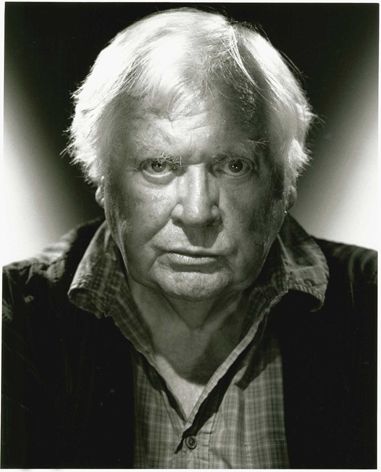
I’m putting the kibbosh on this week’s intended blog post to address the death of one of the most inspired film directors of all time: the legendary Ken Russell.
I won’t attempt to summarize his life and career, so I will point newbies to The Guardian’s collection of articles on the man. Those more knowledgeable of his work would do well to pick up a copy of Phallic Frenzy: Ken Russell & His Films by Joseph Lanza. I did so at the BFI museum over a year ago and am currently staring at the back cover, which features an aged Russell riding atop a statue of a horse in his garden.
The message of the photo was simple: Ken Russell is as bonkers as you think he is.
That’s the sort of thing I admired about the man. Ken Russell wasn’t premeditated nor did he put on a persona. The man was bold, passionate, intelligent and unapologetic. Like many film artists who rose to prominence before the 90′s, Russell makes me yearn for the days before publicists, soundbite talk shows or focus group testing. Right now, the most talked-about film director is Brett Ratner (at least as far as controversy goes) and there’s so much wrong with that it damn near drives me to suicide.
The Devils is, without a doubt, the English filmmaker’s masterwork. Ideally, in light of his death, the film will finally receive its much-needed remastering and restoration. Other films, such as The Music Lovers; The Who’s Tommy; Lair Of The White Worm; or his recent short, A Kitten For Hitler, among others, offer a glimpse of the man’s range and talent.
Filmgoers have lost a true original and I’m going to miss him quite a bit.
Captivity (2007)
Sat, Nov 26, 2011
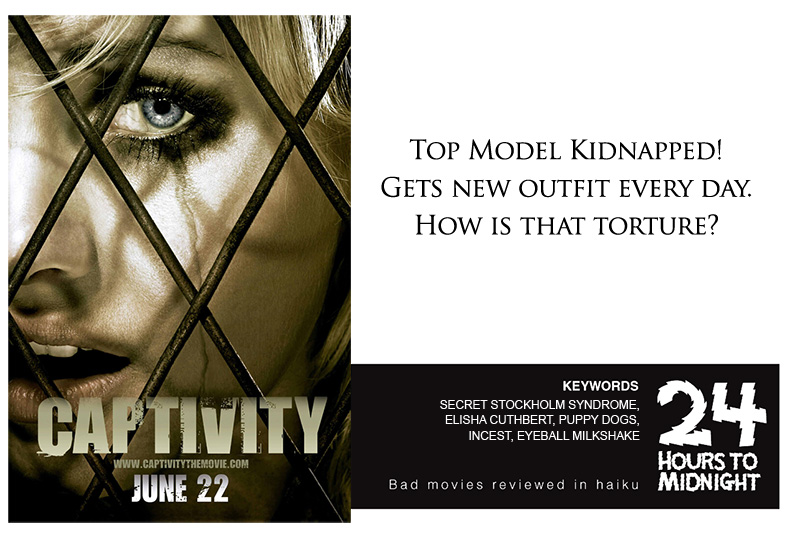
Written by Larry Cohen (Maniac Cop, It’s Alive) and Directed by Oscar Nominee Roland Joffé, this piece of “torture porn” is so terrible it’s hard to even know what to say about it. Top model Jennifer (Elisha Cuthbert) is stood up at a club, orders an appletini, and begins to feel dizzy. She passes out and wakes up in a strange room filled with storage lockers and a bunch of her personal belongings. It’s actually pretty cushy. Throughout the days that follow, she is tortured into shooting her dog, drinking a disgusting mix of eyeballs and organs, and wearing fabulous outfits selected by her kidnapper.
What makes this movie slightly interesting is that she discovers that she is not alone in her torment, as Gary (Daniel Gillies), a Harry Hamlinesque gentleman, has been holed up in the cell next door. Together they try to escape, he gets his tooth extracted for her, and they fall in love! ROMANCE! However, things are not quite as they seem, and Jennifer has to face her true captor on her own. Will she crotch-kick her way to freedom? YOU BETCHA.
The North American release of this film is quite different from the original version, which was more of a thriller than a horror movie. The gore was added after the fact to appeal to North American movie-goers. This didn’t work out as planned, as Captivity was nominated for several Razzies, and was named the “Worst Horror Film of 2007” by Bloody-Disgusting.com. Better luck next time!
The X-Files: Fight The Future
Tue, Nov 22, 2011
With the announced Doctor Who movie, there’s been some trepidation as to whether or not it can be successfully pulled off. I’ve argued that Who is like a band whose deep cuts are better than its singles. The show works best when it’s not trying to build a mythology, but rather when it’s a cheerful, funny, thrilling bit of escapism. That a film would likely try to be big and important means that it will fall prey to the worst instincts of the past few seasons of the show.
Every cult success flirts with mainstream acceptance. Sometimes the gambit pays off, as per the Star Trek franchise, which I’ll be writing about next week. More commonly we get films that are little more than feature-length episodes, like the Mystery Science Theatre 3000 and Firefly movies. Or, as per The X-Files‘ first cinematic adaptation, a film that tries to please the fans and be a blockbuster that fulfils neither of those expectations.
Time has not been kind to 1998′s The X-Files: Fight The Future, which was ultimately the show’s last hurrah. Following the film, the series would be subject to dwindling praise, enthusiasm and relevance as it eventually petered out with one of the worst series finales of all time. Once the Fox network’s flagship series, The X-Files has become a popular topic of scorn as a prime example of what happens when a series is kept on the air past its prime. The X-Files: Fight The Future killed the show’s chance of ever becoming mainstream. The less said about 2008′s belated follow-up, The X-Files: I Want To Believe, the better.
Y’know, the average movie is content to have only one prologue, but so would an average The X-Files episode. Since bigger is better when you’ve got $50 million to play with, we get three, and frankly, the first two kinda bite. The opening credits segues into a peculiar combination of 2001 and Alien, as a grey, reptilian creature attacks two goofy-looking cave folk. Yet, once the creature is subdued, it begins to secrete black blood from its wounds and it looks like the real horror is only beginning for Lothar of The Cave People. Cut to the present day, where a pint-sized Texan falls through a loose area of soil and crashes into the very same cave, discovering what is presumed to be the late Lothar (of the Cave People)’s skull. What follows is the scream from any viewer who hates inauthentic kid dialogue.
The exchange between the Fallen In A Cave Kid and his friends, verbatim:
Friend 1: Stevie, are you okay?
Fallen In A Cave Kid: Yeah, I got the wind knocked out of me…
Friend 2: It looks like a cave or something…
Friend 1: Stevie, what’s goin’ on?
FIACK (Whose Name We Now Know To Be Stevie): *picks something up* It’s a human skull
Friend 2: Toss it up here, dude. (?!)
FIACK: No way, butt-wipe. It’s mine! (??!!) … Anyway, there’s bones all over the place, man.
cue black oozing out of the ground and under FIACK’s skin; he wheezes and looks up with newly blackened eyes. His friends react with shock and run away
At this point, firefighters surround the hole to rescue the child only to see a lone black helicopter and a school of white tanker trucks take over the situation. This leads to one of the nicest lines in the film as the man taking charge of the situation skulks away from the scene and dials the number of some undoubtedly shadowy figure, opening with, “sir, remember the impossible scenario we never planned for?”
We now move on to the third prologue for the film as we swoop down from the metropolitan skyline to the top of a skyscraper in Dallas. There, Fox Mulder and Dana Scully (David Duchovny and Gillian Anderson) discuss a bomb threat that was called in to the building across the street. It seems Mulder is playing one of his trademark hunches as he believes that the potential threat might not be in where they were informed it might be, much to Scully’s amusement. Unable to chase the paranormal now that they’ve been thrown off the x-files (again!), Mulder pops down to get a soda in the building he had a hunch about only to discover a bomb where there should be a Fresca machine. When Scully informs the counter-terrorist team of the bomb’s true location, the building is evacuated, leaving only their new boss to defuse the bomb. Instead of attempting to defuse the device, he just sits there facing the bomb with his head in his hands and a look of doomed resignation. The bomb explodes in his face and levels the building completely and killing four men. The deaths being the aforementioned Michaus, along with two firemen and a small child, despite the fact that the building had been cleared.
Later, Mulder and Scully are forced to explain their curious absence from the source of the bomb threat as it was called in. Apparently the head of the FBI is going to pin the blame for the destruction on two expendable FBI agents and, faster than you could say “Mulder’s a good cop!”, Scully plans to resign while covering for her partner’s “lucky hunch”. Meanwhile, Mulder is off to drain his sorrows in Schlitz.
While drunkenly lamenting his role in “an ongoing government charade” and urinating on an Independence Day poster (nice touch), Mulder is approached by a man named Alan Kurtzweil (Martin Landau). Kurtzweil seems to know an awful lot about the half-hour of movie that just passed before our very eyes. Y’see, Kurtzweil has followed Mulder’s career for “a good while… back when [Mulder] was just a promising young agent — before that” (the show’s already been there…) and even knew Mulder’s father (…and done that) and ultimately tells Mulder that the recent activity is directly connected to the conspiracy (…and bought the trenchcoat). It seems that there’s one thing that the public reports on the recent bombing have overlooked one crucial detail… all the bodies that were recovered from the building, save Darius, were already dead. His nose for cover-ups thoroughly revived, Mulder tracks down his former partner and the two are soon bluffing their way into military installations (been there), uncovering deformed, unearthly bodies they weren’t supposed to find (done that), which hold traces of material in their blood stream; material of extra-terrestrial origin (bought the…hey, wait a minute!). Soon, Mulder and Scully are going on a cross-country trip to uncover yet another plot about aliens (did I mention the whole ‘been there, done that’ thing?).
Agh!
Cut to: A swarm of black helicopters, a bizarrely breast-shaped installation in the middle of nowhere and a man calmly exiting one of said aerial devices calmly and with a long drag of a cigarette (series regular William B. Davis).
I believe it was Scooby Doo who once said “ruh-roh.” Allow me to apply the same here.
What follows is the much-hyped ‘truth’ the film’s ad campaign boasted that this big screen offering would reveal. Here we learn that the ‘shadow government’ are not the heinous men in black with plans for world domination at the side of alien captors, but double agents who have spent the better part of the twentieth century attempting to halt the invasion from the inside.
Yeah, I don’t buy it either, but there’s still more truth to go around.
What we learn, and what the series has told us, is that aliens of a certain physiology are maleovelent beings with their eyes on Earth and its people for colonization. Somehow, they’re technologically advanced enough to achieve this and have communicated with Earth since at least the 1940s but have chosen not to invade just yet. Apparently the intervention of a group of men who, through their wealth and influence during the Cold War, became aware of the aliens’ scheme and struck a bargain with their would-be extra-terrestrial conquerors: hold back on the invasion and said group of men will pave the way for their success when doomsday comes by spreading a sentient lifeform known as ‘black oil’ like a disease, which will apparently will enslave humans. Their surface reason for doing this was to save themselves from being infected, but it appears that this syndicate has actually spent all this time secretly working on a vaccine to prevent the invasion and save mankind. Only it seems that the Shadowy Government On A Shadowy Planet aren’t the only ones with something to hide, as the ‘oil’ gestates and grows within the infected, unconscious bodies. This infuriates the shadow-folk, who are not used to being on the receiving end of a double-cross, so they have to test out the vaccine immediately, before they suffer the same fate as those who came in contact with the oil in that cave.
Oh, and somehow African bees will be the means to transmit the alien virus, and possibly corn oil… who knows! Time for two agents to find where conspirators and aliens are keeping bees and corn!
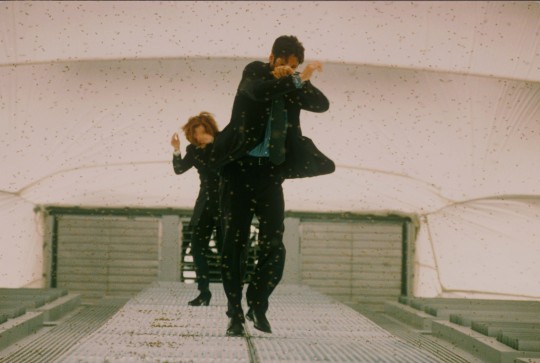
Since they’re supposed to be the stars of this picture, Mulder and Scully find the corn rows and breast-shaped Bee and Bee Factory where, after entering in the unlocked and unguarded (?!) facility, the two are chased by bees. Once they’ve fled the facility and gotten free of the corn rows, the chase is off.
Well, not quite. Apparently the goal is to scare the two away, as they wouldn’t want to harm Mulder (*yawn*) as that would “turn one man’s quest into a crusade” (*double yawn*). So, Mulder and Scully go to the FBI to report their findings, but that’s not all The Syndicate has planned for them. The conspiracy leader, Strughold (a character played by Armin-Muehler Stahl who, like Danner, was an unseen figure prior to and after this film) has a mighty scheme. It’s his idea to rob Mulder of that which he “cannot live without,” which turns out to be Mulder’s collection of sasquatch porn… err… I mean Scully.
Scully runs into Mulder and tells him why she has to resign and that he can pursue his quest for The Truth without her holding him back. Mulder is shocked by what he hears, confessing that Scully has “saved” him and that her rational point of view has made him “a whole person”. After getting so emotional, the two lean in for a kiss… but Scully reels back in discomfort.
Does Mulder have tuna breath? Is this the work of the evil gingivitis? Worse! Remember those killer bees? One snuck into Ms. Scully’s collar and went unnoticed for at least six hours as the two left the Bee Factory and return to Washington, stinging on command!
Just think about that for a moment.
No, no, take a moment to let that sink in. I’ll wait.
Now that’s pretty f***in’ stupid.
Mulder calls an ambulance immediately, but is treated rather coldly by the driver. Turns out The Syndicate intercepted Mulder’s call and sent a phony ambulance to pick up Scully and bring her to Antarctica(?!) There, the shadowy men will test out the vaccine on her. Mulder gets uppity with the driver, who shoots Mulder point blank in the skull. So much for not harming Mulder, lest one want to make him a martyr.
Correction: That was pretty f***in’ stupid.
Mulder awakes in a hospital, surrounded by a trio of nerds who act both as a tip of the hat to the series and a cheap plot device; the film doesn’t bother to introduce us to them, so neither will I. Needless to say, with a convoluted story to resolve, Mulder’s off to Antarctica to save his partner. Needless to say, Scully is rescued, the x-files are re-opened (and guess which two agents have been re-assigned!!), there’s still no concrete proof for the existence of aliens and the characters come back renewed to start back from square one, despite the promises and hints of big changes in the character relationships and overall plot.
Everybody wins, right?
Well, everybody except those who wasted two hours of their life on this thing. Despite retaining most of the cast and crew that made the series a success, The X-Files: Fight The Future generally feels like it’s on auto-pilot, with rehashed plot points, little originality and not a satisfying climax in sight.
On a more praise-worthy note, the direction by series veteran Rob Bowman is stylish, confident and assured even in the script’s most derivative moments. The cinematography manages to create a look that evokes the series, while still looking alien from the episodes that preceded it. The film looks stunning and is graced with some excellent CGI and matte work. It’s just a shame that, aside from the picture’s visual elements, the only thing keeping the film from falling apart is the cast. And the two leads perform admirably with such an uninspiring story. Anderson, always proving herself to be the more capable of the two main actors, is great. Whether she’s asked to be funny, frail or intimidating (her brief turn as an action hero in the bomb threat sequence is particularly good). Duchovny and the supporting cast are mostly good too, even if few of them get any moments to shine and the audience is deprived of even the most perfunctory meeting between either of the leads and the recently introduced Syndicate leader or its most iconic member, Cigarette-Smoking Man/CGB Spender.
Ultimately, The X-Files: Fight The Future isn’t a terrible film — though that “collar bee” plot twist is incredibly dumb — it’s just that the story is more or less unnecessary, given that all but the hint of romance between the leads and the resolution of the Syndicate plotline had been done before. In the end, it’s all flash, shallow thrills, continuity on a big budget, making the film feel less like a cinematic continuation of the series, and more like one of those roller-coaster rides based on hit movies. It’s pleasant to look at, funny in places, but it’s something you forget almost immediately after experiencing.
Hopefull the Doctor Who film will be a bit more successful. I s’pose they can’t be any worse than those two movies about the human “Dr. Who” who fought the Daleks.
Next week: A look at the movies of Star Trek: The Next Generation.
The Paranormal Activity Series
Fri, Nov 18, 2011
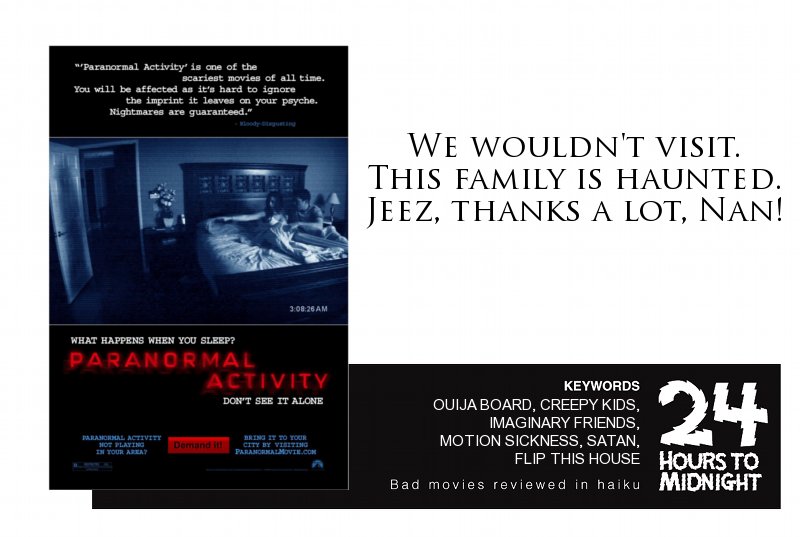
When it comes to so-bad-it’s-good movies, we’ve got our bases covered at 24HTM. However, everyone knows that there are few genuinely scary movies out there, and when you find something that scares the eff out of you, you stick with it. Things that these movies inadvertently gave me trauma about: storm windows, red-haired senior citizens, babies, knocking sounds, bed sheets, sliding doors, closets, basements, hanging pots and pans, video cameras, and open-concept homes. ISN’T THAT GREAT? Seriously though, this series is all about the atmosphere and the slow build. Definitely creepy, and definitely worth checking out!
For those of us who live under a rock, a brief synopsis of the series could be: “HOLY SH*T, HOLY SH*T! DID YOU SEE THAT? THAT THING JUST MOVED.” Basically, it’s about two grown-up sisters who have experienced paranormal activity since they were little girls. The first movie is present day, the second movie is a prequel to the first, and the third movie is a prequel to the second. You get to see the grand finale, and then backtrack to find out MY GOD, WHY??? See it! You won’t be disappointed… Or maybe you will. I don’t know, we like garbage.
Whatever it is about handy-cam, it lends itself perfectly to horror movies: The Blair Witch Project, Cloverfield, and the excellent Spanish zombie spookfest [REC] are all prime examples of the genre at its best, and the Paranormal Activity movies borrow generously and effectively. Why does the handy-cam effect make us so scared? Is it the blurring of the lines between reality and fiction which in turn creates a sense of hyper-real terror? English students, start outlining your honours essays.
You’ve all probably seen these trailers a hundred times, but here they are again in all their demonic splendour:
The Trip (2010)
Mon, Nov 14, 2011
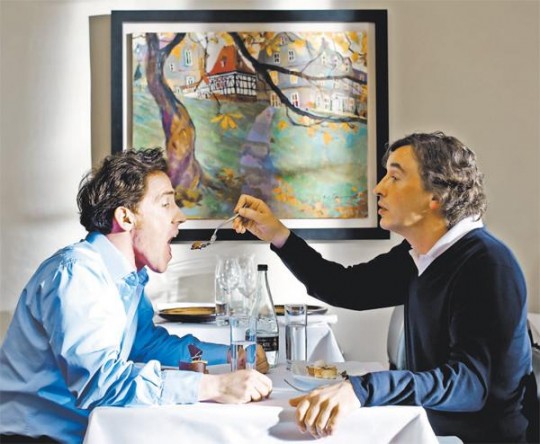
Adam Clarke had hoped to rent the previous Michael Winterbottom helmed Coogan-Brydon vehicle, but instead rented the deceptively titled “Tristam Shandy: A Cock And Balls Story: A XXX Parody”. Boy, is his face red.
“What else babbles?”
“You.”
“No, I ramble. I ramble through the hills and occasionally at dinner parties”
-Steve Coogan and Rob Brydon babble/ramble in The Trip
Steve Coogan (TV’s Steve Coogan, cast against type) is a man with a dilemma: he’s to write an article documenting various eateries in Northern England. On paper, that must sound like an incredible experience, but Coogan knows nothing about food, the restaurants were all chosen by his estranged girlfriend and the only person who agreeds to accompany him is Rob Brydon (TV’s Rob Brydon), an acquaintance at best.
There’s something appealing about a rambling narrative. Not long ago, I went to see The Rum Diary with a friend of mine. While the lack of any building narrative, story structure or resolution was somewhat frustrating to her, I enjoyed the freedom of a screenplay that’s messier than a pulled pork sammich. The Trip has that same ramshackle quality, largely because it’s a feature-length edit of a TV series. Except this doesn’t feel like a rip-off (like when you rented a Kolchak movie that was really just two episodes incoherently strung together). This is a six-episode series condensed to a funny, pleasant package that only just wears out its welcome by the end.
The Trip is at its funniest when we watch Coogan and Brydon spar with each other in increasingly silly ways. In the universe of the film, Coogan is a bitter, successful comic actor who resents the successes of anyone else (“I have an albatross around my neck and it has the face of Michael Sheen”). That includes the successes of Brydon, a gifted mimic whom Coogan has known for 11 years, who jumps into his schtick at the drop of a hat. As a result, Coogan and Brydon face off in a series of competitive impressions, starting with a side-splitting Michael Caine-off.
If Rob Brydon’s constant attention-grabbing impressions come off as somewhat needy, he’s still relatively well-adjusted and sweet and certainly more together than the seemingly-lost Steve Coogan. Coogan’s life is so dispiriting that he even dreams of bland things like being lied to by his agent (in his dream, his agent is a famous American actor). Between these two entertainers is an interesting depiction of what friendship might mean to men approaching middle-age. They neither like nor loathe the other, but each is insecure in their own way and seemingly lacking in any friends outside each other. If you’ve been acquainted with someone for over a decade, you should know them a little bit, shouldn’t you?
But enough with the melancholy! Did I mention the duelling Michael Caine impressions? There’s a Michael Caine-off! What more could you want?
The Trip is playing Thursday, November 17 at the Avalon Mall as part of the MUN Cinema series.
Puppet Master (1989)
Fri, Nov 11, 2011
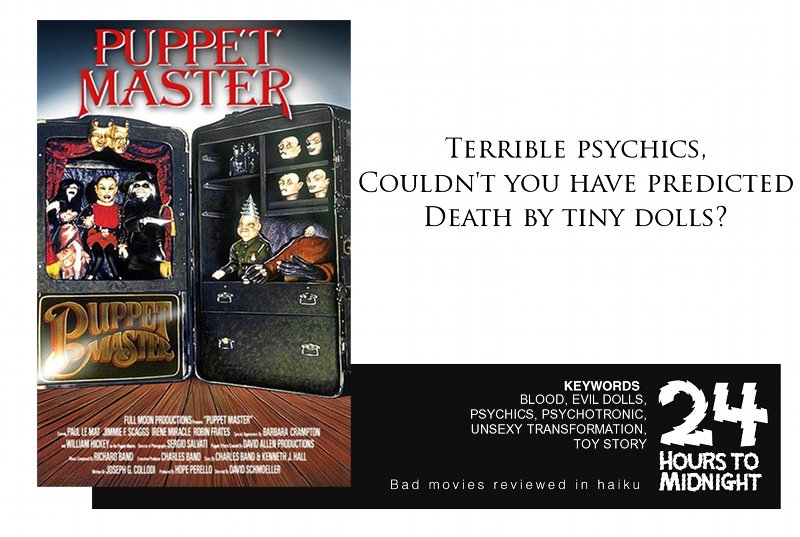
Spawning nine sequels and prequels (as well as a crossover with the Demonic Toys series) the eponymous Puppet Master is equal parts terrifying and ridiculous. Following the death of a former colleague and a bunch of disturbing visions, a group of psychics (including a witch!) find themselves at Bodega Bay Inn. Coincidentally, this inn is the place where Andre Toulon, creator of creepy puppets and a formula of eternal life, has committed suicide. Using psychic powers, their former (dead!) colleague found the formula and has killed himself so he can live forever. This has also awakened the “beloved” puppets, Blade, Tunneler, Pinhead, Jester and Miss Leech, who then go on a disgusting killing spree.
Even though this movie is kind of hilarious, due to a fear of living dolls (thanks Goosebumps!) I still had to watch large portions with my hands covering my eyes. Apparently future instalments involve Corey Feldman, so I am in this for the long haul.
Also! If you would like to be the world’s worst gift giver, you can buy replicas and dolls of all the puppets via the Full Moon Productions website. Hooray?
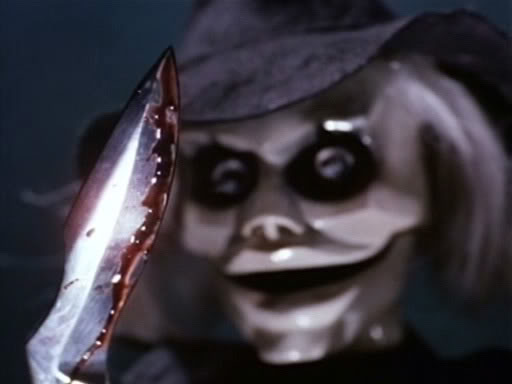
BELOVED.
Empty Promises: The Disappointments Of David Cronenberg
Wed, Nov 9, 2011

In the spirit of the late Andy Rooney, Adam Clarke ‘just doesn’t see the appeal in these newfangled David Cronenberg movies.’
No matter what paths his career has taken, David Cronenberg will forever be known as an intelligent filmmaker who finds a poetry in brutality and has a penchant for hypnotic surrealism. I’ve always been a great admirer of his and he has made some unforgettable films. Nonetheless, I feel as though Spider is the only good film that he’s made of late and his upcoming A Dangerous Method doesn’t fill me with hope.
The critical darling A History of Violence is an annoying and absurd film. Violence was celebrated enough so that I need not recap its plot here, but I can’t help but wonder why it enjoy such a flawless reputation? Is this film only remembered because of its sex-on-the-stairs moment and a scene where a guy practically gets his nose ripped off just because Viggo elbowed him in the face? Frankly, I found the acting of Viggo Mortensen and the rest of those playing his family and neighbours to be so earnest that I was rolling my eyes (“We keep the bad men out”?!) and the school bully/jock of the flick and his wormy sidekick seemed to have escaped from some alternate dimension where people act like The Bowery Boys. The script is goofily conventional instead of honest and the whole sorry affair is hammily acted and overwrought to boot.
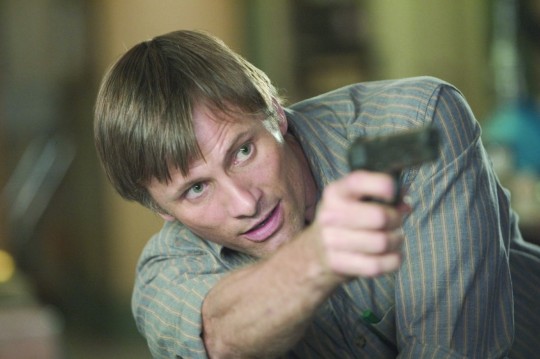
Eastern Promises isn’t much better as it’s neither a return to form, nor is it especially entertaining.
In England, a midwife named Anna (Naomi Watts) successfully delivers the baby of a Russian runaway with no ID. Anna is also of Russian descent and lives with her British mother and drunken, racist Russian uncle. After unsuccessfully trying to get her uncle to translate the runaway’s diary for her, she turns to Semyon (Armin-Muehller Stahl), the owner of a Russian restaurant who also happens to be a ruthless mob boss. Semyon eagerly coaxes Anna to deliver the diary to him, but she refuses to give him anything other than photocopies. Anna is just trying to find the newborn baby’s relatives in Russia in hopes of keeping the child out of the hassle and limbo of foster care, but her desire to protect that baby girl only gets her into trouble.
It isn’t long before Anna finds out the melodramatic truth. The young runaway was named Tatiana and she left Russia in the hopes of pursuing dancing only to become a prostitute for Semyon and his all-violence-no-brains son, Kirill (Vincent Cassell). She’s resenting her life when not tripping out from being force-injected with heroin. It isn’t long before Semyon rapes Tatiana because he fears his son is gay (ugh) when Kirill, um, doesn’t rape her well enough (*ugh*). Semyon is the father of that child, but Anna now knows far too much, but stupidly doesn’t get the police involved, leaving herself, her family and Tatiana’s child easy prey for Kirill and his mysterious driver, Nikolai (Viggo Mortensen).
In comparison to the dreadful Violence, some of the performances in Promises are noteworthy. Cassell makes the most of his cliched character and Mortensen steals the film with a look, but it’s all a waste. There’s no life in the by-numbers screenplay, which is lobbing ham-handed exposition (“That’s why your baby died inside you”) when it isn’t piling on more Russian stereotypes. I watched the whole thing hoping that there’ll be some kind of twist before the insultingly twee ending, but to no avail.
I’m sure there will be a time when I can say that Cronenberg is making interesting films again. In the interim, I’m going to skip A Dangerous Method and just rent Videodrome again.
Deadly Friend (1986)
Fri, Nov 4, 2011
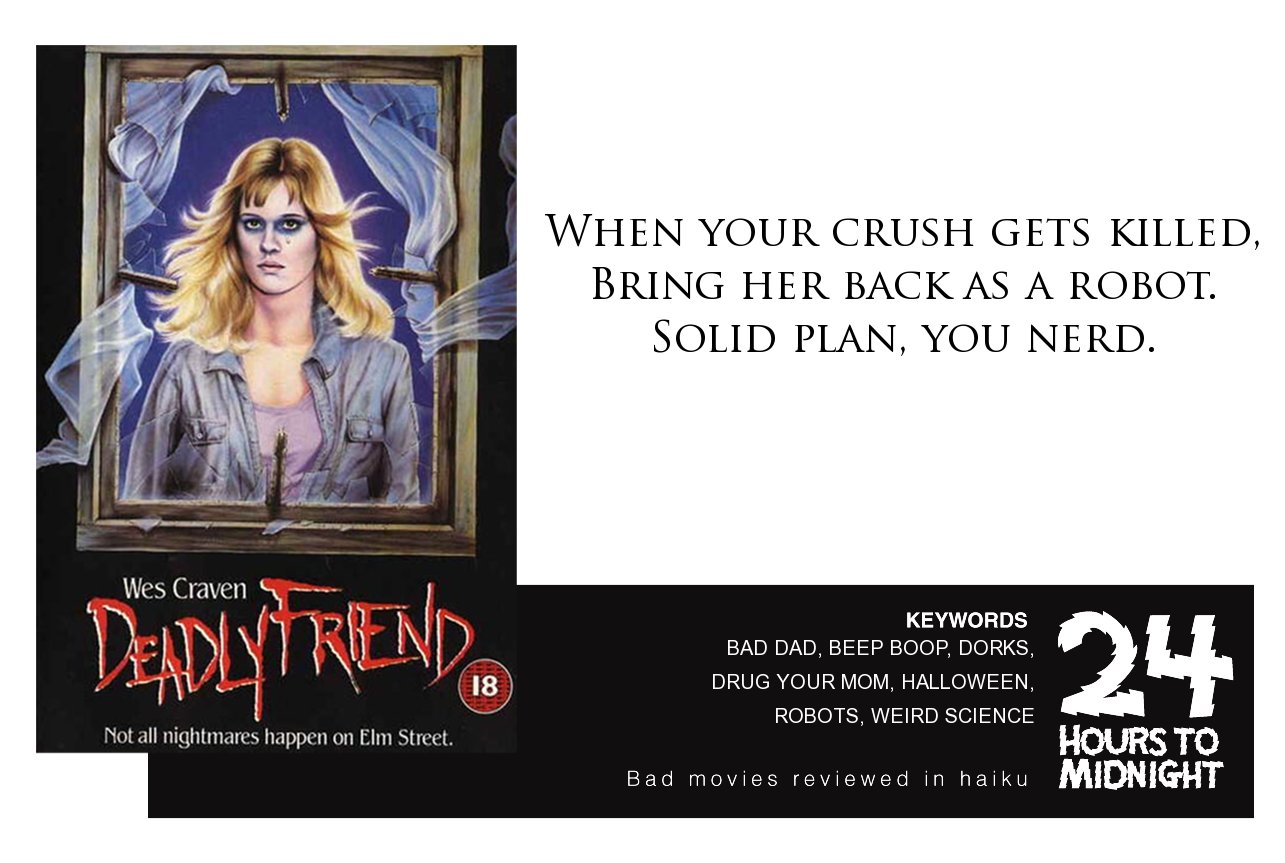
Deadly Friend (1986) is a mostly-forgotten Wes Craven non-classic. It’s not as forgotten as his 1975 sexploitation film, Angela, The Fireworks Woman, but it’s almost as gross.
The movie features Josh, a boy genius, and BB, his adorable robot pal with Roger Rabbit’s voice. The robot looks like a mix between Johnny 5 and Robie the Banking Robot from Radio Shack. In short order, the boy genius falls for the girl-next-door (Kristy Swanson), the robot gets trashed by some local thugs, and Kristy’s father throws her down some stairs and kills her. So, whiz kid that he is, our hero installs his robot’s computer brain into Kristy’s mushy human brain.
From there, Kristy Swanson does a stiff-legged, beep-boop shuffle around the neighbourhood, dishing out robo-justice on the local thugs, and the nasty neighbour lady (played by Anne “Mama Fratelli” Ramsey!). It’s worth noting that, along with her hot mime skills, Swanson’s transformation to cyborg is evidenced by the application of heaps of blue eyeshadow.
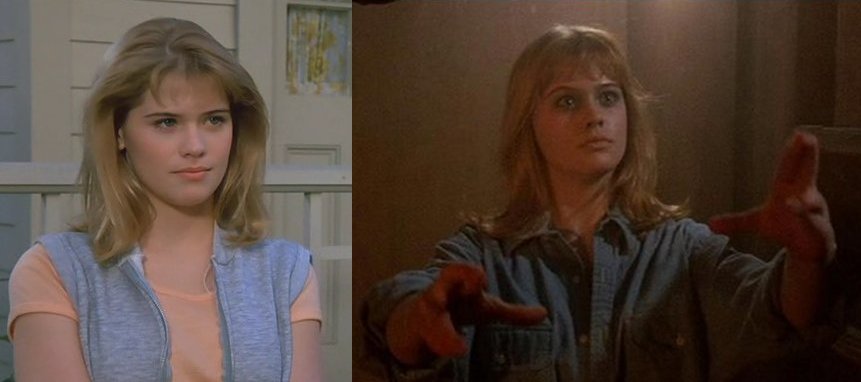
An Oscar-worthy performance.
This all plays out as you’d expect: police shoot-out, followed by twist ending. Solid C+ effort here, Wes!
A Tale of Future Past: A short oral history of Anchor Zone
Thu, Nov 3, 2011
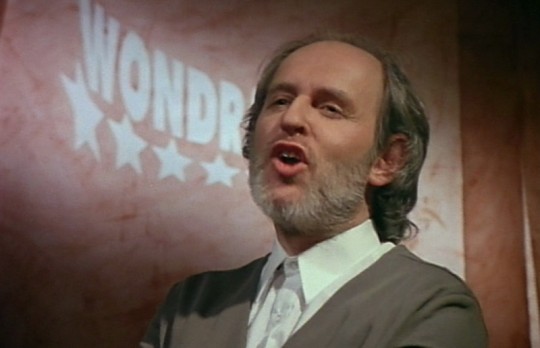
Ron Hynes as Wondracorp's Colonel Bob.
1994’s Anchor Zone was the highest-budgeted Newfoundland film of its time and it was set to jump-start local cinema. It didn’t. Adam Clarke interviewed the cast and crew about the film’s tumultuous production, a punk rock song dedicated to Anchor Zone and a revolutionary plan to release the movie on CD-ROM instead of VHS tapes.
Here’s the scenario: The year is 2010. Newfoundland is ruled by Wondracorp, owned by the evil Colonel Bob—known around these parts as Ron Hynes. Wondracorp’s science division is run by Lawson Hughes, who performs brain experiments on children like Ved.
One man stands to end the tyranny: Radd, also known as Mark Critch on a skateboard. Radd is joined on his quest by his buddy, Dogface, and Hughes’ estranged daughter Robin (Nicole Stoffman, aka Degrassi’s Stephanie Kaye).
Can this trio, aided by the enigmatic Ved, make a difference? Will Dogface’s brother, Brogan (Andrew Younghusband, Canada’s Worst Driver) the Wondra-cop, help them out? And why does Ved have tape on his forehead?
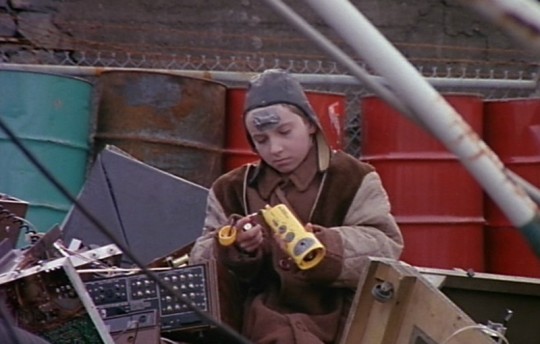
Michael Luke as Ved, the kid with the tape on his forehead.
On the Casting
Ken Pittman (producer): [Henry Czerny] was on his way to do Clear And Present Danger… so we made a deal with him. Part of the deal was that we bought his plane ticket to L.A. after the shoot… So some of the budget got eaten up to give him a round-trip ticket.
T.H. Hatte (writer): [Henry Czerny] was rushed in late and fell back on horrific Frankenstein grimaces and bulls**t backstory antics which were more the creation of [the director] than Henry, who just wanted to fly in, lay down his version of a character… Well, what he was able to grasp. Which wasn’t much.
Pheilm Martin (actor): I just did it for a laugh.
On the Production
Mark Critch (actor): I looked at the script and I remember thinking “cyberpunk? Flying skateboards? This could actually be kinda cool.” As the budgetary restraints become apparent, you start to notice that it’s not going to be a flying skateboard, it’s just going to be a f***ing skateboard.
T.H. Hatte (writer): I was on set to rewrite [daily] until I was barred from the set.
Ken Pittman (producer): [Writer T.H. Hatte] was very opinionated and he wasn’t liked by everybody… [He also] actively challenged the director while she was filming a scene. I asked him not to return to the set.
Andrew Younghusband (actor): [T.H. Hatte] used to wear one of those hats that looks like a Mary Brown’s box.
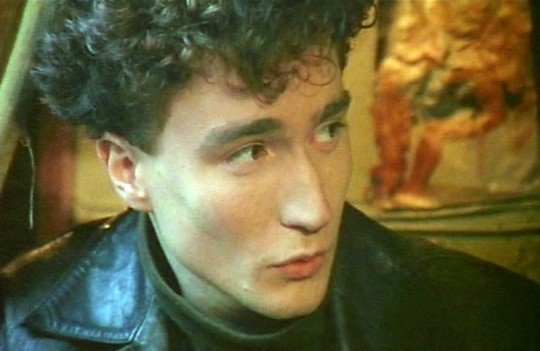
Mark Critch as Radd.
On the Experiments
Ken Pittman (producer): Three things we were hoping to do after the fact: Produce a CD-ROM for the movie, go online with a version of the movie you could download, and release a soundtrack album. All of it was undoable in economic terms. [It was 1994.]
Mark Critch (actor): There was also talk of getting everybody together for a video webchat.
On the Aftermath
Andrew Younghusband (actor): They had a million dollars and were trying to make a big-budget sci-fi, but what they should have done with Anchor Zone is tried to make a b-movie sci-fi.
Nicole Stoffman (actor): On paper, it looked like an action movie.
Mark Critch (actor): I thought of it as “Jim Henson’s Blade Runner Babies.”
Michael Luke (actor): Being an eleven-year-old kid, it was an unbelievable experience. There was a lot of hype and I couldn’t get enough of it.
Pheilm Martin (actor): One night at Bar None [a few years ago], this strange man with long hair and a big long beard comes up to me. It’s Jesse Walker. He told me his band, Skull Face & Others, had a song called “Xtendo Arm Of Creepy Death,” which was about Dogface, [the character I played.]
Mark Critch (actor): Is it just something stoner kids watch now?
T.H. Hatte (writer): I thought it was god-awful. Nothing at all like I had written.
Mark Critch (actor): There are so many other factors that come in, and then things start being traded away. ‘We want to get so-and-so to direct but she’s got to come from this section of the country to get this grant, okay?’ You start doing this little barter system. ‘We need Czerny. Flying him in means we can’t shoot that.’ So you end up with these little Franken-movies
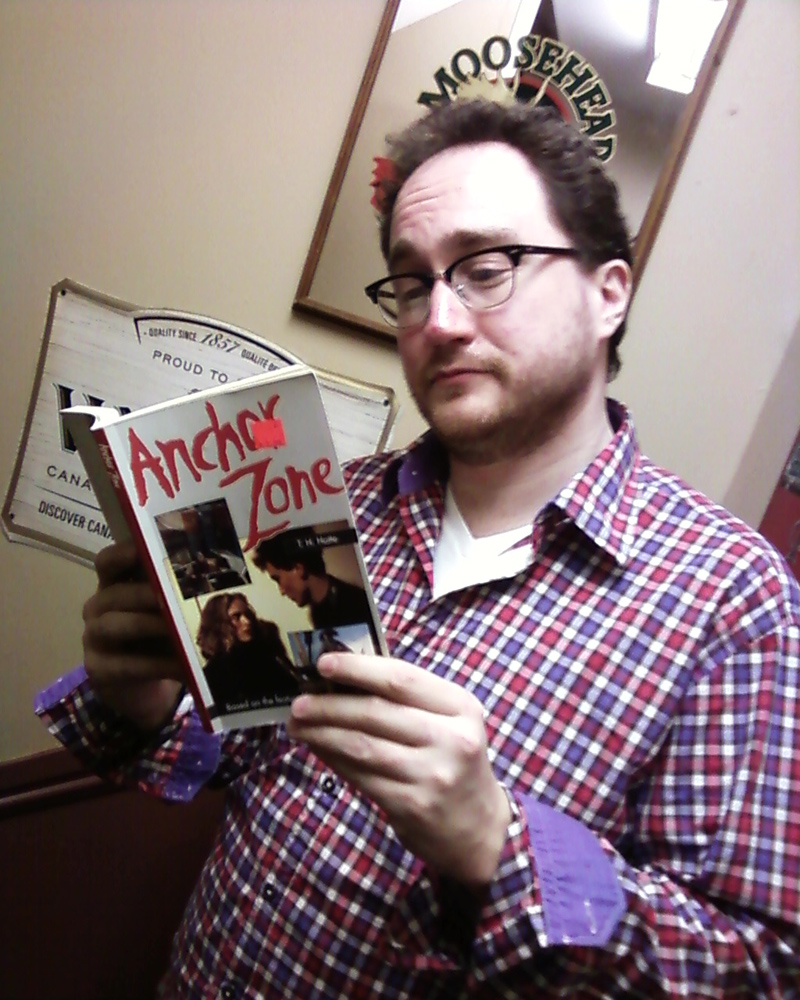
Mark Critch reads from the films novelization. Photo by Adam Clarke.



Mon, Dec 19, 2011
Adam Clarke