

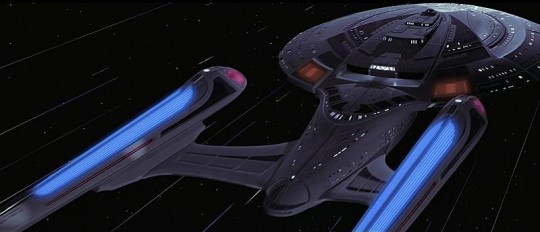
When he dies, Adam Clarke is set to be replaced by the Adam Clark-E. There will be a detatchable saucer section, ladies.
So, continuing with the reverse-chronological order, we’ve now arrived at the most beloved of all the Star Trek: The Next Generation films. Sadly, this TNG is about as exciting as an episode of E.N.G.
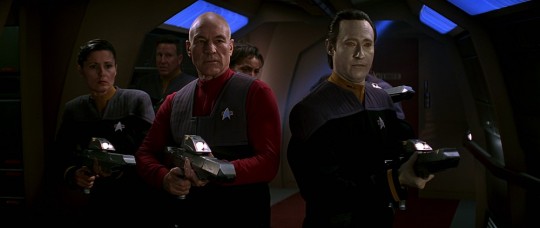
Star Trek: First Contact (1996)
I recall there being quite a bit of hoopla over First Contact. It was going to be the fast-paced, thrilling and action-packed blockbuster that got people’s attention, unlike stuffy, old Star Trek: Generations. The impression one got from the film was that it was an apology for Generations. An apology that critics, fans and moviegoers gladly accepted.
I remember seeing it in theatres and thinking that First Contact was still a very poor excuse for a Star Trek movie.
With fresh eyes, I can say that First Contact has its strengths. It’s got a larger budget than most of the preceding Treks and uses it well. Also, the film is nicely shot and edited, resulting in a pretty snappy pace and its spaceships ‘n’ ‘splosions prologue is an exciting set piece.
Of course, that prologue also highlights the film’s problems. It’s nice to see the brand new Enterprise-E blowin’ up the Borg, but it skips over something relatively major. Since Generations, Picard lost his family, the Enterprise-D was destroyed, Geordi doesn’t wear a visor anymore, Data can apparently turn off his emotion chip and Worf went to spin-off country where he moved in with his estranged father and began hosting a talk therapy show on KACL. If ever there was a time for the viewers to catch up with these characters, it’s now. Before these characters are given any room to breathe, the Borg show up and Captain Picard is told by Starfleet to stay home out of it.
The only reason Captain Picard would be left out of a Borg battle is to create conflict between him and Starfleet. There’s no story function beyond contriving a clash between him and his superiors. Well, none save for the fact that it echoes so many cop movies in which an eager detective is thrown off the case by a hot-headed chief. I’m surprised an admiral didn’t show up on the viewscreen to tell Picard that the Borg have diplomatic immunity and preventing them from assimilating all of humanity is simply not worth all the red tape.
This is especially weird given that Picard is the only one who has been assimilated by the Borg and lived to tell the tale (Voyager was all a holodeck simulation, you guys). As a result, Picard knows all the ins and outs of Borg tech even though he was assimilated over five years ago. Also, he has Borg super-hearing in this movie. Don’t ask.
Since the story was written as if Picard was Mel Gibson, we see Picard go absolutely bananas in his quest to kill the Borg. Picard beefs with Worf, screams, smashes figurines and kills anybody who got captured by the Borg. He says that saving them from assimilation is crueler than killing them, but Picard seemed to have had a lot of fun, post-assimilation. He learned to play the flute thanks to a dead culture (thanks, dead culture!). He got to talk about “Shakma when the walls fell at Tanagra”. He even got a holiday named after him. The two times he re-encountered the Borg, he didn’t go all crazy-cakes, but, since it’s in the script, he does so now.
Speaking of things that didn’t exist on the show and only serve a naked dramatic function, there’s the Borg’s queen (Alice Krige). Krige’s performance captures the movie very well, as she almost pulls off something that is illogical and contrived. See, the Borg, by their very design, are a collective (hence the “Borg collective”) and are one hive mind. Why would they need a queen? Why is she emotional and not Borg-like? What does she do exactly? Was she invented just to seduce Data? Well, that can’t be because Picard remembers her even though we’ve never seen her on the show and he never thought to mention her to anybody ever.
Dangit.
There’s a sub-plot involving mankind’s first experiment with warp speed, which time-travellers Riker, Troi, Geordi and a cameo-ing Reg Barclay (Dwight Schultz, reprising his role from the series) are assisting. Apparently the Borg chose this day to enslave mankind, but the movie kind of forgets about that and splits into two barely connected stories: the Borg threat on the Enterprise and the warp speed shenanigans. Strangely, the latter holds up better than the former in some respects. On its own, it feels like a decent episode of the series. It’s a welcome change to see the somewhat stoic Next Generation supporting cast having fun and in absolute awe of the history they’re witnessing.
Now, there are some fine action set-pieces on the Enterprise-E, but even those moments are ruined by feeling like every dumbed-down action movie of the late 90s. Picard killing potentially assimilated officers in cold blood is very un-Trek. Picard acting crazy is a disappointing use of the character. Worf saying, “assimilate this!”, before blowing up a Borg ship with a bazooka is just TERRIBLE.
Still, these scenes have a certain technical pizzazz. While some credit is due to director Jonathan Frakes for a few stylish sequences, composer Jerry Goldsmith delivers a typically brilliant score. Goldsmith, who all but saved the first and fifth films in the franchise with his compositions, returns for the first time since 1989′s The Final Frontier. Goldsmith’s music captured something lacking in two highly uneven movies; he provided the adventure and excitement when none was present on screen and provides First Contact, Insurrection and Nemesis with the coherence, style and lushness that they largely don’t have. His scores for the TNG film are their main redeeming qualities. Since Goldsmith’s march from Star Trek: The Motion Picture was adopted as the opening theme for Star Trek: The Next Generation, it seems fitting that he would score that crew’s last three films (bad as they were).
First Contact wasn’t designed to be thought about, even for a second, which is an awful standard for Star Trek. You have the Borg acting very strangely and not just because of the Queen being retconned into existence. If the Borg ever discovered time travel, it would be the most devastating thing. No other species would exist, as the Borg would’ve calmly and logically travelled back to said species’ most vulnerable points and assimilate accordingly. That they wage a war on Starfleet only to travel back to the date of First Contact and humanity’s first warp speed experiments doesn’t make a lot of sense. Especially since we never see the Borg attack anyone on Earth. Apparently the Borg are just really dumb now…
First Contact is a frustrating mix of ideas that would’ve worked had everyone just tried a little harder. While it makes no sense for the Borg to care about First Contact, it would work with certain Trek baddies. I mean, the Romulans would probably want to stop humanity from developing warp speed and contacting Vulcans given that they hate both those species. It would’ve made sense for Klingon sisters Lursa and B’etor to want to engage in time travel just to mess with the Federation. Or it would’ve if they hadn’t died pointlessly in Generations (more on that next week). Even the work of a sole Federation-hating madman would’ve made more sense than the Borg.
Worse than the misuse of the villains in the film is the misuse of the Enterprise-E crew. First Contact sets the formula that would be used subsequently in Insurrection and Nemesis: Picard the rogue badass goes up against physically repulsive villains and, ever the diplomat, solves his problems by having the biggest gun. See, the trouble isn’t with making Picard an action hero, as the TV series could bring that out of him if the situation called for it and did so without sacrificing his character. The problem is that the films do so only by changing his personality. It’s a shame, really. Generations has him shaken and grieving for his lost family, First Contact has him experiencing Post-Assimilation Stress Syndrome and Insurrection, due to the influence of a magical planet, has him experiencing “aggrassive tendencies” which he expresses through mambo-ing. The less said about Picard as written for Nemesis, the better.
If you need a TNG film to be a Summer movie epic to compete with the stupidities of Roland Emmerich and Michael Bay, then the focus of the movies shouldn’t be Picard or Data when you have the likes of Worf and Riker standing right there. Despite mellowing with age, Will Riker was still a gung-ho officer who was designed to fill Captain Kirk’s shoes, toupee and girdle. Worf is an intensely proud Klingon who lives for combat. Why is Riker exploring on Earth in First Contact while Picard, the noted historian, is shooting all Borg in the face? The film really is the worst of both worlds, if you’ll pardon the Trek pun.
Next week: the Trek marathon concludes with a crossover event that’s not as good as “A Star Is Burns”, but better than “The Jetsons Meet The Flintsones”. It’s also the closest we ever got to a good TNG movie. Yes, really.






December 19th, 2011 at 1:37 pm
Electronic News Gathering!
December 19th, 2011 at 8:04 pm
Has anyone watched the Plinkett reviews for the Star Trek films (movies on http://www.redlettermedia.com? If not, you definitely should.
They also rip apart the first three Star Wars films as well (Phantom Menace, Attack of the Clones and Revenge of the Sith).
Freaking hilarious stuff.
December 20th, 2011 at 4:11 am
Didn’t you find the Moby Dick symbolism totally meta? Like, the script goes all Captain Ahab, then it explicitly references Moby Dick. And then you realize that Patrick Stewart has actually portrayed Captain Ahab in a production of Moby Dick.
Mind. Blown.
December 20th, 2011 at 7:40 pm
darmok and jalad at tanagra!
December 26th, 2011 at 9:40 pm
Yeah, I mean forgetting the fact that if the Borg have time travel abilities then they could just have easily doubled back and stopped Piccard from stopping them or whatever, the fact that they would go back in time to assimilate humanity before they come of technological age contradicts their mandate, which is to add a culture’s biological *and* technological distinctiveness to their own, which is how the Borg advance as a species.
And why fly to Earth first and then do the time warp where they risk the chance of being stopped in their tracks or, say, followed and then stopped? Why not go back in time in Borg space and then make the trek to Earth to pointlessly assimilate a bunch of troglodytes into their collective?
Oh right, because as it turns out this was all an elaborate plan to get Piccard back in the sack with the Queen. Or was it meant to be Data all along? It’s hard to remember something when you spend most of your time trying to block the memory of it out.
I agree with some of your criticisms, Adam, and they are finely crafted and made for an enjoyable read, but this is where mine end.
The line must be drawn heeah!
http://youtu.be/cGF1NP-FrCU
Which reminds me, you left out the intense praise and adulation Patrick Stewart’s performance in that scene deserves whenever First Contact is discussed in any context. No one but PS could have delivered that line with so bone chilling, hair raising intensity while whisper shouting through clenched teeth.
I honestly don’t find Piccard’s segue into insanity all that hard to believe. As he says in the speech, this time the Borg have pushed him too far. I think the fact that we get to see Piccard’s breaking point is one of FC’s greatest strengths, and pushing familiar characters into unfamiliar mental and physical territory is the kind of thing a feature film based off of a TV series should be striving to do (Mal going into Reever mode in Serenity, anyone?).
His killing of crew members that have been bitten by the Borg makes sense, too, since he can’t guarantee that any of them will ever be de-assimilated and as he no doubt recalls, being a Borg was like a living nightmare. Leaving them to potentially live out their days like that would indeed be cruel.
While it’s true that the entire plot is horribly contrived from the start (and all the way to the end – the moon’s gravitational field, my ass), I find myself willing to forgive this since it does result in setting up some great conflict and, as you’ve mentioned above, some pretty awesome action sequences, the likes of which the TV series was never allowed to indulge in.
Also, “Assimilate this” was the best/only good thing to ever come out of Warf’s mouth, and he blew up a communications dish thingy that was floating away with some Borg on it, not a Borg ship. Not that this makes everything else you wrote about this movie that I disagree with wrong, but it does.
Ok, maybe just one more time!
http://youtu.be/cGF1NP-FrCU
December 28th, 2011 at 4:11 pm
Stewart is great, but he usually is. To me, it’s more surprising when he gets it wrong, as per the crying scene in Generations or all of Nemesis. Most of his career, even in something like Masterminds (yes, I watched Masterminds), Stewart always elevates his material.
But FC having Worf’s only awesome moment? Never. I still hate that line and Worf’s best scenes on TNG came when he was interacting with Q (“What do I have to do to prove that I’m mortal?” “Die.”), immersed in Klingon politics or just being the straight man (“Sir, I protest. I am NOT a merry man!”).
One’s enjoyment of FC depends on whether or not you like Picard having a dark side. I’m all for characters having depth and I praise the first six Trek movies for taking the TOS characters to interesting places, but Picard going mad ruins the character for me. What made Picard special was that he was the epitome of 24th century greatness. For all his minor flaws, Picard was ruled by his ethics. That’s why Beverly Crusher can appeal to his morality in “I Borg”. As much as he hates the Borg, he knows that killing all of them would be an act of genocide; an act Picard simply could not live with.
Speaking of, why is Beverly reduced to following orders in FC? McFadden should’ve been given most of Alfre Woodard’s dialogue in the latter’s scenes with Stewart. Woodard doesn’t need to be in the movie.
Picard as a character works best when he’s shown to be cerebral to the point of distant and someone who fights for higher ideals. Seeing him go mad is definitely different and superficially exciting, but it spoils him. Worse, we never witness him descend into madness. The movie opens with him having multiple Borg nightmares and establishes that he can still hear the Borg post-assimilation. For “the line must be drawn HE-YAAA-ARRGH” scene to work, we should’ve opened with the kinder, gentler Picard we know and love and watch the circumstances drive him loony. In FC, Picard starts off trigger-happy and wounded and stays that way, merely getting louder as the film progresses. What this film does to his character interferes with me ever enjoying it.
December 28th, 2011 at 8:14 pm
Ok, maybe you’re right about Warf. I guess I just find it hard to hone in on the good stuff since most of what comes out of this mouth is “I have an idea, let’s shoot stuff at them,” an idea which almost always gets shot down, making him appear more stupid than strong. After Troy, Warf was my least favourite character on the show.
As for Picard, we had seven great years of seeing him calmly consider his options. And lest we forget, before he decided to directly violate Star Fleet orders and warp it to Earth, phasers a blazin’, we did get that moment in his quarters with the classical music on blast and the pensive Picard face in the reflection of his window to outer space.
I mean I get what you’re saying, and if this movie were meant to stand alone from the series and reach out to an audience beyond the fans (as the promotional talking points always claim is the case when it never is), then I’d agree with you that Picard’s arc ought to be larger and span a greater amount of story time. But really, in a movie about cyborgs in outer space there’s no room for Picard’s softer side. And since we’ve already established that side in the series, I think it’s fair to have him hit the ground running in the movie so long as the situation supports it, which in the case of FC I think it does.