

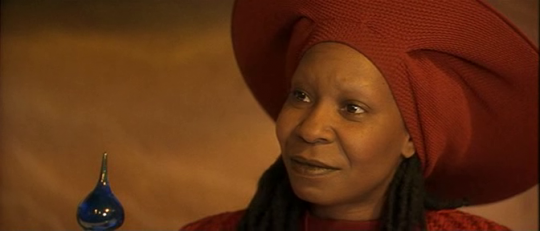
Adam Clarke always believed that Guinan was some kind of a mushroom, based on her hat collection.
1994 was a big year for Trek. Between Deep Space Nine‘s second season, the final season of Star Trek: The Next Generation, Voyager being developed for the now-defunct UPN and the upcoming Generations, Trek was inescapable. Curiously, with all these new projects, no one seemed to be paying any attention to the flagship show, nor had they fully worked the kinks out of the script for the TNG crew’s first big screen outing. All this Trek would be the franchise’s undoing, even if it still resulted in one of the better Next Gen movies…
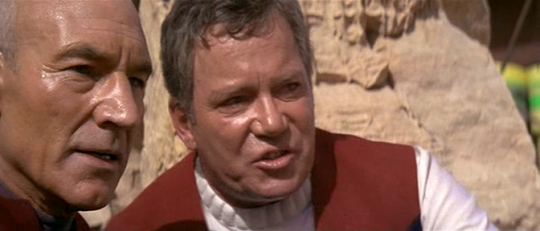
Star Trek: Generations (1994)
We begin with Scotty (James Doohan), Chekov (Walter Koenig) and James T. Kirk (The Mighty Shat) as invited guests on the newly-christened Enterprise-B. The original crew are more or less retired, so these three geezers go from being The Golden Girls in their prime to being holdovers on the Golden Palace. The Palace analogy is cemented by the fact that both De Forest Kelley and Leonard Nimoy were asked to reprise their roles and rightfully declined (both appeared on TNG). Instead, we get the Enterprise alum with the funniest accents, but not the funniest voice (that honour will always belong to George Takei).
Kirk hates the new Enterprise and its captain as we all knew he would, but gets swallowed up by what’s described as an “energy ribbon” or “The Nexus”. See, the space-ribbon is destroying whatever comes in its way except when it doesn’t and instead deposits people who were living inside of it on the nearest spaceship. Anyway, as the Enterprise-B rescues some of the members of the Occupy Swirly Space-Ribbon movement, Kirk goes out in a blaze of glory, it seems, and is ripped out of the Enterprise-B. His “death”, as with Data’s death in Nemesis, pretty much rips off Spock’s death scene from The Wrath Of Khan and ripping off Khan is what Next Gen movies do best (see also: First Contact and Nemesis).
So, what did that opening have to do with the TNG crew? Nothing! The initial prologue introduces the Nexus, Kirk’s disappearance, our villain and, for those unfamiliar with TNG, Guinan (the future Enterprise-D bartender played by Whoopi Goldberg). As such, you might be forgiven for thinking that it accomplished a lot of exposition in a sleek, 15-minute action set piece. However, I’m not forgiving and you’d be wrong. If you showed Generations to someone who’d never seen it and you skipped the entire Enterprise-B sequence, they wouldn’t be any more confused. The film introduces the villain (more on him later) to the Enterprise-D crew and no one is aware of his backstory or the magic space-ribbon. We get introduced to the ribbon concept through Super Mario‘s Toad, er, Guinan, who establishes what the Nexus is, what it does and what the villain’s motives are. There’s no need to explain why Guinan knows him or that it was the Enterprise-B that took them out of the space-ribbon somehow since they’re members of the same race, she says that she knows our villain and that they both spent time in the damn ribbon.
“But what of Kirk?” you ask. “Without the Enterprise-B prologue, we’d be waiting to see him, we wouldn’t establish how he got there and never know that he’s in the movie”. Nuts to your objections. We know Kirk’s going to be in the movie because William Shatner’s face is on the poster, his name is in the credits and the film is called Generations, as in more than just TV’s The Next Generation. The movie’s tag line is “Two Captains. One Destiny”, so you know he and Patrick Stewart are going to meet at some point. When Picard finds Kirk in the ribbon, he could have easily asked him how he got there and Kirk could sum up the prologue in a single line. That entire sequence could’ve been lost to develop the film’s story and characters, which would solve one of the film’s biggest problems (more on that later).
Speaking of scenes that could’ve been cut, we jump nearly eight decades later to the Enterprise-D where Worf (Michael Dorn) gets promoted and Dr. Crusher (Gates McFadden) is pushed into the ocean (don’t ask). Data (Brent Spiner) is irreversibly changed when an emotion chip (sigh) gets fused to his brain. Also, Geordi La Forge (Levar Burton) gets kidnapped by space-ribbon enthusiast and requisite villain, Dr. Tolian Soran (Malcolm MacDowell).
Soran is working with TNG baddies Lursa and B’etor Duras (Gwynyth Walsh and Barbara March) in order to complete his nefarious plan: he’s going to blow up the sun of a planet no one’s ever heard of in order to be picked up by the space-ribbon. You see, you can’t drive a shuttle into the space-ribbon ’cause it’ll destroy the shuttle and everyone aboard. You can get the ribbon to pick you up provided you have exact change and blow up the sun.
Soran isn’t completely one-note. He’s only trying to get back to the Nexus after most of his race fell prey to the Borg. His own life is so nightmarish, that he can’t bear to live without the ribbon. As such, he’ll sacrifice an entire solar system just to be at peace. This attempt at characterization doesn’t really mean much since Picard never tries to reason with him, he never acts like anything other than a super-villain and he gets blown up at the end anyway.
While Data is too busy acting like a putz because of his emotion chip, Picard is all weepy because his family died in a fire. The execution of this plot element is the worst of both worlds for both fans and casual viewers. Trekkies will be disappointed that these characters died for nothing; Non-Trekkies will wonder why characters they’ve never met, nor will they ever meet, were undramatically killed off-screen.
Okay, okay. We briefly see Picard’s nephew in Picard’s Christmas-themed space-ribbon fantasy (AKA Picard’s Uncontrollable Christmas), but that doesn’t really count.
I think Picard’s crying scene was written solely to give ship’s counselor Deanna Troi (Marina Sirtis) something to do. Where was I? Oh yeah. Soran successfully blows up the sun of a planet no one’s ever heard of and the Enterprise-D blows up with our beloved crew aboard.
Credits? No! Picard is also swept away by the ribbon. You see, the space-ribbon is like a genie and the fountain of youth rolled into one. There, he meets a still-living Captain Kirk, who’s been chilling out in the Nexus for nearly an entire century. Picard knows the Nexus is just a fantasy, but apparently Kirk, the guy who spent half of his life throwing himself out of false paradises, completely buys into it.
Argh.
Picard tells Kirk he’s in a ribbon. Kirk says he’s learned to stop worrying and love the ribbon. Kirk’s been living out his fantasy of riding horsies and making omelettes for a woman who was his last great love (even though we’ve never heard of her before). Picard says to lay off the ribbon, man! And Kirk’s all, like, I can quit anytime I want! And Picard’s, like, Prove it! And Kirk’s all, Make me! and then they horsie-back ride their way out of the magic space-ribbon and arrive moments before Soran blew up the sun with his magic rocket.
Wait. Wouldn’t there be two Picards? Wait, you can walk out of the ribbon at ANY TIME? Wait, wouldn’t the ribbon just deposit you wherever it was physically at that moment as opposed to wherever you wanted to go? ARGH.
Anyway, we’re back in time before the sun and the Enterprise-D blew up. The magical, swirly space-ribbon is on its way and Malcolm McDowell wants to go back in time and prevent Tank Girl from happening or something. So, it’s Captain Kirk to the rescue. He saves the day, but a bridge falls on him and Picard buries Kirk’s body under rocks and tells no one of what happened. The end.
Say what you will about the scripts for the following three films, but at least they’re relatively straightforward. Between Kirk, space-ribbons, Picard’s family, Data’s breakdown and Dr. Soran, precious little of Generations connects in a coherent fashion.
In addition to the incoherent, patchwork story, it was a mistake to introduce Data and Picard to film audiences by changing them both irreversibly in the first half-hour. Picard spends most of the film haunted by the loss of his family while Data uses his newfound feelings to hurt my feelings with his birthday clown antics. One would think that Data’s emotion chip would see Data behave slightly differently due to his new, er, hardware. Nope, seems Dr. Soong’s emotion chip has been permanently set on “Schmuck” as Data gurns, sings, guffaws and does puppet shows (I wish I were kidding) to the amusement of no one.
The rest of the cast is given little to do save hold the fort. I guess Geordi being kidnapped is kind of a C-story (D-story?) in the film, but…meh. It’s telling that the most screen time he receives is in a film where he’s essentially the damsel in distress. At least Generations is the only one of the films to remember his close friendship with Data.
So, it’s up to William Shatner to bring some life into this sucker. While the Captain Kirk depicted in this film bares only a passing resemblance to the one from the past six movies, The Shat gives the movie an energy it’s sorely lacking otherwise. Generations never works as a cross-over event because there’s no reason for Kirk to be in the movie. The only reason you’d want a cross-over is for a story that required the presence of Captain Kirk. Generations is the story of how Jean-Luc Picard stopped time in order to get a James T. Kirk to punch a complete stranger in the face.
The only reason you’d have a character like Kirk enter the picture is if he had some knowledge that drove the story. Otherwise, why would he be in the story? In Generations, Picard could’ve pulled out a dinosaur from the Nexus and little would’ve changed. Observe!
Picard and a Tyrannosaurus rex in a Starfleet uniform emerge from the Nexus to fight Dr. Soran. The T. rex eats Soran and disables his sun-exploding missile, but is fatally injured in the fracas. Picard tends to his Cretacious chum in its final moments…
PICARD: I couldn’t have done it without you, Lt. Chomps.
CHOMPS THE T.REX: GROK!
PICARD: Yes, Chomps. You made a difference one last time.
CHOMPS: (quietly) Grok.
Chomps the T. rex dies.
For a cross-over story to work, the character of Jim Kirk should play a key role in the story and serve as a counterpoint to his successors on the Enterprise-D. Ideally, we’d also get a sub-plot in which Jim Kirk and Will Riker become each other’s wing-men, but their friendship is tested after Kirk beds Counselor Troi.
This is where we get to the film’s biggest flaw (which I mentioned at the beginning of this review some ten years ago): so much time is spent on the checklist of items in Generations‘ scattered plot that we almost never see any of the characters interact or have much of an impact on each other. The Enterprise-B scene should’ve given the Federation some knowledge of space-ribbons and Soran, but nobody knows about them in the era of the Enterprise-D. Lursa and B’etor have a history with Worf, but they never meet and the importance of their deaths is not addressed. Despite having a shared history, Guinan and Soran never have a single exchange in the film, nor do we ever see his Nexus fantasy. Most damning of all, as I wrote earlier, no one meets Kirk, Picard never has a real conversation with the guy, none of the other Next Gen characters interact with Kirk and Picard never tells anyone of what happened.
Now, I don’t think Generations should’ve been a cross-over movie. If they had to make one, Kirk needed to be pivotal to the plot. How about instead of the Nexus nonsense, Soran travels to the past to get revenge on the man who brought the Borg into existence: James T. Kirk? One long-standing fan theory is that the machine-human hybrid lifeform created at the end of the first Trek film was a proto-Borg, so that would make sense. All you have to do is come up with a reason why Soran ends up squaring off against an older Kirk instead of preventing the ending of Star Trek: The Motion Picture and you’ve already made a better movie. Let’s say Soran’s time-travel doohicky petered out and he couldn’t go back any further in time. Being rather enterprising for an old psychopath, he decides to kill Kirk anyway. If life gives you lemons, you might as well turn them into murder.
Meanwhile, the Enterprise-D crew tail along, simultaneously trying not to alter history while still hoping to run into a living legend. Generations could then open with Kirk getting shot by Soran. After the credits, we go back to the future, so to speak, to slowly build up to why that happened. The Enterprise-D crew would sense a disturbance in the force or something and find out that someone’s been doing unstable time-travel experiments. Then they discover Soran’s plot, follow him through time and prevent him from killing Kirk. When Picard and his crew return to their century, they see their universe has changed into something they don’t recognize. So, our heroes travel back in time again, this time not only interacting with Kirk in the hopes of discovering why his continued existence resulted in the undoing of their timeline, but also trying to avoid their previous set of selves who travelled back in time to prevent Kirk’s death in the first place.
There. In just 3 seconds, I came up with a better story than the Generations team did in over a year complete with explanation as to why Kirk only appears at the beginning and end of the film. And I did it all with no awkward and pointless scene with the Enterprise-B, no appearance by McDowell during said prologue that creates numerous plot holes (wouldn’t Soran warn people about the Borg, giving Starfleet decades to prepare for an invasion?), no magic space-ribbon, no Picard crying sequences and no watering down/killing off fun TNG villains.
As with First Contact, any returning villains from the series have their menace undercut by new characters. The Borg are an alien race that absolutely will not stop until we’re assimilated? Give ‘em a slutty robot-lady that Data can make out with. Yeah, make her their leader. Think the Duras Sisters, who’ve been toying with Worf for years, are pretty cool? Yeah, let’s have them play second-fiddle to the dude from Tank Girl and blow them up without fanfare.
At least Soran and the Borg Queen are both played by the right actors. Nothing of Insurrection or Nemesis suggests that F. Murray Abraham’s Plastic Surgery Pat or Tom Hardy’s Bald Murphy Brown could have been anything other than embarrassing. If they had such trouble inventing a villain for the big screen, why not use one of the many black hats from all the Trek on television? On TNG alone, you had Q, the omnipotent ham; the parasites that took over the Federation that one time; Gul Madred, Picard’s Cardassian torturer; Nagilum, the face in space; Tomalak, the Romulan badass…
The list goes on. Hell, why not bring in some of the cool enemies from Deep Space Nine? It would make sense given the “Federation at war” storyline that developed on that show while the TNG films were being made. Have the Enterprise crew go up against Weyoun. Since he comes from a race of clones, they can blow him up and he can be back on Deep Space Nine without a hitch. Have the Enterprise crew go up against the Maquis or fight a couple of bad Breens or something. Sheesh.
Look, we all know the TNG movies aren’t very good. What interests me is why. It wasn’t all studio interference. Paramount execs are responsible for this film’s awkward structure (“we want a cross-over film, but one where Kirk only appears at the beginning and end!”), but are otherwise blameless. According to Michael Piller, most of the studio’s feedback on his Insurrection script would’ve made the film a lot better had the filmmakers followed it. It’s not that the writers were bad, as Ron Moore, Brannon Braga and Piller were all seasoned Trek veterans who had penned some of TNG‘s best episodes. John Logan is an Academy Award-winning screenwriter who recently penned the script for Martin Scorsese’s Hugo but, by the end of the day, he’s still the guy who wrote Nemesis.
What it really comes down to is that 1994-2001 were the years where too much pressure was put on the golden goose. The same folks who made Star Trek: The Next Generation a success splintered to create Voyager, DS9 and the movies. Left to its own devices, TNG was a show that offered a variety of episodes including slow character pieces, big action stories, political intrigue, time-travel romps, moralizing through metaphor (a Trek staple), holodeck mishaps and Q dicking around Picard for giggles. These elements were expanded and/or rehashed on the series that followed, but developing those series left TNG‘s 7th season and its subsequent films without much of an identity.
DS9 would build on the seeds of political intrigue, alien cultures and tricky diplomacy in TNG, as well as its more character-driven stories, resulting in a slower-paced series that had the most well-rounded characters of any Trek. Voyager opted for more action-packed stories, old-school “this alien culture is doing something that mirrors a 20th century issue” stories and abused the holodeck and time travel more than any other Trek. When things got dull, Q or Reg Barclay or George Takei would show up. Hell, I’m convinced that the head writer of Voyager was the Swedish Chef given that most of the scripts boiled down to “Borg! Borg! Borg!” What could any of the TNG films offer when TV was serving up intergalactic war, shape-shifters, Klingon legends, Ferengi shenanigans, Jeri Ryan, weird alien cultures and omnipotent god-things twice weekly?
Hell, every episode of TNG, DS9 and Voyager that paid homage to the original series did so better than Generations did. Deep Space Nine‘s Trials & Tribble-ations is pretty much unbeatable in that regard. The TNG films were made by people who had made their homes on other Treks. Working on their own shows meant that no one knew what to do with the Next Gen crew anymore. Creative fatigue resulted in bland, unmemorable Next Gen movies that simultaneously aped the blockbuster films of their time and the more successful Trek films of the past.
This gives Generations a kind of purity over its three follow-ups. Though it certainly has the most incoherent script of any Trek, the film also feels more like an episode of TNG than any other Star Trek: The Next Generation movie. It feels like a lesser episode from that show’s often-boring, mostly-terrible final season, but that’s better than wannabe Summer movies like the other three. Admittedly, the film’s extended episode-like quality may be due to Generations‘ apparent low budget, composer Denis McCarthy’s blandly TV-ish score and the fact that many of the special effects are recycled from episodes of TNG (when they’re not recycling stock footage from Star Trek VI: The Undiscovered Country, that is). Mostly, it’s that Generations is trying to be about something. It’s not an apology for a failed movie like First Contact. It’s not trying to be the light-hearted opposite of First Contact like Insurrection. It’s not an attempt to wrap up the series in one last dark, epic story that still has time for dune buggy rides like Nemesis. It’s obvious that writers Ron Moore and Brannon Braga wanted Generations to be its own beast. They wanted the film to say something about coping with loss, making the right decisions and the dangers of letting life pass you by. It’s also obvious that they didn’t have a clue how to write a story about those things.
Well, I completely regret this decision to revisit the Star Trek: The Next Generation films. While I still love the show, these movies are even worse than I remembered. I wished the films had picked up on the threads of the TV show. We could’ve seen Picard growing closer with his crew, hinted at in the series finale. We could’ve seen Riker get court-martialed as per the events of The Pegasus. We could’ve done the “evil twin” motif of Nemesis with the emotion chip plot by having Data reconstruct his twin brother Lore to learn more about the chip and how it works (meanwhile, Will Riker burst his Maquis twin, Thomas Riker, out of prison). The films could’ve given the supporting cast more to do and given nemeses like Q, the Romulans and the Duras Sisters their due. Instead, the film series begins by dropping a bridge on Captain Kirk. Compared to the indignities yet to come for the TNG crew, he got off easy.






December 28th, 2011 at 5:39 pm
Absolute great series of articles. I haven’t watched any of the movies recently, but after reading this series I may just do that. When I think back at TNG movies, my thoughts are “Well, there’s First Contact, and a bunch of other ones”. I hate how the TNG movies had so much past material to work with, but instead opted to make up new villians for movies (except FC).