

Archive | Books RSS feed for this section
A Poetic Tour of Newfoundland
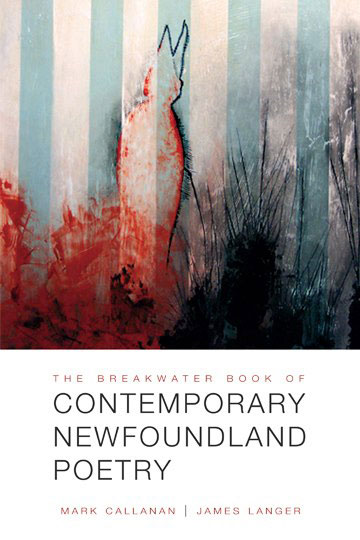
We stand at points of interest — Bonavista, L’Anse Aux Meadows, Cape Spear at the edge of the earth — carrying brochures and travel guides, comparing the glorious landscapes.
Now another guide is in reach, this one, a poetry born and bred of the undulating tides, the deafening strut of the wind.
Here’s a real insider’s guide to Newfoundland.
The Breakwater Book of Contemporary Newfoundland Poetry leads the reader on a journey from the deep past, from the hum of “an old love song learned by some fireside” to the cosmopolitan world of the number five bus and the “passport black” in a Newfoundland sky today.
Co-editor Mark Callanan said each of these eleven poets share a notion of the tradition of broader Newfoundland culture. “But it’s not so much a lamentation as it is an appreciation of their upbringing, and a carrying of that into the 21st century.”
This collection is a guide, a point of reference, a getting at Sue Sinclair’s red pepper heart of what Newfoundland is, and what it is becoming.
An anthology, said Callanan, is also a conversation.
A master narrative pulsating with its own rhythm. “It’s like a dinner party. Bringing these people—poets—together, seeing what kind of conversation gets sparked.”
It’s also a place for readers to explore the spaces between monuments, in the past when salt fish was traded in Europe, and the present when it is still “about to rain. It is always about to rain.”
by Carrie Ivardi
Maybe We Should Tell the Newfoundlanders
Wed, Jan 30, 2013
An interview with Greg Malone by Drew Brown.
Greg Malone has written an excellent book called Don’t Tell the Newfoundlanders: The True Story of Confederation with Canada. It recounts, in great detail, the confidential negotiations that took place between the British colonial administration in Newfoundland, and Canadian authorities in the years leading up to our political union in 1949.
I do have some reservations about the book. I didn’t come away newly convinced that the actual vote outcome was rigged (the 52-48 margin looks different when you consider the overwhelming support for Confederation in the outports). I’m also a little wary of the romantic lens through which we’re shown the ruling class of pre-Canadian St. John’s. (Grad school sucks the fun out of everything!)
That said, I think it’s worth a read. Conspiracy theory aside, Malone does a good job of highlighting just how shoddy the confederation process was. It may not have been rigged, but the deck was certainly stacked in confederation’s favour. By not restoring responsible government after World War II, and then overruling the decision of the National Convention to keep confederation off the referendum, the British disrespected Newfoundland’s right to democratic self-determination. While I’m sympathetic to Confederation, I’m left raw after reading this book.
But probably the most compelling reason to read Malone’s book is because it is probably the best articulated statement of Newfoundland nationalist politics to date. It will get you thinking—and talking—about our democracy, our history, and our place in Canada.
It certainly got me thinking, so I caught up with Greg Malone to talk more about it.
- Don’t Tell the Newfoundlanders: The True Story of Newfoundland’s Confederation with Canada Greg Malone Knopf Canada, 2012 352 pages; $18.77
I really liked the book, and I get the sense that it was a long time coming for you. How long have questions about Confederation and Newfoundland’s place in Canada been on your mind?
All my life actually. Since my early adult life. As I say in the book, I came to Toronto a Canadian and went home a Newfoundlander because I didn’t realize the differences and the prejudices that were about Newfoundlanders.
When I came to Toronto in the 70s, I was very much an internationalist; a citizen of the world. I had been to London and I came to Toronto to make it in theatre. But I couldn’t believe the stuff people would say to me. They’d say, “Oh you’re from Newfoundland,” and they’d laugh and they’d say, “Do you live in an igloo? Have you ever seen television?”
Geez.
I guess I was flabbergasted. We did “Cod on a Stick”, which was laced heavily with political satire about Canadians’ attitudes and about our own attitudes. It was a direct response to that whole wall of prejudice. And so my whole life has been dealing with that issue, in a way. And here I am dealing with it in a scholarly way, 50 years later.
It’s amazing, the attitude is still there. I’ve got a lot of great Canadian friends. Canada’s a great country and it’s done a lot of great things, but the point is, this is not one of them. This is the low point in Canadian history, you know?
The correspondence you go over between the British and Canadian governments—it’s fascinating, but it’s horrifying. It seems almost like they were deliberately being malicious. Why would they act this way?
It’s interesting to note too that they were lying to their own parliaments and their own populations because they were afraid that their own people would disagree violently with what they were doing in Newfoundland. Which is true of course. We were lied to, but everyone else was lied to as well.
There are a couple of points where you talk about how different British MPs and even Canadian MPs—some staunch imperialists—were thrown off by how it was being handled.
That’s what amazed me. The amount of opposition there was in London and Ottawa as well as St. John’s was astounding. Even in the caucus of Mackenzie King there was a big split and a vicious fight over what they were doing in Newfoundland with Lester Pearson, and Norman Robertson, and Wishart, and McCann and him saying, ‘This is wrong. We shouldn’t be even on the ballot in a referendum in Newfoundland. You got to wait ‘til they get their government back and do this thing properly or there’ll be problems forever.’ And they were right.
And in Britain, they were saying the same thing. Lord Beaverbrook and Churchill were down in the bunker arguing about Newfoundland as the bombs were dropping overhead, and Beaverbrook was saying, ‘We’re in an illegal position over there. We need to get out. We need to give them back their government and put this thing right because we’re going to be in an awful position after the war.’ So there was a tremendous amount of conflict in both governments about what was being done. That was very interesting to see and quite heartening to see.
On the one hand it’s awful that this is how it happened, but it’s nice also that it wasn’t monolithic. There were people that were pushing for fair play.
Exactly, and I think that even though it’s a difficult and painful history, and it’s a very shabby kind of a sad history, I think people are going to feel a lot better after they know it, because it’s everything they suspected anyway. To have the truth confirmed is so therapeutic. I think this is going to empower people when they see the real truth and the real way people behaved.
I could see that. Even in the more generous histories of Confederation everyone still seems to lament how badly it was carried out. And after reading this book it seems like that’s putting it mildly. You raise an interesting point toward the end of your book about the weird legal limbo that the Terms of Union actually exist in. Do you think this might be something that could be challenged in court?
Oh, yes. The Terms of Union are a fraud. No Newfoundland authority ever negotiated, accepted or approved them. Ottawa unilaterally imposed them. They were accepted and approved and negotiated by the British government in St. John’s that got a group of cooperative Newfoundlanders to sign it. That’s the best that can be said for it. I don’t think they’re legal or binding on Newfoundland at all. I think we’re Canadians by usage and custom, but not legally.
That’s fascinating. It seems like this has the possibility to open up a whole new avenue of politics. I don’t know if it’s fair to say that you’re in favour of a Newfoundland separatism, but, I mean, logically, where else could our politics go at this point? Especially after reading of the process and the results of Confederation for 60 years, how can you not come to that conclusion?
I think Confederation has suffered chronically because of this. I think it’s crippled. Confederation was manipulated as a tool of empire. All they wanted was resources, so you have a case where the heartland, Quebec and Ontario, are running the country, and they have no idea what to do with the east coast. They didn’t want it. They had no idea what to do with the west coast; the west has kind of slashed and burned its way in now because they’ve got economic power. They’ve pushed their way in.
But Ottawa has had no vision for building the country. We need a proper, mutually-respectful Confederation where everyone can get in and build this country or it’s not going to happen the way it needs to happen. And so we really do need to take a fresh look at these lies and deal with them; get them out of the way. We will never move on if we don’t deal with this.
Yeah, it’s hard to imagine how the country can go forward if we were, like you say, bounced into Confederation. God knows everyone out west has not stopped being mad about it either. It’s almost like we need to actually just reopen the Terms of Union for everybody. We need to refashion the Canadian cooperative.
Definitely. We need to mutually recommit to this thing or it’s not really going to move for us. The whole notion that Newfoundland was a basket case, and that Canada had to save us, and that Canada was our saviour—that’s all bull. If Canada hadn’t got Newfoundland, they would have been the ones who would have disappeared, not us.
That’s what Jack Pickersgill was terrified of; that if the States established themselves in Newfoundland and Labrador and had Alaska, where would Canada be in 20 years? It would be a part of the States. It wouldn’t have any power.
So they had to have Newfoundland. Newfoundland saved Canada, not the other way around. That’s the point of this whole thing.
I just have one last question, and I almost hate myself for even broaching this topic, but I do have to ask: What do you make of the present state of democracy in Newfoundland? Do you ever get the sense that we’re facing a similar situation where say a government that shall remain nameless may be playing fast and loose with our own democratic institutions for say maybe a resource deal of some kind?
Isn’t this funny? It’s all too familiar, isn’t it?
I think that any government that suppresses democracy, suppresses information or weakens the democratic institutions doesn’t do their country any good. They’re not doing Newfoundland or Newfoundlanders any good if they do that. When those dictators go, or those premiers and prime ministers, whatever you want to term them as, all you got left is your system. It’s a process. The democratic process, that’s all the people got. That’s what’s theirs.
If you’ve degraded this, you’ve left your country worse off than when you came in, so you’re not doing your country any good. They do it time and again if they smash freedom of information and suppress democratic procedures in the parliamentary committees. It really, really rots me. That’s treasonable if you ask me. That’s working against your people.
Is there anything else you’d like to let people know?
I wrote this for Newfoundlanders. I felt like it was needed. I really feel that talking about this has the power to liberate us and heal us, really, and make us feel better about ourselves by dispelling the lies of the past. I really hope it does give everyone energy and inspire people.
Magic That Works
Thu, Oct 4, 2012
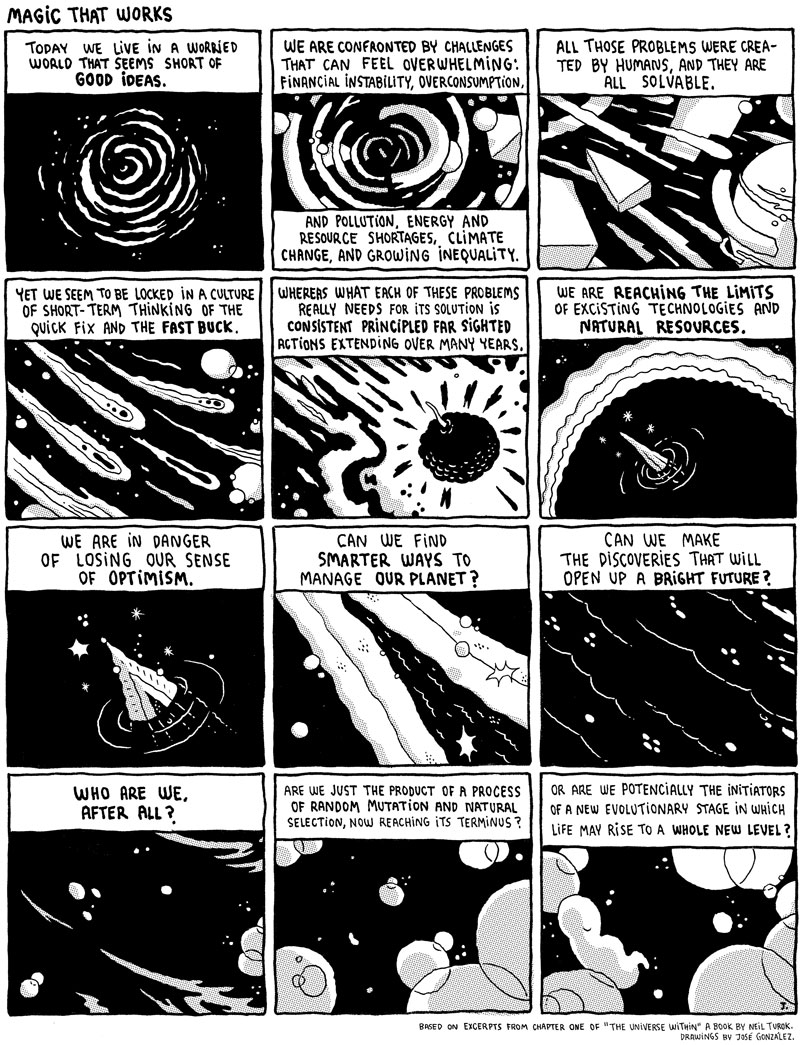
Quotes from The Universe Within. llustration for The Scope by Jose Gonzalez. Click for full comic.
This year’s CBC Massey Lecture series will be given by scientist Neil Turok, the Director of the Perimeter Institute for Theoretical Physics in Waterloo. St. John’s will be the first leg of his cross-Canada lecture series entitled The Universe Within: From Quantum to Cosmos, which looks at the amazing scientific discoveries of the past three centuries, from the relatively intuitive world of classical mechanics to the strange probabilistic world of the quantum.
This is the world you live in, and it’s a world Turok wants us all to want to know more about. And he’s excited about what’s to come.
Interview with Elling Lien.
The Universe Within From Quantum to Cosmos by Neil Turok (House of Anansi Press, 2012, 280 pages; $19.95)
I want to say I really, really enjoyed the book, and I’m excited to hear you speak here in St. John’s
Thank you.
It’s a beautiful book. Personal, elegant, easy to read, inspiring. All of that. It was really ambitious. You start to tell the story of the beginning of science, the beginning of humanity even, and then you go all the way up through to explain key discoveries of classical physics and onto the weirder quantum stuff. Huge! How did you approach writing it?
Uh… Petrified! [laugh]
In February this year, I finally realized the immensity of the task and so I called on my friends at CBC and Anansi Press and I said, “I’m really struggling with how on Earth I’m going to explain all of physics, all of history, all about the future, and make it interesting. They came and we did some interviews and they asked questions. It was very much guided by their sense of what would or wouldn’t be accessible or interesting. I have a tendency as a physicist to get technical and I had to keep that firmly under control.
My editor was extremely helpful and when I was suffering from writer’s block she would say, “let it out. Just write and say what you feel.” And so I found the process of writing the book became a lot about me expressing my core beliefs. This is not a scientific thing, right? It’s more a question of why you do it, why you think it’s important. What it means. What it will mean for humanity. And essentially, writing the book was like a crash course in the liberal arts for me. I’ve never taken a History course or a Philosophy course. I’m a physicist by training, so it was a great chance to look back through history and read a ton of books and try to find a thread: Where did this magical knowledge come from?
And so the lecture I’m giving in Newfoundland is called “Magic That Works.” For me it’s still a miracle. We can learn how nature works on a size the billionth the size of an atom or ten trillion times the size of the solar system. We can figure it out and understand what’s going on. It’s incredible. It gives you a sense of amazing privilege. Of amazing opportunity. Because we’ve done so little with this yet. What is going to come, with quantum computers and quantum electronics and technologies, is going to vastly exceed anything science has created so far.
And, you know, speculating about that: will it change us? How is life going to evolve in the future—because the change may be more through technology than biology. And I think that’s tremendously exciting. I think everyone should be interested in this, whether or not they can follow the technicalities. People should realize this is profoundly important for the future of the world.
I’m really excited to come to Newfoundland and to have the chance to travel across Canada for this, hopefully to impart a sense of optimism. People are so pessimistic today, in spite of the fact that we have these huge opportunities.
[laugh] I appreciated that you quoted the comedian Louis C.K. in your book. [“Everything’s is amazing right now and nobody’s happy.” p.204]
Yeah, I love that quote! Everything is amazing right now, and people are really unhappy. And part of my last lectures I did was to try to understand why people are so unhappy about the technology we have. We’re spending our lives digitizing our thoughts and living glued to a Blackberry or a computer, and it’s pretty unpleasant.
What I realize in thinking about this is that we—I summarized it in the phrase “we’re analog beings living in a digital world.” We like music, we like art, we like continuous natural, if you like, experiences, but the digital is quite harsh. There’s nothing more definite than a 0 or 1. It remembers everything perfectly and is completely unforgiving.
And then I contrast that with the quantum world, which is nature. We are analog beings, but nature is actually quantum. And that’s a whole other level of reality that we’re just beginning to appreciate. I think in the future we will be interacting with this quantum world though quantum computers and quantum technologies, and my hope, which I express in the book, is that it will elevate us to a new level of experience, of knowledge, of insight. And who knows what it will bring, but it’s certain it will completely change us as people.
As I thought about it, one of the things I realized is that people talk about quantum computers as if they are simply a quantitative increase on computers.
Right. That they’re just bigger computers. Faster.
Bigger or faster, more powerful, blah, blah, blah. That’s not the point. They are qualitatively different. There is no comparison. The quantum world works through a simultaneous awareness of all possibilities. It has this sense of knowing all the possibilities of a physical system. I think that’s tremendously exciting. When we start to interact with quantum information, it will raise the level of our thought, rather than lowering it, as digital technologies do. That’s my hope.
[laugh] The quantum world… It’s so… weird! I know you understand that. How the world works at that level seems so unintuitive.
Yes, it’s very hard to conceptualize. But the message I want to get across to people is that we know this is the way the world works. We know there is vastly more potential in the universe than we have used so far. And you look at how successful we’ve been at utilizing basic physics in everything that underlies modern society. When you then think of how much more there is to come, how can you not be optimistic about the future? It’s insanity to feel pessimistic, because, you know, we have energy problems and climate problems and financial problems, but there’s so much more to come, and there’s a whole universe out there. I’m very optimistic we will be exploring the universe, we will be discovering new ways to access energy, we will be rising to a completely new level of intellectual experience with quantum computers. What’s there not to look forward to? It’s incredible prospect.
It’s mind blowing.
When preparing for this I obviously read lots of popular science books to see how other people did it, and one of my heroes is [American astronomer, astrophysicist, cosmologist] Carl Sagan, and to read his books in the early 70s, above all the optimism…
He was extremely optimistic…
Oh yes! It was so cool. And the thing is, you realize the number of people who got into science because of Carl Sagan—or because of Stephen Hawking today—was huge. And those people made a massive, massive difference to the world. The people who invented the smart phone and the internet, and that gave rise to all these other phenomena, including the Arab Spring. So this is a very important cycle of explaining what science is and how much fun and how important it is. Motivating young people to get into it and then seeing them do completely unexpected things.
So this is kind of a complicated question, but would you consider yourself a religious or a spiritual person?
It’s a hard question. I have a huge amount of respect for religious people. I do consider myself to be very deeply spiritual, in the sense that I believe that the universe is amazing, and we have no understanding of why it exists. Physics is helping us to understand how it works, but the fact that it does work, and that we can understand it is absolutely amazing. I think that’s the greatest privilege you could possibly hope for in your existence.
I have a deep respect for religion, partly based on my origins in South Africa, where religion played a very positive role ensuring that the transition from Apartheid was peaceful and people didn’t seek revenge in spite of the gross inequities of the past. So in the book I do make some comments about scientists like Richard Dawkins [an outspoken atheist and biologist] for example, who are utterly dismissive of religion…
I appreciated your blasting of Dawkins too. I find him pompous.
[laugh] You know the danger is not religion. The danger is intolerance. And when a scientist stands on a soapbox and says “you religious guys don’t know the first thing about anything!” He’s not admitting his own ignorance and fallibility. We’re all in this together. I see that scientists can make terrible mistakes too. There’s no guarantee of good behavior because you’re a scientist.
I think it’s very sad that this sort of apparent conflict exists. One of my scientific heroes was [Georges] Lemaitre, a Jesuit priest. He’s the founder of the Big Bang theory, and people asked him “how can you study cosmology and study the Big Bang and all of that—the creation of the universe—and at the same time be a Catholic priest? Aren’t you questioning God when you do this?” And he said, “It’s just two facets of existence. It’s like swimming and walking. You use different muscles. And becoming good at one shouldn’t prevent you doing the other.”
Religion and science are not mutually exclusive for him then.
Not at all! No. It’s part of who we are. There’s a lot of mystery about our existence.
When I was a really small child I lived with my grandmother when my parents were in jail [both his parents did jail time during the struggle against apartheid in South Africa], and she was deeply religious. I saw the attraction. Not just the attraction, but the spiritual side of it. This appreciation.
I remember having very long discussions with my relatives who were Christians and we ended up agreeing that essentially the reason they were religious is through their appreciation of the universe and the miracle of existence. And I think what motivates scientists is very much the same thing.
The CBC Massey Lecture “Magic That Works” with Neil Turok will take place on Wednesday, October 10 at 8pm. Tickets are $25/$15, and are available at the Arts & Culture Centre box office. The print version of the entire lecture series is available now, and is published by House of Anansi Press.
St. John’s From Behind the Wheel
Thu, Oct 4, 2012
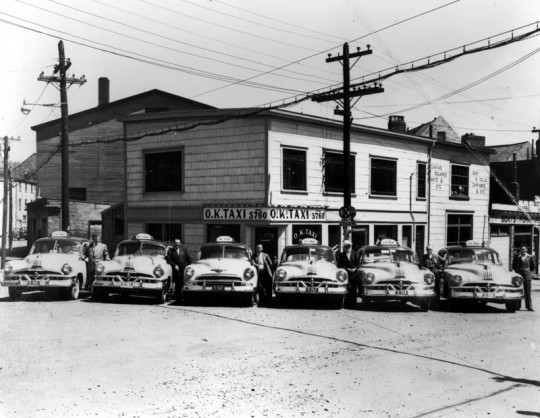
The OK Taxi stand on George Street in 1946. From The Other Side of Midnight (Courtesy the City of St. John’s Archives)
Mike Heffernan’s new book, a collection of interviews with anonymous St. John’s taxi drivers is a fascinating glimpse at an under-regulated industry and a side of the city most never get to see. By Sarah Smellie.
The Other Side of Midnight: Taxi Cab Stories by Mike Heffernan (Creative Publishers, 2012, 250 pages; $19.95)
“One of the things I try to stress in the book,” says Mike Heffernan, “is that these cab drivers see a side of life that the majority of people don’t know exists, let alone see.”
Heffernan’s newest book, The Other Side Midnight: Taxi Cab Stories, is a collection of interviews from over 40 taxi drivers about their lives and their experiences behind the wheel.
Focusing on older drivers—career taxi men, or people who have been in and out of the industry throughout their working lives—Heffernan got a lot of the stories you might expect: a few fights, some bootleg liquor, encounters with drunks and some shuttling of prostitutes.
But he also got a picture of an industry that’s changed with the city, and workers that are trying to make a buck in an under-regulated industry.
“Back in the day, no one owned a car,” he says. “If Nan wanted to go for a run, you called up a cab company. After the Second World War, there were 40-odd cab stands in town. The largest cab companies had maybe 10 cars, whereas Gulliver’s today—now City Wide Taxi—has 90 or so.”
The cab stands were often just a guy operating out of his shed, with a telephone, says Heffernan.
“They also used to have what they called a ‘taxi man shelter,’” he says, “which was not much more than a telephone booth.”
Back then, he says, you had a good chance of knowing your driver and knowing the family behind the company.
But as gas and insurance prices crept up, the companies got bigger.
“Brokers started to emerge in Newfoundland in the late seventies as expenses were going up,” he says. “A broker owns anywhere from two cars to God knows how many, and they’ll rent these cars out to drivers. So, if Gulliver’s has 90 cars, they might own 50 of them, and the rest of them are independently owned by brokers.”
As the industry grew, he says, it also became less regulated: where drivers were once required to have a special licence and a criminal record check, they now just need a Class Four driver’s licence.
“Taxis are governed by the St. John’s city council bylaws,” he says. “And the city has continually deregulated the industry. There is no full-time inspector any more, there are two bylaw inspectors. And they do a whole bunch of things: they enforce the bylaws for the hotdog carts, for example.”
The result is an every-man-(and-sometimes-woman)-for-himself industry that runs on cash and is supplemented by hustling.
If you get in a cab and the driver settles on a price with you—maybe a five-dollar run up Prescott at 3 a.m.— and never flicks on the meter, he or she is “cribbing.” If you have a cab company deliver a bottle of rum to your party, that driver is bootlegging alcohol and making more money for less time and effort than it takes to crib successfully.
“One guy said to me, ‘You get some honest men out there, and they’re probably retirees looking to get out of the house,’” says Heffernan. “‘But honesty is the road to poverty.’”
Some drivers, after picking them up a few times, become chauffeurs for prostitutes. Others have more elaborate set-ups.
“Things you don’t see, but that I saw, are the young couple hanging out in front of a taxi stand looking to sell their slip to get their methadone,” he says. “They’ll have a slip for 80 bucks to go to Paradise and back, to pick up their methadone, and they’ll sell it to a cab driver—who knows their name and has clearly done this before—for forty bucks and buy some Oxycontin. The driver gets to pocket forty bucks for doing nothing.”
Heffernan stresses that all of this has been a part of the city for years; the taxi drivers he spoke to have been a part of the hustle since motels started going up in the 1970s.
“We’re such an insular society here,” he says. “We think that there isn’t any prostitution, that drugs are new, that violence is new. But it’s not. These guys have seen it all, and it’s always been around. The way it’s portrayed by the media, you know, ‘Violence is on the rise, lock your doors!’ But that’s not the way it is. I tried to hammer that home with this book too.”
He also emphasizes that he’s not looking to get cab companies into any hot water.
“The purpose of the book is not a witch hunt,” he says. “I’m trying to describe the working conditions of an underrepresented portion of the working class. Not every guy is out there running liquor. The average taxi driver is just another working class guy, and if he has a chance to make a dollar off the meter, he’ll probably do it. Taxi drivers will take those extra risks because they’re not making enough to feed their families.”
“Ultimately,” Heffernan adds, “that’s what I’m interested in—people and their work environments. Everyone has a job, whether you’re cleaning up garbage or you’re a doctor, everyone has something to tell about their lives through their jobs. And their jobs say just as much about who we are as they do about who they are.”
Mike Heffernan will be reading from The Other Side of Midnight at its launch on Thursday, October 18 at 7pm 6pm at Bianca’s on Water Street.
Fresh Fish deadline fast approaching
Fri, Jun 3, 2011
If you’re a Newfoundland and Labrador writer with an unpublished manuscript burning a hole in your desk, the Writers’ Alliance of Newfoundland and Labrador (WANL) wants to hear from you.
They’re currently accepting submissions for The Fresh Fish Award for Emerging Writers, the WANL’s annual chance to give a deserving local writer a leg, er… fin up in getting their first book published.
The contest is open to residents of the province — you have to have lived here for 36 of the last 60 calendar months — who’ve never published a book before. Manuscripts can be any genre, but entry is limited to one per writer [for the extra-industrious out there].
The winner of the Fresh Fish Award will reel in a $4000 cash prize, $1000 toward professional editing services, and a miniature replica of “Man Nailed To A Fish” by sculptor Jim Maunder for the mantelpiece. Runners up will each snag $500 in cash.
Past winners include Craig Francis Power, author of Blood Relatives; Sara Tilley, for The Skin Room; and Jamie Fitzpatrick, for his novel It All Comes Down To This.
The deadline for submissions is Friday, June 17. Click here for full contest details.
And stay tuned to The Scope — we’ll be publishing excerpts from this year’s freshest fish.
Dividing Island
Fri, Apr 15, 2011
Mark Callanan reviews Lookout by John Stefler
If you consider that John Steffler’s Newfoundland and Labrador Book Award-winning poetry collection, Helix: New and Selected Poems, published in 2002, devoted a mere twenty-six pages of its one hundred and thirty page total to new work (which, while a nice sized serving of pie chart lemon meringue, is still comparatively small), then it’s been twelve years since Steffler has produced a full-length collection of new poems. Given such a protracted length of time, one might expect Lookout to be honed to a pretty fine edge. The Atlantic Poetry Prize jury seems to think so: Steffler’s latest collection has been shortlisted for this year’s prize.
One of Lookout’s ongoing concerns is the self’s relationship to its surroundings—one’s sense of belonging, or not, to a place. In “Dividing Island,” the newcomers on an unnamed island (presumably Steffler and his wife, presumably Newfoundland—though it’s a mistake to read poetry as biography) are described as being “proud of their isolation, the hard / fisherman’s history they’d borrowed, / but hating their dislocated selves, / their forced selves [...]” The end of the poem describes how identity can become subsumed by place, how “people split and / split,” eventually “unable to be / anything but the place, speaking / the place, if not joyously / at least beyond care”—a cultivated stoicism.
In Steffler’s poetry, the relationship between people and the land they settle is usually a frustrated one. Humanity is not much more than a speck on a wide panorama of land and sea. The Blomidons in the prose poem “Lean-To,” for instance, “bend down through mist to study your face,” like some curious folktale giant. In the prose poem “Removals,” the act of observing a clear sky from the “bald Lewis Hills” becomes a reminder of one’s own tenuous place in the world: “it’s easy to lose faith in gravity and see the sky as a depth into which any unsecured body might fall,” Steffler writes, “[...]The whole island a brink.”
In another poem, the man who has “run // a stick fence straight up the hill’s / side, balanced it there like a twig / on the back of a moose who will // twitch its hide in a minute or take / a step” will have to “try again or try something / else.” Humanity’s dominance over the natural world (as symbolized by the fence) is illusory, liable to be dispelled at any moment.
One of the most interesting sections of Lookout, “Colonial Building Archives,” is based on archival photographs of early industrial development in the Corner Brook area. The first of these poems, “VA 13 Humber Mouth,” ends on the crucial image of the photographer himself coming “out of the solid / bush with his sextant and camera and dynamite.” A sextant is a tool for navigation, for locating oneself within the geographical context; a camera is an apparatus for recording the visible world; dynamite is a destructive agent, but one used toward a constructive purpose within the poem (i.e. clearing ground for the laying of railroad track). It’s a nice summary of the settlement archetype: Having found a place and recorded it, we set about bending it to our will.
This conquering impulse is aptlydescribed in “A30-161 Mill Manager’s House, Corner Brook,” in which someone’s brother is returning from Burma “where he built a railroad / through a swamp the size of Holland” and someone’s cousin “spent a year heading up / the Ministry of Language in Ceylon— / completely redesigned their verbs / and prepositions.” The two kinds of imposition (on landscape; on language and culture) are related. When Steffler writes, of the Corner Brook pulp and paper mill’s giant machines, that “You must worship them and be / ashamed of all your heart’s old treasures,” he is suggesting a tension between technological innovation and traditional life.
There is much to admire in this new book, and a few poems worth forgetting. A series of Greek vacation poems just can’t escape the realm of personal anecdote. Reading the opening of the poem “Without Maps” (“We went up Nikis, across Kidathineon, / down Adrianou to Ermou, up along Voulis / across Apollonia into the park and out again, / and this morning by taxi down Ermou to Monastiraki [...]) holds as much appeal as hearing an office colleague recite his summer travel itinerary.
I’se the B’y
Tue, Mar 1, 2011
Mark Callanan reviews Larry Matthews’ The Artificial Newfoundlander.
In Newfoundland literature it’s almost legendary how the Burning Rock Collective, a writing group made famous by the most famous of its members, grew out of a creative writing course taught by author and academic Larry Mathews. While most of the attention has gone to stylistic pyrotechnicians Michael Winter and Lisa Moore, Mathews’ 2003 short story collection, The Sandblasting Hall of Fame, has gained some small (if inadequate) recognition. In a Canadian Encyclopedia entry on the Collective, Mathews’ first book is identified as being among the best short story collections to have been produced by the BRC writers.
 And, truth be told, it is a solid collection: comically adept, but also capable of serious and piercing insights into the human condition. Describing its characters on the jacket copy, Mathews calls them “Clowns [...] that see the Fall of Man whenever they slip on a banana peel.” But “They’re pilgrims too, always looking for something they usually think they’ve found.” The narrator of Mathews’ first novel, The Artificial Newfoundlander, pilgrim though he may be, has no such illusions about having already found what he seeks; Hugh Norman, a fifty-eight-year-old divorced professor of English, seems to have no idea what he is looking for.
At the start of the novel, Norman’s daughter Emily has left her husband, Terry Foley, and taken her children from Vancouver to St. John’s, to live with Norman until she finds her feet. Foley, Norman’s former student and “sometime drinking buddy,” follows Emily to St. John’s, apparently intending to use Norman as a go-between in his quest to reconcile. Soon, however, it becomes apparent that the circumstances around Emily’s leaving have less to do with Foley’s marital infidelities, and more to do with an unresolved crime that Emily may or may not have committed back home in Vancouver.
Norman’s academic obsession is the writing of an obscure Oblate priest, Alphonsus Ignatius Cleary, who, having published four novels “which could never make it onto a university syllabus [...] because they can’t be used to illustrate some grand Canadian theme or other,” disappeared in 1985 “under suspicious circumstances.” His body was never found. Cleary’s greatest distinction (aside from being almost universally unread) is to have been “that rarest of species, a Newfoundlander who loathed Newfoundland and chose to live elsewhere.”
Added to this is the subplot of a burgeoning romance between Norman and Maureen, former colleague, ex-lover, and author of Liza Speaks Her Mind—a poetry collection comprising monologues in the voice of the character Liza from the song “I’se the B’y.” The Liza collection is Maureen’s attempt to portray “the nineteenth-century Newfoundland woman from a serious feminist perspective.” Each poem, as Norman puts it, has Liza “describing some incident from daily life glossed with appropriate feminist commonplaces.” And while the satire here is not very effective, on account of its descriptive vagueness (what exactly is an “appropriate feminist commonplace”?), there is a funny parody of Margaret Atwood’s heavily anthologized hook and eye poem.
Elsewhere, Mathews skewers the world of academe, at one point describing an “eminently acceptable” Ph. D. thesis as “the standard combination of sophistication and tunnel-visioned gullibility that passes for intellectual achievement, the whole enterprise surrounded by an aura of not-really-mattering.” Departmental politics also come in for a drubbing, with Mathews subtly mocking the internal workings of workplace societies, in the university’s ivory tower and beyond.
As the novel progresses, Norman (somewhat unwittingly) comes closer and closer to uncovering the circumstances surrounding the Oblate novelist’s apparent death, he and Maureen slowly rebuild the intimacy of their former romance, Emily is further implicated in the aforementioned west coast crime, and Foley generally makes an ass of himself.
Throughout, Norman remains caustically humorous, endearingly self-deprecating, and often painfully introspective. (He seems doomed to remain an outsider in his adopted province, despite the fact he has lived there for eighteen years.) Mathews makes him say some pretty funny things in service of comedy, but he is also capable of creating the kind of touching moment that results when, for instance, Norman observes his grandson playing soccer rather badly, “his skinny legs pumping ludicrously in the general direction of manhood.”
It is moments like these that push The Artificial Newfoundlander beyond light satire and into deeper cultural commentary, but on the whole, the book comes up short in that respect. It’s a funny and highly entertaining novel, but it doesn’t quite manage the trick of Mathews’ short stories, whose characters manage to be both clowns and, almost in spite of themselves, seers.
Illuminated Script
Wed, Feb 2, 2011
 “A new Chafe play,” Newfoundland theatre scholar Denyse Lynde writes in her introduction to Robert Chafe: Two Plays, “is an event of some importance; it is impossible to predict its nature, but it will be new, it will be different, and it will be theatrically exciting.” If precedent is any indication, then each new Chafe play is also likely to be nominated for one of this country’s highest literary honours: “Butler’s Marsh” and “Tempting Providence,” the scripts that comprise the aforementioned Two Plays, earned Chafe a 2004 Governor General’s Literary Award nomination. Last year, he not only made the GG shortlist once again—for his stage adaptation of Michael Crummey’s short story “After Image”—but won.
Flesh & Blood, the 1998 story collection from which “After Image” is drawn, is set in the town of Black Rock, Newfoundland—“a fictional mining town,” Crummey tells us in his brief introduction to Chafe’s Afterimage. He goes on to describe the gestation of his short story, how numerous real-life anecdotes “began circling one another” in his head and “created a gravitational field that pulled in dozens of other stray incidents and stories” that he had heard growing up, “many of them offering variations on images of fire or electricity.”
Much of Chafe’s adaptation sticks close to Crummey’s original storyline: In the beginning, Winston Evans, a line worker, is badly electrocuted while working on a downed line. He recuperates in the hospital, where he is cared for by a laundress, Lise Lacoeur. Lise is a community fortune teller whose powers of prognostication inform her that she and the burned man will one day be married. And so it comes to pass. Some years later, they have two children of their own, Theresa and Jerome, and have adopted a third, Leo.
Though Leo is unaware of his adopted status, it’s clear to him that he doesn’t quite fit in with the rest of the Evans clan. Theresa and Jerome have their mother’s flaming red hair, are left-handed, and seem touched with her precognitive gift. Winston is so scarred from his electrocution that the school children, while teasing the Evans kids, refer to him as “the hamburger man.” Leo has neither visible wounds nor physical attributes in common with his supposed family. The play’s tension is rooted in Leo’s difference, which, ironically, lies in his utter normality—at least by wider societal standards.
One thing that sets this play apart from other productions, and makes it such a successful adaptation of the story on which it is based, is its highly innovative set design. In designing the set, Jillian Keiley, Artistic Director of Artistic Fraud of Newfoundland (which premiered Afterimage at the Harbourfront Centre, Toronto, in 2009), and frequent collaborator of Chafe’s, made the metaphorical literal by creating an electrified stage. The actors’ costumes were wired such that they could create sparks or mimic flashing cameras, or otherwise literally manifest the electrical current that figuratively runs through Crummey’s short story, and through the play.
Thus, the “Evans touch”—which is what teasing schoolchildren warn against while avoiding physical contact with the Evans kids—is physically manifested by sparks touched off between actors. Electricity becomes the defining element of kinship, a current that passes through the family members like electricity through a completed circuit. That Leo lacks the Evans touch is further proof of his difference.
Honestly, though, writing this review feels a bit like trying to describe Rome by quoting a map or guidebook, without ever having visited the city itself. There’s value in examining a play as text, but I suspect that Afterimage is the kind of theatre that must be seen in order to be fully experienced. It seems to me that much of its effect relies on the accumulation of impressionistic scenes, shot through with electric light, and that much of the script (including the presence of a chorus, which relates snippets of interior monologue and occasional editorial summations), works to contextualize that visual experience of light and dark—the interplay between the two.
Here’s hoping for a remount sometime in the near future.
Death Looks Like a Pontiac
Thu, Nov 4, 2010
Boxing the Compass by Richard Greene, Véhicule Press, 2009, 102 pages; $16
An acquaintance of mine, a poet and critic of some note (or of as much note as is accorded to anyone in Canada who spends their time either writing poems or picking them apart) maintains that poetry should be written as if it is in competition with every distraction the twenty-first century has to offer. And it’s true. It has to compete with Wii and the latest incarnation of American or Canadian or Lithuanian Idol, with the demands of family and with the annoyingly insistent demands of BlackBerry. It has to duke it out with YouTube and Facebook and, yes, even Scrabble—the wooden tile kind. As such, it has to be as arresting as the latest Hollywood blockbuster, minus overpriced concessions.
Richard Greene’s third collection of poems, Boxing the Compass, is up to that challenge. Along with novelist Kathleen Winter and playwright Robert Chafe, Greene is one of three Newfoundland writers to have been nominated for this year’s Governor General’s Literary Awards. (Though, sadly, Greene is perhaps better known—if at all—for having edited Graham Greene: A Life in Letters than for writing poetry.)
Because it includes work composed over the past twenty years, some of which was previously published in one or other of his first two collections, Boxing the Compass reads like a Selected Poems—it’s varied in its tone and approach and has the feel of something spanning many years of work. As indicated in an epigraph to the title poem, the book takes its name from a nautical expression. To “box the compass” is “Not only to repeat the names of the thirty-two points in order and backwards, but also to be able to answer any and all questions respecting its division.”
Several of the poems here have a nautical, or at least maritime, theme. “Whaler” celebrates a great-grandfather “whaler out of Nantucket” (with a wink to Robert Lowell), who, having fallen from a roof near the end of his life, “lingered days to tell / his last stories.” The poem “The White Fleet” reflects on the Portuguese sailors who once populated St. John’s harbour, and would, in act of charity, “pour out their twenty pints / to save some stranger bleeding at St. Claire’s [sic].” The latter poem mourns not only the disappearance of the White Fleet, but also the pillaging of cod stocks by modern fishing methods. “Something ended,” Greene writes; “thirty years of dragnets / harrowed the seabed to a kind of hell.”
Greene’s poetry is at its most vital, though, when it fixes on the present tense. “At the College” makes a microcosm of a college campus, the student body standing in for wider humanity. “Here, among these fierce and sentimental students,” Greene writes, “I stand on the edge of a world not my own, / snatching small goods from the large irrelevance // of what we do, making the old sorrows known / to children bearing their first calamities, / teaching solitude to the newly alone.” “Beside the Funeral Home” displays the wonderful Six Feet Under-ish “any broken heart / costs twelve grand and death looks like a Pontiac, / chrome-detailed and rust-proofed in every part.”
The book’s greatest accomplishment is the long (a full thirty-two pages) narrative poem “Over the Border,” in which the narrator, a character that seems a close facsimile of its author, travels across the United States by trains and buses in order to access the university-housed papers of Graham Greene.
His journey is as much spiritual as it is physical, taking him through bus stations spiked with violent potential (where “each adolescent shout / contains a naked threat of knife or gun”) and archive reading rooms. Along the way, he’s privy to the private lives of Americans, engaging as he does in talk with fellow travellers (there’s something about the camaraderie of travel that makes one more likely to open up to strangers). In the final section of the poem, he arrives at the Lincoln Memorial in Washington where, nearby, a family of ducks moves beyond all human concerns, “casually insisting on what comes next.” It’s a highly symbolic moment, those ducks going steadily about their duck lives, oblivious to human history. You can almost imagine it on the big screen.
Sunday, November 14: Author Miriam Toews at The Ship
Tue, Nov 2, 2010
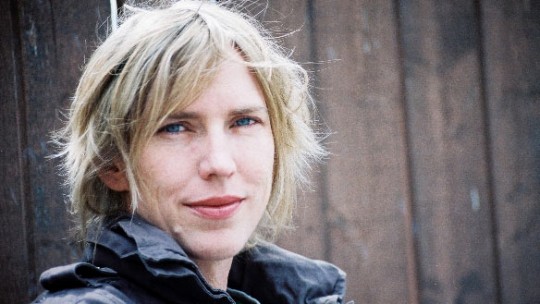
Photo by Carol Loewen
Nomi Nickel is a Sweet Cap-smoking, Lou Reed-listening Manitoban Mennonite looking to piece together the reason why her mother and sister packed up and left her and her God-abiding father behind in their closed-off, tourist trap town. She says things like, “That was before I took boys and drugs into my heart,” and gives Holden Caulfield a run for his money in literature’s Best Dysfunctional Teenager race. She was created by author Miriam Toews, and is the star of Toews’ brilliant novel, A Complicated Kindness, which won a Governor General’s Award. Though Nomi can’t be here, Miriam Toews can, and will be, at The Ship beginning at 8pm on Sunday, November 14, as part of the Writer’s Alliance’s Come From Away Reading Series.
CORRECTION: We made a typo during the editing process! The print edition of The Scope listed this event for November 5th. We apologize for the confusion.
Three local authors up for GG Literary awards
Fri, Oct 15, 2010

Photo of Robert Chafe by Andrea Hann. Photo of Richard Greene by Linda Dobbs.
Finalists for the Governor General’s Literary Awards were announced on October 13th, and three Newfoundlanders have been nominated for the prize.
In the English-language Fiction category, Kathleen Winter has been short-listed for her novel Annabel which tells the story of Wayne Blake, a hermaphrodite born in 1960s Labrador. St. John’s playwright Robert Chafe was short-listed in the English-language Drama category for Afterimage, a play revealing the intimate and electric lives of a family on the margins of society. Richard Greene, originally from St. John’s, was nominated in the English-language Poetry category for his collection of poems Boxing the Compass, which includes the long narrative poem Over the Border about random encounters on American buses and trains.
The short-list represents 70 nominations out of 1,702 submissions. Winners will be announced November 16th in Montreal and will be presented in Ottawa at Rideau Hall on November 25th. Click here to see the other authors in the running.
*Edited on October 17 to include Richard Greene’s nomination.
Kathleen Winter interview
Wed, Sep 15, 2010

If you’re looking for our review of Annabel, click here.
From the press release: “In 1968, into the beautiful, spare environment of remote coastal Labrador, a mysterious child is born: a baby who appears to be neither fully boy nor girl, but both at once. Only three people are privy to the secret — the baby’s parents, Jacinta and Treadway, and a trusted neighbour, Thomasina. Together the adults make a difficult decision: to raise the child as a boy named Wayne. But as Wayne grows to adulthood within the hyper-masculine hunting culture of his father, his shadow-self — a girl he thinks of as Annabel — is never entirely extinguished, and indeed is secretly nurtured by the women in his life.”
Elling Lien spoke with Kathleen Winter, author of Annabel.
Your decision to write about Wayne, you said you had written a short story about another intersex person? How did you make the decision to write a novel around the subject?
Well, when I got into the story I realized that being intersex is different from being anything else on the gender spectrum. It’s different than being transgender, it’s different from being gay or lesbian, it’s different from all these things because it’s still secret and hidden and invisible even to the person themselves, as we find out in many, many cases. At least it was in 1968 when Wayne was born. I’d come to find out it still is and I find that idea of hidden, underground scenes within a person really compelling for some reason, it’s why I wanted to explore it more. The question of gender and what it is I also find really compelling. There’s a section in the novel where someone who’s from St. John’s is looking at men and women and how they appear on the surface. It’s almost a surrealistic section and it’s not very long. It talks about the chasm between people who are placed at both extremes of what we call male and female. The idea of someone walking the tightrope between that and having that territory in between, I just find fascinating. I think we’re all in the territory in between. I think the spectrum ends are really social concepts, so I just find that whole question really, really compelling.
It comes down to millimeters. Medically, it comes down to millimeters, at birth.
Yeah. Many, many people who are intersex never live a life of acknowledging it, it’s kept a secret. Even if they find out themselves, they have to go through all kinds of difficulty to maintain the semblance of one end of the spectrum, and they still live as male or female. It’s only beginning now that some children when they’re born, and normally they have doctors with the parents –- there’s quite a lot written about allowing the ambiguity to exist until the child grows old enough to decide. It’s more in theory now than in practice because I think even a couple of weeks ago I’m hearing this happened to a person I know and it’s the same thing that happened to Wayne. Theoretically, in our minds and in our ideas, as a society we’re embracing ambiguity and duality but in practice we’re still afraid of it.
The Globe and Mail interview mentioned that John Metcalfe didn’t like the short story. It seems to indicate that you took that as a challenge?
I did. John Metcalfe really means a lot to me. He found my stories and gave me the Metcalfe Book Award and also gave me a lot of really important editorial mentorship, but he had certain preferences and one of them was that he didn’t like anything he felt was improbable, outlandish or surreal. I have a lot of stories like that that didn’t get in the book. This one, he kind of put in that category but I didn’t put it in that category. To me it was inspired by what I knew to be real things that happened to real people, so I did take it as a challenge. I thought well, let’s see what else I can do with that one.
Having moved to Newfoundland and having that feeling of being somewhat of an outsider, do you think that made you gravitate towards this kind of story?
I wouldn’t say that it’s a conscious thing, although I am aware that the answer’s probably yes. A lot of the childhood stuff that happened in school about the cliques, especially in grade five, and the bullying -– even if it’s not physical, sometimes it’s physical, sometimes it’s psychological bullying. That’s very much written from observation and experiences. I think that yes, I really do feel compelled by stories of belonging and yes, that was definitely why and that would be one big reason why I felt that need. When I went to Marystown, I was brought pretty kindly behind the school and taught how to speak properly, like a person from Marystown. I had, I was probably from the Newfoundland of England. I didn’t have the Queens accent; I had a really working class, rough, northeast English accent. I’d stick my hand up in the classroom and say, “Can I go to the toilet please?” That would be the subject of much correction and ridicule. Then I remember going to, when I went to Curling in grade four I felt a sense of belonging for some reason. Everybody liked me and they didn’t treat me like some sort of outer space person. Then in Corner Brook it was absolute, unmitigated torture in grade five at Corner Brook for me as a kid. In many, many ways the Wally Michelin of the book was me, in many ways she’s not. But many of the things that happened to her psyche, I know how that feels. That’s why I wrote it. Not just her, but Wayne as well. I wondered if it was too pressing. I don’t want to –- I really try to also put in some light as well, but I’m aware that it’s a novel that has a lot of darkness, and some light, but I’m not sure how to read it.
I was reading that someone else was talking to you about your decision to move to Montreal and a host at a reading wanted to lie on a poster and say that you’re currently living in Newfoundland.
He was writing a poster and he didn’t want me to say that I lived in Montreal. He said Newfoundland is way more exotic, right? The funny thing is, it’s where you are. If you’re in Newfoundland, people from Montreal coming into Newfoundland are considered pretty exotic too sometimes. People want to know what gave me the right to write about Labrador. Did I live there? Did I visit or did I make it up? So I always had to talk about that.
So what is your connection to Labrador? [laugh] You led me right there.
I did a documentary that was an independent documentary but ended up at the Women’s Film Festival in Saint John’s and also on CBC. To do that I went to Labrador and spent some time there, a week or two at a time over a couple years. It got so when I had to leave I got really emotional about it because the place really did something to me. I went for the creative arts festival, I don’t know if you ever went to that, but it’s an annual week-long film festival where they ask different disciplines, including writers, to do and work with young people. So I did that twice. I had made friends there so I would go and visit. People took me into their homes, and not only their houses, but some families have homes in tents and I went there and slept in a tent for days. So I got to see a lot of different ways of living and I wrote journals, but I never intended to set my piece of fiction there until this. Annabel started as a short story and I set it in Labrador. When it turned into a novel, I just kept it there and I realized that I could write it there because I did know, I had seen firsthand enough different ways of living that I could actually write about it.
You moved to Newfoundland when you were little. Do people have the same kind of qualms about you writing about Newfoundland?
Nobody says anything to me about that. I have never been made to feel like I don’t belong, but at the same time I wasn’t born in Newfoundland and I was eight when my family emigrated from Northeast England and moved to Marystown first, and then Curling and Corner Brook. I grew up in Corner Brook and then I worked at the Telegraph for a while after I graduated from journalism school. That’s how I got to St. John’s. Some people say “I’m a fifth generation Newfoundlander.” I can’t say anything like that and I don’t try.
Going by that standard, I would be a first generation. So does that make me any less a Newfoundlander? I don’t know.
I don’t know either. There’s always the question -– I lived on the Southern Shore for a while and I used to be really taken aback when my landlord, who was an old fisherman, he’d ask me, “Where do you belong?” It took me ages to realize that he didn’t really mean “where do you belong,” but it felt like that. I’d go into this existential vagueness of, “I don’t know…”
Then I’d have a person -– and this is in the book, I transferred it to Labrador, but somebody actually said to me –- I used to buy cabbages from him, he was a cabbage farmer, and he said “you’re not from around here because you called them ‘cabbages’ when in fact you’re supposed to call them ‘cabbage,’ no matter how many of them you’re talking about.” I didn’t know that.
But now you do and you told everybody in your book!
I told everybody, yes! But I wrote it as if it was in Labrador, and as in “you can tell you’re not from Labrador…” when in fact it’s from probably one bay in Newfoundland. I never know how local things are, that’s another thing. I don’t know if it’s just local or all Newfoundland. There’s lots of things I don’t know! [laughs]
Annabel, Annabel, Where Did You Go?
Mon, Sep 13, 2010
I’ll probably never forget the experience of reading Kathleen Winter’s short story collection called boYs, not because it was a particularly memorable book (though it is—Winter’s talent is obvious even in her freshman outing), but because I was reading it in a hospital bed after a near-fatal illness, scrawling notes in a weak, childish hand on the inside back cover—in pencil, natch—and trying to come to terms with the fact that I was still around but almost hadn’t been.
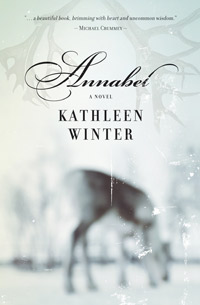
Annabel Kathleen Winter House of Anansi Press, 2010 465 pages; $32.95
Hospitals are borderlands, thresholds between life and death—a place for those in an in-between state. It’s fitting, then, that Wayne Blake, the protagonist of Winter’s first novel, Annabel, should be so painfully acquainted with them.
Having been born with both male and female sexual organs, Wayne is what, at the time of his birth in 1968 in the fictional, coastal Labrador community of Croydon Harbour, would have been called a hermaphrodite—our current vocabulary favours intersex to describe the condition. In addition to having both a penis and a vagina, he also has a fully developed testicle, a single ovary, and a uterus.
The very notion of an intersex birth must raise a profound ethical dilemma for the parents of the child in question, one that Winter examines in her novel. Should they choose what seems to be the child’s dominant sex and have the other set of sexual organs surgically removed, or should the child be raised with all its male and female parts intact? If they decide upon the latter, are they merely setting their child up for a life of alienation from a society that has little tolerance for physical abnormalities?
Medical science has its own, cold methods to determine which sex is dominant. “If the penis reaches or exceeds this length,” a surgeon explains to Wayne’s mother, Jacinta, soon after Wayne’s birth, indicating a marking on an instrument called a phalometer, “we consider it a real penis.” “When a phallus is less than one point five centimetres, give or take seven hundredths of a centimetre,” he continues, but Jacinta interrupts him: “What if it’s right in the middle?”
It’s a question that Thomasina, a close friend of the family and the only other person besides Wayne’s father, Treadway, who is privy to the child’s intersex status, seems to understand better than anyone in this novel. “To Thomasina people were rivers,” Winter writes, “always ready to move from one state of being into another. It was not fair, she felt, to treat people as if they were finished beings.”
But Treadway decides that Wayne should be raised as a boy, and so the surgeon performs the necessary operation to remove the “presentation” of “female aspects” and Wayne begins daily hormone treatment. What follows is a painful journey through Wayne’s childhood toward self-awareness, with Treadway attempting to steer him away from what he deems to be female pursuits. Jacinta is more accepting of Wayne’s “feminine” interests and aptitudes, and even allows Wayne to buy himself a girl’s bathing suit when he becomes obsessed, for a time, with synchronized swimming.
Part of Winter’s strength here is in how she creates, in Treadway, a character that is no brute stereotype of maleness—it would have been easy for her to reduce him to a caricature of machismo—but a man capable of sensitivity who is simply unable to deal with the complication of having a child of indeterminate sex. She is adept at creating such complexities within her fiction. The liminal nature of Wayne’s existence is not just about his having two sets of sexual organs, it is about the duality (or multiplicity) of human nature, human life. No one in this book is any one thing. Jacinta, for instance, is torn between her love for her childhood home of St. John’s and her desire to be in Labrador with her northern-born husband; Treadway is torn between his need to be alone on the trapping line, and his desire to be with his family.
It’s this complexity of vision, this refusal to accept false absolutes that makes Annabel such a stunning novel—that is, up until the latter part of the book. It’s hard to speak to the subject without revealing too much of the plot, so let’s just say that the resolution Winter finds involves the ultimate triumph of one of Wayne’s childhood friends over overwhelming odds, and that when it happens, you feel as if you’ve been wrenched from the hands of an accomplished novelist, and fobbed off on a writer of made-for-TV drama, for whom a pat, emotionally satisfactory ending is more important than the painful truth: that life is not only capable of cruelty, but is often sadistically bent on being cruel. It hurts, largely because Winter, in the bulk of the book, has taken such pains to create a character whose life is (believably and beautifully) one big open wound.
Life after Pi
Thu, Apr 22, 2010
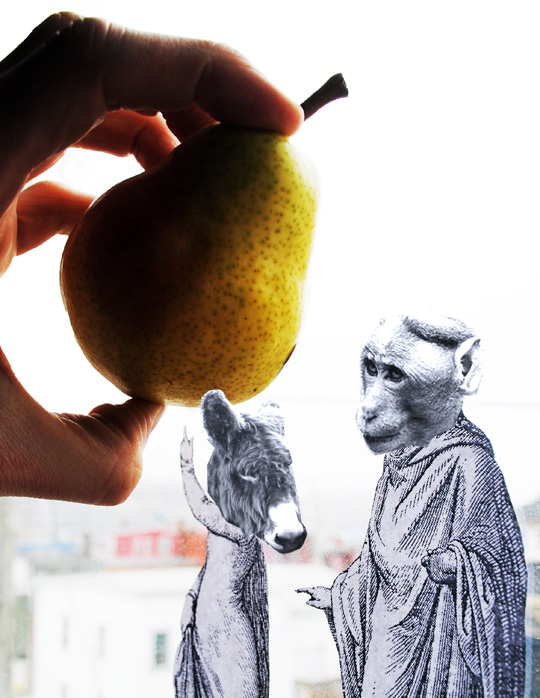
Illustration by Elling Lien
Beatrice & Virgil
Yann Martel
Alfred A. Knopf Canada, 2010
“Writers seldom become public figures,” Yann Martel writes in the opening pages of Beatrice & Virgil, his first novel since the Man Booker Prize-winning Life of Pi. Between the wild, international success of Pi, his much-publicized role as Stephen Harper’s English tutor (see www.whatisstephenharperreading.ca), and the media fervour around this newest novel, it’s clear that Martel has made himself an exception to this general rule.
Part of the reason Beatrice & Virgil has generated so much media interest is that it purports to be about one of the most horrifying events in recent history, the systematic murder of some six million Jews during the Second World War. Strange, then, that Martel’s book about the Holocaust should turn out to be not at all about the Holocaust—or, at least, not directly.
Beatrice & Virgil is the kind of postmodern tale whose plot sounds almost parodic in summary. Henry, a writer, has seen the publication of two successful novels. His third book, however, a gimmicky treatment of the Holocaust that involves the co-publication of a piece of fiction and a piece of non-fiction, has recently been rejected by his publishers and editors as commercially suicidal. Stunned and reeling from this unanticipated slight, Henry and his wife relocate to an unnamed metropolis, “one of those great cities of the world that is a world unto itself.”
There, Henry eventually makes the acquaintance of a taxidermist (also named Henry) who is at work on a play about a donkey named Beatrice and a howler monkey named Virgil, the taxidermied bodies of which he keeps in his shop. Henry begins helping the reticent taxidermist with his script, and much of Beatrice & Virgil unfolds in the form of that stage play. Its setting and its execution owes much to Waiting for Godot—a fact acknowledged by Martel’s sparing use of stage directions and dialogue adapted from Beckett’s existentialist masterpiece.
The initial scene between the two unlikely protagonists is clever, wryly humorous, and proceeds with the bantering back and forth-ness of a Socratic dialogue. Virgil is trying to describe a pear to Beatrice, who has never encountered one:
VIRGIL: …You must imagine an apple that is at its widest in the bottom third.
BEATRICE: I can see it.
VIRGIL: But we must not push the comparison too far. The bottom of a pear is not like an apple’s.
BEATRICE: No?
VIRGIL: No. Most apples sit on their buttocks, so to speak…
Soon, though, it becomes clear that their situation is not as light-hearted as this initial discussion of produce would suggest. The two have experienced an event they refer to as “the Horrors,” are greatly disturbed by it, and are still living under its threat.
Beatrice and Virgil’s central struggle is in finding a language with which they can talk about the Horrors. It’s a monumental task. How does one speak about the unspeakable? How can language describe inconceivable suffering? “Virgil has this idea for short plays where every word…would be qualified by sic,” Martel’s taxidermist says at one point, “because every word, in the light of the Horrors, is now erroneous.”
Fundamentally, this is a story about language’s failure to adequately represent experience. The pear exchange between B & V illustrates the difficulty in describing a common object to one who is unfamiliar with it. How much more difficult, then, to explain the abstract: love, say; hate. In a sense, the Holocaust itself (the macabre details, the catalogue of horrors) is secondary to Martel’s intent. As such, its true impact, the very gruesome reality of all those who died at the hands of the Third Reich, is never represented.
Or almost never. The final section of the book, “Games for Gustav,” comprises a series of short hypothetical situations that speak to the experiences of Europe’s murdered Jews. They are meant as moral contemplations for the reader. The most affecting of these reads: “Your daughter is clearly dead. If you step on her head, you can reach higher, where the air is better. Do you step on your daughter’s head?”
These “games,” concise in form and limited in number as they may be, do what much of Martel’s novel cannot: make us feel, on a deeply human level, what it is to look around and see only death. The rest of Martel’s book is fascinating and extremely well written, but in its coy use of inter-textual references and of signature metafictional tricks, curiously empty of emotion. In a way, its account of aftermath is no less clinical than the cold statistics history has given us, and which fiction should ideally attempt to render more human. Beatrice & Virgil is a successful novel, but a failed work of art.
Galore up for a Governor General’s literary award
Wed, Oct 14, 2009
Nominations for Canada’s most prestigious literary award were announced today, and Newfoundlander Michael Crummey’s novel Galore is in the running for the English-language fiction category. It’s the 50th anniversary for the prize, and the winners will be announced November 17 in Montreal.
From the G-G website: “Michael Crummey’s Galore is a gorgeous and mysterious whale of a book – part multi-generational love story, part riff on the Bible, and part tall tale. Spanning several generations in a remote Newfoundland outport, this story is bursting with fantastical events, colourful characters and delicious dialogue. An unforgettable journey.”
For the shortlists, visit the G-G awards site here.
(Am I right in saying this is the first Newfoundland book up for that award since Wayne Johnston’s The Colony of Unrequited Dreams? Probably not. But lemme know in the comments.)


Tue, Jul 2, 2013
The Scope