

I’ll probably never forget the experience of reading Kathleen Winter’s short story collection called boYs, not because it was a particularly memorable book (though it is—Winter’s talent is obvious even in her freshman outing), but because I was reading it in a hospital bed after a near-fatal illness, scrawling notes in a weak, childish hand on the inside back cover—in pencil, natch—and trying to come to terms with the fact that I was still around but almost hadn’t been.
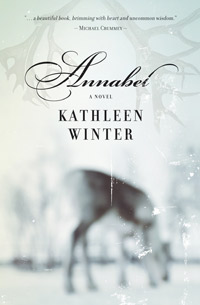
Annabel Kathleen Winter House of Anansi Press, 2010 465 pages; $32.95
Hospitals are borderlands, thresholds between life and death—a place for those in an in-between state. It’s fitting, then, that Wayne Blake, the protagonist of Winter’s first novel, Annabel, should be so painfully acquainted with them.
Having been born with both male and female sexual organs, Wayne is what, at the time of his birth in 1968 in the fictional, coastal Labrador community of Croydon Harbour, would have been called a hermaphrodite—our current vocabulary favours intersex to describe the condition. In addition to having both a penis and a vagina, he also has a fully developed testicle, a single ovary, and a uterus.
The very notion of an intersex birth must raise a profound ethical dilemma for the parents of the child in question, one that Winter examines in her novel. Should they choose what seems to be the child’s dominant sex and have the other set of sexual organs surgically removed, or should the child be raised with all its male and female parts intact? If they decide upon the latter, are they merely setting their child up for a life of alienation from a society that has little tolerance for physical abnormalities?
Medical science has its own, cold methods to determine which sex is dominant. “If the penis reaches or exceeds this length,” a surgeon explains to Wayne’s mother, Jacinta, soon after Wayne’s birth, indicating a marking on an instrument called a phalometer, “we consider it a real penis.” “When a phallus is less than one point five centimetres, give or take seven hundredths of a centimetre,” he continues, but Jacinta interrupts him: “What if it’s right in the middle?”
It’s a question that Thomasina, a close friend of the family and the only other person besides Wayne’s father, Treadway, who is privy to the child’s intersex status, seems to understand better than anyone in this novel. “To Thomasina people were rivers,” Winter writes, “always ready to move from one state of being into another. It was not fair, she felt, to treat people as if they were finished beings.”
But Treadway decides that Wayne should be raised as a boy, and so the surgeon performs the necessary operation to remove the “presentation” of “female aspects” and Wayne begins daily hormone treatment. What follows is a painful journey through Wayne’s childhood toward self-awareness, with Treadway attempting to steer him away from what he deems to be female pursuits. Jacinta is more accepting of Wayne’s “feminine” interests and aptitudes, and even allows Wayne to buy himself a girl’s bathing suit when he becomes obsessed, for a time, with synchronized swimming.
Part of Winter’s strength here is in how she creates, in Treadway, a character that is no brute stereotype of maleness—it would have been easy for her to reduce him to a caricature of machismo—but a man capable of sensitivity who is simply unable to deal with the complication of having a child of indeterminate sex. She is adept at creating such complexities within her fiction. The liminal nature of Wayne’s existence is not just about his having two sets of sexual organs, it is about the duality (or multiplicity) of human nature, human life. No one in this book is any one thing. Jacinta, for instance, is torn between her love for her childhood home of St. John’s and her desire to be in Labrador with her northern-born husband; Treadway is torn between his need to be alone on the trapping line, and his desire to be with his family.
It’s this complexity of vision, this refusal to accept false absolutes that makes Annabel such a stunning novel—that is, up until the latter part of the book. It’s hard to speak to the subject without revealing too much of the plot, so let’s just say that the resolution Winter finds involves the ultimate triumph of one of Wayne’s childhood friends over overwhelming odds, and that when it happens, you feel as if you’ve been wrenched from the hands of an accomplished novelist, and fobbed off on a writer of made-for-TV drama, for whom a pat, emotionally satisfactory ending is more important than the painful truth: that life is not only capable of cruelty, but is often sadistically bent on being cruel. It hurts, largely because Winter, in the bulk of the book, has taken such pains to create a character whose life is (believably and beautifully) one big open wound.





Mark Callanan | Mon, Sep 13, 2010 | 1206
Books