

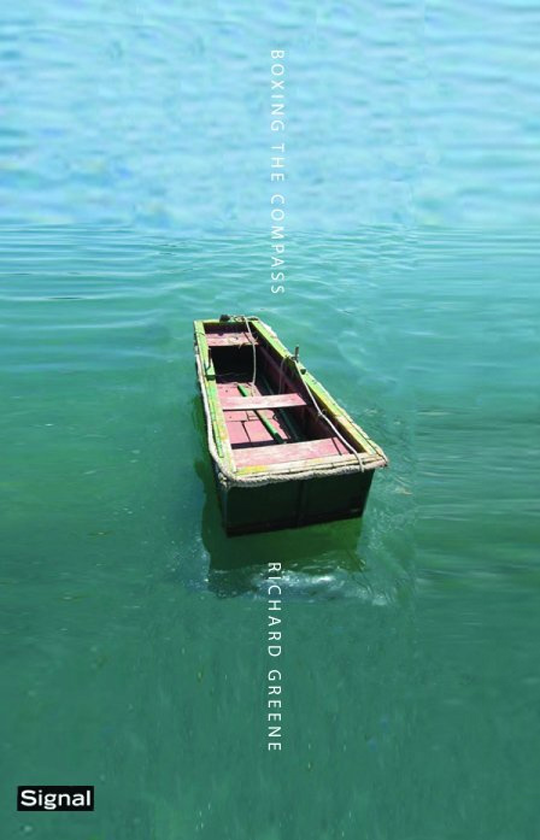
Boxing the Compass by Richard Greene, Véhicule Press, 2009, 102 pages; $16
An acquaintance of mine, a poet and critic of some note (or of as much note as is accorded to anyone in Canada who spends their time either writing poems or picking them apart) maintains that poetry should be written as if it is in competition with every distraction the twenty-first century has to offer. And it’s true. It has to compete with Wii and the latest incarnation of American or Canadian or Lithuanian Idol, with the demands of family and with the annoyingly insistent demands of BlackBerry. It has to duke it out with YouTube and Facebook and, yes, even Scrabble—the wooden tile kind. As such, it has to be as arresting as the latest Hollywood blockbuster, minus overpriced concessions.
Richard Greene’s third collection of poems, Boxing the Compass, is up to that challenge. Along with novelist Kathleen Winter and playwright Robert Chafe, Greene is one of three Newfoundland writers to have been nominated for this year’s Governor General’s Literary Awards. (Though, sadly, Greene is perhaps better known—if at all—for having edited Graham Greene: A Life in Letters than for writing poetry.)
Because it includes work composed over the past twenty years, some of which was previously published in one or other of his first two collections, Boxing the Compass reads like a Selected Poems—it’s varied in its tone and approach and has the feel of something spanning many years of work. As indicated in an epigraph to the title poem, the book takes its name from a nautical expression. To “box the compass” is “Not only to repeat the names of the thirty-two points in order and backwards, but also to be able to answer any and all questions respecting its division.”
Several of the poems here have a nautical, or at least maritime, theme. “Whaler” celebrates a great-grandfather “whaler out of Nantucket” (with a wink to Robert Lowell), who, having fallen from a roof near the end of his life, “lingered days to tell / his last stories.” The poem “The White Fleet” reflects on the Portuguese sailors who once populated St. John’s harbour, and would, in act of charity, “pour out their twenty pints / to save some stranger bleeding at St. Claire’s [sic].” The latter poem mourns not only the disappearance of the White Fleet, but also the pillaging of cod stocks by modern fishing methods. “Something ended,” Greene writes; “thirty years of dragnets / harrowed the seabed to a kind of hell.”
Greene’s poetry is at its most vital, though, when it fixes on the present tense. “At the College” makes a microcosm of a college campus, the student body standing in for wider humanity. “Here, among these fierce and sentimental students,” Greene writes, “I stand on the edge of a world not my own, / snatching small goods from the large irrelevance // of what we do, making the old sorrows known / to children bearing their first calamities, / teaching solitude to the newly alone.” “Beside the Funeral Home” displays the wonderful Six Feet Under-ish “any broken heart / costs twelve grand and death looks like a Pontiac, / chrome-detailed and rust-proofed in every part.”
The book’s greatest accomplishment is the long (a full thirty-two pages) narrative poem “Over the Border,” in which the narrator, a character that seems a close facsimile of its author, travels across the United States by trains and buses in order to access the university-housed papers of Graham Greene.
His journey is as much spiritual as it is physical, taking him through bus stations spiked with violent potential (where “each adolescent shout / contains a naked threat of knife or gun”) and archive reading rooms. Along the way, he’s privy to the private lives of Americans, engaging as he does in talk with fellow travellers (there’s something about the camaraderie of travel that makes one more likely to open up to strangers). In the final section of the poem, he arrives at the Lincoln Memorial in Washington where, nearby, a family of ducks moves beyond all human concerns, “casually insisting on what comes next.” It’s a highly symbolic moment, those ducks going steadily about their duck lives, oblivious to human history. You can almost imagine it on the big screen.





November 16th, 2010 at 4:40 pm
It’s a winner! http://bit.ly/a7l0ft