

Archive | Books RSS feed for this section
The real rock radio
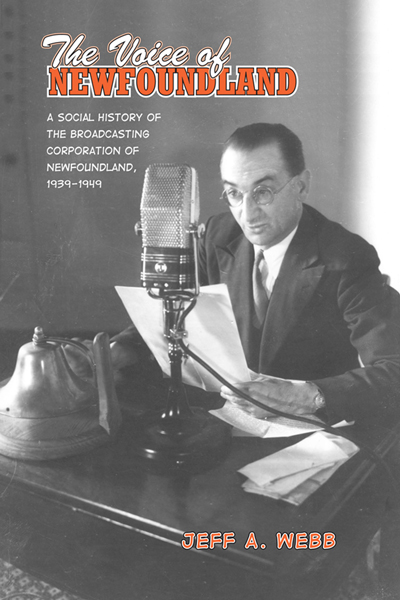
Dave Sullivan and Elling Lien tune in to a new book on the history of the Broadcasting Corporation of Newfoundland—The Voice of Newfoundland.
Before the CBC appeared in this neck of the woods, and before Newfoundland was even a part of Canada, we had our own publicly-funded radio station called the Broadcasting Corporation of Newfoundland.
In a new book titled The Voice of Newfoundland, author Jeff A. Webb looks at the social history of that station between the years 1939 and 1949—a pivotal decade in local history.
War, lack of elected government since 1934, increased economic hardship… it wasn’t pretty. When the first debates on confederation started in 1946, things got really interesting. (more…)
Pushing the boulder
Thu, May 22, 2008
Andreae Prozesky on Marie Wadden’s new book, Where the Pavement Ends.
Aboriginals in Canada have suffered immeasurably at the hands of the Canadian government. The legacy of colonialism and residential schooling, loss of language, loss of tradition and land, and generations of physical and sexual abuse have left communities shattered, and people without direction. While, according to the UN, Canada ranks fourth in the world in terms of standard of living, many Aboriginal people here live in conditions similar to that in the developing world. (more…)
Interview with Sara Tilley
Thu, Feb 14, 2008
A conversation with the author of the recently published novel Skin Room, out on Pedlar press.
Andreae Prozesky: Hi, Sara. What are you doing in Vancouver?
Sara Tilley: I am actually here on a Canada Council grant to mentor with my Clown through Mask teacher, Ian Wallace, for 6 months, to learn to teach other people how to do this work. We’re going to be working with all kinds of people – high school kids, a theatre troupe for people with disabilities, a group of people with terminal illnesses – and I’ll be absorbing as much as possible so I can pass it on. I’m the first person to be trained by Ian in ten years and I will probably be the last, so I feel very honoured. It’s an amazing opportunity and I can’t really believe it yet. (more…)
More than real
Thu, Feb 14, 2008
By Andreae Prozesky
When I try to get in touch with Sara Tilley about Skin Room, her début novel, she’s on her way out of town. Can I send her a few questions over e-mail? Sure.
I’m interested in her narrator, Teresa Norman. Teresa tells her story from two points in time and space; the action of the book alternates, chapter by chapter, between the remote Inuit community of Sanikiluaq, where Teresa is an awkward, bookish twelve-year-old, and St. John’s, where she has grown to become an early-twenty-something photographer, taking head shots of Theatre People by day and snapping tormented self-portraits by night.
Throughout the novel there are elements of the magical, of mythology and mysticism. Teresa’s dream world is vivid and portentous, and her waking life is filled with symbolism and coincidence that may seem at first glance to be a little over the top. And yet, even with all the weirdness that surrounds her, she is startlingly like people I have known, strangely normal in a damaged, neurotic kind of way.
A snippet of my interview with Sara follows.
Why was it important to you to set Skin Room in ‘real-life’ St. John’s?
Both the Newfoundland and Nunavut sections of the book are set in real places. I wanted readers who know the city to feel like they’ve sat next to this character before, or seen her walking down the street, and for readers who had never been here to feel as though they had been. Because the St. John’s portions are set in ‘real’ places, hopefully the reader is also able to read the Sanikiluaq sections and get the same sense of being grounded. Teresa is a character looking for somewhere to belong, and she is fiercely connected to the physical world around her, making the writing about place as important as anything else in her story, I think. (more…)
The Wiggly Wizard
Thu, Dec 6, 2007

It was in September 2006 that Nicholas Gurewitch’s syndicated comic strip first appeared in The Scope. The first panel of the four panel strip showed a poster of a boy sliding down a rainbow and into a book. The next two showed a group of curious kids taking a book from a library, then sliding down a rainbow and inside. In the final panel the kids were shown drowning in an ocean of angry-looking snakes.
Suddenly, the people of St. John’s were transported into a strange world from which there was no escape—full of snakes, crocodiles, angry wizards, and anthropomorphic candy.
It’s a year later, and Gurewitch has published a new book collection with Dark Horse Comics, The Trial of Colonel Sweeto and Other Stories, so we thought it was time to check in. The Scope’s man-on-the-phone Jonathan Adams got a chance to talk to him recently about the new book and the surreal world of The Perry Bible Fellowship.
Outgoing message on Nick Gurewitch’s answering machine:
Boy 1 (dejected): Josiah … we’re doomed.
Boy 2 (despondent): We’re lost without the Wiggly Wizard.
Magical-Sounding Man: Did somebody say my name?
Boys 1 & 2 (together, ecstatic): Wiggly Wizard!!! (Beep.) (more…)
The Architect
Thu, Nov 22, 2007
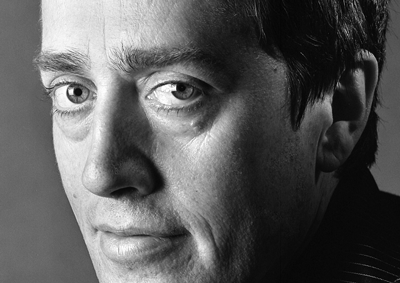
Anna Kate MacDonald chats with Michael Winter about his new book The Architects are Here.
Even for veteran writer Michael Winter, writing a book is still pretty damn hard.
“I don’t really know what I’m doing for a couple of years. I just have a hunch that I have some characters and a few scenes that I know I want in the book. And then I have to figure out a way to hook them all together.”
In his latest novel, The Architects are Here, Winter successfully finds that hook with temptress Nell Tarkington, who links the novel’s three main characters. (more…)
What runs around the yard but never gets tired?
Thu, Nov 8, 2007
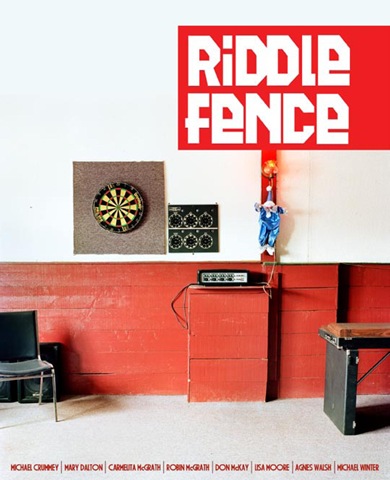
Anna Kate MacDonald takes a peek at the newest local literary journal, Riddle Fence.
To celebrate their twentieth anniversary, the non-profit group Writers Alliance of Newfoundland and Labrador is publishing a new literary journal.
Under the editorship of Mark Callanan, local poet and contributor to The Independent, Riddle Fence intends to shine a spotlight on local talent and serve as a venue for creative writing, as well as a venue for writing about writing.
Learn by doing
Thu, Oct 25, 2007
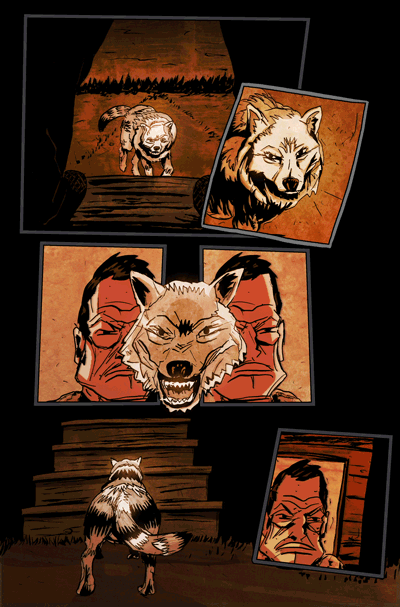
For St. John’s illustrator Paul Tucker, comics are slowly becoming more than just a private obsession.
Having published only a few short comic stories before this year, he was selected by Texas company Viper Comics to do the art for a horror/adventure script they had on hand called Underworld Railroad.
Now, a year later, the 112-page book is ready to launch.
It’s an epic story of Heaven vs. Hell, full of zombies, guns, and plenty of action-movie inspired dialogue. The story is good, but Paul’s art really shines.
Elling Lien sat down with him to talk about how he developed his love of comics, and how he got caught up in the business of comics. (more…)
Over-exposed
Thu, Mar 1, 2007
Jonathan Adams covers up under the blankets with a flashlight to read Mike Heffernan’s Exposed!
No one could have been more tickled, piqued, or (let’s be frank) aroused than myself upon learning there was a new writer in town claiming to lead the parade of a new school of fiction certain to shake up the literary scene: Newfoundland Horror! This is probably the wrong perception to have of Mike Heffernan, however, and one he might never have intended – which is just as well, because he also doesn’t entirely live up to it. (more…)
Death by chocolate
Thu, Feb 1, 2007
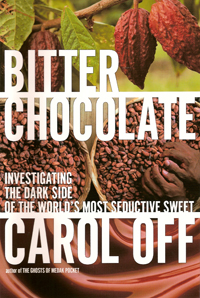
Following accounts of child labour, Carol Off headed straight to the heart of the world’s cocoa production, Côte d’Ivoire. The West African country supplies nearly half of the world’s cocoa beans, which are the principal ingredient in chocolate.
In the past few years, civil war and corruption have weighed heavily on farmers in the region already at the bottom end of a multi-billion dollar business. It left them forced to take drastic measures – including smuggling boys in from surrounding countries and keeping them as indentured servants.
Off’s book Bitter Chocolate is an investigative account of the dark side of this multi-billion dollar industry. Removing the innocent mask from the world’s favourite sweet, the investigative journalist and host of CBC radio’s As It Happens reveals a cycle of exploitation which originated in Central America with the Mayan and Aztec rulers and continues through to the multinational corporations of today.
“One thing is consistent,” the book reads, “then and now, chocolate is a luxury consumed by the privileged at the cost of those much less so. For thousands of years, the chocolate cravings of an elite have been satisfied by the hard labour of an underclass.”
I caught up with Off by phone…
Ten years ago I was a participant in a Canada World Youth exchange in Burkina Faso, in West Africa. I stayed with a family with boys who occasionally mentioned they might head off to Côte d’Ivoire for work. I had no idea they could eventually be heading into something like what you describe in the book…
I don’t think it was initially as drastic as it is. I think maybe ten years ago – maybe starting then because of the World Bank and IMF Structural Adjustment Programs, which forced the ideology that you tear down all the marketing boards, and you tear down all the programs, and people fend for themselves, and price finds its own place, and everyone gets rich. They collected less and less for the cocoa beans they grew.
And what happened is these cocoa farmers just collapsed into penury, because there was no way to defend themselves. So, initially, the labour was pretty mutually helpful. The farmers needed the labour and the labour needed the work. So then suddenly they couldn’t afford to pay for the labour. That’s when the farmers in Ivory Coast started to use their own children and other peoples’ children from outside the country who were desperate for work.
How do they get the kids to stay?
The kids, first of all, think they’re going to be paid eventually. They put up with a lot because they think they’re going to be paid. They’re going through all this shit and they have a moment when they try to get paid and they find out they’re not going to be paid. Then they realize that they’re hopeless, because the whole point of coming to the farms was to make money. When we’re kids and we do work and are treated badly we grin and bear it because we know we’ll get paid. The conditions are much worse there, but it’s the same idea. And then they have nowhere to go, because they were brought there. If you go to these farms and these farmlands, it’s just jungle. They’re not used to the geographic environment, because they come from a barren, prairie-like place. They get into the hills of Ivory Coast and it’s thick and dense jungle and it’s completely foreign to them. They don’t know how to get out and they have no place to go.
When did you first know you had to write this book?
I was going to do a documentary about it, about the children and how they were being treated.
I knew I had to do a book because I wanted to help explain the layers of how this can happen. When you take something like chocolate, which is so innocent and so childlike and central to so many great occasions in our lives, and you show that our pleasure – which is cheap – creates this chaos… Our needs cause all of this suffering. I wanted to show the layer that this suffering is historic. Chocolate has been a luxury that’s been enjoyed by elites at the cost of an underclass since it was first discovered. It shows us, the consumers of the chocolate today, as part of a continuity. We’re no different from Montezuma. We’re no different from Louis XIV. We’re no different from any other group that exploited others to enjoy ourselves. The fact that we think things are now democratic, that the industrial revolution has brought us all to the same place, that we’re all equal, it ignores the reality that a small part of the world is enjoying a democracy of pleasure and goods at the cost of others who have nothing and will have nothing.
I wanted to show the history of chocolate going from the Mayans and the Aztecs up through the issues that the World Bank and the International Monetary Fund introduced to it, and show the trend of slavery and exploitative labour which runs through that whole history. There was only one way to do that and that was a book. I thought I could really show an epic sweep of something this thing most people think of as quite innocent.
And what about the disconnect? How do you feel that people don’t know about this?
I think that people would like to do the right thing, but we want to have cheap goods. We don’t acknowledge, and for the most part don’t want to acknowledge that the price of our cheap goods is paid by somebody else, somewhere else. And that’s whether it’s gasoline you’re putting in your car or chocolate. We live in a fool’s paradise of pleasure and indulgence that someone else, someplace else, pays for.
People know about all the other horrible things that we enjoy that someone else pays for, but I thought chocolate was so strikingly innocent, and so childish, that it was really startling to show people how much we enjoy of life at someone’s expense. Because these are children who are cultivating the beans for us! They are providing the beans to make the chocolate for the children who enjoy it.
I thought nothing – nothing – could be more simple. It’s a perfect example of how unequal and completely unjust things can be.
What has been the public reaction to the book?
It’s been overwhelmingly “Oh my god, what can we do?” Which actually was encouraging for me, because my final moments are completely pessimistic.
That was going to be my next question. Your final sentence in the book was “For as far as anyone can see into the future, there is little likelihood that this ancient and enduring injustice will be corrected.” How did it feel to write that sentence?
I felt absolute despair.
Even as I was telling people I was writing this book they would say, “Oh no, another thing we have to worry about,” or, “Oh great, now I can’t eat chocolate any more.” All kinds of cynical messages, even among people I thought would care. I thought if that’s the reaction to my writing this book, I don’t give up much hope for change.
What also gave me despair was to realize people can’t fight this on a consumer level. I don’t think fair trade products are a solution.
A lot of people would be surprised that you’d say that.
Yeah, I think so. And I don’t want to disparage people who are really trying to do something like that, but fair trade is such a small part of the product.
It also removes the consumers who are conscientious and who put pressure on things, who have something to say, from the game.
They say, “All right, I can’t deal with the whole bloody mess, so I’m going to eat this fair trade stuff and feel okay, so I can get through my day.”
Fair trade removes all the people who could put up a really good fight, and it leaves the people who don’t care making the decisions.
So I concluded that my despair came from realizing there was no consumer solution to the issue of child labour and chocolate. We don’t have much power as consumers. We have far more power as citizens. It’s far more important to insist that we cannot have products coming into the country that have exploitative labour as an ingredient.
The giant corporations are not going to suddenly say, “Well, fine, we’re not going to make chocolate any more if you do that.” They’ll be forced into fixing things. That’s where the pressure comes from.
That’s what gave me a lot of hope. People who are contacting me and who are mobilizing politically.
How are they mobilizing?
They’re pressuring government. I’ve heard from a lot of people in Ottawa, NDP people, I’ve read some blogs where people were saying, “We have to make this one of our issues.” That’s in Canada.
In the United States there’s this fantastic group, the International Labour Rights Fund, who are mounting a challenge against the chocolate companies in court. I think challenging corporations in court is really useful.
But that’s the kind of aggressive political action you have to take. Use the courts, use the political system, use committees.
I think we’ll see, now that the Democrats have Congress again that we’re going to start seeing some mobilization again on the cocoa trade. And you sort of feel, “yeah, maybe the world’s waking up.”
Is there a particular image that sticks with you after finishing your book?
Yeah, the kids in Côte d’Ivoire on the cocoa farm, and hearing them say they said they didn’t know what the cocoa beans were used for. And these were the third generation of kids up there, you know? Plucking those beans. They didn’t know what we did with them. Their parents and their grandparents didn’t even know what we did with the beans. They send the beans here, and they don’t know what we do with them.
And this is the world’s chocolate.
At that moment I wasn’t thinking, “Those poor children, they need some chocolate.” I was thinking, “Those children need some shoes. They need something to eat. They need inoculation against diseases. They need a place to go to school.”
Carol Off’s Bitter Chocolate: Investigating the Dark Side of the World’s Most Seductive Sweet is published by Random House.



Thu, Nov 6, 2008
The Scope