

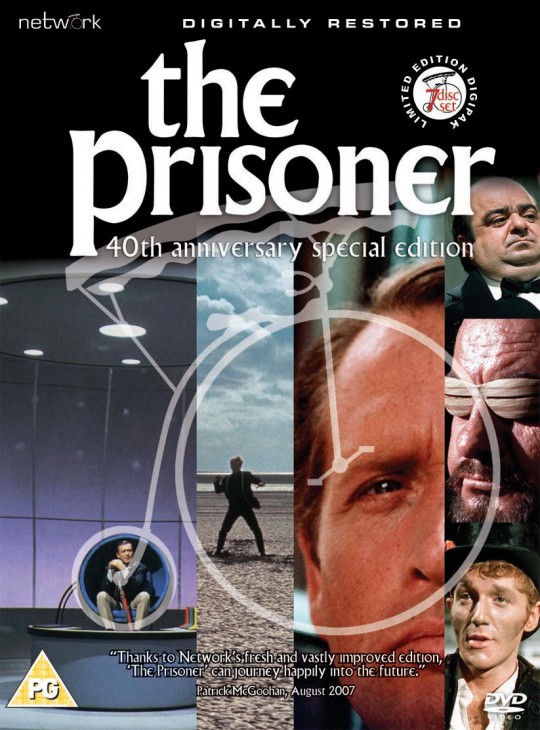
Adam Clarke‘s current ringtone is the trippy “Speedlearn” music used for this episode.
Where am I? Since arriving in the Village, the man called Number Six has had his identity shaken by the sudden appearance of an identical twin claiming to be the real Six. He’s been drugged, beaten and betrayed by fellow prisoners and double-agents alike. He’s tried to escape many times to no avail. Rescue isn’t an option since the Village has arranged it so the rest of the world thinks him dead. All the rotating Number Twos want to know is why he resigned. Six just won’t budge.
My ordering of the first seven episodes of The Prisoner is as follows…
1. Arrival
2. Dance of the Dead
3. Free For All
4. Checkmate
5. The Schizoid Man
6. The Chimes of Big Ben
7. The General
“Chimes” was the second episode to air, but was clearly set later than the episodes aired after it when compared with “Checkmate” and “Dance” (both aired much later). “The Schizoid Man” had a teaser for “The General”, which aired directly after “Schizoid” on ITV. However, having “Chimes” occur before “Schizoid” makes no sense. Six would never come close to another person after the far-reaching betrayal from Nadia and his employers at the end of “Chimes”. So, “Chimes” is a brief respite from a loose trilogy of episodes (more on that later)…
Enough about the sixth episode, let’s briefly recap the fifth before reviewing the seventh. In “The Schizoid Man”, Anton Rodgers’ Number Two made mention of “the General”, which was hinted as having great power in the Village and not being altogether human. Tonight, we meet “the General”…
The Plot (In Six Words Or Less): Top hats plus supercomputers equals learning.
The General
Written by Lewis Greifer (credited as Joshua Adam).
Directed by Peter Graham Scott.
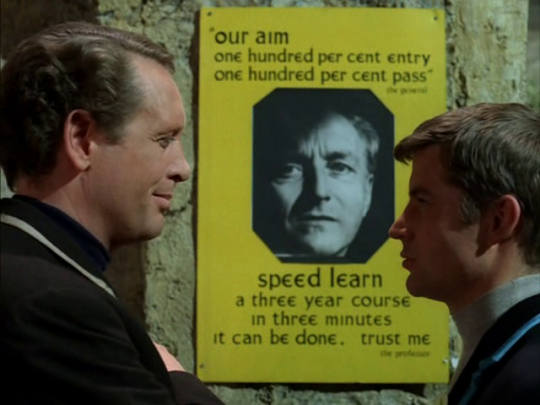
Having lost trust in Nadia/Number 8 and Alison/Number 24, Number Six is alone in the cafe watching helicopters soar over the Village. Over the sound system is an announcement from “the General’s department” urging people to return to their homes and watch the broadcast of someone called the Professor. Most of the cafe’s customers scarper home, but Six stays for another coffee. Looking about, he sees various posters showing an old man’s face, advising Villagers that they can learn six months worth of studying in a matter of minutes. He also spots a young man (John Castle aka the villain from Robocop 3) staring at him…
The man, the new Number Twelve (it’s safe to say this isn’t Curtis from “The Schizoid Man”), introduces himself as “a cog in the machine”. Number Six asks him who the Village helicopters are after. Twelve states that the man the Village is hunting for is their much vaunted Professor, then leaves Six before Village eyes take notice.
Six, unsure of Twelve, makes his way towards the beach where he spots the old man from the cafe posters (Peter Howell) running for his life. He is the Professor. With nowhere to run, the Professor collapses and is quickly captured by a Village search party. As he’s dragged back to the General’s office, Six spots a tape recorder on the beach. On the recording, the Professor warns anyone listening about the dangers of the Village’s new method of learning. Six buries the tape recorder in the sand before any Village goons take notice.
At Six’s residence, the television is already on as an announcer (Al Mancini) introduces viewers to the Professor’s wife (Betty McDowall) while Six sits and watches, eager to find out more about the Professor and the General. When the announcer is informed that the Professor is in a more agreeable state of mind, the screen jumps to an image of the Professor in his study. There, he makes an announcement about Speedlearn, a subliminal transmission that imprints a six month study of any subject in three minutes. The process seems impossible, the Professor admits, but the General has made it a reality. Speedlearn will end teaching as we know it.
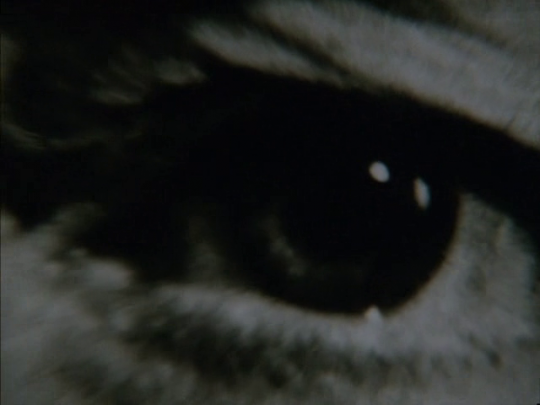
Soon the live feed of the Professor is replaced by a photo of the Professor’s face. The image slowly turns into a close-up of the Professor’s eye intercut with flashing lights. Six stares, hypnotized by the Speedlearn montage. After the broadcast, in walks the new Number Two (Colin Gordon). He’s looking for the Professor’s tape recorder and suspects Six has it. While a search of Six’s residence proves useless, Number Two is eager to prove the effectiveness of Speedlearn and asks a few questions about the treaty of Adrianople and the like. Six answers them, offhandedly at first, but is then unable to stop. As Six robotically repeats textbook answers to European history questions, Two joins in and repeats Six’s spiel word-for-word. “Ten out of ten,” Two quips.
Before departing, Two offers a bargain. If he returns the Professor’s recorder, Six can leave the Village. Unnerved by the effects of Speedlearn, Six telephones another Villager and asks him the same questions Two asked moments before. The man on the other end of the line repeats the same answers Six gave without variation. Hanging up the phone, Six ignores the announcement of the Village’s curfew time and heads back to the beach.
Returning to the spot he’d buried the recorder, Six spots Twelve again. Twelve hands him the recorder, but Six doesn’t trust him. For Twelve, this doesn’t matter. Though he’s serving the Village’s board of education, Twelve is trying to subvert the Village’s intentions by working with them as a cover for helping Six. As Twelve heads back to Village HQ, Six listens to the tape recorder. This is the speech the Professor wanted to make, urging Villagers to destroy the General.
The next morning, the Professor’s wife meets with a group of Villagers near her home. She’s an artist and is encouraging them to make any kind of art they feel like. Amongst them is Number Six, sketching on a notepad. Six expresses incredulity towards this art class, noting that one Villager is standing on their head and another is ripping up a book. The Professor’s wife says the former is gaining a new perspective and the latter is making a fresh concept; creating something new by destroying something old. Six hands his portrait to the Professor’s wife, which is a caricature of her decked out in militaristic regalia. Disgusted, she tears it up. “Creation out of destruction?” Six asks.
Oh, Number Six, you’re such a dick.
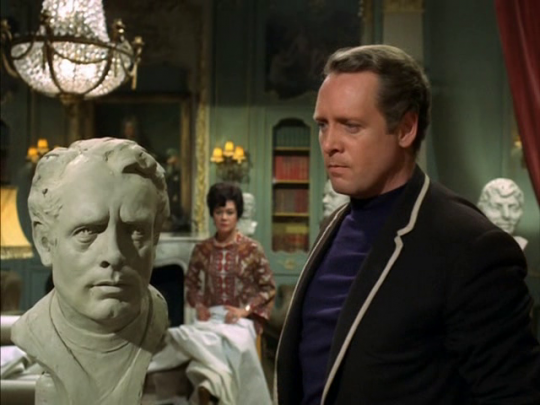
Tailing her back to her house, Six grills the Professor’s wife about her husband and the General, ripping sheets off various sculptures in her home. Among them are busts of Leo McKern’s Number Two (previously seen in “Chimes”), Colin Gordon’s Number Two and Number Six. Gordon’s Number Two then strolls in with a doctor who informs Six that the Professor’s resting. Behind them, the Professor’s head is visibly peaking out of his bed. Six wanders over with a cane and whacks the sleeping Professor in the face with it. The Professor’s face smashes into several jagged pieces, as that was just a hollow sculpture. With the real Professor elsewhere, Two tells Six that his offer of escape in exchange for the Professor’s recorder is cancelled.
Six returns home to find his power’s gone out. This is the work of Number Twelve, who uses this brief blackout to give Number Six some electronic passes he’ll need to circumvent Village security and sabotage the General’s upcoming broadcast. The next day, Six shows up dressed as a Village board member. Using the passes Twelve gave him, Six nearly disturbs the Speedlearn transmission only to be knocked out by a guard before he can cause any damage.
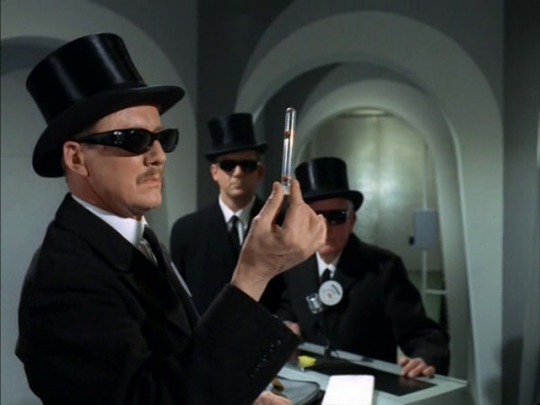
Eager to find out who gave passes to Number Six, Number Two drags Six and Twelve to the only one who could uncover the Six’s co-conspirator with 100% accuracy: the General. At the General’s office, the Professor is preparing more information for a Speedlearn broadcast. Two beams with pride as he reveals that the General is a supercomputer devised by the Professor. With the initial Speedlearn broadcasts a success, the Village can soon move on to its true aims. They don’t want to educate people, but to change the way they think. With Speedlearn, any information people want will be theirs without having to crack open a book. If the Village controls the information, they can distort reality to suit any purpose with the masses none the wiser.
As Two prepares a request for the General to deduce which Village board member is the saboteur, Six interrupts with a promise that he can stump the supercomputer. Number Two calls Six’s bluff and lets him ask a question so insoluble, even a sophisticated supercomputer with a reel-to-reel might not know the answer. This being a TV show filmed in 1967, guess what happens next…
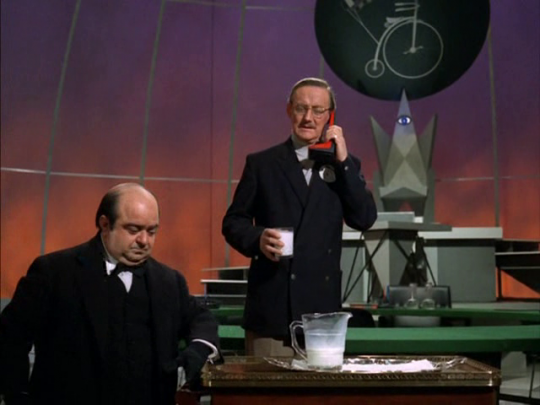
Who is Number One? One fan theory was that the mute butler, featured in most episodes and played by Angelo Muscat, was Number One. Many have cited that the butler isn’t in the scenes where Number Two takes a phone call from some supervisor (presumably Number One) and, other than that, it would’ve been a SHOCKING TWIST. That theory is disproved by this episode where we see Muscat in the room while Gordon’s Number Two is on the phone with some unheard boss.
I haven’t written about Muscat or the butler in these pages, but I will when we get to the two-part finale, which sees his importance increase dramatically.
Whose Side Are You On? After the end of “Chimes”, we see Six’s goals have changed as the series has progressed. After various attempts to escape in the first six episodes, Number Six’s now focused on beating the Village. At no point does escape take precedence over the mystery of the General and Six’s need to disrupt the Village’s plans.
There’s a handful of episodes of The Prisoner that crap out in the last act. While “Checkmate” had a fine ending that hurts the episode only in re-watch value, “The General” goes for broke with a very silly climax involving a supercomputer that you know will be outwitted by Six before the episode’s end. I’m surprised they didn’t have two supercomputers, so McGoohan could turn to one and say “I love you” before turning to the second, identical supercomputer and say “but I hate YOU”.
That line’s straight out of “I, Mudd”, an episode from Star Trek‘s second season which aired the exact same day as “The General”. November 3, 1967 was an exceptionally good day to watch TV heroes outwit machines. Especially if you didn’t realize Trek had aired an episode with the exact same stock ending (“The Changeling”) five weeks prior. Though outwitting the supercomputer is not as enjoyable a trope as the doppelganger, I still love “The General” and its stupid, stupid ending.
So, why is this an essential episode when more respected episodes like “Hammer Into Anvil”, “Many Happy Returns” and “A Change of Mind” don’t make the cut? For starters, “A Change of Mind” has an even dumber ending than this episode, losing steam completely after the first twenty minutes. I’m also trying to avoid repetition. “Returns” is a slick, Twilight Zone-esque episode, but it doesn’t hold a candle to the escape scenes in “Chimes of Big Ben”. In the episodes “A. B. and C.” and “Once Upon A Time”, we’ll see more imaginative and interesting takes on the “Number Six causes Number Two to break down” plot than “Anvil” offers.
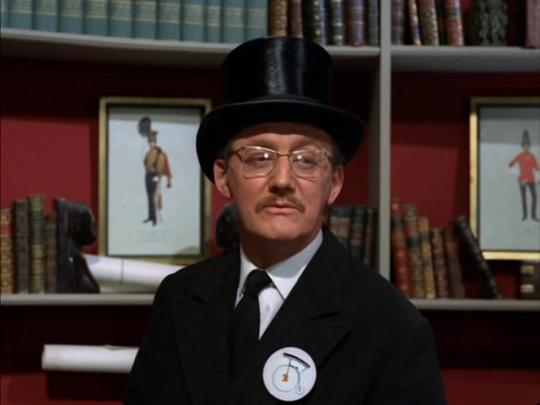
Also, unlike “Anvil”, the script isn’t spoiled by a rotten Number Two. Number Two is such a perfect part; a menacing blank slate for character actors to do whatever they want. While the demonic Mary Morris and avuncular Leo McKern are a great deal better than the other Twos, most of the actors put enjoyable and often memorable spins in their turns as Prisoner villain of the week. Colin Gordon may be a poor man’s Vincent Price, but he’s leagues ahead of the awful Patrick Cargill in “Anvil”. Gordon is not a great actor, but like Eric Portman in “Free For All“, he’s got great chemistry with creator-producer-star Patrick McGoohan. Like the best episodes of The Prisoner, “The General” is full of clever, snappy dialogue, which McGoohan and the current Two savor.
“The General” forms a loose trilogy with “The Schizoid Man” and “A. B. and C”. Not an immediate trilogy, as “Chimes” still makes the most sense when sandwiched between this episode and “Schizoid”. This series of episodes offer more than interconnected plot points or straight cliffhangers. “Schizoid”, “General” and “A. B. and C.” (more on that next week) tackle the ways we think through notions of identity, education and the subconscious. The Village can copy you, condition you and even invade your dreams. You’re constantly fighting the outside influences that pollute your mind and weaken your thinking. Your mind is always on the risk of being broken by the evil forces around you. It’s a terrifying, paranoid worldview even though the last two Colin Gordon-starring episodes of this trilogy bring the Village closer to Stan Lee than the terror of “Dance of the Dead”.
Education is the perfect theme for this show to explore and showing the dangers of Number Two’s “No Village child left behind” policy, even if the execution is silly. Silliness is no great detriment to this show. I wouldn’t have as much interest in The Prisoner if I didn’t like dark surrealism as much as I love silly spy-fi shows of the late 60′s. This episode boasts a great atmosphere with elaborate sets, the quirky boardroom costumes and excellent incidental music (the dreamy Speedlearn theme being the highlight). What’s not to love?
As per “Chimes” showing us that the Village’s reach extends to London and maybe beyond, “The General” shows us what the Village does when they’re not just out to break Patrick McGoohan. For the first time, we see the Village attempting to change society instead of one man. Also of note is Number Twelve in “The General”. With 12, we have a Village double-agent who’s actually trying to help Six (and pays a heavy price for it), syncing up perfectly with Six’s altered intentions (now engaged in war with the Village instead of looking to escape) and offering a refreshing to change to viewer expectations.
In another twist to audience expectation, we have the General itself. Yes, the supercomputer cliche was already a cliche when this aired, but this episode is almost daring you to invest some greater mythology in the machine. It’s a nice fake-out for the many viewers who doubtlessly thought that either the General was Number One or that One would turn out to be a supercomputer. The General is said to be an unbelievably important Village experiment and implied to be the first Village plan of such complexity. By blowing up the big computer at the end of this episode, the series seems to be blowing up the idea that Number One will turn out to be a robot or Nomad from The Changeling.
Of course, the actual conclusion to the series would be far crazier than a mere supercomputer running the Village. More on that at the end of this series. Instead we say goodbye to “The General” as a mostly successful, if dated, part of an immensely entertaining trilogy of episodes. Be seeing you.
Next time: This trilogy gets weirder still.






October 20th, 2013 at 12:29 am
A wee bit harsh on Colin Gordon perhaps? :) Gone back to watch this episode following your review having skipped it so far on my rewatch and is proving better than I remembered :)
October 23rd, 2013 at 10:35 pm
Colin Gordon had it comin’
I really enjoyed the episode, but the climax can’t support the intriguing storyline. I nonetheless enjoy how silly said climax is, even if it is a letdown.