

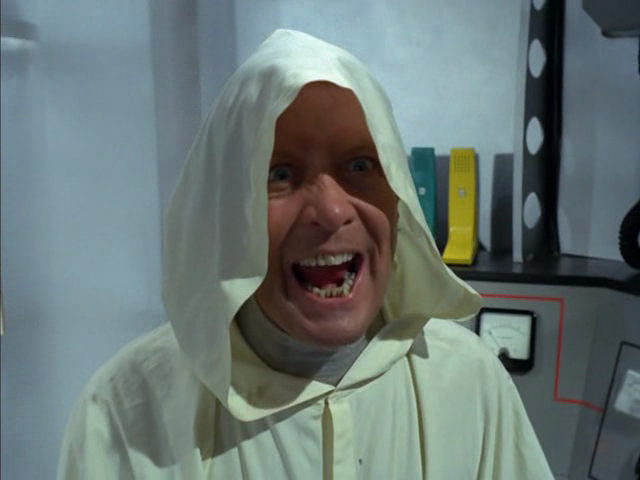
Adam Clarke gives The Prisoner finale a stare.
Where am I?
When we last left Number Six (Patrick McGoohan), he’d been locked in the Embryo Room with an old Number Two (Leo McKern) he met in “The Chimes of Big Ben”. What followed was a battle of wills in experimental psychology, but Six quickly turned the tables on Two and seemingly killed him. When a Village supervisor (Prisoner regular Peter Swanwick) entered the Embryo Room, he congratulated Six. The man called Number Six has been drugged, hypnotized, drugged, had his dreams analyzed, forced to run for mayor of Jefferton, put in a VR simulation that made him think he was a cowboy, drugged, beaten, hypnotized again and drugged again. Having now beaten the Village, the supervisor takes him and Number Two’s Butler (Angelo Muscat) to meet Number One.
Tonight’s Plot (In Six Words Or Less): This episode? Six words? Nope.
Fall Out
Written & Directed by Patrick McGoohan
Whose Side Are You On? I’m not going to bother recapping this episode since it’s much more about style than plot. Just a few basic questions to be answered…
Did Leo McKern’s delightful Number Two really die last week? Yeah, but he got better. It looked like he had a heart attack, but Two suspects Six poisoned him. The Village hooked Two up to a machine that revived him (seemingly made out of leftover parts of “The General”).
Do we meet Number One? Yes and no.
Does Six escape the Village? See above.
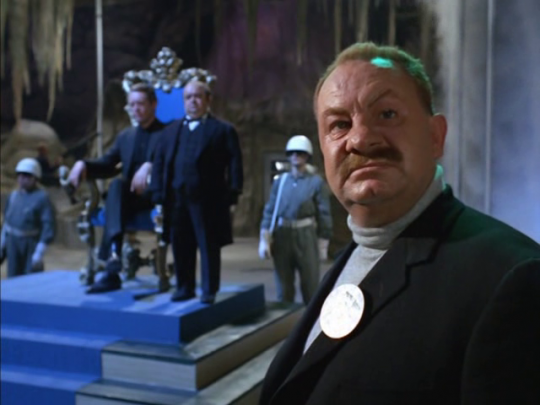
Where does the Supervisor take Six and the Butler? To an underground lair where we meet the entire board that runs the Village. They’re all in robes and masks, but each masked figure lords over different aspects of society with titles like Pacifists, Activists, Identification, Security, Education, Welfare, etc. There, Six meets the President of the Village (Kenneth Griffith, who played Number Two in “The Girl Who Was Death”), who proclaims that Six shall become their new leader. He was the One they were looking for, so to speak. The President gives Six two options: he can lead the Village or he can be given his old life back and leave the Village like nothing happened.
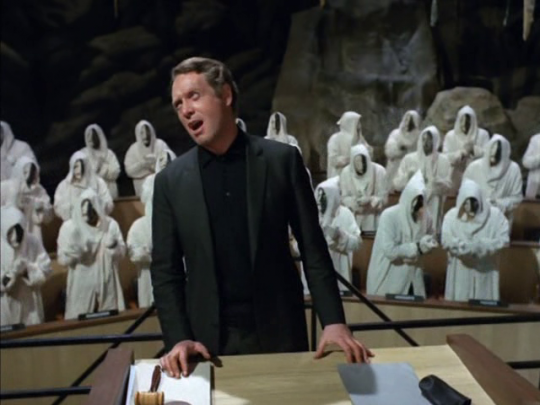
Six sits on his throne, but doesn’t decide, opting to watch the President preside over a few rebels in the Village, namely Leo McKern’s old Number Two and the new Number Forty-eight (Alexis Kanner, in a very different role from his villainous turn in “Living in Harmony”). Number Two has failed and even his old Butler won’t take orders from him, opting to serve Six instead. Number Forty-eight is a hippy type who tunes out the Village by singing. Both Numbers are given a chance to state their case before the jury of cloaked/masked Village authorities, but are sentenced to be placed in a state of suspended animation until Number Six decides the verdict.
Meanwhile, a rocket with a peering green eye represents Number One, watching the events with great interest…
I mentioned in my “Living in Harmony” review that McGoohan and co. returned to the series with a bit of creative exhaustion. No one was really sure how to progress or end The Prisoner, so the four episodes produced to wrap up the show (“Do Not Forsake Me Oh My Darling”, “Harmony”, “The Girl Who Was Death” and “Fall Out”) were created under tremendous pressure. While the first half of the finale, “Once Upon A Time”, had been shot a year before “Fall Out” aired, there was no ending plan. McGoohan had written himself into a corner with that episode’s cliffhanger and allegedly wrote “Fall Out” in 48 hours.
And it shows…
No, I’m not one of those fans who bashes the finale for getting a bit too weird, even by Prisoner standards. In fact, “Fall Out” is one of the most outrageously original and unpredictable stories ever filmed. Not just of The Prisoner, but of anything. I also think that the script Patrick McGoohan wrote to end his series could only come out of that manic high you get when you’ve got a lot of ideas, but no time or any real structure. As such, the finale of the most surreal television show to air is even stranger than everything that preceded it by a country mile.
A few things do feel off, certainly. Take the characterization of Number Six, for instance. Throughout the series, Six is depicted as witty and talkative. The man who wouldn’t spill his secrets is chatty on just about any subject save the matter of his resignation. For Six to just sit on the thrown, uttering cryptic dialogue is atypical. It’s only when he asks McKern’s newly-revived Number Two about meeting Number One that Six starts to sound like himself. It’s weird that The Prisoner‘s final episode features an almost mute Six, but it suits the deranged atmosphere of “Fall Out”. The Village, too, is a lot goofier and less menacing than in the early episodes, but–as I stated in my “Free For All” review–McGoohan didn’t care much about making them a formidable foe. They exist solely to represent societal ills and nothing more.
“Once Upon A Time” and “Fall Out” feel more like experimental theatre than television. While “Once Upon A Time” was very much rooted in The Prisoner‘s world, “Fall Out” could’ve leapt from a different series entirely. Its looseness and the free-flowing structure could’ve only been the result of the very tight deadline under which it was scripted. You can wish for a more conventional finale all you want, but you can’t deny the power of an ambitious, surreal piece of television like “Fall Out”. It blew my poor widdle mind when I first saw it and it continues to do so even now.
So, how does the finale gel with the earlier episodes of the series despite its somewhat different style? The episode, like the majority of the series, is beautifully directed and utilizes music for exceptional dramatic effect. As in previous episodes, “Fall Out” creates an atmosphere with a series of memorable music cues from its score and its use of The Beatles’ “All You Need Is Love” during the episode’s beginning and climax.
“Fall Out” also builds upon the previous episode with Angelo Muscat’s Butler becoming Six’s unlikely ally. Having seen Six overpower Two in “Once”, the Butler begins to serve Six and ultimately helps him destroy the Village once and for all. It’s the Butler who signals the Prisoner to attack the Village’s guards and steal their machine guns, leading to their escape.
That’s one of the great ironies of the series and, I think, a crucial message in “Fall Out”. This finale is full of references to the 60′s youth movement, which McGoohan had once described as a revolution that only needed a leader. Just as the hippies didn’t completely alter society, our Prisoner falls short of his goals. Clearly sympathizing with the Butler, the hippy-ish Number Forty-eight and even Leo McKern’s old Number Two, Number Six bands together with them to escape the Village through the only means he can now think of: violence. The man the Village could not break ultimately betrays himself in pursuit of escape as he guns down the Village board members and guards without remorse. But what good was it? When we see him return to London at the end of the episode, his front door opens automatically like it did for his Village residence. By embracing the amorality of the Village and gunning down those who posed him no threat (the President said he was free to go), our Prisoner takes the Village with him; permanently tarnished by his actions. Violence was a short-term solution that created a brand new prison from which Number Six can never escape.
Bleak stuff, innit? Good thing this episode is a musical. While the subject matter of “Fall Out” could’ve rivaled “Dance of the Dead” for being The Prisoner‘s darkest hour, the presentation deliberately clashes with all the violence and intrigue. So, we have the old Number Two laughing as he chastises himself for agreeing to serve the Village, a few renditions of “Dem Bones” care of Number Forty-eight (which all Villagers, even the President, dance to) and our escapees partying as they make their way back to London.
When Number Six unmasks the man in the Number One cloak and sees himself, we’re confronted with an idea addressed in “The Chimes of Big Ben”: it doesn’t matter who Number One is. Though McGoohan claimed he had no idea how the series would end until he wrote it, there’s enough hints that Number One is not a real person but someone Six is being groomed into becoming that it fits perfectly with the series (this resolution was hinted at in McGoohan’s “Free For All”). So, who’s been calling the various Number Twos over the past 16 episodes? Why, the board, of course. Since the Village preaches about community and conformity, I’d always assumed that the board members weren’t just high-ranking authorities that we’ve seen before (like Peter Swanwick’s supervisor), but most of our former Twos as well. The Village’s rotating authority system is designed to make its citizens serve the Village in unison, so it makes sense that everyone gets a chance at being Two for a week. Until a true individual is found, all the authorities and all the Number Twos add up to a single leader. That’s how Two became One…until they offered the keys to the palace to Number Six.
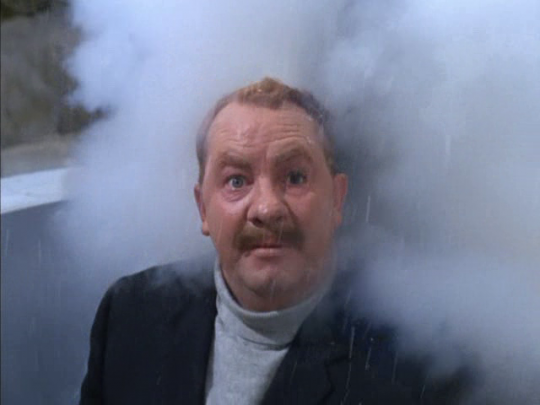
Of the cast, McGoohan is great despite being given very little to do onscreen. Alexis Kanner just oozes charisma as the flamboyant 48 and Ken Griffith delivers an impish, Andy Jones-like performance as the President. The real star of “Fall Out” is Leo McKern. McKern becomes Six’s unlikely cohort in escape and it wouldn’t have worked with any of the previous Number Twos. It’s hard to imagine Mary Morris, Guy Doleman, Georgina Cookson or any of the others being given the sympathetic treatment McKern’s given here. His Number Two appeared quite fond of Six and he shared a fairly cynical view of the world, joining the Village because its creation seemed like an inevitability (“Chimes”). Now we see him rue that he gave up rebelling as he rose to power and finally takes action with Six and the others.
The Prisoner ends in a confounding, exhilarating hour in a television series that is one of the masterpieces of the medium. In a sense, it’s also the end of Patrick McGoohan. Despite the aptitude McGoohan displayed for writing in the two-part finale and “Free For All”, as well as his stylish direction of those episodes, “A Change of Mind” and “Many Happy Returns”, The Prisoner is his last gasp of mainstream popularity after becoming a superstar thanks to high profile roles in Brand, The Quare Fellow and Danger Man. After The Prisoner, McGoohan would direct a single film, direct five episodes of Columbo, appear on one episode of The Simpsons and sporadically act until 2002.
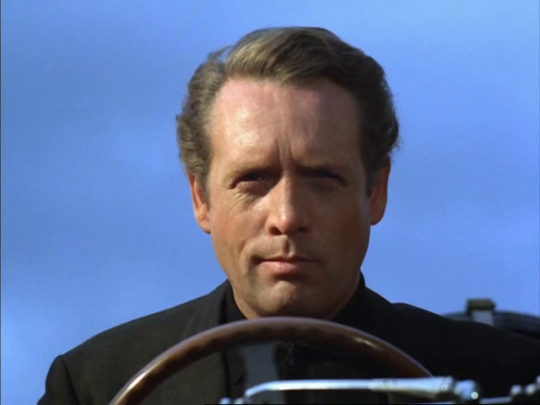
Though his career had stalled after The Prisoner–despite a few notable roles in popular films like Braveheart, Silver Streak & Scanners–The Prisoner and its controversial finale would be his legacy. Between Six’s pacifist failure, the redeeming of McKern’s Two and a glut of stylish set pieces, that’s not small potatoes. “Fall Out” is an ironic tragedy where principals are betrayed, many are gunned down and our heroes never truly escape, but done as a musical, after all. When Patrick McGoohan escaped from this world in 2009, he did so as a complete original.



Adam Clarke | Tue, Nov 19, 2013 |
On Screen