

Adam Clarke is seeing double: four Krustys!
Tonight’s Plot (In Six Words Or Less): A second 6 is 12.
For the first time in this look back on the most iconic, important and essential episodes of this classic British series, we have an episode where my ordering of episodes syncs up with the original broadcast order on ITV. “The Schizoid Man” aired fifth and should be placed fifth. Following “Arrival”, I’ve placed previous episodes based on Number Six’s behaviour, his knowledge of the Village and the references to past and future episodes. It makes no sense to have “Dance of the Dead” any later than second in episode order when Six has “never seen a night” in the Village, he knows nothing of observers or Dutton, and the outside world might be looking for him. “Free For All” and “Checkmate” naturally fit after “Dance”, with the episode where Six promises to separate the prisoners from warders is followed immediately by the one where he does just that.
When we last left Six, his escape attempt backfired when he realized that no Villager could be certain if he was one of their warders. Though the larger effort failed, Six is now aware of the Villagers he can trust and even befriend. Tonight’s episode opens with a meeting between Six and one such prisoner…
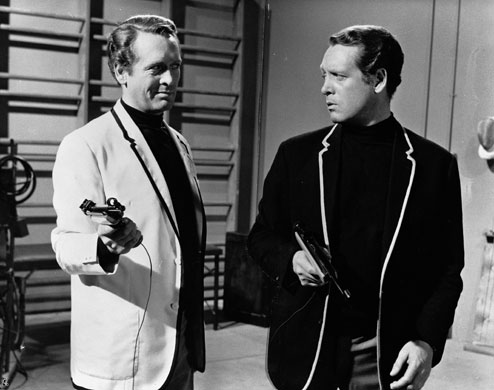
The Schizoid Man
Written by Terence Feely
Directed by Pat Jackson.
At residence #6, Six and Number Twenty-four aka Alison (Jane Merrow) are re-enacting Bill Murray’s first scene from Ghostbusters. Six and Alison are testing out a psychic link they seem to have as Alison is ESP-sensitive. Six holds up a card away from her gaze and Alison can see the image on the card as clearly as if it were in front of her. It’s a rare pleasant evening in the Village for Six, barring a brief moment where Alison knocks over a bottle that bruises one of his fingers.
The following morning, Six wakes up in a foreign bedroom (no, not Alison’s). Catching a glimpse of himself in a mirror, he doesn’t recognize his face. His basic facial structure is the same, but he now has darker hair and a thick moustache. He goes to the closet and sees his black jacket with white piping is still there. The jacket now has one of the numbered buttons he refuses to wear, but its number isn’t 6. It’s 12.
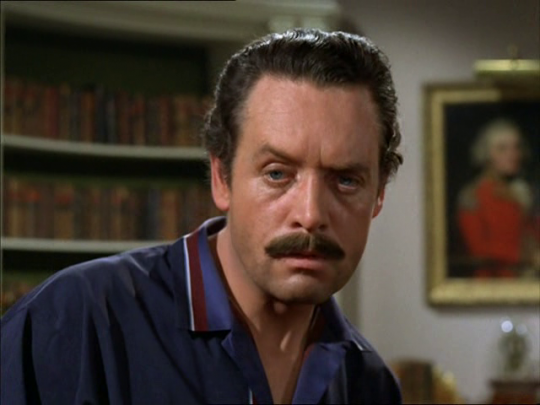
Victor Newman?
Six rips the button off as usual and then receives a phone call from the new Number Two (Anton Rodgers). Addressing him as “Number 12”, Two tells Six that he hopes his flight went well and invites Six over for breakfast. On his way to the Green Dome, everyone in the Village greets Number Six as Number Twelve.
At Number Two’s HQ, it’s clear this younger Two is a friend of Number Twelve (who we learn is a secret agent named Curtis). Two reminisces about Six/Twelve’s wife/girlfriend, Susan, who hated kissing Curtis without the moustache (“good for Susan,” says Six). Two explains why Six/Twelve’s been flown in to the Village: by using a man who looks exactly like Number Six, they intend to shatter Six’s sense of identity to ensure his cooperation with the Village.
Tossing him the dossier on Number Six, Two chides Six/Twelve for catching it with his left hand, as Number Six is right handed. Otherwise, he finds the resemblance between Curtis and the real Six to be astounding. Six/Twelve insists to Number Two that he is, in fact, “your Number Six” and Two is delighted to see Six/Twelve getting into the part. After a brief moment to have his hair lightened and his moustache shaved, Six/Twelve is placed in the house he used to live in, residence 6. When the door opens, Six isn’t prepared to see a man who looks identical to him in nearly all respects.
Of course, viewers can easily spot the major differences. The real Six sports his usual black jacket with white piping, while the impostor wears a white jacket with black piping (I assume Frank Gorshin was the costume designer). Also of note, Curtis (the man in the white jacket) has no problem wearing his assigned number 6 button.
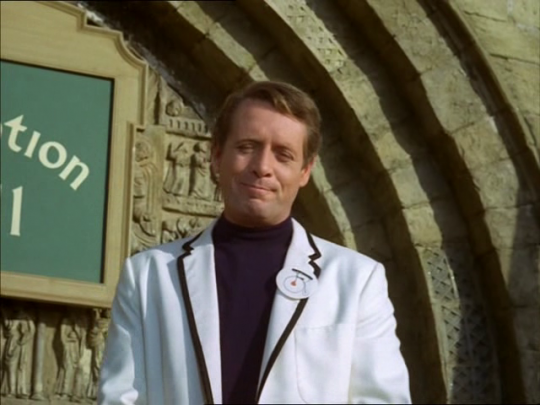
Curtis says he’s already aware of the Village’s plot and chides Number Six for getting it all wrong. Number Six likes the wrong kind of cigarettes and Six’s nowhere near the fencer or marksman the real Number Six is known to be. The real Number Six is confused because Curtis is right. Just as Six has switched from right to left handed overnight, his tastes and talents are similarly changed. To the outside world, Curtis is the real Six and Six is the impostor.
To sort out which man is the real Number Six, Alison is brought to Number Two’s residence. While Two watches nervously, Six and Curtis test Alison’s psychic link. Using the card test from before, the real Six fails to prove their link while Alison guesses each of Curtis’ cards correctly. Curtis walks away with Alison, while Two chides Six for spoiling his scheme. Later that night, Curtis and Two watch Six via hidden camera. Six is trembling in his bed, seemingly broken.
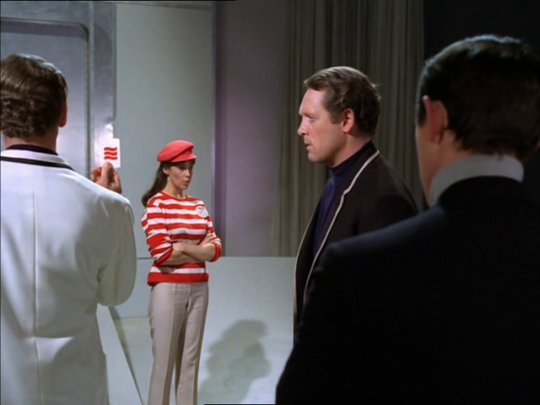
Later that night, Six spots the bruise underneath his fingernail from his psychic test with Alison at the start of the episode. This seems to undo a bit of the Village’s conditioning, as Six begins to remember what Number Two’s lackeys did to ensure he would think he’s Curtis. They used pain reinforcement to change him from right to left-handed, hypnotized him into liking different foods, and made a few cosmetic changes to his appearance.
Now aware of what he’s been through, Six sneaks into his old residence and finds Curtis resting there. Six mocks a confessional, conceding victory to Curtis. When Curtis asks why Six resigned, Six attacks him and soon a familiar roar is heard outside Six’s home. Six and Curtis race out of the house to be greeted by Rover, the bouncy ball of doom. In the confusion over which Six is which, Rover kills Curtis and Six reports to Number Two in his place.
At Number Two’s insistence, Number Six visits Alison and asks if her psychic powers had given her any special insight into the supposedly deceased Six. Alison insists that true ESPies don’t read or share minds, but receive psychic flashes in spasms. She says psychically-linked persons finish each other thoughts. When she takes out a cigarette, Six lights it without even seeing she’d brought one to her lips. Alison instantly figures out what happened, but Number Six insists it’s a coincidence.
Six continues to masquerade as Curtis in the hopes he’ll be flown out of the Village. Two is still shocked that Six is dead, but the real Six shows no sympathy…
6: It was your idea.
2: That’s a strange thing to say. You know it wasn’t.
6: You certainly didn’t resist.
2: Bearing in mind its origin, no I didn’t.
Two sees him out as “Curtis” is to be returned home. Two is growing wise to Six’s ruse and later asks him about a proposal he’d given Curtis regarding further work in the Village. Six is reluctant to say anything, but Two assures him that “the General” is nothing to fear. When Six says he’ll have to wait until he reports to the General, Two finds it odd that he refers to the General as human (“Report to the General? That’s a new one.”)
Near the helicopter, Alison has a few parting words for Number Six, telling “Curtis” that she regrets what she did and wishes it were possible to have a second chance. Six tells her there are no second chances and gets in the helicopter. Before take-off, Two hands Six a blindfold as part of the usual Village procedure and asks that Six give Susan his regards. Six promises to do so and puts on the blindfold.
Six is flown up, hopeful that he’s finally made his way out of the Village. When the helicopter descends, he removes his blindfold only to be greeted by the smiling face of Number Two. Two explains: “Susan died a year ago, Number Six”.
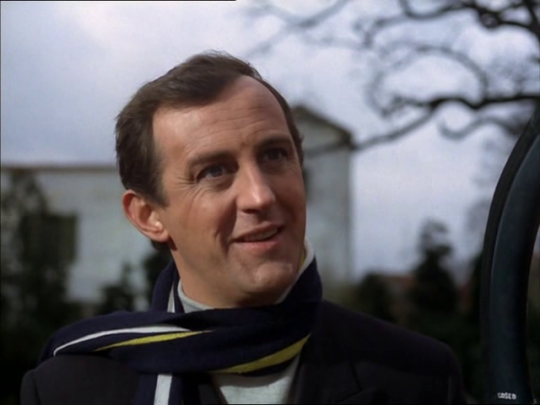
Whose side are you on? Returning to form with “The Schizoid Man” after the slightly disappointing “Checkmate”, The Prisoner pulls off one of its most compelling hours by using the oldest trope in the book: the doppelganger.
I confess, of all the archetypal plots in the history of TV, I have the greatest fondness for an Evil Twin episode. Some cliches have a strong batting average and there’s no better one than Evil Twins. Just as Freaky Friday episodes are always horrid (the only terrible episode of The Prisoner is the switched bodies outing, “Do Not Forsake Me Oh My Darling”), Evil Twin episodes seem to have a direct path to the pleasure centre of my brain. Even if the script wasn’t as good as it is, “The Schizoid Man” would have won me over with the sight of Curtis and his bizarro version of Six’s jacket.
“Schizoid” explores the horror of the doppelganger while still using variations on the stock plot’s archetypal scenes. The scene where Rover does not know whether to attack Six or Curtis is a variation on the old standby of a character not knowing which twin to shoot. Still, this was the perfect story to explore one of The Prisoner‘s key themes: identity.
Number Six keeps himself at a distance from the Village because his life is his own and he will not be contaminated by a society he wants no part of. Six’s individuality is his main defense against everything the Village puts up against him, so this doppelganger plot could actually get him to crack. It almost works, too, thanks to the cooperation of Alison and the other Villagers.
The way Number Six confirms his identity is a nice, subtle touch. He never reveals his real name to us (and it will never be heard, seen or spoken during the series), so keeps a sense of himself by refusing to acknowledge his number. When Two accidentally calls Six “12”, Six corrects him. However, he tells Two that he isn’t Number Six, but “your Number 6”. Later, Six drops the pretense and refers to himself as Number Six when speaking to Two and Curtis. Curtis’ perfect imitation shakes him to his core, causing Six to briefly accept his number. That is a huge victory for the Village.
Upon the arrival of Curtis, Six must acknowledge himself as Number Six and not the free man he claims to be. Six needs society, even if he hates it, because that opposition is one of his defining traits. As much as he’s an island unto himself, Six does need other people to establish his identity. The minute that changes, he begins to unravel. Six is not so headstrong when he has a bit of evidence to doubt his own sanity. It’s a rare moment of vulnerability for TV’s most passionate and ill-tempered main character.
Speaking of vulnerability, I don’t think Six would trust anyone as much as Alison after “Chimes of Big Ben” or before “Checkmate”, hence the episode placement. It’s rare to see Six or McGoohan befriending a woman. McGoohan was reportedly quite sour around female co-stars, but he’d been successfully paired with Jane Merrow several times before on Danger Man. The two had chemistry on those shows and there’s a sweetness to the friendship between Alison and Six that we don’t often see in this series. Merrow underplays the role, which makes her an interesting match for a walking powder keg like McGoohan.
Merrow’s a nice addition to The Prisoner‘s list of guest actors, as is Anton Rodgers as this week’s youthful Number Two. Yet, this episode belongs to its star like no other. Spending most of the episode playing a more vulnerable Number Six, as well as the sinister Curtis, McGoohan effortlessly creates distinct personas for the lead character and his double. Even at his best, Curtis is not quite Number Six. McGoohan plays him with a mannered swagger and cockiness that rings false for those who know the real Six. While The Prisoner‘s Number Six may be one of McGoohan’s finest hours, he deserves a lot of praise for making Curtis such a distinct, memorable villain.
Going back to the topic of episode placement, some cite this episode as occurring just before a patch of episodes that don’t feature Rover. Though Rover is largely absent in the middle of the series before re-appearing in the final two episodes, I don’t think Anton Rodgers’ order to deactivate Rover was any more than a brief measure implemented to ensure it wasn’t malfunctioning or disobeying orders. Besides, it’s not as though Rover was consciously put out of commission for the middle of the series (it was set to appear in “A Change of Mind”, but the scene was cut before transmission). In my order, Rover’s back again in the following episode, “The Chimes of Big Ben”. That episode is the fitting end to this early run of episodes where Six is more trusting and less abrasive.
“Schizoid” is an important episode for everyone’s favourite homicidal balloon. For one, it’s the only episode where it’s referred to by name. As for whether or not Rover’s a sophisticated weapon or a living thing, “Schizoid” seems to suggest the former. Of course, nothing is certain in The Prisoner. This ambiguity surrounding the evil ball goes all the way back to the early drafts of “Arrival”, as per this extended take of Rover’s introduction scene:
6: What was that?
2: Rover.
6: Rover what?
2: Just Rover.
6: Who drives it?
2 (with a puzzled look): Drives it?
6: Yes. Who?
2 (laughing): That would be telling.
I began my reviews by choosing to focus on the most iconic episodes of the series. Many fans have debated which seven episodes would consist of the original seven stories McGoohan had in mind when he created the series, those lists are always based on faulty thinking. McGoohan and co. had to create a potentially ongoing series and shut it down when they could not sustain the quality of the writing. So, despite all rumors, there is no McGoohan-approved seven episodes. By pairing down this series of reviews to The Prisoner‘s most essential stories, I’ve picked what I believe to be the eleven most iconic hours of the series.
Though seldom regarded as a highlight, “The Schizoid Man” is a gripping, thoughtful hour of television with just enough spy/action elements to keep it exciting. The doppelganger plot fits perfectly with the themes of the series. With its tightly paced script and a powerhouse dual performance from Patrick McGoohan, “The Schizoid Man” demands to be re-evaluated as one of The Prisoner‘s top episodes.
Next time: Six takes a holiday.





Adam Clarke | Wed, Oct 2, 2013 |
On Screen