

Adam Clarke‘s surprised Number Six didn’t see the First Slayer in his dreams.
Where am I?
Though it aired before “The General”, it’s obvious “A. B. and C.” follows that story. Colin Gordon has altered his performance so that his smug Number Two has become jittery and insecure following the destruction of the General. Another clue is presented after the title sequence, which amends the usual “The new Number Two” response to “I am Number Two” during the standard “Where am I?” opening. Leo McKern (“Chimes of Big Ben”) would state the same thing when he reprised his role as Number Two for “Once Upon A Time”.
Many fans place this episode after “Many Happy Returns”, which sees the return of Georgina Cookson after her small role in this episode. By placing “Returns” 9th, I have no problem with Six’s odd reaction to Cookson’s character in “Returns” after he sees her in his dream in “A.B. and C.” That character was just a person Number Two inserts into Six’s subconscious, so he must have used a Village agent Six wouldn’t recognize. Given that she’s the new Number Two in “Returns”, her presence here could be taken as foreshadowing. Certainly Six’s intense distrust and odd behaviour around Cookson in “Returns” could be seen as a call-back to dreaming of her in this episode.
Since I place “Returns” just before “A. B. and C.”, the events of “The Schizoid Man”, “Chimes of Big Ben”, the two Colin Gordon episodes and “Many Happy Returns” occur between February 10 and March 19. Is that cutting it a bit close? Perhaps, but no ordering of Prisoner episodes is perfect as McGoohan always remained mum on the issue.
Tonight’s Plot (In Six Words Or Less): Colin Gordon, dream weaver.
A. B. and C.
Written by Anthoney Skene
Directed by Pat Jackson.
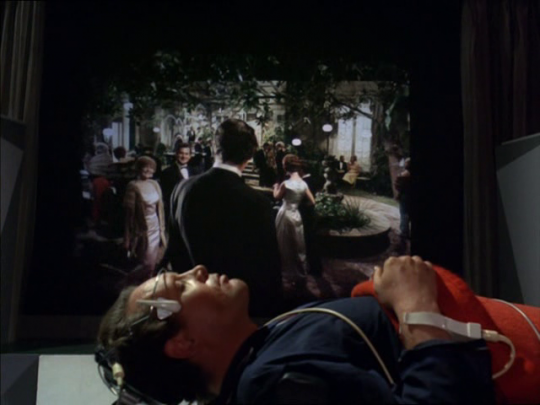
Colin Gordon returns as Number Two. Fresh from seeing the Village’s most important experiment go up in smoke in “The General”, this Number Two makes a last-ditch effort to find out why Number Six resigned. An unconscious Number Six is wheeled in to Number Two’s headquarters, his head covered in electrodes. With the aid of an experimental drug devised by Number 14 (Sheila Allen), 2 is able to manipulate Number 6′s dreams and watch the results on his viewscreen. Almost awake, Six briefly sees Fourteen setting up the experiment before she sends him back to sleep.
2′s theory is that 6 was going to sell top secret information before the Village got to him. Using all the data the Village has acquired on 6, 2 believes there would only be three possible buyers: A (a defected English spy), B (the most bewitching spy 6 has ever met) and C (a person who the Village has very little information). These hypothetical buyers and 6 have one thing in common: they all regularly attended the famous parties thrown by wealthy socialite Madame Engadine (Katherine Kath).
Number 6 behaves as he would at such a party, but is quickly intercepted by A (Peter Bowles). Though friends once, 6 is disgusted by the sight of A. The more A tries to get 6 to sell him information, the more 6 resists. Outside the dream world, Number 2 speeds things up and arranges it so that 6 is kidnapped by A and some thugs. 6 quickly turns the tables by beating them to a pulp, straightening his bow tie and returning to Engadine’s party.
That’s one of Two’s suspects down, but the other potential buyers will have to wait. There needs to be 24 hours between doses of the dream drug, so 6 is returned home while 2 awaits an angry phone call from his unseen supervisor. When 6 awakens in the morning, he spots Number 14 buying flowers near his house. He half-remembers seeing Number 14 before, but isn’t sure where. As trace memories of last night pop in his head, he checks his wrist and sees a mark from where he was injected with the dream drug.
On the second night, 6 is drugged again and dreams of encountering B (Annette Carrell) at Engadine’s party. The two are old friends, maybe more. Before we learn the details of their relationship, 2 pushes his agenda when–what else?–hired goons show up in the dream. When B is held at gunpoint, she tells 6 that they’ll spare her life if he reveals why he resigned. 6 becomes suspicious and interrogates B, asking her about her son. 2 panics because there’s nothing in B’s file about having a son. With no information for 14 and 2 to feed into the dream B, 6 leaves her to the armed thugs.
The next morning, 6 wakes up and covertly follows 14 around the Village. He tags behind her as she enters a secret passage located in a cave on the outskirts of the Village. The cave entry brings 6 to the exact room where he’s been drugged and studied over the past two nights. Reading the files on A, B and C, 6 gets wise to their scheme and locates the solution used to drug him. Finding the wonder drug, 6 empties the bulk of it into a napkin and then fills the syringe with just enough water so that the drug doesn’t appear too diluted.
Later that night, 2 and 14 repeat the procedure on 6 and begin to watch the dream. This time, everything’s askew and 6 acts as though he knows he’s in a dream. With too much at stake, 2 has C enter the dream even though he knows nothing about that person other than they’re a spy and they studied French. He encounters a partygoer (Cookson) placed by the Village that leads Number Six to the enigmatic C…
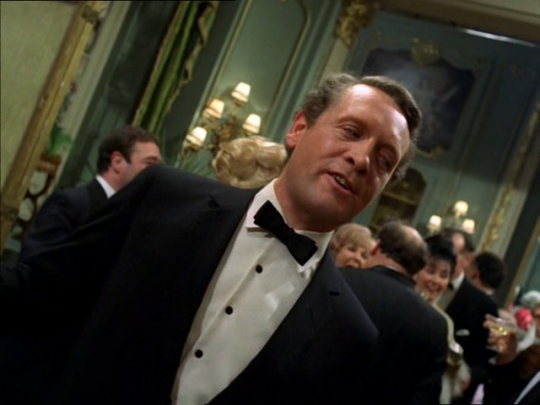
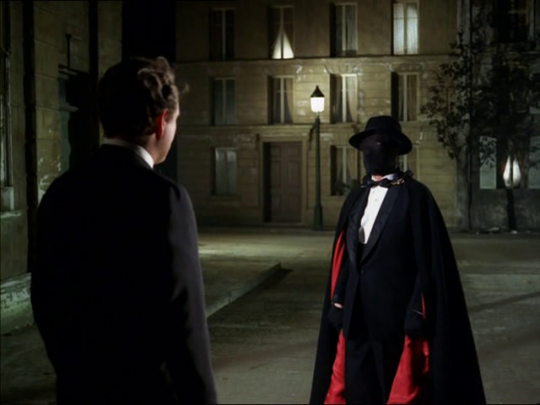
At the dreamy party, Madame Engadine reveals herself to be the spy 6 is looking for. 2 is flabbergasted. He might not have 6′s secrets, but he’s now identified one of the most elusive spies in the world. As 6 and Engadine head for a meeting with the man she claims is in charge, Engadine stops at a church that only 6 can enter. Number Six enters the church, but there’s no interior. The doorway leads to a deserted city in the dead of night, while Engadine waits behind him in the daylight. In the ghost city, Six is confronted by a masked man in a tuxedo and cape. 6 says he’ll sell out, but only if he knows who he’s selling out to. The masked man asks why it would matter, but 6 insists that it’s important to “the people who are watching”. After a minor scuffle, the man in charge is unmasked by 6 and presented to 2 and 14 as being…Number 2.
Two, almost gone mad with stress, watches helplessly as 6 wanders away from Engadine’s party and the masked man’s lair. On the viewscreen, 6 changes out of his tuxedo and into his Village clothes. He then wanders down the paths of the Village and into the cave that leads to 2 and 14′s present location. 6 then opens the door to the experiment room. The viewscreen shows 2 and 14 watching the viewscreen in the experiment room, but surely the real 6 hasn’t walked out of his dreams and into their lair. The real 2 looks back in horror to see if the doors really have opened, but the real 6 is still unconscious on the gurney in front of him. On the viewscreen, the dream 6 gives the dream 2 a series of travel brochures. “I wasn’t selling out. That wasn’t the reason I resigned,” the dream 6 says as he gets on the gurney and begins sleeping as soundly as his real world self.
Having failed in his attempt to get 6′s secrets, 2′s red phone begins ringing wildly…
Whose Side Are You On? Like “The General” before it, “A. B. and C.” is exceptionally silly. The dream sequences are closer to television spy fare that was so popular in the 60′s, but with the added twist of Six controlling his dreams for a memorably surreal conclusion. One particularly clever moment occurs when Six is taken to meet his masked new boss. Six mentions his need to unmask the shadowy figure so as not to disappoint everybody watching, which is a cheeky bit of metahumour for viewers dying to see Number One.
“A. B. and C.” is equal parts Prisoner and Danger Man, McGoohan’s hit spy series that aired between 1960 and 1967. “A. B. and C.” pulls off a spy story while remaining grounded in The Prisoner with greater success than the underrated later episode “The Girl Who Was Death”. Those two episodes do share a similar problem when compared to the earlier Prisoner stories: the Village is starting to lose its edge. The methods Six uses to sabotage Number Two betray the all-powerful control centre depicted in the early episodes. Nonetheless, Six’s contrived infiltration of Two & Fourteen’s experiment room (none of the Village’s many cameras saw him sneak into that cave) is an acceptable price to pay for this episode’s dream sequences and their imaginative conclusion.
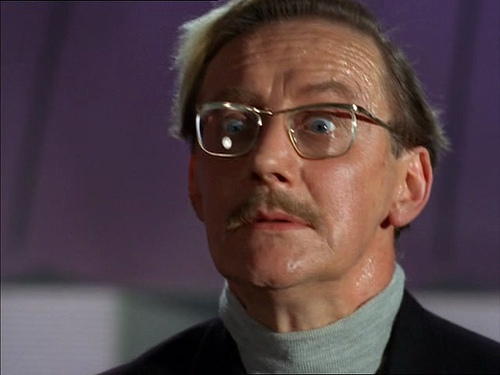
I’m also quite fond of Colin Gordon’s sub-plot, undergoing a nervous breakdown after the events of “The General” and his failure to steal Six’s secrets here. Gordon is quite good as he grows more unhinged with the tantalizing info Six threatens to spill in the dream world. It’s a fun performance from an actor so middling he can’t even read the “In the Village” lines from the secondary title sequence with anything resembling authority. I wouldn’t completely slag off Gordon, but his sub-Vincent Price delivery in the secondary titles is borderline parody and he can’t even pull off a good villainous laugh. When the Number Twos (or series voice-over artist Robert Rietty) do the evil laugh at the end of this sequence, it’s always been appropriately menacing. With Gordon, his forced guffaw is exactly what the “I’m using the internet” Quaker would sound like. It’s just embarrassing.
So, why is this silly episode essential? In addition to being one of the series’ most entertaining, accessible stories, we also learn a bit about Six in the process. He was a spy, not unlike John Drake of Danger Man, and he wasn’t selling out or defecting. He was just trying to go on vacation, as depicted in the opening credits. It seems his main objection to his job was a moral one, hence his need to get away from England to think. Six’s aversion to violence is an issue that will be explored in later episodes, but “A. B. and C.” is a worthwhile lighter episode of this enigmatic series.
Next Time: Number Six wakes up a new man.






Adam Clarke | Mon, Oct 21, 2013 |
On Screen