

Archive | On Screen RSS feed for this section
In Defense of George Lucas
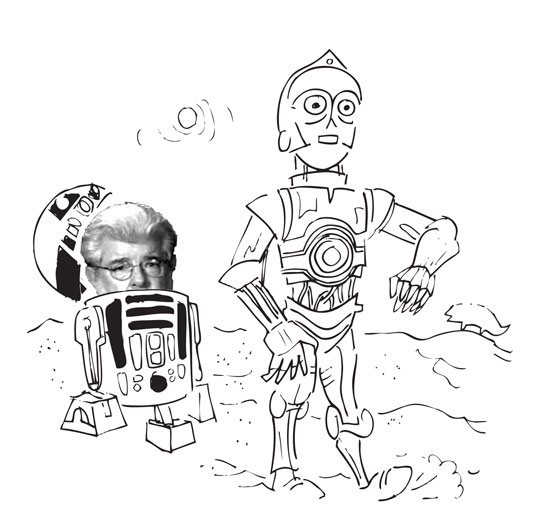
Illustration by Ricky King
Star Wars is now in the hands of Uncle Walt Disney and everyone you know has expressed their celebration, dismay or confusion at the acquisition on Facebook. The whole thing brings to mind that great Simpsons line, “But Krusty, why now? Why not twenty years ago?”
I think it’s really the best thing for all concerned.
I neither love or hate Lucas’ work. He’s responsible for great films like Star Wars, Raiders of the Lost Ark and THX-1138. On the other hand he’s also responsible to varying degrees for Howard the Duck, the Star Wars prequels, and Temple of Doom.
I mean, where would the world of computer games be without LucasArts titles like the point-and-click fun of Sam & Max Hit the Road? And dare we dream of a world without Maniac Mansion and, more importantly, the Joe Flaherty sitcom of the same name?
Okay, kidding aside, the experimental and playful side of George Lucas has always been apparent through his interest in new technology. Classic LucasArts games like Monkey Island were quirky, funny and inventive. The THX sound system was developed with the intention of improving cinema-going, and was developed out of Lucas’ desire to have the sound design of Return of the Jedi represented authentically. Lucas is also the guy who founded Industrial Light & Magic, which became the most recognized name in special effects, and branched out from Lucas’ film work to lend special effects for other movies, including Star Trek films, and even Schindler’s List.
I could go on about Lucas’ development of Pixar, back when it was The Graphics Group, or the privately-run film studio American Zoetrope (Apocalypse Now, The Outsiders, Lost in Translation), or countless innovations he achieved until I’m blue in the face.
These days, though, the prevailing opinion seems to be that Lucas is a lazy and unimaginative guy who rode the coattails of others while keeping a close eye on the bottom line. And that’s mostly unwarranted.
I say mostly because that’s the image of Lucas filmgoers have had ever since he started fiddling with Star Wars. Even before the new prequels, the re-released versions of the original trilogy were just as bad — nearly all of the changes were to the detriment of the original films.
The problem wasn’t that Lucas revised them, but that he chose to revise them in idiotic ways. Take the infamous “Greedo shoots first” scene, for instance. Switching who of the two shot first changes the tone of the scene, and clashes with the characterization of Han Solo. The intent of the changes in the re-release, wasn’t it to eliminate problems, not create new ones? It was perfectly okay to tinker with some of the outdated effects, but this was silly. Fans were left with a terrible taste in their mouths, and it would only get worse when the prequels were released a few years later.
But Star Wars wasn’t the only film franchise Lucas created. Raiders of the Lost Ark is my favourite Lucas film, and I believe his legacy is that an Indiana Jones film without him still seems pointless. The Star Wars universe is so broad that anyone could have a crack at it, but Indy wouldn’t feel right without Lucas, Spielberg and Ford collaborating. Indy’s all about a particular style and, like it or not, Lucas is key to it. He’s connected to it on a greater level than Star Wars because Indy doesn’t have a giant world to explore. This is the reason why 2008’s Indiana Jones and the Kingdom of the Crystal Skull actually feels like an Indiana Jones movie, while Phantom Menace seems as much of a rip-off as Starcrash or Dünyayı Kurtaran Adam (Turkish Star Wars). The far-fetched plot of Skull is perfectly at home with Indiana Jones. As a result, it has a legitimacy to it that the Star Wars prequels never had because the tone and the style are right—even if the film isn’t.
If we can forgive Gene Roddenberry for the first season of Star Trek: The Next Generation, we can overlook the mistakes George Lucas visited upon us. His babies are now in a better place, perhaps, and it’s time we remember him for his invention and not his lacklustre later efforts. So let’s all just try to forget about Hayden Christensen once and for all and celebrate Life Day in peace.
Eddie Pepitone: Meeting The Bitter Buddha
Mon, Dec 17, 2012
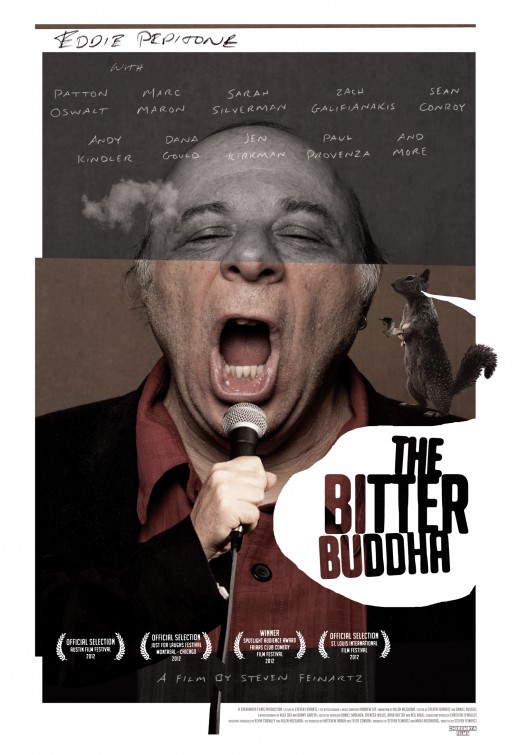
“The only things stopping me today are: genetics, lack of will, income, brain chemistry and external events.”
– Eddie Pepitone
It’s no secret that I’ve long been a fan of stand-up comedy. By age 15, my tape and CD collection largely consisted of Bill Hicks, George Carlin, Woody Allen and what little Richard Pryor I could dig up at Urban Sound Exchange (RIP). In March 2011, I finally got off my ass and starting doing some myself. As a depressive, weirdo comic, I was attracted to the more cerebral approach currently favoured by the likes of Stewart Lee, Marc Maron, Patton Oswalt, Dana Gould and Maria Bamford. That all but one of those names have been open about their damage and/or mental illness isn’t that much of a shock to me.
Of all the comics who openly (to paraphrase TV’s Frank Conniff) raise their “freak flag” of emotional scarring, actor-writer-comedian Eddie Pepitone is the most unabashedly raw and challenging. Onstage, he talks about his depression and his failings. He recreates screaming matches between him and his father, and, in a particularly inspired closer, jumps into the audience to heckle himself with very specific insults (“Why do you dream of red birds at night?!”). Eddie Pepitone is one of the most dynamic and inspiring performers in the scene today.
Despite his powerful presence, Pepitone toiled in relative obscurity for years as a comic’s comic (translation: other comics will watch your set, which is a triumph in itself, but you won’t get booked on Letterman anytime soon). At present, Eddie Pepitone has become, dare I say it, popular. At fifty-four, Pepitone now has an intense cult following from his stand-up, the Puddin’ webseries, his frequent podcast appearances (particularly his rants at the end of Marc Maron’s live WTF shows) and his bit parts on Community and Conan.
Eddie Pepitone arrived in Toronto to perform in The Dark Comedy Festival last month. I was in a bit of a rut with my own act, struggling with certain audiences who were uncomfortable with me wringing laughs from CRIPPLING DEPRESSION, so the time was right to see one of the greats at work. I’ve seen live performances by Todd Glass, Louis C.K., Andy Kindler, Sean Cullen, James Adomian and Norm MacDonald, but none of these compare to the amazing show Pepitone delivered to an awed crowd on November 10th. The performance was followed by a screening of a documentary about Pepitone that’s been making the rounds at film and comedy festivals this year.
The release of Steven Feinartz’s The Bitter Buddha could not be better timed. Despite the current saturation of documentaries and podcasts about stand-up, Feinartz’s film is compelling and never old hat. Buddha captures a lot of what makes Pepitone such an interesting figure in the comedy world and what makes him an inspiration to mugs like myself.
As with many documentaries about artists and entertainers, The Bitter Buddha builds up to one big show. The film follows Eddie Pepitone as he prepares for a brief return to his old New York digs after relocating to L.A. years ago. Staten Island native Pepitone is an established figure in L.A., but succeeding on his home turf is important. Especially as the critical eyes of his father will be among those watching him at the Gotham comedy club that night.
As an arc for the film, Pepitone’s return to headline Gotham is satisfactory. More interesting is how the film humanizes the fractious, introspective personality suggested by the title. Pepitone rails at the success of some of his peers, lamenting that Aziz Ansari has nothing to say or that NBC’s Whitney is blandness personified. As his friends note, Pepitone is not above auditioning for and appearing on series like Whitney even as he skewers them in his act. Another friend notes that, for all his philosophical and political ranting, he doesn’t think Pepitone has ever voted.
The man we see in The Bitter Buddha is a fascinating one, which is why the film occasionally frustrates when certain aspects of its focus remain underdeveloped. Early in the film, there’s tension between Marc Maron and Pepitone after one of Maron’s live shows, but it never blossoms into anything. Maron later appears with Pepitone during an uncomfortable audio interview, but their relationship doesn’t amount to anything in the film. Fellow comic Jen Kirkman also shows up to tell us that Pepitone has gone off his medication and she can already sense a change in her friend. What is this change? Have others noticed? Why did he get off the medications? What does his girlfriend think? Again, this a thread that’s briefly introduced before it’s thrown away.
But these are minor complaints. The Bitter Buddha does present Eddie Pepitone, the avuncular madman of L.A’s alt-comedy scene, in an honest light. The film shows Pepitone as a man with a large, sometimes contradictory personality, resulting in some welcome raw moments. Buddha doesn’t shy away from showing Pepitone as he freaks out over which headshot to send for an audition. Nor does it break away when Pepitone loses his temper over a parking ticket before realizing that he parked his girlfriend’s car at a crosswalk.
I was fortunate enough to chat for a moment with Eddie Pepitone following the Buddha screening. I told Pepitone that he inspired me to talk openly onstage about my own struggles with depression and anxiety. Seemingly delighted by this – -and the fact that I came from Newfoundland to see his show — his eyes lit up.
“You’re depressed? Good. Fucked up people are the only ones who should be doing this. No one else is funny,” Eddie Pepitone told me. That was enough to get this bag of damaged goods to start writing once more. They call him the “Bitter Buddha” and, sure enough, he made me re-think my reluctance to get back on stage.
Regardless of your familiarity with its subject, The Bitter Buddha is one of the best of documentaries about stand-up comedy. That the film does justice to the man and his skill is no small feat. Eddie Pepitone is a fascinating figure and an extremely gifted comic.
Even if he does dream of red birds at night.
For more Eddie Pepitone:
• The Long Shot Podcast.
• A Great Stillness (album).
• Eddie Pepitone and Matt Oswalt in Puddin’
Twilight: Breaking Dawn Part II (2012)
Sun, Dec 16, 2012
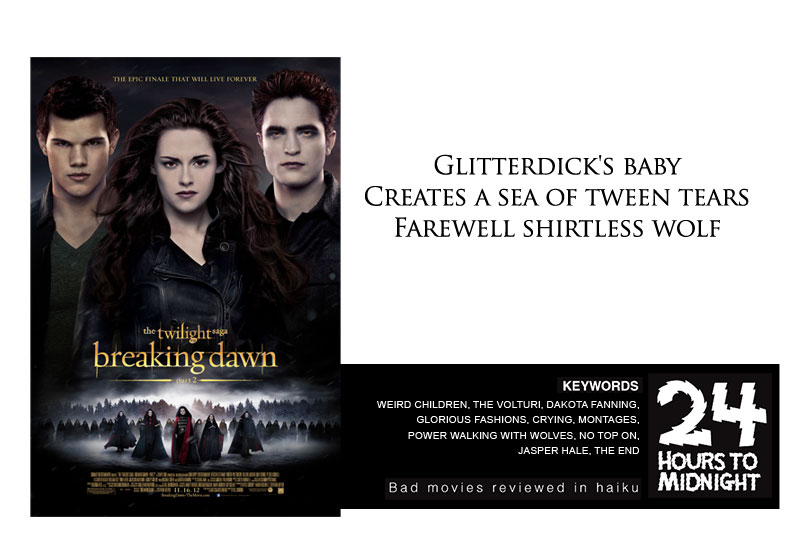
You guys, it’s finally over. For years we’ve been dragging ourselves to Fog City, drinking way too many jugs of Black Horse and stumbling into the theatre with glee, and the final installment of the Twilight saga did not disappoint: it was surprisingly violent and kind of shocking, but also touching enough to make an entire theatre of teen girls openly weep over a montage of Edward and Bella’s romance. There were crazy vampire super-powers, child burning flashbacks and an insane fight featuring a power walk! Even though Breaking Dawn, Part II is not a quality film by any means, it was definitely entertaining.
We’ll miss you, Edward and Bella and your strange child, Renesmee. We’ll miss the pouty Cullen family. We’ll miss yelling “take your top off” at the screen whenever Jacob appears. We’ll miss Bella’s dad’s really good moustache.
But really, here is what we will miss the most:
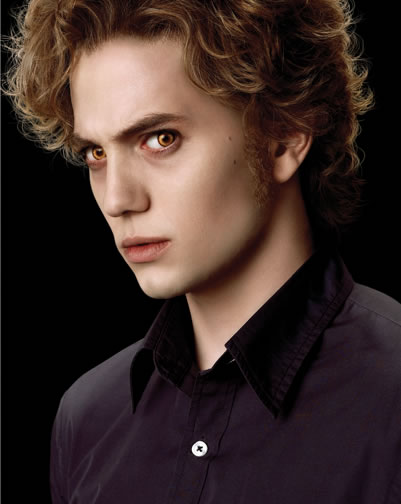
FAREWELL.
The Sound Of James Bond
Tue, Dec 11, 2012
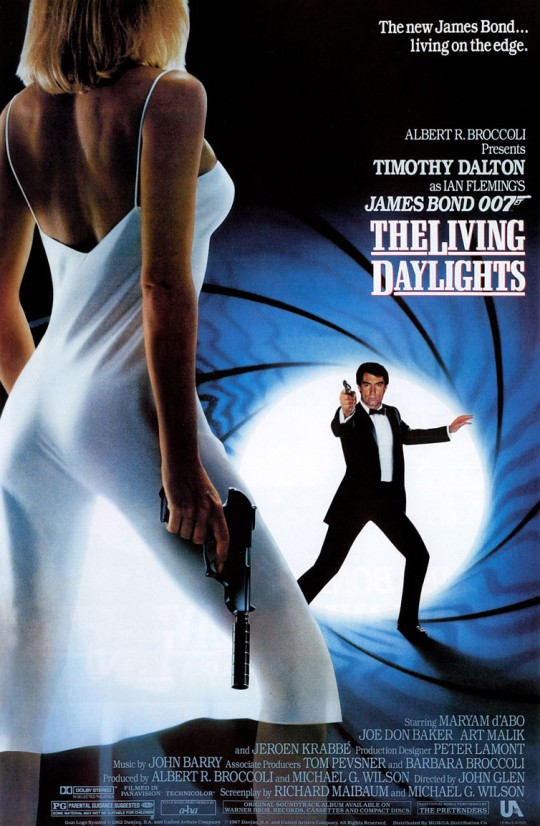
Timothy Dalton is still Adam Clarke’s favourite James Bond. He hopes Timothy Dalton wins an Oscar and beats Sean Connery over the head with it.
Whenever there’s a new Bond movie you can’t help but compare it to the Bonds of old. All the Bond films have their strengths and weaknesses, but my favourite aspect of these films are their soundtracks. For that we have to thank the late English composer John Barry, whose credits include Dances With Wolves, Enigma, The Ipcress File and the 1976 King Kong remake.
If you’re looking to explore the music of the series, Barry’s the man behind the milestones.
Barry joined the franchise when it began with Dr No in 1962. While Monty Norman is always the credited creator of the Bond theme, Barry and the filmmakers have often said otherwise. Norman won several libel suits against Barry when the latter claimed authorship over the iconic theme. Yet, it was Barry, not Norman, who the producers had hired for From Russia With Love (and ten of the ensuing sequels). There’s some credibility to the rumors that the producers were unhappy with Norman’s original contributions and hired Barry to re-score the film uncredited. Particularly because the Dr. No soundtrack bares virtually no resemblance to music as heard in the film and Norman was never once lured back to the series.
Essential Works
1. From Russia With Love (1963)
The series wouldn’t really find its voice until the sequel. As much as Dr. No works, From Russia With Love really set the blueprint for what was to come and was a much tighter and more exciting thriller. Barry’s music is a lot more in tune with what viewers would come to expect from the series, alternating as it does between bombastic action and a hint of exotic instrumentation for a particular locale. This film would also introduce the propulsive “007″ theme which Barry would reprise in many of the sequels before retiring it in Moonraker.
2. On Her Majesty’s Secret Service (1969)
On Her Majesty’s Secret Service, like From Russia With Love, opens with a memorable orchestral theme rather than the usual title song (Russia‘s theme, with added lyrics, played over that film’s end credits). In fact, free of the irritating, campy and one-note type of song he composed for Goldfinger, Barry can play up the intrigue with brilliant cues like Gumbold’s Safe Break, which underscores a suspenseful scene with John Carpenter-like simplicity. Combine that with some of Barry’s best action cues and “We Have All The Time In The World” (sung by Louis Armstrong) and you’ve got what is arguably the best Bond soundtrack in the entire catalogue.
3. Moonraker (1979)
Barry would take a hiatus from the Bond series in the 70′s, absent for two of the five films released that decade. The result is some of Barry’s most fascinating, uneven work. The Man With The Golden Gun is Barry at his least-inspired and the mediocre score produced both his most fun track, Scaramanga’s Fun House, and his worst song contribution to the series. Diamonds Are Forever is easily the most coherent and has the best of the three Shirley Bassey songs in the series, but suffers from adhering too much to the film’s confused tone.
That leaves with Moonraker, which compensates for a bland Bassey tune with some of Barry’s most restrained and gorgeous compositions. Like Barry’s work on z-films like Howard The Duck and Starcrash, Moonraker compensates for a campy tone because Barry opts to score the scenes as sincerely as possible. This is James Bond music at its most low-key.
The show-stopper of the soundtrack is a beautiful six and a half minute piece entitled Flight Into Space. In context, it struggles to prevent the film from going off the rails (and compliments some excellent model fx work), but on its own, the piece possesses a hypnotic, dreamy quality that’s easy to get lost in.
4. The Living Daylights (1987)
After a successful collaboration with Duran Duran, Barry teams up with A-ha for a return to synth-pop in the title song. Two other songs, by Barry and The Pretenders, add colour to the film. Barry’s work with The Pretenders produced Where Has Everybody Gone?, a funky song with a sinister synth riff that compensates for every soggy ballad that plagued the Roger Moore era. With thrilling variations on the film’s themes aided by stand-out cues like The Sniper Was A Woman and Airbase Jailbreak, it’s no wonder Barry decided to quit the Bond films while he was ahead.
Further studies
Since mainstay composer John Barry left the series after The Living Daylights, various composers have struggled to find the right tone for Bond. Do they blatantly ape Barry’s style (as David Arnold did from Tomorrow Never Dies to Quantum Of Solace), try to break new ground (Eric Serra’s disastrous porn music for Goldeneye*) or wed the expected Bond musical flourishes to their own style (as Michael Kamen did with Licence To Kill)? Thomas Newman (Road To Perdition, Finding Nemo), like Kamen, effectively chose the third option for the most recent film. The resulting score for Skyfall offers a bit of fresh air for the series and a decent new song.
Adele’s title song compensates for its underwhelming lyrics with great production and a haunting atmosphere (I’m particularly fond of the backing vocals in the chorus). After a brief flirtation with 80′s pop, the James Bond series has struggled to create a memorable title tune. “Skyfall” ranks somewhere between k.d. lang’s “Surrender” and Garbage’s “The World Is Not Enough”. It’s a welcome addition to the Bond song catalogue after Jack White & Alicia Keys’ less-than-stellar song for the previous film. To be even kinder, I’d say it’s a masterpiece compared to previous embarrassments by Madonna and Gladys Knight.
Ranking
Best Score: On Her Majesty’s Secret Service and The Living Daylights (tie).
Best Song: Nancy Sinatra’s title track from You Only Live Twice.
Best Non-Barry Score: A tie between Marvin Hamlisch’s brilliantly cheesy The Spy Who Loved Me and Michael Kamen’s brooding Licence To Kill.
Worst Song: The Madonnabomination.
Worst Score: Eric Serra imitating Brad Fiedel badly in Goldeneye
*Oddly enough, George Clinton’s music for the Austin Powers series would be far more at home in Goldeneye. Yes, Eric Serra’s soundtrack is less genuine than the film scores that parody James Bond music
Dark Shadows (2012)
Thu, Dec 6, 2012
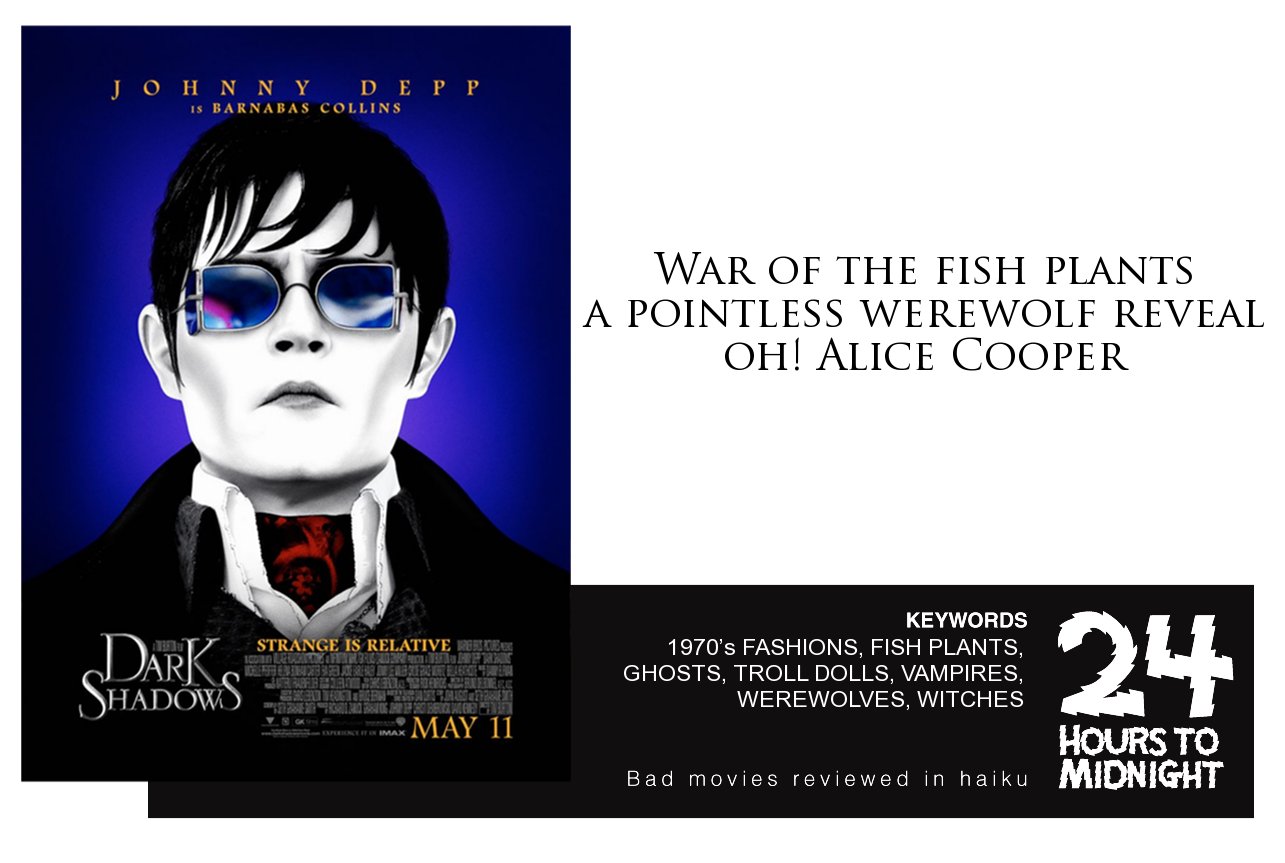
Here Johnny Depp stars as uppity vampire Barnabas Collins in Tim Burton’s remake of a classic television show. In the late 18th century, Barnabas was the heir to an affluent fishing company and cannery in Collinsport, Maine. After scorning Angelique, one of his family’s many servants and a secret witch, he is cursed to live forever as a vampire and to watch his true love Josette fling herself off of a cliff while under Angelique’s spell. Angelique reveals to the townsfolk that Barnabas is a vampire, and they lock him up in a coffin and bury him. Two hundred years later, in the 1970s, Barnabas is inadvertently released by an unsuspecting construction crew. After draining the crew dry of blood, he makes his way back to his family’s estate, Collinwood, now inhabited by his descendants: Sister and brother, Elizabeth and Roger Collins, Elizabeth’s daughter Carolyn, Roger’s son David, as well as a caretaker, a maid, a nanny and Dr. Julia Hoffman, a live-in psychiatrist, played by Helena Bonham Carter.
The plot of the film focuses on Barnabas’ attempts to restore his family’s estate and business to its former glory, while trying to fit into a modern 70’s town as a secret vampire. Luckily for Barnabas there’s a second chance to be with his lost true love, as it happens that the nanny Victoria is the reincarnation of his beloved Josette. Unluckily for him, Angelique (now going by Angie) is alive and well, and is the major player in the fishing and cannery market in Collinsport. Even after all this time, Angie is still obsessed with having Barnabas all to herself, and goes about making his and his family’s lives a living hell. In the end, the house and business both burn down, and Angie shatters into a million pieces, but the family is closer than ever, and Barnabas finally gets to spend eternity with Victoria, as he makes her into a vampire to spare her from the same fate that befell Josette.
The movie is sort of entertaining, but gets bogged down in the middle with anachronistic gags, as if the writers got super excited about getting to use all of their “18th century man in the 1970’s” jokes. Also, because the film tried to stay somewhat true to the television show, there were some unnecessary plot points that seemed to be shoved in haphazardly, such as the part about Roger being a deadbeat dad, Dr. Hoffman trying to become a vampire, or the unnecessary revelation that Angie had turned Carolyn into a werewolf when she was a baby. Come on people, a werewolf should never be pointless! Werewolves are both scary and awesome. Also, while Victoria is supposed to be Barnabas’ reincarnated soul mate, not much emphasis is put on the importance of her character, or his loyalty to her. During the raunchier parts of this (at first glance) family friendly movie, Barnabas accepts a BJ from Dr. Hoffman, and has a fling with his ex Angie. Oh yeah, but he totally loooooves Victoria.
Although Angelique is mildly traumatizing, I really wish that a witch would open a fish plant here in Newfoundland. Other pleasant things about this movie include: Fun 70’s fashions, ridiculous paintings of Angelique through the ages, a home renovation montage, a cute and hilarious troll doll, and the best Alice Cooper cameo since Wayne’s World. This is not a totally great movie, but it’s not totally awful either.
Skyfall: Same Old James
Wed, Dec 5, 2012
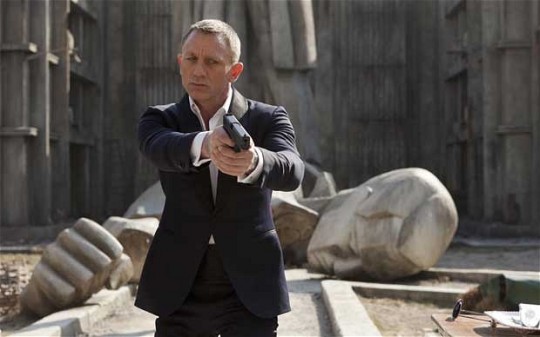
Adam Clarke wonders why James Bond doesn’t wear a hat anymore. Also, why doesn’t the Batman dance anymore? Do you kids remember the Bat-tusi?
Bond. James Bond.
There’s something so reassuring about that little catchphrase, isn’t there? With a film series lasting 50 years, James Bond is a cinematic icon whose enduring longevity and fame is comparable only to Godzilla — who, lest we forget, is King of the Monsters. The Bond films derive their success from balancing the fresh with the familiar. Some Bond movies work because they know their limitations and follow the established formulas to the letter (Goldeneye, The Spy Who Loved Me). Others eschew the camp flamboyance that became the series trademark to recapture the tone of Ian Fleming’s potboilers (among them, Daniel Craig’s celebrated debut as Bond, and the overlooked For Your Eyes Only).
The campy tone resulted in A View To A Kill and the largely unwatchable Pierce Brosnan era. The gritty approach is bound to produce equally tedious disappointments like Licence To Kill. Neither approach is necessarily the correct one, but the more down-to-earth style suits Daniel Craig and his Bond more than excess.
Skyfall is on par with Casino Royale because it knows when to surprise us and, perhaps more importantly, when not to. The plot, while engaging, hardly matters. Like audiences who line up to revisit the crews of Starship Enterprise or watch a masked bogeyman return to Haddonfield, we see each new Bond film in the hopes that it will hit the right buttons, and as a Bond film, Skyfall does just that. It’s got an appropriately menacing and somewhat tragic villain (played by Javier Bardem), impressive action set pieces, a bit of globe-trotting, a dose of sex appeal and, as has become the norm in the Daniel Craig films, a bit of character development for Bond and M (played once more by Judi Dench). That relationship has been pivotal to the success of the Craig-era Bonds.
Lacking the freshness of Casino Royale, Skyfall easily has the best Bond villain since… er, I can’t remember. With Bardem we finally have a villain with decent motivation, as he has every reason to direct his rage at M for abandoned him after a mission gone awry. Though he enjoys excess like all Bond villains, Bardem’s need for revenge clouds all other considerations. He publicly outs a series of undercover agents, but only to further twist the knife in M’s side. Past villains like Scaramanga and 006 have acted as a dark reflection of Bond, but without the depth of Bardem’s character. Some liken Skyfall to the C. Nolan Batman films and Bardem’s character to Bane, but the film has much more in common with The Wrath Of Khan… Skyfall is as much about its aging characters as it is about revenge.
As previously mentioned, Skyfall knows when to surprise us, resulting in an unexpectedly low-key showdown with Bardem in Scotland. Gone are the days of fighting an army of Donald Pleasence-trained ninjas in a hollowed-out volcano (yes, ninjas with all the power of Donald Pleasence). This time Bond spends much of the film in London before luring Bardem and his goons to his childhood home in Scotland. You’ve never seen a Bond film with a third act like this. The results are tense enough to excuse an anti-climactic resolution.
Skyfall is still a film where Bond beds a doomed femme fatale and an unlucky henchman is eaten alive by a komodo dragon. No matter what you do with the series, it’s still the “same old James” and we like it that way. It’s adept at adding a few new pieces to the patchwork franchise while reminding us why we love these films in the first place.
It’s a film that plays like an inverted Goldeneye. Pierce Brosnan’s debut stylishly dusted off cliches while giving the characters a bit of humanity (but not too much) and making appropriate concessions to political correctness (but not too many), and it worked because it excised the parts of the formula that had aged the worst. Skyfall is a more modern thriller and follows modern convention. It’s more character-driven, the violence is typically not played for laughs and there’s a real sense of danger that’s become rare for the series. The pleasant Goldeneye was a rehash with some fine tuning, but Skyfall is its own beast, using Bond tropes sparingly and to great effect.
Next week: From Dr. No to Quantum Of Solace (and beyond), a look at the evolving sounds of the Bond series.
Let’s Play: Wreck-It Ralph
Tue, Nov 27, 2012
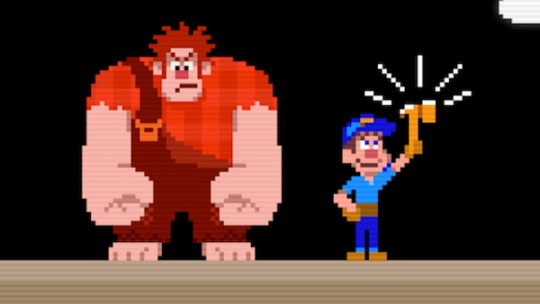
Top casting choices for the Adam Clarke biopic include John C. Reilly and Paul Giamatti.
Ralph (voiced by John C. Reilly) is the Big Bad of a classic arcade game in the Donkey Kong vein. Every time a kid puts a quarter in the Fix-It Felix, Jr machine, Ralph rises from his garbage heap bed and smashes a luxury apartment complex. Players control Felix (voiced by Jack McBrayer), a repairman with a magic hammer devoted to thwarting the rampaging Ralph.
As loved as he might be in the outside world, the land of video games is far less forgiving. As a villain, Ralph is a social pariah and the closest friends he has are members of a video game villain support group (among them Dr. Robotnik, Zangief and M. Bison). When the hapless residents of the Fix-It Felix, Jr arcade game throw a party for Felix, Ralph is hurt that he isn’t invited.
Since villains never seem to reap any rewards or medals, Ralph seeks to win one from a first-person shooter game. Ralph sticks out like a sore thumb in the Hero’s Duty shooter, but goes unnoticed by Sgt. Calhoun (voiced by Jane Lynch) in the fight against a legion of robo-bugs. Ralph lucks into getting a medal, but it’s quickly stolen by Vanellope von Schweetz (voiced by Sarah Silverman). Schweetz is a glitch who aspires to become a playable character in the racing game Sugar Rush, so Ralph has to help her if he ever wants to see that medal again. Meanwhile, Felix needs Ralph in order for Fix-It to continue, so he and Sgt. Calhoun team up to bring Ralph back to his own world. If they fail, Fix-It Felix, Jr will be unplugged, leaving all of its characters homeless.
Wreck-It Ralph is one of those films you want to like only because they’re clever. The cast is terrific and parts of the film are really funny if you’re a gamer (I stopped playing games in ’95, so I’m sure I missed many in-jokes). I want to praise this movie because it has a “Sonic Says” segment in which Sonic warns sprites not to get trapped in other games (spoiler alert: Sonic says that getting trapped in someone else’s arcade console is NO GOOD). I want to praise it for getting Jack McBrayer to speak to Q-Bert in its own language, or the souvenir of Zangief’s that Ralph discovers in a bar, but these are moments of fun in a fairly by-the-numbers kids flick. After a giddy first act which explores a few different video game universes, we’re stuck in the fairly one-note world of Sugar Rush.
Wreck-It Ralph is certainly not a terrible movie. It doesn’t talk down to children, nor will it irritate grown-ups who see it. Still, it falls far short of being a Who Framed Roger Rabbit? for the video game world, say. Framed had an interesting story and fun new characters that weren’t drowned in a sea of in-jokes, but Ralph struggles to regain the energy of its first act once all the cute nods to classic games are abandoned.
That said, it’s better than Captain N: The Game Master, but not by a hell of a lot.
Sinister (2012)
Mon, Nov 26, 2012
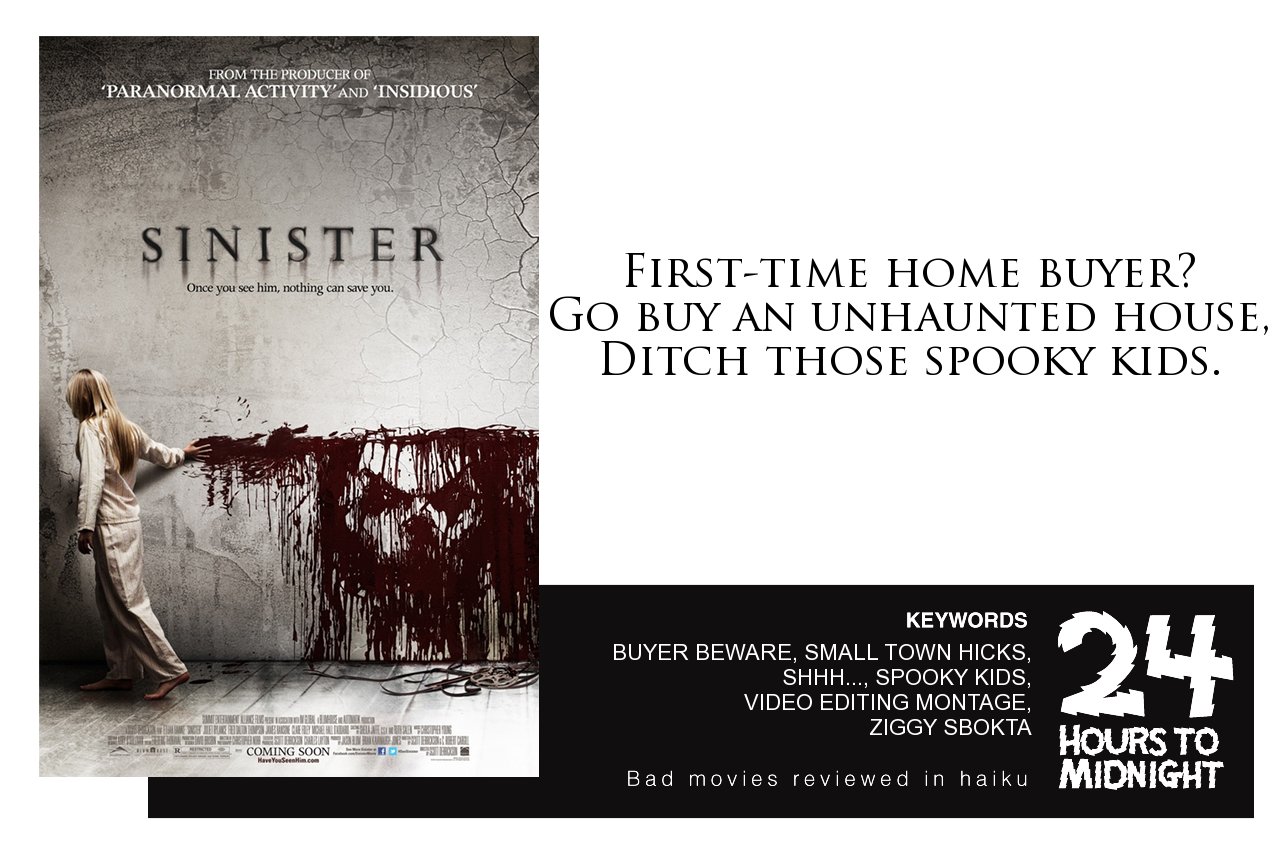
We’re on a Ethan Hawke kick, OK? We’re like Uma Thurman circa 1998 (when we really should be more like Uma Thurman circa 2004.)
Something else that’s stuck in 1998? Sinister.
First, the soundtrack, performed by electronic dark ambient group, Accurst. Their Amazon.com reviews say that it’s “…echoing distant screams psychotic laughter-soundtrack to a soulless madman’s dream…”. In other words, it sounds like your loner roommate is watching Se7en again, for the hundredth time.
Second, the villain: a masked, serial-killing demon. Good thing Ethan Hawke’s best bud Vincent d’Onofrio is the university’s resident demonologist (from the Faculty of Convenient Experts).
Still, Sinister doesn’t just rely on dated cliches. It also delivers fresh, modern cliches like found footage and creepy kids. Like the easy-to-forget Insidious (2010) and that other one where the kid is at the top of the stairs, creepy kids are played out, and this movie has a half-dozen, skulking around the house in silly outfits like it’s a dark re-imagining of Daddy Day Care.
Overall, Sinister is very familiar territory, with a lot of Ethan Hawke, Ethan Hawke-ing it up.
You Can’t Go Home Again: Revisiting The Halloween Sequels – Part Four
Tue, Nov 20, 2012
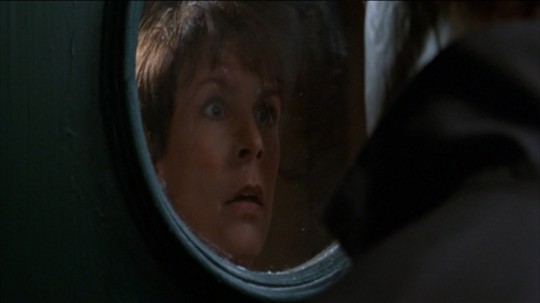
Michael Myers frightens Jamie Lee Curtis the same way Activia terrifies Adam Clarke
I feel like a ‘Nam veteran after watching all these Halloween sequels. I’ve seen things you wouldn’t believe, man. Evil Irish mask-makers, Stonehenge, psychic connections, incest, legit Druid cult conspiracies, fake Druid cult conspiracies…
Oh, and Michael Myers. We forgot about him, didn’t we? In the hopes of bringing the series back to its roots, Jamie Lee Curtis was lured back for Halloween H2O & Halloween: Resurrection. Both films make a conscious effort to go back to basics after the increasingly convoluted mythology of the past few sequels. In Halloween H2O and Halloween: Resurrection, we have Myers returning to some aspect of the first film: his dogged pursuit of Laurie in H2O and finally coming home in Resurrection. These films would mark the end of the series before it was rebooted by Rob Zombie in 2007.
Halloween H2O
1998. Twenty years after Halloween, we learn that Michael Myers simply disappeared after the events of the first film… or the second film… or the sixth film. With H2O, there’s an attempt to clear up the confusing mythology from the last couple of films that only muddies the water even more.
So here’s what we know: in H2O, Laurie Strode (Curtis) faked her death sometime after her run-in with Myers, which was implied by the character’s offscreen disappearance in Halloween 4. She knows she’s Myers’ sister, so Halloween II is still part of the story. However, neither Myers nor Loomis died in the explosion at the end of Halloween II. There seems to have been no explosion, given that Loomis died some time in the 90s, which seems to correspond with the end of Halloween: The Curse of Michael Myers (theatrical). Myers also has no burn marks in this film and it’s said that he never struck again after 1978.
So everything in Halloween happened. Parts of II happened. Loomis was alive until recently (as per the 88-95 sequels), but there are no Druids or genetic experiments as per the events of Halloween II, III and the various versions of Halloween: The Curse Of Michael Myers. Jamie Lloyd probably wasn’t born, but if she was, Laurie Strode ain’t talking about it.
You’d need Superboy to punch a hole through the universe to make sense of any of that. Thankfully, the film doesn’t try. We now know that Laurie is the headmistress of a California prep school, where she’s been working for years under a new name. For some reason, Myers comes out of hibernation, finds out where she lives and stalks her yet again. But is it Laurie he’s after? She was attacked when she was 17, which just so happens to be the age of her son, John (Josh Hartnett). Laurie will now have to face the family secret she’s been running from for twenty years and kill her homicidal brother.
Lauded as the sequel with Laurie Strode kicking ass, H2O feels even more like “Halloween in name only” than Halloween III: Season Of The Witch. The opening scene just seems to confirm this notion as we pan across a series of news clippings related to Myers and Laurie. Instead of of coughing up a few extra pennies to license the use of Donald Pleasence’s real voice, the H2O team hired a cheap soundalike to re-record Dr. Loomis’ “devil’s eyes” speech from the first film. Why pay homage to the actor who gave Halloween and its sequels their power when you can save a couple of bucks to throw towards the film’s wrap party. H2O tries to pay homage to the original, but does so only by doing the bare minimum.
The look of H2O seriously undermines its success, as the film could easily be mistaken for a big-budget episode of Dawson’s Creek. Say what you will about Halloween 5, but at least that had an autumnal feel and tried to create a frightening atmosphere. Director Steve Miner, best known for directing two Friday the 13th sequels, is competent at best. He never generates any tension save for a brief sequence with Michael Myers flipping tables in a classroom.
Worst of all, Michael Myers is all wrong. It’s bad enough that the film is overlit like a soap opera, but this Myers is constantly being pummeled or knocked over. Sorry, but seeing the once-terrifying “The Shape” get knocked out by Josh Hartnett is heartbreaking. To make matters worse, the various masks used for Myers throughout the film all look really chintzy. The effect of these oversights is that the guy playing Myers never convinces. He’s a PC-brand Michael Myers. He’s not The Shape, he’s No Name Brand Presents Budget Shape-like Murderer.
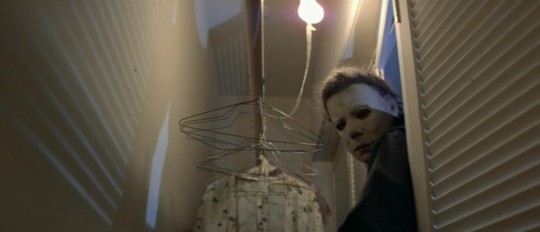
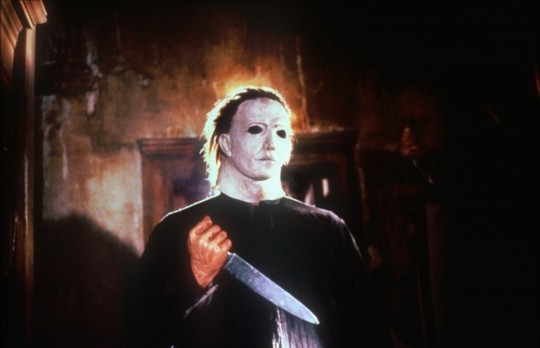
It shouldn’t be hard to replicate the original mask used in the first two films. Previous sequels sported acceptable variants on the Myers mask, but H2O‘s mask reveals the actor’s eyes in every shot. The earlier films opted to keep the actor’s features hidden whenever he was wearing the mask, emphasizing Michael’s lack of humanity. If you always see his eyes, the actor just looks like a guy at a costume party. Comparing H2O‘s mask to the original or the ones used in any the previous sequels, you can’t help but notice how wrong it looks.
Halloween:
Halloween 5:
Halloween H2O:
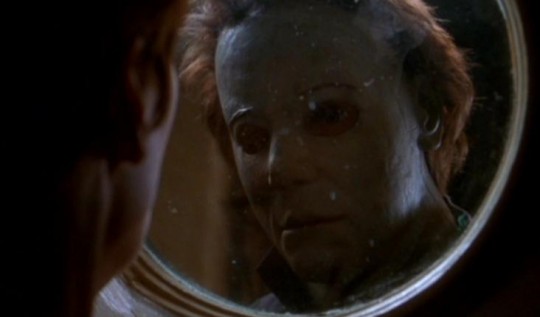
See? That’s not The Shape. That’s just… some guy.
H2O updates the characters from the original and Laurie fares much better than Michael. Laurie would definitely become an overprotective mom and she’d definitely be working in education. It makes sense that she’d have nightmares, drink too much and quietly mourn her dead friends from the original (I wish more lip service had been paid to them). Some moments, like the idea that she was married to a meth addict(?), ring incredibly false. Still, we’re here to watch Laurie finally kill off Michael and move on with her life. While there’s a certain thrill in seeing Curtis battle her iconic opponent, it takes about an hour before that happens.
While the scenes with Laurie are quite good (especially those with her son), the main problem from Halloween: The Curse Of Michael Myers resurfaces here. No, there aren’t any references to Thorn or gene-splicing in H2O, but it does suffer from too many characters running around. Since we know Myers won’t get Laurie’s son (that would defeat the purpose of the film), we need potential victims. The script introduces us to some nondescript teens and a security guard who moonlights as a romance novelist. To pour salt on this particular wound, the filmmakers have cast LL Cool J as that security guard. Woo.
H2O doesn’t have much reason to exist save the novelty of seeing Jamie Lee Curtis again. This is one aspect where the film doesn’t disappoint and the climax works more often than not. Some viewers might also get a kick out of seeing Joseph Gordon-Levitt (Brick), Janet Leigh (who previously appeared alongside Curtis in The Fog), Michelle Williams (Take This Waltz) and Nancy Stephens (er… Halloween) pop up even if the script gives them nothing to do. Though it was praised upon release, H2O‘s just a generic post-Scream slasher that grinds to a halt whenever Curtis isn’t onscreen.
Oh, and to leave you with a bad taste in your mouth, a Creed song plays over the film’s end credits. Goodnight, America!
Halloween: Resurrection
Rather than having such a padded first and second act, H2O would’ve benefited from an extended coda where we see Laurie piece her life back together. While such endings can often be clunky (see James Cameron’s original ending for Terminator 2), the star of H2O was Laurie, not Michael. The last moments should’ve been given to her instead of a severed head. Such a coda would prevent the inevitable sequel after H2O‘s success.
Enter Halloween: Resurrection, which brings Rick Rosenthal back to the series because it seemed like a good idea at the time.
Rosenthal directed Halloween II, which was partially re-shot by John Carpenter since Rosenthal’s cut was “as scary as an episode of Quincy” (as per Carpenter’s description). Resurrection offered Rosenthal a second chance to prove himself. Turns out John Carpenter was right. Halloween II was a little drab, but it was a decent slasher. Halloween: Resurrection has a bad script and, impressively, even worse direction.
Resurrection (originally given the more suitable title, Halloween: Homecoming) has Myers improbably surviving the climax of Halloween H2O. He finds Laurie Strode in an insane asylum (don’t ask) and finally succeeds in killing her. The result is a bewildering scene where Laurie kisses Myers before dying, recreating a behind-the-scenes candid shot from the original Halloween. So here we have something that would theoretically please fans who get the reference, but makes no sense whatsoever in any other context.
With that business out of the way, Myers heads back to his childhood home in Haddonfield. Lucky for him, the Myers house is now the site of a reality show populated by hot, young stereotypes. When Myers shows up and begins eliminating contestants in his own way, there’s only one man who can stop him. With Dr Loomis and Laurie Strode dead, it’s up to Busta Rhymes to defeat evil while rolling off catchphrases like “Trick ‘r’ Treat, motherfucka!”
Halloween: Resurrection is a failure on every conceivable level. It’s ugly, poorly-shot, cheaply-produced, nonsensically-written and the acting is atrocious. With John Carpenter’s help, Rick Rosenthal created Halloween II, which was a sometimes chilling film. Without Carpenter, the end result is Halloween: Resurrection.
In revisiting the Halloween series, one thing seems obvious: they focused on the wrong aspect in trying to build the series. Rather than bringing back Michael Myers or having Tom Atkins fight haunted masks, the key to the series’ success was right in front of everyone’s face: Loomis.
Nevermind that Donald Pleasence had the chops to lend gravitas to even the most hokey scripts. Loomis as a character had a lot of potential and Pleasence made him an icon of the genre. The smart thing to do would’ve been if Halloween II had picked up where the first one left off, but Myers doesn’t return. He simply vanishes. While searching for his former patient, Loomis ends up facing different threats, overtly supernatural or not, in his unending search for others who, like Myers, have come to embody evil. Say what you will about that idea, I’d take Dr Loomis fighting vampire women over Busta Rhymes, long-lost siblings or genetic engineering shenanigans any day of the week.
Next week: There’s no way in Hell I’m watching Rob Zombie’s remake. I’ll review something without a William Shatner mask, I promise.
The Woman in the Fifth (2012)
Mon, Nov 19, 2012
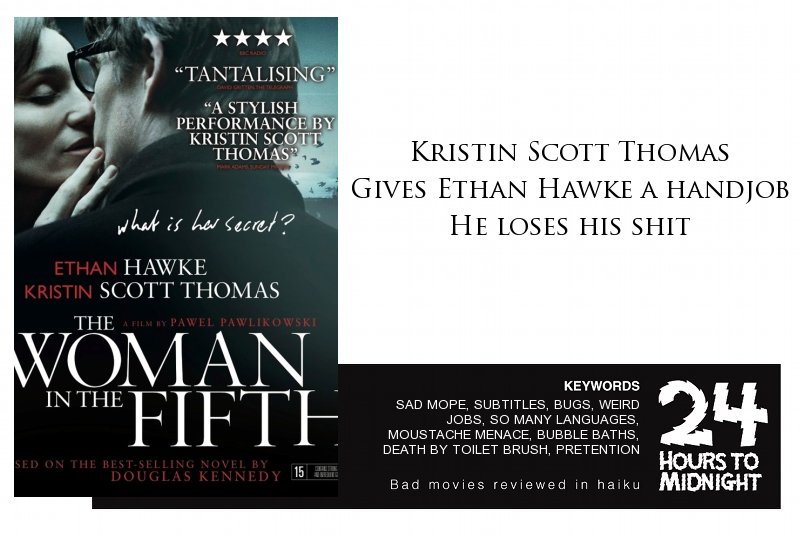
The Woman in the Fifth features Ethan Hawke in a role that somehow combines, basically, every role he has ever played.
Tom Ricks, divorced and possibly violent father and author, wanders around Paris and falls in love with Kristin Scott Thomas and a blonde Polish woman he meets at his motel and then a bunch of murders start happening around him. So, basically, we’ve got Reality Bites meets Before Sunrise meets Sinister meets probably 10 more Ethan Hawke movies meets HIS REAL LIFE. (Only in French and apparently with a ghost.)
Because the movie itself left me asking questions about WTF actually happened, I went to the internet for research and found out that it was based on a novel by Douglas Kennedy. In the film, Kristin Scott Thomas is revealed to have committed suicide back in the 90s and is actually a malevolent spirit that may or may not be either killing people herself or possessing Ethan Hawke… WHO KNOWS!? There are way too many dots left unconnected to get a clear picture of what the director was trying to get across, and instead what’s left is an incoherent, but beautiful, mess.
You Can’t Go Home Again: Revisiting The Halloween Sequels – Part Three
Tue, Nov 13, 2012
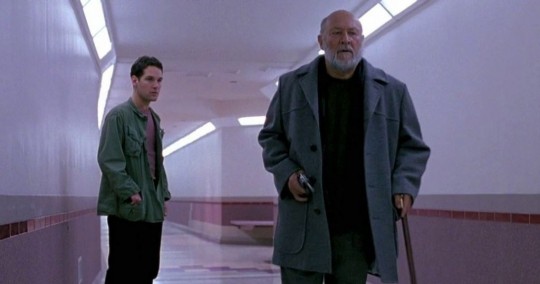
Adam Clarke knows enough about Druids to know that no one knows who they were or what they were doing.
Why can’t the sequels recapture the magic of Halloween? The first mistakes were made with the first sequel. The crucial difference between Halloween and Halloween II is subtlety. The original is a suspenseful, slow-burn horror film with few death scenes. Halloween II ramps up the body count, throws some (mild) gore into the mix and generally makes everything bigger and louder.
Upping the stakes in a sequel is to be expected, but even the characters are magnified in Halloween II. The filmmakers took Donald Pleasence and Charles Cyphers’ characters and made them literally louder by having them bellow in several of their scenes. Pleasence, the patron saint of actors who elevate the material they’re given, can sell the methodical Dr Loomis becoming unhinged after the events of the first film even if it results in illogical behaviour. There’s no excuse for Loomis to chase down an unlucky teen whilst screaming and waving a gun in Halloween II (Unhinged? Sure, but Loomis is not crazy). Nor was there any reason for said teen to keep the mask on instead of revealing that he wasn’t Myers. It’s lazy writing, but Pleasence makes it fun through the sheer power of overacting.
Alas, Halloween II would change its killer as well. I’ve already addressed the transformation from The Shape to Michael Myers: Sister Slasher. More than that, Halloween II grants Myers super-strength as he walks through several doors despite moving as quickly as your nan. By Halloween 5, I expected to see him knock down the Great Wall of China with his laser-eyes. Again, this is subtlety gone out the window. It’s not enough that Michael Myers be a mysterious figure with ropes and knives. No, he should be able to rip a man’s head clean off with a flick of the wrist.
These trends plagued the sequels more often than not. Halloween 4 presents Myers’ super-strength in an even sillier fashion than II and boasts some contrived scenes (why are doctors transferring Myers on October 30? Isn’t that THE WORST IDEA?) Regardless, it was a fine, b-grade horror movie with good acting, a few strong shocks and it brought some new ideas to the series. Of the sequels that followed, only one would try to inject new life into the diminishing returns of the franchise. To put it mildly, the results were mixed.
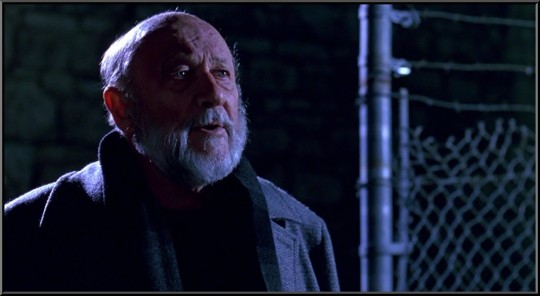
Halloween: The Curse of Michael Myers
There’s two fairly different movies called Halloween: The Curse of Michael Myers (aka Halloween 6). One is the film as originally shot and the other is the version that ultimately ended up in cinemas and on video. The original cut (aka the “producer’s cut”) of the film attempts to build a mythology that connects all of the Halloween movies. Yes, even Halloween III. That version never saw the light of day outside the bootleg circuit. The version that arrived in cinemas in 1995 was…different.
Confused? Oh, man. You don’t know the half of it. By the end of this review, you’ll learn about Paul Rudd, Druid wizardry, head explosions, Dracula’s birthday, pickled fetuses and more. Welcome to the batshit crazy worlds of the two movies called Halloween: The Curse Of Michael Myers.
Curse follows Halloween 5‘s conclusion with the Man In Black rescuing Michael Myers from prison. You may recall that in Halloween 5 we see that Myers now sports the symbol of Thorn on his wrist and so does the mystery man who frees him. The one thing we didn’t see is that the Man In Black kidnapped Myers’ niece, Jamie Lloyd, at the end of the film as well. As the Man In Black drives off with Myers and Jamie, the Haddonfield police station goes up in flames behind them.
We then jump from October 31st, 1989 to October 30th, 1995. Doctor Sam Loomis (Pleasence, in his final film) seems happily retired. The ’89 explosion has lead most to believe that Lloyd and Myers were dead and, unexpectedly, Loomis is fine with this. He’s put the past behind him, even going so far as to get skin grafts to cover up the burn marks on his right side (“at least I don’t frighten people anymore”, he says). Sure, he’s listening to a call-in radio broadcast about the Haddonfield slayings (VOCM Question of the Day: Are nubile teens doing enough to prevent getting slaughtered?) but ’tis the season and it is Loomis we’re talking about here.
Loomis now lives in a cozy home where he’s regularly visited by an old friend, Terence Wynn (Mitch Ryan). You remember Wynn, right? You don’t? But he showed up for a brief scene in the original Halloween where he argued with Loomis and was never named onscreen! Oh, and he was played by a different actor in the original. Surely you remember that or perhaps got a greater idea of who he was from the first film’s novelization? Geez. Do your homework, casual viewer…
In this film, Wynn and Loomis are oldest, bestest friends despite the former never being seen or mentioned in previous sequels. Wynn is retiring from Smith’s Grove sanitarium (where Michael escaped from back in 1978) and wants Loomis to take his place, but the good doctor turns him down. It’s surprisingly sweet to see Loomis make a life for himself that doesn’t involve monologues about evil. Of course, it won’t last.
A familiar voice calls in to the radio program he’d been taping, which immediately gets his attention. It’s the voice of young woman asking for Loomis’ help. It’s Jamie Lloyd (JC Brandy, replacing Danielle Harris) who, sure enough, is being chased by her uncle once again. Only this time, she’s got an infant with her. Naturally, Michael Myers has his sights on killing his niece and her child.
Back at his house, Loomis loses his kindly demeanor and retrieves his revolver for the first time in years. This little scene is one of Curse‘s genuinely awesome moments. Naturally, it’s been cut out of the theatrical version. Otherwise, both versions are essentially identical up to this point, but I’ll focus on the original version of Halloween 6 for now.
Lloyd’s holed up in an abandoned bus station, but her call is cut off and she’s soon caught by Myers. In the ensuing cat-and-mouse game, Lloyd’s able to hide her baby and makes her way to an old farmhouse. Loomis, Wynn and the police eventually arrive at said farm house, but it’s too late. Lloyd’s wheeled away in critical condition with a butcher knife lodged in her back.
Where’s Jamie’s baby, you ask? The child’s fallen in the hands of Tommy Doyle (Paul Rudd, replacing Brian Andrews. Yes, Paul Rudd aka Tayne).Tommy Doyle was the boy Laurie Strode was babysitting in the original Halloween and his experience with Myers has reduced him to a socially inept shut-in. Over the years, it seems Tommy’s become as obsessed with Myers as Loomis.
While I’m glad to see Doyle back, the way he finds the baby is incredibly contrived. On Halloween morning, we find Tommy constantly replaying Jamie’s phone call from last night’s radio broadcast. From a bit of background noise, he’s able to pinpoint that Jamie Lloyd was calling from a bus station. How does Tommy find the baby? Well, the bus station has a blood trail that leads to the ladies room and there was a crying baby inside that nobody noticed.
Let’s not address the stupidity and contrivance of how Tommy’s discovery is handled. Let’s instead wonder why Michael Myers, who is on the hunt for this baby, doesn’t think to search the one other place that Jamie had been. I guess he just got bored…
Loomis tries to convince the Haddonfield police to take preventive action against another Myers rampage, but the new sheriff shrugs Loomis off because that’s a great idea. Loomis, horrified by the threat of another Haddonfield massacre, fears he’s far too frail to fight Myers on his own and turns to Wynn for help.
Arriving at the hospital to check on Jamie Lloyd, Loomis runs into Tommy Doyle. Doyle tells Loomis about the baby. With one more relative still out there, Halloween 1995 is destined to be a bloodbath. Tommy also informs Loomis that a new family are living in the old Myers house: the Strodes. Loomis leaves Wynn at the hospital in the hopes of getting to the Myers house before Michael does.
Those familiar with the series will remember the Strodes. Michael’s sister Laurie was adopted by the Strodes, as revealed in Halloween II (why the Strodes didn’t adopt Jamie Lloyd following Laurie’s death is a question the film can’t answer). The Strodes at the Myers house aren’t Laurie’s parents, but her aunt and uncle. Unlike the sweet, intelligent Laurie, these clowns seem to have wandered in from a made-for-TV movie being filmed next door. There’s the lunkhead son, the timid mom and the alcoholic, abusive dad. Collect them all!
The only characters of interest at the Myers place are Kara (Marianne Hagan), the Strodes’ estranged daughter, and Kara’s preteen son, Danny (Devin Gardner). She’s quite likable as the film’s Laurie Strode stand-in. By contrast, her son is the quiet type. Quiet as in “Michael Myers in 1963″ quiet. He’s constantly visited by visions of Myers, Thorn and the Man In Black.
While Kara’s off to college, Loomis warns Mrs. Strode and she takes the threat of Myers as well as anyone could. When Loomis leaves, she calls her husband, packs her bags and plans to get her family outta Dodge. Unfortunately, her husband dismisses her concerns and she gets whacked with an axe before she can warn anyone else about Myers.
When Kara returns to the Myers house, she doesn’t find a trace of her mom, but does find her son hanging out with a twenty-something dude and a baby. Tommy Doyle introduces himself to Kara, but she’s naturally apprehensive of the twitchy, socially inept man her son met on the street. Doyle tells her about Myers’ inevitable return and, in a moment clarity rare for this type of movie, Kara and Danny flee the premises. Tommy takes them to a boarding house he’s been staying at run by the kindly Mrs. Blankenship (Janice Knickrehm).
Since the film decides that it needs more exposition and backstory, Tommy Doyle tells Kara all about the curse of Thorn. The bearer of the mark of Thorn is a vessel for pure evil, but is also granted great power. The Druids supposedly believed that if a child was given the curse and slaughtered his/her family in sacrifice, the rest of the tribe would be spared from the forces of evil. Doyle believes Michael Myers has been cursed, which would explain his immortality and his increased strength over the years.
In his research, Doyle discovers the Thorn symbol coincides with a similar-looking constellation that periodically appears on Halloween night. This constellation has appeared four times before in the last century: 1963, 1978, 1988 and 1989. Sure enough, Michael Myers has only attacked around Halloween during each of those years. Since the constellation is visible tonight, Doyle knows Myers will return.
Back at the hospital, Jamie Lloyd is recuperating, but still unconscious. The film flashes back nine months previous, as the Man In Black and his followers dress Lloyd up in ceremonial garb and chain her to an altar. She’s then locked up with Michael Myers, implying that he was ordered to rape her. As the flashback ends, the Man In Black enters Jamie Lloyd’s room at the hospital and takes out a gun rigged with a silencer. Loomis returns to find Jamie Lloyd with a hole in her head.
While father-uncle Myers hunts for his incest-baby (I can’t believe I just wrote that), Kara, Danny, Doyle and Loomis reunite at the Blankenship boarding house, but Jamie’s baby is missing. Danny, hearing a familiar distorted voice, runs to a stranger in black sitting in the living room. Loomis, realizing the Man In Black was under his nose all along, hisses the name “Wynn”.
Wait, Terence Wynn? He who was introduced as Loomis’ old friend? The guy who hasn’t been seen since the original film and is played by a different actor? He was the Man In Black? Quelle surprise!
Upon this shocking revelation, Dr. Wynn smiles at our heroes (probably because he’s mastered the art of changing from a light trenchcoat to a fabulous black giallo outfit in under thirty seconds). Mrs. Blankenship, cradling Jamie’s baby, advances on Kara with a pair of scissors. Before the others can react, a dozen figures in black robes spill into the boarding house and the film fades to black.
No, this movie doesn’t end on a cheap cliffhanger like Halloween 5. The original cut of Halloween 6 resumes with Kara chained to an altar. On her right, her son stands beside her, knife in hand. On her left, Michael Myers stands quietly over his baby. When the ceremony begins, Michael will kill the baby and his power will expire. Then Danny will inherit his powers and take the knife to his mother.
Sam Loomis and Tommy Doyle regain consciousness outside the boarding house. Loomis, now understanding what Wynn had in mind with his “come back to Smith’s Grove” talk at the beginning of the film, returns to the sanitarium with Doyle. Loomis takes out his gun, but Doyle stops him and suggests that the key to stopping Michael isn’t violence. He believes he can use the power of white magic through positive rune stones to stop Michael Myers forever because yeah, why not. Loomis tells him that the gun isn’t meant for Michael and our two heroes split up. Doyle spots one of the robed figures from earlier and follows him to the Thorn cult’s hidden ceremony room. Loomis heads to Dr. Wynn’s office, intending to empty his revolver into Wynn’s smug face.
Sure enough, Dr. Wynn’s sitting at his desk in full costume when his former colleague hobbles in. It’s at this moment that the continuity-obsessed sequel allows itself a moment of fun. The otherwise subdued Mitch Ryan relishes the hammy Wynn speech he’s about to deliver as though he were reciting the Queen Mab monologue.
Dr. Wynn claims Michael Myers must relinquish his power and a new child be selected to appease the forces of evil. Giving Danny the curse of Thorn will “restore the natural order of things” and put an end to 90′s malaise (no, really). He also wants Dr. Loomis to act as Danny’s protector (just as Wynn had been to Myers) and become the new cult leader. Rather than let this Bond villain speech go on a moment longer, Loomis raises his revolver, but is conked on the head by one of Wynn’s followers.
I must mention Mitch Ryan’s acting once again, which progressively enters Shatnerian overdrive during this scene. Clad in a giant black cloak and waving his hands about, Ryan acts like he’s Dracula at a birthday party. Remember that note I made about overacting at the beginning of this review? Ryan’s pretty good at it.
Down at the ceremonial altar, we see a fair number of Haddonfield townsfolk awaiting the sacrifices. Kara notices that Myers hesitates to kill the baby and reasons that it might be his. This ruffles Wynn’s cloak and he starts barking out orders while Kara appeals to Myers’ humanity. Their attempts to tell Myers what to do are reminiscent of Bugs Bunny and Daffy Duck telling Elmer Fudd whether it’s rabbit season or duck season. Only here, Elmer Fudd is Michael Myers, Bugs Bunny is a single mom, Daffy Duck is a poor man’s Christopher Lee and the hunting season in question is infanticide.
During this Model Druid U.N. debate, Tommy Doyle grabs Wynn and holds a knife to his throat, demanding the release of Danny, Kara and the baby. Loomis pops by to aid Kara, Danny and the baby escape while Tommy stays behind to face Myers. Doyle frantically creates a circle of rune stones, drops some of his blood on the ground and says a magic word (yes, really), all of which stops Myers dead in his tracks. This spell will apparently cancel out the dark power that Myers has had all this time, perhaps making him mortal/human again.
Outside, Kara, Danny and Tommy Doyle get in a Smith’s Grove van and Loomis tells them to get as far away from Haddonfield as possible. Tommy and Kara urge Loomis to join them, but he stays behind, telling them he has “some unfinished business” to attend to. After they drive away to safety, Loomis heads inside the sanitarium and finds Michael’s body lying in the circle of runes Tommy made. When he reaches down to unmask his former patient, Loomis instead finds a confused, possibly dying Dr. Wynn in his place.
“Michael’s gone!” Wynn shouts and grabs Loomis by the wrist. “It’s your game now, Dr Loomis,” Wynn says before collapsing. Loomis pulls back, but the Thorn symbol appears on his wrist like an infection. After a moment of shock, Loomis begins to howl in pain as the film cuts to Michael Myers in the shadows. The Haddonfield slasher is unmasked, sporting Wynn’s clothes and walks away into parts unknown. The end?
The original version of Halloween 6 is a little problematic. It’s a mess loaded with characters new and old, plot twists, homages to the first film and attempts to explain Michael Myers all in about 96 minutes. I summarized the film as best as I could, but I still left out sub-plots involving a radio DJ, a Halloween celebration and all the drama surrounding the Strodes. This is the most top-heavy, plot-drenched slasher movie I’ve ever seen. It might be the only slasher movie that can be described as such, which proves to be both a blessing and a curse for The Curse Of Michael Myers.
Re-watching Halloween 6, I feel the impossible has happened: we’ve gotten character development for the first time since Halloween 4. For better or worse, this movie changes our understanding of Michael Myers and some of it worked. The reintroduction of Tommy Doyle is handled quite well (despite Rudd’s spotty performance), as Tommy’s obsession with Myers is the perfect way to write that character back in the story. On top of that, Kara Strode makes a fine addition to previous Halloween “Final Girls” like Laurie, Jamie and Rachel.
Best of all are the scenes with Loomis, which give the character more to do than any other film in the series. As much as I like the character, the depth of Loomis’ personality was only revealed in small touches throughout the films. Usually, he’s just there to remind us of how frightening and powerful Myers is or to offer insight into the killer’s (lack of) personality. Loomis has an actual character arc for the first and only time in these movies. Beginning the film in a peaceful hermitage, Loomis is unprepared for Myers’ return and turns to Wynn because he needs to have a friend with him. In his interactions with others and his reactions to deaths around him, we see that Loomis’ obsession has subsided so much that he’s lost his sometimes cold demeanor. Loomis is now visibly distraught when the bodies start piling up. This mellowed out Loomis must nonetheless risk facing Michael and, later, his own best friend to try and stop the Thorn curse once and for all.
On that note, it must be said that the Wynn character is a catch-22. Mitch Ryan is good in the part and Wynn’s relationship with Loomis is interesting, but the character is so obviously our Man In Black that there’s no mystery. Imagine if, instead of Wynn, they’d brought back Nancy Stephens to reprise her role of Nurse Marion from the first two films. After all, the person who cursed Myers as a child doesn’t necessarily have to be the one who’s been looking after him since Halloween 5. We’re less likely to guess the stranger’s secret identity if they have a history with Loomis we’ve actually seen. Wynn fits the storyline as is, but the mystery’s about as deep as the identity of the traitor aboard the Enterprise in Star Trek VI.
The handling of Jamie Lloyd’s character is a major disappointment. The incest/kidnapping storyline is problematic because, like the sudden importance of Wynn, it’s never more than a contrivance (also, kinda gross). We know the baby exists just to write out Jamie Lloyd and that Lloyd must be written out to prevent Loomis and Doyle from getting to Smith’s Grove before the film’s third act. Jamie is killed off in both versions of 6 without a second thought and it’s unsatisfying to put a major character from the series through Hell only to kill them off for the sake of a plot twist. If anyone should’ve been alongside Loomis and Doyle at the end of this film, it should’ve been Lloyd. What a disappointing send-off for a once-important character.
This version of the film is so uneven, but I can’t help but appreciate it for being ambitious, weird and sometimes unpredictable. Screenwriter Daniel Farrands is actually trying to give us something new. As goofy and clunky as the original/producer’s cut sometimes is, I have to give it credit for a memorable, ambiguous ending. Unlike the “business as usual” approach of Halloween 5, Loomis and Myers are different characters by the end of the movie. At the end of this version of Curse, it looks as though Myers is walking away from his former self and is no longer possessed by the Thorn spirit. Loomis has been made the head of a crazy cult and would be required to protect Myers (or his successor) after a lifetime of trying to stop him.
If the production team had a bit more money to play with, Curse‘s original/producer’s cut would be much more successful. Visually, Halloween 6 begins the trend that plagued the series ever since: pedestrian cinematography that has no mood or ambiance. Curse is the first of the Halloween films to look flat and uninspired, as would the next two sequels and Rob Zombie’s remakes. That said, Curse is the worst offender in terms of cinematography. Both versions of the film resemble any number of straight-to-video genre films released in the mid-90′s.
The film’s direction is also pretty flat. Joe Chappelle, a director best know for helming episodes of The Wire, tries to pay homage to John Carpenter and fails miserably. Chappelle’s lifeless work means that Curse is at its least interesting whenever Michael Myers is onscreen. Say what you will about Rick Rosenthal, Dwight Little and Dominique Othenin-Girard, but each of those directors was able to get some mileage out of Myers in previous sequels.
The acting in the film is highly variable. Some of the actors are quite good, like Donald Pleasence, Mitch Ryan, Kim Darby (as Kara’s mom) and Marianne Hagan. Others, like Devin Gardner and Paul Rudd, are sometimes astoundingly bad. Gardner can kindly be described as a poor man’s Jake Lloyd, while Rudd is miscast as the obsessed Tommy Doyle.
When you watch either version of Curse, two things are readily apparent about the script: it was written by a fan and it was tinkered with a few too many times. Originally, Dr. Loomis was supposed to die in a random jump scare before the end credits, but this was wisely dropped after Pleasence objected. Other drafts of the script had Jamie Lloyd surviving the film. Some ended with Wynn kidnapping Danny and/or the baby and flying away in a helicopter. Some versions of the script changed who the father of Jamie’s baby was. Throw in some last-minute dialogue additions by producers to spell out a few scenes (including such clunkers as “the power of the runes stopped him” and “we have been drugged!”) and the end result should be abominable.
Yet, I kinda like the original/producer’s cut of this film, warts and all. This version of Curse is typically at its best when developing Tommy Doyle and Sam Loomis or delving into the Thorn mythology. There’s a sequence in the middle of the film where Mrs. Blankenship tells Danny some Halloween lore that’s easily one of the best moments in any of the sequels.
You can’t help but pity screenwriter Daniel Farrands for having to jump through so many hoops to write a new story. He sought to unify the black magic/Samhain elements of Halloween II & III with the rest of the series, explain the Myers-must-kill-his-family plot thread from II onward, explain why Myers could never die, reintroduce characters not seen since the first film and resolve the plot threads introduced in Revenge (the writers of 5 never concocted a backstory for the Man In Black or the sudden appearance of Thorn on Myers). Sure, the script is loaded with fanwank designed to explain inconsistencies throughout the series, but I find that kind of endearing. I just can’t hate a film that, when confronted by series plot holes like “why would Myers get transferred just before Halloween 4?”, calmly explains that a wizard did it. I particularly liked the ending of this version of 6, as it’s the rare horror sequel that ends with the promise of a series going in an interesting new direction.
That new direction was desperately needed because Myers is far from scary the fifth time around. The trouble with the producer’s cut of Curse isn’t that it veers too far from the basics, but that it doesn’t abandon ship sooner. It’s well over an hour before the identity of the Man In Black is revealed, so the script loads itself with too many characters. Halloween 6 has so many plot threads and characters running around that Michael Myers seems like an afterthought in his own movie.
While the Thorn storyline works on its own terms, the lack of a budget is all too evident during the showdown between Tommy Doyle and Michael Myers. This should be a big moment. Say what you will about the Nightmare On Elm Street sequels, but each one tried to make Freddy Krueger’s defeat the highlight of the movie. When Doyle stops Myers, we’re not treated to lightning bolts or spectacular visuals. Myers just walks up to Tommy and freezes dead in his tracks. That’s it.
Again, that’s the sort of thing the studio/producers should’ve spent a little more money on.
Once this cut of the film had been previewed, the filmmakers knew the end result didn’t quite work. Anyone who’d seen this cut of the film would know that it was a slow-paced, indifferently-shot thriller. Its real strengths were the character scenes with Loomis and Tommy (despite Rudd’s acting), the Thorn mythology and the ending.
So, the filmmakers cut the extraneous characters, shortened the first hour to get to the Smith’s Grove scenes earlier and re-shot the Myers-Doyle confrontation, right?
Not exactly. Tommy’s confrontation with Myers is indeed different and the build-up to the Man In Black reveal is shorter. However, they kept all the major character scenes except for any of the stuff with Loomis and Wynn. Oh, and the last twenty minutes of the film consists of a new ending the director wrote on the spot without Farrands. In summary, the production team decided that this fat would taste a great deal better without any of that pesky steak in the way.
In the theatrical cut, Loomis enters the movie without any explanation as to what happened to the scars on his face and hands. In fact, Loomis barely seems to be in the film at all. Though many of his scenes from the earlier film remain, they’ve all been whittled down to a few lines of dialogue. Jamie is given a brutal new death scene and, instead of getting shot by Wynn in the hospital, Myers now impales her on some farm equipment. Of course, without the flashback scene in the hospital, we’d never find out who the father of Jamie’s baby was (Kara’s reference to this in the original climax has been cut). Oh, well. This version doesn’t deem that plot thread important when it can spend time with Kara’s drunk dad or the couple who have sex in the Myers house with predictable results.
After Wynn kidnaps Danny, Kara and the baby, we’re treated to an entirely new climax. Instead of Smith’s Grove crawling with Thorn cultists, it’s revealed that the whole thing was just a prank. It turns out that Wynn and company have been pretending to be Druids (for some reason) because they’re doing experiments on fetuses that they keep pickled in an underground lab (for some reason) and Michael Myers is key to that (for some reason). Myers then freaks out and kills all the doctors (for some reason). Tommy then beats Myers with a pipe, which causes green goo to ooze out of his head (for some reason). Loomis helps Kara, Tommy, Danny and the baby escape before heading back to Smith’s Grove for unfinished business. The last we hear of Loomis are the sounds of Donald Pleasence screaming offscreen, implying that he’s finally met his end at the hands of the undying Myers.
Kinda makes Halloween III seem like a master class in narrative clarity, doesn’t it? I’d understand if they removed the Thorn plot completely (which seems to have been the intention here), but the theatrical cut retains the scene where Tommy tells Kara that Myers only appears when a certain constellation is in the night sky. Why would that mean anything if Wynn and company were just ordinary doctors the whole time? Also, if Wynn isn’t a magical Druid wizard, how is he communicating with Danny? More importantly, why does he want Danny if there’s no curse to pass in the first place? And if there’s no curse, why kidnap Danny and Kara at all?
Furthermore, if it’s now just doctors who are the robed figures, why does Mrs. Blankenship help Wynn kidnap the others? In the original version, Blankenship is seen donning cult robes in the climax. In fact, the original cut implies that a good chunk of Haddonfield townsfolk are in the cult. But if they’re just doctors…ugh, let’s not pretend the theatrical cut makes any sense. This version of Halloween: The Curse of Michael Myers is one of the most incoherent pieces of garbage I’ve ever seen.
The theatrical cut opts for bigger and louder, offering the series’ goriest kills, manic editing and a wailing guitar version of the classic Halloween theme to take us home. Oh, and the movie now takes false scares to a pathetic extreme. It’s bad enough when horror movies spice things up by having a cat jump into frame or innocent characters bumping into each other and screaming. This version of The Curse Of Michael Myers dubs in loud noises even when nothing’s happening.
For instance, there’s an early scene in which Kara’s brother gives his girlfriend a kiss from behind while she talks to Kara. In the producer’s cut, this plays without music because nothing is happening. In the theatrical cut, there’s a loud “SKRUNG!” at the end of this scene…for some reason.
In addition to having loud metallic bangs throughout the movie, the film will suddenly cut to a rapid montage of earlier/later scenes while someone screams on the soundtrack. Also, whenever there’s a jump cut, there’s a big, echoing scream. Needless to say, this version of Curse is eerily similar to that South Park Halloween special that was filmed in “Spooky Vision”.
The gore is plentiful, but generic. I already mentioned Jamie’s new death scene, but the theatrical cut blows its respective wad when we see Myers killing Kara’s dad. In the original cut, he’s electrocuted when Myers impales him on a fuse box. In the theatrical cut, this death scene now ends with the father’s melon head exploding. After his head explodes, the movie’s kind enough to give us an instant replay, showing the explosion again.
So, the Druid angle in the original version is off-putting to some and understandably so. I agree that Myers doesn’t need to be explained. In fact, Halloween II‘s revelation that Laurie is Michael’s sister is easily the most damaging thing that ever happened to the character. Bonehead creative decisions like that in the previous sequels are precisely why the cult storyline was introduced in the original/producer’s cut.
If you’re going to keep making sequels to a movie that was never intended to have them, all sorts of inconsistencies will pop up. While the Friday The 13th and Nightmare On Elm Street sequels blissfully ignore their contradictions, Daniel Farrands opted for a different approach when writing Halloween 6. He was saddled with many bizarre elements left unexplained by other writers, like the Samhain scene in II, Myers’ Jason Voorhees-level strength in 4 and the random giallo dude from 5. It’s probably foolhardy to attempt to unify all these oddities into one coherent story, but Farrands does the best job anyone could. The presence of child-murdering Druids in this film is certainly an attempt to link the series with the stand-alone Halloween III: Season Of The Witch. The Thorn curse is a “get out of jail free” card that rationalizes the inconsistencies in the portrayal of Myers and would give future writers new fodder for the character if more sequels were on the way.
If you’re willing to watch yet another sequel by the time a franchise passes the III-mark, then you’re probably willing to go along for outlandish plot elements. Besides, John Carpenter’s Halloween is a strong enough movie that none of its sequels, remakes or rip-offs have ever diluted its power. I never get troubled with the plot elements from the sequels when I watch Carpenter’s film, just as I don’t get troubled by thoughts of “good locusts” and sweaty Richard Burton when I watch the original Exorcist.
Halloween: The Curse Of Michael Myers, in its original producer’s cut, works as a sequel to the previous sequels. It develops the elements of the sequels and characters introduced in Halloween in a way that entertained me. It should’ve been a lot better, but I still give the film a lot of credit for the way it developed Sam Loomis and Tommy Doyle. The less said about the theatrical cut, the better. It’s a shame that the theatrical version of the film is readily available in video stores while the intriguing-but-flawed producer’s cut of the film is relegated to comic conventions and dark corners of the internet. There’s been some talk of Disney officially releasing this frequently-bootlegged original version of the film, but nothing has materialized as of yet.
Regardless of which version of this Halloween sequel you watch, it must be said that a follow-up to a story as simple as Carpenter’s original probably shouldn’t court plot elements like curses, incest, cults or, if you’re watching the theatrical version, gene splicing (or something). Given that Halloween 6 was an attempt to fix the unwieldy story that had developed over the series, we’re reminded once again that Halloween should never have been sequelized in the first place. A lesson we’d learn twice more in 1998 and 2002.
Next week: Since the death of Donald Pleasence left The Shape without a worthy opponent, Jamie Lee Curtis was lured back to the series to face the boogieman one last time. Then once more in 2002.
Post-Halloween Films (Threat level: Traumatic)
Fri, Nov 9, 2012
Remember those films we mentioned last time? The R-rated blood-and-guts horrorshows? Well here they are. A list of scary, gory, films to keep you terrified all the way through ’til Christmas. YOU’LL NEVER SLEEP AGAIN.
Eden Lake
(2008)
Kids are scary. Not possessed children, who have become as lame and generic as hook-handed serial killers, but real, unpredictable, uncontrollable kids. If you’ve ever crossed the street to avoid a rowdy group of teens and then kicked yourself for being so painfully old, Eden Lake will find that uncomfortable pit in your stomach and stick a butcher knife into it. When a young couple (Michael Fassbender and Kelly Reilly) has their romantic weekend getaway transformed into a horrific cycle of complication and escalation, all based on their encounter with a group of teen jerks, it’s as uncomfortable as an episode of Louie, with the comedy swapped out for horror.
Twisted Nerve
(1968)
Written and directed by the Boulting Brothers, Twisted Nerve tells the story of a manipulative and sinister young man named Martin (Hywel Bennett), who may or may not be schizophrenic and at times pretends to be a child named Georgie. Martin, babied by his mother and detested by his stepfather, becomes obsessed with Susan (Hayley Mills), moves into her home, and it all just gets weirder from there. This is also the source of that creepy whistling heard in Kill Bill and American Horror Story. Less gory then the other films on this list, Twisted Nerve is still scary enough to make you think twice about opening your door on a spooky night.
The Descent
(2005)
A young woman named Sarah loses her husband and daughter in a tragic car crash. One year later, she reunites with five friends for a spelunking expedition. After a rock fall blocks their way back out, the women must continue on through the cave past hungry predators to reach daylight. Claustrophobia plus monsters equals hella scary!
Inside
(2007)
French horror has a reputation for grueling gore and terror, and Inside (aka A l’interieur) is undoubtedly partly to blame. Set during the 2007 riots in France, the vast majority of the film takes place conspicuously inside the house of a young expecting mother, Sarah. When a stranger appears in the dark outside, Sarah uses her camera’s flash to reveal a mysterious woman who has been stalking her for days. The woman soon makes her way inside, and the film spirals into a dizzying scramble for survival as both women become intent on killing each other with the various domestic items throughout the house. The pace is breathtaking, but the horror will linger long after the credits roll. Don’t forget to double-check the locks, and for god’s sake hide the knitting needles.
You Can’t Go Home Again: Revisiting The Halloween Sequels – Part Two
Tue, Nov 6, 2012
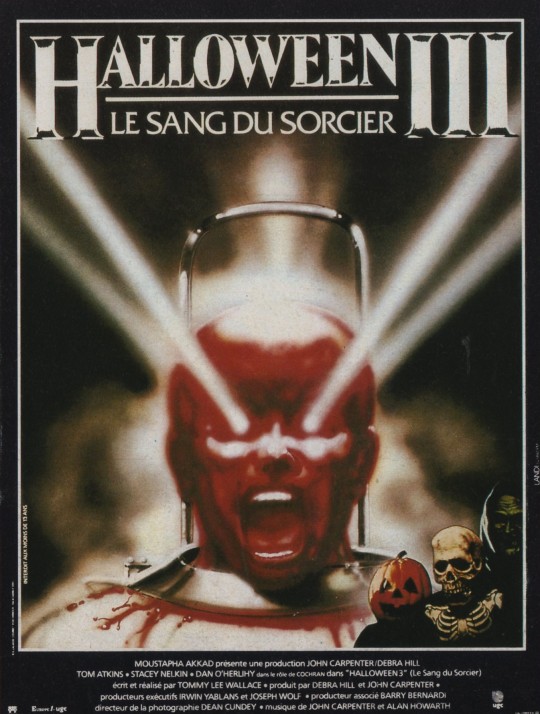
Adam Clarke was shot seven times. He got better.
Halloween III: Season Of The Witch
Last week, we saw Michael Myers and Laurie Strode go from stangers to siblings, demystifying the character of The Shape/Michael Myers in the process. By the end of Halloween II, Loomis had incinerated Myers, sacrificing himself in the process.
None of that matters now! We’re off to crazy world of Halloween III: Season of the Witch. A world of make-believe! A world of evil masks, disappearing landmarks, closed-circuit cameras and killer robots!
Promoted with a great teaser that seemed to promise a Suspiria-like film, Halloween III is a memorable oddity that plays like an R-rated Disney picture. Halloween III has Dan (b-movie favourite, Tom Atkins) and Ellie (Stacey Nelkin, Bullets Over Broadway) trying to stop a conspiracy to murder children with a combination of deadly masks, magic and a commercial jingle. The man responsible for this plot is Cochran (Dan O’Herily, Robocop), a mad billionaire who intends to bring menace and fear back to the holiday and will sick his army of robots on anyone who gets in his way.
Halloween creators John Carpenter and Debra Hill had an idea for continuing Halloween, not with direct sequels, but by making a series of one-off horror films tied to the season. Before pursuing this idea, producers demanded that they end the Myers-Loomis-Strode story. Halloween II and III are the rich bounty of this decision.
There’s nothing wrong with these ideas on paper, but I can’t help but wish all parties could’ve compromised to make Halloween II an anthology film with two or three stories. Halloween II, as is, would be better if it was cut from 92 to 30 or 45 mins. That way you eliminate the dumb long-lost sister and Ben Tramer plot elements, you cut down on the film’s plodding mid-section and you keep all the stuff that works into a lean package.
Halloween III is not at fault for being as weird as it is. I enjoy how weird it is. But it also doesn’t really go anywhere for long stretches of its running time and, frankly, doesn’t make a damn lick of sense. Cut this down to a 30-45 minute story about Cochran pulling an intensely nasty prank on the world and you’d have an above-average episode of Tales From The Darkside.
Had Carpenter and Hill combined these two films into one anthology film, the end result would be a lot easier for audiences to swallow future sequels without Michael Myers.
While not the worst of the Halloween sequels, it’s hard to believe that anyone would stake the future of a potentially lucrative franchise on a film as alternately goofy and bleak as Halloween III. To its credit, the film sports great cinematography (provided by frequent Carpenter collaborator, Dean Cundey) and an effective, synth-laden score by John Carpenter and Alan Howarth. Also, the cast is pretty strong. Tom Atkins is always a lot of fun to watch and Dan O’Herily is particularly good here.
When the Myers-less sequel was greeted with hostility from fans, series producer Moustapha Akkad caved and gave the people what they wanted. The new film spells it out right in the title: Halloween 4: The Return of Michael Myers. The film returned to Haddonfield, brought Loomis and Myers back to life and gave Myers a troubled niece to chase in place of Jamie Lee Curtis. I’ve already reviewed that film, but I will once again complement Halloween 4‘s creative team on bringing back elements of the first film in a fresh, sometimes inventive package. Its sequel, on the other hand, is a different story…
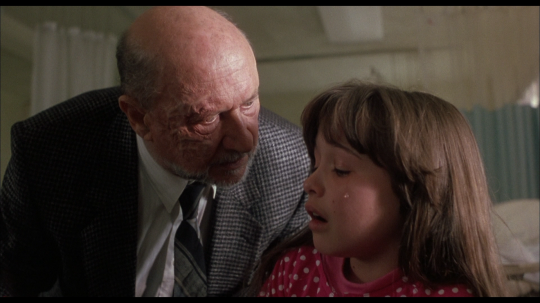
Halloween 5: The Revenge of Michael Myers
By the end of Halloween 4, Myers was dead and his curse was seemingly passed to his niece, Jamie. Just as Michael Myers killed his sister in 1963, Jamie had killed her stepmother in 1988. By the end of that film, we expected history to repeat itself again as Dr. Sam Loomis would try to prevent Jamie from getting out of the insane asylum. Sounds like a great hook for a sequel, right?
I hope you like disappointment because Halloween 5 will spend the bulk of its run time pissing away the good will built up by its surprisingly enjoyable predecessor. Revenge disregards that film’s ending to show us that Myers didn’t die and was nursed back to health by a kindly hermit. Jamie (Danielle Harris), now mute from shock after her brief shift into homicidal madness, is at a children’s ward where she’s routinely visited by step-sister Rachel (Ellie Cornell) and Dr. Loomis (Donald Pleasence).
Loomis knows Myers will strike again, but is now of the opinion that the rage within his family can be controlled. In a sense, Michael Myers could become a human being again(?). This “rage” the good doctor keeps referring to is implied to be inherent in the Myers bloodline, thus giving us a lame reason to retcon the ending of Halloween 4.
When Halloween 1989 rolls around, Myers awakens from his bullet-induced coma and promptly stabs the good Samaritan who took him in. Loomis realizes that Jamie has a psychic connection to the killer now (easily my least favourite horror trope), so he urges her to write or draw any clues pertaining to Myers’ next target. Loomis and Jamie’s constant games of slasher Pictionary can’t prevent Myers from killing off Rachel (boo! She was likable!) and stabbing his way through a cast of partying pseudo-teen non-entities.
In what can barely be called a subplot, a stranger dressed as the killer in every giallo movie steps off a bus for Haddonfield. This man in black pops up occasionally, sporting the Thorn rune symbol on his wrist. Myers, for the first time ever in the series, also sports the symbol.
Fun fact: This plot point will amount to virtually nothing until Myers is imprisoned and freed by this stranger at the end of the film.
Hastily put together after the success of Halloween 4, this film reunites most of its predecessor’s cast for a less successful horror movie. That’s right, Halloween 5 is to Halloween 4 what Halloween II is to the original. Let that thought sink in next time you’re at the video store, hurting for another visit to Haddonfield, Illinois.
If Halloween II would be better if it was cut down to 45 minutes, then Halloween 5 only has about 15 minutes of decent material. The opening credits are really stylish, as is the climax and a handful of other scenes. These qualities can’t compensate for the fact that huge chunks of the film are incredibly tedious.
As per most of the Halloween films, 5 sports crisp cinematography, a moody score by Alan Howarth, a couple of nice set pieces (particularly the scene where Jamie is hiding from Myers in a laundry chute) and the presence of Pleasence to anchor the whole thing. This is all wasted on a cheap, cynical script that doesn’t have anything new to offer.
The only novel aspect of Halloween 5: The Revenge Of Michael Myers is the sudden appearance of the Thorn symbol on Myers. Otherwise, Revenge is so unbelievably contrived and predictable. Why does a hermit rescue Myers? Is he related to the Man in Black? What’s the connection between this cloaked figure and Myers? Why did Jamie’s newfound psychic powers make her kill her stepmom? What does Loomis mean by all that “stop the rage” stuff, as if he’s suddenly decided Myers has regained his humanity? Why’re teens partying in Haddonfield when they know the police are hunting for Myers again?
After Halloween 5 introduced these ill-conceived plot twists, the Halloween series would continue to go into even murkier waters. Like the good Dr. Loomis, I’m destined to study them and warn the public before it’s too late.
Next week: Two movies called Halloween 6. Wait, what?
You Can’t Go Home Again: Revisiting The Halloween Sequels – Part One
Wed, Oct 31, 2012
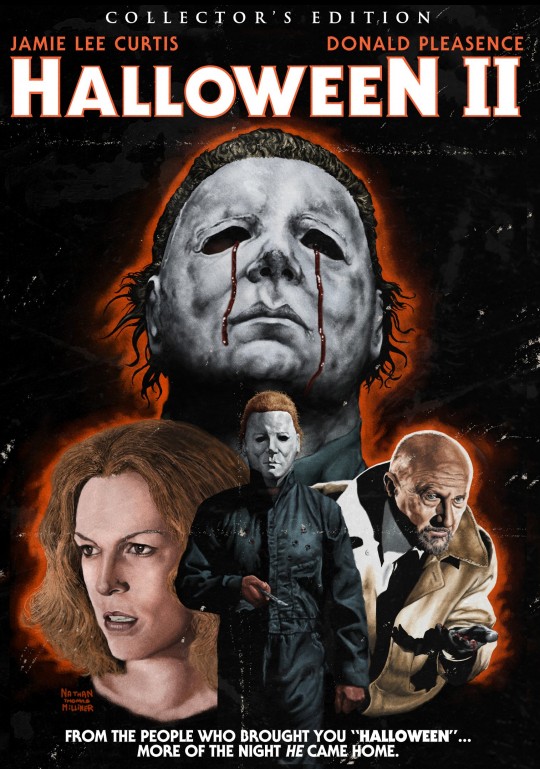
Adam Clarke would like to legally change his name to Pamela Susan Shoop.
John Carpenter has nearly always been punished for being ahead of his time. The satirical They Live, the crazed genre-hopping Big Trouble In Little China and a horror masterpiece like The Thing were each met with indifference only to have their importance realized subsequently on home video. Fortunately, some of Carpenter’s films didn’t meet such a fate. Halloween may still be John Carpenter’s most successful film and its impact is still felt in the horror genre.
What more can be said about Halloween? It’s a masterpiece of simplicity enriched by a creepy atmosphere, tense music and an iconic performance by the great Donald Pleasence. Halloween stands proud along undisputed classics of the genre like The Exorcist, Nosferatu, Psycho and Carpenter’s own The Thing. The film tells an efficient, frightening story that is perfect from its first scene to its last, book-ended by the haunting melody of Carpenter’s music.
Halloween was never meant to be sequelized. When Pleasence shoots the killer in the heart, only to find that he has somehow walked away and vanished, the story’s over. It’s a classic tag, like the old story about the couple finding a serial killer’s trademark hook embedded on their car door. The point isn’t that there’s more story to tell, but that the evil is still out there.
But box office demands the story continue. Producers with dollar signs in their eyes needed the story to continue. What interests me is the approaches taken to ensure the Halloween name survived. How do you continue a story as simple as Carpenter’s film?
Halloween II has a strange history. Intended as nothing more than a cash-in, Carpenter and co-writer Debra Hill had no interest in producing a follow-up to their 1978 classic. With so many knock-off slashers reaping the box office rewards in the absence of a Halloween sequel, Carpenter and Hill knew that Halloween II was going to go ahead with or without them. They opted to take the cheques and write the film lest series producer Moustapha Akkad and Halloween II producer Dino de Laurentiss hire z-list talent that would make a mockery of the earlier film.
In some ways, they needn’t have bothered. Carpenter and Hill found plenty of ways to retroactively tarnish their original film with this one, but I can’t dismiss Halloween II as a complete waste of time.
In one of the film’s more inspired touches, Halloween II takes place on the same night as its predecessor. We open with a brief recap of the original film’s ending, as Dr Loomis (Pleasence) fires six rounds into a masked maniac (Nick Castle in the original film, Dick Warlock here), saving Laurie Strode (Jamie Lee Curtis) in the process. Loomis peers out over Strode’s balcony and, instead of finding the killer, there’s only a small pool of blood. Loomis runs to the police in the hopes of finding the killer, while Laurie is wheeled to Emergency to deal with the injuries she received in the first film.
No longer able to keep the press away from this story, news instantly hits that a masked man is on the loose and it’s none other than Michael Myers, the boy who was locked away in 1963 for butchering his sister. Now he’s back in his hometown of Haddonfield, Illinois. Yet, despite the additional police attention and news coverage, no one seems aware of Myers until it’s too late. It isn’t long before the killer is stalking the very same hospital Strode is in, but this time she’s too doped up to fight back. It’s up to crusading psychiatrist Dr. Loomis to step in once again.
It’s easy to pick on Halloween II for not living up to the original, but it’s not without its merits. The funky reworking of Carpenter’s original score (by Alan Howarth) is interesting, if a little too gothic for such a film. I also liked some of the film’s little stylish touches, like the occasional Psycho-inspired camera angle and the use of “Mr. Sandman” by the Chordettes. The film is given added legitimacy by reuniting most of the original cast and dropping enough references to the first film, that many consider this to be Halloween‘s true sequel.
While it’s nice to see so many of these people back, almost nothing is done with them. Sheriff Brackett (Charles Cyphers) disappears as soon as he learns of his daughter’s fate in the first film. This introduces a new deputy character just so he and Loomis can kill time by having Loomis repeat everything he told Brackett in the first film. Then, we have Laurie, once strong, intelligent and resourceful, now reduced to vegetating in a hospital bed until she gets chased again.
Only Pleasence benefits from returning for the sequel. Though he’s forced to go over a lot of the same ground covered in the first film, Loomis is given some great, action hero one-liners that give Halloween II a bit of energy. Pleasence is clearly having a ball with his sudden transformation into Bruce Willis and sells even the hokiest bits of the script. Just close your eyes and listen to his pointless (and inaccurate) monologue on “Samhain”. The lines have nothing to do with the story, seemingly offering an explanation for Myers’ killing spree before the film drops that angle in favour of a different explanation. He sells it perfectly. You can’t beat that voice. You don’t want to argue with the spirit of dark and lonely water.
The most disappointing aspect of the sequel is that the killer is given motive. In Halloween, Michael Myers stopped existing the moment he picked up that butcher knife in 1963 and murdered his sister. He is now pure evil. He’s the boogieman, plain and simple. That’s why, in Halloween, Nick Castle was credited as playing The Shape, not Michael Myers.
Halloween II transforms this monster back into a man by giving him a weird motive. In a dumb twist, apparently conceived by Carpenter after he decided to kill his writer’s block by drinking heavily, Laurie Strode is revealed to be Myers’ long-lost adopted sister. In Halloween, Laurie is dealt a cruel hand by fate simply because she was in the wrong place at the wrong time. She stops by the abandoned Myers house on Halloween night, 1978. Myers sees her and targets her for the rest of the film. In Halloween II, Myers somehow knows Laurie is his sister and is determined to kill her.
The worst thing about adding this backstory is that it isn’t even necessary. No one cares how, say, Darth Vader became a galactic threat. What matters is that he’s an imposing, iconic screen villain. The same is true for The Shape. Turning him into “Michael Myers: Sister Slasher” dilutes his appeal. It’s strange that, no matter how many sequels and remakes there are of the Halloween series, they always return to that stupid idea.
This mistake was completely avoidable, too. There a scene fairly early on in Halloween II where Myers overhears a news report, learning that Strode is at the hospital. That’s all the motivation you need. By trying to answer questions about the character, it only makes things more confusing. What happened to Michael and Laurie’s parents? Who knows Laurie’s adopted? Surely a small town like Haddonfield couldn’t keep such a thing a massive secret, right? What was the point of hiding this info from Loomis?
Another aspect of the first film that gets trounced is tone, which Halloween II bungles at nearly every opportunity. Halloween was smart enough to tell a tight, interesting story while still having room for lightness. Whether it’s Laurie chatting with her spunky friends, the sweet relationships between the teens and the kids they were babysitting or Loomis playing a practical joke on some kids during some unexpected downtime, Halloween had a lightness to it. These variations in tone strengthened the film and offered a welcome respite from the grim sense of fate that dogs every character in Halloween.
Halloween II is relentlessly grim and mean-spirited. Ever hear rumours about razor blade apples? Here there’s a close up of a kid with a blade lodged between his lips as the sole other patient at the hospital where Laurie is. Remember, Ben Tramer? The guy Laurie Strode had a crush on in Halloween? He’s burned alive during a contrived sequence where Loomis mistakes him for Myers and the poor high school kid dies horribly for no other reason than to pad out the film. Halloween II is a movie where almost no one makes it out alive, but without any emotional payoff. You had sympathy for those murdered by Myers. All I could remember about the hospital staff was that one guy was played by The Last Starfighter, one guy was played by b-movie actor Leo Rossi and there’s a cute nurse played by an actress named Pamela Susan Shoop.
Halloween 4: The Return of Michael Myers is, without a doubt, the best of the sequels. I’ve already reviewed that fourth film, so I’ll refrain from detail here. It’s successful because it kept elements of Halloween II, but returned to the lurking, outdoor atmosphere of Carpenter’s original. Halloween II gives Loomis a great death scene, which was ultimately retconned by Halloween 4. This was a smart move as a Halloween without Donald Pleasence is a Halloween not worth seeing, which I’ll be addressing in greater detail next week.
Next week: No one knows who they were or what they were doing…or Druids! Druids! Druids! A look at Halloween’s weirder sequels.
Cogito Argo Sum
Wed, Oct 31, 2012
Ben Affleck looks seriously into making a fake movie in Argo (Warner Bros.)
It’s not often that a movie has me as soon as the studio logo hits the screen. In fact, these days, after ten minutes of trailers, car commercials, and inane pre-show “entertainment,” followed by so many logos doing thirty second CGI soft-shoe routines, you often can’t help but be in a bad mood when the film you paid to see finally begins.
Argo, though, nails it. Since the film depicts the 1979 hostage crisis in Iran, the first thing we see is the little-loved Warner Bros logo used during that period. It’s one of the many nice touches that director Ben Affleck uses to create the atmosphere of the late 70s and connect us with the events of Argo—a film with a plot so outlandish it has to be prefaced with “based on a true story.”
The film begins with a storyboarded “Iran 101” history lesson which takes us up to the start of the Iranian Revolution and the storming of the American embassy in Tehran. While 52 Americans are taken hostage, six embassy staff escape and are hidden in temporary security at the house of Canadian ambassador Ken Taylor (Alias’ Victor Garber). Though most important American documents were shredded or burned, the Iranians get their hands on the remnants of an embassy yearbook of sorts, which lists each embassy employee by name and photograph. In time, with the help of children piecing the shredded documents back together, the revolutionaries will know the six they are missing.
Back home, the State Department invites CIA specialist Tony Mendez (Affleck) to aid them in devising a plan for rescuing the six hostages. Numerous bad ideas are thrown around, such as covertly delivering bikes and maps to the six so they can peddle to freedom, or having secret service agents pose as ESL teachers to pop by and rescue the hostages (despite the fact that the revolution occurs in November and new American teachers arrival might just arouse suspicion). It’s up to Mendez to come up with a better bad idea.
Later that night, while watching Battle For The Planet Of The Apes, it dawns on him that if he were to pose as a film producer doing a location scout in Iran for an exotic sci-fi film he could supply the six with false credentials and bring them back home. After the state department reluctantly accepts this plan, Mendez teams up with Apes make-up artist John Chambers (John Goodman) and film producer Lester Siegel (Alan Arkin) to generate the necessary publicity for a space opera entitled “Argo.” This Stars Wars-lite script might be the only thing saving the six embassy workers from public execution, if Mendez can get them out in time.
Argo continues Ben Affleck’s transformation from late-night punchline to respected filmmaker, and the results are incredible. Unlike 2011’s well-acted but flawed The Town, Argo is captivating from the beginning, and the suspense drummed up in the final half-hour is unrelenting.
With a tight script, confident direction, excellent acting— particularly Affleck, Arkin and Bryan Cranston as Affleck’s boss—Argo is easily the best movie I’ve seen all year.



Tue, Dec 18, 2012
Adam Clarke