

Adam Clarke would like to legally change his name to Pamela Susan Shoop.
John Carpenter has nearly always been punished for being ahead of his time. The satirical They Live, the crazed genre-hopping Big Trouble In Little China and a horror masterpiece like The Thing were each met with indifference only to have their importance realized subsequently on home video. Fortunately, some of Carpenter’s films didn’t meet such a fate. Halloween may still be John Carpenter’s most successful film and its impact is still felt in the horror genre.
What more can be said about Halloween? It’s a masterpiece of simplicity enriched by a creepy atmosphere, tense music and an iconic performance by the great Donald Pleasence. Halloween stands proud along undisputed classics of the genre like The Exorcist, Nosferatu, Psycho and Carpenter’s own The Thing. The film tells an efficient, frightening story that is perfect from its first scene to its last, book-ended by the haunting melody of Carpenter’s music.
Halloween was never meant to be sequelized. When Pleasence shoots the killer in the heart, only to find that he has somehow walked away and vanished, the story’s over. It’s a classic tag, like the old story about the couple finding a serial killer’s trademark hook embedded on their car door. The point isn’t that there’s more story to tell, but that the evil is still out there.
But box office demands the story continue. Producers with dollar signs in their eyes needed the story to continue. What interests me is the approaches taken to ensure the Halloween name survived. How do you continue a story as simple as Carpenter’s film?
Halloween II has a strange history. Intended as nothing more than a cash-in, Carpenter and co-writer Debra Hill had no interest in producing a follow-up to their 1978 classic. With so many knock-off slashers reaping the box office rewards in the absence of a Halloween sequel, Carpenter and Hill knew that Halloween II was going to go ahead with or without them. They opted to take the cheques and write the film lest series producer Moustapha Akkad and Halloween II producer Dino de Laurentiss hire z-list talent that would make a mockery of the earlier film.
In some ways, they needn’t have bothered. Carpenter and Hill found plenty of ways to retroactively tarnish their original film with this one, but I can’t dismiss Halloween II as a complete waste of time.
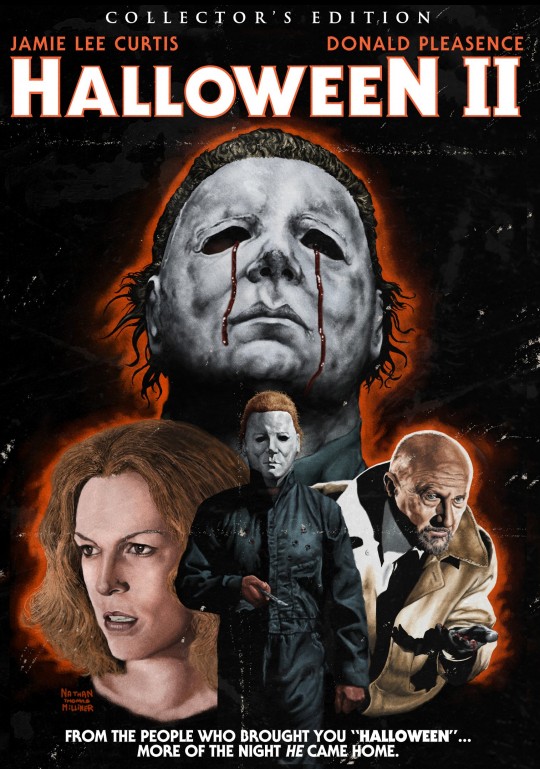
In one of the film’s more inspired touches, Halloween II takes place on the same night as its predecessor. We open with a brief recap of the original film’s ending, as Dr Loomis (Pleasence) fires six rounds into a masked maniac (Nick Castle in the original film, Dick Warlock here), saving Laurie Strode (Jamie Lee Curtis) in the process. Loomis peers out over Strode’s balcony and, instead of finding the killer, there’s only a small pool of blood. Loomis runs to the police in the hopes of finding the killer, while Laurie is wheeled to Emergency to deal with the injuries she received in the first film.
No longer able to keep the press away from this story, news instantly hits that a masked man is on the loose and it’s none other than Michael Myers, the boy who was locked away in 1963 for butchering his sister. Now he’s back in his hometown of Haddonfield, Illinois. Yet, despite the additional police attention and news coverage, no one seems aware of Myers until it’s too late. It isn’t long before the killer is stalking the very same hospital Strode is in, but this time she’s too doped up to fight back. It’s up to crusading psychiatrist Dr. Loomis to step in once again.
It’s easy to pick on Halloween II for not living up to the original, but it’s not without its merits. The funky reworking of Carpenter’s original score (by Alan Howarth) is interesting, if a little too gothic for such a film. I also liked some of the film’s little stylish touches, like the occasional Psycho-inspired camera angle and the use of “Mr. Sandman” by the Chordettes. The film is given added legitimacy by reuniting most of the original cast and dropping enough references to the first film, that many consider this to be Halloween‘s true sequel.
While it’s nice to see so many of these people back, almost nothing is done with them. Sheriff Brackett (Charles Cyphers) disappears as soon as he learns of his daughter’s fate in the first film. This introduces a new deputy character just so he and Loomis can kill time by having Loomis repeat everything he told Brackett in the first film. Then, we have Laurie, once strong, intelligent and resourceful, now reduced to vegetating in a hospital bed until she gets chased again.
Only Pleasence benefits from returning for the sequel. Though he’s forced to go over a lot of the same ground covered in the first film, Loomis is given some great, action hero one-liners that give Halloween II a bit of energy. Pleasence is clearly having a ball with his sudden transformation into Bruce Willis and sells even the hokiest bits of the script. Just close your eyes and listen to his pointless (and inaccurate) monologue on “Samhain”. The lines have nothing to do with the story, seemingly offering an explanation for Myers’ killing spree before the film drops that angle in favour of a different explanation. He sells it perfectly. You can’t beat that voice. You don’t want to argue with the spirit of dark and lonely water.
The most disappointing aspect of the sequel is that the killer is given motive. In Halloween, Michael Myers stopped existing the moment he picked up that butcher knife in 1963 and murdered his sister. He is now pure evil. He’s the boogieman, plain and simple. That’s why, in Halloween, Nick Castle was credited as playing The Shape, not Michael Myers.
Halloween II transforms this monster back into a man by giving him a weird motive. In a dumb twist, apparently conceived by Carpenter after he decided to kill his writer’s block by drinking heavily, Laurie Strode is revealed to be Myers’ long-lost adopted sister. In Halloween, Laurie is dealt a cruel hand by fate simply because she was in the wrong place at the wrong time. She stops by the abandoned Myers house on Halloween night, 1978. Myers sees her and targets her for the rest of the film. In Halloween II, Myers somehow knows Laurie is his sister and is determined to kill her.
The worst thing about adding this backstory is that it isn’t even necessary. No one cares how, say, Darth Vader became a galactic threat. What matters is that he’s an imposing, iconic screen villain. The same is true for The Shape. Turning him into “Michael Myers: Sister Slasher” dilutes his appeal. It’s strange that, no matter how many sequels and remakes there are of the Halloween series, they always return to that stupid idea.
This mistake was completely avoidable, too. There a scene fairly early on in Halloween II where Myers overhears a news report, learning that Strode is at the hospital. That’s all the motivation you need. By trying to answer questions about the character, it only makes things more confusing. What happened to Michael and Laurie’s parents? Who knows Laurie’s adopted? Surely a small town like Haddonfield couldn’t keep such a thing a massive secret, right? What was the point of hiding this info from Loomis?
Another aspect of the first film that gets trounced is tone, which Halloween II bungles at nearly every opportunity. Halloween was smart enough to tell a tight, interesting story while still having room for lightness. Whether it’s Laurie chatting with her spunky friends, the sweet relationships between the teens and the kids they were babysitting or Loomis playing a practical joke on some kids during some unexpected downtime, Halloween had a lightness to it. These variations in tone strengthened the film and offered a welcome respite from the grim sense of fate that dogs every character in Halloween.
Halloween II is relentlessly grim and mean-spirited. Ever hear rumours about razor blade apples? Here there’s a close up of a kid with a blade lodged between his lips as the sole other patient at the hospital where Laurie is. Remember, Ben Tramer? The guy Laurie Strode had a crush on in Halloween? He’s burned alive during a contrived sequence where Loomis mistakes him for Myers and the poor high school kid dies horribly for no other reason than to pad out the film. Halloween II is a movie where almost no one makes it out alive, but without any emotional payoff. You had sympathy for those murdered by Myers. All I could remember about the hospital staff was that one guy was played by The Last Starfighter, one guy was played by b-movie actor Leo Rossi and there’s a cute nurse played by an actress named Pamela Susan Shoop.
Halloween 4: The Return of Michael Myers is, without a doubt, the best of the sequels. I’ve already reviewed that fourth film, so I’ll refrain from detail here. It’s successful because it kept elements of Halloween II, but returned to the lurking, outdoor atmosphere of Carpenter’s original. Halloween II gives Loomis a great death scene, which was ultimately retconned by Halloween 4. This was a smart move as a Halloween without Donald Pleasence is a Halloween not worth seeing, which I’ll be addressing in greater detail next week.
Next week: No one knows who they were or what they were doing…or Druids! Druids! Druids! A look at Halloween’s weirder sequels.



Adam Clarke | Wed, Oct 31, 2012 | 564
On Screen