

Adam Clarke knows enough about Druids to know that no one knows who they were or what they were doing.
Why can’t the sequels recapture the magic of Halloween? The first mistakes were made with the first sequel. The crucial difference between Halloween and Halloween II is subtlety. The original is a suspenseful, slow-burn horror film with few death scenes. Halloween II ramps up the body count, throws some (mild) gore into the mix and generally makes everything bigger and louder.
Upping the stakes in a sequel is to be expected, but even the characters are magnified in Halloween II. The filmmakers took Donald Pleasence and Charles Cyphers’ characters and made them literally louder by having them bellow in several of their scenes. Pleasence, the patron saint of actors who elevate the material they’re given, can sell the methodical Dr Loomis becoming unhinged after the events of the first film even if it results in illogical behaviour. There’s no excuse for Loomis to chase down an unlucky teen whilst screaming and waving a gun in Halloween II (Unhinged? Sure, but Loomis is not crazy). Nor was there any reason for said teen to keep the mask on instead of revealing that he wasn’t Myers. It’s lazy writing, but Pleasence makes it fun through the sheer power of overacting.
Alas, Halloween II would change its killer as well. I’ve already addressed the transformation from The Shape to Michael Myers: Sister Slasher. More than that, Halloween II grants Myers super-strength as he walks through several doors despite moving as quickly as your nan. By Halloween 5, I expected to see him knock down the Great Wall of China with his laser-eyes. Again, this is subtlety gone out the window. It’s not enough that Michael Myers be a mysterious figure with ropes and knives. No, he should be able to rip a man’s head clean off with a flick of the wrist.
These trends plagued the sequels more often than not. Halloween 4 presents Myers’ super-strength in an even sillier fashion than II and boasts some contrived scenes (why are doctors transferring Myers on October 30? Isn’t that THE WORST IDEA?) Regardless, it was a fine, b-grade horror movie with good acting, a few strong shocks and it brought some new ideas to the series. Of the sequels that followed, only one would try to inject new life into the diminishing returns of the franchise. To put it mildly, the results were mixed.
Halloween: The Curse of Michael Myers
There’s two fairly different movies called Halloween: The Curse of Michael Myers (aka Halloween 6). One is the film as originally shot and the other is the version that ultimately ended up in cinemas and on video. The original cut (aka the “producer’s cut”) of the film attempts to build a mythology that connects all of the Halloween movies. Yes, even Halloween III. That version never saw the light of day outside the bootleg circuit. The version that arrived in cinemas in 1995 was…different.
Confused? Oh, man. You don’t know the half of it. By the end of this review, you’ll learn about Paul Rudd, Druid wizardry, head explosions, Dracula’s birthday, pickled fetuses and more. Welcome to the batshit crazy worlds of the two movies called Halloween: The Curse Of Michael Myers.
Curse follows Halloween 5‘s conclusion with the Man In Black rescuing Michael Myers from prison. You may recall that in Halloween 5 we see that Myers now sports the symbol of Thorn on his wrist and so does the mystery man who frees him. The one thing we didn’t see is that the Man In Black kidnapped Myers’ niece, Jamie Lloyd, at the end of the film as well. As the Man In Black drives off with Myers and Jamie, the Haddonfield police station goes up in flames behind them.
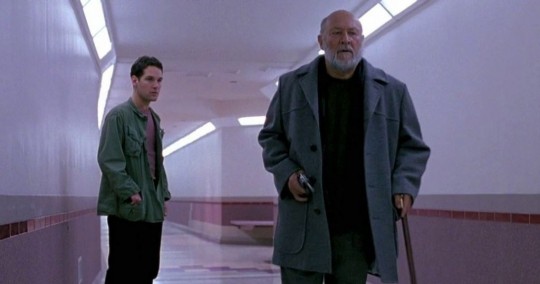
We then jump from October 31st, 1989 to October 30th, 1995. Doctor Sam Loomis (Pleasence, in his final film) seems happily retired. The ’89 explosion has lead most to believe that Lloyd and Myers were dead and, unexpectedly, Loomis is fine with this. He’s put the past behind him, even going so far as to get skin grafts to cover up the burn marks on his right side (“at least I don’t frighten people anymore”, he says). Sure, he’s listening to a call-in radio broadcast about the Haddonfield slayings (VOCM Question of the Day: Are nubile teens doing enough to prevent getting slaughtered?) but ’tis the season and it is Loomis we’re talking about here.
Loomis now lives in a cozy home where he’s regularly visited by an old friend, Terence Wynn (Mitch Ryan). You remember Wynn, right? You don’t? But he showed up for a brief scene in the original Halloween where he argued with Loomis and was never named onscreen! Oh, and he was played by a different actor in the original. Surely you remember that or perhaps got a greater idea of who he was from the first film’s novelization? Geez. Do your homework, casual viewer…
In this film, Wynn and Loomis are oldest, bestest friends despite the former never being seen or mentioned in previous sequels. Wynn is retiring from Smith’s Grove sanitarium (where Michael escaped from back in 1978) and wants Loomis to take his place, but the good doctor turns him down. It’s surprisingly sweet to see Loomis make a life for himself that doesn’t involve monologues about evil. Of course, it won’t last.
A familiar voice calls in to the radio program he’d been taping, which immediately gets his attention. It’s the voice of young woman asking for Loomis’ help. It’s Jamie Lloyd (JC Brandy, replacing Danielle Harris) who, sure enough, is being chased by her uncle once again. Only this time, she’s got an infant with her. Naturally, Michael Myers has his sights on killing his niece and her child.
Back at his house, Loomis loses his kindly demeanor and retrieves his revolver for the first time in years. This little scene is one of Curse‘s genuinely awesome moments. Naturally, it’s been cut out of the theatrical version. Otherwise, both versions are essentially identical up to this point, but I’ll focus on the original version of Halloween 6 for now.
Lloyd’s holed up in an abandoned bus station, but her call is cut off and she’s soon caught by Myers. In the ensuing cat-and-mouse game, Lloyd’s able to hide her baby and makes her way to an old farmhouse. Loomis, Wynn and the police eventually arrive at said farm house, but it’s too late. Lloyd’s wheeled away in critical condition with a butcher knife lodged in her back.
Where’s Jamie’s baby, you ask? The child’s fallen in the hands of Tommy Doyle (Paul Rudd, replacing Brian Andrews. Yes, Paul Rudd aka Tayne).Tommy Doyle was the boy Laurie Strode was babysitting in the original Halloween and his experience with Myers has reduced him to a socially inept shut-in. Over the years, it seems Tommy’s become as obsessed with Myers as Loomis.
While I’m glad to see Doyle back, the way he finds the baby is incredibly contrived. On Halloween morning, we find Tommy constantly replaying Jamie’s phone call from last night’s radio broadcast. From a bit of background noise, he’s able to pinpoint that Jamie Lloyd was calling from a bus station. How does Tommy find the baby? Well, the bus station has a blood trail that leads to the ladies room and there was a crying baby inside that nobody noticed.
Let’s not address the stupidity and contrivance of how Tommy’s discovery is handled. Let’s instead wonder why Michael Myers, who is on the hunt for this baby, doesn’t think to search the one other place that Jamie had been. I guess he just got bored…
Loomis tries to convince the Haddonfield police to take preventive action against another Myers rampage, but the new sheriff shrugs Loomis off because that’s a great idea. Loomis, horrified by the threat of another Haddonfield massacre, fears he’s far too frail to fight Myers on his own and turns to Wynn for help.
Arriving at the hospital to check on Jamie Lloyd, Loomis runs into Tommy Doyle. Doyle tells Loomis about the baby. With one more relative still out there, Halloween 1995 is destined to be a bloodbath. Tommy also informs Loomis that a new family are living in the old Myers house: the Strodes. Loomis leaves Wynn at the hospital in the hopes of getting to the Myers house before Michael does.
Those familiar with the series will remember the Strodes. Michael’s sister Laurie was adopted by the Strodes, as revealed in Halloween II (why the Strodes didn’t adopt Jamie Lloyd following Laurie’s death is a question the film can’t answer). The Strodes at the Myers house aren’t Laurie’s parents, but her aunt and uncle. Unlike the sweet, intelligent Laurie, these clowns seem to have wandered in from a made-for-TV movie being filmed next door. There’s the lunkhead son, the timid mom and the alcoholic, abusive dad. Collect them all!
The only characters of interest at the Myers place are Kara (Marianne Hagan), the Strodes’ estranged daughter, and Kara’s preteen son, Danny (Devin Gardner). She’s quite likable as the film’s Laurie Strode stand-in. By contrast, her son is the quiet type. Quiet as in “Michael Myers in 1963″ quiet. He’s constantly visited by visions of Myers, Thorn and the Man In Black.
While Kara’s off to college, Loomis warns Mrs. Strode and she takes the threat of Myers as well as anyone could. When Loomis leaves, she calls her husband, packs her bags and plans to get her family outta Dodge. Unfortunately, her husband dismisses her concerns and she gets whacked with an axe before she can warn anyone else about Myers.
When Kara returns to the Myers house, she doesn’t find a trace of her mom, but does find her son hanging out with a twenty-something dude and a baby. Tommy Doyle introduces himself to Kara, but she’s naturally apprehensive of the twitchy, socially inept man her son met on the street. Doyle tells her about Myers’ inevitable return and, in a moment clarity rare for this type of movie, Kara and Danny flee the premises. Tommy takes them to a boarding house he’s been staying at run by the kindly Mrs. Blankenship (Janice Knickrehm).
Since the film decides that it needs more exposition and backstory, Tommy Doyle tells Kara all about the curse of Thorn. The bearer of the mark of Thorn is a vessel for pure evil, but is also granted great power. The Druids supposedly believed that if a child was given the curse and slaughtered his/her family in sacrifice, the rest of the tribe would be spared from the forces of evil. Doyle believes Michael Myers has been cursed, which would explain his immortality and his increased strength over the years.
In his research, Doyle discovers the Thorn symbol coincides with a similar-looking constellation that periodically appears on Halloween night. This constellation has appeared four times before in the last century: 1963, 1978, 1988 and 1989. Sure enough, Michael Myers has only attacked around Halloween during each of those years. Since the constellation is visible tonight, Doyle knows Myers will return.
Back at the hospital, Jamie Lloyd is recuperating, but still unconscious. The film flashes back nine months previous, as the Man In Black and his followers dress Lloyd up in ceremonial garb and chain her to an altar. She’s then locked up with Michael Myers, implying that he was ordered to rape her. As the flashback ends, the Man In Black enters Jamie Lloyd’s room at the hospital and takes out a gun rigged with a silencer. Loomis returns to find Jamie Lloyd with a hole in her head.
While father-uncle Myers hunts for his incest-baby (I can’t believe I just wrote that), Kara, Danny, Doyle and Loomis reunite at the Blankenship boarding house, but Jamie’s baby is missing. Danny, hearing a familiar distorted voice, runs to a stranger in black sitting in the living room. Loomis, realizing the Man In Black was under his nose all along, hisses the name “Wynn”.
Wait, Terence Wynn? He who was introduced as Loomis’ old friend? The guy who hasn’t been seen since the original film and is played by a different actor? He was the Man In Black? Quelle surprise!
Upon this shocking revelation, Dr. Wynn smiles at our heroes (probably because he’s mastered the art of changing from a light trenchcoat to a fabulous black giallo outfit in under thirty seconds). Mrs. Blankenship, cradling Jamie’s baby, advances on Kara with a pair of scissors. Before the others can react, a dozen figures in black robes spill into the boarding house and the film fades to black.
No, this movie doesn’t end on a cheap cliffhanger like Halloween 5. The original cut of Halloween 6 resumes with Kara chained to an altar. On her right, her son stands beside her, knife in hand. On her left, Michael Myers stands quietly over his baby. When the ceremony begins, Michael will kill the baby and his power will expire. Then Danny will inherit his powers and take the knife to his mother.
Sam Loomis and Tommy Doyle regain consciousness outside the boarding house. Loomis, now understanding what Wynn had in mind with his “come back to Smith’s Grove” talk at the beginning of the film, returns to the sanitarium with Doyle. Loomis takes out his gun, but Doyle stops him and suggests that the key to stopping Michael isn’t violence. He believes he can use the power of white magic through positive rune stones to stop Michael Myers forever because yeah, why not. Loomis tells him that the gun isn’t meant for Michael and our two heroes split up. Doyle spots one of the robed figures from earlier and follows him to the Thorn cult’s hidden ceremony room. Loomis heads to Dr. Wynn’s office, intending to empty his revolver into Wynn’s smug face.
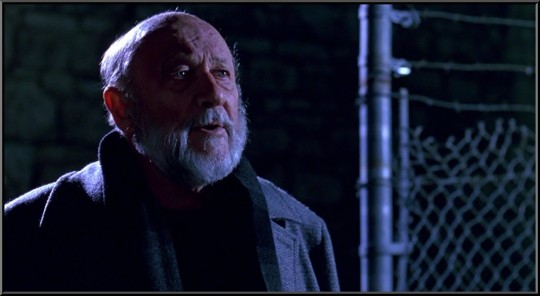
Sure enough, Dr. Wynn’s sitting at his desk in full costume when his former colleague hobbles in. It’s at this moment that the continuity-obsessed sequel allows itself a moment of fun. The otherwise subdued Mitch Ryan relishes the hammy Wynn speech he’s about to deliver as though he were reciting the Queen Mab monologue.
Dr. Wynn claims Michael Myers must relinquish his power and a new child be selected to appease the forces of evil. Giving Danny the curse of Thorn will “restore the natural order of things” and put an end to 90′s malaise (no, really). He also wants Dr. Loomis to act as Danny’s protector (just as Wynn had been to Myers) and become the new cult leader. Rather than let this Bond villain speech go on a moment longer, Loomis raises his revolver, but is conked on the head by one of Wynn’s followers.
I must mention Mitch Ryan’s acting once again, which progressively enters Shatnerian overdrive during this scene. Clad in a giant black cloak and waving his hands about, Ryan acts like he’s Dracula at a birthday party. Remember that note I made about overacting at the beginning of this review? Ryan’s pretty good at it.
Down at the ceremonial altar, we see a fair number of Haddonfield townsfolk awaiting the sacrifices. Kara notices that Myers hesitates to kill the baby and reasons that it might be his. This ruffles Wynn’s cloak and he starts barking out orders while Kara appeals to Myers’ humanity. Their attempts to tell Myers what to do are reminiscent of Bugs Bunny and Daffy Duck telling Elmer Fudd whether it’s rabbit season or duck season. Only here, Elmer Fudd is Michael Myers, Bugs Bunny is a single mom, Daffy Duck is a poor man’s Christopher Lee and the hunting season in question is infanticide.
During this Model Druid U.N. debate, Tommy Doyle grabs Wynn and holds a knife to his throat, demanding the release of Danny, Kara and the baby. Loomis pops by to aid Kara, Danny and the baby escape while Tommy stays behind to face Myers. Doyle frantically creates a circle of rune stones, drops some of his blood on the ground and says a magic word (yes, really), all of which stops Myers dead in his tracks. This spell will apparently cancel out the dark power that Myers has had all this time, perhaps making him mortal/human again.
Outside, Kara, Danny and Tommy Doyle get in a Smith’s Grove van and Loomis tells them to get as far away from Haddonfield as possible. Tommy and Kara urge Loomis to join them, but he stays behind, telling them he has “some unfinished business” to attend to. After they drive away to safety, Loomis heads inside the sanitarium and finds Michael’s body lying in the circle of runes Tommy made. When he reaches down to unmask his former patient, Loomis instead finds a confused, possibly dying Dr. Wynn in his place.
“Michael’s gone!” Wynn shouts and grabs Loomis by the wrist. “It’s your game now, Dr Loomis,” Wynn says before collapsing. Loomis pulls back, but the Thorn symbol appears on his wrist like an infection. After a moment of shock, Loomis begins to howl in pain as the film cuts to Michael Myers in the shadows. The Haddonfield slasher is unmasked, sporting Wynn’s clothes and walks away into parts unknown. The end?
The original version of Halloween 6 is a little problematic. It’s a mess loaded with characters new and old, plot twists, homages to the first film and attempts to explain Michael Myers all in about 96 minutes. I summarized the film as best as I could, but I still left out sub-plots involving a radio DJ, a Halloween celebration and all the drama surrounding the Strodes. This is the most top-heavy, plot-drenched slasher movie I’ve ever seen. It might be the only slasher movie that can be described as such, which proves to be both a blessing and a curse for The Curse Of Michael Myers.
Re-watching Halloween 6, I feel the impossible has happened: we’ve gotten character development for the first time since Halloween 4. For better or worse, this movie changes our understanding of Michael Myers and some of it worked. The reintroduction of Tommy Doyle is handled quite well (despite Rudd’s spotty performance), as Tommy’s obsession with Myers is the perfect way to write that character back in the story. On top of that, Kara Strode makes a fine addition to previous Halloween “Final Girls” like Laurie, Jamie and Rachel.
Best of all are the scenes with Loomis, which give the character more to do than any other film in the series. As much as I like the character, the depth of Loomis’ personality was only revealed in small touches throughout the films. Usually, he’s just there to remind us of how frightening and powerful Myers is or to offer insight into the killer’s (lack of) personality. Loomis has an actual character arc for the first and only time in these movies. Beginning the film in a peaceful hermitage, Loomis is unprepared for Myers’ return and turns to Wynn because he needs to have a friend with him. In his interactions with others and his reactions to deaths around him, we see that Loomis’ obsession has subsided so much that he’s lost his sometimes cold demeanor. Loomis is now visibly distraught when the bodies start piling up. This mellowed out Loomis must nonetheless risk facing Michael and, later, his own best friend to try and stop the Thorn curse once and for all.
On that note, it must be said that the Wynn character is a catch-22. Mitch Ryan is good in the part and Wynn’s relationship with Loomis is interesting, but the character is so obviously our Man In Black that there’s no mystery. Imagine if, instead of Wynn, they’d brought back Nancy Stephens to reprise her role of Nurse Marion from the first two films. After all, the person who cursed Myers as a child doesn’t necessarily have to be the one who’s been looking after him since Halloween 5. We’re less likely to guess the stranger’s secret identity if they have a history with Loomis we’ve actually seen. Wynn fits the storyline as is, but the mystery’s about as deep as the identity of the traitor aboard the Enterprise in Star Trek VI.
The handling of Jamie Lloyd’s character is a major disappointment. The incest/kidnapping storyline is problematic because, like the sudden importance of Wynn, it’s never more than a contrivance (also, kinda gross). We know the baby exists just to write out Jamie Lloyd and that Lloyd must be written out to prevent Loomis and Doyle from getting to Smith’s Grove before the film’s third act. Jamie is killed off in both versions of 6 without a second thought and it’s unsatisfying to put a major character from the series through Hell only to kill them off for the sake of a plot twist. If anyone should’ve been alongside Loomis and Doyle at the end of this film, it should’ve been Lloyd. What a disappointing send-off for a once-important character.
This version of the film is so uneven, but I can’t help but appreciate it for being ambitious, weird and sometimes unpredictable. Screenwriter Daniel Farrands is actually trying to give us something new. As goofy and clunky as the original/producer’s cut sometimes is, I have to give it credit for a memorable, ambiguous ending. Unlike the “business as usual” approach of Halloween 5, Loomis and Myers are different characters by the end of the movie. At the end of this version of Curse, it looks as though Myers is walking away from his former self and is no longer possessed by the Thorn spirit. Loomis has been made the head of a crazy cult and would be required to protect Myers (or his successor) after a lifetime of trying to stop him.
If the production team had a bit more money to play with, Curse‘s original/producer’s cut would be much more successful. Visually, Halloween 6 begins the trend that plagued the series ever since: pedestrian cinematography that has no mood or ambiance. Curse is the first of the Halloween films to look flat and uninspired, as would the next two sequels and Rob Zombie’s remakes. That said, Curse is the worst offender in terms of cinematography. Both versions of the film resemble any number of straight-to-video genre films released in the mid-90′s.
The film’s direction is also pretty flat. Joe Chappelle, a director best know for helming episodes of The Wire, tries to pay homage to John Carpenter and fails miserably. Chappelle’s lifeless work means that Curse is at its least interesting whenever Michael Myers is onscreen. Say what you will about Rick Rosenthal, Dwight Little and Dominique Othenin-Girard, but each of those directors was able to get some mileage out of Myers in previous sequels.
The acting in the film is highly variable. Some of the actors are quite good, like Donald Pleasence, Mitch Ryan, Kim Darby (as Kara’s mom) and Marianne Hagan. Others, like Devin Gardner and Paul Rudd, are sometimes astoundingly bad. Gardner can kindly be described as a poor man’s Jake Lloyd, while Rudd is miscast as the obsessed Tommy Doyle.
When you watch either version of Curse, two things are readily apparent about the script: it was written by a fan and it was tinkered with a few too many times. Originally, Dr. Loomis was supposed to die in a random jump scare before the end credits, but this was wisely dropped after Pleasence objected. Other drafts of the script had Jamie Lloyd surviving the film. Some ended with Wynn kidnapping Danny and/or the baby and flying away in a helicopter. Some versions of the script changed who the father of Jamie’s baby was. Throw in some last-minute dialogue additions by producers to spell out a few scenes (including such clunkers as “the power of the runes stopped him” and “we have been drugged!”) and the end result should be abominable.
Yet, I kinda like the original/producer’s cut of this film, warts and all. This version of Curse is typically at its best when developing Tommy Doyle and Sam Loomis or delving into the Thorn mythology. There’s a sequence in the middle of the film where Mrs. Blankenship tells Danny some Halloween lore that’s easily one of the best moments in any of the sequels.
You can’t help but pity screenwriter Daniel Farrands for having to jump through so many hoops to write a new story. He sought to unify the black magic/Samhain elements of Halloween II & III with the rest of the series, explain the Myers-must-kill-his-family plot thread from II onward, explain why Myers could never die, reintroduce characters not seen since the first film and resolve the plot threads introduced in Revenge (the writers of 5 never concocted a backstory for the Man In Black or the sudden appearance of Thorn on Myers). Sure, the script is loaded with fanwank designed to explain inconsistencies throughout the series, but I find that kind of endearing. I just can’t hate a film that, when confronted by series plot holes like “why would Myers get transferred just before Halloween 4?”, calmly explains that a wizard did it. I particularly liked the ending of this version of 6, as it’s the rare horror sequel that ends with the promise of a series going in an interesting new direction.
That new direction was desperately needed because Myers is far from scary the fifth time around. The trouble with the producer’s cut of Curse isn’t that it veers too far from the basics, but that it doesn’t abandon ship sooner. It’s well over an hour before the identity of the Man In Black is revealed, so the script loads itself with too many characters. Halloween 6 has so many plot threads and characters running around that Michael Myers seems like an afterthought in his own movie.
While the Thorn storyline works on its own terms, the lack of a budget is all too evident during the showdown between Tommy Doyle and Michael Myers. This should be a big moment. Say what you will about the Nightmare On Elm Street sequels, but each one tried to make Freddy Krueger’s defeat the highlight of the movie. When Doyle stops Myers, we’re not treated to lightning bolts or spectacular visuals. Myers just walks up to Tommy and freezes dead in his tracks. That’s it.
Again, that’s the sort of thing the studio/producers should’ve spent a little more money on.
Once this cut of the film had been previewed, the filmmakers knew the end result didn’t quite work. Anyone who’d seen this cut of the film would know that it was a slow-paced, indifferently-shot thriller. Its real strengths were the character scenes with Loomis and Tommy (despite Rudd’s acting), the Thorn mythology and the ending.
So, the filmmakers cut the extraneous characters, shortened the first hour to get to the Smith’s Grove scenes earlier and re-shot the Myers-Doyle confrontation, right?
Not exactly. Tommy’s confrontation with Myers is indeed different and the build-up to the Man In Black reveal is shorter. However, they kept all the major character scenes except for any of the stuff with Loomis and Wynn. Oh, and the last twenty minutes of the film consists of a new ending the director wrote on the spot without Farrands. In summary, the production team decided that this fat would taste a great deal better without any of that pesky steak in the way.
In the theatrical cut, Loomis enters the movie without any explanation as to what happened to the scars on his face and hands. In fact, Loomis barely seems to be in the film at all. Though many of his scenes from the earlier film remain, they’ve all been whittled down to a few lines of dialogue. Jamie is given a brutal new death scene and, instead of getting shot by Wynn in the hospital, Myers now impales her on some farm equipment. Of course, without the flashback scene in the hospital, we’d never find out who the father of Jamie’s baby was (Kara’s reference to this in the original climax has been cut). Oh, well. This version doesn’t deem that plot thread important when it can spend time with Kara’s drunk dad or the couple who have sex in the Myers house with predictable results.
After Wynn kidnaps Danny, Kara and the baby, we’re treated to an entirely new climax. Instead of Smith’s Grove crawling with Thorn cultists, it’s revealed that the whole thing was just a prank. It turns out that Wynn and company have been pretending to be Druids (for some reason) because they’re doing experiments on fetuses that they keep pickled in an underground lab (for some reason) and Michael Myers is key to that (for some reason). Myers then freaks out and kills all the doctors (for some reason). Tommy then beats Myers with a pipe, which causes green goo to ooze out of his head (for some reason). Loomis helps Kara, Tommy, Danny and the baby escape before heading back to Smith’s Grove for unfinished business. The last we hear of Loomis are the sounds of Donald Pleasence screaming offscreen, implying that he’s finally met his end at the hands of the undying Myers.
Kinda makes Halloween III seem like a master class in narrative clarity, doesn’t it? I’d understand if they removed the Thorn plot completely (which seems to have been the intention here), but the theatrical cut retains the scene where Tommy tells Kara that Myers only appears when a certain constellation is in the night sky. Why would that mean anything if Wynn and company were just ordinary doctors the whole time? Also, if Wynn isn’t a magical Druid wizard, how is he communicating with Danny? More importantly, why does he want Danny if there’s no curse to pass in the first place? And if there’s no curse, why kidnap Danny and Kara at all?
Furthermore, if it’s now just doctors who are the robed figures, why does Mrs. Blankenship help Wynn kidnap the others? In the original version, Blankenship is seen donning cult robes in the climax. In fact, the original cut implies that a good chunk of Haddonfield townsfolk are in the cult. But if they’re just doctors…ugh, let’s not pretend the theatrical cut makes any sense. This version of Halloween: The Curse of Michael Myers is one of the most incoherent pieces of garbage I’ve ever seen.
The theatrical cut opts for bigger and louder, offering the series’ goriest kills, manic editing and a wailing guitar version of the classic Halloween theme to take us home. Oh, and the movie now takes false scares to a pathetic extreme. It’s bad enough when horror movies spice things up by having a cat jump into frame or innocent characters bumping into each other and screaming. This version of The Curse Of Michael Myers dubs in loud noises even when nothing’s happening.
For instance, there’s an early scene in which Kara’s brother gives his girlfriend a kiss from behind while she talks to Kara. In the producer’s cut, this plays without music because nothing is happening. In the theatrical cut, there’s a loud “SKRUNG!” at the end of this scene…for some reason.
In addition to having loud metallic bangs throughout the movie, the film will suddenly cut to a rapid montage of earlier/later scenes while someone screams on the soundtrack. Also, whenever there’s a jump cut, there’s a big, echoing scream. Needless to say, this version of Curse is eerily similar to that South Park Halloween special that was filmed in “Spooky Vision”.
The gore is plentiful, but generic. I already mentioned Jamie’s new death scene, but the theatrical cut blows its respective wad when we see Myers killing Kara’s dad. In the original cut, he’s electrocuted when Myers impales him on a fuse box. In the theatrical cut, this death scene now ends with the father’s melon head exploding. After his head explodes, the movie’s kind enough to give us an instant replay, showing the explosion again.
So, the Druid angle in the original version is off-putting to some and understandably so. I agree that Myers doesn’t need to be explained. In fact, Halloween II‘s revelation that Laurie is Michael’s sister is easily the most damaging thing that ever happened to the character. Bonehead creative decisions like that in the previous sequels are precisely why the cult storyline was introduced in the original/producer’s cut.
If you’re going to keep making sequels to a movie that was never intended to have them, all sorts of inconsistencies will pop up. While the Friday The 13th and Nightmare On Elm Street sequels blissfully ignore their contradictions, Daniel Farrands opted for a different approach when writing Halloween 6. He was saddled with many bizarre elements left unexplained by other writers, like the Samhain scene in II, Myers’ Jason Voorhees-level strength in 4 and the random giallo dude from 5. It’s probably foolhardy to attempt to unify all these oddities into one coherent story, but Farrands does the best job anyone could. The presence of child-murdering Druids in this film is certainly an attempt to link the series with the stand-alone Halloween III: Season Of The Witch. The Thorn curse is a “get out of jail free” card that rationalizes the inconsistencies in the portrayal of Myers and would give future writers new fodder for the character if more sequels were on the way.
If you’re willing to watch yet another sequel by the time a franchise passes the III-mark, then you’re probably willing to go along for outlandish plot elements. Besides, John Carpenter’s Halloween is a strong enough movie that none of its sequels, remakes or rip-offs have ever diluted its power. I never get troubled with the plot elements from the sequels when I watch Carpenter’s film, just as I don’t get troubled by thoughts of “good locusts” and sweaty Richard Burton when I watch the original Exorcist.
Halloween: The Curse Of Michael Myers, in its original producer’s cut, works as a sequel to the previous sequels. It develops the elements of the sequels and characters introduced in Halloween in a way that entertained me. It should’ve been a lot better, but I still give the film a lot of credit for the way it developed Sam Loomis and Tommy Doyle. The less said about the theatrical cut, the better. It’s a shame that the theatrical version of the film is readily available in video stores while the intriguing-but-flawed producer’s cut of the film is relegated to comic conventions and dark corners of the internet. There’s been some talk of Disney officially releasing this frequently-bootlegged original version of the film, but nothing has materialized as of yet.
Regardless of which version of this Halloween sequel you watch, it must be said that a follow-up to a story as simple as Carpenter’s original probably shouldn’t court plot elements like curses, incest, cults or, if you’re watching the theatrical version, gene splicing (or something). Given that Halloween 6 was an attempt to fix the unwieldy story that had developed over the series, we’re reminded once again that Halloween should never have been sequelized in the first place. A lesson we’d learn twice more in 1998 and 2002.
Next week: Since the death of Donald Pleasence left The Shape without a worthy opponent, Jamie Lee Curtis was lured back to the series to face the boogieman one last time. Then once more in 2002.



Adam Clarke | Tue, Nov 13, 2012 | 760
On Screen