

Archive | News & Views RSS feed for this section
Plan of proposed subdivision on Signal Hill Road
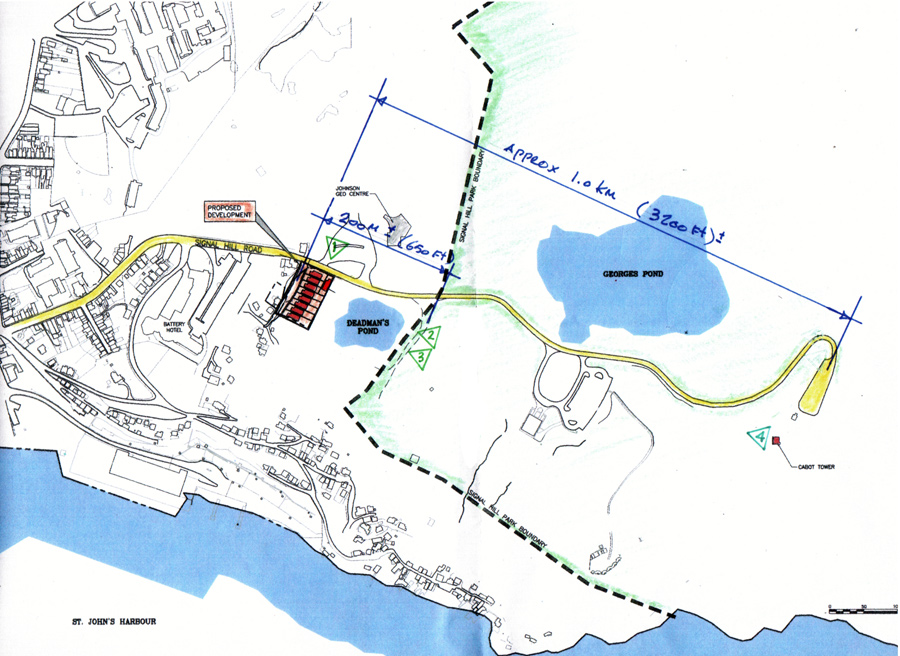
Just to post this somewhere while I have it, this is a map of the proposal submitted to City Hall to build a nine-lot subdivision on the hill on Murphy’s-Right-of-Way, off Signal Hill Road.
Some of the new condominium developments downtown
Thu, Sep 30, 2010
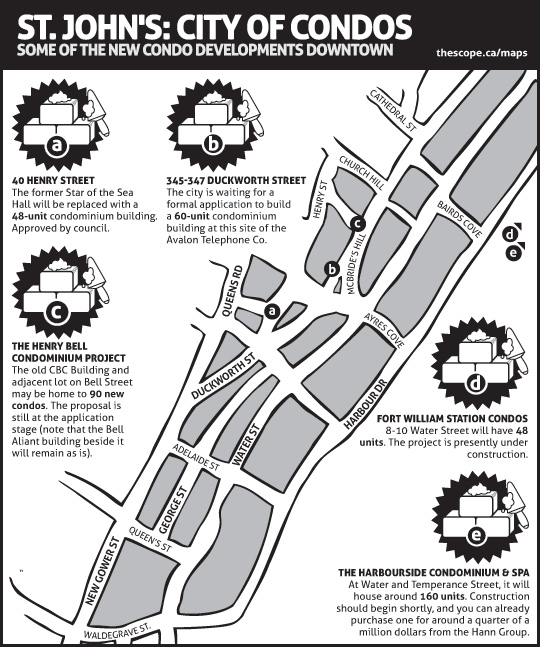
Note: Since press time the Harbourside Condominium and Spa development has been confirmed at 100 units.
Harbour Haunt homeless
Thu, Sep 30, 2010
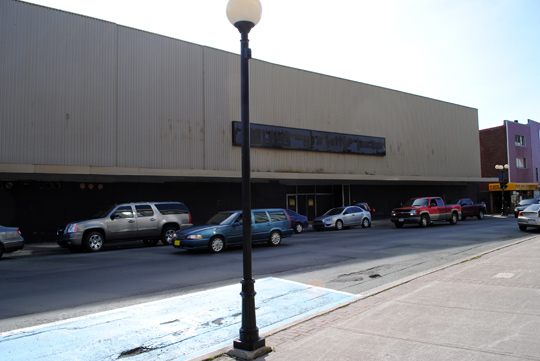
The former Woolworth’s building on Water Street, where the Harbour Haunt resided for its first five years.
The St. John’s Harbour Haunt has been scaring the pants off of the public for the past eight years, but this year however, the annual haunted house has been forced to close its creaky doors. According to organizers, securing a venue for the event has been extremely difficult over the past few years due to the competitive commercial real estate market in the city. The event is a major fundraiser for the Easter Seals, a charitable organization that raises money for disabled children in the province. In both 2007 and 2008, the Harbour Haunt raised close to $100,000 for camp programs for children with physical disabilities and provided assistance for families in need. With so many monsters and mayhem, the Harbour Haunt needs at least 8,000 square feet of donated space, and according to Amanda Puddicombe, Development Manager with Easter Seals, they are still searching for a large space with creepy potential, but time is quickly running out.
Moratorium on oil and gas development called
Thu, Sep 30, 2010
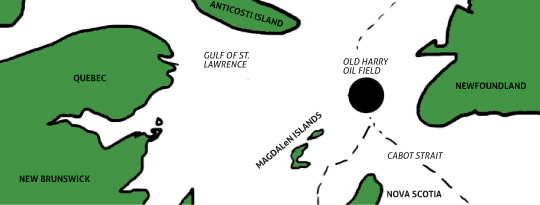
A recent proposal by an oil and gas exploration company to perform seismic testing in the Gulf of St. Lawrence, near the Cabot Strait, has provoked environmentalists and fishermen to call for a moratorium on oil and gas development in the area.
One hundred kilometres from St. George’s Bay, tucked just inside Newfoundland’s offshore boundaries, Halifax-based Corridor Resources is proposing to explore the Old Harry oil field, believed to contain up to 2 billion barrels of oil.
But eighty kilometres southwest of the site are the Magdalen Islands, whose economy relies heavily on fishing in the Gulf. The project is proposed for the fall of next year, but according to Ghislain Cyr of the Association of Pelagic and Groundfish Fishermen of the Magdalen Islands (RPPUM), the timing of the project is lousy.
“September, October, November is the best time for fishing for all species, like groundfish,” says Cyr. “That’s the time they are right there in the channel. And seismic blasts have been shown to disturb their migration patterns.”
His association is also concerned about the Atlantic cod which, they say, congregate near there at that time of year.
Cyr, along with the Magdalen Islands’ Association for Professional Fishermen (RPPIM), sent letters to the Canada-Newfoundland and Labrador Offshore Petroleum Board (C-NLOPB) highlighting their concerns and asked for more consultation with affected groups from the provinces in the region.
Corridor Resources met with the Magdalen fishermen, and stressed that the project would be using low-impact seismic activity, and the work would last for just over a week.
Nonplussed by the response, both the RPPUM and the RPPIM signed onto the moratorium, joining organizations like the PEI Fishermen’s Association, the Northumberland Fishermen’s Association and the David Suzuki Foundation.
“Maybe what they’re going to do is nothing, but it’s what might come after,” says Cyr. “We don’t want to see any drilling there. That’s the entrance to the Gulf for all the fish species. You cannot take a chance there.”
When contacted, the Fish Food and Allied Workers union (FFAW), representing Newfoundland fishermen, say they don’t plan to sign on to the moratorium request. They’re using a different approach to address their concerns, they say.
“No doubt about it, we do have concerns,” says David Decker, the FFAW’s Secretary-Treasurer, “but the position we’ve taken is to work with the oil and gas industries to work out those concerns. We believe we’ll make more progress that way.”
“We’ve been dealing with the oil and gas industry for a while here in Newfoundland, most dramatically off the Grand Banks, which is a rich fishing ground,” he adds. “It’s an important industry to the province and we understand that.”
The C-NLOPB is expected to make a decision about Corridor’s proposal soon, perhaps even sometime in early October.
Curbside recycling program will not collect glass
Thu, Sep 30, 2010
The City of St. John’s curbside recycling program is due to launch this month, but they will not be collecting glass. City officials say broken glass would contaminate the other recyclables as well as cause problems during the sorting process. What do you think?
 |
 |
 |
| Meredith Daniels | Gordon Pricey | Jimmy Kennard Jr. |
| Performance Artist | Landscape Coordinator | Information Construction Agent |
| “I have a solution! If the glass is breaking, I will wrap it carefully in my Smurf garbage blanket! I love that darned thing!” |
“Does this recycling thing mean I have to give away my collection of toy animals crafted from toilet paper rolls?” |
“If they packaged spaghetti sauce and mayonnaise using the same material as edible underwear we wouldn’t be in this mess, now would we?” |

We recycle now
Fri, Sep 17, 2010
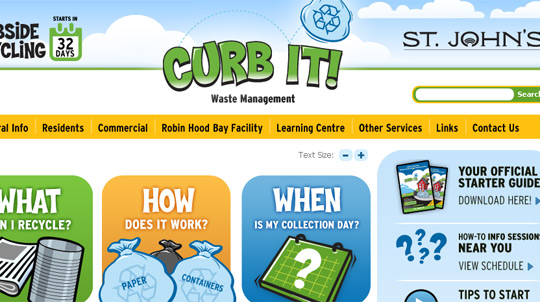
Screen capture of www.curbitstjohns.ca
Though it’s too windy for blue boxes, St. John’s is finally getting on with the curbside recycling program, leaving Regina, Saskatchewan as the last capital city in the country without one. Beginning on October 18th, we’ll be able to blue bag our recyclables, and leave it all at the curb to be whisked off to the Robin Hood Bay Waste Management Facility.
Recyclables have been divided into two categories, “paper products” and “containers,” and the two have to be in separate bags — no tossing in a cat food tin with the magazines.
The bags have to be clear, plastic and blue. The city will hand out a few complimentary bags in their Starter Kit, slated to hit mailboxes in the next few weeks. Otherwise, you’ve got to buy the bags yourself from hardware or grocery stores. Those blue bags will be recycled, but they can’t accept any other plastic bags. Or glass.
On the plus side, you don’t have to cover your recycling with a net or blanket, and you can recycle stuff like Tetra Paks. Garbage days will also be streamlined so that they fall on the same day each week. You’ll only have to consult those little calendars is if your garbage day falls on a holiday. Then the schedule resets back to the regular day the following week.
Garbage pick-up will continue to be a weekly thing, and recycling will be bi-weekly, picked up on every second garbage day. Calendars are available at the Waste Management Division’s flashy new website, where you’ll also find an instructional video, an awkwardly written message from Mayor O’Keefe, coloring activities for kids, and a virtual tour of the Robin Hood Bay facility. Wheee! Heads up for the auto-play video.
Here’s what qualifies as recyclable:
Cardboard boxes, corrugated cardboard, shoe and gift boxes, paper bags, coffee trays, egg cartons, magazines and catalogues, glossy paper and junk mail all count as paper products.
Pop and beer cans, pie plates, soup cans, coffee tins, and most plastic bottles and containers are welcome in your container bag.
Check out a complete list here.
Should we be drilling deep water oil wells?
Wed, Sep 8, 2010

It has been five months since the explosion on board the Deepwater Horizon deep water oil rig in the Gulf of Mexico. Since then, 776 million litres of crude has spewed from the undersea well. Today BP published its 193-page WTFHappen report.
So what will be the disaster’s lasting legacy? Jeff Rubin was the Chief Economist at CIBC World Markets for almost twenty years, and he was one of the first economists to accurately predict triple-digit oil prices back in 2000. He is now one of the world’s most sought after energy experts. According to him, the spill might create the same stigma as Three Mile Island did for nuclear power.
I got a chance to chat with him when he launched his book Why Your World Is About To Get a Whole Lot Smaller: Oil and the End of Globalization back in May…
What advice would you give the Premier of Newfoundland or the government of Newfoundland and Labrador in terms of energy policy?
Well, Newfoundland’s energy policy is of course going to be determined by what happens to the fate of deep water. As you probably know, Chevron is drilling a well that’s almost twice the depth of the ruptured well in the Gulf of Mexico [Update: They finished drilling]. I think your province produces somewhere around 300,000 barrels a day. Most of it is not deep water. Most of it is still continental shelf, but I think the future certainly involves deep water.

Let me say this about that issue: I don’t think the future of deep water drilling, in either the Gulf of Mexico or the Sea of Labrador, is going to be determined by government. In other words by President Obama declaring a moratorium, or lifting a moratorium, or by Danny Williams saying it’s okay or not okay to drill there. I think it’s going to be determined by the market. BP has already lost over 50% of its value on the stock market. That is a number that is 30 or 40 times anything that it has spent on the clean up. If the fate of BP is ultimately Chapter 11 bankruptcy protection, then the question will be how eager will its competitors be to want to follow in its deep water footsteps? The impact of Three Mile Island in 1979 wasn’t just regulatory changes. It made it virtually impossible for new nuclear power plants to be financed or insured in the market.
And you see a similar legacy for the Gulf spill?
The same could well be for the Gulf spill. The key to what happens in the Gulf is what happens to BP. If one of the largest oil companies in the world has to go into bankruptcy protection or has to sell itself or sell huge chunks of its company to competitors to stay alive, chances are its competitors are going to take note. So that’s what I’d say about the future of deep water. At the end of the day it’s not going to be about Danny Williams, it’s not going to be about President Obama. It’s going to be about what happens to BP.
You argue in your book that as the cost of extracting oil rises, the oil our economy relies on will be so expensive we’ll have to change the way we live. Why do you think people are so resistant to that idea?
People get angry when people tell you you can’t live the way you used to live. I think our obsession with finding new forms of supply at increasing economic environmental cost, whether we’re talking about a well a mile below the ocean floor in the Gulf of Mexico, or we’re talking about the Canadian Tar Sands, or we’re talking about foreign-based flow. It’s all about finding new supply, because we really don’t want to have to address what has to be addressed.
So to put it this way, instead of trying to find a way to turn cow shit into high octane fuel we just got to learn to get off the roads. I mean, but we’re very resistant to that. However, prices are going to take us off the roads.
[laugh] Well, there’s a lot of shit in the world.
Everybody’s so focused on finding a solution for future sources of energy. I’m sure in time we will, but the point of my book is that we don’t have time. We have to adjust now. The way we adjust now is to find ways of using a whole lot less energy. The way that peak oil doesn’t become peak GDP is we go from a global economy to a regional economy, because in the process of doing that we’re going to be able to use a lot less oil per unit of GDP.
Why Your World Is About To Get a Whole Lot Smaller: Oil and the End of Globalization is published by Random House.
Our Chinese Heritage
Thu, Sep 2, 2010
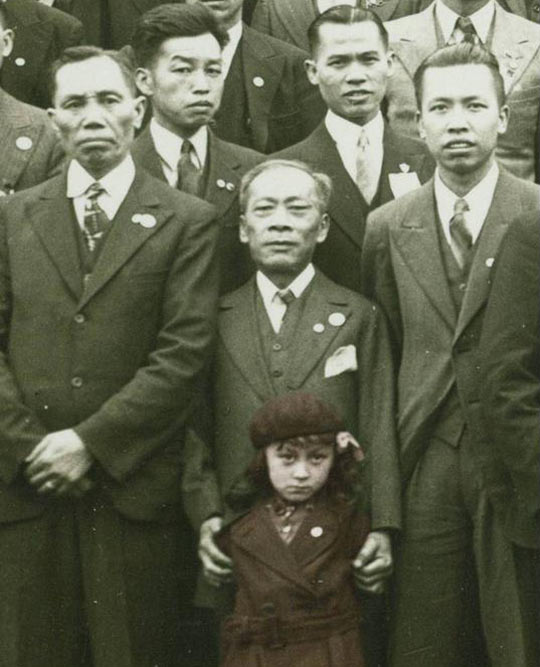
Photo detail from the monument unveiling poster
What do your imaginings of pre-Confederation Newfoundland look like? Fishermen, fishwives, merchants and sailors? If you’re going by the history books, Newfoundland and Labrador Headtax Redress Organization (NLHRO) think you might be forgetting something.
On September 17th, NLHRO will be unveiling a monument in the park adjacent to the City Hall Annex building, between New Gower and George street, commemorating the pioneers of the Newfoundland Chinese Community. The monument sits at the site of the first Chinese laundry in Newfoundland, opened in 1895. It’s the first of a four-part initiative, funded by Citizenship and Immigration Canada, and sponsored by the City of St. John’s, the Grand Concourse Authority, and the NLHRO.
“We’re also developing a website where you’ll be able to learn what the headtax was in Newfoundland, how it came about, who paid it, and read stories from original immigrants,” explains Gordon Jin NLHRO president.
From 1906 to 1949, Chinese immigrants, about 330 of them, were required by the government of Newfoundland to pay a $300 headtax if they wanted to call the dominion their home. Danny Williams issued an apology for the racist headtax via press release, in 2006, one week after Stephen Harper issued an apology for Canada’s Chinese headtax.
“The apology came, the apology went, but nobody seems to know what happened back then in Newfoundland,” says Jin. “We felt that it was deficient in the history books… Sons and daughters of headtax payers, their grandkids, they don’t even know what happened to pave their way to come to the dominion or the province that they’re living in.”
“I’m a descendant of a head tax payer and I think that the trials and tribulations that my father and those 330 colleagues of my father went through… It’s just a forgotten thing,” he says. “Many of these people couldn’t speak a word of English, and they came when they were very young – my father was sixteen. In those days, $300 was equivalent to two years’ salary. You can imagine the hardships.”
“The Chinese restaurants, the laundries that were here for many years, would not be here if it weren’t for these pioneers,” he adds.
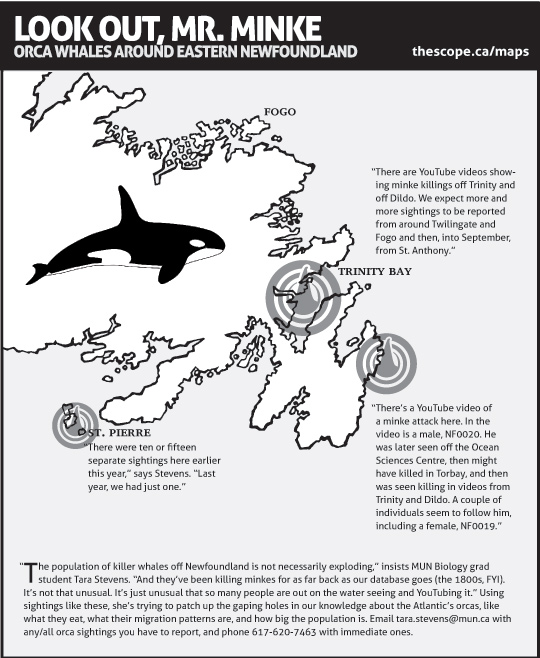
Wild phytoplankton party off the southern Avalon
Wed, Aug 18, 2010
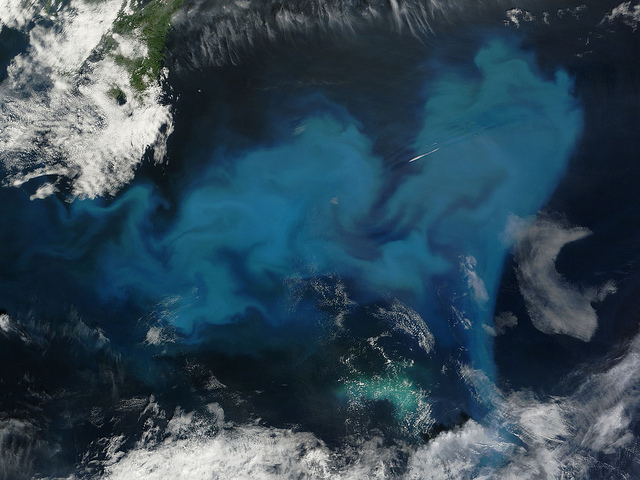
Yes, there’s something in the water, and it’s turned the water a rather beautiful shade of turquoise.
Phytoplankton — the base of the aquatic food chain — are usually too small to see with the naked eye, but when concentrations like in the image above occur, they give the water a greenish hue. The colour comes from the sunlight-sucking chlorophyll in their tiny little bodies. Blooms are a mysterious but regular occurrence in oceans around the planet, especially in summer. NASA took this satellite image of a huge bloom off the Avalon Peninsula just a couple weeks ago.
Dalhousie Oceanographer Marlon Lewis was impressed with it, too.
“You’ve got a lot of algae growing up there!” he laughs. “It’s almost assuredly a type of algae called a coccolithophorid. It’s a small, single-celled algae that’s covered with these calcium plates, so they’re kinda cool looking.”
Phytoplankton blooms are common, mostly in the spring. Usually, though, we can’t see them because the organisms are so small. “What you’re really seeing there is the sun’s reflection off those little calcium carbonate shells,” says Lewis.
In deeper waters, Lewis’ research has shown that phytoplankton populations are rapidly decreasing, which doesn’t bode well for our marine ecosystems. But along coastal areas, Lewis and his team found that populations were increasing.
This, he says, can be both good and bad.
Blooms are stimulated by the presence of carbon, nitrogen, and phosphorus, which usually get there via sewage. “Our areas around our coast are generally poor in nutrients in the summer, so the nutrients we provide stimulate the growth of phytoplankton, which feeds the other organisms. But, like everything else, everything in moderation.”
Click here to download a desktop background-sized image.
Greetings, friends!
Tue, Aug 3, 2010

Illustration by Ricky King
Move over, Exxon Mobile. Newfoundland has a cuter group of new friends to cozy up to.
Scientists from Halifax, St. John’s, Quebec and Spain set off on the Coast Guard ship Hudson, and came back with pictures of all kinds of corals and sponges and prehistoric sea cucumbers never before seen by man, the scientists believe. They found these little guys with a submersible robot, two to three kilometers below the surface at the Flemish Cap and Orphan Knoll, near the Grand Banks. You know, where they’re doing all that offshore oil drilling and/or exploration.
Uh…wait a sec…
You can head down to The Rooms and check out a live video feed from the Hudson of all these creatures.
Graffiti knitting is keeping your parking meter warm.
Wed, Jul 21, 2010
Not only does the city of St. John’s have to deal with the terrible new scourge of hip hop-looking graffiti, they now have a major new threat to the beauty and safety of our public environment: Knit and crochet street art.
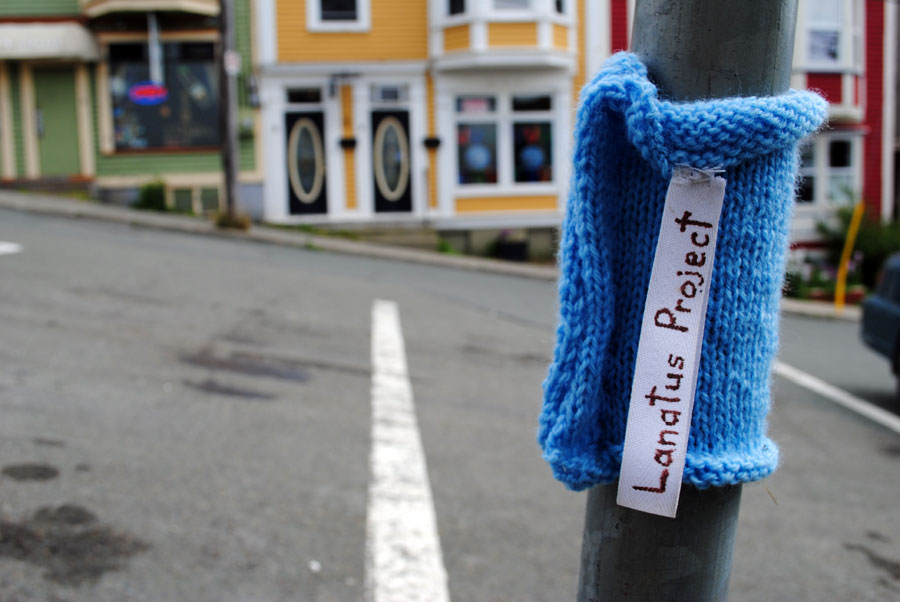
Also known as yarnbombing or graffiti knitting, we spotted this particular piece of vandalism wrapped lovingly around a parking meter on Bates Hill.
Could this be the product of a ruthless gang of obsessive knitters who are itching to keep their hands busy in the summer? Ones who like to eat watermelon (latin name “citrullus lanatus”)?
While it is directly across the street from new yarn shop A Good Yarn, owner Jenny Metler refused to comment.*
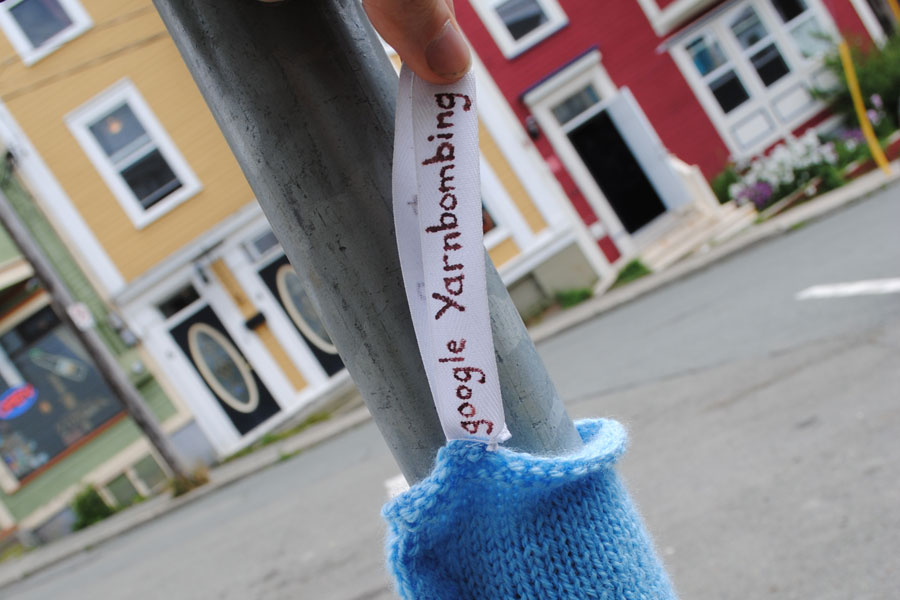
* – Okay, this is a lie. Metler said she hadn’t noticed this particular yarnbomb before, but she says the trend is growing in the city.
Blood drive a key part of this year’s Pride Week
Sat, Jul 17, 2010

It’s Pride time! A long way from the local annual gay rights marches of yesteryear, this year’s Pride celebrations comprise ten whole days of fun and education, ranging from boat tours to seminars to the annual Pride parade down Water Street.
“It’s all just fabulous,” says St. John’s Pride Chairperson and Organizer Suzanne Gulliver.
The key events this year for Gulliver? The blood drive, without hesitation.
“We have this blood drive because we disagree with the policy that MSMs, men who have sex with men, cannot donate blood,” explains Gulliver. “We feel it’s discriminatory. It’s just based on sexual orientation, as opposed to sexual practices such as unsafe sex and lack of monogamy. They don’t ask those questions to heterosexuals, and they really should. They’re looking to help get this policy changed by asking MSMs who are excluded from giving blood to find someone to donate on their behalf. “This way we can show Blood Services that they would have actually had twice as much blood, had they not had this ban,” she says.
Anyone who supports this position is welcome to come by and donate blood. A guest book will be available so donors can write down their own names and the names of the people they donated for. The guest book will then be sent to Canadian Blood Services to show them how much blood they’re missing out on. The blood drive happens on Thursday, July 22nd, from 12-4pm at the blood donation clinic on Wicklow Street. They’re also looking for volunteers to help out with refreshments and donor cards and the like.
New to Pride this year is the LGBTQ Person of the Year Award. “We’re giving the award to Susan Rose, who has been an amazing champion of LGBTQ rights throughout her life,” says Gulliver. “Presently, she’s working with EGALE (Equality for Gays and Lesbians Everywhere) on eliminating homophobia in the schools by bringing LGBTQ material into the curriculum, so that kids are taught about different families and family structures, and protecting youth who are being bullied because they are LGBTQ or they have been percieved as such.”
Gulliver is also really looking forward to this year’s Pride parade. And, really, who isn’t? “We want to emphasize that it is family friendly, and we would love everyone to come march with us, not just LGBTQ people, but their friends and their families, just anyone who supports equality,” says Gulliver. “And that invitation to extends to all of our events.”
This weekend’s events
Saturday, July 17th:
All Ages Photo Scavenger Hunt, 11:00am, meeting at the Colonial Building.
Big Gay Boat Tour!, 6:30pm – 9:00pm, meeting at Pier 7 at 6:00pm. Excellent party to follow.
Sunday, July 18th:
Planned Parenthood Walk/Run For Respect, 9:00am, meeting at the Mews Centre. There’s still time to put together a team, like the Pride crew did, and enter!
Pride Picnic at Bannerman Park, 1:00PM, you supply the blankets and baskets, they supply the face painting and free swims.
Check out their website at www.stjohnspride.ca for the full rundown.


Fri, Oct 8, 2010
Elling Lien