

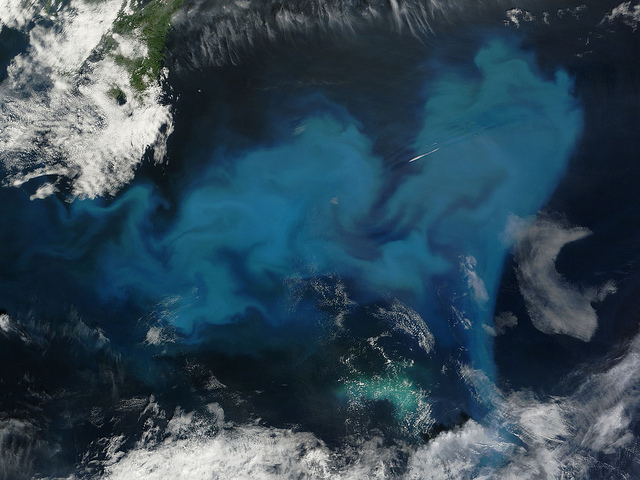
Yes, there’s something in the water, and it’s turned the water a rather beautiful shade of turquoise.
Phytoplankton — the base of the aquatic food chain — are usually too small to see with the naked eye, but when concentrations like in the image above occur, they give the water a greenish hue. The colour comes from the sunlight-sucking chlorophyll in their tiny little bodies. Blooms are a mysterious but regular occurrence in oceans around the planet, especially in summer. NASA took this satellite image of a huge bloom off the Avalon Peninsula just a couple weeks ago.
Dalhousie Oceanographer Marlon Lewis was impressed with it, too.
“You’ve got a lot of algae growing up there!” he laughs. “It’s almost assuredly a type of algae called a coccolithophorid. It’s a small, single-celled algae that’s covered with these calcium plates, so they’re kinda cool looking.”
Phytoplankton blooms are common, mostly in the spring. Usually, though, we can’t see them because the organisms are so small. “What you’re really seeing there is the sun’s reflection off those little calcium carbonate shells,” says Lewis.
In deeper waters, Lewis’ research has shown that phytoplankton populations are rapidly decreasing, which doesn’t bode well for our marine ecosystems. But along coastal areas, Lewis and his team found that populations were increasing.
This, he says, can be both good and bad.
Blooms are stimulated by the presence of carbon, nitrogen, and phosphorus, which usually get there via sewage. “Our areas around our coast are generally poor in nutrients in the summer, so the nutrients we provide stimulate the growth of phytoplankton, which feeds the other organisms. But, like everything else, everything in moderation.”






Elling Lien | Wed, Aug 18, 2010 | 521
News & Views