

Archive | News & Views RSS feed for this section
Bike Plan Petitions: Hear the CBC Morning Show interviews

Anti-cycling plan petition
“Some people in a St. John’s neighborhood don’t like the idea of losing parking spaces to make room for cycling lanes. We talk with one resident of Frecker Drive who helped start the petition which was presented to council this week.” Listen here.
Cycling lanes plan support
“On Thursday’s show we heard from a man on Frecker Drive in St. John’s who doesn’t like some parts of the city’s proposed cycling plan – and helped organize a petition against it. Today we got reaction – first a call from a listener reacting to what he heard on Thursday… and then we speak with the editor of The Scope magazine who is one of the people behind the latest petition in support of the plan.” Listen here.
Sign this petition or they will take your cycling lanes away.
Wed, Jul 14, 2010

Photo by Flickr user Richard Drdul
In the present version of the City of St. John’s Cycling Master Plan, some of the streets scheduled to have bike lanes painted on them would lose on-street parking on one or two sides. Though they have driveways, the residents of those streets are pissed. A 300-name petition against the bike lanes scheduled for Frecker Drive was tabled at last night’s city council meeting.
City officials have suggested this might even put a stop to the implementation of the cycling plan.
WTF!?
To counter this, MUN BikeShare and The Scope have set up a petition in support of the Cycling Plan, at http://www.ipetitions.com/petition/stjohnscyclingplan/ If you support the Cycling Plan, please please take a minute to sign it.
The City’s Parks and Recreation Committee is meeting this Friday afternoon to make some decisions about the Cycling Plan, so we’re hoping to get as many signatures as possible by then.
There is more information about the Cycling Plan and its present state at the petition website, specifically in the links section and in the blog section.
Petition here. For more information on the plan, visit the St. John’s site here.
Call in the reinforcements
Thu, Jul 1, 2010
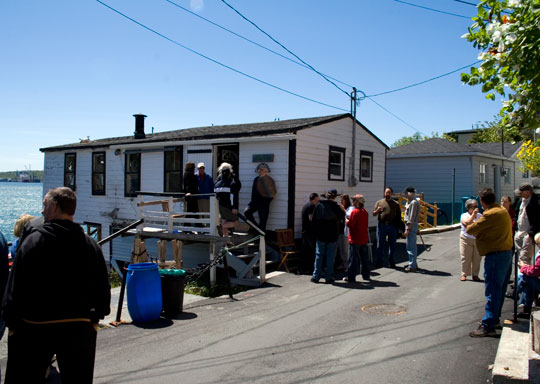
Photo by Martin Connelly
The people of the Battery are coming together to fix their neighbourhood, and have formed a new neighbourhood association to get it done.
By Martin Connelly.
Last winter the storm surge came in hard and fast, like a one-two punch. First in January, and then again on February 5th storms pushing waves up to eight meters high ravaged The Battery and Quidi Vidi Village. On the morning of the 6th, while the rest of St. John’s woke up to shovel out their cars, residents of Quidi Vidi and Outer Battery Road were already up, hoping desperately that their property wouldn’t wash out into the harbour.
In the wake of the storms, deputy mayor Shannie Duff went on the record saying the city needed to help protect the areas, while Mayor O’Keefe told the CBC that “if you’re talking about private property, then the private property becomes the responsibility of the private owner anywhere in the city.”
Rebuilding the Battery became a matter of public debate. On the one hand, it was private property, and why should public money go into fixing up someone’s shed? On the other, the Battery is a crucial piece of St. John’s heritage—its image is instantly recognizable, and is used widely by Tourism Newfoundland.
Walter Burry, an Outer Battery resident, put it this way: “It’s the same story all over town. Council wants the place for a tourist attraction, but they won’t put no money in it.”
Beyond the fact that the city couldn’t help with personal property, the big problem in all of this is that once you start doing repairs, the whole building needs to be brought up to code—and because the damages were done to harbour-side structures, it has to be an engineered design, which costs money.
Outer Battery residents and property owners held a series of emergency meetings, which eventually lead to the birth of the Outer Battery Neighbourhood Association (OBNA). “They were really in crisis,” said Elizabeth-Anne Malischewski, secretary of the Georgestown Neighbourhood Association. “Their place was falling into the ocean.” Malischewski offered practical advice about bank accounts, incorporation, and association constitutions, all of which needed to be settled before the association could gain official status, which it did on April 6th.
“We decided to come together to help people with repairs, to try, as much as possible, to keep things they way they are,” said Joanne Butler, OBNA Secretary. “When the fishery ended, people kind of forgot about the Battery, and I think we kind of forgot about ourselves, too. The storm brought some immediacy to it.”
One of the buildings almost swept out to sea in February was Jack’s Twine Store, which Loraine Michael, MHA for Signal Hill-Quidi Vidi, described as “the heart and soul of that community for over sixty years, as well as a popular St. John’s tourist attraction.” Jack’s Store straddles the line between public and private. Mr. Wells owns the property, but it serves as a community space, somewhere for weddings, parties, and naturally a scatter drop or two. Mr. Wells and his store also featured prominently in a Rooms exhibit, lending some credence to the claim of heritage value.
Starting in March, even before the OBNA was officially formed, residents started a grassroots fundraising effort to save the store, which was hanging precariously out into the harbour. The call went out on Facebook and Twitter, and the CBC aired a three part documentary about Jack by Chris Brookes, a fellow Battery resident (and OBNA chair). That fundraising campaign officially ended on June 19th, having brought in $6176. Future funds will go into the OBNA account, and will be available to the whole neighbourhood.
The same day, the OBNA held it’s first public event, a public barbeque and sign unveiling. The sun was bright, the wind was blowing, and there were burgers and dogs on the grill. It was open to all, but mostly it was for the neighbourhood. People talked politics, history, and they also talked about their children and grand children. It was a community gathering.
Twine Shop owner Wells was on hand chatting in the parking lot. He didn’t really want to talk about the store, but was positive on the subject of the new association.
“I’ve lived here 77 years,” he said. “And it’s bringing people together, people who never met one another met this year.”
Halfway through the afternoon, the music stopped and people gathered in a loose semi-circle to watch Michael and Brookes unveil the new Outer Battery sign and collection box.
“The main purpose of this event is that we all get together,” said Brookes. “But we also have a new sign and a donation box.”
“Tourists who come to St. John’s aren’t coming to walk on Elizabeth Ave, ” said Michael. “They’re coming to walk through the Battery.”
The sign relates the history of the neighbourhood and the inshore fishery, and it shows before and after photos of the damage. The hope is that some of the walkers (Parks Canada counted 84,000 on the North Head Trail between May 15th and December 15th, 2008) who pass by every summer will put a loonie or a toonie in the box. Without government support, this is how the OBNA hopes to raise the funds it needs.
Five months after the storm, a lot of the early questions have been answered. The city won’t help the Battery financially, but it hasn’t been wholly unhelpful. “What the city has agreed to do is act as a point of contact,” said Duff. “Residents have to come in with a proper plan of what they intend to do stamped by an engineer, but once they have that plan the city will do it’s best to facilitate the other required permits besides the city permits.”
On the other side, the Outer Battery Neighbourhood Association is officially ratified, and moving forward with systematic deliberation. “The association’s role is to facilitate for and help individuals,” said Butler. “We have to be in compliance with code which is expensive and difficult. We want to do things right, and carefully.”
For the time being, the OBNA is focusing on fundraising and organizing. Birds have come back to nest on the Battery, and it’s illegal to disturb a nesting sea bird. “We never used to get the gulls in here,” said long time resident Ches Sweetapple, “they used to stay way out.” With the fishery gone, the seabirds have come inshore, and for now at least, they’re doing their part to protect the structures that remain.
More: Starting a neighbourhood association
If you believe in bike lanes, tonight is the time to speak up.
Wed, Jun 30, 2010

Photo by Flickr user MoRisa
Without support, great opportunities can be lost. That’s what Piotr Trela of the Sierra Club is thinking might happen with essential portions of the City of St. John’s Bike Plan.
Trela attended the second round of public consultations on the City of St. John’s Bike Plan last night and was surprised by the lack of support for the plan. He estimates that of the 20 people in attendance, around five spoke in favour of bikes. The vocal majority were concerned about parking spots being removed.
“Apparently, this hearing was already an improvement over the one held on Monday, which was even more skewed in favour of people criticizing the Bike Plan for the parking restrictions it will impose on them,” says Trela. “The person from the city told me that the plan may be in jeopardy if the prevailing comments are the negative ones.”
The third and final consultation will take place tonight, Wednesday, June 30, and he’s calling on bikers and bike-friendly folks to come show their support, or at least pass on your words of support. The streets being discussed tonight will be Airport Heights Drive, Churchill Road, East White Hills Road, Selfridge Road, and Viscount Street.
“Even if you do not live in this area — if you think you may bike there you have a right and perhaps civic duty to speak up,” says Trela. “Please make you voice heard. Now is the time.”
The meeting will take place tonight, Wednesday, June 30, from 7pm – 10pm at the Pleasantville Legion, The Boulevard (click for Google Street View).
For more information on the plan, visit the St. John’s site here.
Zen and the Art of Bicycle Maintenance
Thu, May 20, 2010
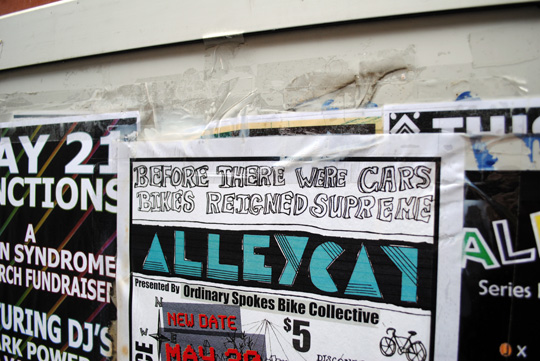
A poster for one of Ordinary Spokes’ popular events, the alleycat. Photo by Elling Lien
Ordinary Spokes is a new grassroots organization in town that promotes cycling as a great way to navigate your busy city life. Co-founder Juls Mack sat down with Jillian Butler to discuss.
If you ask Juls Mack, life on a bike is a just another flavour of transportation.
“I started riding a bike when I was 19, and it changed my life,” she tells me. “I stopped buying a bus pass. It makes your life so much easier to have a bike.”
The bike culture in St. John’s has enjoyed healthy growth recently, but it still has a long way to go, Mack says. So she, along with the six other core members, formed Ordinary Spokes, a community-oriented bicycle repair shop and resource centre here in St. John’s.
Run by devoted volunteers, Ordinary Spokes opened its doors on January 1st, 2010, and since then have been offering drop-in bicycle care, workshops and other resources. At least two of the members are bike mechanics.
Mack has seen the importance of a thriving bike culture, having lived in Vancouver before moving here a year and a half ago. “A wider variety of people bike as a form of serious transportation in Vancouver. Lawyers, doctors, everyone.”
St. John’s isn’t quite there yet.
There are plenty of benefits to cycling, which Mack, a former bike messenger, is happy to point out: a bike costs less money, can be easily repaired, and keeps you in shape. Plus, it’s often a whole lot faster than its competition.
“When I first moved here, I thought I lived an hour away from the mall, because I’d take the bus,” Mack says. “When I rode my bike it only took me twenty minutes.”
Hoping to promote cycling as a legitimate form of transportation around the city, they also refurbish old bikes and resell them for about $50. “It’s a really accessible way for the average person who wants to start biking to work, or bike on the weekends,” Mack says, adding they have a wide selection of children’s bikes. A certified mechanic checks every bike that leaves the shop.
Ordinary Spokes hopes that sharing their knowledge with the public will teach the average cyclist that bicycle maintenance is pretty painless.
“About five members of the collective barely knew anything when they started. Now they’re swapping cables out, repacking bottom brackets,” she says. “Knowing how to do your own repairs makes cycling really accessible.”
Ordinary Spokes started with a friend’s empty basement and a desire to make the space useful. “Most cities across North America have these communal places where anyone can use the tools to fix up their bike with a little bit of guidance. I feel like this is something that St. John’s needs.”
Of course, there are real challenges for the St. John’s cyclist—namely, the unpredictable weather. But according to Juls, all it takes to survive a St. John’s winter on wheels is a little know-how.
“We do workshops on how to put on your winter tires. And it makes a difference—I put winter tires on this year and I didn’t spin once,” she says.
And then there’s the Ordinary Spokes alleycat races, a fundraiser based on the daily routine of bike couriers.
“In most cities, it’s the messengers that do the race. It’s like a scavenger hunt on a bike,” Mack says. “You get a list of locations, and you make up your own route, while staying safe. It’s more about finding your way than speed.”
What Ordinary Spokes needs to grow is volunteers, whether to help with promotion or even take on repairs.
“We need more people! Everyone in the collective is busy, but we all really believe in the shop. And as we’ve seen, anybody can become a good mechanic within a month.”
Right now the shop is open three days out of the week—Tuesdays, Thursdays and Saturdays—with a bike sale on the last Sunday of every month. To drop by and either get advice or get involved, all will be revealed with a quick email to ordinaryspokes@gmail.com. Since the shop operates out of a residential basement, they don’t like to advertise the location.
“We have the goal of becoming a real bikeshop. We’re actually trying to register as a non-profit,” she says. “What we really want is for kids to be able to visit the shop, so we can do summer bike programs. Get them riding when they’re young.”
NLAC Award Winners 2010
Tue, May 11, 2010
The annual NLAC Awards were held on May 1st, in Happy Valley-Goose Bay, to honour artists and their achievements in 2009. Here’s a quick run-down of the winners.
Manfred (Mannie) Buchheit – Arts in Education Award
Born in Alsace, France, Manfred Buchheit has been working in the arts in Newfoundland since he set up as a professional photographer when he first arrived in St. John’s in 1971. In addition to being a revered and award-winning photographer and artist, he’s a well-known and well-loved teacher, having taught photography and art at Memorial University for many years.
Wallace Hammond – Patron of the Arts Award
Born and raised in St. John’s, Wallace’s band, Da Slyme, headed up the first punk show in the province. Over thirty years and almost as many bands later, Wallace is still a staple in the St. John’s music scene – he’s the first sound guy everyone calls. Indeed, he’s done sound for everyone from Pat Metheny and Muddy Waters to the Idlers and the Pathological Lovers. His legendary genius behind the soundboard comes from an honest place; in his spare time, he builds his own switching boards.
The Flummies – Hall of Honour Award
The Flummies are five-piece Inuit and Metis band based in Happy Valley – Goose Bay. Singing traditional Inuit, Metis and Innu-influenced songs from Labrador, The Flummies have been together for over thirty years, preserving the songs, stories and culture of the indigenous people of Labrador through their music.
Helen Fogwill Porter – Hall of Honour Award
Known for both her own writing and mentoring new writers, Helen Fogwill Porter is the author of such works as Finishing School and January, February, June and July, which was shortlisted for the WH Smith/Books in Canada First Novel Award in 1988. Born and raised in St. John’s, she has been writing fiction, non-fiction, poetry and humour for over thirty-five years.
Des Walsh – Rogers Arts Achievement Award
Des Walsh is a poet who also happens to write plays and screenplays, and play fiddle in the group Tickle Harbour. He is noted as a “key participant in the St. John’s cultural rebirth of the 1970s,” by Newfoundland and Labrador Heritage, and wrote the script for Random Passage and co-wrote the Gemini award-winning script for Boys of St. Vincent. His screenplay for Love and Savagery, based on his book of poems of the same title, was nominated for a 2010 Writer’s Guild of Canada Screenplay Award.
Chad Pelley – CBC Emerging Artist Award
Chad Pelley has accomplished a lot in a short time. In his six years of writing, his short stories have garnered nods from the Telegram’s Cuffer Prize, including a win in 2009 for “Holes to China,” and his debut novel, Away From Everywhere, was nominated for The National Post’s Canada Also Reads competition. He’s also the creator of, and sole contributor to, the popular blog Salty Ink.com: A Spotlight on Atlantic Canadian Writers.
Duo Concertante – Artist of the Year Award
Husband and wife Nancy Dahn, violin, and Tim Steeves, piano, make up Duo Concertante, dubbed “the next generation of classical music stars” by BRAVO!TV. They’ve been performing since 1997 and, unlike most violin and piano duos, they put equal emphasis on both instruments in their compositions. Both Dahn and Steeves teach at the MUN School of Music and are Artistic Directors at the Tuckamore Chamber Music Festival.
What are we putting in the water?
Thu, Apr 22, 2010
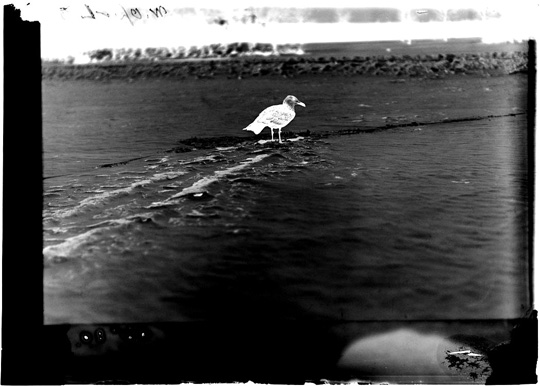
Exposure to even small amounts of oil can kill diving seabirds in cold-water regions.
Greenhouse gas emissions from Alberta’s oil sand developments, including emissions from related facilities, totalled 38.4 megatonnes in 2007; about five per cent of Canada’s overall emissions.
By comparison, Newfoundland and Labrador’s (albeit much smaller) offshore petroleum industry has mostly escaped the scorn of environmentalists and the media.
Like the in oil sands, offshore oil and gas production creates greenhouse gases, though there are greater environmental impacts of producing heavy oil than of extracting light crude. But what are the potential environmental hazards of extracting offshore oil?
by Kerri Breen
Believe it or not, seabirds like hanging around oil rigs, which occasionally doesn’t work out very well for them. In cold-water regions such as the Grand Banks, exposure to very small amounts of oil can affect a diving bird’s ability to protect itself from the elements.
Hundreds of thousands of oiled birds from the Grand Banks have died annually, according to local researchers Francis Wiese and Gregory Robertson, who created the first scientific model to assess seabird deaths due to chronic oil spills.
In 2004, they concluded that the annual mortality of Newfoundland and Labrador seabirds due to oil spills is on the same scale as that caused by the infamous 1989 Exxon Valdez oil spill off the coast of Alaska.
These findings were presented in the Journal of Wildlife Management two years before this province’s recorded oil industry spillage would peak in 2006. Just over 274,000 litres of various types of petroleum were reportedly leaked into the ocean that year.
The trend is, however, changing. In 2009, fewer than 300 litres of oil were reportedly spilled off the coast of Newfoundland between the three mega-projects, Hibernia, White Rose, and Terra Nova. Frequency, or number of spills—another way of considering the impact—has fluctuated between years, however.
This reduction in the quantity of spillage cannot be chalked up to decreased oil production either, as current levels are less than three times what they were in late 1997, when the province was producing just about a quarter of a million barrels of oil a month, compared to today’s roughly 8-million barrels per month.
Ken Taylor, environmental compliance officer with the Canada-Newfoundland Offshore Petroleum Board, explains this improvement is a function of how the industry is working to reduce incidents.
“From the board’s point of view … for the number of spills, the target is zero,” he says.
Taylor, a civil engineer by training, “deals with the nuts and bolts of environmental protection” in his role as an environmental compliance officer. It’s his job to assess environmental protection plans submitted by the oil operators, and to make sure they stick to them over the period for which they are approved—and he’s bringing this environmental expertise to the public.
On Earth Day, April 22, Taylor will give a presentation on the potential environmental hazards of offshore petroleum activities from the preliminary stages through the development phase. His presentation will include information about seismic exploration, exploratory environmental risks, and protection for each stage of offshore oil development.
“There are a number of environmental issues that come up during the whole lifecycle of a petroleum project and those issues are dealt with in different ways,” Taylor says.
In the offshore, there are more environmental considerations than accidental spills, however. Some waste is discharged from platforms as a matter of regular operation.
For example, the offshore drilling process uses drilling fluids (water-, synthetic-, or oil-based mud) that is circulated in wells to clean and condition the hole. Oil-based muds are not allowed to be ejected into the sea, according to the Offshore Waste Treatment Guidelines.
This document outlines recommended minimum standards for the treatment and disposal of wastes from petroleum drilling and production operations in Canada’s offshore, and for the sampling and analysis of waste streams to ensure compliance with these standards.
“If things are discharged within the targets set out in those guidelines, they don’t generally pose significant risk to the environment that we’re operating in,” he says.
Drilling also generates drill solids (cuttings from the holes). In the Newfoundland and Labrador offshore, cuttings are only allowed to be released into the sea if a non-oil based drilling mud has been used.
As well, the thousands of litres of wastewater discharged through offshore petroleum activities each day may have negative effects on marine ecosystems. “Produced water” can contain contaminants: trace heavy metals, radionuclides, sulfates, treatment chemicals, produced solids, and hydrocarbons.
The guidelines state that produced water should be tested twice yearly for various metals and hydrocarbons, and annually for aquatic toxicity. The concentration of oil in produced water that is discharged is supposed to be measured every 12 hours, and should only contain minimum quantities of oil.
An essential tool for identifying a project’s impact is the environmental assessment.
The C-NLOPB, the body that regulates the offshore oil and gas industry, evaluates proposals for all offshore activity to identify their potential effects on the natural environment and other users of that environment.
It also evaluates measures proposed to prevent or mitigate these effects.
The Earth Day presentation–Environmental Aspects of Petroleum Offshore Development is presented by the Natural History Society of NL and CPAWS-NL. It’s happening on Thursday, April 22 at 8:00 p.m, at SN-2067 at Memorial University. The lecture is free and all are welcome.
Women of the house
Thu, Mar 25, 2010

Photo illustration by Elling Lien
For the first time in this province’s history, three of the province’s political parties were led by women for the six weeks Premier Danny Williams was recuperating from heart surgery. Is this still a landmark for women’s representation in politics if few made the connection?
The stars aligned for Newfoundland and Labrador provincial politics last month, and for the first time ever, provincial party leadership was a girls’ club.
With Danny out of commission, the promotion of Deputy Premier Kathy Dunderdale to the role of acting premier was a matter of temporary circumstance. Nonetheless, having three female party leaders—Cartwright-L’Anse au Clair MHA Yvonne Jones of the Liberals, Signal Hill-Quidi Vidi MHA Lorraine Michael of the NDP and Virginia Waters MHA Dunderdale—is nearly unprecedented in Canadian politics.
In 2007, women constituted 22 per cent of members of provincial legislatures in Canada. Women’s representation in cabinet is slightly higher, but there have been only four female premiers in Canadian history.
It was only three years ago Newfoundland and Labrador possessed half the female provincial party leaders in the country—there were just four. (Now there are nine—many opposition leaders).
Throughout the world, explains political science PhD Amanda Bittner, women’s participation in politics has reached a plateau of 20 or 22 per cent.
Why then did no one seem to notice that women were—at least in one sense—running the show in Newfoundland and Labrador for over a month?
Bittner, a political science professor at Memorial and researcher in the area of women’s representation in politics, says people aren’t thinking about gender as much any more.
“If you ask a person walking down the street they’re not going to really think about women in politics that much,” she says.
The belief that the barriers for women’s participation in politics were removed when they were given the right to run is fueling complacency, even though most societies are far away from having equal gender representation in the political sphere, she says.
“Because we don’t have these grand, symbolic goals like suffrage, let’s say, it’s hard to rally around [the issue],” she says.
Bittner is working with two graduate students on a conference paper called “Who Cares? Canadian Attitudes About Women in Politics.” The as yet unfinished paper is about the simple, but potent idea that women aren’t as represented in politics because the public, and therefore policy makers, haven’t prioritized the goal.
“Until we kind of care about it, as a population, nothing is really going to happen,” Bittner says.
Newfoundland and Labrador is an interesting case: It’s ahead of Canadian averages in some measures of gender equality in politics, but not in others. The representation of women in cabinet is at 31.5 per cent, which is high by Canadian standards.
“We’re a little bit above average on that, and we’re a little bit below average in terms of the numbers of women in the legislature in general,” Bittner says.
Just over 30 women ran in the 2007 provincial election; 11 of them won.
“The biggest barrier to having women in legislatures is getting them to run in the first place. If they run, they win, as evidenced by the number of women who have won in Newfoundland in the last election,” Bittner says.
The variables that prevent them from running are complex and deeply rooted in other issues affecting women. Bittner attributes women’s lower levels of participation in politics to the fact that women are statistically poorer than men, giving them less access to campaign funds. Generally speaking, women also have the lion’s share of childcare responsibility.
“There are things that prevent them from getting involved that other members of the population don’t have to face, and until we deal with those kinds of things, there’s going to be a problem.”
There’s a debate as to whether it’s unwise for female politicians to talk frankly about being women in politics, as opposed to politicians who happen to be female.
Bittner says being a feminist is a taboo—and not just for women—but studies have shown that women who run on women issue’s platforms tend to do better than those who don’t.
“Which is kind of a bizarre thing you might not expect, but when you point out that you care about those issues and stand up for those issues, others who identify with those issues will tend to vote for you, and others who don’t necessarily will also respect you for what you’re doing and sort of go from there.”
It’s unwise to align oneself with any sort of symbol of weakness in politics, even if the weakness is theoretical, statistical or historical and not experienced by everyone in the same manner. Female Members of the House of Assembly—or any other Canadian legislature—don’t publicly acknowledge their gender often.
Privately, it may be another story. The public and the media may not have noticed that the province’s three political leaders were women, but Bittner bets the leaders themselves made the connection.
Looking both ways
Thu, Mar 11, 2010
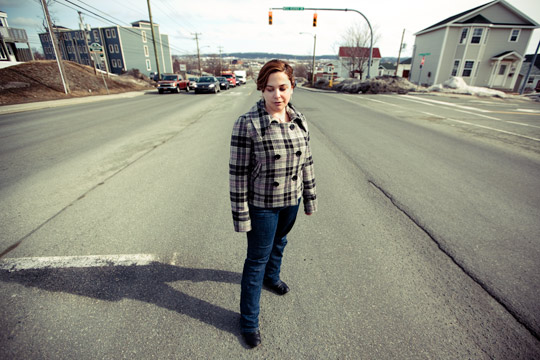
Photo by Kevin Coffey
During the minute and a half she lay on the Thorburn Road asphalt, Carly Bigelow says she realized she wasn’t brain dead because she could still hear her iPod…
It was just getting dark on a sleety, messy February evening last year as Bigelow, a 22-year-old Memorial University student, got off a Metrobus near Moss Heather Drive and attempted to cross the street.
“I was crossing and I looked both ways…and I guess she was coming from the direction I looked in first and I didn’t realize until I was crossing and I saw light getting really close to me,” she says. “I turned really quickly and there were headlights and I realized how close the frigging car was to me.”
In a deer-in-headlights moment, Bigelow stopped for a split second, and then felt the car’s impact above her hip, then on her shoulder and she landed on the road.
The driver had attempted to slow down, so Bigelow’s injuries were minor.
“I had a sprained ankle and one side of me was really sore for about a week or so,” she says.
Others weren’t as lucky. According to Statistics Canada, 1220 Canadian pedestrians died after being hit by vehicles from 2000 to 2005, the latest data available.
Pedestrians account for 12 per cent of deaths in motor vehicle accidents across Canada, and over a third of them are seniors.
Bigelow was struck down just a few blocks away from what city data conclude as St. John’s fifth most dangerous intersection, Columbus and Prince Philip Drives at Thorburn Road.
Predictably, the intersections with the most traffic accidents—some of which involved pedestrians—were along the city’s most popular drags: Newfoundland Drive, Columbus Drive and the Prince Phillip Parkway, according to 2006 data.
A 2006 study of Montreal pedestrian accidents found they are not limited to problem intersections, however. Three-quarters of injured walkers were either hit between intersections or on street corners where only one or two pedestrians had been injured within the five-year study period.
A handful of significant vehicle-pedestrian accidents have been reported St. John’s already this year. In the last six months, there has been about half a dozen.
In the media, drivers have been blamed, pedestrians have been blamed, even geography and infrastructure have been blamed.
But what’s the solution? Research from Atlantic Canada suggests awareness may be the key.
In the late 1980s, researchers from Université de Moncton and Saint Mary’s University conducted a pedestrian safety experiment in St. John’s, as well as in Moncton-Dieppe and Fredericton.
They launched an awareness program called Courtesy Promotes Safety that resulted in an increase in the numbers of St. John’s motorists that yielded to pedestrians from 54 to 71 per cent.
The percentage of pedestrians injured decreased by a whopping 50 per cent, based on data from three and a half years before and two years after the program’s implementation.
The program’s reach was vast. It educated the public through the use of flyers and large feedback signs reporting the percentage of motorists yielding to pedestrians each week. There were school-wide training programs and media buzz.
Advance stop lines were introduced and motorists were encouraged to yield father back behind crosswalks. Signs at problematic crosswalks instructed pedestrians on how to safely cross the street, and police gave out warning flyers and warning tickets to motorists who failed to yield (and small incentives such as a pen and bumper sticker to motorists yielding to pedestrians).
Despite the large scale of the effort, the program cost about $40,000 to implement, including the cost of traffic observers, signs, and all required materials. The City of St. John’s recovered about a third of the cost through the corporate sponsors, states the article, which appeared in a 1990 edition of the academic journal Heath Education Research.
The program was terminated, but the special crosswalk signs and pedestrian prompts were still on the go for years afterward.
A 1999 review of the literature on Canadian research on pedestrian safety said multi-faceted campaigns like Courtesy Promotes Safety are effective in modifying the habits of pedestrians and drivers alike.
Bigelow says visibility was poor the night she was hit, so she doesn’t blame the driver entirely, but calls inconsiderate drivers her biggest pet peeve.
She admits she wasn’t using a crosswalk the night she was hit, but she is more cautious these days.
“I’m ridiculously paranoid about crossing Thorburn Road now,” she says.
Hit or been hit? Leave a comment below.
Climate change
Thu, Jul 5, 2007
Elling Lien, inspired by academic, environmental and political activist George Monbiot’s book Heat: How To Stop the Planet From Burning, looks at some of the local numbers and asks, “what does St. John’s and the rest of the province have do to help stop the planet from burning?”
The planet is getting warmer, arctic sea ice is melting, sea levels are rising, weather is getting stranger and more severe…
To doubt that man-made climate change is happening, one has to totally ignore the evidence.
Every week a new detail is revealed.
Recently, for example, Arctic researchers reported that several ponds, which had been around for more than 6000 years, have dried up completely. The Arctic, referred to as a climate change canary, is a sensitive warning spot that is able to let people know of greater oncoming danger.
And those dried up ponds, and melting glaciers are telling the rest of the planet to wake up out of it. Unless we do something quickly, and on a large scale, a period of relatively stable climate that has existed for more than 10,000 years will be upturned.
We in Canada, right here in Newfoundland, have to make very serious reductions in our greenhouse gas emissions.
Like, now.
(more…)


Fri, Jul 16, 2010
Elling Lien