

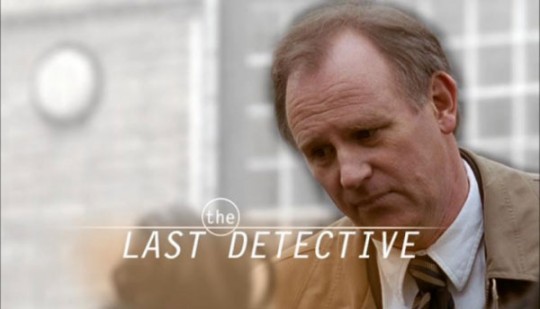
Adam Clarke discovers the charms of this English mystery series.
In the world of The Last Detective, nobody listens to Detective Constable Davies (Peter Davison, Doctor Who). In fact, the relationship he has with his superiors is downright hostile and his ex-wife, Julie (Emma Amos), seems to regard him with a mix of pity and frustration. Davies is trapped in a world where being the victim is the norm. He’s reasonable, gentle, hard-working and intelligent, but his introspective nature is mistaken for a lack of ambition, so he’s constantly underestimated. Fortunately, so do the criminals trying to evade him.
Bright spots are few for the middle-aged detective, who has been given the derisive nickname “Dangerous” by friends and colleagues alike. All he’s got is a shaggy St. Bernard, the passion he invests in his job and the late-night chats with his best friend Mod (Sean Hughes, The Commitments), a perpetually-unemployed alcoholic.
Such is the general outline of The Last Detective, a British mystery series that aired from 2003 to 2007 and was recently collected in a nice little box set from Acorn Media. Unlike the gritty, po-faced elements of Prime Suspect or the formulaic storytelling of the glossy CSI, Detective is a lot like its protagonist: charming, quietly funny and under-appreciated.
In the first episode, Davies is already at the bottom of the ladder. His divorce is still fresh, but his wife’s already seeing someone. He’s been overlooked for promotion by his hard-drinking superior, Aspinall (Rob Spendlove), in favour of the young, fashionably-dressed Chris Morris lookalike, Pimlott (Charles De’Ath). Davies’ endless bad fortune sees him assigned to a decades-unsolved murder case, which has long gone cold. Aspinall is getting Davies out of the way, but the detective’s kindness and empathy for the victim’s family bring Davies close to solving the case. The promise of closing a stone cold whodunnit sees Aspinall wave the promise of a much-deserved promotion for the belittled detective. However, as the evidence increasingly points to a police cover-up, Davies may end up killing his career to bring the killer to justice.
Needless to say, Davies’ solution ends up destroying all the good will built up in that story and Aspinall dubs him “The Last Detective”, as DC Davies is the last detective he’ll ever assign to a real case. Once again, Davies has few friends in the department and his wife still sees him as a joke. Even with the murder solved, the victim’s family find little comfort in Davies digging up the past. The detective’s kind-heartedness proves to be his undoing each time, resulting in another late-night pint with Mod.
The Last Detective offers a welcome break from the kinds of heroes who are currently fashionable on television. “Dangerous” Davies is sweet, well-meaning, compassionate and hard-working. He has no special powers and no tragic backstory (even his divorce is treated as more of a disappointment than a failure). He’s a middle-aged man who looks his age with thinning hair, fading looks and coffee-stained teeth who we never once see shirtless and who seldom gets the girl. He’s a rumpled underdog along the lines of Carl Kolchak or Det. Columbo.
Most importantly, he’s not a genius. Don’t get me wrong, I prefer my genre heroes to be shown as “brains”, but most fictional geniuses tend to be written as someone who makes logical leaps and is rewarded by a script that rewards jumping to a conclusion as if it were thoughtful analysis. Surround that character with idiots so that (s)he appears more intelligent (TV writers must take a Hack 101 workshop to perfect this trope) and you’ve got a hit series. Cast Hugh Laurie in the title role of said series and you’ve got House.
Indeed, the only criticism I can level at the show is that after the first season, the writers throw in ever more contrived reasons to keep Davies at the bottom. The first season seems to carry through an arc, showing Davies working his way up to the top on his terms as he continues to prove himself to his superiors and to himself. The final season, in a mark of desperation, features increasingly violent and improbable stories, miscast b-level guest stars (Roger Daltery and Whose Line‘s Tony Slattery) and an overwhelming desire to keep the status quo. As such, the series doesn’t end, so much as it stops without ever giving Davies a proper finale. Acknowledging that, however, the early episodes are exceptional, particularly in the 2003 season.
This past decade continues to be an amazing age for television, producing in shows that are experimental and unpredicatable (Louie), as detailed as any novel (The Wire), unabashedly clever (Community) and completely gripping (True Blood…wait! I meant Breaking Bad! Yes, Breaking Bad) Yet, in an age that has produced the aforementioned new classics and some ambitious misfires (sorry, The Cape…I mean, Rubicon! Yes, Rubicon), there’s something to be said about a genre piece done right. This cozy British mini-series makes for an ideal evening of comfort food TV.






Adam Clarke | Wed, Sep 7, 2011 | 950
On Screen