

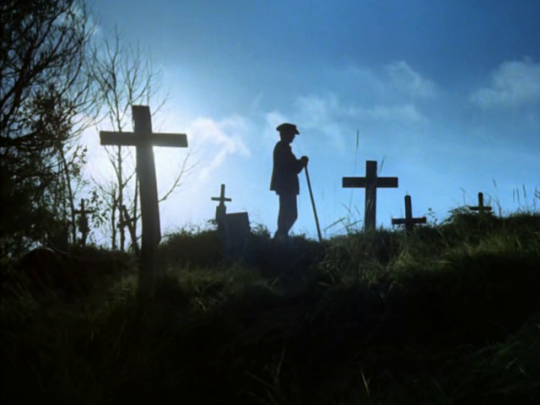
Just in time for ‘ween, Adam Clarke revisits The Prisoner’s costume party.
Where am I?
Only going over the 11 most essential episodes of The Prisoner, I’ve jumped further ahead for these last three reviews. So, to bring us up to speed, my ordering of the entire run of The Prisoner is as follows with links to the original trailers for each episode.
1. Arrival
2. Dance of the Dead
3. Free for All
4. Checkmate
5. The Schizoid Man
6. The Chimes of Big Ben
7. The General
8. A. B. and C.
9. Many Happy Returns
10. Hammer Into Anvil
11. It’s Your Funeral
12. A Change of Mind
13. Do Not Forsake Me Oh My Darling
14. The Girl Who Was Death
15. Living In Harmony
16. Once Upon A Time
17. Fall Out
After the first nine episodes, I switch back to the order the episodes were originally aired in with one exception. I switched “Living in Harmony” and “The Girl…” because “Harmony” has more in common with the two-part finale than the latter episode. As such “Harmony” works better preceding “Once Upon A Time”, but airing directly after “Do Not Forsake…” and “The Girl…” Other than that, the second half of my order is identical to the way these episodes were first broadcast.
Since I’m not reviewing all of the episodes and only the most iconic ones, what of the episodes not addressed here? I skipped everything between episodes eight and fifteen, the latter being the focus of this review. So, what did we miss? Well, Number Six escaped and was recaptured in episode 9, escaped and recaptured in episode 13 (which also told us Six had a fiance back home and has been in the Village for an entire year), caused another Number Two to have a full-scale breakdown in episode 10 and didn’t do much of importance in episodes 11, 12 and 14.
Of these skipped episodes, “Do Not Forsake…” is atrocious television, but it’s the only one episode of the series that’s poor. “Hammer Into Anvil” is a fine story let down by an appalling performance from guest Two, Patrick Cargill. “A Change of Mind” makes little sense after a terrific first half and “It’s Your Funeral” feels more like a Marvel comic based on The Prisoner (sadly, Jack Kirby’s The Prisoner was never finished) than a real episode of the show. “The Girl Who Was Death” is a fun spy romp, but is hardly essential.
What’s wrong with these episodes? “A Change of Mind” and “Do Not Forsake…” are the only poor scripts, although the former has a few great scenes in the Village’s mental rehabilitation centre (“Believe me. Believe me. Believe me…”) and a nice turn from John Sharp as Number Two. Other than that, they’re not bad. “The Girl Who Was Death” is loads of fun and cleverly plays with the “Is Number Six really Danger Man‘s John Drake?” confusion by suggesting McGoohan’s popular Drake character was a fairy tale Number Six made up to entertain children in the Village. “It’s Your Funeral” has a great Number Two thanks to Derren Nesbitt’s playful performance, but doesn’t have much in common with the rest of the series. “Many Happy Returns” is beautifully shot, but offers little new to viewers who’d seen the superior “Chimes of Big Ben”.
So, while I enjoy episodes 9, 11 and 15 more than “Checkmate”, they’re not crucial episodes. Admittedly, it’s debatable as to whether or not I should’ve included “A Change of Mind” or “It’s Your Funeral” in my series on the show. No, not for their unusual depictions of Village life (“Funeral” for its Village rebels and “Mind” for the Village’s citizens community) or the great performances of Sharp and Nesbitt. No, I probably should’ve written about them just so I could discuss Kosho.
Kosho, easily the most dated aspect of the series, was a game Patrick McGoohan devised between nervous breakdowns. The game, equal parts American Gladiators and Super Mario Bros, has two players with boxing gloves jumping from trampoline to trampoline as they attempt to wrestle each other into a pool of water in the centre of a gymnasium. This was meant to be one of the many aspects of The Prisoner to suggest that the Village was international and incorporated elements of all cultures. Instead, it’s a really goofy concept that, in a hopeless attempt to seem foreign, has stereotypical Eastern “pling-plong, pling-plong-plong” music underscoring every Kosho match. It’s stupid, but I kind of love Kosho…albeit in the same way I love the ending to “The General”.
Anyway, that Kosho sure is silly, isn’t it? You know what isn’t silly? OLDE TIMEY WESTERN THEMED EPISODES.
Tonight’s Plot (In Six Words Or Less): No gun, can’t travel.
Living in Harmony
Written and Directed by David Tomlin.
Story by Ian Rakoff.
There are no opening credits to this episode, nor is there a “Who is Number One?” secondary title sequence. We open not in the Village and the 60′s, but in an unspecified time in the American West. A sheriff (Patrick McGoohan) throws his badge away and leaves town. Or, at least, he tries to leave town, but is intercepted by a group of thugs who beat him and take him to a new town called Harmony. In Harmony, McGoohan’s stranger is brought to a saloon to meet the Judge (David Bauer) and his sadistic lackey, the Kid (Alexis Kanner). The Judge wants this man with no name to become Harmony’s new sheriff, but the stranger refuses to do anything that’ll lead to him carrying a gun. The stranger just wants to get out of Harmony and stay away from violence, but the townspeople won’t let him go. Since the Judge is running the show, he locks the stranger in the town jail.
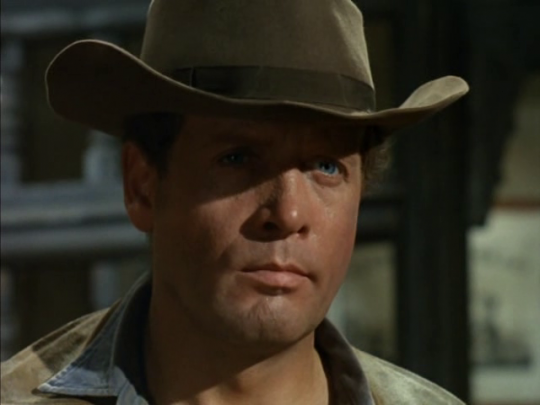
Plus ca change. We may be in Western territory, but this man with no name is still a Prisoner…
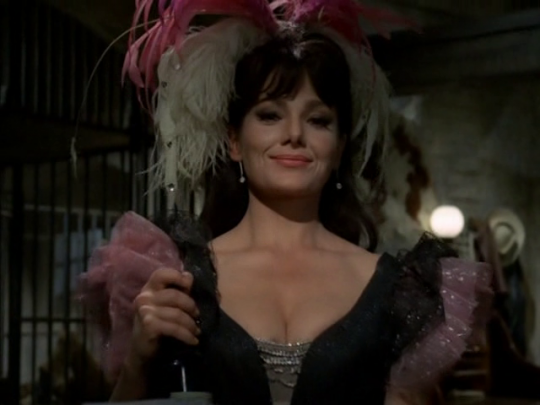
Kathy (Valerie French), a barmaid, has no love for Harmony after the Judge had her brother lynched. She goes to the county jail and finds the stranger guarded by the Kid. The Kid is a quick shot, but not quick witted and is hopelessly in love with Kathy. Taking advantage of the smitten Kid, Kathy gets him stone drunk and engineers the stranger’s escape. The escape is short-lived, however, and the stranger is brought back to the Judge. Harmony, like the Village, isn’t an easy place to leave.
Once again, the Judge offers the nameless cowboy the position of sheriff. The stranger’s firm refusal is compromised when Kathy is arrested for aiding the stranger’s escape and is sentenced to hanging. In exchange for a pardon of Kathy’s crime, the stranger accepts the position of sheriff on one condition. He won’t carry a gun. The Judge accepts the stranger’s terms, but is keen to see his new sheriff with a six-shooter. The Judge gets a bunch of cronies to beat the living hell out of the stranger, but the Judge mistakes our hero’s pacifism for weakness. The stranger is badly beaten, but still overpowers the gang of thugs set loose upon him. Afterwards, the stranger reluctantly agrees to carry a gun.
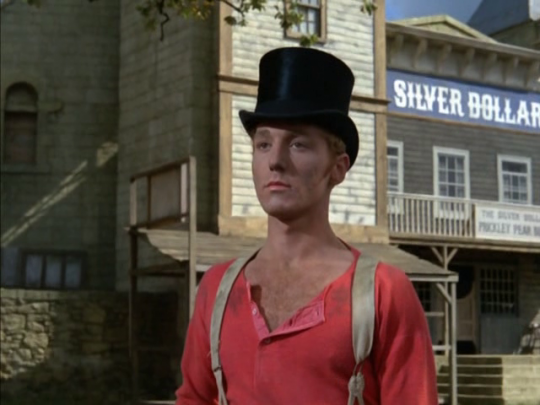
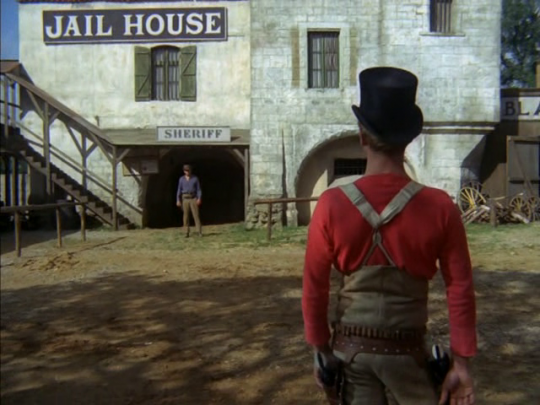
In the meantime, Kathy and our stranger have fallen in love and are plotting to escape together. The Kid, as stable as one-legged piano in the best of times, has a psychotic episode and murders Kathy. Distraught, Harmony’s new sheriff buries his love and returns to town. Now holding the gun he’d avoided for so long, he faces off with the Kid in a duel and wins. With no reason to stay in Harmony, the stranger resigns once again. The Judge won’t let him leave and tells the stranger that he’s working for Harmony now. The stranger walks away and is eventually shot in the back.
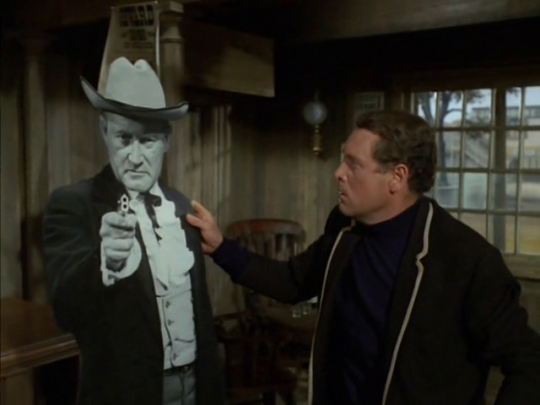
Back in the 1960′s, Number Six wakes up in the saloon with headphones on, but he’s out of his cowboy gear and back in his usual Village clothes. He removes the headphones and wanders around Harmony, spotting cardboard cut-outs of Kathy, the Kid, the Judge and even his horse. It seems that the new Number Two (Bauer) and his sidekicks, Number Twenty-two (French) and the new Number Eight (Kanner), have immersed themselves in a virtual reality experiment designed to break Six. By giving him a love interest and killing her, the scenario devised might make Six lose his sense of purpose and go on living in service of his new Village masters.
Six may have fallen for Kathy/Twenty-two in the Western dream world, but the VR experiment has taken its toll on the Village authorities as well. Their Western counterparts all behaved as they would have if they were really in that situation, so Twenty-two sits in Two’s office crying for her lost love. While Two is worried about getting a call on his big red phone, Number Eight watches Number Twenty-two with a crazed look in his eyes.
Whose Side Are You On? When asked about why there was a Western episode of The Prisoner, the (possibly apocryphal) response from McGoohan was that he’d never done a Western before and that was the only reason this episode was devised. He would later appear in the Western comedy, A Genius, Two Partners & A Dupe in 1975 where, even away from The Prisoner, his lines were inexplicably dubbed over by the default Number Two voice in The Prisoner‘s “Where am I?” secondary title sequence, Robert Rietty*.
“Living in Harmony” may have been conceived as a frivolous Western-themed episode as Community, Supernatural, Red Dwarf and various Star Treks would do later on. When production resumed on The Prisoner after the initial 13 episodes were filmed (which, by my ordering of the episodes, would consist of episodes 1-12 and 16), McGoohan had claimed he’d fought off three nervous breakdowns. With such pleasant, but lackluster episodes as “A Change of Mind” and “It’s Your Funeral”, the series risked growing long in the tooth if it went on much longer. A change of scenery was needed and the Western episode was McGoohan’s approved solution.
“Harmony” injects the series with some much needed style and vigor after aforementioned c-grade episodes like “Mind” and “Funeral”. The final four episodes produced gave writers a series of challenges. One, there would be no new sequences filmed in Portmeirion (all Village scenes in the last four are sets or previously shot footage). In addition, at least two episodes had to be done with little to no scenes with Number Six while McGoohan was off filming John Sturges’ entertaining Ice Station Zebra. McGoohan would barely appear in “Do Not Forsake Me Oh My Darling” and “The Girl Who Was Death”, but would take centre stage for “Harmony” and “Fall Out”. The penultimate episode, “Once Upon A Time”, was completed during the initial production block of 13 episodes.
As per my “Arrival” review, accounts of The Prisoner‘s production differ wildly. We know for certain that McGoohan originally devised of it as a seven episode miniseries and was talked into making more episodes. We also know that McGoohan returned to the production desperate to end the series with a magnificent flourish and was taking story pitches from everybody working under him including an editor (Ian Rakoff, who came up with the initial story for “Harmony”). We also know that script editor George Markstein and McGoohan had a major falling out, with the former quitting the series and accusing his boss of hogging the limelight. Given McGoohan’s detestation of public appearances and fame, as well as his supportive comments about his production team for interviews conducted during the show’s production, that assertion rings false.
I’m still not sure how we got 17 episodes of The Prisoner. Some have alleged that the four episodes filmed in 1968 were part of a second season that was quickly aborted after McGoohan felt the series had already run its course. Many have also said that this first season was to have ended with “Many Happy Returns” as a fake series finale, fooling viewers into thinking our prisoner had escaped until its ending. However, this doesn’t make sense given that “Once Upon A Time” (aired sixteenth, but produced shortly after “The Chimes of Big Ben”) sets up Number Six’s long-awaited meeting with Number One. Other sources cite The Prisoner‘s 17 episodes as the compromise made between Patrick McGoohan and ITV owner, Lord Grade, and that it was always intended as a one-off series. So, the break in production was just an ordinary one and not a full break between seasons. As with all things Prisoner, there doesn’t seem to be a definitive answer to what was intended with the series.
Frivolity aside, “Harmony” is a terrific episode and essential Prisoner viewing. David Tomblin and Ian Rakoff deserve a lot of credit in shaping a vacation away from The Prisoner into a strong story that fits the series a great deal better than most of the more “traditional” episodes from the mid-to-late point in its run. “Harmony” isn’t a just fun sidestep, but an excellent Western yarn about a man who continuously suffers for trying to take the high ground. It explores Number Six’s distaste for violence (a crucial characteristic in the upcoming “Once Upon A Time”) and shows us exactly what he wants to avoid. Sheriff Six is closer to the townsfolk in Harmony than the Judge who wants his loyalty. Six’s sympathies aren’t with authorities. He’d gladly defend someone who needs help, but murder is inexcusable. Even when he kills the Kid in the Village’s Olde Timey Horsey Fantasy Land, he’s loath to do it and resigns as soon as he’s fired his weapon.
Unlike the “Do Not Forsake…” and “It’s Your Funeral”, there’s nothing here that contradicts the core aspects of the series. “Forsake” presented Number Six as having a humdrum life back home as a man who had a fiance (despite all signs that he’s single in “The Chimes of Big Ben” and “Many Happy Returns”). “Funeral” suggested that all Number Twos are executed eventually and that the Village had active rebel forces, neither of which jibe particularly well with other episodes. Number Two’s fear of superiors in “A. B. and C.” aside, there’s no reason to think that, say, Mary Morris or Peter Wyngarde’s Twos were facing death. Also, early episodes show us that the Village doesn’t take kindly to rebellion and are only tolerant of Six because they see him as having a future working with them.
For a fantasy episode intended to break up the routine of the series, we learn an awful lot about Six. “Harmony” gives us a sense of the clash of wills he regularly would have had with superiors while working for the British government. In exploring Six’s character, “Harmony” slips into the series with ease. It’s also one of the most cinematic episodes of the series, with the gorgeous shot of Sheriff Six burying Kathy and the shaky POV of her brother being lynched are but two highlights. French, McGoohan and Kanner are all terrific. The actors, combined with strong direction, excellent production values and a smart script, really sell “Harmony” as a gripping hour of television.
Next time: Pop goes Number Two.
*Rietty did voice-over on most episodes of The Prisoner for a variety of dubbed or offscreen characters. He was the standard voice of Number Two during the secondary titles when that week’s Number Two didn’t record their half of the exchange.






Adam Clarke | Thu, Oct 31, 2013 |
On Screen