

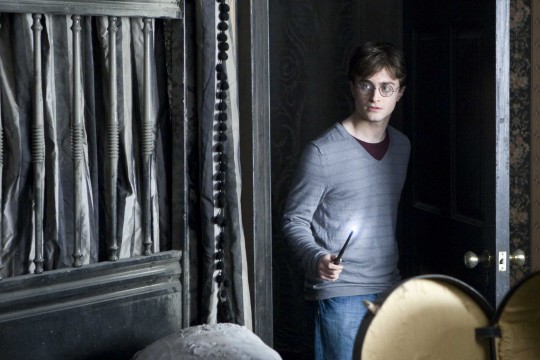
The only wizard Adam Clarke can accept is Luke Edwards.
The penultimate instalment of the Harry Potter film franchise came to theatres last Thursday night. I was to be amongst the wizard people that night and had made every preparation. Lo, I had to bargain with a mighty Gryphon in order to attain the sacred horcrux and a cloak. The cloak granted its owners invisibility, so that I would swiftly fly past many bespectacled witches and fiesty, scarf-wearing goblins. The mighty horcrux would allow me admission to the theatre. Without it, I risk being challenged by a uniformed usher-elf with a flashlight and asked to leave.
So, I didn’t see it and I’m not going to.
As I got closer and closer to the premiere, I realized that it would be pointless to review Kill Bill: Vol 1…sorry, Harry Potter & The Deathly Hallows: Part 1. It’s pointless to praise or condemn half of a single story in a multi-story series that I’m barely familiar with.
My first exposure to Harry Potter came to me when a girl I was dating in university asked me to read Harry Potter & The Philospoher’s Stone and I reluctantly agreed. After about 50 pages, I gave the book back to her and told her I wouldn’t read another word. I dismissed it as “Roald Dahl for people with no imagination.” Needless to say, that relationship didn’t work out.
In hindsight, that was a bit of a harsh judgment. I just wasn’t into reading a child’s fantasy at the time, but I am told the series improves after the first book. Nearly a decade later, I would see a handful of the movies because I was dating another Harry Potter fan. I only wanted to see the third one, as it was directed by the great Alfonso Cuaron (Y Tu Mama Tambien, Children Of Men). The end result was tried and failed to balance corny jokes with a darker storyline. The Prisoner Of Azkaban was a nice-looking, but forgettable film, as were the adaptations of the first and fifth books that I saw. However, I really liked the cast. The child stars were right for their roles and brought a real warmth to them. Needless to say, when a supporting cast including Ralph Fiennes, Michael Gambon, Alan Rickman, Richard Harris… well, you can’t sing their praises enough.
So, I do plan to read some, if not all, of the Harry Potter books and I welcome suggestions about where to start among you fine wizard people. However, I was interested in what appealed to readers and filmgoers about Harry Potter. There are times where I found him to be somewhat ineffectual character in the films as the series’ defacto hero. As a voracious reader of superhero comics, with their dynamic, purporseful protagonists, I began to wonder if Harry was an effective hero. Sure, he fulfills the basic requirements (I assume he kills Voldemort eventually), but does he embrace or embody that role effectively? Or, is Harry Potter fandom similar to Buffy fandom, where fans loved the supporting characters and their crazy world, trying their best to ignore the petulant and self-absorbed “hero” of the series?
I asked those I knew who were pretty familiar with the series if they thought Harry was real hero material.
“I think Rowling paints him in broad enough strokes that he is sufficiently vessel-like, something I believe heroes should be. He isn’t a terribly interesting character because heroes seldom are; it’s the characters around him, like Hermione or Ron or Luna Lovegood or Snape or whoever, who captivate more successfully… An adventure needs a protagonist the reader/viewer can use as an access-point to the world of the book or film: a loser or a fish out of water, ideally, and Harry Potter starts as both, and Rowling is to be commended for maintaining an element of that in his character well into the series”
- Michael Collins (2010 Cuffer Prize winner, Scope alumnus, level-2 wizard person and all-around solid chap)
“He is a hero. He’s the chosen one, which is a trope that dates back to King Arthur.”
- Jedediah Baker
“I don’t consider him all that effective actually, and yet I don’t dislike him…
I think the later movies improve on the books in a lot of ways because the demands of the medium means you have to edit and leave things out for the sake of the run time. The first is the most faithful, and the most leaden because it’s almost a scene for scene copy of the book.
…I loved the supporting cast, Hogwarts and all its ghosts, and the various places in the Wizarding world we’d get to see. I never identified with Harry, but an embarssing amount with Hermione. Bookish, big teeth, and trying to find her place in the world, what can I say?”
- Jessica Ritchey
“Harry = totally ineffective hero, especially in the last book–it’s one reason I hated the ending. He’s constantly being saved, helped, or sacrificed for. Harry of the films is more dynamic, I’d say, but a more shallow character.”
- Tim Gerolami
“Throughout the books, Harry is a reluctant hero at best; he would obviously rather not have to deal with the trials and tribulations sent his way, and I think this in part is what makes him compelling for many readers. What Rowling has done is create a character whose finds himself at the center of events he did not seek out, and who navigates through them successfully not because he is exceptionally talented but because has a solid moral compass. Again and again, he makes the hard choices and avoids the easy outs, which is what ultimately sees him through.”
- Christopher Lockett (English professor)
“I’m going to be pursuing a degree in pop culture studies at a graduate level, and part of studying the pop artifacts of a given time and place is knowing about them. I could read a whole bunch of papers about the world of Harry Potter or I could go for the primary source and read the novels. I decided to check them out of the library where I worked and give ‘em a spin because everyone else was already reading them. To my surprise, they’re actually rather well written. Most remarkably, the story and the world in the novels gets darker year by year, which means that the kids lucky enough to have been born at the right time to read them as they originally came out get to have their fictions grow up along side them. It’s a genuinely remarkable feat of plot, setting and characterization to have things get darker, authority figures become untrustworthy, the government of the wizarding world be compromised by evil, and the heroes growing up during wartime all at the same time.
Having said that, I think most of the characterization in the books is pretty one-note (Harry goes from being The Kid Who Has To Face Down The Bad Guy in the first six books to The Kid Who Faces Down The Bad Guy And Also Wins in the seventh). The secondary characters–with one exception–tend to hit all the same notes every time they show up as well. But Snape is different–he’s a Shakespearean rogue tortured almost to the brink of madness by his *good* side, and he makes the witnesses to the brave, selfless, loving deeds that he commits to swear never to tell a living soul about them. He’s a fascinating study in the shades of dark grey in a series that tends to view things only in black and white.
The first few books play out sort of like my light-hearted adventures at school, with the teachers bending the rules from time to time in order to help Harry out; by the fifth or sixth book Hogwarts has gone from being a safe space for Harry to occupied territory controlled by Voldemort and run by sadists. I can’t remember the character’s name but there’s a middle-aged woman that runs detentions in Hogwarts and she’s described as a stereotype generator, always wearing pink and I believe she has a fluffy little rat-sized dog as a pet. And she tortures children for her job, because she knows nobody will believe the kids about how bad things are under her control. That kind of thing is a viciously dark, and to have it show up in a series that started out written for eleven year olds amazed me. I don’t know what kind of battles Rowling fought with her editors or publishers in order to keep that in the book but it’s a much darker and richer work for it.
There’s also a scene where someone (Mad Eye Moody, perhaps?) looks at an old photo of the first Order of the Phoenix and lists everyone in the picture and the ways that they were killed by Death Eaters or by Voldemort himself, and that’s another kind of thing that generally doesn’t show up in childrens’ books. As I recall it was a litany of things like Tortured to death, tortured to death, turned to stone, burned alive, they never found all of him, another one tortured to death… and so on. There were always bad things that could happen in the books (there’s a giant spider in the forest that tries to eat Harry and Ron in the second or third book) but having an authority figure torturing children knowing that they’ll never be punished for it is…a little bit beyond the pale. And it preys on a pretty common childhood fear–telling the truth about something awful and being told that you’re lying.”
- Tim Lehnerer
So, what say you, Potter fans? Where should I start my reading or should I try to go through the Harry Potter novels in order? How do you feel about the character and the progression of the series. Do you have a preference for the whimsical earlier entries or the later, darker books in the Potter series? How did you find the latest film (or half-film)? Would it work for muggle/non-fan? Does Deathly Hallows stand up on its own? Leave a comment below.



November 26th, 2010 at 6:13 pm
Jedediah Baker raises an excellent point–Harry Potter is an orphan raised in ignorance of his gifts, his predestined enemies and his powers. This means that he shares an origin, to a greater or lesser extent, with King Arthur, Moses and Superman. And, of course, “it turns out you’re really awesome and have been all along” is one of the most common wish-fulfillment tropes in fiction.
November 26th, 2010 at 10:56 pm
twilight > harry potter
November 26th, 2010 at 10:57 pm
Twilight sucks.
November 27th, 2010 at 12:11 am
Indeed, Thrash.
Tim: On a barely-related note, I wish It’s A Wonderful Life had ended with Jimmy Stewart saying “Well, gee…it turns out I was awesome all along!”
November 30th, 2010 at 12:14 pm
I like the fourth book (Goblet of Fire) best, personally. I find after that, Harry becomes the typical “whiny Teen”. However, the plot overall stays quite good and gets really interesting.
If you’re going to start it though, it’s best to start at the beginning. They are children’s novels, and as such they read quite quickly. You should be able to blow through the first three in a few days.
December 3rd, 2010 at 12:00 pm
Thanks for your comment, M. How did you find Harry’s character in the final two books. Is he stuck in whiny teen mode, in your estimation, or does he mature and become much less annoying?
December 13th, 2010 at 5:57 pm
By now I think you have read all the books but here it goes.
I think the series doesn’t have a Hero in the classic superman sense. To me the sidekicks are as much of a hero as Harry. In addition, the movies are not to me the best adaptations ever. When I read the first book back in 97 I was much more amazed by the detail of the world that Rolling painted before my eyes. As the time passed, the characters evolved in what could be said complimented that world. If I was going to rate the books, it would go more or less Prisoner of Azkaban tied with Half-blood Prince, then Order of Phoenix, Deathly Hallows, Goblet of Fire, Chamber of Secrets, and Philosopher Stone. The reason being that in the first two mentioned books, the characters show the side that you don’t expect them -Snape turning out the way he did and Wormtail sprang to life like that. But still, the characters are just parts of the puzzle that I like to call Harry Potter World. While I would definitely love to live in such world, meeting with the said characters for me is not that important. This is the reason that I don’t like the movies, because they show nothing of the world and everything of the characters.