

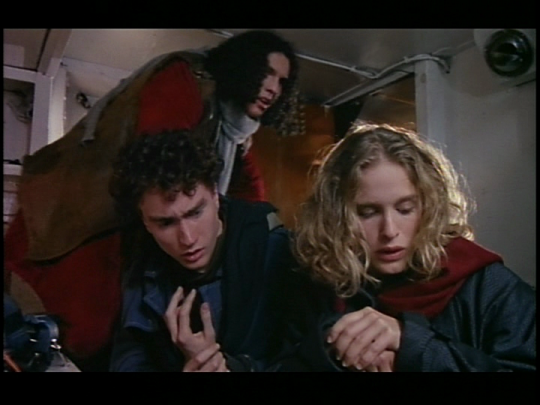
Still from Anchor Zone: Nicole Stoffman (right), Mark Critch (centre), Pheilm Martin
Not long ago, The Scope published a condensed draft of an oral history of Anchor Zone — a local sci-fi film — which I had compiled as part of a larger project on local cinema. Not everyone got their say due to space limitations, so here’s one of two addendums to that original piece. Last week featured an interview with the film’s youngest star, Michael Luke. This week, we go back to the future past once more with an expanded interview with star Nicole Stoffman
How did you get involved with the film?
The Anchor Zone shoot was the first time I’d set foot in Newfoundland, or ever met T.H Hatte [the film's screenwriter]. I didn’t go through the usual casting process to snag the lead in Anchor Zone, however. I was friends with Andrée’s ex-husband, who suggested me for an on-camera audition. I think it may even have been at her house. My favourite kinds of casting processes are like that; the ones that come out of the artistic network rather than the humiliating casting call.
What was your experience with the cast and crew?
Mark Critch made me laugh until my stomach hurt, which made it very difficult at times to maintain the post-apocalyptic tone of the shoot. He gave me a beautiful framed watercolour painting of the St. John’s Harbour by a local artist which I still have. Henry Czerny was very supportive, and an intense actor whom I enjoyed working with. I don’t remember noticing that anyone was inexperienced, in fact I felt a little embarrassed that I had to be imported ‘from away’, as if Newfoundland doesn’t have an embarrassment of riches where acting talent is concerned. I don’t know if I lived up to people’s expectations or not. Andrée Pelletier was a very grounded presence and very aware of everyone’s emotional arc. She left me a lot of ‘space’, and had a lot of trust in her actors.
Was it difficult maintaining a sense of seriousness on a limited budget?
What could be more serious than a limited budget?
What did you make of the finished product?
It was more intimate than it looked on paper. On paper it looked like an action movie, whereas the final product was really a story about how difficult circumstances can bring the unlikeliest of people together. It reminds me of the blackout we had in Toronto in 2003, there was a total transformation of my neighbourhood of Little Italy, where I was living at the time. Because there was no electricity, there was no music. I hauled out my guitar and people stole a stool from a pizzeria and put it between two parked cars and I played for the first time in front of an audience. I met so many wonderful people that night. The next day, the power was fixed. I rode around on my bike looking to see if the party had moved elsewhere but it was gone….
Though it’s unrelated to Anchor Zone, I can’t help but ask about Learning The Ropes. What appealed to you about its odd concept [in a nutshell: "my Dad, the wrestler"]?
I segued from Degrassi to a sitcom completely intentionally. I wanted a new experience and I got it. Two completely different ways of shooting television — film and multi-camera video. It being a bigger budget situation, I immediately noticed that I didn’t have to carry sandbags around and that there was a driver picking me up every morning. I especially enjoyed the live aspect of shooting in front of an audience, although we also did a regular shoot ‘for choice’, as they say. The concept was intended to give Lyle Alzado a chance to shine as an actor and a bodybuilder. It was perfectly tailored to him since he was a talented actor and a loving dad in real life. I thought it was a good concept because the ‘double-life’ conceit has built-in tension.



May 31st, 2012 at 6:04 pm
I promise to buy the Learning The Ropes DVD, if it’s ever released.
June 1st, 2012 at 11:33 am
That is a petition I can get behind.
June 4th, 2012 at 8:24 pm
As Ric Flair liked to say “WOOOOO!”