


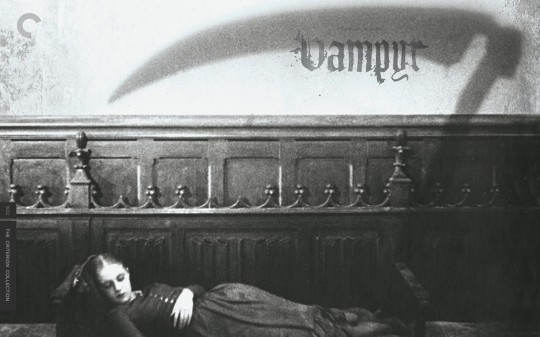
Vampyr (1932)
“A wound in the throat, in appearance similar to that received from the bite of a cat or rat, is the mark of damnation.”
Directed by Carl Theodor Dreyer.
What kind of horror movie is it? Early vampirism.
The closest I ever came to facing death was in a terrifying encounter with a dinosaur. It was a T-Rex and, in a terrifying feat of bio-mechanical evolution, its laughably stubby arms were replaced by immense rotating sawblades. I was lucky to escape death by using the greatest trick of all: I woke up.
No matter how many horror films I end up watching, few can offer the madness of my dreams. Especially that one. That I enjoy my nightmares (at least, after I’ve done crying and wetting myself) explains not just my fondness for the horror genre, but an attraction to surreal horror in particular. There’s a power in dream logic that goes beyond cynicism and rationality. Nothing has to make sense for you to have a few moments of raw fear in any nightmare. It may only be a minute or two, but there’s a distinct moment in which you’re absolutely terrified that you’re being chased by dinosaurs with saws for hands.
If I were to explain the plot of Vampyr to you, it would make no more sense than the last dream you’d had, but I’ll try.
Allan Gray (the film’s producer Nicholas du Gunzburg acting under the pseudonym “Julian West”) is a young man who encounters an older man at an inn. The older man gives Gray a copy of a manuscript to be read after his death. The manuscript is entitled “The Strange History Of The Vampire.” The young Gray meets two girls, one of whom is very sick and sporting puncture marks on her neck.
Make sense? Didn’t think so. The power of Dreyer’s film is in its use of menacing imagery and its deliberately free-flowing storryline. Dreams are an active part of the film’s plot, such as it is. Whenever our hero falls asleep, he is subject to some very strange incidents. In one scene, a skeleton enters his room and threatens to poison him. Later, Gray will fall asleep on a bench and his transparent dream-body will seperate from his sleeping biological double. As the dream-Allan investigates its surroundings, he finds his real body sapped of energy and placed in a coffin. Then he wakes up once again, picking up on the hint in his dream of where the titular vampire might be hiding. In Vampyr, dreams pull characters from place to place and are even quite malevolent. Rather than being subject to unconscious impulse entering the brain, there are invisible forces at work in the real world, all vying for our attention.
Another interesting aspect of Vampyr is how untraditional it is in its depiction of vampirism. Some of the rules still seem to apply and there is a bed-ridden, Mina Harker-like character who nearly attacks the square-jawed Allan. However, the head vampire is unique. Rather than the depictions of vampires as disfigured ghouls (Nosferatu and its remake), suave lotharios (the 1979 Dracula) or demonic (as per the Hammer films). Instead, the head vampire of Vampyr is a gruff old woman. She is not sexual or ethereal. She possesses little in the way of super-strength, but is dimunitive and quiet.
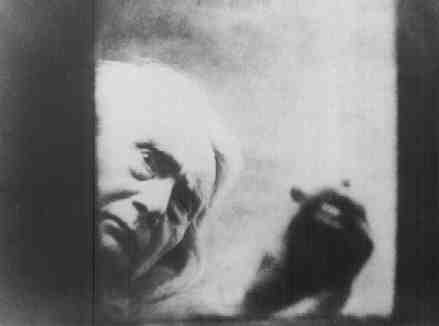
Too often we use the term “dream-like” to describe that which is merely random or cartoonishly surreal, but Carl Theoder Dryer’s creepy Vampyr has the loose plot and array of arresting visuals that characterizes the most haunting of dreams. Its beautiful imagery and restrained, effective score (composed by Wolfgang Zeller) give you everything you could want from a dream. Well, everything save dinosaurs with saws for arms.
Availability: Available in a gorgeous special edition from Criterion.


Sat, Oct 9, 2010
Adam Clarke