


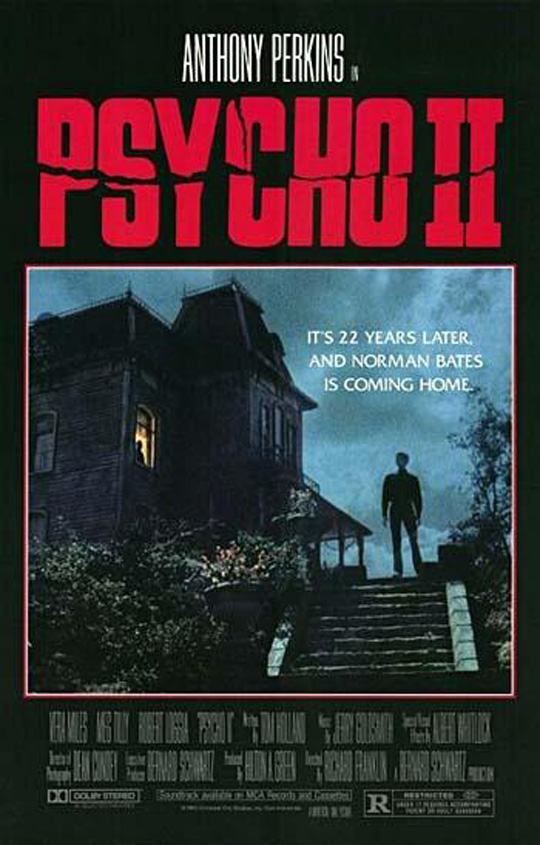
The film poster
“If Norman Bates is crazy, there are a whole lotta people in this town runnin’ him a close second”
Directed by Alfred Hitchcock II…er, Richard Franklin. Written by Tom Holland.
What kind of horror movie is it? Murder-mystery with doses of revenge flick and slasher trappings.
I chose this film for Blogowe’en because it has been so overshadowed by its famed predecessor. Everybody knows about Psycho, but the very idea of a sequel that came out two decades later. It seems like such a blatant cash-in. That there are so many Psycho tie-ins from the eighties and nineties, such as book sequels, films and TV specials, only helped to bury Psycho II. Now, it’s not perfect, but it is unjustly forgotten.
A sequel can only work if it the filmmakers have given serious thought about what stories could be told with returning characters. That’s one of the great rewards of Psycho II, a film that isn’t content to rehash its predecessor. Writer Tom Holland, who wrote and directed the clever Fright Night, offers a surprisingly sympathetic portrayal of a rehabilitated Norman Bates. Instead of having Norman dress up like his dead mother again, he falls victim to those who won’t let him forget his past.
Anthony Perkins returns as Norman Bates, now being released after spending twenty-three years in a county sanitarium. This news is not without its objectors. Most vocally is Lila Loomis (Vera Miles, also reprising her role from Psycho), whose sister was slain in one of the Bates Motel showers in 1960. Loomis has a petition with “700 signatures”, but it’s no use. Norman is going home.
Returning to his childhood home and the Bates Motel stirs up uneasy memories for Norman. He still has contact with his psychiatrist (Robert Loggia), but due “cutbacks”, he will not be in the care of a social worker.
The cutbacks were definitely made as part of a hearing on screenplay-mandated contrivance.
Anyhoo, Norman runs into Mary (Meg Tilly), a down-on-her luck waitress caught in a rainstorm. The two quickly develop a camaraderie, fuelled by Bates’ need for company following his release. He tells Mary everything about his past and she’s unfazed by every detail. It seems that Norman Bates, bullied all his life by both his mother and mental illness, may finally have a friend.
But, this is a horror movie, so no happy endings are on the horizon, I’m afraid. Norman Bates is being plagued by phone calls and handwritten notes allegedly written by his mother. Lila Loomis is the culprit, secretly tormenting Bates as part of her quest to have him recommitted. Norman isn’t fooled, but he’s clearly shaken by the elaborate hoax.
But when the police get word of a teenager being stabbed to death in Bates’ fruit cellar, Norman starts losing his cool. He couldn’t have committed the murder. But Loomis couldn’t go that far, could she?
Waitaminute! Since the first film is an adaptation of a novel by Robert Bloch, you’d think Psycho II must be an adaptation of Bloch’s novel of the same name. Of course.
Well, no, you’re wrong. Psycho II is one of those films where the history behind it might be more interesting than what’s on screen.
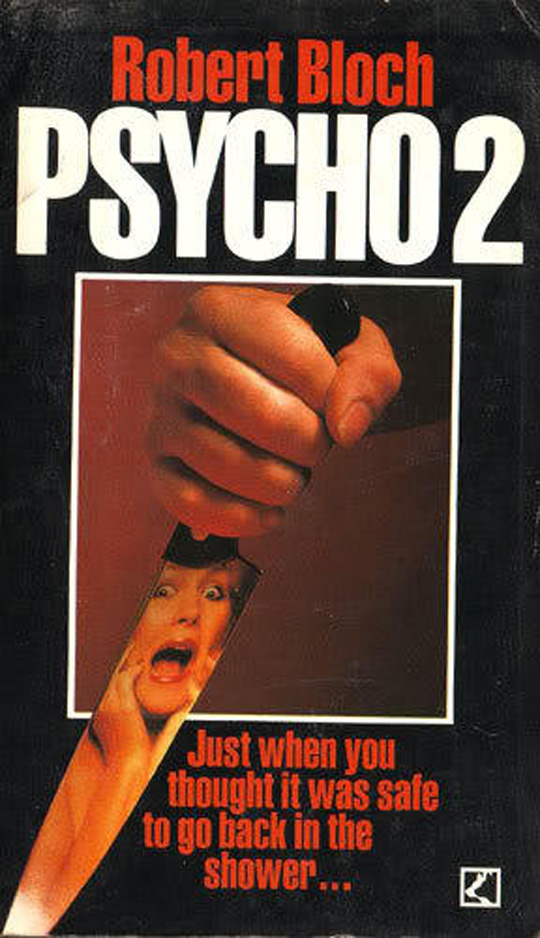
The book cover
The Story Of The Sequel Part II: The Sequel (Renegade Version)
Sequels are such a dicey proposition. Studios bend over backwards to jump-start a franchise on just about any film that once turned a profit and the end results are almost never satisfying. This is true to such a degree that filmmakers openly acknowledge disappointing sequels this by making more sequels as a reaction against a film’s previous sequel.
When Japan’s Toho Studios started making Godzilla movies in the eighties, they were determined to start a new continuity to erase the kid-friendly image they gave the fire-breathing behemoth from 1962′s King Kong Vs. Godzilla to 1975′s Terror Of Mecha-Godzilla. So, 1984′s sombre Gojira (aka Godzilla 1985) was deemed the “true” sequel to the original film.
Other franchises have yielded similar results. Every Highlander sequel and TV series was little more than an apology for the widely-reviled Highlander: The Quickening. Most recently, Terminator: The Sarah Connor Chronicles pretended that Terminator 3 never happened. And we were all the better for it.
Psycho II is an early example of this kind of “choose-your-own-adventure” sequels. Rumor has it that when Universal was investigating a follow-up to Psycho, they contacted horror veteran Robert Bloch, author of the novel on which Alfred Hitchcock’s film was based, to pen the script. If Norman Bates was going to be sprung from the nut-house, who better to script his return than his own creator? When Bloch’s script was rejected, he rewrote it as a novel, published a year before the upcoming, unrelated film sequel.
Years after the film Psycho II was released, Universal filmed a TV series pilot called Bates Motel, which ignored the events of both Psycho IIs altogether.
Bates Motel is the most experimental of the bunch, abandoning slasher-movie cliches altogether by turning the titular murder site into a Fantasy Island-like dream factory(!) It is also about as fun as drinking a hot cup of owl poop.
In the opening chapters of Bloch’s Psycho II novel, a deranged Norman Bates sneaks out of a mental institution. However, Bates’ is killed off within moments of his escape and the book shifts perspective by focusing on an ultra-violent Hollywood slasher being made about Bates. It isn’t long before someone starts picking off the filmmakers and, just like the slimier Bates of the novels, he’s sexually confused. This revelation comes after a beautiful actress’ cat is found slain on the set. A character abruptly points out that since the murderer killed the cat instead of coming for the woman, he clearly did it to subvert his sexual frustration.
Y’see, cause the killer “penetrated” the actress’ “pussy” as a character explicitly and moronically exclaims. That’s the bargain-basement level of writing that the once-impressive Bloch is willing to settle for.
I can’t say this lightly, but I have to say it: Robert Bloch’s Psycho II is the single most poorly-written book in the English language. I actually burned my copy one cold winter evening, and no tears were shed.
That brings us back to Psycho II, the film directed by Ozsploitation veteran Richard Franklin. Rather than assuming that Norman Bates’ story is a dead-end that would have to be discarded, Norman Bates, especially the boyish, surprisingly gentle characterization seen in the films, did have a story to tell. For the bulk of its run time, Psycho II wisely eschews Bates’ dark side by focusing on how he’s changed. The film is at its best when Norman is trying to settle to take charge of his life after so many years under his mother’s thumb. For a while, Psycho II is very promising indeed with stylish direction, a beautiful score by Jerry Goldsmith all anchored by the terrific Anthony Perkins and a nice turn from Vera Miles.
But, acting and cool camera angles can only get you so far, and the film takes a bit of a dip in quality in its final act. The filmmakers eventually abandon the revenge angle and focus exclusively on making Norman unhinged again and the ending of the film, though very engaging visually, is a total cop-out. I won’t spoil it for those who haven’t seen it, but I will say that reuniting Norman with his mother was not the best ending for the movie. It would’ve been better to have kept Norman innocent throughout. Nonetheless, the film’s final twist is so contrived and slapdash that it threatens to upstage the rest of the movie.
Psycho II was definitely greenlit by movie execs with dollar-signs in their eyes. It’s no coincidence that Dean Cundy — director of photography for several John Carpenter movies including Halloween — was hired to give Psycho II a creepy atmosphere. Nonetheless, don’t be scared away by the sequelitis. Sequels can sometimes outdo their inspirations. Psycho II does not, but it offers a nice little thriller for those who want to take a chance on it.
Availability: Psycho II has been issued as a standalone DVD and as a triple-feature with two other (awful) Psycho sequels.




October 2nd, 2009 at 12:14 pm
I watched this movie yesterday, and really enjoyed it.
It was very playful. You could tell the director (Richard Franklin) was just having the time of his life.
It was very visually striking. It had a real 80′s look to it. The colours seemed muted, except for shocking neon blues. A kind of blue that was everywhere in the 80, and then disappeared.
I also got kick out of seeing Dennis Franz, as the gleefully sleazy hotel manager. In fact the cast is strong across the board. Anthony Perkins, and Meg Tilly, are both great, and have exactly the right kind of chemistry.
It’s not often that you would call a Slasher charming, but this really was.
I remembered the very end from seeing this play on NTV when I was a little kid, and I kind of liked it, as goofy as it was.
I would also recommend Richard Franklin’s earlier Hitchcock tribute “Roadgames”. It’s set in Franklin’s native Australia, and is sort of “Rear Window” set on the highway.
October 2nd, 2009 at 6:33 pm
Also, did you know that Anthony Perkins tried his hand as a crooner.
Here’s a link to him singing “Swing On A Star”.
http://www.megaupload.com/?d=OILOKIBG
October 3rd, 2009 at 11:42 am
Anthony Perkins puts Paul Anka to shame.