

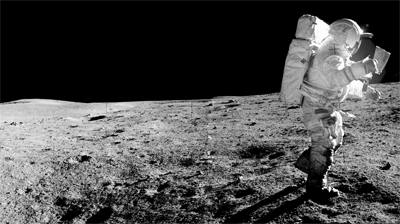
Dave Newman on the documentary In the Shadow of the Moon
After he returned to Earth, Buzz Aldrin toured the world. As he met people, he began to realize people around the world shared the same enthusiasm for the moon landing as the people of the United States. They used the term “we did it” in a way that had never been used before. The “we” was referring to humankind, united, for a time, towards a goal that for so long had been considered impossible.
Even for those too young to have experienced it first-hand, the events of June 20, 1969 are deeply engrained in our minds. The imagery of the Apollo 11 lunar mission is a part of our society’s collective consciousness—the slow, careful descent down the ladder from the landing craft, the first bouncing steps on the moon’s surface, the raising of the American flag by the astronauts’ clumsy gloved hands, and of course the immortal words from Neil Armstrong, his voice tinny through the spacesuit communicator, “That’s one small step for [a] man, one giant leap for mankind.”
David Sington’s documentary In the Shadow of the Moon brings us the details surrounding those events and more, allowing the astronauts from the Apollo missions to open up and tell their most candid stories. Coming from the mouths of the men themselves, we’re granted a glimpse into the entire process of space travel, from the training process at NASA, to how it feels at the moment of liftoff, to the experience of looking out your window and seeing the entire frame of the Earth juxtaposed against the vastness of space. The insights they share are sometimes amusing—such as Buzz Aldrin’s frank description of his first piss on the moon—often awe-inspiring, and at times terrifying.
One particularly chilling sequence describes one of the men reading aloud an alternate version of a Presidential speech dedicated to the astronauts—the one that would have been read had the men been stranded and left to die up there.
The film gives us a sense of the danger the men put themselves through, trusting their lives to pieces of machinery that had been practically untested.
Apollo 11, despite being the main focus of much of the movie, was only one of many in the Apollo program, and several others are also discussed, most notably the debacle of Apollo 13, where only quick thinking and ingenuity delivered three men home from near death. One of the men interviewed describes the Apollo 13 crew landing back on Earth as “NASA’s finest hour.”
Throughout the documentary, we are made aware of the social significance of the manned moon missions in relation to the state of the world in the late 60s. America was a hotbed of change, and the conflict in Vietnam was beginning to create gaping ideological divides, casting a shadow on the country’s patriotic spirit. Against this backdrop stands John F. Kennedy, urging that the country reach the moon by the end of the decade. The movie portrays him as a person spurred on by much more than a simple desire to beat the Russians. Americans needed something to believe in.
At one point, an astronaut confides that he sometimes felt they were training so hard for the express sake of the president himself, and that even though it was after his death, the successful completion of the Apollo 11 mission was done in his honor. The moon landings were something Americans could look upon proudly as their own, and it was certainly not just Americans who were caught up in the excitement.
A touching sequence towards the end of the film sums up what made the Apollo missions truly significant—to the men themselves, to NASA, and to the world around them.
In The Shadow of The Moon will be showing as part of the MUN Cinema Series at the Empire Studios Avalon Mall. Thursday, March 13. 7pm. $7/$8






The Scope | Thu, Feb 28, 2008 | 532
On Screen