

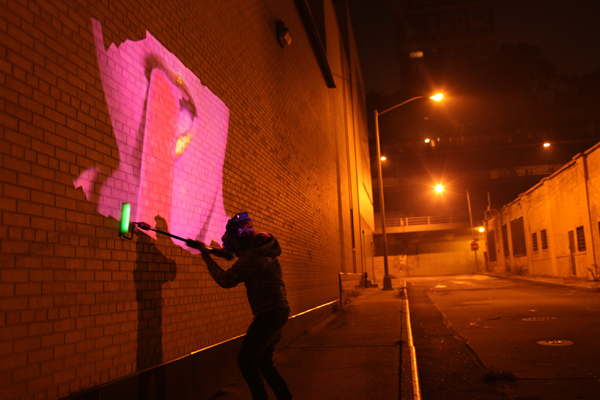
Media art duo SWEATSHOPPE has developed a technology dubbed “video painting” that uses cameras, projectors, and computer vision software to track a paint roller, projecting video wherever it moves to create the illusion that video is being applied to a surface. We caught up with Bruno Levy and Blake Shaw to ask them about their performance tonight (10pm-12am) at the Eastern Edge.
When did you come up with the idea for video wheatpasting?
Bruno: Blake initially thought of the idea of painting video. I was working on a A//V performance with a friend of mine and had brought Blake in to help with the programming and technology. I don’t remember exactly when but Blake came over one day after he had been out partying for three days with the idea of painting video. We wanted to change the space with the application of video to the walls during the performance. For example: while we would perform music, people come out with paint rollers and paint a panoramic scene of the desert on all the surrounding walls. We wanted to apply video in a way that would allow the viewer to loose themselves a bit more in the performance experience. We were really inspired by some of the video mapping that was happening in europe, especially the work of Anti-VJ and wanted to create a similar magic that could alter the association that we have with the spaces we occupy.
Blake: I was really into a lot of work going on with urban projection at the time. The idea that we are able to create our own reality really appeals to me, and so I think video painting became this way that Bruno and I could propagate our own fantasy future together. Through being able to develop digital technology on our own I hope to be planting the seeds of the physical future, who knows how long it will be before there is liquid crystal paint and every kid is out there scrubbing pornography onto the city walls?
Why street art?
Bruno: The urban environment added a potential of scale. When we did our original test indoors it did not carry the same weight. We wanted to do what we where doing on a big scale and that meant our city. I think when you do art in urban environments, you observe the city in different ways, you look out for walls, textures, architecture that accentuate the artwork, you place your work in the areas that makes the work come to life. In a way, for us, the urban environment and the internet is a socialist platform, it allows anyone to make their works public, the work does not have to be for sale or have a artist statement. The communication of the work happens with the work itself.
Blake: Video painting in the streets as opposed to the studio really changed everything. Originially we were painting onto a projection screen and at that point the paint roller might as well have been an extra bulky mouse. As soon as we removed it from such a sterile setting it created an illusion. When people see it, it usually takes a few minutes or a short conversation with us before they realize that its video projection and not actually paint.
Have there been many times when authorities have stopped you when you were working on a video painting? What happened?
Bruno: We where near Penn Station in NYC, a black car blinking red pulls up, Im behind our car taking photos and hear: “What the f… are you doing?”
“Huummm, we are making art.”
“That’s not art thats fu…in’ graffiti, do you wanna go downtown?”
Then Blake convinces the cops to turn off the projector, and voila, no more mark. The cops were a bit stunned and asked for for an explaination. After a short tale of floating blurbs, open gl, and matrixes, the cops asked us if we were millionaires, started praising our creation and wished us luck, and that was that.
Blake: Yeah, I’m just glad he didn’t pat us down.
SWEATSHOPPE, The Landing from SWEATSHOPPE on Vimeo.



August 18th, 2010 at 11:42 am
It’s a big deal for SWEATSHOPPE to be coming here, so tell your friends.
August 18th, 2010 at 7:17 pm
yes listen to Elling and even if it’s raining the show will happen