

Against a russet background, Minister of Natural Resources Jerome Kennedy poses in an office chair with his hands folded in his lap. A printer sits on a table over his left shoulder. “@JackRoseHG,” reads his latest dispatch. “UC power will be returned in 2041 but still need access across Quebec.” Beneath that, he takes a swipe at Dale Kirby, House Leader for the NDP, and waxes poetic while his daughter sings at the Kiwanis Music Festival.
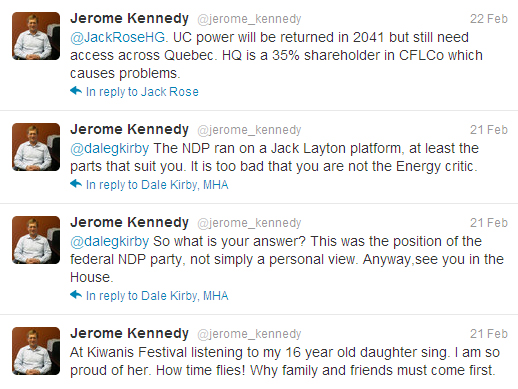
Recent tweets by Cabinet Minister Jerome Kennedy.
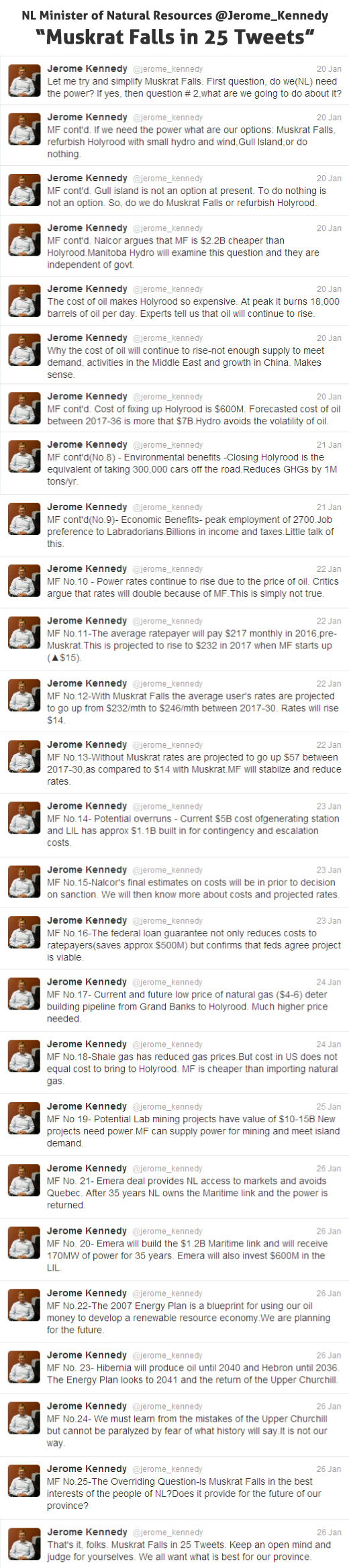
Kennedy’s Twitter feed was the subject of much scrutiny recently. Over seven days in January, he gave us “Muskrat Falls in 25 Tweets,” a series of tweets intended to simplify an issue that is, at best, unsimple.
It was the most the public heard from an MHA about Muskrat Falls since May, when the House of Assembly was last in session. Normally, the House sits each year in the spring and in the fall; an average of 44.9 days a year, the second-lowest in the country. In 2011, MHAs clocked out after just 31 days. Premier Dunderdale said there was no legislation to pass, and that the House wasn’t a good place for “open, constructive” debate because opposition parties didn’t do enough research.
With such a notoriously inactive legislature, maybe Dunderdale and Kennedy are onto something; maybe there are better ways to have better debates and more public engagement.
Sure, the necessity of the The House of Assembly is indisputable, even outside of passing legislation. Any session includes a 30-minute Question Period, which provides the Liberals and the NDP their only opportunity to question the government. The post-Question Period scrum also affords the media a regular opportunity to fire questions at the Premier and the MHAs.
And it’s symbolic. It shows that our MHAs, the third-highest paid in the country, are passing legislation, debating issues and, ostensibly, making the province better.
But it isn’t quite the vehicle for democracy that it could be. Liberal and NDP MHAs work with small budgets and they oversee multiple portfolios, each of which typically has just one PC MHA assigned to it. They’re also up against an overwhelming PC majority and their chances of bringing about change are small. In fact, according to a December 2011 paper by MUN political scientist Alex Marland in the Canadian Parliamentary Review, a glitch in the House rules has ensured that non-cabinet members have never able to pass a bill. Ever.
Malign it all you want, but Twitter has its place. Just ask Jerome Kennedy. Well, actually, we tried—via email, phone and Twitter—and he wouldn’t respond to us. So, we asked Daorcey LeBray, Communications Advisor for Calgary mayor Naheed Nenshi. An underdog candidate who started off in the election polls at 8 per cent, Nenshi and his communications team took his campaign to Twitter and Facebook and wound up winning the election.
“If people are having political discussions then, as a politician, you want to be there,” says LeBray. “And people are having a lot of political discussions online.”
“Social media provides a good way to have conversations,” he continues. “It’s also a good place to listen to what ordinary people are talking about, and it opens up an opportunity for more direct connection between politicians and citizens—it’s much more responsive.”
LeBray thinks that it can be an avenue for genuine, useful debate, as long as politicians allow it.
“Politicians need to know that it’s not just a place for them and their followers to hang out,” he says. “They need to be prepared to respond to criticism as well as support, and they should open up the discussion to people who disagree with them.”
Allowing and responding to criticism ultimately contributes to the authenticity of the Facebook page or the Twitter feed, he says.
Twitter isn’t a huge leap for Newfoundland politicians. VOCM’s Open Line call-in show has played a long, recognized role in Newfoundland politics. Another paper by Alex Marland, “The Audience is Listening: Talk Radio and Public Policy in Newfoundland and Labrador,” says that Newfoundlanders listen to more talk radio than people in any other province. VOCM is often called “Voice of the Cabinet Minister” for all of the politicians it attracts and, according to Marland, some political scientists think the legislature is open so infrequently because Open Line is seen as a mini-Question Period.
Open Line had its usual stream of callers during the past nine months, but VOCM really stepped up last month, with a live, hour-long debate about Muskrat Falls. The debate was hosted by Open Line hosts Paddy Daly and Randy Simms, and it was the first debate of its kind on VOCM.
“At least it was in my time,” says Simms.
Simms thinks the empty House played a significant role in the broadcast. “I think it led to the value of the debate,” he says. “As a result it had a very big listenership.”
“I hope that we will consider doing more of them,” he adds.
In January, Bob Wakeham, a retired journalist who covered the House for over 30 years, used his Telegram column to encourage local media–specifically the CBC–to organize a political spat or two. Doing so, he wrote, is “crucial” with the legislature closed.
But despite the democratic merits of social media, open lines and publicly broadcasted debates, the House doors have got to open.
“We are on the cusp of a real change in the way we, as politicians, are communicating our messages,” says Randy Simms. “The blogosphere has made everybody a pundit, and social media has made it possible to make people feel that they’re in close contact. But I don’t think it could ever replace proper, formal debate.”
“It won’t replace something like a House of Assembly,” agrees Daorcey LeBray. “But it will augment that and improve that. Social media is more akin to an issue space, where politicians will go and engage with citizens about something. But they ultimately have to make decisions, and they should use social media to better understand what their citizens think and to better represent their citizens when they do go into a council or legislative assembly.”







March 2nd, 2012 at 1:50 pm
You said:”But it isn’t quite the vehicle for democracy that it could be. Liberal and NDP MHAs work with small budgets and they oversee multiple portfolios, each of which typically has just one PC MHA assigned to it.”
I don’t think I would have put it quite that way. It is true that the Liberal and NDP MHAs (as part of the opposition), work with small budgets, and they are usually assigned more than one portfolio as critic. A portfolio would be Finance, Education, Justice, Environment, etc – essentially, for every Minister in government and Department, there is someone assigned by each opposition party to be the critic for that area. With a small opposition, each MHA needs to be a critic for more than one area.
The statement that these portfolios “have just one PC MHA assigned to it” is a bit misleading. This PC MHA would be the Minister for that Department. Unlike the opposition members, the Minister has Deputy Minister, Assistant Deputy Ministers, and a massive political machine at his or her disposal, as well as armies of public servants to carry out the work of the government. I don’t think “just one PC MHA assigned to it” leaves the correct impression.
March 2nd, 2012 at 2:37 pm
This is a really interesting article. This may sound insane but I honestly believe that Canadian democracy would function better if we abolished parliament altogether. Question period is a farce, there are plenty of more effective ways for the government and opposition to make their views known. The real day-to-day work that backbench MP’s and MHA’s do is non-partisan in nature and could easily be done by bureaucrats, it would likely be more effective that way and would cost less. Parliament is a waste of time and money, it’s all for show. Backbenchers show up, spout talking points, and vote the party line… at an EXTREMELY high cost to the taxpayer.
Most people already vote for the party, not the candidate, so why not make it official? Let the high-ranking party officials make their case to the public, then we vote for the party that we want to govern the province or country. We don’t need all of these backbenchers getting paid hundreds of thousands of dollars each to put on a trained seal act in parliament, just vote for a party and let them govern.
March 2nd, 2012 at 3:37 pm
You have a very superficial understanding of how a legislative assembly should work in a parliamentary democracy. I don’t fault you for it though, because this province has a very superficial form of democracy. In other jurisdictions, you have a variety of committees that MHAs from all parties sit on which does a tremendous amount of work on legislation – they have real input on the laws of the land, which is why we elect them. Most people don’t realize that the role of the assembly is not simply shouting, but in NL the MHAs simply aren’t given the role that elected members in other provinces have. Did you know that new laws are debated and discussed and studied at a committee level in other jurisdictions before being brought to the assembly for first reading? MHAs are called lawmakers, but here, most of them don’t get to do that. Even backbench government MHAs have no real job when it comes to the House. We don’t have such committees. Did you know that independent officers of the legislative assembly such as chief electoral officers, ombudsmen, auditor generals, etc, are hired by an all party search committee and then ratified by the house? Not here. They are hand picked by the government and simply put to a yea or nay vote in the house, where the government has a majority. I could go on and on. It’s not that parliaments or legislatures don’t work, it’s simply that we have a very superficial form of something that is supposed to work much better. That can only change if we demand change, not if we abandon it. Twitter is a communication tool, but it is not a major part of the functioning of a robust democracy.
March 2nd, 2012 at 3:58 pm
It isn’t just Newfoundland, all through Canada we have a system where governing parties run de facto dictatorships. Committees make recommendations, but at the end of the day the decisions are made by the governing party brass. I’m not saying this is right, but it is reality. And I think that most Canadians like it that way, minority governments and coalitions simply don’t work here. My suggestion is certainly not ideal, but given the reality of Canadian politics it makes a lot more sense than the current system.
What you’re talking about sounds like a US-style system where no one branch of government holds absolute power. In the American government committees actually matter. In Canada, not so much. Theoretically they do, but in practice they do not, and abolishing parliament would simply affirm what is already obvious to anyone who pays attention to Canadian politics. This facade is costing us a lot of time and money.
Oh, and I’m not advocating Twitter as a tool of democracy. Like I said, this is an interesting article, but the headline is a bit unfortunate. I cant stand Twitter, note the root word.
March 2nd, 2012 at 7:05 pm
No, I’m not talking about the American system. It varys from province to province, but there are some where legislation is routinely sent to a committee first before it goes to the house. This is where the type of, not quite non-partisan, but more cooperative work gets done, beyond the glare of the cameras, where the real words of a law are discussed and their implications are debated. Committees are extremely powerful in the US system, so much so that they are part of the gridlock of US politics, so I’m not proposing that approach.
Here’s Marland’s paper, worth a read:
http://www.revparl.ca/english/issue.asp?param=205&art=1443
March 5th, 2012 at 3:25 pm
Here’s another paper comparing the function of our legislature with others in Canada:
http://www.cpsa-acsp.ca/papers-2009/Reid1.pdf