

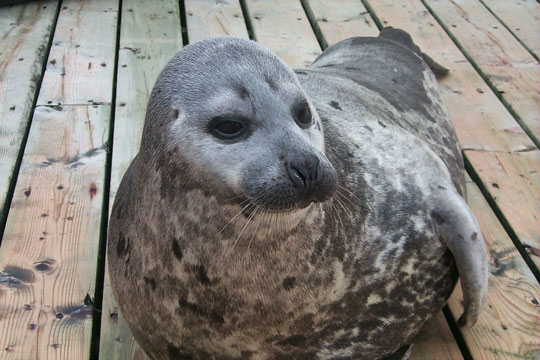
Submitted photo
Known for his discerning palate, Jamie the harp seal died suddenly and mysteriously on Friday, October 11. He was 19 years old.
Daryl Jones, seal overseer at Memorial University’s Ocean Sciences Centre on Logy Bay Road, says Jamie had been fine in the days leading up to his death, and autopsy results have been inconclusive. The search for answers is now put on hold while his friends, fans, and keepers await the results of tissue sample tests which have been sent to the mainland for analysis.
Jamie was the Major Charles Emerson Winchester III of the OSC seal herd: his appearance haughty and sophisticated (for a seal at least), his demeanour high-strung and somewhat temperamental, with impeccable taste in fine Atlantic herring—refusing to anything but the best, most immaculate fish.
Jamie was an OSC lifer, born at the centre in 1994. He is survived by his mother Babette (about 35 years old), stepfather Tyler (23 years old), step-siblings Lenny (13) and Deanne (11), and a multitude of fans who have visited the seal observation deck, which is open year-round in Logy Bay and via webcam on the Ocean Science Centre website (www.goo.gl/AYvmRP).
While Jamie’s life at the Ocean Science Centre might have been about as relaxed as life for a seal can get, it was not an all-you-can-eat herring buffet with fish balls on the weekend (a plastic whiffle-ball-like thing filled with frozen capelin that the seals are treated to on the weekends) the seals do have to earn their keep. They’re put through daily paces as part of an extensive enrichment program. The real world is a stimulating and trying place for a seal, so to recreate those conditions, unlike the faux rocks and whatever else a zoo might do to feign authentic habitat, the Ocean Sciences Centre seals participate in a series of training exercises to keep their minds and bodies sharp. This includes an elaborate matching game called “Match to Sample,” that the seals play twice per day. Not unlike Let’s Make a Deal, each seal faces three doors and the middle door opens, revealing an object, then the doors on either side open revealing two more objects—one that matches the sample in the middle. The seal then must choose the matching object. They get it right and they are rewarded with a bite of fish. Get it wrong and they get the horn and have to try again.
There are other games, or training, the seals participate in that help both keep them active, sharp, and well fed, and to help their keepers handle them in a safe and efficient manner. The Ocean Sciences Centre is home to the only enrichment program for captive seals like this in the world.
Each seal also has their blood, whiskers (vibrissae, in scientific seal-talk), size and weight monitored regularly.
The Ocean Sciences Centre seals have been the leading subjects of some of the most advanced harp seal biological and behavioral research in the world, so the loss of Jamie is not only a tremendous loss for his tight-knit seal and human family at the Ocean Sciences Centre, but also for seal science in general.
He will be missed.
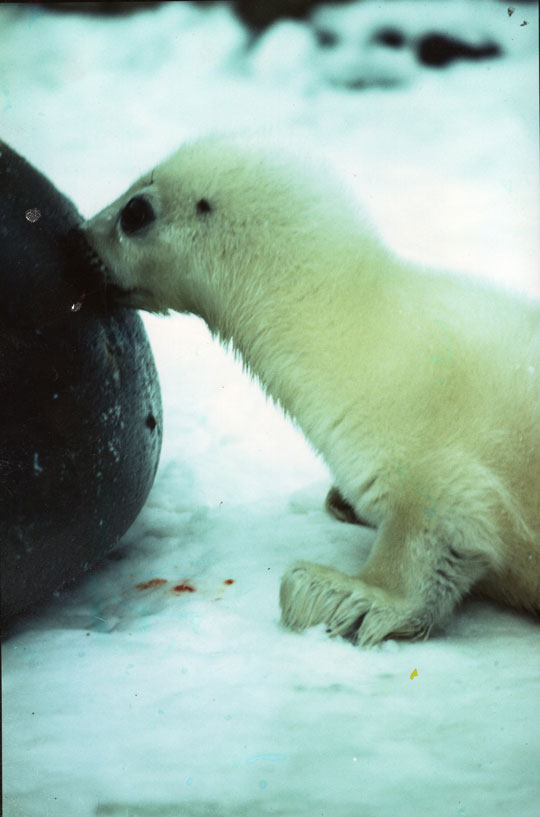
An early photo of Jamie. Submitted photo.






November 6th, 2013 at 8:14 pm
I find it funny how there is such controversy over the seal hunt yet no one bats an eye at the tiny tanks these seals are trapped in. Harp seals are a migratory species, travelling 2,500 km journeys. If you compare it to the size of their tanks, there is no amount of “exercise” or play that can be provided that would even slightly compare to that. Eventually there will be strict rules on the size of tanks animals are kept in and tanks such as these will be seen as barbaric things of the past. I hope.