


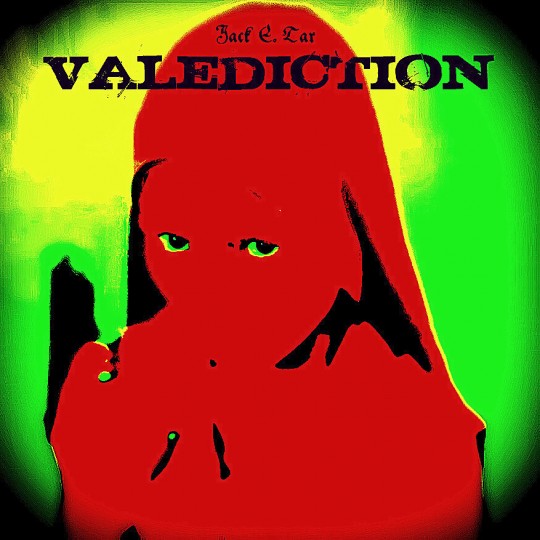
'Slippery Roads Ahead For Us' by Jack E. Tar
When I first heard the 2010 Jack E.Tar RPM album, Tempered, it was as if he came out of nowhere. Since then he has recorded a noise album for the RPM, Symphonic Affective Disorder, and has just released another new disc, Valediction, which is currently available at Fred’s Records. I recently interviewed the elusive Jack E.Tar about his the record, his unique writing and recording process, and weird yearbook pictures among other things.
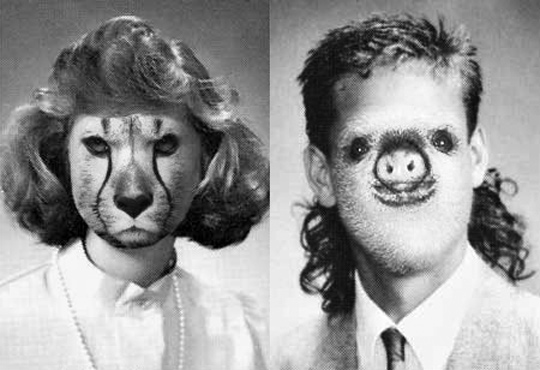 Where did the title of your new album Valediction come from? I noticed you on Facebook posted some hilarious high school year book pictures of classmates with animal faces superimposed on them. Did it have anything to do with the whole high school graduation experience?
Haha, I almost forgot about those! They were made using one of those silly web templates where you supply your own facial portrait. I found some nice pics of various animal faces and tried substituting those instead of a human façade, and although the theme there was graduation, it really had nothing to do with my own high school experience, just an experiment in nonsense. The title of the album is mostly about saying goodbye. I’m saying goodbye to some part of myself, hopefully the part that didn’t make records for a long time.
So all of the songs on Valediction were written based around improvised drums tracks? Can you tell us how that whole process went?
Well…the biggest problem I have in terms of recording consistently is a viable location to record drums on a regular basis. I can quietly track everything else using headphones at home, so when I get the opportunity to set up and play drums somewhere for a while, I generally try to capture as much of that as possible. I record myself playing drums for varying amounts of time, take those lengthy sessions and edit out what I consider to be the most coherent, useful sections. In some regard, I’m intentionally trying to create songs as I’m doing this, but ultimately I just arbitrarily choose points to stop and start playing. Either that or I’ll simply find a convenient place in the session to make an edit that creates the illusion that I’d actually intended to start or stop the song in that particular place… In the end, very little temporal editing is actually done to the drum takes, mostly just where the beginnings and ends occur. I’ve been playing drums longer than any other instrument, and I still often find myself tapping incessantly to the sound of songs I’ve yet to write. There’s always the idea of a song floating through there somewhere, and it usually starts with a beat.
You didn’t use a single guitar amp on the record. How did you record the guitar parts and still get such great tone?
I’ve been using amp emulator plug-ins through my DAW these days. Now, most amp purists who seek great tone will likely disagree with me here, but I think some of them actually sound pretty convincing. I would definitely encourage all guitarists who want a nice well stuffed toybox at their disposal, for a relatively cheap cost, to explore to wonderful world of plug-ins. Programs like Guitar Rig (Native Instruments), Eleven Free (Digidesign) or any of the IK Multimedia plug packs, especially the authorized Fender one, are just great things to have at your fingertips. The other reason I think the tone turned out nicely on this recording is a result of using a number of different guitars. I only used two different electrics when I recorded Tempered last year, and when I listened back to it, I knew I’d seek a more diverse range of guitar tone for this record. I think I used six or seven different guitars this time around, and I’m much happier with the resulting sound.
I love the lyrics on Valediction. They have this William S. Burroughs cut-up quality which is very obscure yet cohesive enough to convey some pretty strong imagery. I love the line “Overhead the skies descend. It’s raining Wurlitzer grands with American Standards. That’s what we get when we pander. Let’s dissect the rejects first, then collect the remaining few for the last research we need to do” from “Stolen Articles of Faithless Proportion”. Where do you get your ideas and inspiration for lyrics? How do you go about writing them?
I’d say that line is fairly easy to dissect in its’ own right. As for the rest of what I write, I guess it comes from the same places it likely does for many people who write songs. I write about what I see, where I’ve been, and often the things that either really piss me off or make me even a little bit happy. The lyrics do have a tendency to be abstract on occasion, and sometimes I don’t even know what it really is that I’m writing about until playback a couple of hundred times during the mixing process. I seem to labour over lyrics in a way that I don’t in comparison to creating the music. I’ve always been hyper picky about the way words flow in a song, and it’s definitely the part I’m the least satisfied with when I listen to my own music. I appreciate the likening to Burroughs, although I wouldn’t have necessarily noticed…I’ll admit I started reading his work more than 20 years ago and have always been an admirer of his words, and the way he presents them.
Is it just me or are there some nods to Alice in Chains on this album? On songs like “Slippery Roads Ahead for Us” and “The Golden Calf” I could swear that’s Layne Staley singing back up. I also picked up some hints of Pink Floyd on “Prize Winning Pig” and “Stolen Articles of Faithless Proportion”. Who would you cite as influences for Valediction?
I’ve never really been into Alice in Chains in a big way actually. There were so many other bands I liked more that cropped up around the same time that AIC were becoming big news. That being said, I’ve certainly heard most of it over the years. Weird how influence might seep into you from places you never would have expected. Now as far as those Pink Floyd flashbacks go, those were definitely intentional. What came out in 1973? Me and Dark Side of the Moon. Influences? That could turn into an unnecessarily lengthy conversation. I’ve listened to a lot of Future of the Left lately and I think that’s where the hankering to make a more abrasive sort of rock record came from this time around. I also really liked the Karkwa album that took the Polaris Prize in 2010.
You seem to be pretty concerned with the mixing process and put a lot of well spent time and effort into getting the best sound possible on your albums. How do you approach mixing?
I approach mixing like I approach grilling meat …You just sort of know when it’s done right for you, and while I really am concerned with attaining the best possible sound I can, we all know great mixes come down to having the best sounding BBQ you can afford.
Ha ha. Good analogy. I’m always eager to get recording advice. I got some great tips from Vic Lewis on drum mic placement that really helped during RPM this year. You always get an incredible sound on your albums. Do you have any tips or advice you’ve found useful that you’d like to pass on to fellow home studio recorders and RPMer’s?
Good sources determine good recordings. You need to be happy with the sound being generated in order be happy with the sound you’ve recorded. I’ve found many people take the approach that studio tools will either fully or partially resolve limitations of a recording, which can be true, but in fact they should be more concerned with the quality of the sound being initially produced. My advice here is to get at least one really good general purpose microphone, probably a decent condenser of some sort, and spend lots of time exploring the dynamic effect of compressors and multiple types of EQ’s as well as experimenting with the proximity of the microphone to each source. As far as recording drums goes, where you put the mic depends on a number of variables, like how hard the drummer hits, what part of the drum head is attacked primarily, muffled vs. not, what sort of room you’re tracking in, and what sort of mics you’re using. There is absolutely no sure fire place to position a drum mic that will work equally well for every drum and drummer you happen to be recording. My suggestion is to find yourself a wide open room with tons of reflection to get some free and potentially unusual and cool reverb by positioning your ambient overhead mics at a longer distance from the kit. The combination of closely mic’ed drums with condensers positioned further away is neat. Open concrete basements have shown interesting room results to date for me, at least for tracking drum sets… A good recording is entirely dependent on what you define as “good” sound, so it’s all relative. The bottom line is, a good source plus good mic plus good preamp plus good monitors plus good recording device equals potentially great sounding recording.
So far Jack E.Tar is a one man recording project. Any plans to put a band together and do some live shows?
I’m hoping that will happen sooner than later. Anyone who likes where it’s heading and would like to make some noise, feel free to make contact with me through Bandcamp or ReverbNation. And even if that never happens, you can definitely expect records to keep appearing.
Valediction is currently available at Fred’s Records and for download at the Bandcamp link below.





Jun 27, 2011
Damian Lethbridge