


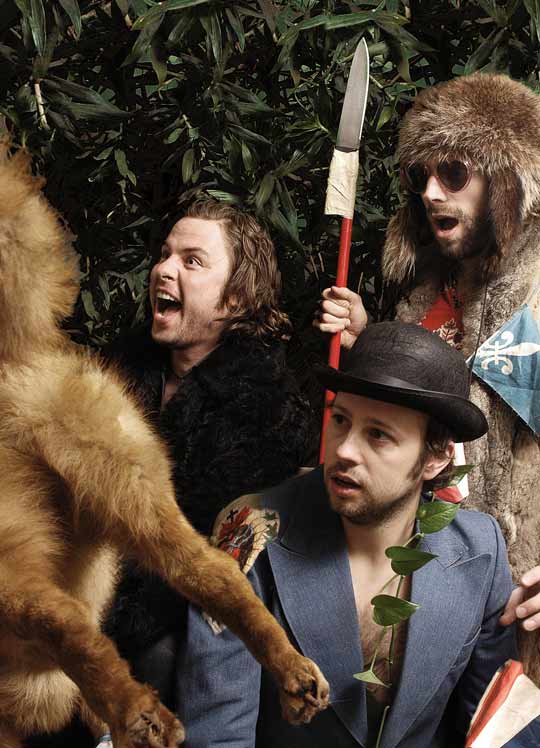
Montreal trio Plants and Animals can’t help but admit they’ve had a pretty frickin’ incredible year. Their album Parc Avenue has been had audiences’ and critics’ ears pricking up since it was released in February. They made the top ten shortlist for the Polaris national music prize, and even the notoriously ornery bunch over at the American music website Pitchfork gave it an 8 out of 10, and listed it as one of their favourite overlooked records of the year, making these guys officially a big deal on either side of the border.
Okay, I admit, there’s a bit of a connection here: Back in the late 90s I attended Concordia University, and enrolled in a bizarre-but-fascinating course called Electroacoustics I — a class where we listened to and produced experimental music with electronic instruments. Bleeps and bloops from Karlheinz Stockhausen, repeated vocal samples from Steve Reich, late nights in the studio gargling into microphones… Definitely weird, definitely interesting, and definitely fun. I have fond memories of meeting Warren Spicer and Matthew Woodley through that class, so it was a treat to reconnect with one of them.
I spoke with Plants and Animals drummer Matthew Woodley.
By Elling Lien.
Congratulations on Parc Avenue. I’ve really been enjoying it.
Thank you!
I’m definitely not alone either. It seems a lot of other people are enjoying it too! It’s funny… I know you, and I know Warren — who I did an Electroacoustics project with in first year… Now it’s funny seeing you on music websites and on the cover of magazines across Canada and in the States.
Heh… yeah… makin’ it big in Hollywood! But after all that I’m just like the next guy. I still sleep on a big bail of hay. But one day!
You’ll be moving up to stuffed garbage bags one day!
Yeah! One day… You just wait! Everyone, you just wait!
Actually, I wanted to bring up the Electroacoustics program briefly, because that’s where you three got together. You and Warren knew each other from back in Nova Scotia even before you attended Concordia, but how did you guys meet Nicholas?
Warren and Nicholas actually met up when I was away from school for a year in South America… They met, I think it was in an Electroacoustic Composition class at Concordia. When I came back they had been working on some ridiculous experimental music together, and that’s when we all started playing music together. I started playing with them on their compositions and recordings, and everything sort of grew from that.
At one point Warren got a grant to make a record — more along experimental lines — and we three worked on that together. It was an instrumental record, and we became an instrumental band because of that, and we played as such for the next couple of years. A sort of open-ended, rambling sound, with seemingly no real beginning or end… Then as we started working on what ultimately became Parc Avenue. We started crafting songs, actual songs, with beginnings, middles and ends.
So you started on the far-out end of the spectrum and settled a little more down-to-earth…
Yeah, it was definitely more far out then. But we were never a jam band. I’ve never really liked that term. We still get that every once in a blue moon, and I’m not really sure why, either. Is it because we have longer instrumental parts, or that we stretch it all out a bit live? But we’re definitely not soloing over the same riffs ad nauseaum as jam bands tend to do. We go where we’re going, and keep things fairly diverse…
When did that first, self-titled Plants and Animals record come out?
That was 2003. I think that record should have really been put out under a different band name, because Parc Avenue is more of our debut album, and it’s being treated largely as our debut album. It would have been a little more convenient for helping other people make sense of things to have put it out under a different name, but hey, we’re gettin’ on okay.
So no plans to revert back to an all-instrumental thing? Maybe when your Pitchfork rating goes below 8.
[Laugh] Yeah, well, that’s not so hard to get below 8. Yeah, if they give us below an 8, we’re gonna go instrumental.
Congratulations on that especially. Those guys are hard to please.
Yeah, they are, and before that judgement day came down [March], I really had no idea how it would have been received by them. It seemed to be a bit of a toss-up. But Pitchfork do have this reputation, and people seem a little scared of them, but we did this thing for Pitchfork TV this summer where we played on the roof of a building in Manhattan, and we ended up meeting a bunch of the editors and people connected to it, and they were all really great, down-to-earth, normal people. So there’s no reason to be afraid of Pitchfork.
There’s a real confidence to the band that exudes the idea that ‘it’s okay for things to happen organically.’ That seems to be reflected in your name too. Why go in that direction?
[Laugh] Well, pardon the pun, but it just feels natural. It’s the natural direction. We didn’t name the band for any particular reason, actually. It’s just something that came up years ago and we thought it was kind of funny, in a childish way… a chapter in an encyclopedia… not because we get up in the morning and everyone hugs a tree or anything. In fact, Nick, in particular, hates trees. He grew up in the suburbs and grew up in the city, and you take him out of that and pull the van over on the side of the road to pee and he’s actually quite uncomfortable. Wherever he can’t get a wireless connection… the man can’t go without a wireless connection. That’s his law of nature, for sure.
For us, if organic means anything, it stems from our musical sensibilities and what we like to listen to, and a lot of that is kind of natural… Things that are created with real instruments, and that open and unfold in a way that feels natural, you know? Where one thing grows into another, and grows into another. That’s kind of vague, but I guess that’s where it comes from. We haven’t really stretched out with our extensive Electroacoustic training yet. [laugh] Who knows man, maybe it’ll happen… Because we all have degrees in Electroacoustics.
You all have degrees in Electroacoustics? That’s crazy!
[Laugh] Yeah, all three of us. It’s pretty funny. I did it because it was a new major that popped up and it just made things a little easier for me. I didn’t have to take a certain ear training that I didn’t want to take, and it simplified the complicated Concordia credit system a little. That’s why I did it. Not because I’m passionate about bleeps and blops; pink noise and white noise. It was interesting though, and really good ear training I think. And we all learned a lot about studios.
And you all spent a lot of time in the studio recording Parc Avenue. That’s really where you guys developed the sound you have now…
Over some of that time, Warren was teaching the introductory recording course at Concordia. It fell in his lap and he really got himself wrapped up in sound and a lot of production ideas. Over that time we did a lot of things in the studio, and were lucky enough to have friends who owned a studio, and we could get decent rates so we didn’t have to stress out and say, “oh, shit, we’ve got six days here, and we’ve got this much work to do. Let’s just crank it out as fast as possible and deal with it.” But we got to play around with our songs, and with sounds, and re-record things, and experience a lot of trial and error. Then eventually Warren got a bunch of gear at his own apartment where we could do overdubs — still on analogue tape — and create as we were recording instead of trying to plan it all out beforehand. That process definitely affected how the record sounds quite a bit.
What did it feel like when you finally recorded “Mercy”? I’ve heard you say before it was that song where you all felt a little bit of a ‘click’, and you all realized the band was headed in a bit more of a pop direction…
Yeah, I think that was one of the first songs that we finished recording in the beginning of year one (2005). And I don’t know how many times we tracked that… The one that we actually used on the record was probably at the end of the two year recording time. We’d done it so many times to get the feel of it right. We were playing more as an instrumental band, and that was one of the songs that seemed to make a poppier connection with the audience. It was a light we followed.
How did it feel to hit on that?
Good. Really good. You look up and people aren’t all furrowing their brows — enjoying the music but thinking really hard — but instead they’re dancing and laughing. That was really good. I liked that. I was like, “let’s do that more.” [laugh]
Have more fun with it…
Yeah. Yeah. I mean, not at the expense of the music. We wanted to keep things interesting, but why not simplifiy things a little bit and make it a little more pop?
Still, your music isn’t exactly light, and you’re only three guys. So to maintain a high level of intricacy, it can’t be easy on stage…
It is hard to keep it all up in the air, especially when we’re live. We’re only as strong as our weakest link, and if somebody’s having a bad night, then we’re all screwed. You can’t hide in the shadows. Everyone’s a pivotal part of the sound. I like that about it though. The riskiness that having so few members on stage presents… People occasionally come up and tell us, “I heard the record and I expected there to be 15 people on stage,” (a la Arcade Fire or something, because there are so many instruments on the record) but often people say, “wow, there’s just the three of you and I really liked it. I thought I was going to be disappointed and it was great.” On stage it’s all about trying to bring a bigger energy to things, instead of having it all dispersed in the strings and horns and things like that.
How exactly does stripping it down for the stage affect the sound?
I guess we just try to bring a bigger energy to it. We turn it up a little bit. It’s a little louder, it’s a little heavier, we all play out a little bit more, and we really get into it. Whereas when you’re in the studio — especially as a drummer — I try to hold back a little bit more. You don’t want to hear a recording of someone going apeshit on the drums over and over again. You want to hear a little bit of restraint for a recording.
Speaking of restraint: you were doing jazz drumming early on…
Yeah, that was a big influence of mine. Warren and I and another guy in Halifax, before we moved to Montreal, had a jazz-y, jazz-esque trio… Jazz free wildness. That’s definitely a big influence, but that said, I haven’t played anything remotely jazzy in five or six years.
Another element for the next album?
[Laugh] Shoo-bee dee bop!
You’re going to be doing a bunch of shows with Wintersleep around Atlantic Canada. What’s your connection to them?
We didn’t know them before… Warren and I moved away from Halifax in ’96, so we just knew of them. We met at the Wolf Island festival in Kingston in the summertime. True to good Haligonian form, they’re really great people. We liked their band, and they asked us if we wanted to come do this tour with them, and it was a no-brainer. I think we’ll go well together.
Well, I think you’ll enjoy Newfoundland.
I’ve been all over this great land, and I haven’t been to the rock yet, so I’m totally excited for that. We’re there for two nights too, which isn’t that long, but normally on a tour you’re in a place for a single night. Double the pleasure.
Plants and Animals will be performing alongside Wintersleep and Dog Day on January 24 and 25 at Club One. Doors open at 9pm. Tickets are available at Big Ben’s and The Sundance and at all Ticketpro outlets including Holy Heart Theatre box office, by phone at 1-888-311-9090 and online at www.sonicconcerts.com.
Photo by Caroline Desilets





Jan 12, 2009
Elling Lien