

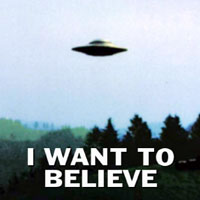
*Cue the X-Files theme*
Imagine tuning in to the evening news, and hearing this secret and terrible truth: Newfoundland is under unlawful foreign occupation. Britain upended our democracy and sold us into permanent colonial servitude. Swindled by a demented pig farmer in owl-eye glasses, the Grand Banks lie destitute and French Canada, like a vampire, sucks Labrador dry. Confederation was an inside job.
If only. That’d be quite the scandal. It makes a riveting tale of political intrigue, which might explain why this conspiracy theory has the staying power it does. Six decades on, and Confederation is still an open wound for a lot of people who were never even there. Local journalists, artists, authors, intellectuals, assorted cranks and a Member of Parliament from Mount Pearl have all made (or unmade) careers out of their dogged persistence to the Republic of Newfoundland—and that’s just the card-carrying Cashinites. Who knows how many fellow travellers are out there, nodding along in silent solidarity with the struggle? It’s enough to make the mind boggle.
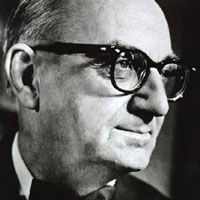
Joey Smallwood: Politician, pig farmer, double agent.
Not that I don’t appreciate the sentiment. Nothing warms my icy heart quite like getting really mad about Anglo-Canadian colonialism. But there are a few things profoundly wrong with the idea that Newfoundland was smuggled into Canada through cloak and dagger, and since this idea has most recently been revived by works like Greg Malone’s new book (Don’t Tell The Newfoundlanders), it’s probably worth taking a look at what those are.
For starters, when you take the normal absurdity of Newfoundland politics and plant it way out into the fringe, you yield some pretty strange fruit. Joe Smallwood, we learn, used a pig farm in Gander as an elaborate front for British espionage at the exact same time he was Lester B. Pearson’s Manchurian candidate (we theorize the orders were transmitted via psychic bowtie beacons). There are whispers of English aristocrats in pith helmets conspiring with Montreal bankers to let Korean car manufacturers strip mine Labrador. It’s unclear whether the buck stops with the Queen, International Freemasonry, or a Satanic prophecy revealed to Mackenzie King during a séance, but the Truther rabbit hole runs pretty deep.
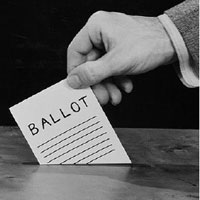
Hold on a second, this is a paper shredder!
Of course, this is me being a little glib. The most ‘mainstream’ conspiracy theory focuses on how the referendum vote was a sham. Urban legends abound about shadowy colonial agents fudging vote counts and burning crates of ballots in the Grace Hospital incinerator. A MUN professor encounters a nameless old man in London who makes a deathbed confession to rigging the vote before vanishing forever into the fog of history. Somewhere, lying in the ruined root cellar of some resettled outport, there is a cheque from the British treasury, never cashed out of mortal shame.
Popular pre-Confederation coffee mug
Despite what some people might insist, none of this is true, as a cursory visit (literal or figurative) with a Newfoundland historian will tell you. But I can understand why the idea of a grand, flawless web of manipulation appeals to anti-Confederates, because otherwise they’re left holding the distasteful conclusion that Confederation happened because a bunch of bayfolk were duped into it by their supposedly inherent love of welfare. This idea is rarely so crassly expressed (unless the speaker bleeds blue), but for all the handwringing about the ‘disrespect’ Newfoundland’s democracy suffered in 1948, no one seems to have much respect for the exercise of democracy by rural people.
Malone tells us on page 84 of Don’t Tell The Newfoundlanders, for instance, that making it a legal requirement for elected officials to actually live in the districts they represented was part of a sinister British plot to ensure that Water Street merchants “would not dominate any elected body or control political events in Newfoundland.” Forcing rural places to elect rural representatives was a mistake, because it meant “[depriving] the [National] Convention of many qualified candidates” — no doubt the same ‘qualified candidates’ who bankrupted the country in 1933. ‘Local control’ is a pretty loud political cry when St. John’s wants something from Ottawa, but apparently falls on deaf ears when the poor ask something of the rich.
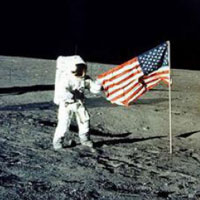
Could the Newfoundland moon landing have been faked?
None of this is to imply that the exercise of democracy in 1940s Newfoundland wasn’t pretty wild and wooly otherwise. Smallwood was definitely running around being a giant sleveen with British support, and a big part of why the Confederates won is because they were peddling the Canadian welfare state in one of the most destitute parts of North America. Put it in context: living in rural Newfoundland, back in the day, was not so much a time. Have you ever read Random Passage?
Time and distance may put a wistfulness on it but there is nothing romantic about that existence. No one who got a taste of a decent life on an American army base wanted to go back to the way things were. You don’t need your grade ten to understand that basic material well being is infinitely more valuable than whatever fuzzy feeling Ryan Cleary gets when he throws on an old sou’wester.
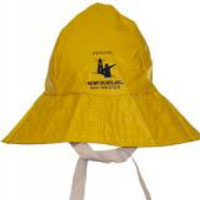
Can double as tinfoil hat!
But worse than being lazy history, conspiracy theories are a depressive politics. If we buy the line that the Newfoundland nation was forsaken by Anglo-Canadian manipulation or ‘ignorant and avaricious’ outporters, we are buying a story where Newfoundlanders are the eternal victim. Pathologically fixated on an imagined past, we are cut adrift in a very real future and can never move forward. It’s an emotionally exhausting worldview. That these ideas are a political dead end is obvious in the fact that no ‘sovereigntist’ movement has ever enjoyed even marginal success in the six decades since our ‘annexation’.
Everybody knows that the only thing worse than Confederation is limiting the world to a lonely island in the North Atlantic.
Canada isn’t perfect. In fact, the country is ripe with problems at any given moment. Take your pick: our democratic institutions are rusting out, aboriginal peoples are still getting the rawest deal, and Stephen Harper is seven years into his quest to slay the environment. And yes, some mainlanders still tell Newfie jokes, because there are ugly people everywhere. But we’ve been part of the Canadian family for sixty-four years, and our other dysfunctional siblings need us now as much as we ever needed them. In 2013, the problems are too big and the stakes are too high to fantasize about crawling away into a nationalist cocoon.
Popular Newfoundland band The Who
Greg Malone and his comrades are right about many things. Democracy in Newfoundland and Labrador is not, and certainly never has been, as robust as it should be. British colonialism does have a long and dirty history. Modern Canadian life is crisscrossed by exploitation. And, yes, Newfoundland and Labrador’s distinct society and history deserves more recognition than it currently enjoys from the Canadian establishment. But rehashing the same tired, discredited arguments about how our forebears were a bunch of suckers is not the way to deal with this. We can write a better—and more empirically accurate—political drama by casting Confederation as an imperfect but genuine popular victory. Among other things, it’s a lot more empowering.
But mostly? We just need to move on.
Follow Drew on Twitter @drewfoundland




July 5th, 2013 at 7:25 pm
Well this piece was quite the hatchet job. The author here sets up various straw men that can be easily torn asunder and then demands empirical proof from those who question dogmas about Newfoundland history.
“Of course, this is me being a little glib” No, it is the author engaging in straw man argumentation. Period.
Whether you believe the accepted truths and dogmas of Newfoundland history or whether you question them, there should always be room for alternative ways of looking at history.
No historical question should be closed and settled.
The British had means, motive and opportunity to rig the vote. Does that mean they rigged it? No.
Would they have left documentary proof of a rigged vote? Probably not.
Historians are trained to look for documentary proof. But are the historians the only ones allowed to look at historical questions?
Why does the author, in such a shrill way attack those who do not subscribe to textbook Newfoundland history?
We live in a journalistic world where those who question accepted truths are a called “conspiracy theorists” and then lumped in with those who believe the earth is flat and the moon landings were faked.
But just because I do not agree with you does not make me crazy.
Many people suffered terribly for their views for hundreds of years. Many were burned at the stake. Our history textbooks tell us that the Age of Enlightenment ushered in a new era of debate and open ideas.
Maybe the author missed that part of the history lesson.
July 9th, 2013 at 12:01 pm
It’s not questioning accepted truths that’ll get you labeled a conspiracy theorist. It’s coming up with your own (or buying into) set of truths based on conjecture.
August 10th, 2013 at 7:45 pm
I’m so glad this was written and published, especially in The Scope. It’s so refreshing to hear something other than ‘We were had!’, or the romanticizing of an imagined past. Cheers, and thank you.
September 15th, 2013 at 6:02 pm
You are woefully wrong. In today’s world of morally and intellectually bankrupt journalism, merely questioning cherished and sacred truths can get you tarred with the pejorative label “conspiracy
theorist”.
September 17th, 2013 at 9:16 pm
yo, Neil.
Is that really your name?
I don’t mean to be antagonistic at all – I just can’t believe you have the same name as me, but backwards.
Gerard Neil