

Archive | Food Nerd RSS feed for this section
Chicken pakoras
Andreae Prozesky didn’t burn her house down.
Fridays, to celebrate another week of making it through the madness of kindergarten without incident (or to provide some solace after a particularly difficult few days, depending), we hand the joy of dinner selection over to the delightful Miss B. More often than not, this means chicken fingers. Like her mother before her, Miss B. goes cracked for a plate of fried chicken. So strong is this love that the menu pronouncement is often accompanied by a little chant dating back to Miss B’s toddler years, and that goes, “Chicken and fries! Chicken and fries! My little girl loves chicken and fries!” You’ve got to say it kind of sassy-like. Dancing is an optional, but enjoyable, addition.
Since we’ve had to kick gluten to the curb, however, chicken fingers have taken a hit. No longer can we scurry up to our favourite takeout and walk home with dinner steaming its greasy way through layers of cardboard plates and paper bags. I’ve tried making chicken fingers with coatings of corn flakes and rice cereal, of tapioca and potato starches, I’ve tried broiling, baking, and pan-frying, and the results have been pretty uninspiring. I have made a few good batches, only to be unable to replicate them. For the most part, the chicken fingers have been pretty gross. Soggy, oily, strangely sweet or else awfully bland. A shameful thing to do to otherwise perfectly tasty chicken.
It only struck me a couple weeks ago where I was going wrong. The hubby and I were out for a big ol’ Indian dinner (a very rare occurrence these days), and, in an unusual manoeuvre, ordered chicken pakoras as an appetizer. I’m generally a veggie pakora kind of gal, but we were awfully hungry and chicken seemed like the way to go. If you’ve never had pakoras, they’re just an Indian take on fritters. In the vegetable version, pieces of cauliflower, onion, potato, mushroom, and whatever other veggie is on hand are dipped into a spiced chickpea-flour batter, deep-fried, and served with chutney or herbed yogurt for dipping. Chicken pakoras have the same crispy chickpea flour coating, but instead of vegetables they’re made with delicately-flavoured marinated chicken pieces. Keep this in mind if ever you’re at an Indian restaurant with a child who has decided that curry is the enemy. When our order of pakoras came to the table, I knew that this was what I would have to replicate if I were going to make chicken fingers worth eating.
I bake with chickpea flour a fair bit at home, and I use it in sauces and gravies all the time, but I had forgotten what a great batter it makes. Texturally you get a bit of heft, which is what I like for chicken (though not for fish; fish requires an airy, tempura-like lightness). The flavour is a little earthy, but not overly assertive like some other bean flours. It’s available in bulk shops, and also in specialty shops where it may be labeled gram (not to be confused with graham) or besan.
Pakoras, like many of the tastier things in life, are deep fried. Do not be alarmed at the amount of oil called for in the recipe; you want at least two and a half inches of oil in the bottom of the pot. So long as you don’t scorch it, you can strain it and use it over and over again. Keep an eye on the pot and don’t let the temperature get too high; the oil should bubble insistently, but not furiously. If you’re using a thermometer, it should read between 350F and 375F. Chances are you’ve had a parent or insurance agent try to scare the wits out of you with tales of people burning down entire city blocks through inept use of chip fat; I’ve been deep-frying for ages and I’ve never burnt anything, but I approach the process with reverence and awe. Never turn your back on boiling oil, and make sure no children come near the stove. Do not answer the phone, run a bath, or go outside to weed the garden while you’ve got pakoras cooking. Don’t wear long flowing sleeves, and tie your hair back, for heaven’s sake. Don’t say I didn’t warn you. If you’re nervous, check out this website: tinyurl.com/howtodeepfryanything
Obviously, in an Indian restaurant these wouldn’t be served with fries and ketchup, but don’t let that stop you. If you want to keep it authentic, chop some cilantro or mint finely and stir it into some yogurt to make a nice, simple dipping sauce, then follow the pakoras with any of your favourite homemade or store-bought curries.
—
Chicken pakoras
(serves 4 as an appetizer)
2 chicken breasts (about 400 g), skin and bone removed
Marinade
½ cup yogurt
1 tablespoon lemon juice
2 cloves garlic, crushed
½ teaspoon salt
1 teaspoon garam masala
¼ teaspoon cayenne pepper
optional: chili garlic paste (sambal olek) to taste
Batter
1 cup chickpea flour
1 tablespoon rice flour
½ teaspoon coriander
¼ teaspoon cayenne pepper (or more, to taste)
¼ teaspoon salt
¼ teaspoon baking powder
cold water to make batter
canola or other vegetable oil for frying (about 1 ½ litres)
1. Cut chicken breasts into strips or nuggets. Try to make sure the pieces are of equal thickness; this way they will all take equally long to cook through. Combine marinade ingredients in a bowl. Add chicken pieces, stir to coat, and refrigerate at least 40 minutes.
2. When chicken is ready, combine batter ingredients, using enough water for proper consistency; it should be thinner than pancake batter, about as thick as honey. Remove chicken pieces from marinade and drop them into the batter.
3. In a large, heavy-bottomed pan, heat your oil over a medium-high burner. You will see little swirly trails in the oil as it heats up. When it reaches 350F, it’s ready; a ball of batter dropped from the end of a spoon should sink and then immediately rise, surrounded by bubbles.
4. Gently drop pieces of batter-coated chicken in the oil, making sure not to overcrowd the pot; turn the pieces occasionally to make sure the batter cooks on both sides. The chicken will take 6-8 minutes to cook through. With a slotted spoon, remove nuggets to a newspaper-lined tray to drain. Serve warm.
To make vegetable pakoras instead, you can a) dip bite-sized pieces of your veggies of choice (cauliflower, potato, pepper, and onion are all common) into batter and fry, or b) shred up a whole pile of veggies, stir them into the batter, and drop by the spoonful into the oil; either way the vegetable fritters should cook about 5 minutes.
Send your questions, comments, and inauthentic suggestions to dreae@thescope.ca
Salted caramels
Thu, Apr 9, 2009
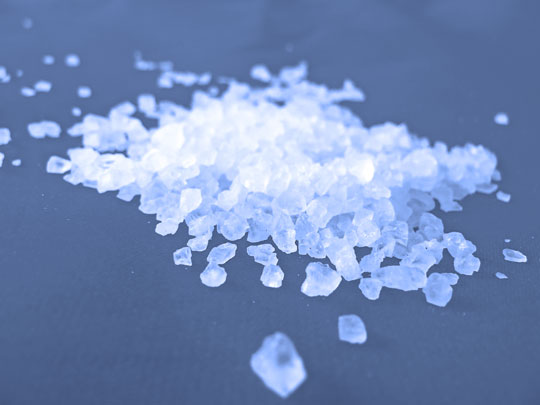
Andreae Prozesky is worth her weight in salt for sure.
I hope I’ve never come off as a salt snob. Really, I’m not. I do use sea salt in most of my cooking and baking, and I specify it in my recipes because I want to record them as accurately as possible. The reason I use it is this: the last time I looked at a box of free-flowing table salt, it had a list of ingredients that read “salt, invert sugar.” Ingredients? Sugar in the salt? What the hell? I mean, I like sugar and salt together, in, say, a bag of salted caramels, or in the form of a DQ Peanut Buster Parfait, but what are those two doing in the same box? No, sir, I don’t like it.
I was living out of St. John’s when I made the sea salt switch, and I selected my salt based mainly on the packaging. The neighbourhood I lived in had a wonderful Greek supermarket, and there was a brand of “award-winning sea salt” on display there. On the side of the container there were artists’ renderings of the various awards that the salt had won, and one of them looked just like an Emmy. Hilarious. How could I not buy Emmy-winning salt? It didn’t hurt that it was cheap as chips. I took my salt home and began to imagine the sorts of acceptance speeches a container of award-winning Greek sea salt would make. Sophisticated form of diversion, I know.
So, as a sea salt user, it doesn’t bother me a mite that there are people out there dusting their chocolate truffles in fleur du sel, or flinging pink and grey mineral salts over their plates like wedding confetti over a set of church steps. And I figure that if you want to pay a fortune for glorious pyramid-shaped salt crystals made of angels’ tears, evaporated by the flapping wings of doves, fine. But here’s the thing: it doesn’t make you better than other people. It might be dead tasty, but it won’t cure what ails you, and if you go around pouring it all over everything you’ll end up with hypertension just like everybody else.
Honestly, the way people are going on about sea salt, you would think it was the new penicillin. I mean, it’s salt. You need a bit of it to stay alive, and you need a lot of it if you’re making popcorn, but it’s still just salt.
This is not to say that the idea that sea salt might be a better nutritional choice than regular table salt is completely unfounded. For one thing, sea salt tends to be sold in coarse form, which means that you’re more likely to be satisfied with a small sprinkling of it atop your food than you would with the same small sprinkling of fine table salt. The nuances of flavour in your meal will be more pronounced, you’ll be more pleased with what you’re eating, a flood of happy emotions will surge through you, and you’ll go for a jaunt in the warm spring evening air instead of having another giant bowl of pasta and passing out on the couch. It’s a roundabout kind of health benefit, but the real ones usually are.
Another potential benefit is that sea salt, coming from sea water, is full of minerals. This is why sea salt is often grey, sometimes pink or red or brownish. You can taste the difference, which is kind of neat. Whether these minerals have any real dietary impact, though, is difficult to judge. You would probably have to eat an awful lot of chunky grey salt for it to count as a magnesium or potassium or iron supplement. And while sea water is mineral-rich, it’s also full of, well, filthy man-made toxins and pollutants, which can just as easily show up as residue on the salt. If your sea salt has been cleaned and refined, the toxins will have been removed, but so will have been the fancy minerals. If the sea salt is unrefined, you’d best be sure it’s from a reputable source (or that it’s won an Emmy).
I suppose there’s an economic factor to consider; if you’re someone who tends to use too much salt, and you replace all the Sifto in your house with snappy gourmet salts at 10$ for a half-cup package, you’re likely to be a tad more judicious in how you season your food. But since the most damaging salt is not the salt you cook with but the nefarious salts that the food giants sneak into your frozen dinners and take-out meals, simply replacing your salt shaker at home with a grinder full of salt chunks probably isn’t going to do anything for your health.
If there is one major advantage that sea salt has over table salt, it’s a karmic one; most table salt is mined, and the conditions for the workers are often cited as atrocious. Mining salt has a host of negative environmental effects, too. Sea salt, on the other hand, is usually produced by small companies, and is available with fair trade and organic certifications. Your body might not be able to tell the difference, but supporting ethical business practices is definitely good for you. Even if that means eating extra salted caramels.
—
SALTED CARAMELS
There’s nothing difficult about making candy, so long as you have a candy thermometer, which you can pick up for a few bucks in the gadgetry aisle of your grocery store. Have all your ingredients and your pan ready to go so that you can keep an eye on the temperature: too low, and you have caramel syrup, too high and you have brittle, filling-removing toffee (neither of which is a terrible thing, mind you).
Makes a whole lot of little bite-sized candies.
1 cup whipping cream
5 tablespoons unsalted butter
2 teaspoons sea salt
1 ½ cups sugar
¼ cup brown rice syrup (or corn syrup if you can’t find brown rice syrup)
¼ cup water
Line an 8-inch square pan with parchment so that there will be enough overhang to pull the caramel slab out of the pan. Brush the parchment with oil and set aside. Fill a glass with cold water and keep it close by to check the doneness of your caramel.
In a small, heavy-bottomed saucepan, bring the cream, butter, and salt to a boil. Remove from heat.
In a large, heavy-bottomed pot, combine sugar, syrup, and water. Stir over medium-high heat until sugar is dissolved. Continue to cook, swirling the pan over the heat (but not stirring), until thermometer reads 248F. Add cream mixture; it will bubble up furiously. Cook, swirling, until the heat has returned to 248F but do not let it go past that point. If you want to test your caramel, drop a bit of it from the tip of a spoon into your glass of cold water; it should form a ball as it sinks to the bottom.
Pour your caramel syrup into the prepared pan and set aside for two hours to firm up. Cut into bite-sized pieces and wrap in waxed paper. If you want to dip each square in tempered chocolate, then go mad. If you have fancy, pretty sea salt, you might want to sprinkle a bit more over for decoration.
Send your questions, comments, and salty suggestions to dreae@thescope.ca
Several really kind of gross things I dearly love
Thu, Mar 26, 2009
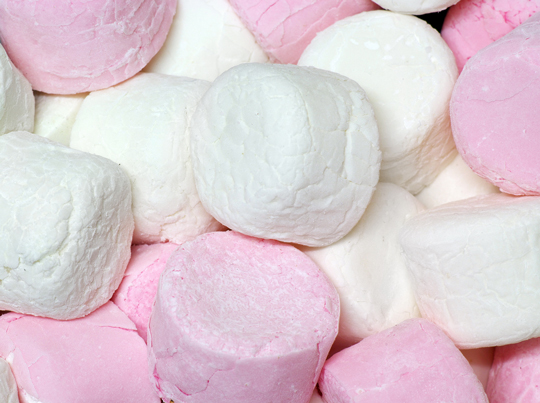
Andreae Prozesky isn’t quite as pure as one might think.
Every now and then I’ll have a weird encounter involving food. I’ll be out picking up groceries or grabbing some kind of quick bite and someone, sometimes a stranger but more often a vague acquaintance, will come up to me and say, “you write that food column, don’t you?” “Yes,” I’ll reply, and realize that my shopping basket is carrying packets of Kool-Aid and a bag of white dinner rolls and a Styrofoam plate of confetti squares, or that my food court tray is holding up a large poutine and a giant waxed-paper cup of Sprite.
Then I’ll get the look, the “well, now I can’t believe anything you say, because I caught you sucking back high-fructose corn syrup at the mall” look. If I were a truly secure person, I would be able to ignore this judgey judgeness, perhaps even offer a cheese curd-draped French fry. But instead I get all socially-awkward and say things like, “Uh… I’ve just read a fascinating article on dying felted wool with Kool-Aid… if only you could get organic drink powder, but oh well, heh heh heh…” or “Man, this Sprite is gross, but when you look at the environmental impact of bottled water, I mean, heh, what are you supposed to do?” Then I babble nervously for a while, and the Nerd-spotter walks away, no doubt never to read my column again. Way to go, Food Dork.
I mean, yes, Sprite is gross, but it’s a kind of gross I like. I don’t drink enough of it to do any lasting damage, and it’s only ever in combination with greasy fries. Based on my own highly scientific research, I feel that the acidity of the soft drink counteracts the greasiness of the dinner somehow—although that’s probably wrong in about fifteen different ways. Oh, well. And poutine? Well, that’s food of the gods if you ask me. I’ve been known to go to the mall for no other reason than to get a big dish of it. Poutine is just tasty stuff.
Invariably, as the judgey-pants former reader walks away, I get all mad with myself for being so sheepish about my trashier food choices. For one thing, I know enough about food to balance my confetti square addiction with steady doses of green vegetables and whole grains. For another, just because I love a plate of sautéed Swiss chard with garlic butter, does that mean I can’t also revel in the magic that happens when hot gravy meets cold cheese? Just because I can whip up a gorgeous brown-rice soda bread, resplendent with sultanas, each slice yieldingly gritty beneath its thick layer of sweet butter, does that mean I should be ashamed of the pleasure I get from tearing paste-white dinner roll from paste-white dinner roll, the strands of unholy gluten pulling and snapping, the interiors soft as the dough they once were?
Hells no!
These are the sorts of things people call “guilty pleasures,” but I think that’s ridiculous. Feeling guilty about food isn’t going to help you eat more healthfully, and it’s certainly not going to make you a better person. In fact, I think that applying the principle of guilt to eating just waters down the meaning of guilt. Guilt is a potent feeling, so for heaven’s sake, save it for when you’ve actually done something wrong. If I eat half a chocolate cake, I may feel bloated, sticky, simultaneously wired and lethargic, and mildly nauseated, but I’m not going to feel guilty. Unless I stole the cake from a child’s birthday party. (Stealing from children is so wrong!)
Eating too much cake is perhaps a little stupid, but it’s not immoral.
So there you go. No guilt, no shame, and moderate amounts of junk food. There’s not a thing in the world wrong for it. Should you catch me in the grocery store, loading my cart with nasty, sugary, chemical doughnuts, rest assured it’s not something I do often, and that I’ll pay for it later when I feel like absolute rubbish. Then it’s back to the sensible homemade goodness for me.
—
Several really kind of gross things I dearly love
(in no particular order)
Marshmallows. I can’t have them in my house because I will devour the entire bag over the course of 48 hours, standing on a chair in my kitchen so that I can reach the top self where I’ve hidden them. And those fruity pastel mini marshmallows don’t even make it to the 36 hour point.
Miracle Whip. Oh how I love it. I know it’s not real mayonnaise. But you know what? Neither is Hellman’s. It’s all just glop in a jar. I’ll take my glop in a jar sweet and tangy, thanks.
Egg salad sandwiches made with Miracle Whip. On white bread, cut in triangles. At a school fundraiser. So very good.
Assorted squares. Of the sort that you find in the bakery section of your grocery store, or in convenience stores, especially those attached to gas stations, for whatever reason. Assorted squares needn’t be square, actually: peanut butter balls and their cousins, peanut butter mice, both count. I cherish them, even if they actually list “Parowax” as one of their ingredients. *Shudder*
Fried egg sandwiches. If you look at the components of the fried egg sandwich – fried egg, toast, cheese, mayonnaise (ahem, Miracle Whip, ahem) – there’s nothing actually wrong with them, but any sandwich that drips greasy egg yolk is kind of gross. But it’s oh so tasty.
Viva Puffs, and any of their copycat versions. See above entry on marshmallows. I can easily eat a whole package of them. Nobody in my house likes them but me. I’m so lucky!
Fried chicken. From Mary Brown’s. With Orange Crush. There, I’ve said it. Now you know.
—
Send your questions, comments, and guilt-ridden suggestions to dreae@thescope.ca
Eating well in these hard economic times
Sun, Mar 15, 2009

Andreae Prozesky cheaps out.
At first, I didn’t pay much attention to this whole global economic downturn business. If anything, I felt kind of privileged to not have the burden of wealth hanging over me. It became a bit of a joke around the Food Nerd labs. “Oh heavens, our precious retirement funds, all gone! Oh, wait, we’re writers—we don’t have retirement funds. We don’t have any funds! Ha ha ha ha!” Somehow, it seems a lot funnier after that bottle of cheap, screw-top wine. But I stand by my belief that economic collapse is a lot easier to take when you don’t have a house to lose or a car to pay for or money to fall back on. You hardly even notice the change.
Until you go to the grocery store. This isn’t really a cheap-groceries town as it is, and things ain’t getting any cheaper, even though the cost of the gas that drove the prices up in the first place has dipped way down (figure that one out.) To add insult to injury, it seems everything at the Liquor Corp has gone up too. Shouldn’t booze be subsidized now, when we need it the most? We’ve still got a good, oh, four long, hungry months before the first local foods start appearing at the farmers’ markets and roadside stands, and before any good foraging can begin (although I’ll be the first one out there with my fork when the dandelions come up, let me tell you).
What on earth is a Food Nerd to do?
“More is more” is the downturn-era refrain shouted from the greater Stavangerdeen area, but buying groceries by the flat only works if you’re actually going to use what you buy. That tin of artichoke hearts the size of my head may seem like a bargain, but I know how much mayonnaise and Parmesan I’d need in order to convert all those hearts into creamy, delicious dip before they went funny. And just how flavourless would that club pack of curry powder be by the time I got halfway through it? Never mind getting out to the megashops if you’re among the city’s carless child-luggers. Practically impossible, potentially dangerous, and almost certainly unpleasant.
Clipping coupons is a smart little exercise, but most of the coupons I’ve found are put out there to promote some corporate food guy’s super-packaged insta-food. If I were looking for a discount on frozen dinners, I’d be in luck, but try finding coupons for stuff like carrots and apples and chickpeas and flour. Nobody cares about the promotion of carrots unless they’re in tetra-pack soup form. So in order to save a few bucks, I’d have to buy things that are twice as expensive as the ingredients would be to make them. I’m no math whiz, but that just sounds stunned.
Not that there aren’t bargains to be had. You know those giant slabs of cheddar and mozzarella cheese in the dairy section of the grocery store? In my carefree, college years I used to look at those with disgust, asking, “Who the hell eats that much cheddar cheese?” Well, carefree college Andreae, you’re lookin’ at her. In the mirror. Ouch. And those slabs of cheese go on sale every other week, it seems, for about half price. If you’ve got the freezer space and the elbow grease to grate them up and freeze them, you’ll keep yourself in macaroni for a good while. Grated cheese makes better grilled cheese sandwiches, too. Grated mozzarella freezes fine and makes for quick pizza-makery too, if that’s your style. I wouldn’t freeze good, expensive cheese, but if you’re going to put it in a sauce or grill it until bubbly anyway, chances are that you’ll never notice the difference.
Should you want to, say, squeeze a vegetable into your recessionista diet, might I suggest the freezer aisle? I don’t usually hang around the freezer aisle, but after having a look at what passes for a fresh vegetable right now, I’m thinking of setting up camp there. While I’m not totally down with eating frozen green beans from Belgium, they seem like a sensible alternative to their half-rotten, slimy “fresh” cousins from Chile or California or wherever they’re sliding in from this week on their black Styrofoam sleds. I know we’re supposed to be eating with the seasons, but sometimes a girl just needs a pile of green beans, you know? Interestingly enough, I did manage to find a coupon for those, in the little pamphlet that came with my canning jars last fall. Go figure.
Painful as it is to have to hold myself back from buying the big-ticket grocery items I so enjoy, I’m pretty lucky to be buying groceries at all. It could be worse, and often has been. Chins up folks, and visualize those dandelions. Spring is not far off.
—
Eating well in these hard economic times
Take your culinary cues from people are used to making something tasty from humble ingredients. A whole lot of people get by on lentils and beans. In the Middle East they eat brown lentils and rice stewed with cumin and garlic and topped with caramelized onions; in India they turn red lentils into deliciously spiced dahl; in Mexico refried pinto beans are a staple. And, if you’re from around here, your nan probably has a great recipe for split pea soup. Pick a spot on the map and find out what they do with beans there.
If you find nice-looking veggies on sale, buy what you can afford, stuff yourself, and then freeze what’s left. Most vegetables are best blanched before freezing: boil a big pot of water, dump your cleaned, trimmed veggies down in it, cook for about three minutes, then take the veggies out and plunge them into ice-cold water. Drain, bag, and freeze. There’s a chart with info on freezing specific vegetables here: tinyurl.com/brqncf
Want a taste of the good life? Start hitting events like cultural awards ceremonies, book launches, and art openings. Any launch or opening should have some eats on the go, but keep a sharp eye out for anything with government or corporate sponsorship; they have real catering budgets, which means mini-quiches and sausage rolls, baby. If you’re the type to feel guilty for showing up at an event and not buying the thing being celebrated, avoid the book launches and go for the art gallery hoo-haws. In these hard economic times, nobody expects you to drop hundreds or thousands of dollars on a painting or photograph, but they can’t fault you for wanting to observe a bit of beauty. Take in some art, and walk away with some inspiration in your soul and some gouda in your belly.
Send your questions, comments, and frugal suggestions to dreae@thescope.ca
Moroccan-spiced Moose Stew
Thu, Feb 26, 2009

Andreae Prozesky wonders how to spell “Bullwinkle” in Arabic.
There are some wonderful things that happen when your education in cooking coincides with a period of strict vegetarianism. You learn to be inventive, to dream up substitutions for the ingredients you’ve chosen to exclude from your diet. You picture ingredients as somehow more elemental. When you can’t just grab the same old thing off the shelf, you improvise, you experiment, and you learn to work from intuition rather than from convention. Rather than seeing, say, walnuts as just the crunchy bits in banana bread, you see them as brain-shaped protein pieces, suitable for any number of preparations. You get to nerd out over the little puzzle pieces of nutrition, figuring out how to put them together the right way.
The downside of this is that if you someday start eating meat, you may be completely stunned about what to do with it.
Way, way back, I confessed that I had gone until the end of my 20s without ever having eaten a hamburger. I’ve since eaten many, to make up for lost time, but I had to have a friend show me how to make them. The whole thing was completely foreign to me.
Ask me to pick up a roast at the supermarket and I’ll end up staring at plastic-wrapped meat for an hour, wondering what qualities one expects in a roast, and how do I tell a good roast from a bad roast, and what am I supposed to do with this once I get it home. Ask me to make you a lentil loaf, and I’m fine, but throw some meat into the equation and I’m lost.
Which is how I end up making things like Moroccan Moose Stew.
Yes, I know, people don’t eat moose in Morocco. North Africa is not exactly moose country. From the recipes I’ve looked at, Moroccan cooking involves a lot more lamb than ours does. And goat, which has never quite made it big on the North American culinary scene. Why is that? I’ve only had goat once, in a lovely curry, and there was nothing particularly weird about it. It was downright tasty, actually.
Flavour-wise, Moroccan food is layered with richness. Sweet spices, the heat of a fiery chili sauce called harissa, and the tang of dried fruit, mean that there’s a lot for meat to stand up to. While something mild like chicken serves fine as a platform for all these flavours, a more assertive meat would lend a real musky, earthy quality. At least, that’s what I was thinking the first time I was faced with a hunk of moose meat that had been in my freezer long enough. Clueless as to proper moose-cooking procedure, I chopped the meat into bits, gathered some ingredients I thought would compliment the wildness of our familiar, delicious, highway-stalking big game, and got to it.
In truth, it started out more “Renaissance Faire” than anything else, my thinking being that meat would have been more hunted and less farmed back in the day, and therefore gamier, and so the spices and such that went into some real old-fashioned cooking might be appropriate. But where did those guys get their ideas? Oh, their extensive travels throughout the Arab world, that’s where.
Well, not so much “travels” as “holy wars,” but that’s a conversation for another time.
Either way, the path led back to the North African recipes I love so much. So instead of going historical, I went geographical. Authentic it’s not, but delicious it is.
There are two ingredients in this recipe that you may not have on your shelf already: harissa, the all-purpose chili paste used as a condiment in Morocco, Tunisia, and throughout North Africa, and pomegranate molasses, which is a wonderful thing to have on hand for flavouring salad dressings, stews, soups and the like. They’re both well worth tracking down.
As for the moose, well, that’s one of those “I know a guy” kind of situations. If you can find someone with moose in their freezer, you’re a lucky person indeed. Caribou would be lovely, too. Failing that, though, stewing beef would be just fine. And if you’re a vegetarian, lentils and fava beans would make this recipe completely different, but still delicious. Experiment and enjoy.
Moroccan-spiced Moose Stew
Serves 4
4 tablespoons olive oil, divided
½ cup flour, seasoned with salt and pepper
1 pound moose stew meat
1 onion, quartered and thinly sliced
3 cloves garlic, crushed
½ teaspoon cinnamon
¼ teaspoon turmeric
1 teaspoon powdered ginger
¼ teaspoon paprika
2 carrots, 1 parsnip, and ½ small turnip, peeled and cut into 1-inch pieces
1 ½ cups water
1 cup red wine (or beef stock)
1 tablespoon pomegranate molasses
¼ cup currants
2 tablespoons slivered almonds, toasted
½ to 1 teaspoon harissa
yogurt, for serving (optional)
1. Heat 2 tablespoons of olive oil in a heavy pot. Toss meat with seasoned flour and add to pot. Turn to brown meat on all sides (don’t cook it through, just sear it). Remove meat from pot and set aside.
2. Turn heat to medium-low and add remaining olive oil to pot. Add onions and cook, stirring, until they turn translucent (about 5 minutes). Add garlic and stir for one minute. Add cinnamon, turmeric, ginger, and paprika, stirring. Add vegetables and toss to coat. Add ½ cup water and cover 10-15 minutes, until vegetables just begin to soften.
3. Add partially cooked meat and any juices that have come out of it. Stir and add remaining cup of water, and red wine. Stir in pomegranate molasses, currants, and almonds. Add more water if necessary; the meat and vegetables should be almost covered in liquid.
4. Bring stew to a simmer, then reduce heat and cook, covered, until meat is cooked through and vegetables are soft, about 40 minutes. Stir in harissa, tasting to make sure it’s hot enough to suit you (you can always add more at the table). Add salt to taste.
5. Serve over couscous, or, if winter has you carbed right out, on a bed of shredded, sautéed cabbage. Top with a dollop of yogurt, if desired.
Send your questions, comments, and local wild game + random geographic suggestions to dreae@thescope.ca
Fudgy sludgy (gluten free) brownies
Thu, Feb 12, 2009
Andreae Prozesky is a gluten for punishment.
Go ahead: ask me something about gluten. ‘Cause I can tell ya. And if I can’t tell ya, I can find out and tell ya next week.
For the last few months I’ve been reading books about gluten-free cooking, scouring the web for gluten-free recipes, and lurking in the far corner of the Bulk Barn, where the freaky flours live. My last bag of all-purpose flour languishes on the shelf, crowded out by flours made from rice, buckwheat, chickpeas, quinoa, tapioca, potatoes, and corn. I actually own a bag of xanthan gum, and I dip into it almost every day.
Oh—and I make brownies out of black beans.
Whuh?
Well, way back in December I figured out that gluten wasn’t agreeing with my darling daughter’s constitution one bit. You want to talk about mood swings? Try living with a five-year-old who sulks and stomps like a black-nail-polish-wearing, Smiths-t-shirt-sporting teenager who’s just realized, too late, that she really did want to go to the grad after all. Yeah, it was that bad. After some desperate consultation with the internet and my nutritionist, I felt that wheat and its gluten-y brethren might be the problem. We cut the gluten out of the kiddo’s diet on the first of December, and by December third her moods were like those of your average (okay, moderately melodramatic) kindergartener. Even at Christmas. Go figure.
Gluten, if you’re unfamiliar, is a protein present in large amounts in wheat, and in smaller amounts in spelt, kamut, rye, and barley, and which sometimes contaminates processed oats. For most people, it’s either fully digestible or only mildly annoying, causing a bit of bloating, some sinus congestion, or a headache. If I overdo it on the baked goods and sandwiches, for example, I get a stuffy head something fierce. The same thing happens, I’m afraid to say, after about half a beer. Which, I guess, makes me and wheat frienemies: we can hang out, but every now and then she’ll totally turn on me.
But for people with more acute sensitivities or intolerances, gluten can cause digestive misery, migraines, skin and hair conditions, and mood imbalances. For people with celiac disease, which is actually an autoimmune disorder, the body’s reaction to gluten prevents the body from absorbing nutrients the way it should. This, in turn, can result in any number of awful problems, including depression, fatigue, anemia, gastric agony of all description, miscarriage and infertility, dermatitis, and an all-over feeling of intense and unyielding bleh.
The good news is that, for most people with gluten issues, there’s no medication required: all you have to do is eliminate gluten from your diet.
The bad news is, it’s is a lot easier said than done. You see, every flippin’ thing in the grocery store, and at almost every restaurant, has some form of wheat or gluten in it. If you don’t believe me, do a quick ingredient scan next time you’re out shopping. Tomato soup, vegetable stock, yogurt, hot dogs, meatless burger patties, seasoned chicken breast strips: any one of them can be a gluten disaster waiting to happen. So you’ve got to be awfully careful. Do your research, spend some quality time in the health-food section, and work up the nerve to ask a lot of questions when you eat out.
If you happen to like a baking challenge, and if you cook everything from scratch anyway, well, this makes it kind of fun. You get to think of yourself as a bit of a mad scientist. Nothing in the world behaves like wheat, which is why it’s so popular, so you can’t just replace wheat flour with some other flour. You’ve got to get experimental. My bread recipe uses ground pumpkin seeds, almond flour, corn flour, tapioca flour, oats, and eggs (and xanthan gum!) And it works. Too cool, what? You also have to apply every bit of baking knowledge you have. If non-wheat flours make cupcakes dry, you have to compensate with something moistifying, like buttermilk, or applesauce, or both. There’s a lot of trial and error involved, and you have to accept that you’ll end up tossing out some very expensive ingredients that you’ve baked into inedible bricks.
But the results are well worth it in the end.
Intriguingly enough, the recipes I’m using these days really are the best I’ve ever had. My buttermilk-applesauce chocolate cupcake recipe blows all my previous chocolate cupcake recipes away. My buckwheat-rice waffles rule. My quinoa-teff peanut butter bars are causing serious addictions issues around the Food Nerd Laboratories.
And the black bean brownies? Oh merciful heavens. Even if you eat white flour by the scoopful without any trouble at all, you really should try these. Fudgy, sludgy, dense, and black. Just in time for Valentine’s day. Now there’s nothing to stop you from bestowing some gluten-free love upon the world. Dig it.
—
Fudgy sludgy (gluten free) brownies
(makes one 8”x 8” pan)
To make the black bean purée, drain and rinse one 19 oz tin of black beans, then whizz them in the blender with a little water until they reach a good, smooth consistency. One tin will yield a little more than a cup of purée, which may mean that you have to make two batches of brownies. There are worse things.
½ cup unsalted butter
½ cocoa powder (splurge on the best you can find)
2 eggs
1 cup dark brown sugar or ½ cup brown sugar and ½ cup muscovado sugar
½ cup black bean purée
2 tablespoons instant coffee
½ teaspoon sea salt
½ cup chopped pecans, or ¼ cup mini white chocolate chips (optional)
1. Preheat oven to 350F. Line your pan with parchment paper so that there’s some overhang on two sides; this way you’ll be able to lift the brownies out of the pan.
2. Melt butter and add to cocoa; stir until smooth.
3. Beat eggs and sugar until light. Mix in bean purée, cocoa mixture, instant coffee, and salt until well combined.
4. Stir in pecans or chocolate chips, if using.
5. Pour batter into prepared pan. Smooth top and bake about 35 minutes, or until top is dry and centre is set. Let cool in pan on a rack. When completely cool, lift brownie slab out by the parchment paper overhang and cut into pieces.
If you want to make these in the ever-popular two-bite style, grease a mini-muffin tin, fill cups ¾ full, and bake about 15 minutes. Cool completely before tipping out of the pan.
Send your questions, comments, and gluten-free suggestions to dreae@thescope.ca
Mocha ricotta for two
Thu, Jan 29, 2009
Andreae Prozesky gotta make ricotta.
My hatred of my neighbourhood supermarket seems to grow daily.
There was a time when I loved grocery shopping. The food store was my happy place. The joy of finding a new ingredient or a good sale was such that I could overlook the shop’s shortcomings. But over the last year the shortcomings have become too much to bear. The greens are sprayer-soaked and slimy, the unsalted butter vanishes for months at a time, the wise cashiers are being replaced with young people who can’t identify the simplest items of produce (“What is this?” “Uh… it’s an orange.” “Oh! Right!”), and the management seems to feel that opening more than three cash registers at a time, even on the busiest of evenings, is a little extravagant. And there’s this awful recording that comes over the P.A. with this woman who wants to be my friend and share cooking hints with me. Only she sounds a little too friendly. Very loud. Scary-like.
The whole thing has become an ordeal.
So last week when I realized, partway through assembling ingredients for a cauliflower casserole, that I had failed to pick up a tub of ricotta cheese during the big grocery run, I said, “shag it, I’m not going back there,” and decided that I’d make my own ricotta, or some ricotta-like substitute, or die trying.
How hard could it be? I already make yogurt, and ricotta is really just milk curds anyway. Dinner might end up being late, sure, but think of the satisfaction! Home-made ricotta! How cool would that be? Oh, how very many foodie points I would earn!
Well, after a few moments consulting the great god Google, I had to reevaluate, at least on the foodie-points front. Ricotta cheese requires no expertise whatsoever. No skill. You take some milk, you heat it up, you curdle it, strain it, and it’s done. There’s no culture to add, no incubation, no nothing. It is actually easier than yogurt—and I didn’t think anything could be easier than food that’s meant to be ignored all day. There are a couple of different ways you can go at it, and some methods are slower than others: I chose the quickest, and the one that used stuff I already had in the house. Stupidly easy. I could make ricotta and still have dinner on the table at a reasonable hour.
Now, strictly speaking, ricotta is meant to be made from the whey you have left over from making other kinds of cheese, like Parmesan or mozzarella. But chances are that if you don’t live in an Italian village, you probably don’t have little pots of whey all over your kitchen waiting to be ricottified. So you have to go straight to the source: milk. And chances are you don’t have your own sheep or goats or water buffalo on hand either, so that milk’s going to have to come from a carton. I used whole milk because that’s what I buy, so I can’t say what would happen if you were to use the watery stuff. Give it a go, though, if you like. Why not?
So here’s how it works: for one cup of ricotta, heat four cups of milk on the stove in a nice, large steel pot. Four cups of milk for a cup of ricotta might seem like a bit much, but it’s still a bargain, and the homemade stuff has no weird junk in it (bonus!) You’ll want a thermometer, a colander, and a muslin cloth to strain your cheese; a clean tea towel is what I use, one of those soft, flour-sack ones, but anything with a fairly tight weave and a flat texture (no waffle business) should work fine, and I think a pudding bag would be a grand substitute.
When the milk has reached 200F, add about 1/8 cup lemon juice, and stir. The milk will curdle and separate before your very eyes. Remove the pot from the heat, and pour the whole mess through the muslin, which you will have placed in the colander, which, in turn, should be sitting in the sink. It’ll look fairly gross for a minute, but then, as the whey drains off, you’ll be left with curds as lovely as anything shipped in plastic containers from that Saputo crowd. Just beautiful. Leave it to drain about 15 minutes, flip it off the cloth and into a bowl, and add some salt if you like. You can keep it in your fridge for a few days, but really it’s best used right away. Lasagna? Why not? Cheesecake? Bring it on. Or you can make the dessert below, and revel in the lovely (okay, obscene) creaminess of it.
Mocha ricotta for two
This is an inexact recipe, more of an idea really… and don’t get all judgey on me about the instant coffee; by rights this should use instant espresso powder, but do you think I can find such a thing around here? If you have any leads, please let me know. Also, increase the recipe to serve as many people as you like, so long as there’s enough room in your blender.
2 teaspoons instant coffee crystals
3-6 teaspoons sugar, depending on how sweet you like it (3 teaspoons is just enough to take the coffee edge off, so add more if you’d like it to be actually sweet)
dash salt
1 cup ricotta
1/4 – 1/2 cup cream , enough to get a pudding-like consistency (I used whipping cream, but coffee cream would do fine if you’re not the sort to throw whipping cream in all your food)
Toss the coffee crystals, sugar, and salt into your blender and whizz it into a powder. Add your ricotta and cream and blend until thick and smooth. Spoon into two dessert bowls or cocktail glasses or something chic like that (or go rustic like I did and use 125 mL jam jars) and stick it in the fridge. Serve as is, or with a sprinkling of cocoa or cinnamon or shaved chocolate, or a couple chocolate-covered coffee beans or something.
It occurs to me, too, that this would make a lovely filling for a chocolate cake. I’m just sayin’. And if you wanted to leave out some of the cream and throw in some appropriately-flavoured booze, well, I wouldn’t stop you.
Send your questions, comments, and cheesy suggestions to dreae@thescope.ca
Winter salad ideas
Fri, Jan 2, 2009
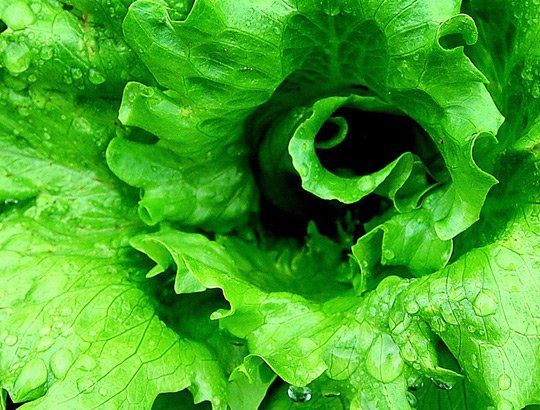
Salad: not just lettuce any more.
Andreae Prozesky is in her winter salad days.
When the festivities have wound down and the last of the truffles has been eaten, when the cherry cake has all but vanished and you realize that the only non-alcoholic beverage you’ve consumed all week has been gravy, it’s time to take a step back, drink four glasses of water or so, and have a nice, wholesome salad.
As difficult as it is to admit at times, a body needs vegetables to keep itself ticking along. Fruit is pretty important, too, and no, carrot cake and candied cherries don’t count.
That’s all fine and good in the summer and fall when market stalls and roadside stands are brimming with fresh greens, but what to do right now, in the frozen season? It’s so… blah. Limp, sad lettuce slowly drowning in the mist of the produce-section spray hoses, slimy of leaf and brown of stem. Plastic bins of salad greens can be okay, but they have their flaws. The small ones are expensive, and the large ones are just too much for a single person (or even a small family) to tackle. The spinach turns to sludge within days, rendering the rest of the leaves virtually useless.
Who among us has not tried to pick all the slimy spinach bits from a bin of otherwise okay salad greens, only to toss the whole thing away in disgust after ten grueling minutes and no great progress?
In my mind, salads divide themselves into two camps: winter and summer. Winter salads are sturdy and nutrient-rich, and perfect for helping you steel yourself against the icy wind; summer salads are fluttery and light, lovely for lunch on scorching days when it the very thought of hot food makes a person tired. While summer salads serve as refreshing tonics, winter salads will have you filled up and fortified. Summer salads take no time to make and must be eaten immediately, before they go flat and floppy. Winter salads take longer to put together, but they last longer, too, and many can be packed for lunch and picked at for snacks over the course of a number of days.
In summer, salads are composed primarily of greens, but in winter I prefer to make them with rice, lentils, or some other grainy, starchy foodstuff. It’s cold out there, after all. I also like to throw in fruit, probably because I seem to need sweet food more in the winter than I do in the summer (perhaps it’s to help ease me off the Christmas sugar high). Apples are good right now, pomegranates are enjoying their season, and citrus fruits are plentiful. Dried fruit like raisins, currants, and dates are salad staples for me. I also throw nuts and seeds in just about anywhere I can. Sunflower seeds and pumpkin seeds add life to a potentially drab salad, while almonds, pecans, and walnuts do wonders for texture (and add piles of nutrients).
If you want some greenery in your salad, but don’t want to buy the plastic bin stuff, you can do one of two things. With a few days of forethought you can grow some of your own sprouts, which is fun, cheap, and educational (search on thescope.ca for some advice.) Or you can find someone else to do it for you. Bloom’n Shoots sells (and delivers) bags of organic micro mix, which is kind of like sprouts, only the shoots are a little bigger and the roots aren’t attached. The bags of mix include shoots of, in alphabetical order, arugula, beets, broccoli, buckwheat, cabbage, chard, cress, herbs, kale, mustards, oracle, pea, radish, and sunflower. If you’re in town, you can contact Bloom’n Shootsperson Sarah at stokedjoy@hotmail.com to arrange a little micro mix distro. Bloom’n Shoots also sells pea shoot growing kits; pea shoots are incredibly tasty and would rock the heck out of any salad.
For salad dressing, I usually make a simple vinaigrette. And I mean real simple: I take a jam jar, pour in a half-inch of balsamic or red wine vinegar, pour an inch of oil on top, add salt and pepper, screw on the jar lid, and shake. In ambitious moments, I’ve been known to add some combination of the following: crushed garlic, honey, Dijon mustard, fresh herbs, maple syrup, orange or lemon or lime juice, curry paste, and ginger. But I always stick to the one-part-vinegar-two-parts-oil formula. I usually use straight olive oil, but for lighter-flavoured salads I sometimes substitute part canola or grapeseed oil. Olive oil has a certain gravity to it that is not always appropriate. Even in St. John’s in winter.
SALAD IDEAS
I’ve never once measured what I’ve put into a salad. And I don’t think I’ve made exactly the same salad twice. I’ve tried, but it’s just never happened.
Brown rice and quinoa salad
In one pot, cook one cup brown rice according to package directions. In another pot, cook one cup of quinoa according to its package. When cooked, combine the two grains. When cool, add diced orange (or one tin of mandarin orange sections), chopped dates, a handful each of raw cashews and raw pumpkin seeds, diced red pepper, diced red onion, snipped green onion, salt and pepper. Add red wine vinaigrette to coat.
Lentil walnut salad
Cook one cup French lentils (“Dupuys” lentils) according to package directions. Cool and add one diced apple, a handful of currants, and a handful of chopped walnuts. Make a balsamic vinaigrette and add a couple tablespoons of pomegranate molasses. Garnish with pomegranate seeds if you can get your hands on some.
Leafy winter salad
Buy some of the plastic bin greens labeled “fresh herb mix” (both the big grocery store chains carry them). Grab a big bowlful and top with diced tart apple, diced white cheddar, toasted pecan halves, and balsamic vinaigrette.
Composed grapefruit salad
Slice an avocado into a bowl. Add the segments, membranes removed, of one red grapefruit. Top with sprouts or micro mix, and squeeze the juice from the remaining grapefruit over top. Drizzle with olive oil and flavour with salt and pepper. If you can afford blood oranges, they are a great addition to—or substitute for—the grapefruit.
Send your questions, comments, and suggestions to dreae@thescope.ca
Foody gifts
Thu, Dec 18, 2008
Andreae Prozesky keeps the cookies in Christmas.
I know there are a lot of haters out there when it comes to this whole Christmas racket. “It’s all so commercial!” they despair, like Charlie Brown before Linus goes all Gospel of Luke on him. Did I ever tell you I was Linus in my grade-five production of A Charlie Brown Christmas? True story. And I rocked it. I am, and always have been, a dedicated fan of the holiday season.
My heart grows three sizes just hearing Dean Martin croon, “It’s Beginning to Look a Lot Like Christmas,” and positively explodes by the time I get to all the Whos down in Whoville with their “Dah who dor-aze” and whatnot.
I flippin’ love it.
This is not to suggest, however, that I’m one of those people who goes out and gets all her shopping done in October. Or in November. Or that I even shop much at all. I buy a few sparkly things for the resident princess-ballerina-fairy obsessed little girl, and I troll the Christmas fairs for cool, handmade local goods by our city’s fine craftspeople, but when that’s done I go home and make up a grocery list, pick out some recipes, and get busy in the Food Nerd Laboratory.
In a season of commercial frenzy and grown-ups having meltdowns in traffic from Stavanger to Kelsey, my kitchen is an oasis of floury calm. And yours, my friend, can be one too.
I’m a big fan of the edible gift. I like giving food, and I like getting food. After all, Christmas is a foody time. Whether you’re attending a family dinner for 25 or sitting down to watch Rudolph alone with a nice glass of wine and a full box of Toffifee (as I’ve been known to do), it’s all about savouring the deliciousness of the season. Plus, you know, there’s that seven pounds you’re supposed to put on every winter to help get you through the cold, damp, bone-chilling days between now and April. If you haven’t gained that much by New Year’s, you’re totally going to freeze. Seriously. In that light, isn’t a gift of buttery, buttery shortbreads as good as a sweater? Certainly tastier, no?
Of course, if you’ve got people on your list who are going to give you grief over a delicious, home-made treat of a Christmas gift, then knock them off your “to-cook-for” list. I don’t want your efforts in the kitchen to go unappreciated. Your fifteen-year-old nephew isn’t likely to be all that impressed by a jar of chutney, no matter how artfully you’ve balanced its acidity and sweetness. Get him a gift certificate for Fred’s or something. Buttery, buttery shortbreads won’t go over too well with your vegan sister or your wheat-sensitive mother-in-law either, but non-dairy coconut truffles just might do the trick.
You won’t be the only one giving gifts of food, I promise. There are people out there signing one another up for cheese-of-the-month clubs as I type. Jars of exotic jams are resting on mounds of straw in fancy gift-baskets like shiny, bright-hued eggs in overpriced nests.
On a recent trip to a certain giant bookstore (might I call it a biblioplex?), I spied harried shoppers picking up fancy gifts of—I’m not kidding—’smores-making kits. That’s right, some graham crackers, marshmallows, and chocolate in a box. At $12.99 a pop. For that price, you could assemble the same thing using gorgeous fair trade organic chocolate. If you wanted to go all fancy-like you could even make your own marshmallows. My, um, colleague, the venerable Martha Stewart, has a much-loved recipe over on her website. I’ve never made them, but I’ve always wanted to. Perhaps this is the year. I do enjoy a good feed of ’smores.
If you’re worried that people will be disappointed that you’ve given them a gift that won’t last forever, don’t be. They won’t be disappointed. Chances are, they’ll be grateful. It means they won’t have to worry about dusting off that mantelpiece ornament every time you come over. They won’t have to run to the very ends of town trying to find something worth spending that gift card on, among all the other people running around trying to find things to spend their own gift cards on. They won’t have to live in fear of the heartache of snowglobe-breakage.
See how you’re improving the lives of the people you love? Not to mention improving your own life.
Making homemade presents in your very own kitchen means not having to set foot in the mall through the entire holiday season. You can avoid Stavanger, you can avoid Kelsey, you can make your own hours and you can do it all in your slippers, if you like, watching A Charlie Brown Christmas and getting down with the true spirit of the season.
—
A few gifty, foody ideas…
When you’re making food gifts, make sure you take any allergies, sensitivities, or other dietary concerns into account. There’s no sense messing up dishes to make presents that people aren’t going to be able to enjoy.
There are plenty of gifty-type recipes in the Food Nerd archives on The Scope site. Here are a few:
• granola, in individual jars or bags
• truffles
• peach-rhubarb chutney (you can substitute tinned peaches and frozen rhubarb in the recipe)
• pumpkin chocolate-chip cookies (these are great to give someone to put in their freezer for post-Christmas detox)
• the infamous golden fruitcake, if your loved ones are that way inclined
There’s always room for the semi-homemade gift. One easy one is marinated olives. Pick up some choice-looking olives, drain them, and soak them overnight in lemon juice. Drain the juice, and divide the olives among gift-sized jars (I use 250 ml jam jars). Add to each jar ¼ teaspoon hot pepper flakes, one peeled garlic clove, and a bay leaf. Top them up with olive oil and you’re done. You can do the very same thing with plain canned artichoke hearts, too.
One last one: hot nuts. Fun to say, easy to make, awesome to eat. In a bowl, beat one egg white until frothy. Add a big pinch of coarse sea salt, and whatever spices you enjoy—cayenne, cinnamon, allspice, coriander, curry powder, whatever—to a total of, say, 2 teaspoons. Add a teaspoon of sugar if you like. Toss in about 3 cups of nuts—pecans, cashews, almonds, or peanuts if you’re on a budget—and bake, on an ungreased pan, at 250F for 25-30 minutes, stirring once or twice. Let them cool, package them up, and enjoy a week of holiday mirth and hot nuts jokes.
Send your questions, comments, and suggestions to dreae@thescope.ca
Cornbread stuffing
Thu, Dec 4, 2008
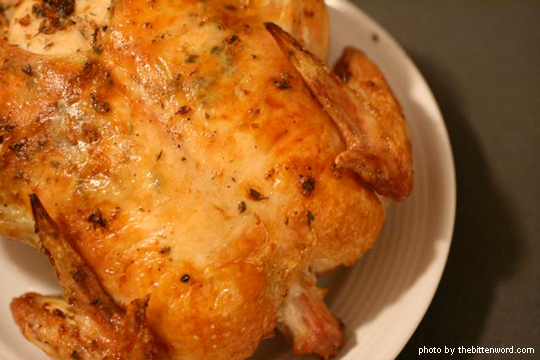
Andreae Prozesky chickens right out.
As the dark days close in, as the frigid north Atlantic winds find their steely way down the backs of necks and up coat sleeves, as the pre-holiday madness fills up calendars and drives the citizenry to distraction, there’s one thing that can make it all right.
That thing is a nice dinner of roast chicken.
Unless you’re a vegetarian, of course. Then it’s a nice dinner of roast squash. Don’t worry, I’ll get to that at the end.
Around the Food Nerd labs, we roast a chicken about once a week. It’s a pretty cheap and satisfying meal, especially if you manage to snag your chickens when they’re two for the price of one. The two-for-one local chicken phenomenon happens at all the major grocery shops in town, and it seems to follow some kind of pattern, but I can’t tell what that pattern is. I suppose I could ask someone over at Country Ribbon or wherever, but that would take the mystery right out of it. And then where would I be?
A lot of people seem to think of roast chicken as a time-consuming, we’re-having-people-in kind of thing. Roasting anything has a bit of a Sunday-dinner-ish-ness to it, yes, but really, there’s no work involved. You chuck the salt-and-peppered chicken into the oven, walk away for a while, then remove it from the oven and dig in. Mash some potatoes, steam some greens, and you’re rockin’ your dinner in a most homestyley fashion.
An unstuffed chicken is plenty functional, but I tend to fancy it up a bit. Last month, for instance, I made a miraculous discovery. For the first time, I experienced the joy of cornbread stuffing. I had read plenty of recipes for it, but I had never actually made it, or even tasted it. Oh how my life has been wasted!
I have a horrible habit of making cornbread and then only eating half of it. My favourite cornbread recipe doesn’t divide well, so doing a half batch doesn’t work, and it’s not nearly as good the next day as it is when it’s just out of the oven. So I end up tossing out half-batches of cornbread, or sticking them in the freezer so I can throw them out eight months later, all dried up and freezer-burnt and sad.
Throwing away food hurts my soul, especially food made with wholesome ingredients in my very own kitchen. It seems so ungrateful. Times being what they are, with the global economic downturn and all, I’m in full waste not, want not mode. So I looked up some recipes, tweaked a little, meddled a bit, and now, several chickens later, I’m a convert to the cornbread stuffing way of life. It’s tasty, it’s got textural oomph, and the gold colour looks gorgeous against the brown tones of the chicken.
One other thing I’ve learned to do when roasting a chicken is to crank up the heat. For some reason, probably due to my lifetime of muffin- and cake-makery, I cook just about everything at 350F. It’s my go-to oven temperature. But a chicken wants to be thrown in there at a good 450F, or even 475F if your oven is clean enough to go that high without setting off the smoke alarm. Mine is only ever that clean for about one week a year, but maybe you’re a more disciplined oven cleaner than I.
A chicken roasted at a nice high temperature will yield a crispy bronze skin and plenty of nice brown sticky bits on the bottom of the pan should you choose to make gravy. I don’t usually bother, but I should, given my waste not, want not campaign. One should never be wanting for gravy, and those sticky brown bits are so very, very tasty.
Chickens don’t need regular basting like turkeys do, although when I’m roasting a chicken I do usually pull it out partway through and spoon a bit of the fat from the pan over the top of the chicken, just because I like doing it. There are times when I don’t bother, or when I’m too busy, and it doesn’t seem to make any difference in the end. An average-sized chicken, well stuffed, takes 45-60 minutes to roast in a 450F oven; you can check doneness by piercing the thickest part of the breast with a sharp knife. If the juices run clear, it’s dinner time.
I’ve included the cornbread stuffing recipe below. If you’re a vegetarian, try using this stuffing to fill a nice winter squash: cut the squash in two, scoop out the seeds, heap in the stuffing, and roast the halves at 400F for 45 minutes to an hour, or until the flesh can be easily pierced with a knife. You’ll likely want to leave out the bacon too, and I would suggest putting in a handful of pan-toasted, coarsely chopped hazelnuts in its place. Sauté your onions and apple in 2 tablespoons of olive oil in lieu of bacon fat.
—
Cornbread stuffing
Makes enough for two average-sized chickens, or six acorn squash halves.
2 strips of bacon, chopped
one small onion, finely diced
one apple, diced
¼ cup butter
3 cups crumbled cornbread*
1 ½ teaspoons Mt. Scio savoury
½ teaspoon salt
pepper to taste
Preheat oven to 350F
In a large pan, cook bacon over medium heat until crispy. Remove bacon to a large bowl. Cook the onions on the bacon fat until translucent, about 5 minutes (if this grosses you out, remove the bacon fat and use olive oil). Add the apples and cook, stirring, another two minutes. Add butter to melt.
Add the crumbled cornbread to the bowl with the bacon. Pour the onion-butter mixture over top and stir to combine. Mix in savoury, salt and pepper.
Extra stuffing can be saved for future chickens, but make sure you keep it in the freezer, not the fridge. If the spoon you were using to stuff the chicken went back and forth between the chicken and the bowl you want to be careful of food poisoning.
*If you don’t have a good cornbread recipe on hand, you can use the recipe for berry muffins with quinoa and cornmeal I wrote on a few months back. Just leave out the berries, and swap the honey for one tablespoon of sugar. Bake the batter in a square pan about 35 minutes. You can find that recipe here.
—
Send your questions, comments, and suggestions in lieu of bacon fat to dreae@thescope.ca
Photo by thebittenword.com
Wildly Wholesome Pumpkin Chocolate-Chip Cookies
Thu, Nov 20, 2008
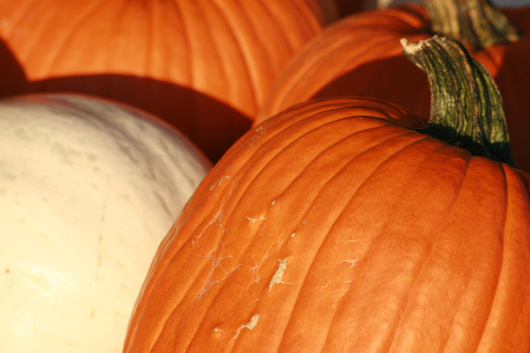
Andreae Prozesky takes the pumpkin back.
As we near the end of November, all but the last traces of smashed jack o’lanterns have been rained off the city’s sidewalks and front stoops. The last survivors may indeed be the ones slowly decomposing outside my front door. Fine food for slugs, but I’ll pass. Our local American expats will likely be making a pie or two for their Thanksgiving dinners, and then pumpkin season as we know it will be well and truly over. (more…)
Homemade yogurt from purchased yogurt
Thu, Nov 6, 2008

Andreae Prozesky, like her yogurt, is well cultured.
If you know me, you’ll know that I’m not someone who identifies as hippie-like. I prefer my clothes crisp, my jewellery un-hempen, my hair tidy, and my shoes free of cork.
But when it comes to food, I have to admit that I lean a little towards the hippie direction. As if the home-made granola didn’t tip you off. (more…)
Applesauce fruit bars
Thu, Oct 23, 2008
Andreae Prozesky breaks out the super mega awesome fruit bars.
I know that I’ve been churning out a lot of wholesome-snackey-bakedgoody recipes these days. I’ve got a couple reasons.
First, it’s getting colder out there, and that just makes me want to bake nicely spiced, warm-you-through cakes and cookies and bars and such. Change of seasons and all that. I live in a virtually un-heat-able old house, and having the oven on means that at least one room feels cozy.
Second, I have a school-age youngster, and if I send her off to school with some store-bought snack full of high-fructose corn syrup and artificial flavour, she’ll be totally wired from recess until dismissal, and it’ll be one of those “bad listening days” where I have to give her a talking-to about her behaviour, knowing all the while that it’s my own stupid fault for sending her to school with the chocolate-dipped, marshmallow-studded granola bar in the first place. Hardly seems right to discipline a five-year-old when I’m the one who’s supplied the ammo for her kindergartenly defiance. As a result, I’ve been inventing snacks that she can take with her and that she’ll actually enjoy. I’m pretty sure that the window of time during which she believes me when I say that homemade is better than store-bought is swiftly closing, and I’m trying to get as much good snacking in as I can before the grocery-aisle fights begin. (more…)
How to support a breastfeeding mom
Thu, Oct 9, 2008
Congratulations, Andreae! It’s a boy!
If you are reading this, I’m officially a mother of two.
If memory serves me from the last time around (a foggy five years ago), I’ll be trapped under a voraciously breastfeeding infant for about sixteen hours a day when this column goes to press.
And that’s okay with me. (more…)
Beet vegetable soup
Thu, Sep 25, 2008
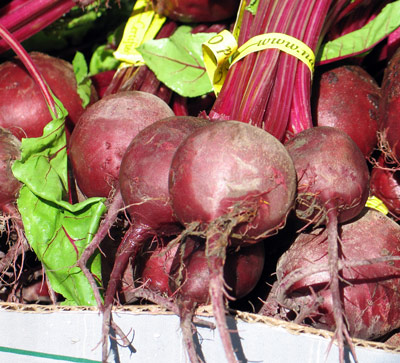
Andreae Prozesky tames the savage beet.
It’s been a while since I went on about my love of beets, hasn’t it? Oh friendly beet, you sweet, red heart of loveliness, with your delicious wine-veined leaves and burgundy-bleeding stems! How I love thee! How I am going cracked at farmers’ market and grocery store alike, eager to eat as many of you as I can while you’re still sugary and fresh from the ground! Oh, bounty!
Yes, they taste like dirt, but in a good way. (more…)


Thu, Apr 23, 2009
Andreae Callanan