

Archive | Food Nerd RSS feed for this section
Florentines
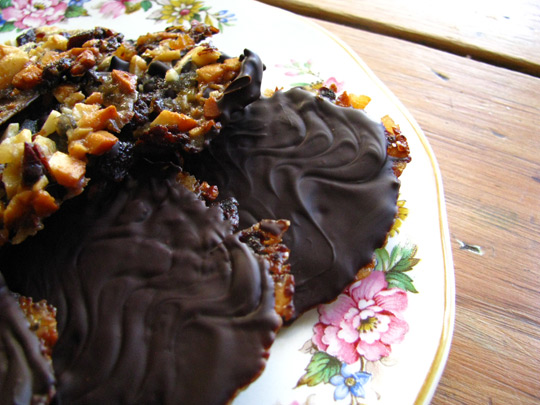
Photo by Andreae Callanan
Andreae Callanan keeps cookies in Christmas.
By the time you read this, it will be December. As I write, though, the St. John’s Christmas Parade hasn’t yet happened. It’s an unseasonably warm November day. Still, according to Facebook, four people I know have already put up Christmas trees. In their houses. On purpose.
When I was a kid, I’m pretty sure we never had the tree up more than a week before Christmas. The needles would have fallen off, for one thing. I don’t even think you could buy Christmas trees earlier than the middle of December back then. I know that loads of people have the pretend ones now (although unless you have a deadly spruce allergy, I really can’t understand why), but really, settle down. The ornaments will be all dusty, and the cat will have eaten your tinsel by the time Christmas actually comes. Besides which, we’re Newfoundlanders, and are obliged to keep our trees up until Old Christmas Day.
Even if you wait until the first of December, that’s five long, needle-shedding weeks. Think about it.
This is coming from someone who goes completely insane about Christmas. I love it. I love everything about it: the decorations, the presents, the shopping (to a point, mind you), the wired children bouncing around the house, the family gatherings, the parties, the television specials, the music, the food, oh the glorious, glorious food! I love hanging stockings by the chimney with care, I love ding-dong-merrily-on-high and fa-la-la-la-la-la-la-la-la.
I also really, really love cookies.
I started baking Christmas cookies on my own when I was in high school and living with my father, who “doesn’t do Christmas.” Well bah and humbug to you, sir. Armed with cookbooks and a great deal of butter and flour, I made some of my family’s classics, like shortbreads, and invented some recipes of my own, like my half-moon-shaped chocolate-dipped orange-zest sugar cookies.
When I hit university and had my very own kitchen, I started churning out batch upon batch of Christmas cookies, and would do up little gift bags for my friends. Since I was studying literature, I never had much in the way of final exams, so I would finish school while my friends were still cramming away. I would bake busily, and they would snack hungrily. Cultural exchanges were made, and I got to go to some rockin’ Hanukkah parties, and a few swingin’ Solstice celebrations, further strengthening my theory that all people, when they find themselves in the dark and cold, are compelled to eat stupidly rich treats and light candles. We may come up with different reasons for it, but really: dark and cold. Need I say more?
When it comes to selecting cookies to bake, I go about it systematically. The way I see it, there are six categories of Christmas flavours: buttery, chocolatey, fruity, nutty, spicy, and citrusy. The six flavours can be combined—as in the recipe for Florentine cookies here—but they must all be equally well-represented. And Christmas cookies for me have to be “shaped” cookies, which means that they’re either roll-out cookies that I then go at with the cookie-cutters, or they’re the sort of cookies made by rolling balls of dough in your hands. This is probably because Christmas is the only time I could be bothered with the tedium of rolling a triple batch of cookie dough into ¾-inch balls.
Last year, I slacked on the cookie baking. I had just put my daughter on a gluten-free diet and really didn’t have what it would take to convert all my favourite recipes to weird and unusual flours. I also had a three-month-old baby glued to me, so that didn’t help. Now, though, I’m excited to get back at it. I was cracking out the old Christmas cookie magazines this year on Labour Day weekend. Does that make me worse than the November tree-putter-uppers? Perhaps. Except the cat won’t be eating my tinsel.
•••
Florentines
There are many variations on this recipe; mine is based on ones I used to eat in a Greek café where I worked in Montreal. Flourless nut wafers studded with dried fruit, suspended in caramel, and coated in chocolate. Yum. Makes about 36 cookies
1/2 cup slivered almonds
1/4 cup dried cherries
1 tablespoon candied citrus peel
1 tablespoon raisins
1/4 cup salted butter
1/4 cup sugar
1 tablespoon whipping cream
4 ounces good chocolate
1. Preheat oven to 300F. Line your baking sheets with parchment paper. (The cookies will never come off if you don’t!)
2. Roughly chop almonds. Finely chop cherries, peel, and raisins. Combine in a medium bowl.
3. In a small pot, melt butter. Stir in sugar until dissolved. Bring to a boil for one minute, until mixture begins to turn golden.
4. Add sugar mixture to nuts and fruit. Add cream. Stir well. This will not look like any kind of cohesive dough, just a bunch of sticky stuff in a bowl.
5. Using a teaspoon (as in a measuring spoon), make little mounds of nut mixture on your parchment-lined sheets. Leave plenty of space – no more than 12 cookies per sheet. Flatten slightly.
6. Bake about 10 minutes, turning sheets halfway through, until mounds have spread out into circles and are bubbling, with slightly darker edges. Remove sheets from oven and let sit several minutes before carefully removing cookies to a rack to cool (you’ll want a thin-edged spatula for this).
7. When cookies have cooled completely, melt chocolate in a double boiler, and use a spoon to cover smooth sides of cookies in chocolate. Use a fork to make the traditional “wave” pattern in the chocolate. Let cool completely and enjoy. Keep cookies in a tightly sealed container in the fridge, but try to let them come to room temperature before eating.
Peanut sauce
Thu, Nov 19, 2009
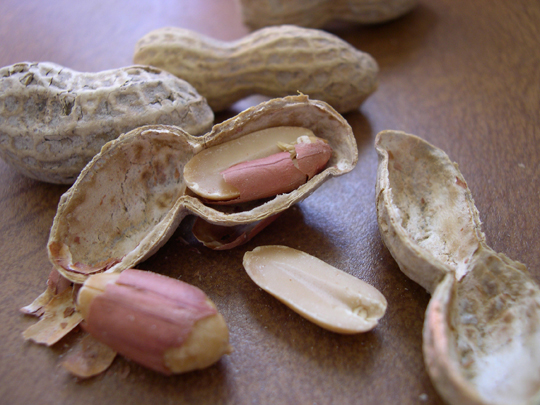
Can’t we all just get along?
You know what’s good? Peanut butter. Well, anything with peanuts, really. Most of us know this, but it hadn’t occurred to me just how good peanuts are until I received, honest to goodness, an e-mail from a national peanut marketing group with some good-time holiday peanut recipes, suited to these tough economic times. Now, I’m not in the employ of said group, but I do like peanuts, and their buttery, buttery sandwich-spread incarnation, and I’m going to declare it to you all.
When I was in elementary school, I ate a peanut butter and jam sandwich on whole wheat bread for my school lunch every day. Every day. My daughter’s school is peanut-free, so I can’t send the same predictably delicious lunch with her, and as a result we really don’t have peanut butter around all that often. Or bread, for that matter (I’m still working on finding a gluten-free bread recipe that the child will eat). If my dedication to peanut butter has waned in the age of the school lunchroom peanut ban, I wonder how many other peanut butter lovers are passing through the sandwich-spread aisle and foregoing that most luscious and mouth-stick-togethery of toast accoutrements?
Of course there’s the allergy issue. The latest stats suggest that about 4 per cent of us have food allergies of some sort. That may not seem like a lot, but it means that you probably know at least a couple people who have to steer clear of the Cracker Jack. And that every school has its allergic contingent. If you’re a parent of non-allergic kids, you’ve probably had your moments of being overly hard on the parents of kids with food allergies, who are perceived as being the force behind the lowly peanut’s troubles (and your lunchtime dilemmas). But you’ve got to cut the parents some slack. I like to think I’m a pretty level-headed person, but still and all if I were convinced by my doctor that my child might stop breathing if the youngster across the table ate a handful of Reese’s Pieces, I might behave in a, shall we say, hyperprotective fashion. Breathing is pretty important, even for children.
The truly annoying thing about the media exuberance over deathly peanut allergies is that the hoopla undermines the difficulties that the small but significant number of food-allergic folks experience. If people pipe up about their allergies these days, they’re as likely to get a response of, “Oh, you’re one of those, are you?” as anything else. But people with food allergies, believe it or not, aren’t actually out to make your life complicated. They just want to be sure that the sandwich they ordered isn’t going to land them in Emergency. Is that entirely unreasonable?
So it is with this qualification that I call upon the peanut lovers of the world: express your peanutly passion, yes, and express it exuberantly. But don’t send peanut-containing lunches to your kids’ school (you’re not being revolutionary, you’re putting other people’s kids in danger—stop it), don’t bring peanuts to a potluck unless you know it’s okay, and if you’re having people over for dinner, ask them whether they have any food sensitivities. They’ll be happy you asked, and you’ll be happy to make a dinner that everyone can enjoy.
And if you’re among the 96 per cent of people who can eat anything you like, including peanuts, with abandon, then you might want to put this peanut sauce recipe into regular rotation at your house. It’s awfully delicious, full of protein, easy to make, pretty cheap, and is just as good hot as it is cold. I usually throw it on noodles, but it’s just as good over rice, with chunks of grilled chicken or tempeh (if you can get your hands on it), and the odd vegetable wouldn’t go astray in there, either. This recipe got me through my college years, and I’m happy to rediscover it now. Thanks for the note, peanut-marketing people! I’ll buy extra peanut butter now, for those who can’t.
—
Peanut sauce
There are a bazillion different recipes for peanut sauce out there, but this is the one I survived on for about three years. Now that I have youngsters, I cut the chili paste way down, but you can bump it up as much as you like.
(makes about 1 1/4 cups)
1/2 onion
2 tablespoons fresh ginger, grated
3/4 cup natural peanut butter (as in “no salt, no sugar”)
3 tablespoons tamari (or soy sauce)
1 tablespoon honey
2 teaspoons rice vinegar or apple cider vinegar
1/2 teaspoon chili paste (sambal olek), or more to taste
1/4 to 1/2 cup boiling water, as needed to reach desired consistency
Mince your onion very, very finely. If you have a food processor, now is the time to use it.
Put onion and ginger in a large bowl and add peanut butter. Smush it all together with a rubber spatula.
Smush in tamari and honey, then stir in vinegar and chili paste.
Add water, a bit at a time, until an appropriately saucy consistency is reached.
This is great over a stir-fry, but don’t pour it directly into the hot pan—the honey will caramelize and give it a weird taste. If you want to use the sauce as a dip for salad rolls, add a little more water. Or you can toss it with cooked noodles and serve it with some more chopped peanuts or toasted sesame seeds on top. If you have sauce left over, it will last in the fridge for up to a week.
Panna cotta
Thu, Nov 5, 2009
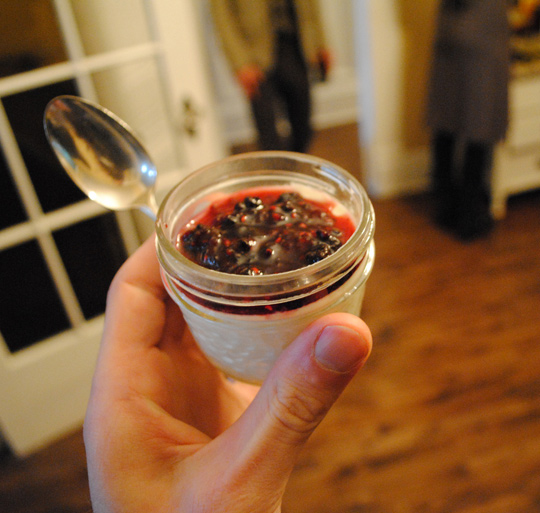
Panna cotta da vida, baby.
So, you may have noticed that I’m going by a different surname these days. Yes, the ol’ girl done got herself hitched. And she’s traded in a big pile of consonants for a lot of extra As.
And so, hearing this news, you may ask yourself, as many of my acquaintances have, what does a Food Nerd serve at her wedding?
Well, if you have visions of a multi-course, sit-down dinner, with me calmly juggling bridal bouquet and tray of chanterelle-stuffed vol-au-vents, then you must be thinking of some other food writer. I’ll admit that when this whole wedding idea got cooked up way back when (it’s been a lengthy engagement… so lengthy that I’ve been referring to my husband as my husband for about a year and a half), I was a little control-freakish about the menu.
But then reality caught up with me and I had to admit that a woman with two youngsters and various jobs just shouldn’t try to handle a wedding’s worth of food on her own.
I am damned lucky, let me tell you, to have family and friends who are as happy in the kitchen as I am. People who, from the moment the wedding was announced, asked, “What can I make?”
I come from a line of food lovers, and whenever there’s an event of any sort, we’re driven to cook something. It’s just how we are. If you should ever find yourself throwing a wedding, and someone asks if they can help with the food (and you’re not tied to a caterer, naturally), say a great big “yes.” As long as they know what they’re doing, of course. Which, more often than not, they actually do, or they probably wouldn’t be offering.
As a recently-wed person, I can tell you that no matter how capable you think you may be, the week before your wedding is no time to be roasting all manner of roast beasts and wrapping pastries and making hors d’oeuvres. You will have other things to do. Best leave the cooking to someone who isn’t about to, you know, get married.
So here’s how the whole thing went down. We opted for a nice, cozy afternoon wedding at a family home, and after a short-ish ceremony we all tucked into a great array of finger foods—wonderful bread, cheeses and olives and pickles and grapes and figs (yes, I braved Costco), thinly-sliced turkey and ham and roast beef from various family ovens, ridiculously delicious spanikopita, wonderful spicy meaty nibbly things.
And the cake? My life-long friend and soul sister Meghan O’Dea (of Pi fame) made what might have been the most deliciously dense, chocolate-full, fudgefully-frosted wedding cake in the history of the sport.
Throw some wine on top of all that, and I ask you: is there a better feast? No having to worry about seating plans or which bits of cutlery to use, and we got to mingle with our guests while hanging on to our little plates and wondering where we left our wine.
It was a proper party, no stress, no pressure, no wedding-day freak-outs.
Did I really leave all the food up to my friends and loved ones? Well, I figured I should pitch in a little—it is, after all, what I do.
So, on the night before my wedding, while other women might be flitting in hennish flocks through the streets of downtown, or drinking fluorescent shooters in some sticky bar, I was at home, making six dozen servings of panna cotta.
To be fair, my husband was up half the night making Ultimate Wedding Mix Volumes One and Two and printing programs, so it all came out even.
Panna cotta, if you’ve never had it, is a lovely dessert of Tuscan provenance—basically sweetened cream set with gelatin. I know, that sounds kind of weird, but trust me, it’s awesome. It’s as rich as ice cream, as smooth as custard, and miraculously light for something that’s made of, you know, cream.
It’s always a favourite of mine when I happen to be in a restaurant, but since that happens less and less these days, I decided to take matters into my own hand and learn how to make the stuff myself.
Well, it didn’t take much to figure it out. The recipe isn’t even a recipe really, just instructions. Honestly, if I could make 72 individual cups of panna cotta in an evening and still manage to get a decent night’s sleep, it can’t be all that hard.
For serving cups, I used 125-ml jam jars (apologies if you were trying to buy tiny jars last month—I may be the jerk who bought them all). They looked mightily cute, and the lids and boxes made transporting them from my house to the wedding site super easy.
And I can reuse the jars for everybody’s Christmas present preserves for the next three years, so it’s an investment.
Normally panna cotta would be unmolded onto a plate, but we kept it simple, eating panna cotta out of jars with a spoonful of berry sauce on top (Pouch Cove blueberries, Cape Spear blackberries, and Pleasant Street raspberries cooked with some apple jelly I’d made earlier in the fall). People loved it, and, at risk of sounding ridiculous, love is what the day was all about. Every 12-serving batch took a whopping five minutes.
I need to throw more big parties just as an excuse to do it again.
Hey, just eleven months until our anniversary…
—
Panna Cotta
1 litre coffee cream (18%)
½ cup sugar
2 teaspoons pure vanilla extract
2 packets unflavoured gelatin
6 tablespoons cold water
¾ cup fruit preserves of your choice
12 125-mL jam jars, or equivalent dessert cups
1. In a large bowl, sprinkle gelatin over the cold water and let sit while you heat the cream. Make sure that you sprinkle it evenly, without any big lumps, so that it will soften throughout.
2. In a large pot, stir together sugar and cream until sugar is dissolved. Heat until just below the boiling point – don’t actually let it boil. Remove from heat and stir in vanilla.
3. Pour hot cream mixture over softener gelatin, and stir until gelatin has been completely dissolved. Distribute the panna cotta evenly between the twelve jars or cups. Refrigerate at least four hours or overnight.
4. Before serving, top each serving with a tablespoon of preserves.
Food Nerd answers your science-y questions
Thu, Oct 22, 2009
Why doesn’t my whole wheat bread ever rise properly?
One of the things people ask me about this Food Nerd gig is, “Don’t you ever run out of things to talk about?”
Well… yes. And so I ask for help. Sometimes in person, sometimes over the phone, and, now, online. I was going to put out a call for reader questions, but I was afraid that nobody would ask me anything and I would look like a total knob. Hey, apparently it happens to everyone.
My pals came through, and now I have a whole pile of questions to answer. I’ve decided to group them thematically, under headings like, “Folks who can’t Eat Anything, and the People who Love them,” “Won’t Somebody Please Think of the Children?” and “Now, What am I Supposed to do With This?” But to start things rolling, here’s a bit of science because, really, it’s all about science, isn’t it?
•••
Why do recipes ask you to separate flour/dry ingredients from wet ones? Is it for the sake of the texture of muffins/cookies and the like, or for some other reason?
– Laura
It’s for a very good reason, I assure you. You’ll find this instruction mostly applies to muffins and “quick breads” like banana bread and zucchini loaf. The reason they’re called “quick” is this: their leavening (rising) action comes from baking soda or baking powder, and it’s pretty much instant. Baking soda starts to work when it comes in contact with some nice acidic liquid, like buttermilk or lemon juice. Baking powder has built-in acid (more on this later), which kicks in when you mix it with any wet ingredient. The reaction is the same as when you did the volcano experiment back in school: acid plus base makes gas. The flour and eggs and everything else in your batter trap the gas, and the muffins puff up nicely.
The whole thing happens fast. Double-acting baking powder draws the process out by kicking in as soon as it gets wet and then oomphing up again once it is exposed to heat, but even with the double oomphing, if you let your batter get a little bit wet, and then add in some more dry ingredients, and fiddle back and forth, most of your leavening action will have burned itself out by the time you get your muffins into the oven, and you’ll end up with hockey pucks.
There’s a second reason, too. Muffins are fairly delicate goodies, and will turn out tough if you stir them too much. I’m sure most of us have done this at some point. Stirring encourages the development of gluten, which is awesome when you want a big fluffy loaf of bread, but bad if you want a nice, crumbly muffin. If you have all your dry ingredients together, and then add all your liquid at once, you can stir your batter with just a few quick strokes and you’ll have delightful, airy muffins instead of dense, doughy ones.
•••
Why doesn’t my whole wheat bread ever rise properly?
– Susan
Um… that depends on what you mean by “properly.” Whole wheat bread never rises the way white bread does, because white flour is lighter, finer, less oily, and, let’s be honest, full of nothingness. The bran, oils, and general wheat-ness of whole wheat flour weigh everything down and prevent gluten strands from forming with wild abandon; in white flour, gluten strands grow uninhibited, and that’s what allows the bread to fluff up so much. Floofy breads that claim to be 100% whole wheat generally have piles of junk in them to help them rise up in this most unnatural fashion (just check out the ingredients list).
If you’re using a recipe meant for white flour, you might have to increase the amount of liquid you use; whole grains are thirstier than refined ones, and bread without enough liquid will end up suitable only for construction or hand-to-hand combat. Whole grain flours go rancid very easily if they’re not refrigerated, so make sure your flour is fresh, and keep it that way in an airtight container in the fridge or freezer. If neither of these things seems to be the trouble, try substituting warm soda water for the liquid in your recipe: the carbonation might give your bread that extra lift it needs.
•••
What the heck is cream of tartar and can I just use baking powder instead?
– Gay
Don’t do it, Gay! They’re not remotely the same! Put the baking powder down!
Actually, they’re not completely unrelated: in baking powder, cream of tartar (that’s potassium bitartrate, if you’re wondering) is combined with baking soda (sodium bicarbonate) so that there are both acidic and basic components: add any liquid at all and they’ll react with one another. But on its own, cream of tartar has no leavening power whatsoever.
What does it do, then? The main use is in making meringues and meringue-based cookies like snickerdoodles; the cream of tartar stabilizes the egg whites and keeps them from deflating too easily. It is also an important ingredient in some icings, like the relatively inedible sort you use on a gingerbread house. Baking powder would definitely not do in either of these recipes.
In case you’re put off by the cryptic name “cream of tartar” or by the laboratory-sounding “potassium bitartrate,” rest assured that the stuff is completely natural; it’s a byproduct of the winemaking industry. When grape juice ferments, white crystals precipitate out of it, and those white crystals, when refined, are what we know as cream of tartar. Nothing to be afraid of, and definitely useful to have around the house.
Gadgets, schmadgets
Thu, Oct 8, 2009
Show me the button and I probably won’t push it, says Andreae Prozesky.
I’m not a gadget person in the kitchen. Kitchen stuff always ends up as clutter, and I’ve moved enough, starting my kitchen from scratch each time, that I’ve learned how to get by with a frying pan, a bowl, and a couple forks. Even with the kitchen gear I’ve amassed, I end up using those three things more than anything else. The fork is the universal stirrer, whipper, smoosher, flipper, fisher-outer. I admire it.
Part of my reason for shunning kitchen gear is that I hate buttons.
Buttons on a kitchen appliance just call out, “I’m going to break. Probably within a year. Keep your receipt, and set aside bus fare to Canadian Tire.”
 This is the reason I haven’t had a toaster for two years. Every one I see has too many buttons. What happened to those slidy things that indicated “light” and “burnt,” and the up-and-down things to get your toast in and out? Was this technology imperfect? No, it was fine, and the appliance companies ruined it. I make toast in the oven now, and it works, so long as I don’t get distracted. It’s not the most energy-efficient way to do the job, I know, but it’s what I’ve got.
In terms of things that plug in, I have few. I have a waffle iron, and I love it. I really do.
I have put a price on the head of the mouse who has been nibbling my waffle iron cord, because if my waffle iron goes, I might never be the same.
I have a blender, and I love it perhaps more than I love my waffle iron, if only for its versatility. My blender is an Oster Beehive that I bought on eBay six or seven years ago. I wanted an old blender, precisely because all the ones in the shops had too many buttons. And little computers in them. There’s no reason for a blender to have a little computer in it. For sixteen US dollars and about the same in shipping, I got some wonderful lady’s old blender and the instructions and cookbook that came with it. The date on the cookbook is 1949, yet it has recipes for soy milk and soy loaf. Who knew?
Anyway, here’s the awesome thing about my blender: the threads of the blender jar are made to be the same as a standard-mouth canning jar. That is post-war American ingenuity at its best. Should you wish to, say, grind some coriander, you put your coriander seeds in a half-pint jar, screw the blender blade on to the jar top, flip it over, pop it on the blender, and flick the switch (there are no buttons, just an on/off switch).
If I want to be the most on-the-ball person on Earth, I can take a bunch of smoothie ingredients and put them in a pint jar in the fridge at night, and then, in the morning, I can pop the jar onto the blender and have my daughter’s breakfast made in 20 seconds. Stick a straw in the jar and I’m done. It’s kind of like that Magic Bullet thing they have on the infomercials, only sixty years earlier and made of metal and glass instead of plastic. And without the zombie infomercial people.
I know I can’t tell you to run out to the shop and pick up a blender from the 1940s, but if you’re someone who trawls eBay, keep your eye out. They come up fairly often, as do replacement parts (which I’ve never needed), and they never, ever die.
Now, I do have one exorbitant, indulgent appliance, but it was a birthday gift and I do use it all the time. The classic, the beautiful, the weighty KitchenAid stand mixer. There are other stand mixers out there, and they may be as good. I don’t know. But this one is iconic. And it was on sale. Score. There really was a need for it: I burnt out the motor of my little hand mixer a while back making gluten-free bread. If you’ve ever had the pleasure, you’ll know that gluten-free bread dough can be remarkably cement-like in texture, and you’re usually instructed to beat it for about 15 minutes in an attempt to incorporate some air into the stuff. Anyway, a couple rounds of that and my trusty hand mixer was reduced to a smouldering handful of warm petrochemicals, grinding and shuddering when I tried to coax it back into action. I did without for four or five months before the stand mixer appeared, all shiny and alien-head-looking. It is so oomphy. It cannot be killed by the most cement-like of dough. If it has one flaw, it is that the dimensions of the bowl prevent you from making small amounts of anything, like, say, one dollop of whipped cream. For that, I go low-tech and use my hand-crank egg beater (another eBay find, but I see them in stores a lot). Or I just dump the whole carton into the stand mixer and suffer the consequences of eating too much whipped cream. There are worse fates.
And you know what? I think that’s it. We have an electric kettle and a coffee grinder, and a clock radio. What a bunch of boring people! But we get dinner made, and that’s what matters.
Gadgets, Schmadgets
Here are the most important non-plugging-in kitchen things, according to me:
• Cast-iron frying pan (about $24 at Canadian Tire)
• Half-decent stainless steel pots (one big and one small)
• Good knives, although you really only need one good chef’s knife and one good paring knife. Those two can take care of everything if you don’t have a big kitchen budget.
• An enameled casserole dish or two. The LeCreuset ones sure are pretty, but there are lots of excellent cheaper brands out there.
• Thermometer for meat, deep-frying, yogurt-making, candy-making. I used to think I was too cool for one of these, but after wasting enough ingredients I’ve become convinced that I am not that cool after all.
• Wooden spoons, a whisk, a really nice thin-edged spatula, some slotted spoons, miscellaneous pans for baking and roasting.
Things I would really like, even though I don’t need them:
• A panini press, not one of the electric ones, but the stovetop kind with the ridged pan and the ridged, weighted lid. They are so cool.
• A cappuccino maker, because there’s only one place I can bear to drink the coffee around here and I’m usually home anyway.
• A marble slab for rolling out pastry, even though it’s not something I do all that often.
• A pressure canner. So I wouldn’t have to put two cups of sugar into every jar of jam I put away.
What’s in your kitchen? And what’s on your kitchen wish-list? Leave a comment below.
Spuds in a barrel
Thu, Sep 24, 2009
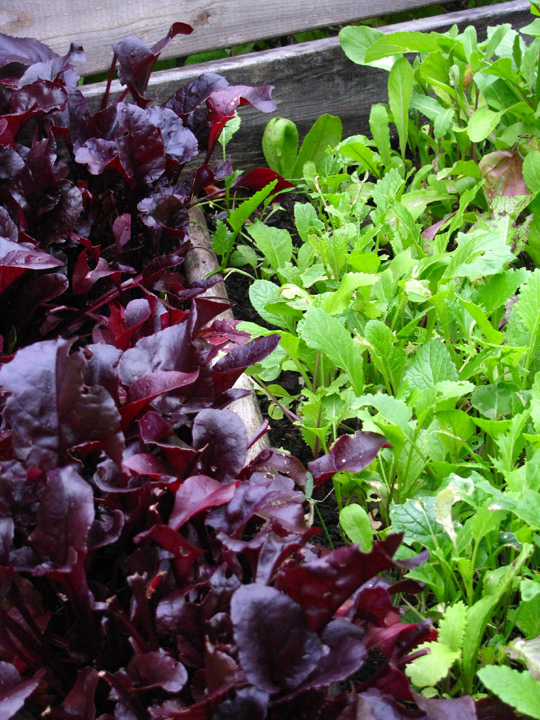
Photos by Andreae Prozesky.
A few weeks back, I waxed on about the magical world I inhabit in my mind, where our agricultural staples are grown right here in Newfoundland, and taste of the salty, capelin-enriched soil of backyard gardens and community veggie plots and small, diverse farms. I’m not saying we have to live without olive oil and chocolate and coffee and peanut butter. I’m not completely insane. But because I love food, and because I love Newfoundland, I really want to find a way to get as much of my food as possible from somewhere I could get to without having to board a plane or a ferry.
While I was writing that column, having just returned from my interview with the exuberant Andrea Maunder, I received an e-mail from my editor about the Eat Atlantic Challenge. Then, while I was still feverishly typing, I got a phone call from CBC Radio, asking if I would like to talk about local food on Crosstalk the next week.
I could hardly say no, could I?
I listen to Radio Noon a lot, usually while making lunch myself. I love that it’s open to callers from all over the province. Sure, it may be a fairly narrow demographic—people who are near both a radio and a telephone in the middle of the day—but it’s an interesting demographic. Some real characters come out whenever you want to talk about food.
There was the townie contingent, the individuals who work hard on committees and boards to help put community gardening back into the consciousness of the average city dweller. Sadly, but truly, many of us on this side of the overpass are complete novices when it comes to tossing a few seeds in the ground and eating what comes up. We don’t know what’s edible and what’s not along the paths and in the vacant lots, and we’ve shagged our soil up to such a degree with our lead paint and whatnot that it’s not fit to play in, let alone to grow a row of peas. We are, in many ways, stunned.
But the same cannot be said for the rest of the island.
One call I got on Crosstalk was from a man in a community of 180 people, who had a pantry the likes of which I dream about: bottled and frozen vegetables and fruit of all description, potatoes, turnips, beets, bottled moose and rabbit, fresh and salt fish. Another was eating homemade seafood chowder and a shrimp sandwich on his own homemade bread, all from fish he had caught or bought in his own community.
“All you have to do is just go down to the wharf and see what they’ve got down there,” he offered by way of advice.
Sadly, for those of us in town, there’s not much wharf action going on. So if you’re reading this around the bay, eat some mackerel for me, would you?
Here in St. John’s, we’re pretty much limited to what we can grow in bins and greenhouses. Last weekend, I took a little tour of a few gardens on the map published on the FEASt (that’s Food Education Action St. John’s) website. Open garden day? Yessir, even in the chilly drizzle.
My mom, my daughter and I set out on foot to take in five gardens in our neighbourhood, and was it ever-inspiring.
None of these five little gardens were being tended by award-winning veggie growers, and none of them were going to feed a family of four over a long St. John’s winter, but they were chugging along, providing greens and herbs and a few roots for the gardens’ devoted stewards. There was one raised bed in a front yard, and there were two in a back yard that was all but hidden by killer raspberry canes. One garden was in shared space behind a school, and another was a borrowed tangle of roses and gooseberries and tomatoes behind a house owned by a chef.
And one was perched on a deck, in handmade cedar and glass cold frames flanking a square-foot garden made from shipping palettes. What a lovely space that was. The recycled window panes shimmering with mist and the seedlings of the year’s last lettuce crop covering the black, wet soil. The cold frames were newly built over the summer, and the smell of the cedar was so lovely, I would have stayed all afternoon if my daughter hadn’t been threatening to eat all of our host’s otherworldly cookies.
I know this is meant to be a food column and not a gardening one, but when you think locally, you can’t really separate the two. Fall is in full swing, and this is harvest time, but for those of us who didn’t get a garden in this year, it’s time to take inspiration where we find it, and start planning for next time around. There’s a lot of garden downtime ahead, perfect for building window boxes and wooden bins, and dreaming of what you’ll have for dinner this time next year.
As for right now, I’m cramming as many local veggies as I can into my freezer and my pantry, and eating the last of the turnip greens before they’re only a memory.
—
Spuds in a barrel
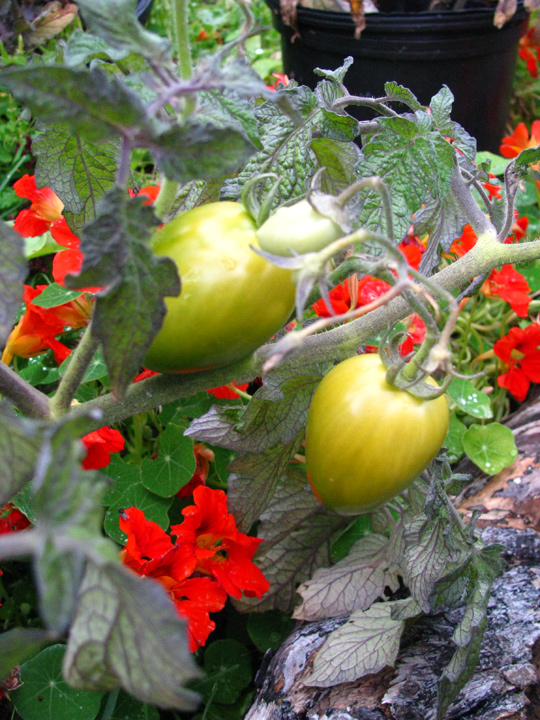
I’ve been reading a lot about maximizing your growing space, and one technique that’s come up is growing potatoes in barrels. Apparently, people do this in Britain a fair bit, where the space you have for growing your veggies is fairly limited. I also found a paper online exploring the suitability of this technique for growing potatoes in certain parts of Africa.
What you do is plant your seed potatoes in compost-rich soil at the bottom of a barrel (or large plastic garbage bin, or wooden structure you’ve constructed for this purpose). When they start to grow, you cover them with more soil, and on and on until your plant bursts out the top, and there is no more room for dirt. The theory is that, at every level where you’ve added more soil, the plant will have sent out more tubers. What you end up with, then, is a potato plant on top and about four feet of potatoes below.
Now, I haven’t tried this, but I’m planning to do it next year. Have any of you readers done it, or even heard of it, before? Anyone else want to grow potatoes in a barrel next summer and compare notes? Drop me a line at dreae@thescope.ca
Crunchy granola bars
Thu, Sep 10, 2009
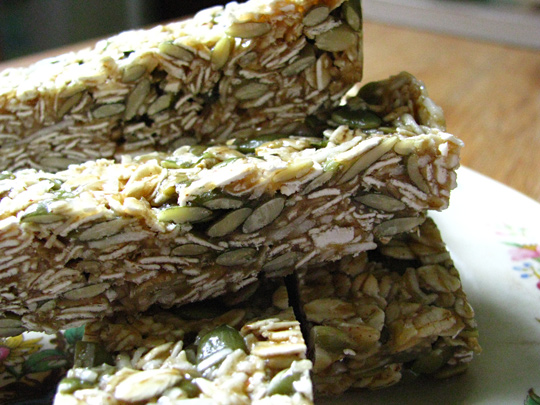
Photo by Andreae Prozesky
Years after my own school days wrapped themselves up in a tidy, red-tape-and-useless-diploma-wrapped academic package, I still catching myself sniffing the air on cool September mornings, hoping to catch a whiff of the intoxicating back-to-school olfactory cocktail of pencil shavings, new socks and shoes, and crisp McIntosh apples.
I always loved the rituals of back-to-school shopping, arranging my newly acquired supplies (standard-issue tartan pencil case, multi-subject binder, weapon-concealing geometry kit) in my canvas backpack. This was back in the stone age when downtown St. John’s had department stores; some years my mother and sister and I, after pillaging Piper’s and Target, would stop for lunch at the Woolworth’s cafeteria for a nourishing meal of red-heat-lamp-warm fries and a fine dessert of Jell-O cubes topped with “whipped topping” and a quarter of a maraschino cherry. I love Jell-O in a cube to this very day.
Now that I have my own school-age daughter, I get to relive it. It’s not quite as much fun paying for school supplies as it once was picking them out, and, due to our twenty-first-century horror of any child being bullied off a cliff for having the wrong kind of glue stick, you’re not really allowed to buy anything fun any more, but, still, it’s back-to-school. The fresh start of untouched scribblers, the erasers showing no evidence of your ever having made a mistake. It’s a time full of hope.
And lunches.
School lunches aren’t what they used to be. Peanut butter might as well be napalm, the way people go on about it. And tuna sandwiches are a stinky, fishy lunch food of the past. I’m not about to weigh in on whether the allergy business in schools is motivated by a genuine desire to keep kids safe or by a wide-reaching allergy hysteria fueled by the big-business pharmaceutical companies or by the school system’s fear of lawsuits. It’s probably a bit of each. Deadly food allergies are incredibly rare, far rarer than you would probably think, but they do happen, and if I were the mom of the kid who the doctors said might stop breathing if the kid next to her ate a peanut butter sandwich, I might react in a way that other parents might not understand. Who knows? I’m already the parent who sends her kid to birthday parties with her own gluten-free cupcakes, and it’s a slippery slope from there.
It’s not only schools that ban certain lunch foods, of course. Plenty of office buildings have a no-peanuts policy, and, well, there are some people who would say that bringing a room-temperature tuna sandwich into a shared kitchen space with recycled air and no windows should be a punishable offence anyway. Tuna’s out, peanut butter’s out, and frustration is in.
One of the recipes I’ve fiddled with and tested with over the last year is for crunchy granola bars. They were a staple lunch food for us children of the children of the sixties. Then Quaker Chewy Dipps appeared, with their prominent Degrassi placement and their chocolate chips and marshmallows and chocolatey coating. How did anyone expect us to learn anything? No wonder our teachers chain-smoked in the lounge every second that they could.
Then, maybe ten or fifteen years ago, the crunchy granola bar started to make a comeback. They’re almost as tooth-rottingly sweet as the chocolate-dipped chewy marshmallow granola confections of the 1990s, but they’ve got the odd whole grain in them, so they’re all right. They’re not all that cheap, though, for something composed primarily of horse feed, and one plastic-foil wrapper for every two skinny bars adds up to a lot of waste.
In all my fiddling with my granola bar recipe, there was one thing I got wrong for a long time. In my attempts to make the bars not too junky, I kept trying to reduce the sugar. It just didn’t work. The crunchiness has to come from some kind of sugary syrup. It can be corn syrup, which is what it would be in most commercial granola bars, or it can be honey, which is delicious and relatively good for you but which has a strong flavour that some kids (well, mine at least) don’t like. I usually use brown rice syrup, which you can buy in health food stores and in the health food section at Dominion. It’s not very sweet-tasting, and it’s almost buttery. I don’t worry too much about a bit of sugar syrup if the stuff the sugar syrup is holding together is all wholesome grains and nuts. I just send a crisp, tooth-scouring fall apple along with it and hope for the best.
—
Crunchy granola bars
Makes 8
1 ½ cups old-fashioned rolled oats
¾ cups various seeds (I use a combination of pumpkin seeds and sesame seeds, but sunflower seeds, toasted soybeans, coconut – which is usually allowed, as it’s not related to true nuts – and other seeds are also tasty)
3 tablespoons butter
½ cup lightly packed dark brown sugar
½ teaspoon cinnamon, if desired
4 tablespoons corn syrup, brown rice syrup, or honey (or a combination)
½ teaspoon coarse salt (kosher salt or pickling salt are fine)
1. Line a 4 ½ x 9” bread pan with parchment paper so that the paper hangs over the two longs sides a little – you will use the overlap to remove the bars from the pan.
2. In a pan over medium-low heat, stirring often, toast oats just until they become fragrant and slightly golden, 5 to 6 minutes. Remove oats to a bowl and add the seeds, stirring well.
3. In the pan, combine butter, sugar, cinnamon, syrup or honey, and salt. Cook over medium heat, stirring, until butter melts and mixture begins to bubble, about 3 minutes.
4. Pour sugar mixture over oats and seeds and stir to combine. Quickly turn mixture into prepared bread pan and press down with a rubber spatula (or your fingers if it’s not too hot). It should be even across the surface. Refrigerate until set, at least 30 minutes. Using parchment paper overhang, lift slab of granola to a cutting board and cut into eight slices. Keep granola bars in an airtight container, preferably in a cool place so they don’t soften up (I keep mine in the fridge).
PS Oats can sometimes be contaminated with gluten, so people with Celiac disease and some acute gluten sensitivities can’t tolerate them. I make these with slightly crushed cornflakes instead of oats and they’re marvelous (I skip the toasting step). Check the box to make sure they’re gluten-free if this is a concern for you.
Become a Locavore
Thu, Aug 27, 2009
Every year, about this time, I get carried away with a marvelously optimistic conviction that our little island, left to its own agricultural devices, just might be okay.
The hills and paths are resplendent with wild fruit, the backyard gardens are tumbling over with zucchini, the woods are teeming with game, the farmers’ market tables are groaning under the weight of beets and broccoli, the fields at Lester’s are waving with tall, beautiful corn.
At each meal I tally how many of my ingredients have come from somewhere on the island, and from the beginning of August until after Thanksgiving, I don’t do too badly. Veggies from local farms and city plots, foraged mushrooms, vacant-lot berries, eggs and milk from local producers, a bit of fish, and some Spyglass butter get thrown together and we eat like kings. And every year I become more convinced that, with a little more planning and forethought, and a slightly bigger freezer, I could eat this way all year ‘round.
It’s not quite the 100-mile diet, but close.
Chances are you’ve heard of the 100-mile diet by now, but if not, here’s the gist: rather than buying just any old groceries from any old place, 100-mile-dieters dedicate their food dollars and their time to the acquisition of local produce. The phrase was coined by Alisa Smith and J.B. MacKinnon, who spent a year eating nothing but food produced within a 100-mile radius of their home in Vancouver. No Mexican mangoes, no Costa Rican pineapples, no olives, no chocolate, and nothing packaged up with shrink-wrap.
“Why on earth would anybody want to do that?” you may well ask.
Well, I can think of a bunch of reasons, but the quality of produce shipped from halfway around the world is reason enough, as far as I’m concerned. Limp greens, mealy tomatoes, and polystyrene-flavoured strawberries have become the norm. We don’t know who grew them, or what sort of environments they came from, we just pick them up at the grocery store, pop them out of their plastic clamshells, give them a rinse and feed them to our families, pleased that we’ve managed to get our kids to choke down their five servings of fruit and veg a day, no matter what the ultimate cost.
What else? Well, how about the fossil fuel required to move produce from one side of the planet to the other, the chemical additives needed to keep fruit looking good for days and weeks on end, the conditions of the workers in the far-off countries that the fruit comes from, the lack of connection to the seasons when you buy the same produce all year round, the uneasy position of relying on imports when we live on an island… need I go on?
“100-mile diet” is just one term for this kind of thinking. The Slow Food movement is a similar phenomenon, encouraging people to celebrate local food traditions, to connect with farmers in their area, and to savour the production and the consumption of food rather than just stuffing something into their mouths and hurrying about their days. “Locavore” is another new term, describing someone who eats only food grown or produces within a certain radius of their community, usually 100 or 150 miles.
Catering to locavores is career ambition for Andrea Maunder, co-owner of Bacalao restaurant, where the “Nouvelle Newfoundland Cuisine” focuses on fresh local ingredients. The foodstuffs aren’t 100% local, but as close as possible given the volume required to keep the kitchen running. Maunder finds it ridiculous “that we need phrases like ‘100-mile diet’ and ‘slow foods movement,’ all this new terminology for stuff we should be doing anyway.”
She has a good point: up until about fifty years ago, the bulk of what Newfoundlanders ate was grown in backyard fields and on small farms. The idea of eating a potato from anything other than Newfoundland soil would have been laughable, and fruit like oranges would have been exotic Christmas treats rather than flavourless commodities, picked while green, shot through with food colouring, and shipped here in unimaginable numbers.
Local traditions carry a great deal of weight for Maunder.
“In the olden days, we canned,” she says. And that’s just what they do at the restaurant. During our interview, in fact, a slew of local veggies were being made into mustard pickles in the kitchen behind me.
To ensure a supply of local berries through the winter, Maunder and her staff freeze some and can the rest. The restaurant has four “dirty big freezers” full of local meat and produce, and, says Maunder, if they ever get a line on moose meat, they’ll “sooner go out and buy another freezer than turn it down.”
Sounds wonderfully Nan-and-Pop-ish to me (aside from the buying-a-new-freezer part) but then Maunder has a very successful restaurant, so she can get away with it.
For those of us working on a smaller scale, a closet-sized deep-freeze and a home-canning kit are probably enough.
If you want to feast on local foods through the year, “you have to start in the summertime,” says Maunder. “It takes planning and preparation.” And I know that not everybody is a freelance food writer on a flexible schedule, or a restaurant owner. But what about heading out to the farmer’s market or your favourite farm stand, buying as much broccoli as you can, and spending a weekend afternoon cutting it into spears, blanching it, packing it into bags, and stuffing it in the freezer? Or picking rosehips on Signal Hill after the first frost, taking them home, and making jelly? How about calling up your great-aunt for advice on making piccalilli with the too-late-to-ripen tomatoes from your balcony tomato pots, or letting your “got-to-get-me-moose, b’y” uncle know that you’ll happily take some stew meat off his hands?
It doesn’t have to be all pickles and moose meat either, of course. Beautiful scald cream (like clotted cream) is being made here, by Glenview’s Finest. There are delicate salad greens being produced seasonally by The Organic Farm and Seed To Spoon, and year-round by The Lettuce Farm (or you can grow your own in a plastic bin in a sunny window). There are juniper berries along the Signal Hill trail, and there is wild mint growing just about everywhere it’s wet.
The biggest difficulty with eating local around St. John’s is that the farmers and producers haven’t had much help in terms of networking and marketing. It takes a lot if legwork to find local farmers and, when you do, it’s not always clear what sort of farming they’re doing.
Maunder recalls looking for her locally-sourced produce: ”I’d find a listing for ‘Jonathan’s Farm,’ but I don’t know whether Jonathan raised carrots or emus.” The St. John’s Farmer’s Market has done a lot to connect area farmers with customers, but if you want to get some rabbit or bakeapples or wild mussels or a duck, you have to put your feelers out and ask around.
Often, though, asking around is all it takes. St. John’s, for all the availability of avocadoes in February, is still a small town, and if you ask a few people to spread the word that you like a bit of flipper pie in the spring, chances are there will be someone, or ten someones, hauling you to a flipper dinner at a church hall the first chance they get.
If there’s one thing I’ve learned in the last few years, it’s that foodies like other foodies. If you want to build a network of locavores, even part-time locavores, the first step is announcing your intentions. That done, be prepared to swap some of your frozen blackberries for a chicken, or to paint someone’s fence for a feed of cod tongues. Blow your birthday money on dinner at a local-foods restaurant or market stand to show them that what they’re doing is important.
It’s how things have always worked, and how they should.
—

Note: these menus have not yet been tried, just dreamed up. If they inspire you, please leave a comment, send a photo, or share your recipe by commenting below.
1. Lamb sausages, dandelion or turnip greens sautéed in local butter, steamed and buttered potatoes, baked rhubarb with honey and scald cream
2. Roast corn, steamed fava beans, mussels steamed in Iceberg vodka with local garlic and shallots and finely–chopped parsley, clafouti-inspired custard made from local cream and eggs, sweetened with honey, and baked with local berries (merci à Martha Muzychka for that one)
3. Cream of chanterelle (wild mushroom) soup, layered casserole of local tomatoes and rainbow Swiss chard with homemade ricotta cheese, baked local apples stuffed with dried chuckley pears (Saskatoon berries) and honey, served with whipped cream
4. Moose pot roast with buttercup squash and kale, potato dumplings, homemade Greek-style yogurt with partridgeberry jam
5. Big ol’ boiled dinner, massive bowl of blueberries with full-fat milk (Okay, this particular menu has been tested and approved.)
Summer vegetable risotto
Thu, Aug 13, 2009
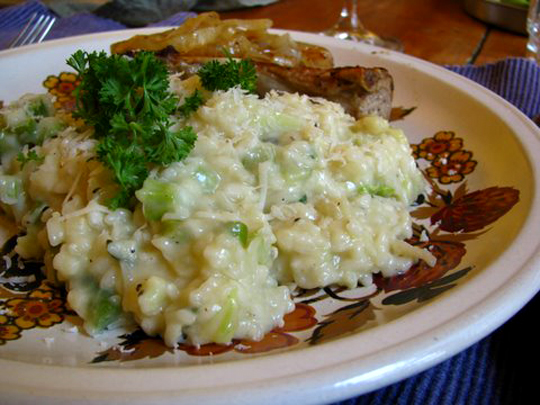
Photo by Andreae Prozesky
This summer, for the first time in many years, I’ve been getting weekly organic vegetable bags from a local farm. Community-Supported Agriculture is probably old news to many of you, but for anyone else, here’s how it goes: in the spring, you buy a share of your CSA crop, paying up-front for your season’s worth of whatever the farm produces. Your payment goes toward all of the seeds, supplies, labour and whatnot that the farm requires. Then you get tasty, fresh vegetables (and some fruits, and berries and herbs and such) through the summer and into the fall.
The wonderful thing about this system is that you’re getting excellent local organic produce for a fairly reasonable price, while at the same supporting good environmental stewardship and labour practices.
The challenging thing about it is you have no control over which particular vegetables you get, and you may have no idea what to do with them.
But this is not at all a bad thing. I would never have tried Swiss chard if I hadn’t ended up with CSA baskets full of it about ten years ago. It’s now one of my favourite vegetables. Normally, I never buy snow peas, because they’re always lashed to a black Styrofoam boat with two layers of cling-wrap, wilting in their own misery. Now, for weeks, I’ve had more snow peas than I’ve eaten since I was a kid (in a friend’s back yard, with gluttonous abandon), and I’ve been compelled to make delicious, black-bean-sauce-laced stir-fries as a result. Garlic scapes are so obscure a vegetable I’ve never even seen them in a grocery store, but earlier in the season I binged on them and lament the fact that their days are gone and I won’t have any more until next year.
Despite my best intentions when opening up my basil-scented, leafy green veggie bag each Tuesday evening, I often don’t manage to use up my veggie share over the course of the week.
Sunday and Monday nights are usually mad scrambles to find the best way to eat up any languishing vegetables. The lettuces and other salad greens, herbs, and edible flowers are easy to work with: toss with oil and vinegar and devour—checking first for any little buggy or sluggy friends who may have made their way out of Portugal Cove hiding along the ribs of my Romaine.
Braising greens like kale, chard, and beet tops, that haven’t made their way onto a plate are blanched and frozen for winter. I’m sure I’ve talked about blanching greens a million times, but just in case: clean and chop your greens, removing tough ribs and stems. Dunk them into boiling water for about a minute (two minutes for really big, tough ones like kale), strain them out into a big bowl of ice water, pat them dry with a tea towel, and put them into freezer bags with the air squeezed out. Nothing to it. Extra green beans, fava beans, cauliflower, broccoli, and the like get the same treatment.
But if I want it all to end up in my bowl instead of in my freezer, I either make some kind of veggie-packed pasta, or turn to my new standby: risotto. For years I scoffed at risotto as having some kind of early-1990s restaurant-chic tackiness to it, but I know now I was wrong. Risotto is so deliciously silky and comforting, so easy and so versatile, it’s the perfect veggie-user-upper. Even children like it, although, if you have children who are old enough to be suspicious of anything too foreign-sounding, you might want to call it “cheesy rice with vegetables.” If you’ve never made it before, and have been under the impression that risotto requires hours of endless stirring, let me assure you that it’s only twenty minutes, half an hour, max, and it’s well worth it. The reason for all that stirring is this: when the grains of rice rub up against each other, their starchy outer layer sloughs off, and that turns into the smooth, glistening sauce that holds the whole thing together.
It’s a beautiful thing. The stirring is quite meditative, really, and watching the grains of rice change from tiny, hard little things, through oil-glistening translucency, to their final, pearlescent state is pure magic.
And, even if it’s not magic, it’s delicious.
—
Summer vegetable risotto
(serves 6)
1 to 1 ½ litres stock (vegetable or chicken)
2 tablespoons olive oil
1 onion, chopped finely
3 garlic cloves
2 cups risotto rice (Arborio and Calrose are easiest to find)
½ cup white wine, Vermouth, or additional stock
3 tablespoons butter
In a large pot on the back burner, bring stock to a simmer. Reduce heat to low.
In a medium Dutch oven over medium heat, sauté onions in olive oil until translucent, about three minutes. Add crushed garlic and sauté one minute more. Add rice and cook, stirring, until a few grains begin to pop. Add vegetables and stir to combine.
Add wine, stirring constantly until wine is absorbed. If your rice or vegetables begin to stick to the bottom of the pan, turn the heat down. Add one ladleful of stock and stir, scraping the bottom, until the stock has been fully absorbed. Continue to add stock, one ladleful at a time, stirring between additions so that it is fully absorbed. This will take about twenty minutes altogether, and you may need more or less stock depending on how absorbent your rice is. Towards the end of the twenty minutes, begin tasting your rice; it should be cooked al dente, soft but with a slight bite at the centre. Italian rices like Arborio naturally maintain a bit of a bite, while American rices like Calrose cook a little softer.
Stir in fresh herbs, if using, and Parmesan cheese. Add salt and freshly-ground pepper to taste. Just before serving, add butter and stir through.
Serve with an additional sprinkling of herbs and Parmesan, if you like.
Vegan option
It occurs to me—and I have no experience to support this—that you could probably replace the Parmesan with some light miso thinned out with wine or stock and a generous sprinkling of good-tasting nutritional yeast, and swap the butter for some more good, fruity olive oil, and have a delicious dairy-free dinner. I don’t think you would get away with calling it risotto, but that’s no matter. If you try this, leave a comment and drop me a line and let me know how it turned out, okay? Leave a comment here or email me at dreae@thescope.ca.
Simple syrup
Thu, Jul 30, 2009
Photo by Elling Lien.
By Andreae Prozesky
A few days ago, I made what is probably my fourth (or maybe my fifth) rhubarb crisp of the summer, and my third (or is it fourth?) since moving into the new house. And for the third (or, you know, possibly the fourth) time, I realized, after having chopped my rhubarb and preheated the oven (in as much as I can do, my oven being satanically possessed), that I was out of brown sugar. Not a difficult thing to find, brown sugar, but I have forgotten to buy it now for what must be two months.
So for the somethingth time, I’ve had to “make” brown sugar. Stop rolling your eyes, I haven’t set up a rudimentary refinery in my basement or anything (yet). I just took some white sugar, drizzled some molasses over it, and smooshed it together with a rubber spatula until, miraculously, brown sugar appeared.
Because, you know, that’s all brown sugar is. They take all the molasses out, then they put it in again. Golden sugar has just a little, dark brown sugar has a little more, but it’s all just refined white sugar underneath. Weird, huh? And why do they do it? Well, there is that slightly molasses-y taste, but brown sugar also serves to keep baked goods nice and moist. If you want to make chewy oatmeal or chocolate chip cookies, brown sugar is what you turn to. White sugar would make them kind of crispy. Which might still be nice, but it’s probably not what you would have had in mind.
White sugar, though, is what you want when you’re making jam. The crystals are small and they don’t have any molasses to clump them together, so they distribute evenly without making big chunks to be broken up. The molasses would also darken the jam a fair bit and interfere with the taste of the fruit. Sometimes the molasses-y taste of brown sugar can compliment fruit quite beautifully—I use brown sugar in my pineapple preserves, for example – but often the brown sugar will kind of weigh down different fruits’ light and summery flavours.
Did you know that you can make your own icing sugar, too? Just take your regular white sugar, throw it in the blender and whizz it around to a powder. Once that’s done, add a couple spoonfuls of cornstarch and whizz it again. The sugar manufacturers put the cornstarch in for a couple reasons. Starch keeps the sugar from clumping, and it also works as a binding agent in some baking. That’s why some recipes, like shortbread cookies and certain sweet pastries call for icing sugar; without the starch component, they wouldn’t hold together quite as well.
This make-your-own-kinds-of-sugar business is good to know if you’re trying to bake with organic ingredients. Organic cane sugar is fairly easy to find, as are organic molasses and cornstarch, but organic brown sugar and organic icing sugar are fairly uncommon.
It’s also good to know if you, like me, forget to buy things for weeks at a time.
There are other varieties of sugar that are less refined than your standard crystal-white by-the-kilo stuff. Demerara and turbinado sugar are the same thing, less refined than regular white and brown sugar. If you put those little packets of “sugar in the raw” in your coffee, this be they. It’s not really what you would call “raw sugar,” strictly speaking, but it’s been through the ringer with less intensity than table sugar has. The crystals are big and kind of amber-coloured, and they’re really tasty sprinkled on top of blueberry muffins before the tray is popped in the oven. Because they’re bigger than regular sugar, the crystals take longer to dissolve, and leave sugary gritty bits at the bottom of your latte, which is either awesome or gross, depending on your perspective. You can’t swap demerara sugar for brown sugar in your baking. Even though it’s brown in colour, it’s not the same as brown sugar. The texture of your cookies (or whatever) will be completely different than it would be with regular brown sugar.
Muscovado sugar, on the other hand, is like brown sugar to the power of brown sugar. It’s much closer to being “raw sugar” than “sugar in the raw” is… sorry if that’s terribly confusing, but it’s the truth. It has a strong molasses taste and big-ish grains, and it is very moist and sticky. You can use it where you would usually use brown sugar, but it’s going to make your baking darker, muskier, more oomphy. I use it all the time in baked goods that can support that kind of intense flavour, like gingerbread, spice cake, chocolate cake, and brownies. Oh my goodness, how I love it. I put it in my tea, too, but I also like to steep my tea in the mug for about twenty minutes until it’s on the barky side. A gentle, dignified cup of tea might not be able to keep up.
Okay, one last thing about sugar, and then I’ll leave you alone. If you wish that you could make homemade lemonade or iced tea without a layer of sugar sludge at the bottom, what you need is to make what’s called a “simple syrup.” If you’ve worked in a bar or as a pastry chef you’ll already know about simple syrup. You use it for mojitos. Need I say more?
—
Simple syrup
This isn’t exactly a recipe, more just instructions. Make as much or as little as you like; it will keep forever in a jar in the fridge.
1 part water
2 parts white sugar
INSTRUCTIONS:
1. Bring water to a boil in a pot on the stove.
2. Add sugar and stir to dissolve.
3. Bring mixture back up to a boil, then reduce heat and simmer about a minute.
4. Remove from heat, cool completely, and store in a clean, covered bottle in the fridge.
For flavoured simple syrup, just add your favourite herb, spice, or what have you to the water before you boil it. Syrups flavoured with fresh mint leaves, vanilla pods, gingerroot, and cinnamon are all delicious for making mixed drinks, for drizzling over ice cream, or for serving with soda water. Quantities depend on your taste, but I would use, say, two vanilla pods or a big handful of mint leaves per cup of water. Once your syrup has cooled, strain out your flavourings and store the syrup in the fridge as usual, but try to use it up within about two weeks. That’s a lot of mojitos!
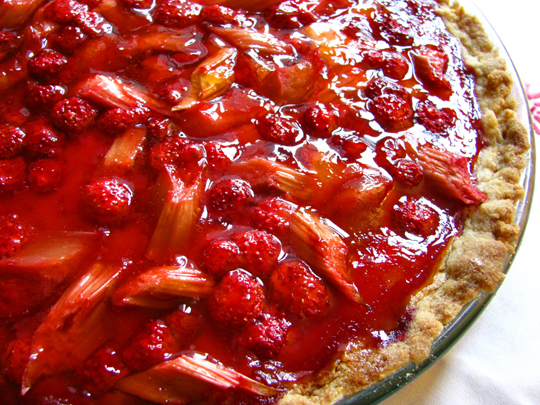
Fruit-topped ricotta tart
Thu, Jul 16, 2009
Andreae Prozesky isn’t normal, but she’s virtuous.
Every year, it’s the same. It all starts with the rhubarb. Then it’s the strawberries, then the raspberries, the gooseberries and blackcurrants, and then comes the glut of autumn blueberries and partridgeberries and rosehips.
Local foraging. I spend my winters and springs dreaming about, nay, obsessing over local foraging. I dream of someday challenging myself to survive the year on local fruit alone. I’m sure it can be done. Already I’ve been out scouting for tangled raspberry patches and pincherry trees and crabapples and chuckley pear bushes in my neighbourhood’s vacant lots. I’m sure there are neighbours who wonder at my frequent emergence from treed-in urban wilderness, the spots which are inhabited by semi-feral cats and the occasional underhoused human. I’ll admit, it looks a little dodgy. But I really am up to something totally normal. Well, perhaps not normal, but virtuous.
Already in the season, I’ve taken a spin around the bay to pick wild strawberries in a friend’s overgrown field, and I’ve eaten as much rhubarb as friends and relatives can throw at me. Almost.
Some of the spoils of my summer foraging, like the tiny and almost unnaturally sweet strawberries, will be mostly eaten out of hand, thrown over cereal or yogurt at breakfast, or smooshed between my thumb and forefinger to feed to my happy nine-month-old kiddo, who scarfs them down with inspiring abandon.
Other fruits will be cooked down and made into preserves. Crabapples aren’t really fit to eat, at least not in any serious amount (unless you have guts of steel), but they make delicious jelly. Same for rosehips, which grow wild and abundant all over St. John’s. So long as they’re wild roses, and not somebody’s cultivated and possibly pesticide-drenched ornamentals, the fruit is pretty much free for the taking after the first frost. Blueberries and partridgeberries are the best to freeze.
And last year was the first time I ever picked chuckley pears. They grow all over town, in green spaces and along walking trails, and nobody under the age of 65 ever seems to notice them. If you’re not familiar with the name “chuckley pear,” you might know them as Saskatoon berries. People all over the rest of Canada go cracked for them, and they’re so full of antioxidants that I’ve read a number of references to them as a new “superfood” (like chocolate and coffee and pomegranates… good company).
I do, of course, bake with lots of the berries and fruits that I forage over the summer. Usually it’s muffins, but over the last couple days I’ve come up with what I think may be my go-to fruit tart. The base is made with ground almonds and buckwheat flour, and it’s a press-in crust, so you don’t have to worry about messing around with delicate rolled pastry in the summer heat (it’s also gluten-free, if you’re among the gluten-averse). The filling is sweetened ricotta cheese, which you can buy in a shop or make at home (the instructions are in this article here), and the topping is whichever fresh, local fruit I’ve hauled home. So far I’ve tried it with rhubarb (result: yum) and with a rhubarb-strawberry combo (result: double plus yum). I’m fantasizing now about making the same thing with raspberries and blackberries on top, knowing that the raspberries will be gone before the blackberries ripen—remind me to set some raspberries in the freezer for this experiment, will you? And chuckley pears will be great on this, perhaps with some lemon zest stirred into the ricotta filling.
The fruit-jelly glaze is what makes the tart so pretty. You know when you go to a bakery and their fruit tarts are all shiny and gorgeous, and then you go home and make what seems like the same thing, but it just looks kind of amateurish? It’s the glaze factor. It just takes it over the top. I’m not saying you should make a batch of apple or rosehip or gooseberry jelly just to have on hand when the mood strikes you to make a fruit tart, but, you know, it wouldn’t hurt. Failing that, store-bought apricot preserves, with the big chunks strained out, are a pretty standard substitute.
Either way, it’s delicious.
—
Fruit-topped ricotta tart
Crust:
¼ cup brown rice flour
¼ cup buckwheat flour
½ cup ground almonds
¼ cup icing sugar
½ cup chilled butter, cut onto small pieces
Filling:
1 ½ cups ricotta cheese
2 eggs
1 teaspoon vanilla extract
1/3 cup sugar
1 tablespoon cornstarch
½ teaspoon salt
Topping:
1 ½ cups fresh summer fruit, pitted/chopped/stemmed as necessary, combined with up to ½ cup sugar, depending on type of fruit (rhubarb will need lots, blueberries won’t need any… judge accordingly)
½ cup light-coloured fruit jelly (rosehip, crabapple, white grape, gooseberry) or heated, strained apricot preserves, optional
INSTRUCTIONS:
Preheat oven to 350F.
In a large bowl, combine flours, ground almonds, and sugar. Work butter into flour mixture with your fingers until it forms a coarse meal. There will still be small lumps of butter, but that’s okay. Press the mixture into the bottom and up the sides of a 9-inch tart pan. If the dough is too sticky, sprinkle with some additional rice flour.
In another bowl, using an electric mixer, mix ricotta, eggs, and vanilla. In a small bowl or cup, stir together sugar, cornstarch, and salt. Add to ricotta mixture and mix well.
Pour ricotta mixture into crust. Carefully place in oven – the filling will be quite liquid, so you might want to place the tart pan on a cookie sheet first, for less sloshing about. Bake tart about 25 minutes, until the filling has begun to set. Remove tart from sheet and distribute fruit evenly across the top. Return to oven and bake another 30 minutes.
In a small saucepan, heat jelly to boiling, stirring with a whisk to break up any lumps. Set aside. Remove tart from oven and spoon warm jelly over top to cover fruit. Set tart aside to cool, then refrigerate to chill thoroughly.
Send your questions, comments, and sweet and sour suggestions to dreae@thescope.ca
Cooking with gas
Thu, Jun 18, 2009
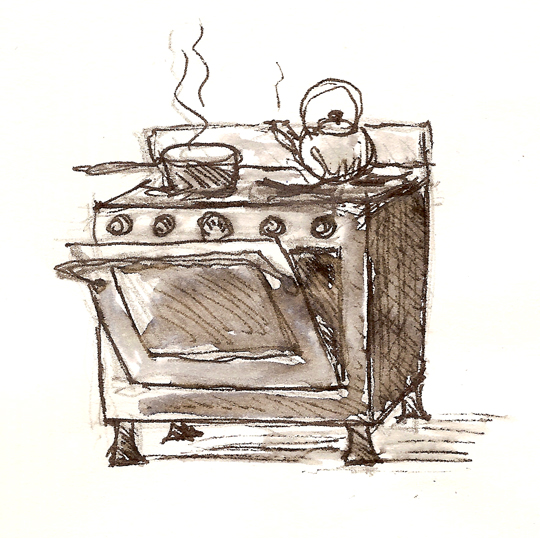
Ilustration by Peggy Pope.
Andreae Prozesky blames the electric oven.
Last week, a wonderful thing happened here at the Food Nerd Laboratory. We—the people and the kitchen—moved. No longer content with our adorably diminutive and exceedingly cramped gingerbread cottage, the Food Nerd family up and relocated to a big house with lots of room, a garden for growing veggies, and a lovely big kitchen with windows on three sides and a cherry tree just outside. It’s a magical place, and I love it, except for one small hitch.
No longer am I cooking with gas.
The last Laboratory location was blessed with a workhorse of a propane stove. The thing was probably thirty years old, and seasoned with grime from who knows how many tenants. The oven door didn’t shut right, and the oven flame was dangerously slow to start, but, dammit, we were cooking with gas. Real professional-like. It was wonderful.
Do you ever look through home décor magazines? The ones that tell you all about renovations and maximizing your house’s potential and all that stuff? Well, all those kitchens in all those magazines have gas stoves. Likewise for restaurant kitchens. It’s not just because blue flame looks badass and sexy, no no no. A gas stove makes cooking way easier. Most electric stoves, especially the common coil-element ones, take ages to heat up and ages to cool down again. They are slow to adjust. They reject any attempt at precision.
The oven parts are okay, unless you put a nice, butter-laden, fatty chicken in there at 425F like you normally would, and the grease spits and gets all over the element and your smoke alarm goes off and wakes up the baby, and then your husband comes home and you can barely see him through the haze of chicken-smoke. Not that I would know. Actually, I would, and I’m not ashamed to admit it: since we moved into the new place, I have ruined every single bit of food I’ve tried to make. The only reason I haven’t ruined the tea is because we had to buy an electric kettle, so slow to boil was a pot of water on the stove (no, I wasn’t watching it).
I super-crisped the outside of the chicken, but the inside remained dangerously pink. I burned the turnip greens, which are among my chief delights come spring time. I made rubbery eggs and crunchy rice. I overbaked the rhubarb crisp, and I undercooked the strange mélange of tinned goods I threw in a casserole dish and called “dinner” on our first day here.
It’s been a very sad state of affairs.
I know there’s bound to be an adjustment period when something changes in the kitchen. An upgrade, a reno, a new appliance, a loved one putting all your dishes back in the wrong places after having insisted (despite your objections) on washing them. Anything that interferes with the way you’re used to doing things, with your—as the office-people say—workflow, is going to cause a little culinary pain. But you get used to it. You adjust your reach, you remember that the counter is shorter or longer than it once was, you read the owners’ manual, you find your hand mixer after all.
You return to your ninja-like state of effortless dinner-makery, at least when it comes to your regular go-to recipes. You don’t burn the hell out of the roast chicken, for heaven’s sake.
It did, after all, take me some time to get used to the immediacy of the old gas stove, the insistence, the fiddliness of getting the flame just right. The fact that the lower right flame crapped out if you tried to set it on low, releasing a stream of suffocating and combustible propane into the air.
But once I figured it out, I remembered why I had loved the gas stove at my father’s house, and the one in my first Montreal apartment. You want it to cook? It’ll cook. Right now. No questions asked. No standing around. You’re done cooking? Turn the flame off, and, whaddaya know, no more heat. The gas does what you want it to, and it doesn’t kick its toes in the sand and reply to your attempts at heat-regulation with a five-year-old’s drawn-out, “alriiiiiiight, I’m coming… in a minute…” As though you were asking your stove to wash the windows or clean the cat litter or something.
I mean, come on. You’re a household appliance: do your job.
I suppose that, with time, I could likewise get used to an electric stove again. I could adapt my cooking style to suit the slow-to-heat, slow-to-cool, quick-to-smoke nature of the stove I’ve got now.
Or I could forgo stoves altogether, get myself a toaster oven and a hot plate and relive the culinary scene of my Yellowknife shack-dwelling days. I could buy a microwave oven and figure out what they do (I’ve only ever used them to heat up coffee; can you actually cook in them?). I could get a rice cooker and a deep-fryer and a slow-cooker and a Panini press and a popcorn maker and a George Foreman grill, and be perfectly well-equipped for any and all alimentary eventualities.
But in a little while we’ll have saved up enough to have a gas line put in, and we’ll buy ourselves a proper stove and I’ll be the foodster I was a week ago.
Until then, I foresee a stretch of cold snacks and leftovers.
Saving For a Better Stove Survival Plan
• Salads. Lots of salads.
• Hummus. Lots of hummus.
• Crackers with cheese and chutney, with sliced apple and a handful of walnut halves on the side (best lunch ever).
• Barbecued everything, including pizza, vegetables, and fruit (grilled pineapple and peaches are both exceptional).
• Chocolate.
• Cereal.
• Granola with yogurt and diced pears.
• Waffle iron as daily-use appliance.
• Snacks from the farmers’ market, doled out slowly over the week. Believe it or not, cold leftover curry is remarkably restorative as a breakfast food.
• Um… more chocolate?
Send your questions, comments, and suggestions for cold snacks and leftovers to dreae@thescope.ca
Illustration by Peggy Pope.
Pasta with Kale, Bacon, and Feta
Thu, Jun 4, 2009
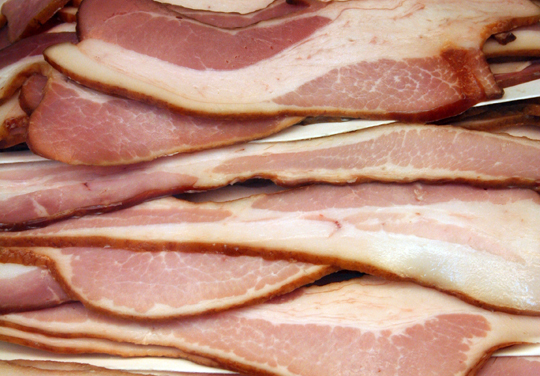
Has Andreae Prozesky‘s inner vegetarian left the building?
If you ever want to really irritate a table full of friends out enjoying a weekend brunch, just tell them that you don’t like bacon. Perfectly sensible people will be beside themselves. “What do you mean, you don’t like bacon?” It’s one thing if you’re a vegetarian and don’t eat any meat at all, so long as you admit that you would eat bacon by the plate if your dietary restrictions would allow it. If you don’t eat it for religious reasons, people will let you off the hook, although they’ll probably look at you with a mix of pity and incomprehension. Anyone who has had to give up bacon for health reasons will likewise be pitied, but it’s a pity mixed with fear, as each person glances at his brunch plate and speaks a silent prayer that he and bacon never be torn apart.
But to simply not like bacon, that’s downright deviant. People refer to it as “the gateway meat” because of its remarkable power to turn the most principled of raw-food vegans into full-English-breakfast-devouring porkivores. One hit of smoky, salty bacon and next thing they’re twitching for a bit of blood pudding. I’ve seen it happen.
On Saturday mornings, my husband and daughter go through a little song and dance we like to call the “Bacon Saturday” routine. Bacon is fried up, and I am offered some. I politely decline, and the game begins.
“I just can’t believe you don’t like bacon.” “Seriously, mom, what’s wrong with you?” “I mean, what kind of a person actually doesn’t like bacon?”
A person like me, I suppose. I just couldn’t be bothered with it. I like the way it smells, especially when there’s coffee brewing at the same time. I’m not grossed out by great pools of bacon fat, and in fact I think I’ve cooked with bacon fat more often than I’ve cooked with bacon itself (fish cakes fried in bacon grease over a Coleman stove while camping is just about the greatest thing ever).
I think part of it is that I can’t quite get around the idea of breakfast meat. For me, breakfast is a festival of carbs: French toast, pancakes, waffles, oatmeal, that kind of thing. Meat in the morning just seems weird. And while I know that there are people out there who think of bacon and waffles as being the best of friends, well, I guess I’m just not one of them.
I have put bacon in waffles, though, and it was pretty good. I put the bacon on the waffle iron grill, poured the cornmeal waffle batter over it, and let ‘er sizzle.
Because I dig bacon as an ingredient.
This is a fairly recent development. I remember my first bacon-appreciation moment perfectly. It was a gorgeous spring day in Yellowknife, a balmy -15C (yes, that’s a minus). I’d been out for a walk and stopped in at the lovely Mary’s Tea Room for lunch. I ordered a pot of Persian Cardamom tea and a bacon, avocado and lettuce sandwich. Just like that. My only explanation is I was pregnant at the time, and my carnivore of a daughter was already making her tastes known.
Since then I have become able to eat an entire club sandwich, picking out only a few little bacon strips once I’ve hit my “bacon wall.” I quite enjoy bacon in a Cesar salad now, so long as it’s actual bacon and not mysterious bacon-flavoured morsels (that’s not even cat food, people). I found a recipe in one of Nigella Lawson’s books for roast chicken where you fry some bacon, stick the cooked bacon into the cavity of the chicken, pour some brandy in with the bacon fat, stick the chicken on top of that and pop it into the oven, basting with the bacon-brandy juices. That’s just awesomely good.
And now I’ve had my own bacon-as-ingredient triumph: pasta with greens, bacon and feta.
How did this magical dish come about? Well, I had a whole lot of fresh Portugal Cove kale looking up at me, and I decided to make one of my standard what-to-have-for-dinner pastas, wherein I cook some pasta, douse it in olive oil and lemon juice, throw in some garlic, some kind of cheese, and whatever else is around, and call it supper. It has never yet failed.
While the pasta sat on the stove, I cleared the table of brunch’s detritus, and found that there were three strips of cooked bacon sitting there, untouched. Why the hell not, I figured, thinking of recipes I’d seen for pasta carbonara and the like, and I chopped the bacon up and threw it into the pot.
Angels sang, my friends, and fireworks went off, and a brilliant new pasta recipe was born. What started as a use-this-stuff-up dinner is now my favourite pasta dish. Bacon.
Who knew? Oh, right… everybody but me.
—
Pasta with Kale, Bacon, and Feta
(serves 4)
200 g pasta (I use brown rice spaghetti)
¼ cup olive oil
¼ cup lemon juice
3 cloves garlic, chopped
4 cups kale, stems removed, torn into bite-sized pieces
2 cups spinach, as above
1 cup roughly-chopped tomatoes (or cherry tomatoes, halved)
½ cup coked chickpeas, rinsed
3 slices cooked bacon, chopped
salt and pepper to taste
crumbled feta cheese to serve
1. Cook pasta al dente, according to package instructions. While pasta is cooking, prepare other ingredients.
2. Drain pasta, reserving ½ cup cooking water. In pasta pot, stir garlic into warm (but not hot) olive oil. Add greens and tomatoes, then the lemon juice and reserved pasta water. Stir to coat, then cover and cook on low about 3 minutes.
3. Add pasta to the pot with the vegetables, along with chickpeas and bacon. Stir everything together, add salt and pepper to taste. Serve, crumbling a big pile of feta into each bowl.
Send your questions, comments, and baconlicious suggestions to dreae@thescope.ca
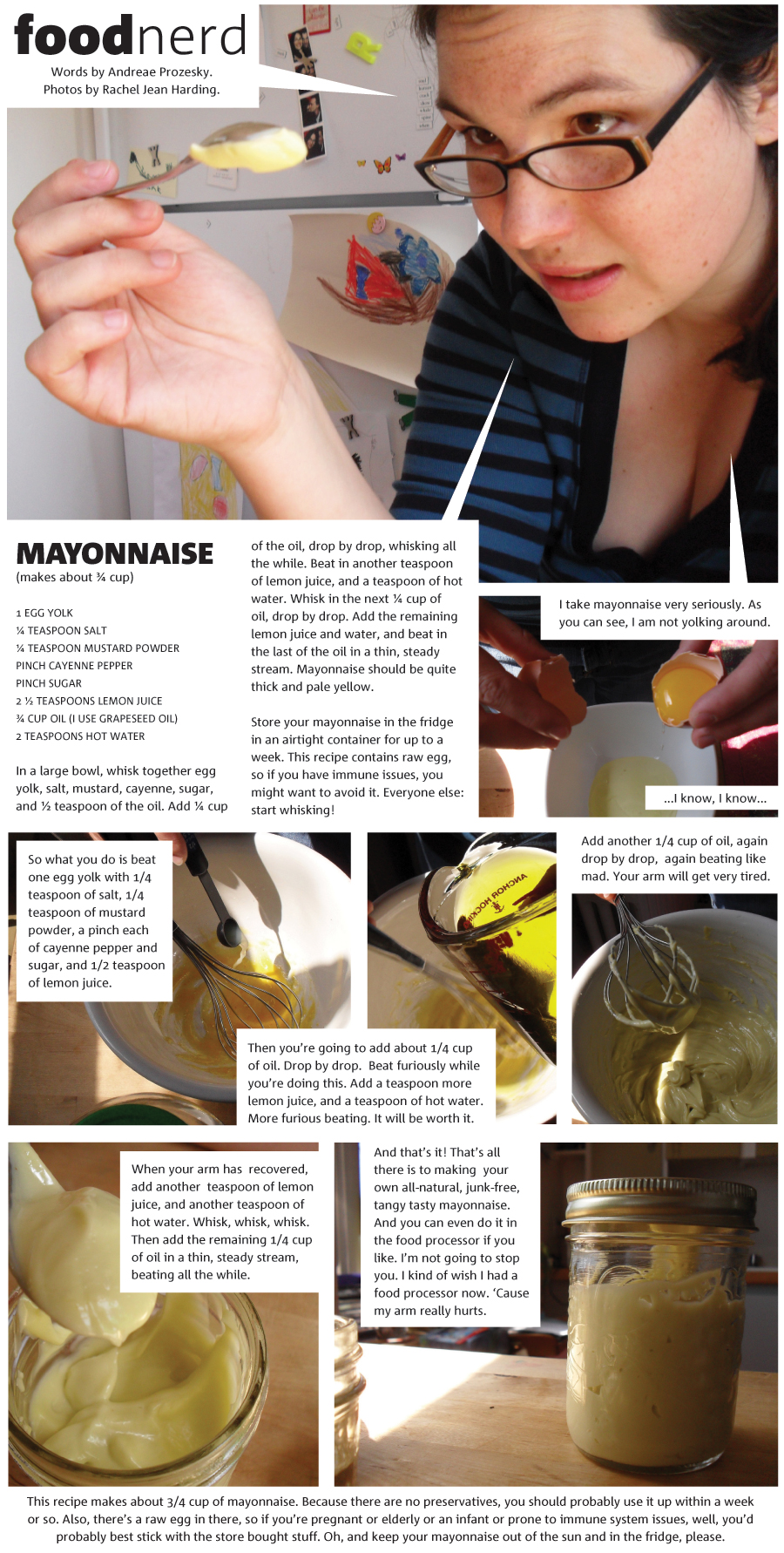
A few things to do with eggs
Thu, May 7, 2009
When I was a wee young nerdlet, my father was a part-time farmer. That is, he was a suit-wearing St. John’s executive by day, and the muck-slinging mastermind behind a Pouch Cove hobby farm by evening and weekend. Turkeys, ducks, geese, pheasants, and, for one season, rabbits, lived short but comfortable lives under my dad’s watchful eye. Come fall they were sent off to be butchered and dressed. He’d sell a few, keep the rest, and we’d be well fed through to next season.
And there were chickens. Some for eating—broilers and fryers, they’re called—and always a good number of laying hens. So there were plenty of eggs at Dad’s house. Brown, white, bright-yolked, sometimes double-yolked, dependable eggs, fresh as anything. Which is why, I suppose, when I sit and dream about the coastal subsistence farm to which I will one day retire, hens are the first animals I picture populating the landscape, scratching for bugs and roosting peacefully in the spacious coop I will have built for them entirely from reclaimed materials.
Yes, this is what I think about, almost all the time.
Hens are the ultimate value-added product on a small farm. Their feed is fairly cheap, they peck and pick and eat the slugs out of your veggie patch, and, if conditions are right, they lay at least one egg a day. Get yourself a half-dozen hens and you’ve got three and a half cartons of eggs a week, which means enough quiches and meringues and crème caramel for you to start your own catering business on the side. Add a rooster to the flock, and your hens make more chicks. Some of those grow up to lay eggs, some of them end up in the soup pot. The cycle of life goes on, and you get to observe it while dining on soufflés and breakfasting on omelets. A wise investment, since, unlike milking cows or shearing sheep, collecting eggs requires practically no effort. Every day is like Easter morning. Only without the chocolate. And with more chicken poop.
My nutritionist (who some of you dear readers might recognize as my mom), calls eggs “perfect food.” They’re inexpensive, full of protein, easy to prepare, and versatile. They’ve got folate, vitamin B12, and the antioxidant lutein. They’re also one of the few protein sources that St. John’s-dwellers can find locally. While there might not be much small-scale meat production on the Avalon, there are a good few family farms producing enough eggs to sell here and there. Ask around at the Farmers’ Market (opening up for the season on June 6 at the Lion’s Club Chalet, and hot damn am I excited), or at any roadside stand and you should be able to hone in on someone willing to part with fresh, happy eggs. But even if you’re strictly a supermarket shopper, you can find local eggs without too much trouble.
If you do buy your eggs at the grocery store, don’t be seduced by promises made about eggs high in Omega-3 fatty acids—I don’t care what the Omega-3 people say, chickens weren’t meant to be force-fed flax seeds and fish oil. That’s some kind of monstrous agricultural hazard in waiting, that is. And while I’m all for the idea of free-range and free-run chickens, some of the large egg producers have taken “free-range” and “free-run” to mean “locked out in the cold all day and all night,” or “free to walk around in a concrete pen under fluorescent lights” which isn’t really all that much better, if you ask me. Organic eggs are lovely, but if they come shipped from Ontario in plastic or polystyrene cartons, doesn’t that kind of run counter to the whole ethos of organic growing? Best to actually find yourself a farmer, get to know him or her, and ask about the sort of conditions his or her chickens live under. If they’re free to eat the odd grub and get out and stretch their wings now and again, you’ll notice it in the flavour of the eggs.
And lest you get all twitterpated about the cholesterol issue, let me just tell you this: freaking out about eggs and cholesterol is so 1980s. And not in a hip cool retro way. Recent studies all say that, for the average healthy person, there is no reason at all to limit egg consumption, and even people with high cholesterol levels can happily indulge in two eggs a week, which is a nice Sunday morning omelet, or two days’ worth of fried egg sandwiches, or a third of a flourless chocolate cake (well, maybe not that).
—
A few things to do with eggs
1. You’ve probably eaten soft-boiled eggs with toast soldiers, but try swapping out the toast for steamed asparagus – which will be in season here real soon.
2. If you’re in your early 30s or younger, you completely missed out on the era of the devilled egg. Learn from your elders: devilled eggs are awesome, and ever-so-slightly kitschy. Look up a recipe in any pre-1980s cookbook, or ask your nan.
3. Here’s one for barbecue season: boil some large new potatoes until perfectly soft. Half them and scoop out egg-sized recesses (save the extra cooked potato for, well, anything). Crack eggs into the hollowed-out potatoes and place the potato halves on the barbecue (make little tin-foil nests for them if they don’t look like they’ll stand up straight). Sprinkle with grated cheese, chopped cooked bacon, chives, whatever. Cover the barbecue and wait until eggs are cooked through (yolks should be runny). Eat at a picnic table or on a blanket on the lawn, with the sun low in the sky and a cold beverage in hand.
4. If you’ve never made your own mayonnaise, and if you don’t get weirded out by the thought of eating raw eggs, stay tuned for an upcoming Food Nerd Tutorial on mayonnaise makery. Trust me, it’ll be fun. And tasty. I promise.
Send your questions, comments, and suggestions for how to justify eating as much chocolate cake as possible to dreae@thescope.ca


Thu, Dec 3, 2009
Andreae Callanan