

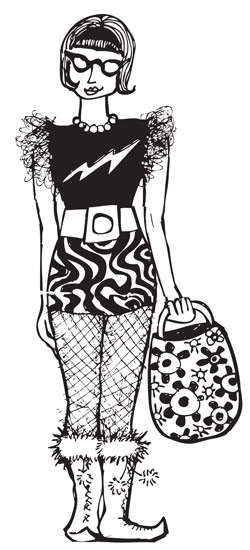
Fashionista Jill Butler takes you vintage hunting.
What’s the difference between vintage and second hand clothing?
The short, not entirely accurate answer: it’s just semantics.
The real answer: it’s a matter of permanence, availability and prestige.
Basically, vintage is something that has been made to last, no one else can get it, and you found it first. Compare the t-shirt you bought three months ago at the mall — the one that had weird splotches after a week and fell apart in the wash — to almost anything your parents would have worn back in the day, chances are vintage will easily survive any hot mess you throw at it. It has already endured the passage of time.
Vintage and thift
There are two categories to begin your search in St. John’s: vintage shops and thrift stores.
Of the latter, the usual suspects—Value Village, the Salvation Army, Previously Loved—require a lot of digging and patience. And while the stuff is cheap as dirt, it can be hit or miss. Vintage shops, on the other hand, do a lot of the digging for you, having collected fantastic pieces and housing them in one place. Model Citizens has done the city a huge favor in this regard. The selection is mouth-watering, but because it’s an true vintage shop, you’ll be paying a little bit more—but luckily, not much.
There’s the online option for those in search of a vintage fix. My favorite place on earth—sadly, I’m only exaggerating slightly—is Modcoth (www.modcloth.com). Modcloth carries a mix of vintage and vintage-inspired pieces, and many of the items are one of a kind. Also scour Viva la Vintage (www.vivalavintage.com) or Fashion Dig (www.fashiondig.com). When you’re looking online, be sure you have your measurements on hand, not just your size. A 14 in vintage is an 8 today—on a good day—and if you go international, sizes are all over the map.
To avoid the shops altogether, consider asking around. Hitting up parents and relatives can turn up some boffo threads. This option is also most likely free, which makes it a top score. Some of the best pieces in my wardrobe were formerly my mother’s (she was a woman ahead of her time—one skirt has pockets! A miracle I thought designers were only coming around to now).
No matter what way you choose to look, you’ll need patience and luck. You need to look often. Walking away with nothing is not a failure, damn it, it’s a time investment. The turnover rate for clothing in shops is high, and some days are diamonds while some days… just aren’t.
Legwork
The wise shopper will closely examine even the most tempting piece before taking it home. Most thrift or vintage stores don’t do returns—which is probably a good thing. Beware the siren song of low prices. From personal experience, even spending four bucks on something you never wear is a waste of money (she says, eyeing the space in the back of her closet that hides the bad investments, price tags still sadly dangling).
Before buying, check stress points like under the arms, and look out for moth holes, sweat stains, or worn patches. Watch for weak seams—a warning sign for dry rot. With purses or belts, test all snaps or closures. For footwear, examine the soles for cracks.
The nature of vintage clothing means that care tags are often washed out or missing altogether, so determining the quality is up to you. Fibers such as wool, silk, cotton, rayon, linen, cashmere, or viscose are safer bets than acrylics (which can easily pill) or polyester (which don’t usually last as long as their natural fibers cousins).
Also, sizes are a ridiculous concept anyway, so it makes sense that vintage pieces might need a little nip and tuck from your tailor.
Bonus: it makes the piece entirely yours.
Snag: while a pair of pants can be easily hemmed for under ten dollars, a lined jacket or dress can get costly.
Shopping vintage sometimes means swimming in a sea of unfamiliar labels. Fear not. At least until the mid 1950s, most clothes were made to measure—as in sewn from a standard-sized base pattern—so they’re probably still of higher quality than today’s stuff. Look to the actual label itself. If it’s sewn down completely, or woven, this is a good sign.
So try it on. Vintage shopping can be an easy way to build your wardrobe with minimal investment. If you find the perfect leather jacket for ten dollars, your life might change: your co-workers might respect you, and that cute barista might slip you extra foam—at no charge. Never know!
Illustration by Kira Sheppard.
Know how to do something and want to share it? Drop us a line at diy@thescope.ca.






December 10th, 2008 at 3:16 pm
There are many great thrift stores in St. John’s. Personally I find that when looking for vintage clothing Toronto is the place to be.
December 26th, 2008 at 8:35 am
The right outdoor clothing is all that is needed to get out and enjoy the outdoors at this time of year