

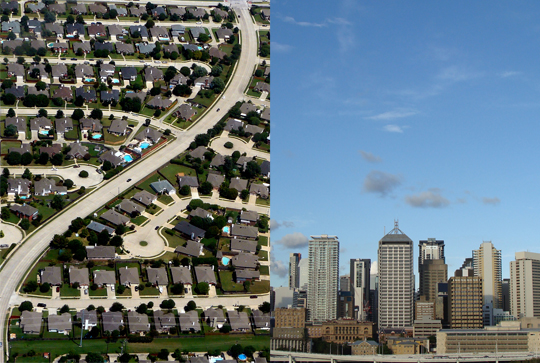
Left: CBS 2012. Right: CBS 2022? (actually, 'The American Dream' by Roma Flowers, and the skyline of Denver.
Considering the rapid growth CBS has been experiencing over the past few years, it should come as no surprise that it is now Newfoundland’s second largest community. There are new roads all along the main highway, each with brand new developments of single family homes. All sorts of amenities are within close reach, and a new big box “Smart Centre” in the area provides even less reason to visit St. John’s.
Debate has raged over the idea of amalgamation for a while, with opponents fearing a bill for services they might not get, and proponents blaming the so-called bedroom communities for the poor conditions of St. John’s roads. But now with CBS population passing the mark for city status, the debate is shifting towards a new question: Is CBS ready to be a city?
CBS lacks most of the traditional elements that people associate with cities. At first glance, it doesn’t seem to have institutional and government edifices, monuments, economic centres, cultural districts, transit systems, notable architecture, entertainment districts with night clubs, theatres, restaurants and hotels.
But maybe CBS isn’t a traditional city. Maybe it’s on its way to becoming an ‘edge city’. In North America, a surprising thing occurred in urban areas in the late 20th century. Suburbs were originally intended to be serene places to live away from the busy urban core of a city, with residents expected to commute to the city centre for work, shopping and entertainment. What happened was that people started moving all those elements closer to the place they live—to the suburbs. Hence, the ‘edge city’ was born. It’s not just a suburb anymore, it has some mid-rise office buildings, maybe a small library, a few schools, a shopping centre or a big box centre. Much like what is happening in CBS—albeit on a larger scale.
Author and futurist Joel Garreau coined the term in his 1991 book titled Edge City. He defines it as having a large geographic area, on the edge of a traditional city, close to a highway or airport, built to the scale of the car. They have mid-rise office buildings, and low-density single family homes. In the long term, edge cities face problems that limit their growth, and these have to do with the fact that they are designed exclusively for car-user lifestyles. Land along primary arterial highways can’t be easily adapted to divide into more lots, and the hierarchical road networks are not amenable to public transit. Essentially, it’s a pedestrian nightmare. It may not sound like a place you would want to spend your time now, but it has been suggested that all cities are chaotic in their early formative years. Garreau is optimistic, and projects a future where abandoned big boxes are akin to the hip converted industrial loft spaces, and sprawling parking lots are community gardens.
For a long time, the ‘city’ has existed in conflict with its suburban counterpart, but now it seems like the suburb-city is starting to be recognized as a phenomenon of its own, without being forced into the mold of the traditional, historic city. I am not so optimistic as Garreau about everthing working itself out on its own. I think CBS has a lot of possible futures and some are better than others. The fact that we can learn from other cities’ experiences with edge cities means that we could have a little more agency in determining that future.






March 21st, 2012 at 3:34 pm
Interesting take on things, Taryn. I think of edge cities as being larger, like Silicon Valley in California, with more employment opportunities. Whatever it is, CBS is certainly growing and changing, along with Paradise and other communities near St. John’s.