

Archive | Science RSS feed for this section
In our yellow Explorer AUV
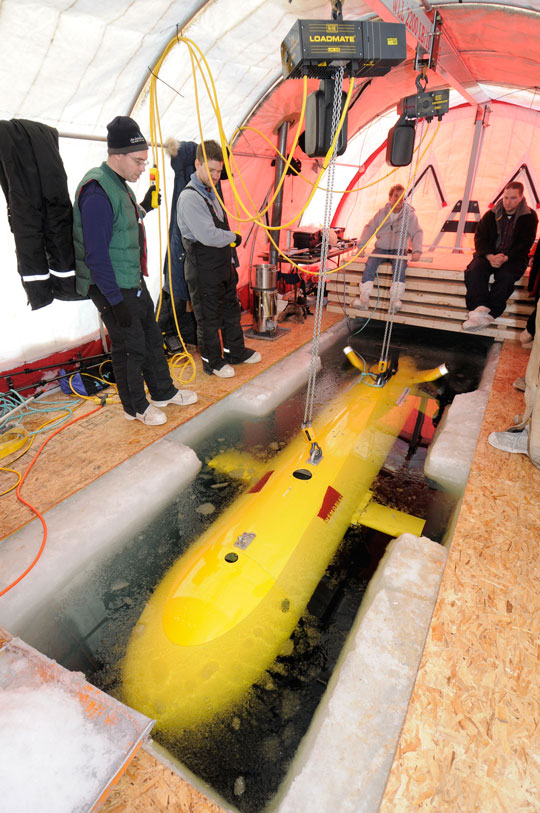
Photo by J. Lang, PCSP/NRCan, CHS/DFO
Engineers are great. Not only are they handy friends to have when things break down, they often get to use, or make, some of the coolest toys.
Case in point: Memorial University’s Explorer Autonomous Underwater Vehicle (AUV). The Explorer AUV looks a lot like a torpedo — it’s a bight yellow tube with fins. It’s large, measuring in at 4.5 meters long, and 670 kilos (1477 pounds). It’s also one-of-a-kind. The BC company who made it (International Submarine Engineering) has only ever sold seven, and the one at MUN is the only Explorer owned and operated by a university in Canada.
MUN received the Explorer AUV in 2006, explains Ron Lewis, Project Manager with the Responsive AUV Localization and Mapping Project (REALM) at MUN. Prior to buying the Explorer, the MUN Engineering Department and Institute for Marine Dynamics had actually built an AUV in-house. “Multiple PhDs, graduate students and work terms were involved in that process,” says Mr. Lewis.
While it was a great learning experience for the community the final product wasn’t fully functional, so the university decided to invest in the Explorer.
At first, the Explorer was used on-campus to study the hydrodynamics of how AUVs move through water. It was also used in the field for environmental monitoring and plume modeling around off-shore drilling platforms, and shoreline sewage treatment plants. The Department of Fisheries and Oceans (DFO) worked with MUN to use the Explorer for acoustic seabed classification in Placentia Bay. As Mr. Lewis explains, “knowing what your seabed is made of you can better understand what the habitat is, and so you have a better understanding of what fish species would want to live in a certain area, or not.”
In 2009, MUN was asked to work with DFO, the Department of Natural Resources (DNR) and the Defense Research Development Canada (DRDC) to take the Explorer AUV to the Canadian high Arctic. Working out of CFS Alert in Nunavut, the most northern permanently inhabited location on Earth, the team worked through the difficult logistics of assembling, launching and recovering the Explorer in this harsh environment. The plan is to eventually run full missions surveying the sea floor in the area to support Canada’s territorial claim in the Arctic, and to expand Canada’s Exclusive Economic Zone.
When asked why MUN is the natural home for the only Explorer AUV at a Canadian university, Mr. Lewis explains that not only is there a “critical mass” of marine engineering and research groups here in St. John’s, the Explorer is well suited to the harsh Newfoundland environment. Unlike similar technology that must stay connected to the surface to receive power and instructions while working, the untethered AUV is much safer to operate in harsh conditions. Newfoundland also provides a good opportunity for developing the technology, because “if you can make a technology work here, you can make it work in a lot of places.”
Mr. Lewis also recognizes that the group at MUN benefits from the rich sea-fearing history of the province. “Culturally and historical there’s a significant understanding of the ocean environment. People who have worked on water can appreciate what you’re into in terms of risk… and so you can call upon those resources to help you in the day-to-day running of this type of machine.”
One example of a local group that MUN regularly calls in to help with the Explorer AUV is Whale Release and Strandings, a non-profit group that helps free entrapped whales and other sea-life around the province. This team is the university’s go-to group for zodiac support, which is used when towing the AUV to and from a dock, and when making adjustments to the AUV while it’s at the surface in the water. Because the AUV is the size of a small boat — or a small whale — other groups are less comfortable and skilled in managing it in the water. But the Whale Release group is comfortable with it. “It’s like [they] said to me once: ‘You just treat it like a whale’,” says Lewis.
Currently, the REALM Project is working to improve some of the AUV’s on-board systems. This project involves multiple prongs, and so MUN is working with many other groups including the Explorer’s original manufacturer, DRDC and the local companies Pangeo Subsea Inc. and Fugro Geosurveys. One of the improvements the group is working on will enable the AUV to interpret the sensory data it’s collecting in real time. This will allow the vehicle to recognize landmarks in its area and correct for small navigational errors that compound over long missions. It will also allow the vehicle to respond to pre-programmed features by performing more in-depth measurements of the area, which saves having to re-deploy the vehicle to do it later. This project’s principal investigator is Dr. Andrew Vardy at MUN and is receiving funding from the Atlantic Canada Opportunities Agency’s Atlantic Innovations Fund and the Province’s Research and Development Corporation.
For the first time, engineers at MUN are getting to “play on the vehicle” says Mr. Lewis, rather than just play with it. Which, if they were honest, they’d admit was probably what they were waiting for all along.
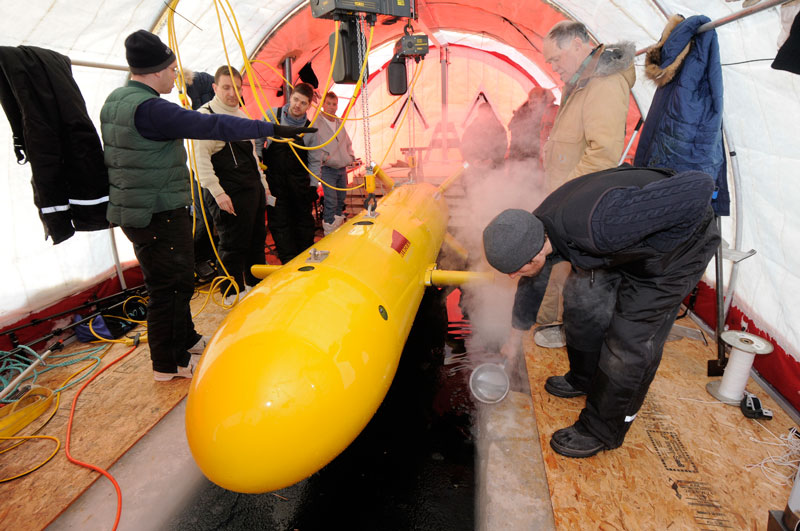
Photo by J. Lang, PCSP/NRCan, CHS/DFO
Great future in green plastics
Mon, Mar 19, 2012
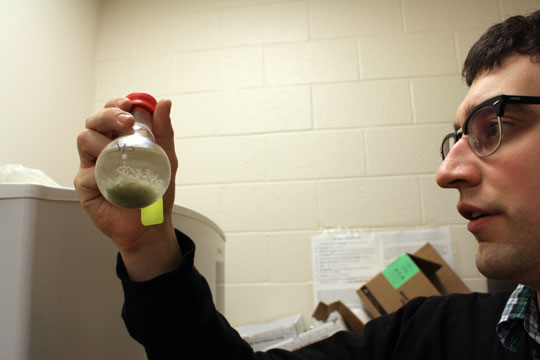
MSc student Justin Belanger examines a sample of green-plastic produced in Dr. Kozak’s lab.
The last time that you were out dodging bags caught in the trees along the Sugarloaf Mountain trail, you might have thought of ways you could produce a bit less waste. Well, researchers at Memorial University in St. John’s are also exploring ways to do that too.
Dr. Chris Kozak is a faculty member of MUN’s Chemistry Department and a member of the Green Chemistry and Catalysis Group. He says his research is part of a movement towards something called a “cradle to cradle” way of making materials which considers the impacts of a material throughout its lifecycle –- including how the material is produced, how it is used in a product, and what happens to it after that product reaches the end of its life. The goal is to design materials that have little or no negative impact on the environment.
Justin Bélanger is a MSc student in Dr. Kozak’s lab at MUN. He is from PEI, and moved to Newfoundland in order to work with Dr. Kozak and perform research on green chemicals. Bélanger’s MSc thesis involves research on green plastic.
Conventional plastics have serious negative impacts on the environment both at the beginning and end of their lifecycles. Plastics are typically made using oil, and their production usually uses very dangerous chemicals as solvents. One example of a common plastic used in water bottles and Tupperware is polycarbonate.
“The way polycarbonate is made right now, it uses two chemicals. One is called Bisphenol A (BPA), and the other is called phosgene. And phoshene is a nerve gas,” says Dr. Kozak.
Even if the solvents aren’t in the final plastic product, disposing of these chemicals can be very harmful to the environment. Then, at the end of their lifecycles, conventional plastics will take hundreds or thousands of years to break down, and so the plastic builds up in the environment.
For an example of the effect plastic has on the world’s oceans, check out this TED talk about the Great Pacific Garbage Patch by Captain Charles Moore of the Algalita Marine Research Foundation.
The green plastic Bélanger is working on is made using carbon dioxide (CO2) instead of petrochemicals, and the solvents he uses are much less harmful to the environment. The plastic itself is biodegradable, which means that microbes or UV light can safely break it down back into CO2. His project involves trying to control the properties of the final product, such as how hard or flexible the plastic will be. As Bélanger and other researchers learn more about green chemicals, and find more efficient ways to make them, industrial companies will become more willing to incorporate them into products.
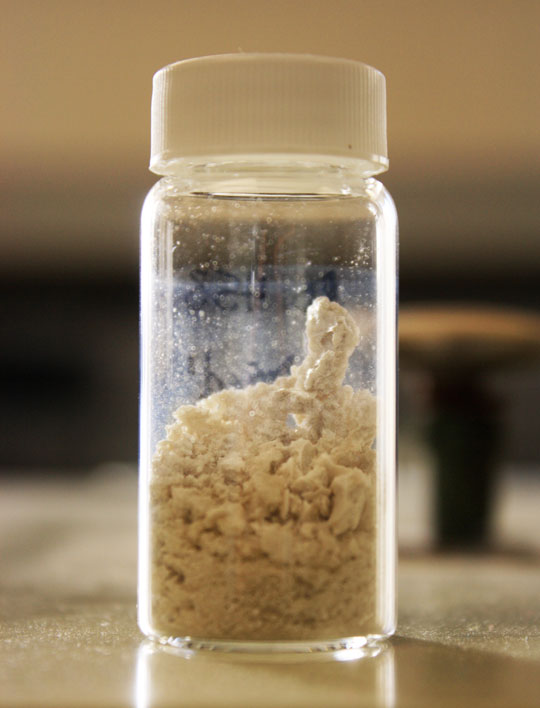
Dr. Kozak’s lab is working to convert their green-plastic products into pellets, so that the plastics can be easily shipped off to industrial partners in the future.
In fact, green chemicals are already being used in some products you use. For example, the plastic bags used by the NL Liquor Store (made by EPI-Global) include around two per cent green plastics — which is enough green plastic that the bags will start to break down in a matter of weeks instead of the centuries.
This is something that you can test yourself: Take a NL Liquor Store plastic shopping bag, and check for the “100% Degradable” stamp. Place the bag in a bowl, and leave it next to a window where it will be exposed to lots of sunlight. After a month or so, you should already see signs that the bag is breaking up.
According to Dr. Kozak, MUN is an apporopriate place for conducting research on green chemicals. The development of the offshore oil industry in the province provides him with local industrial partners for his research. One of his long-term plans is to work with offshore oil producers to capture CO2 produced in combustion, and develop it into green-plastics or other useful products.
“The ultimate goal is that in fifty years, then all chemistry will be green and all processes will be green,” he says.


Tue, May 1, 2012
Dave Jerome