

Archive | On Screen RSS feed for this section
Compliance
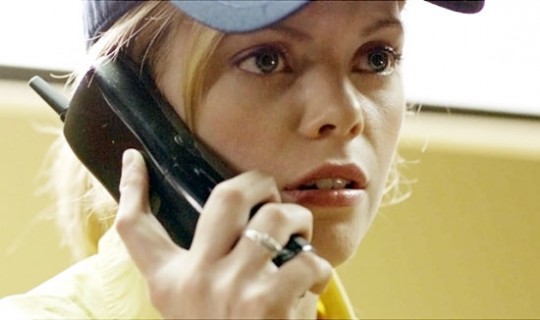
It’s an average day at the Chickwich, a fast food restaurant in American suburbia. Store manager Sandra (Ann Dowd) has screwed up yet again, letting bacon and other toppings spoil before weekend. In the hopes of not getting chewed out, Sandra orders extra without alerting her bosses to the error. For Kevin (Phillip Ettinger), Connie (Nikiya Matthis) and Becky (Don’t Trust the B in Apt 23‘s Dreama Walker), it’s another day at a job they don’t particularly like. They joke around and the kick the conversational can while fielding orders for fried chicken and shoe-string potatoes.
Sandra then receives a call from someone identifying himself as “Officer Daniels” (Pat Healy). He claims young Becky has been stealing and requests that Sandra detain her. Sandra complies and pulls Becky off cash duty. This is the first step in a prolonged humiliation and twisted psychological game conducted by Daniels who, despite any assertions to the contrary, will never step in to investigate Becky’s alleged crime.
Based on true events, Craig Zobel’s Compliance is a tense, riveting hour followed by a third act of diminishing returns. What we have here is a great hour of television or great one-act play that buckles slightly under the constraints of a longer running time. That Becky follows through with Daniels’ increasingly implausible and exploitative requests throws reality out the window by the time Sandra’s boyfriend is tasked with strip-searching Becky. I don’t doubt that Becky’s experience, which mirrors several of these real cases, but it’s hard to make that translate believably in the film. While Compliance makes for a fascinating, if flawed drama, you can’t help but wish Zobel had made a documentary instead.
Compliance will show as part of MUN Cinema on Thursday, September 20 at Empire Studio 12. For details visit www.mun.ca/film.
A special steel-cage Q&A with the director of Beat Down
Thu, Sep 13, 2012
Whilst chatting with Deanne Foley, the director and co-writer of Beat Down (currently in theatres), Adam Clarke puts her wrestling cinema knowledge to the test.
All right, would you like to play a game?
A game? Does it involve drinking?
I give you full license to drink at 1:30 in the afternoon.
I’ll probably wait ‘til 5.
In a series of true or false questions, I’m going to tell you the plot of a movie featuring a wrestler. I want you to decide if it’s a real movie or if I’m making it up. There’s a valuable prize at stake! Ready?
Yes!
Is this a real movie, true or false? Hulk Hogan is sent down from outer space and is tasked with protecting Christopher Lloyd from The Undertaker (who is also from space).
Oh, that’s definitely real.
Correct. The film is a little-seen gem called Suburban Commando.
That’s just a classic Hollywood story.
Was the first draft of Beat Down closer to Suburban Commando?
Definitely. You can never go wrong with aliens.
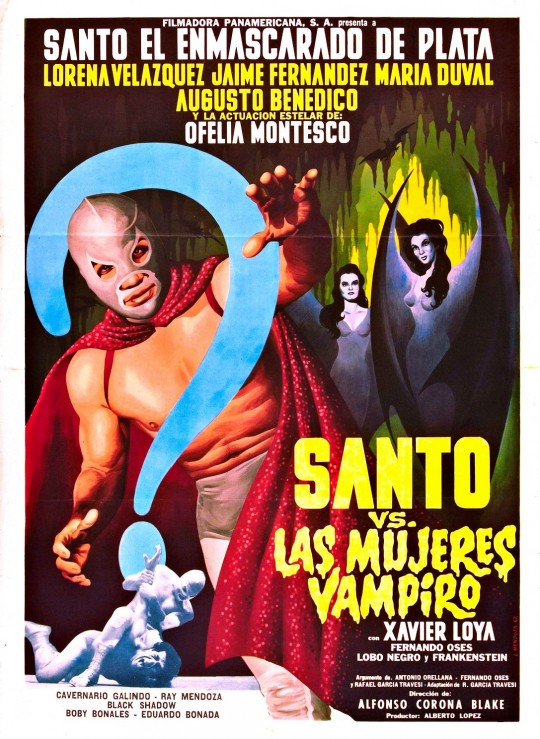
Next: a luchadore is brought in to protect the God-fearing people of a small village from vampire women. Is this a real movie?
Isn’t that Nacho Libre? No. There’s no way that’s real.
Incorrect! Santo Vs The Vampire Women is real. Next: A wrestler named Rip must face off against an evil wrestler named Zeus after said evil wrestler puts Rip’s younger brother in the hospital.
I’m going to say that’s a real movie.
Correct! That’s another Hulk Hogan vehicle, No Holds Barred.
Well, no one sets out to make a bad movie.
Filmmaking is such an ordeal that you’d have to commit. Nobody will waste a year of their life on nothing.
Everyone has to believe that they’re making the next great film. Otherwise why would you do it? You have to care about it. They have to think they’re making something that they’ll be proud of. [Beat Down co-writer] Iain Macleoud has definitely seen every wrestling movie. He was telling me about that one. It sounds hilarious. You can’t believe someone gave people money to make that movie.
No Holds Barred is great, but should never be confused with the WWE’s Shakespeare in the Park series, No Holds Bard.
Don’t tell me that’s real.
You haven’t lived ’til you’ve seen Ultimate Warrior as Hamlet! Next question: True or false — is there a film in which a young man becomes a superhero after beating Macho Man Randy Savage in the ring?
Not real.
Incorrect! I’m afraid that’s an important plot point in Sam Raimi’s Spider-Man.
Wait, really? I feel like I learned something in this interview. Thank you.
The more you know!
Many thanks to Deanne Foley for playing. For getting some of these questions right, I’ll be sending her a three month supply of Slim Jims and Mr Noodles, the breakfast of champions. The grand prize of D.B. Cooper’s bag of money remains in my possession until I call on the next contestant. Who knows? The next winner may be you!
SPOILER ALERT: The next winner won’t be you. I’ve already spent the money on prostitutes and Ringolos. The more you know!
Zombie Apocalypse (2011)
Wed, Sep 12, 2012
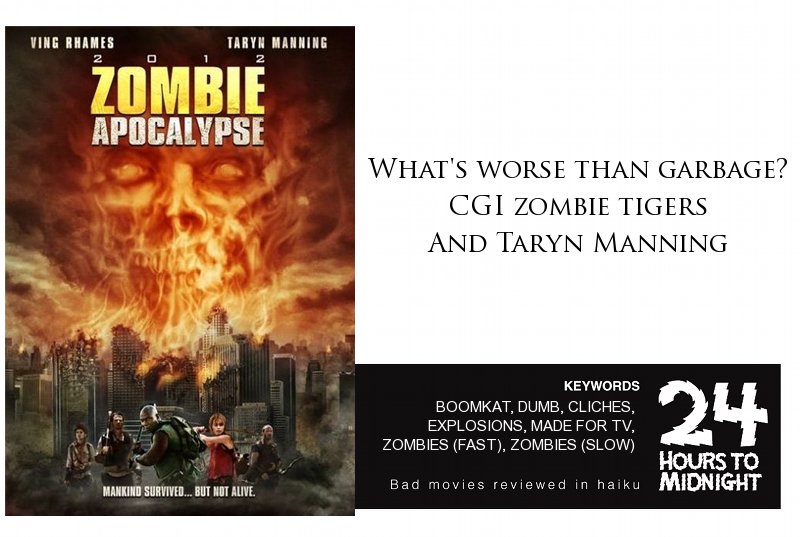
Boomkat frontwoman and professional skuzzbucket Taryn Manning and her bestest pal, Crabman from My Name is Earl, are survivors of history’s most generic zombie apocalypse in Zombie Apocalypse (2011). Zombie Apocalypse was yawned into existence by The Asylum, the creators of Transmorphers, The DaVinci Treasure, Paranormal Entity and other made-for-gas-station films.
As should be expected, the whole thing feels really lazy. Six months into a zombie apocalypse, and they’re still explaining stuff like “Where did all these zombies come from?” It’s like it’s their first day. God!
Plus, it looks like the director promised the actors there was going to be CGI added in later, and then they just didn’t bother. Fortunately, the actors clearly didn’t know how bad the CGI that made the final cut would look, so nobody rolls their eyes when the zombie tigers show up.
The casting, however, is inspired. We’ve got Adventuresome Woman of Indeterminate Ethnicity as Tia Carrere, Squinty Stubbly Man as Ed Burns, Dead-eyed Foreign Mercenary as Jean Reno, and Ving Rhames as Ving Rhames.
In short, it’s a total ugh-fest. Avoid like the coming zombie plague.
Community Season Three: Introduction To Finality
Wed, Sep 5, 2012
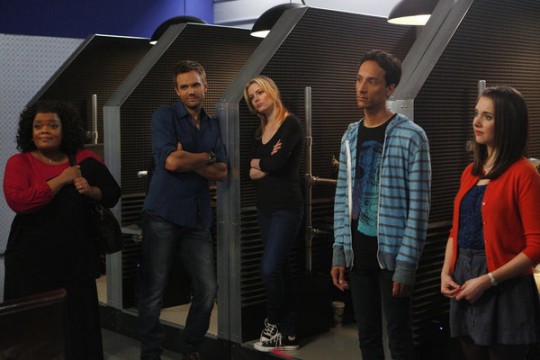
Adam Clarke hit the corner, right on a fresh tatoo.
Did we lose the real Abed this season? Is season three Britta the worst… or the best? And what of Leonard’s crooked wang? It’s time to answer the big questions, friends. In the third and final instalment of this look back on Community‘s third season, I’ll be reviewing the “90-minute finale” that aired on May 10, 2012 and offering some thoughts on characterization, the loss of Dan Harmon and Community‘s future.
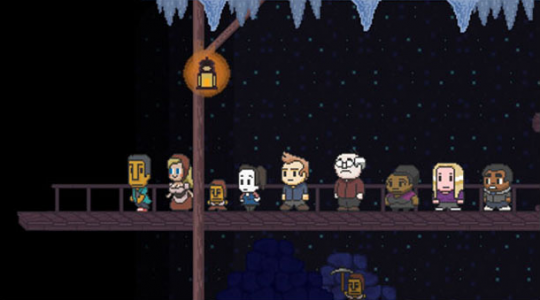
Digital Estate Planning
Crib notes: In order to receive his inheritance, Pierce and his closest friends must compete in a retro video game against his late father’s assistant, Gilbert (Giancarlo Esposito).
Choice dialogue: “Worst. Son. Ever.”
- Cornelius Hawthorne haunts Pierce from beyond the grave in 8-bit form.
Grade: “I did it by having friends”. I know some people can’t stand these gimmick episodes, but it’d be one thing if Community just dropped everything to do an extended gag at the expense of its characters. At no point during any of these special episodes have we lost sight of who these characters are. Community never stops being about the study group. This episode, while mostly animated and playing with the tropes of video games, is still a strong story about the group working together as friends and being there for their worst friend, Pierce.
Not that the above should make the episode sound maudlin. “Estate” has some great set pieces like Annie and Shirley dealing with the Blacksmith and the 8-bit opening credits. Not to mention all those nice little touches for video game nerds (I loved Jeff’s Megaman jump). Easily one of Community‘s funniest episodes. A+
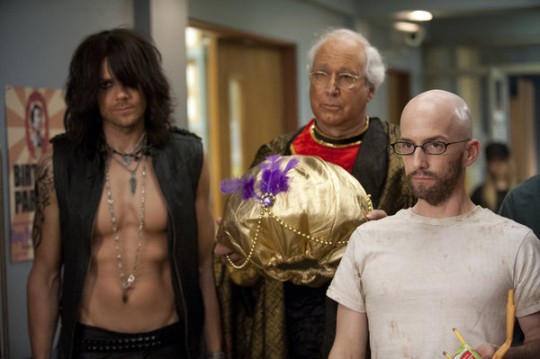
The First Chang Dynasty
Crib notes: The Greendale study group plot an elaborate heist to rescue Dean Pelton from Chang and his army of adolescent security guards.
Choice dialogue: “First Chang kidnaps the Dean, then he throws himself a party? It’s just like Stalin back in Russia-times!”
- Britta Perry, still the worst.
Grade: As the previous episode was rooted in video games, here the Greendale gang are put through the tropes of a modern heist flick. So, elaborate disguises, step-by-step plans, slow-motion, people repeatedly saying “I’m in” even when they’re not actually in the room, etc.
While I was never a fan of the Security Chang story arc (or much of what’s happened to Chang after season one), this is a really entertaining episode. Community doesn’t work as a story arc-driven program, this episode throws so many plot threads together that it’s quite exciting to watch. It’s fitting that the episode takes place during a birthday party, as the crazy costumes and go-for-broke silliness feels like a party for the show and its fans more than anything else. This is Community made by those who feared it would get cancelled and opted to go out with a bang. B+
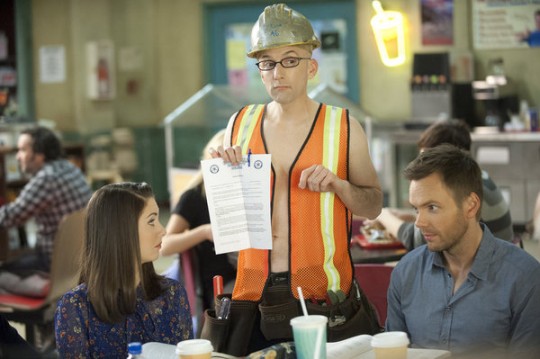
Introduction to Finality
Crib notes: Jeff’s desperate to pass his make-up biology course, but keeps getting dragged into a dispute between Shirley and Pierce. Troy proves he is the truest repairman when he enters the world of air conditioner repair.
Choice dialogue: “Shut up, Leonard! I know about your crooked wang”
“No such thing as bad press”
- Britta vs Leonard
Grade: Mercifully going against the trend of past seasons ending on a small cliffhanger, “Finality” opts to give fans closure in case the series had never returned. Funny, crazy and sentimental in the right places, “Finality” embodies the essence of the show in a script crammed with action. If the show had been cancelled, “Finality” would make a great conclusion to this brilliant series. A-

Community‘s third season got off to an unpromising start. Episodes 301-303 were uniformly poor and 303-305 essentially told the same story of the study group clashing. Of those five episodes, only “Remedial Chaos Theory” and, to a lesser degree, “Biology 101″, offering any kind of depth to the characters. Then we had story arcs that were abandoned because of network notes (Jeff’s dad), scheduling conflicts (the show needed more Vice Dean Laybourne) or just because they realized it was a bad idea.
Another recurring problem was that the show sometimes didn’t know what to do with its characters. While I’ve already written about the inconsistencies with Pierce Hawthorne and Ben Chang (Ken Jeong), I do want to backpeddle a bit in regards to Annie Edison. Annie’s biggest story this season was the half-baked, disappointing “Geography of Global Conflict” and her character was often downplayed. Essentially, Annie was getting treated by the writers the same way Shirley was in season two: no strong stories of her own (Shirley’s pregnancy was really more of a Chang storyline), but she was still given some great dialogue throughout the season.
Annie’s best moments this season had nothing to do with her pining for Jeff or moving in with Troy and Abed. Annie struggling to set up Troy and Britta in “Virtual Systems Analysis”, tell an unexpectedly gory story in “Horror Fiction in Seven Spooky Steps” and keep Britta from her carny ex in “Origins of Vampire Mythology” resulted in Allison Brie’s best work since season two’s “Conspiracy Theories and Interior Design”.
The first few season three episodes were a bit of a let-down for all the characters, especially Shirley. It initially appeared that the writers were going to continue the trend of limiting her characterization to “disapproving Christian”. Season three turned out to be the best year for Shirley Bennett yet, with strong stories about her remarrying Theo Huxtable, her plans to open a sandwich shop, as well as offering a glimpse into her terrifying past life as Big Cheddar, the meanest foosball player of them all.
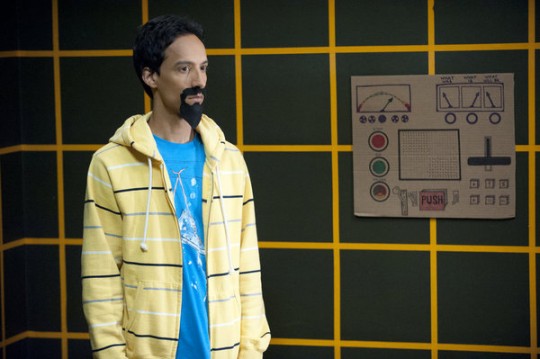
“This is really crazy and inaccessible…and maybe too dark”
- Abed Nadir
I have mixed feelings about Abed’s storyline this year. In Community’s pilot, Abed is an emotionally stunted, socially awkward movie geek (is there any other kind?). Like most of the show’s characters, Abed’s characterization changed for the better within the first six episodes. The twitchy, sometimes annoying version of Abed in the early episodes became an extremely intelligent, pop culture obsessive who handles the emotions of others remarkably well despite difficulties with his own. Abed was the sane one in the study group and his personal limitations never got in the way of his ability to empathize with and help his friends.
We didn’t see that Abed much in season three, although lip service was paid to this idea in this season’s Halloween episode. In the pilot, Abed’s hiding under the table and emitting a high-pitched scream as the study group fights around him. In season three, Abed’s having regular screaming freakouts over TV shows and Daylight Savings. Watching the season unfold, it often felt like a step backwards for the character. It was sad seeing Abed go from being an unexpected source of compassion and wisdom to a guy with “funny Asperger’s”.
Yes, the Abed in season two and most of season one is a version of a nerd that’s too good to be true, but it worked so well that I was sad to see it go. The contrast between Abed in season three and Abed in the rest of the series is pretty dramatic. In season one, Abed won’t move in with Troy because he knows that living together will spoil the friendship. In season three, they’re living together and often step on each others toes. In season two, Abed’s humiliated when the group discovers his notebook, which he’d used to chart his female friends’ emotional highs and lows (inadvertently charting their cycles) in the hopes of being on better terms with them. In season three, Abed considers his other friends “unremarkables” and actually breaks down when forced to consider their feelings.
Abed was annoying in “Biology 101”, “Competitive Ecology” and “Foosball and Nocturnal Vigilantism”, but the “Evil Abed” storyline resulted in a great finale. I just don’t know if a great finale compensates for the character’s change from “funny weird” to “creepy weird”. Abed’s breakdown was like an ongoing retread of season two’s brilliant “Abed’s Uncontrollable Christmas”, but without the sympathy. By having Abed become alienated and lash out at his friends, the show offered another variation on Pierce’s storyline from season two.
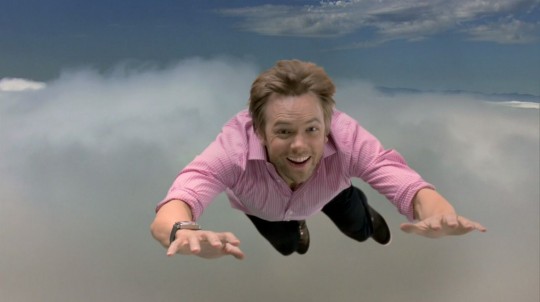
Like Abed, Jeff reverted back to who he was in the pilot for much of the season. Midway through season one, Jeff changed. At the beginning of the series, Jeff was a charming manipulator content to get his law degree and, hopefully, get into Britta’s pants before mid-terms. By season one’s “Comparative Religion” (if not earlier) he became someone who legitimately cares about his friends. The first half of season three saw the character regress to a more sullen version of Jeff from the pilot.
The problem is that the indifferent Jeff Winger of early season three plays against Joel McHale’s strengths as an actor. McHale is charming and charismatic, but having Jeff openly lose interest in his Greendale pals (seemingly for no reason) forces him to downplay the very reason he was cast as Jeff Winger in the first place. At least the Jeff Winger in the pilot uses his charisma to cover up his detachment and self-absorption. Barring some particularly engaging performances from McHale in “Advanced Gay” and “Foosball and Nocturnal Vigilantism”, we wouldn’t see the Jeff Winger we’d come to love until the end of “Pillows and Blankets”.
Aside from that, the show used it characters quite effectively and John Goodman was a terrific, if too short-lived, nemesis. The ensemble all got their moments to shine, but particular praise goes to the use of Greendale Community College Dean and noted “pansexual imp” Craig Pelton. Pelton fared particularly well this season, finally getting his own episode (“Documentary Filmmaking Redux”). The Dean getting a hug from the study group at the end of “Redux” is one of the sweetest moments in the entire series.
Child-like Troy and a somewhat more airheaded Britta were also given a lot to do this season. Britta showed rare competence as a psych major (“Advanced Gay”, “Contemporary Impressionists”) while still making mistakes (or “Brittas” as they’re known in the study group). Sometimes Britta was dumb. Season four Homer in The Simpsons dumb. Nonetheless, I like seeing that side of Britta and Gillian Jacobs has never been better on the show.
Troy was initially a pawn in the game of Vice Dean Laybourne and later became, in one of Community‘s most bizarre and inspired storylines, “the truest repairman”. Britta and Troy’s romantic spark was reintroduced after season two’s “Competitive Wine Tasting” and developed organically during season three. I hope the new showrunners just have Troy and Britta together, already. A relationship doesn’t have to be undergoing dramatic crises every five minutes. Newsradio was at its best when Dave and Lisa were in a steady, happy relationship, so why not Troy and Britta?
While the firing of creator-showrunner Dan Harmon at the end of the season was a heinous thing to do, I’m strangely optimistic about what the show will evolve into without him. As good as season three got, there were signs of rot creeping into the show. In only its third season, Community felt like it was listening to the fans too much. Don’t like the embittered side of Pierce in season two? He’s sorta better in season three! Did you love Danny Pudi’s brief Christian-Bale-as-Batman impression from season one? Here’s half an episode devoted to it! How about a second fake clip show or another documentary episode or multiple episodes with the cast wearing funny costumes?
Most of these familiar elements worked, but this is what you come to expect from a show that’s been on the air for six years, not three. Strangely enough, with Harmon gone, Community‘s third season works a little better in hindsight because these familiar elements feel like a celebration instead of a creative fumble. Community could use a breath of fresh air for its creative team and new showrunners might provide just that. I haven’t seen anything by Community‘s new showrunners (David Guarascio and Moses Port), but I’ll be approaching season four with an open mind.
Season three wasn’t Community‘s best season, but the show deserves credit for finding new ways to top itself. Season three made the best use of the ensemble and its growing list of recurring characters (despite Chang’s pointlessness). As sweet as season one is and as wild as season two is, few episodes in those seasons combined those elements as this season’s best work.
I can bitch about “Competitive Ecology” all I want, but a season of Community that features a decades-spanning jingle about baby boomer narcissism, an episode set in an 8-bit video game and John Goodman playing tuba in a band called “Kelvin And The Zeroes” is better than nearly anything else the 2011-2012 TV season offered. If the next season has episodes as funny as “Advanced Gay”, “Origins Of Vampire Mythology” or “Documentary Filmaking Redux”, we have a lot to look forward to.
Next week: A post that doesn’t mention this show at all, I promise.
Mr. Frost (1990)
Tue, Sep 4, 2012
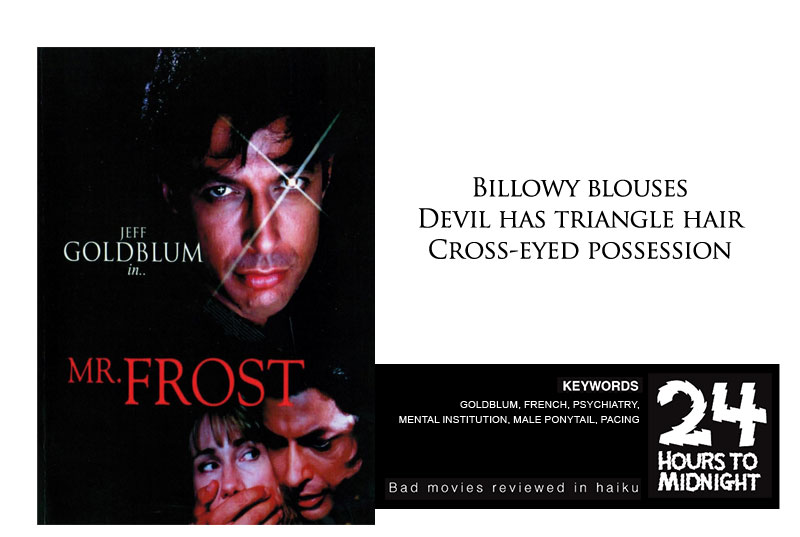
This tense 1990 thriller directed by Phillipe Setbon tells the story of charming serial killer and possible devil Mr. Frost (Jeff Goldblum) who loves cooking, can melt things with his hand and has 24 corpses buried in his back yard. There is no record of him to be found and once captured by Alan Bates, he refuses to speak until Dr. Sarah Day (Kathy Baker) comes onto the scene. Then he decides to convince her to kill him. There’s a bunch of religious mumbo jumbo, some priest-killing due to possession, a lot of weird imagery, and one of the finest Goldbulm performances on record.
How much you enjoy Mr. Frost really depends on how much you enjoy Jeff Goldblum. If you’re like me and you think he’s the most wonderful thing ever created next to Nicolas Cage, you will love him as the Devil, flouncing around in over-sized silk blouses and pretending to control people with his brain. If you’re one of those awful people who think he’s THE WORST, you are better off avoiding this as it starts off strong but then devolves into convoluted mess. It’s one of those movies that could have been great but in the end is just pretty good.
BONUS:
Play this infuriating game!
Twists & Turnbuckles
Wed, Aug 29, 2012
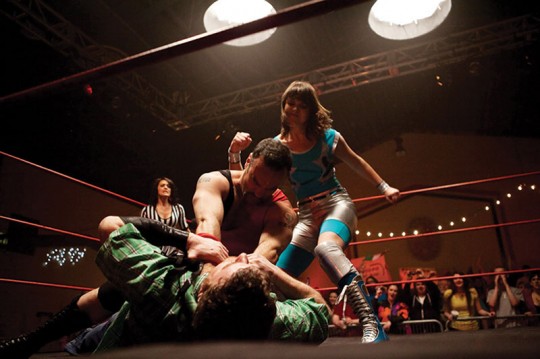
Jimmy Langdon (Tony Nappo) chokes his rival Whitey (Robb Wells) as Fran (Marthe Bernard) attacks Jimmy during a tag team wrestling match in Beat Down. (Maria Hillier photo)
Brother, you best be saying your prayers and eating your vitamins. You best not be too scared to eat a turnbuckle or be subjected to a sleeper hold. Beat Down director Deanne Foley was one such person, as she dove head-first into the world of leg drops, suplexes and body slams.
Not literally, though, ‘cause those moves are something Foley takes very seriously.
“I already had a respect for it,” Foley says. “I wanted to make a film that satisfied the most die-hard wrestling fan, but that you didn’t need to be a fan in order to get into the story… I wanted the wrestling to feel authentic.”
Beat Down is the story of Fran (Marthe Bernard), a Newfoundlander who wants to follow in her father’s footsteps and become a pro wrestler. Her father, Whitey (played by Robb Wells of Trailer Park Boys fame), has long-since abandoned his salad days as a gorgeous lad of wrestling and wants Fran to abandon her dreams. With persistence, and the aid of friends like Michael (Mark O’Brien, Bernard’s Republic of Doyle co-star) and Father Tyrone (prince among men, Andy Jones), Fran makes a name for herself in the wrestling scene. Before the end of the film, she may even manage to get Whitey back in the ring for one more match alongside his daughter.
“Even though it’s choreographed, those moves hurt,” Foley says. “Hitting a turnbuckle hurts. It’s not a stunt. They still take the bang.”
To research the sport, Foley went on tour with Newfoundland’s own Legend City Wrestling. Working closely with LCW founders Dan Bjorkdahl and Steve Clarke, Foley was able to translate all of the theatrics and staggering blows of live wrestling for several key matches in Beat Down.
“When wrestling is done well, it’s an unbelievable show,” Foley says. “I found myself getting involved in the matches, shouting ‘Oh my god! He just hurt his head. Is he okay? I think he broke his neck!’”
“My producer, Paul Pope, would just laugh at me,” Foley says.
***
Five years ago, Foley and co-writer Iain Macleod began working on a script about a family of wrestlers. The first draft focused on Whitey instead of his daughter, Fran, and was, in Foley’s words, “a poor man’s Million Dollar Baby.”
“I hope that draft never resurfaces,” she says with a sigh of relief.
Having decided that the world doesn’t need another training montage set to inspiring music, Foley and Macleod aimed to move away from films like Girlfight and Rocky, to give Beat Down its own identity. The pair turned out another eleven drafts before shooting the film last year. With Foley and Macleod working on other projects, such as Street Cents, Trailer Park Boys and CBC’s late, lamented Zed, Beat Down’s script would be set aside for long periods of time. Foley says this lengthy gestation period brought clarity to the creative process.
“The comedy was a bit broader than what you see on the screen,” Foley says about the initial Beat Down drafts. “Our intent was never to make fun of this world or these characters. Even though these characters may be extreme in nature, their fears, dreams and beliefs were real. The early drafts were a bit more sentimental, which didn’t work. The comedy and the drama needed to support each other for the film to work.”
***
Wrestling fans encompass people from all walks of life, which Foley witnessed first-hand during her time with the LCW.
“The sweetest little girl with blonde pigtails screaming ‘break his arm!’” Foley says. “She must’ve been seven. It’s great entertainment.”
As someone who’s researched wrestling as intently as she has, Foley understands the love and hate fans aim at the wrestlers.
“You don’t just casually think ‘oh, I’ll check out some wrestling tonight’,” she says. “The fans were amazing and their reactions were insane… They hated the bad guy and they loved the good guy.”
Beat Down earned a positive reception during its screening at the Women’s Film Festival last year, and the hope is that the film will connect with cinemagoers the way wrestling fans take to LCW or WWE action. With the film opening in eight theatres across all four Atlantic provinces this month, there’s a chance for the film to strike a chord with audiences who come for the comedy, the drama, or the headlocks.
Beat Down is showing at Empire Studio 12 in the Avalon Mall starting September 7th.
Community’s Third Season Gets Back On Track
Tue, Aug 28, 2012
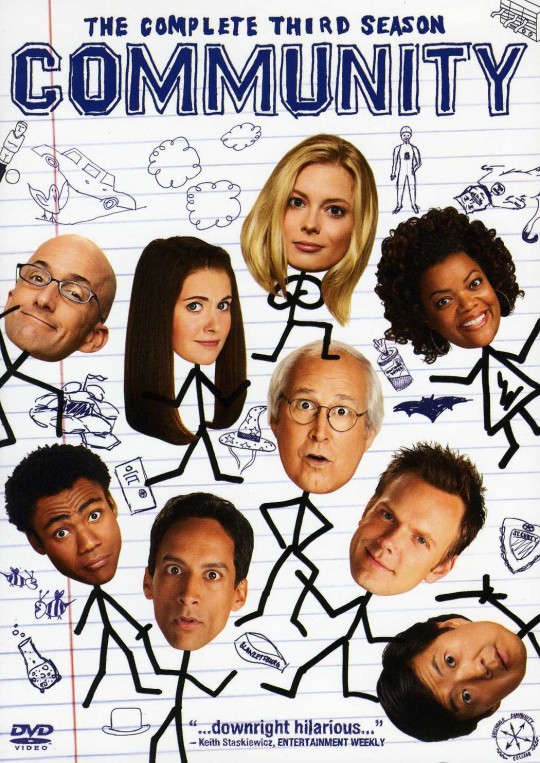
Adam Clarke knows about your crooked wang
In the previous instalment of this review, I went over the flaws of Community‘s third season. Episodes that tried to tell too many stories in a single half-hour, storylines that didn’t go anywhere, recycling ideas from the past two seasons, Michael K. Williams’ stiff performance: all of these problems dominated the first three episodes of the season. Luckily, the rest of the season shaped up to be pretty amazing even if those initial episodes got things off to a terrible start. Dan Harmon earned a grace period with fans. If the fourth season opened with episodes that weak, I know I wouldn’t last all 13 episodes.
The remainder of this season consisted of…
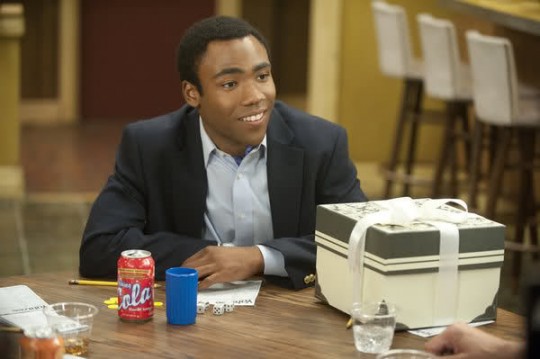
Remedial Chaos Theory
Crib notes: When a game of Yahtzee is interrupted by a pizza delivery, the dice is rolled to determine which member of the study group will get it. This creates a series of alternate universes with each of the Greendale Seven getting up for pizza in separate timelines. Depending on who leaves to get the pizza in the prime timeline, the effects on the study group could be disastrous.
Choice dialogue: “To Pierce, may he rest…in Pierce. Ha!”
“Shirley, I think you’ve had enough”
“…of YOU”
- Britta (Gillian Jacobs) vs a drunken Shirley (Yvette Nicole Brown) in the darkest timeline
Grade: Easily a contender for Community‘s finest (half) hour, with all of the characters getting a moment to shine. This episode introduces the timelines, Evil Troy and Evil Abed, the Scandinavian troll from Troy’s nightmares (“Feel the terror, Troy!”) and has the first funny closing credits tag of the season (partially quoted above).
This episode did some much needed repair work for Shirley’s character. In season two, Shirley seemed to be around not because the writers had any real stories for her, but because Brown could turn every line they gave her into comedy gold. She had more to do in the end credits tag of “Remedial Chaos Theory” than most of the previous season. Her need to bake as a means of contributing something to the group offers a retroactive explanation for Shirley’s more cartoonish moments in earlier episodes. Also, I totally want her “He Is Risen” apron. A+.
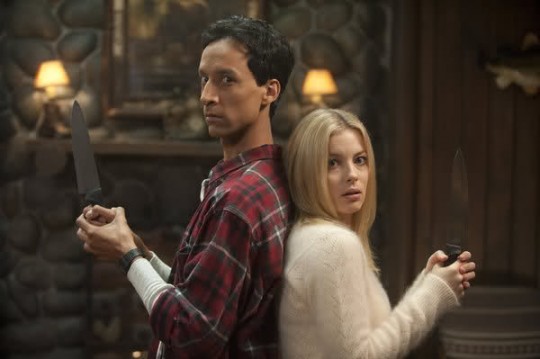
Horror Fiction in Seven Spooky Steps
Crib notes: Britta receives the results of her anonymous psychological questionnaires and it turns out someone in the study group has homicidal tendencies. Britta then invites the gang to a Halloween pre-party and gets each member of the study group to tell a horror story in the hopes of weeding out Greendale’s most disturbed student.
Choice dialogue: “Then he chainsawed them to bits! Then he put them back together. Then he chainsawed them again…forever.”
- Shirley tells a spooky story.
Grade: I once heard that the reason Star Trek: The Next Generation had so many “Wesley saves the day” stories is because every staff writer was asked to write such a story and the producers were only going to film the best one. TV production being what it is, the producers got into a jam and had to film all of them. I don’t know if that’s true, but it feels like a lot of season two and three was comprised of stories dealing with in-fighting amongst the study group. I hope the new showrunners don’t lean as heavy on the “study group is fighting again” plots as Harmon and company did for the first half of the season. It’s also a bit disappointing that the episode reveals that Abed is the only one who tested as sane in Britta’s revised profile. Anyone who’d seen a handful of episodes of the show guessed that. However, it kinda contradicts the “Evil Abed” storyline that develops later this season. Still, this is a funny, stylish episode that retreads all-too-familiar ground and suffers from comparisons to previous episodes about group infighting (particularly “Remedial Chaos Theory”), as well as the last two Halloween specials. B
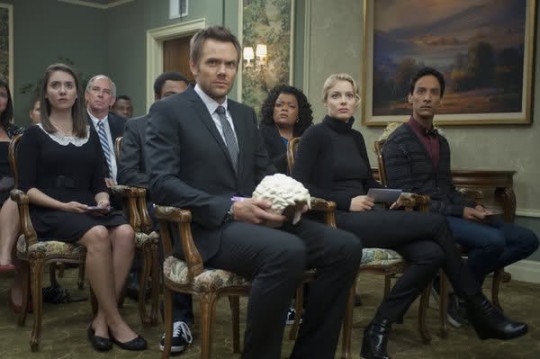
Advanced Gay
Crib notes: Hawthorne Wipes moist towelettes become an unexpected hit with gay consumers, making Pierce something of a gay icon. Jeff defends Pierce against Pierce’s ancient, bigoted father, Cornelius (Larry Cedar). Troy is kidnapped by Vice Dean Laybourne (John Goodman) and pressured to enter the Air Conditioner Repair Annex.
Choice dialogue: “Gentlemen, you are here tonight because you have been selected as potential candidates for the Greendale Air Conditioning Repair School. But why kidnap you? Why put a sack over your head and drag you here in the middle of the night? Why is there an astronaut in the corner making paninis? Simple. We don’t want you telling anyone about this. If you do, we don’t want them believing you. Isn’t that right, Black Hitler?”
- Vice Dean Laybourne
Grade: Another contender for the series’ best episode. Unlike the season premiere, this episode anchors the Laybourne story arc to a strong main story. Pierce as a reluctant gay icon, Pierce and Jeff taking on Cornelius, Britta psychoanalyzing (and annoying) the hell out of Jeff…all make for an exceptionally strong, banter-heavy episode of Community. Pierce’s storyline goes for the sweet, Troy’s storyline goes for the surreal, and the two unrelated plots make for a very satisfying whole. Abed’s Troy impression (“I like football, but also I don’t”), Annie’s disappointment over the cancelled pride party (“I just bought a cone bra”) and the opening scene with an increasingly flustered Pierce (“Stop putting gay things in my mouth!”) feature all members of the cast at their finest. A+
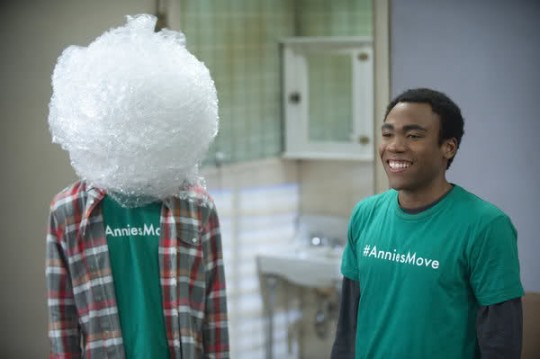
Studies in Modern Movement
Crib notes: The gang help Annie move in to Troy and Abed’s place, save Jeff who’s faking a sick day in order to hang out at the mall…with Dean Pelton.
Choice dialogue: “Men — can’t live with ‘em, can’t leave ‘em alone with your tape”
“Britta, don’t tell jokes. You’re bad at it”
- Britta and Annie
Grade: An interesting question about Annie’s place in the group is raised and dropped. Still, it’s not really a great episode for Annie, as “Studies” works because of its Shirley/Britta and Jeff/Dean subplots. This episode is extremely important for establishing the Dreamatorium, a closet rigged to look like the holodeck where Troy and Abed have pretend adventures. The Dreamatorium will, of course, be tied to Abed’s neuroses, as well as his brief slip into madness in the finale. Even if the episode feels a little rushed (I could’ve watched a whole episode of Shirley and Britta clashing in the car) and lacks a strong conclusion, it’s still a very funny episode. B
Documentary Filmmaking Redux
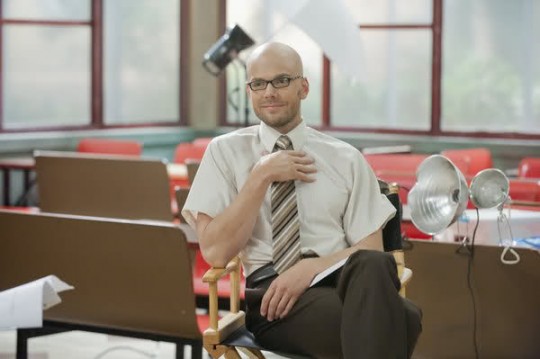
Crib notes: Dean Pelton’s perfectionist and tyrannical sides come out while filming a commercial for Greendale.
Choice dialogue: “I’m thinking about breaking into the TV game since it’s apparently sticking around. I don’t want to wake up 30 years and wonder, ‘what if?’”
- Leonard Rodriguez (Richard Erdman), Greendale’s oldest mature student.
Grade: A long overdue episode to showcase the series’ quirkiest character and beloved Dean, Craig Pelton. While ostensibly acting as a spoof of behind-the-scenes epic, Hearts of Darkness: A Filmmaker’s Apocalypse (name-checked by Abed as being way better than Apocalypse Now), “Redux” does what Community does best: a story that parodies a pop culture artifact on the surface as a vehicle for character growth. In this case, the Dean’s meltdown when he finally takes charge of something important. From the brilliant dialogue (“The word he’s looking for is ‘sassy’. Better pray he don’t find it”) to the rare funny moment for Chang (as a self-appointed understudy for Jeff) to its sweet conclusion, “Redux” is easily in the top 5 episodes of the series. A+

Foosball and Nocturnal Vigilantism
Crib notes: Jeff and Shirley join forces to defeat smug foosball enthusiasts. When his copy of The Dark Knight is destroyed, Abed dresses as Batman to find the culprit.
Choice dialogue: “Shut up, Leonard! I found your YouTube page. What’s the point of reviewing frozen pizzas?”
“You’re talking about it.”
- Shirley and Leonard sum up internet culture in a single exchange.
Grade: Continuing her recovery from a walking stereotype in season two, Shirley gets a strong story alongside Jeff, fighting against Nick Kroll (hilarious in his role as a foosball enthusiast). While the ending’s a little schmaltzy, that story is funny and sweet. It’s great to see Jeff bond with Shirley (it’s easily the best pairing of characters outside of Troy and Abed). Abed’s Batman storyline is less successful, as it just milks Danny Pudi’s Christian Bale impression, which was put to greater effect in season one’s “Introduction to Statistics”. A-
Regional Holiday Music
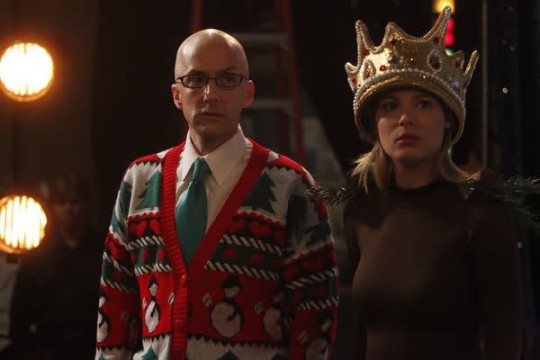
Crib notes: The study group is forced to compete in glee club regionals at the behest of sweatervest-clad, aggressively asexual Mr Rad (Taran Killam).
Choice dialogue: “Glee is the answer when questions are wrong”
-Cory “Mr Rad” Radison, head of the glee club.
Grade: Like Abed’s return as Batman in the previous episode, “Regional” takes a joke Community‘s done before (filling in for the glee club as per “Paradigms of Human Memory”) and expands on it. This time, the results are a lot more successful, as the story’s pretty inspired. Instead of the group being pressured to join the glee club, glee is portrayed in a Invasion of the Body Snatchers light with each Greendale student acting very differently when possessed by glee. Yes, it’s a bit late to be doing a Glee spoof after two seasons of jokes at Glee‘s expense, but songs like “Baby Boomer Santa” and “Jehovah’s Most Secret Witness” justify the project. The only aspects that leave a bad taste in my mouth are the lazy resolution (shifty character confesses to the murder of the glee club at the last minute; the exact same thing would be repeated in the season finale) and the lame closing credits tag. A-
Urban Matrimony and the Sandwich Arts
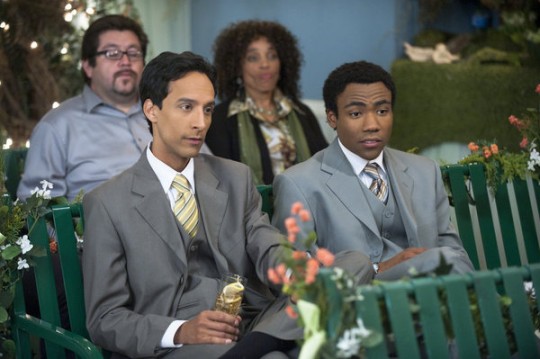
Crib notes: Shirley’s torn between re-marrying Andre (Malcolm Jamaal-Warner) and starting her own business with Pierce.
Choice dialogue: ‘Webster’s dictionary defines’? That’s the Jim Belushi of speech openings! It accomplishes nothing, everyone keeps using it and nobody even knows why!
- Annie destroys Jeff’s wedding speech
Grade: Between Shirley’s wedding, Britta’s unexpected talent as a floral arranger, Annie’s all-too-intense enthusiasm for wedding ideas, the Pierce-Shirley sandwich shop, Jeff’s speech dilemma and ongoing daddy issues, this episode is as overstuffed as the season premiere, but manages to be a lot more satisfying. Troy and Abed becoming normal made for some funny moments, but that easily could’ve been its own story. It’s telling that, despite the wedding being the central plot here, Pierce and Shirley trying to convince the Dean about the feasibility of a sandwich shop (“That’s me! Where did I get all that money I’m holding?”) makes for better television than Andre-Shirley sniping. B
Contemporary Impressionists
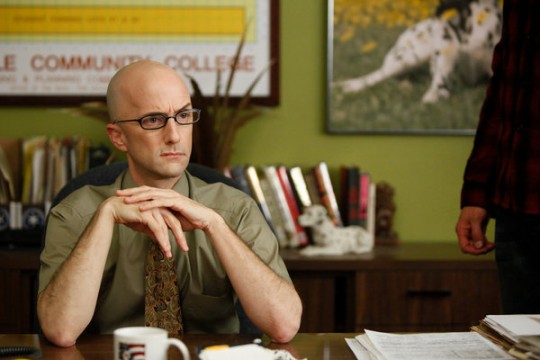
Crib notes: When Abed gets in debt with a celebrity lookalike business, Troy must go out of his way to protect his friend. Meanwhile, Jeff takes anti-anxiety medication with sexy results.
Choice dialogue: “I don’t know who told you pouting was an option for you, but all you’re making me feel is hatred toward Renee Zellwegger”
- Dean Pelton
Grade: A potentially funny idea plays a little flat onscreen with a few too many broad, easy jokes (Jeff being hit on by stereotypical divorcees, Chang’s thought balloons) to be truly great. Still, the subplot with Jeff on anti-anxiety meds gives the character a few interesting places to go before transforming into “Seacrest Hulk” and beating up an army of children. This is where the Evil Abed storyline begins to take hold, but that sort of arc-building is not Community‘s strength. Better is the last conversation with Troy and Abed, where Troy tries to reason with his best friend, who’s been oblivious to the trouble he’d gotten into with the shady celebrity lookalike service. Scenes like that remind me of season two’s great, melancholy “Mixology Certification” (Troy’s birthday), showcasing just how well the show can blend drama with comedy. Still, Chang and his child army are annoying and their scenes wouldn’t go anywhere until “The First Chang Dynasty”. B
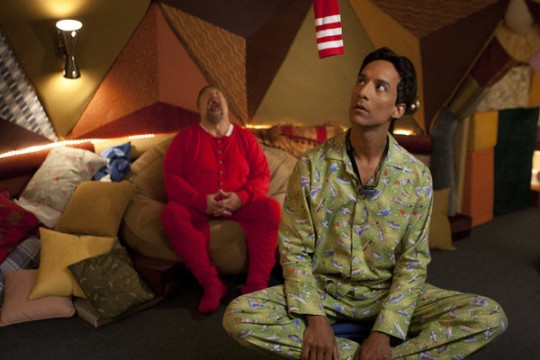
Digital Exploration of Interior Design
Crib notes: Vice Dean Laybourne drives a wedge between Troy and Abed, as they fight over whether to build a pillow fort or a blanket fort. Britta falls for Subway, a new student representing the new franchise that’s opened in the Greendale cafeteria.
Choice dialogue: “Is that you, Subway? My eyesight’s not what it used to be.”
“Eat these tater tots, Harry. For what it’s worth, I think you see more than all of us.”
- Subway (Travis Schuldt) helps a blind man (Wil Garret).
Grade: Building on the rift between Troy and Abed in the previous episode, Laybourne successfully pushes Troy and Abed against each other. But the episode seems to know that the much funnier story involves Britta falling in love with a “corpo-humanoid” (a man who gives up all his rights, freedoms and identity to represent a corporation) named Subway. The Subway love story—and Subway’s subsequent expulsion due to a sex act “well out of the mainstream”–as well as Pierce’s increasingly insane feats of corporate espionage, provide the real laughs in the episode. John Goodman, whose character is “going through some stuff right now” (hence his new look), does some of his best work here. B+
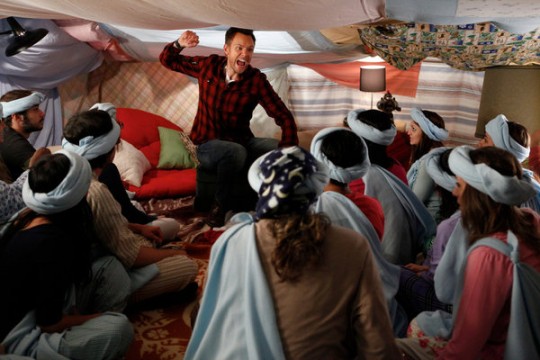
Pillows and Blankets
Crib notes: In this parody of Ken Burns documentaries, we see the results of the all-out pillow fight that resulted from the previous episode.
Choice dialogue: “Leonard likes this”
- Leonard’s award-winning re-enactment of his reaction to Troy’s facebook post.
Grade: A better idea in concept than execution, this episode is very funny when providing dramatic readings of Facebook statuses and texts. Community is at its best when it weds its pop culture stories to strong character development. While I don’t think the Troy-Abed feud/Burns spoof was the best of these, it did hit the right comedic and dramatic beats. It’s perfectly in character that Troy and Abed would keep fighting just to keep their friendship alive and it was a sweet touch that helping them gets Jeff out of his season three funk. Not the show’s finest hour, but worth it for the narration of Keith David (They Live, The Thing, Requiem For A Dream, Gargoyles) and Pierce in a full-body pillow suit of armor. B
Origins of Vampire Mythology
Crib notes: Britta’s ex, a carny named Blade, is her kryptonite, so Annie takes it upon herself to keep the two apart. After a visit from Vice Dean Laybourne, the Dean tries to lure Troy into the air conditioner repair school. Jeff and Shirley visit Blade at the carnival. Chang and Pierce are (briefly) best pals.
Choice dialogue: “Sorry, Britta. Some things are funny because they make no sense and that’s not one of them”
- Annie re: Britta having dated a carny named Blade.
Grade: Community is a show that needs to wear its heart on its sleeve, as its characters are just as important as the craziness of Greendale. Amid the standard TV fare of old flames and friends keeping each other under lock and key are some nice moments of bonding between Annie and Britta, as well as the romantic Troy-Britta tension. It’s great seeing Jeff and Shirley hanging out again (“That don’t change the way mustard taste, Jeffrey”), but the Pierce-Chang plot never gets off the ground. That story could’ve given some fresh material to Community‘s most sidelined, inconsistent characters, but it abruptly ends without doing much of anything. Minor complaints for an episode that brings the Dean into Troy/Abed/Annie’s apartment (I love how hurt he is when they ask him why he showed up) and the best end credit tag of the season: Abed’s stand-up comedy. A
Virtual Systems Analysis
Crib notes: When Troy and Britta go out to lunch, Annie keeps Abed company in the Dreamatorium. What starts off as an afternoon of playing pretend becomes a therapy session between Annie and Abed.
Choice dialogue: “I had to go to the bank today”
- Dean Pelton finally realizes the pointlessness of his many costumes.
Grade: Imaginative, interesting, but not hilarious. It’s an interesting script and brilliantly acted, but I didn’t laugh much, which pretty much sums up the Abed’s story arc in a nutshell. There’s a lot of funny moments (“the duali-Dean of man” in particular), but precious few of them occur inside the Dreamatorium. Outside of Troy’s Inception breakdown (“there’s so many layers”) and the cameos by Leonard (“I don’t have cable”) and “Emmy contender, Pierce Hawthorne”, the episode works more as a drama than a comedy. Sadly, the end credits tag continues the Abed screaming gag from the season premiere, which was never funny and simply reduces his character to “funny Asperger’s man”. This is really clever writing and I appreciate a show that’s ambitious enough to do stories like this one, but I don’t like the depiction of Abed as empathy-free and kind of petulant. B
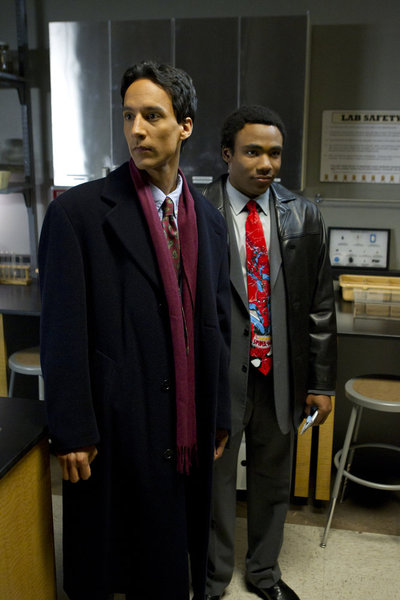
Basic Lupine Urology
Crib notes: When their biology project is sabotaged, the study group splits into two seperate, but equally important groups in their quest for justice. CHUNG CHUNG.
Choice dialogue: “With a few adjustments, I can make the entire image…Old West-coloured!”
- Britta Perry, master of photoshop
Grade: The discovery of the corpse (of a yam) by two janitors, the opening credits, the nailing of both the law (Troy, Shirley and Abed) and order (Jeff and Annie) cliches…all the elements work as a Law & Order parody.
Every now and again, I hear how fans became disenfranchised with Community following the weirder ‘theme’ episodes of season two. Community‘s second season is easily its best, in my view, because it created the template for episodes like “Basic Lupine Urology”. A bad parody would take over the show, forcing characters to enact pre-set roles regardless of characterization. Here, the parody feeds into the stories and characters, resulting in an episode so great, not even Michael K. Williams’ somnambulant performance can louse it up. This episode makes terrific use of both the regulars and the larger ensemble of Magnitude, Todd, Fat Neil, Vicki and, in one of his final appearances, Star-Burns. Plus: any show that hires Michael Ironside (here as Todd’s uncle) and Eddie Pepitone (reprising his role as a janitor from “Competitive Ecology”) is already in my good books. A
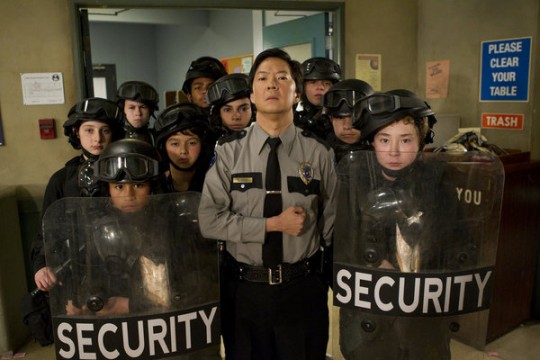
Course Listing Unavailable
Crib notes: After failing their biology class, the study group is expelled from campus. Chang replaces the Dean with a lookalike and begins his rule of Greendale.
Choice dialogue: “You seemed smarter than me when I met you”
- Jeff, summing up Britta’s character development perfectly.
Grade: When people complain about Community being too weird, is this the kind of normal episode they want? Here, a boring story about the group eventually getting expelled doesn’t really gel or offer the kind of special humour I’ve come to expect from the series. I know fans have complained about the show’s obsession with “Inspector Spacetime” (a Dr Who-like show Abed’s obsessed with) and the evolution of Britta’s character, but what were you people expecting? Britta started off as a high school dropout who wanted to impress Radiohead and became one of the most original, charming goofballs on TV. A show that had a Dead Poets Society spoof in its third episode isn’t going off the deep end by incorporating parodies of Dr Who.
I don’t really have much to say about this episode because it highlights Community‘s big flaw this season: story arcs. The expulsion of the “Greendale 7” is so contrived and unsatisfying that the episodes building up to are retroactively tainted by how bland this one is. It’s nowhere near as Community-lite as the trio of episodes that opened the season, but if this is Community being normal, I’ll be in the corner waiting for more fried chicken space simulators and all-out musical numbers. B-
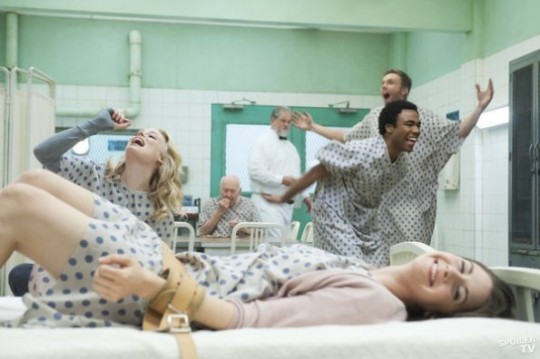
Curriculum Unavailable
Crib notes: When the study group visits a psychiatrist (John Hodgman), he tells them that Greendale is a delusion and they’re all patients in a mental institution.
Choice dialogue: “Good news, guys. I spent all my money!”
- Troy
Grade: Community rehashed Bat-Abed, forts, infighting and glee club takeovers this season, so it stands to reason that there’d be another fake clip show. While this one is not as fresh as its predecessor, it brilliantly parodies the hoariest cliche in the book: the shock reveal that our heroes were insane all along. Rather than taking away points for recycling “Paradigms of Human Memory”, I’ve got to give “Curriculum Unavailable” credit for being as balls-out funny as it is. The sketches of Greendale life and, especially, the sight of the Greendale 7 in straight-jackets re-enacting previous adventures (including the previous fake clip show) are hilarious. John Hodgman makes for a great antagonist even if his role doesn’t make much sense (Chang hired him with what? Was the study group just going to give up so easily?) Again, the arc aspect of season three doesn’t really work, but with episodes this funny, who cares? A
Like NBC before me, I’m going to go through the final three episodes of season three in one night. Join me next week for the final instalment of my look back on Community‘s third season.
Firestarter (1984)
Fri, Aug 24, 2012
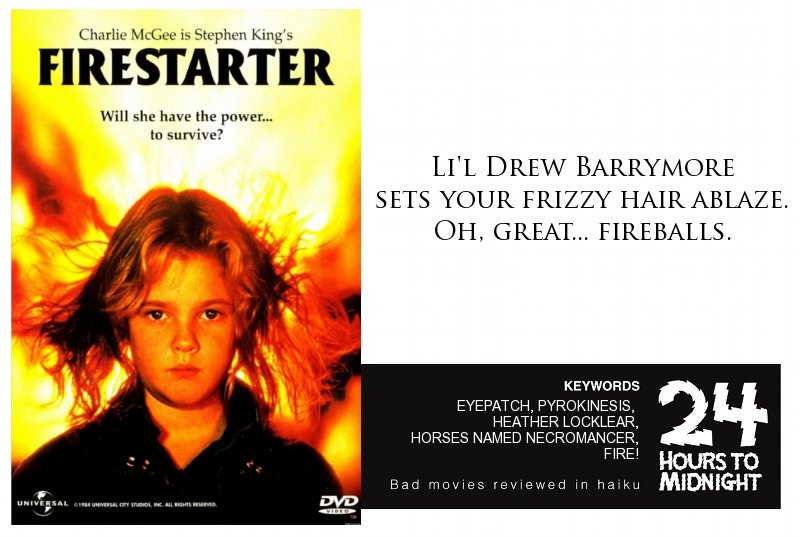
Hot off the heels of E.T., Drew Barrymore stars as the pyrokinetic spawn of Heather Locklear and David Keith in this adaptation of a Stephen King novel. Andy (Keith) and Vicky (Locklear) meet while undergoing scientific experiments for cash. The end result of these experiments is that they make 20 bucks, Andy can control people with his mind, and Vicky can read minds. And, oh yeah, their baby girl can start fires with her brain.
After killing Vicky, the government agency responsible for the experiments, and the Lot 6 drug which caused their abilities, are now on the hunt for Drew and her dad. There are lots of nosebleeds and Drew sets, like, 10 people on fire and then a creepy guy with a frizzy ponytail and one eye (George C. Scott) shoots them with a tranquilizer dart and they are officially caught. He brings them to a weird compound called “The Shop” and then Creepy One-Eye and Martin Sheen try and bribe Drew into using her powers by giving her the entire toy department of Bowring’s, circa 1987.
This moves along very slowly, the acting by Li’l Barrymore and David Keith is spot-on, but there is a tonne of dialogue and relatively little action. You keep waiting for insane-o things to explode and nothing really does until the very end! It’s worth watching for sure, but you will probably find yourself easily distracted and yelling “START A FIRE ALREADY” at the television.
The Expendables 2: Subtitle subtitle subtitle
Tue, Aug 21, 2012
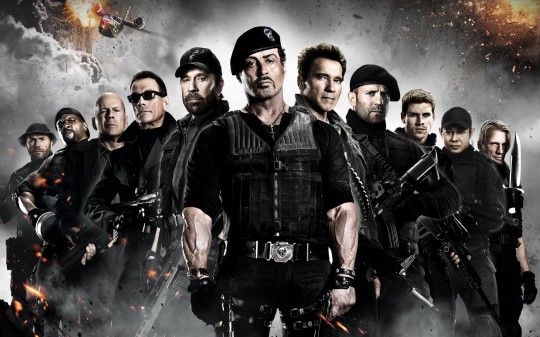
Yes, I saw The Expendables 2: 2 Expendable 2 Furious last night.
Don’t look at me like that. I’m only human.
As some of you may recall, I avoided the first film because it lacked sufficient Arnold Schwarzenegger content. Since this was remedied for The Expendables 2: Expendable By Dawn, I had to go. I tried to stay home and commit to my usual Sunday routine of macramé and Cranford, but I just had to watch big, dumb guys spout one-liners while expensive things blew up.
In the 80s and early 90s, every popcorn-muncher imagined the action film fantasy baseball scenario of all of that era’s gun-toting heroes in one movie. No one ever said “what if we got Van Damme, Ah-nuld, Bruce Willis, Stallone, Dolph and Chuck Norris to star in an action movie so average you’ll have to rent it twice to remember the damn thing?”
So which of these scenarios does The Expendables 2: Your Sister Is A Werewolf fall under? Let me put it to you this way: it was a decent action movie, but it’d be better as a Funny or Die video. I was entertained, I never got bored, I laughed a few times, and I was genuinely happy to see all those action stars in one movie.
I never saw the first film (which really ought to have been called 1990s Wet Dream: The Movie), but I somehow managed to catch up with the labyrinthine plot threads of the story. For those in my position, here’s all you need to know: Barney Ross (Stallone) leads a group of mercenaries that consists of Jason Statham, Dolph Lundgren, Loki (Liam Hemsworth), The Old Spice Guy and some guy who looks like a puffy Jason Statham. They’re the A-Team, but they stole a lot of money from Bruce Willis in the last movie, so he sentences them to GIRL.
In The Expendables 2: Nerds In Paradise, Stallone is joined by Maggie (Nan Yu) at Willis’ request. As payback for stealing five million dollars from him, Willis gives The Expendables their next mission: retrieve some top secret info regarding weapons-grade plutonium. They get the info, Willis will forget the theft.
Naturally, the info falls into the hands of a villain named Vilain (oh, I see…) played by none other than Jean-Claude Van Damme. To show The Expendables that he is a totally for real bad guy and not a lovable rogue like Snake Plissken or Ford Fairlane, he kills pretty boy Liam Hemsworth. This death is made all the worse because Hemsworth was only two days from retirement. (This leads to the film’s sole unintended laugh when a photo of Hemsworth is shown, as Hemsworth’s pose and goofy sweater would not be out of place in an LL Bean catalogue.)
With Hemsworth’s death being sufficient enough reason to say “this time it’s personal”, The Expendables plot their revenge on Vilain and his cronies. In their quest to quell the muscles from Brussels, The Expendables are given a little help by Trench (Schwarzenegger) and Booker (Chuck Norris).
I’m not huge on modern action movies. As much as people seemed to love Fast Five, I was completely bored. It seems like the action movie was something Hollywood perfected in the 80s and early 90s, resulting in the likes of Terminator 2: Judgment Day. Even the “bad” action movies of this period are ridiculously entertaining, as you need look no further than Roadhouse, Cobra or Hard Target to see just how entertaining they could be. Nowadays, Hollywood’s standard product is the superhero movie, and recent American action films can’t hold up to the likes of Point Break, the original Total Recall or Escape From New York. It’s like they forgot how to do it.
The Expendables 2: S. Darko understands this problem even if it doesn’t really fix it. It has no great action set-pieces like the shed scene from Commando. The photography is muddy and the score (once the hallmark of a great action movie) is uninspired. It doesn’t even offer much in the way of funny dialogue. There are no Schwarzenegger-grade puns, with the exception of Statham’s “I now pronounce you man and knife.”
Statham, like Dolph Lundgren, doesn’t have anything to do save be the butt of jokes. Statham’s kicking ass in every movie he’s in right now, so it’s refreshing to watch him bitch about having to fix a plane. Lundgren redeems with a weird, charming performance — something we never saw in the likes of Masters Of The Universe or Universal Soldier. Jet Li only shows up for a cameo, but it’s so pointless that it would’ve been less awkward to have a single line of dialogue explain that he was on a fishing trip during this mission.
The movie makes up for these weaknesses mostly by coasting on the fun of seeing all these action icons in one movie. And, ocasionally, the film throws us a bone that elevates it above average. Chuck Norris doesn’t have much to do beyond show up, make a Chuck Norris joke, and leave. However, it’s probably the best Chuck Norris joke you’ll ever hear. The scene of Schwarzenegger and Willis firing at bad guys while crammed into a smart car is worth the price of admission alone. It’s the little things that kept me interested in Honey I Blew Up The Expendables.
An action film is only as good as its villain, and, I never thought I’d write this, but Jean-Claude Van Damme’s performance stole the movie. Most of his co-stars are fun to watch, barring Randy Couture who seems to struggle with even the most basic dialogue, but Van Damme makes a great, sleazy villain. The film could’ve used more Vilain, especially after hinting that the dude worships Satan. I was waiting on a scene where a robed Van Damme would sacrifice a virgin on an altar, but no dice.
So, if you like larger-than-life action movies and you’re willing to accept a movie that’s better than Eraser, but not as good as Roadhouse (Oh, Icarus, fly not too close to the sun!), then you will leave this movie happy. More than any script or technical flaws, my biggest problem is that the film doesn’t have a subtitle (despite my suggestions here). Subtitles were more or less mandatory in the heydays of Stallone and company. I know it’s tough, largely because “Electric Boogaloo” is already taken, but we need a good subtitle for the next one, okay?
Yes, there will be a next one, and I, for one, am excited for the release of The Expendables III: Smokey Is The Bandit. I know it hasn’t been shot yet, but I expect Stallone et al will be joined by Clint Eastwood, Mr T, Kurt Russell, Danny Glover, a box of Hidden Treasures cereal, Jim “The Hammer” Shapiro, The Ultimate Warrior, Max Headroom and a snap bracelet.
And I want them all to fight Predator. In space.
There will be a continuation of my review of Community‘s third season next week. I just had to write about the explosions and stuff and got distracted. That happens a lot. Oh, well.
Next week: Macrame!
Waitaminute…
Next week: How Community’s third season got its groove back.
Summer Fantasy (1984)
Mon, Aug 20, 2012
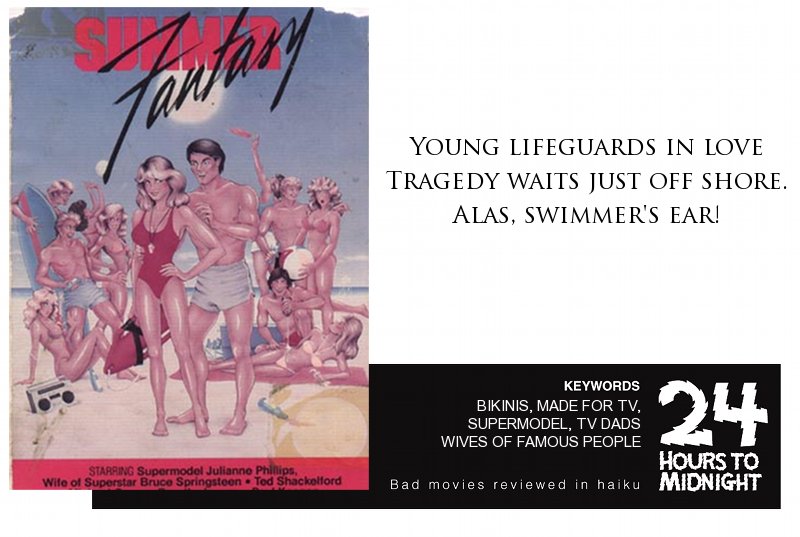
Summer Fantasy (1984) contains no frolicking. It contains very little innuendo. No one applies sunscreen in a sensual manner. No bikini babes lose their bikini tops in the surf. No dogs wear sunglasses. In fact, Summer Fantasy is a made-for-TV drama disguised as a sexy beach romp. The VHS cover is full of cartoon busty bikini babes, but it’s all a dirty lie.
As the VHS case helpfully points out (three times), Summer Fantasy star is Julianne Phillips, “wife of rock superstar Bruce Springsteen” (emphasis theirs). Phillips stars as Joanna, a hard-working high school valedictorian who, in a wild act of reckless abandon, decides to get a summer job as a lifeguard before she goes to university in September.
Subplots include Joanna’s parents’ marital problems (O hai perennial television dad Michael Gross of Family Ties!), and Joanna’s boyfriend dealing with Meniere’s disease, an inner ear disorder that affects balance and hearing. Fantasy!
Community’s Darkest Timeline (Season 3, Episodes 1-3)
Wed, Aug 15, 2012
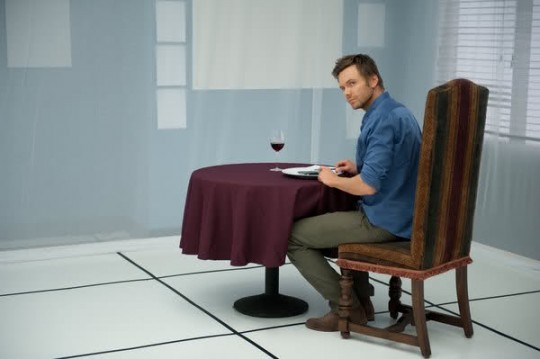
The third season of Community — now hitting DVD shelves — is surely the show’s darkest timeline. Not just for the characters, but for the series.
This was the season of the hiatus, the nasty Chevy Chase phone messages and, most controversially of all, the ousting of creator Dan Harmon as series showrunner. With new showrunners, the loss of Harmon and NBC’s decision to move the series to a Friday night slot, Community fans are getting a fourth season, but at a helluva price.
I’ve already gone on record about how much I love the show and that fourth season’s forever away (October? AUGH), so now’s the time to look back on this turbulent third season. While boasting some of the best episodes of the series, season three was not without its problems, all of which seem to be amplified in the first three episodes of the season.
Biology 101
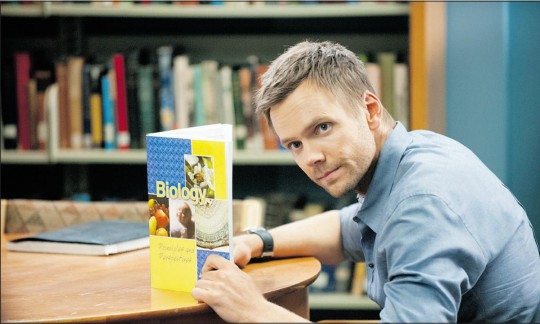
Crib notes: Despite a major falling-out with Pierce (Chase) during last year’s annual paintball showdown, the rest of the study group is ready to accept him back in the fold. All except Jeff (Joel McHale) who maintains that Pierce is a selfish ass, not realizing that his own self-absorption is equal to Pierce’s. In one of 93 subplots, Ben Chang (Ken Jeong) throws a ham at Jeff and gets a new job as campus security. Plus, Troy (Donald Glover) and Britta (Gillian Jacobs) try to help Abed (Danny Pudi) with a special problem. John Goodman and Michael K. Williams make their Community debuts as Vice Dean Laybourne, head of Greendale’s air conditioner repair annex, and Biology teacher Professor Kane.
Choice dialogue: “Monkey knockout gas. Now that’s the type of grounded, sensible idea I’m looking for this year”
-Dean Pelton (Jim Rash)
The first three episodes of the season followed a stated goal to be “less weird than the first two years combined,” and a more down-to-earth approach would’ve been a great way to follow-up the previous year’s finale. When we last left Greendale Community College, Greendale elder statesman — its Van Wilder, if you will — Pierce Hawthorne had come to such bitter terms with his friends that he walked away from the study group, vowing not to return.
And how did the show handle this huge conflict? It was quickly tossed aside with a few lines of dialogue. “Biology 101” had so much potential, but its execution was oddly listless. There was so much ground to cover (Pierce’s return, Abed’s minor breakdown over Cougar Town’s hiatus, Jeff’s isolation from the study group, Dean Pelton’s funding issues, Jeff feuding with the Biology teacher, etc.) that the episode should’ve either been longer or just narrowed its focus and developed one of its many plot threads into a strong A-story. There were a lot of very funny moments in the episode — the opening musical number, Jeff’s 2001-inspired monkey gas hallucination, Britta and Troy’s bickering, every scene with Dean Pelton, etc. — but the episode as a whole feels more like a collection of funny deleted scenes than a real story. By trying to set up so many future arcs, the end result is an episode that is so overstuffed with plot it isn’t really about anything.
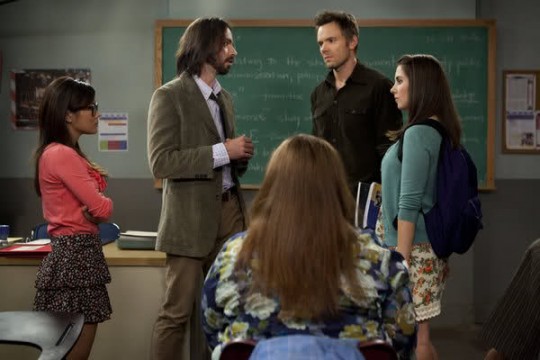
“Geography of Global Conflict”
Crib notes: Annie (Allison Brie) meets a nemesis who shares her namesake and challenges her to a Model U.N. showdown. Meanwhile, Britta attempts to recapture her bygone days as a protester for social justice.
Choice dialogue: Everything Garret (Erik Charles Nielsen) says. Or Shirley (Yvette Nicole Brown) confessing “I far-ted” (it’s the way she said it).
Here we have more setup for the season, with Chang realizing the limitations of his power, Britta’s identity crisis, Annie’s lingering feelings for Jeff, etc. That’s all well and good, but this episode doesn’t stand out in any way. It’s bland. It’s the TV equivalent of boiled cardboard, or Ryan Seacrest’s forehead.
There’s been a dreadful trend in TV writing in the last 15 years where season premieres do nothing more than remind you of what happened the previous season. These premieres pad out a go-nowhere episode that only had 3 minutes of story. Suddenly premiere episodes stopped being an event and just became a series of disconnected scenes to play catch-up with the show’s cast. I remember Buffy The Vampire Slayer being the worst for this, as it was usually best to skip the first two episodes of each season even if it meant missing the odd Xander quote.
Defenders of this type of storytelling praise shows that lay the groundwork for a larger story arc, but if you’re going to do that, the individual episodes should feel like they have some sort of point to them. The first chapter of a book is seldom its most exciting, but it should at least be engaging.
Screw that! The “novel for television” idea doesn’t really work, either. They’re totally different artistic mediums that are equally valid. Having to wait five episodes for a story to start is not like the slow build-up of a novel. It’s like having to buy five mediocre books in order to enjoy three good ones.
Community isn’t The Wire or Breaking Bad. Those two shows excel(led) at slow-burn storytelling because the individual episodes feel like they have a point to them instead of its creators biding their time until they can afford to do something exciting. The first three episodes of Community, while setting up future stories, suffer from being alternately cluttered and undercooked.
Despite the problems I have with these two episodes, I still feel they did their basic job because I did laugh, just not that much. The first two episodes of season three leave me wanting, thinking to myself “it was funny, but…” It’s like watching a recent episode of The Simpsons: it’s not a waste of time, but you know the show has done so much better in the past. By setting the bar so high in its first two seasons, an okay episode of Community just won’t do. Being underwhelming doesn’t make “Biology 101” or “Geography of Global Conflict” bad, just disappointing. We wouldn’t get a bad episode of Community until…
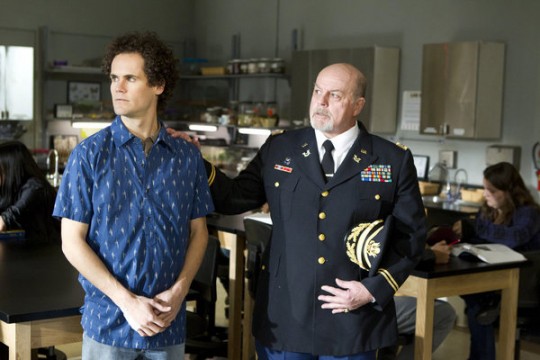
“Competitive Ecology”
Crib notes: The study group reluctantly accept an eighth member, Todd (David Neher), in order to complete an assignment for Professor Kane’s biology class.
Choice quote: None that I can think of. There’s a nice gag about Dean Pelton installing pay drinking fountains to cover Greendale’s budget problems, but that’s it.
In a rare and colossal misstep, Community stages an episode that makes the study group look unbearable and annoying. An episode like this is a missed opportunity. The show’s writers could’ve deconstructed the series from an outsider’s perspective, like The X-Files’ “Jose Chung’s From Outer Space” or The Simpsons’ controversial Frank Grimes episode. Instead, we see the gang acting like one-dimensional caricatures in an episode that feels like an overlong and mean-spirited Community parody. The final scene in Kane’s classroom, as the Greendale gang rag on Todd as he cries alone, is like something from Mad TV.
Community has already done much better episodes about the group’s weird, toxic love (as per Todd’s words), such as season two’s “Paradigms of Human Memory” (the fake clip show) or “Cooperative Calligraphy” (the bottle episode). The show would even visit this theme with greater success in the two episodes that directly followed this one: “Remedial Chaos Theory” (the multiverse episode) and “Horror Fiction in 7 Spooky Steps” (season three’s Halloween episode).
At no point do we really get a sense of Todd being slighted by the study group. He just takes their abuse in good humour until his final, seemingly random meltdown at the end of the episode. There’s no sense of escalation. The episode goes out of its way to make Todd a saint, so he never comes across as a believable character. This should’ve been a story about a nice guy who’s simply unable to handle the group’s eccentricities and cliquishness. What we got was the study group acting like the Sluggo and Mr Hands to Todd’s hapless Mr. Bill.
This episode wouldn’t have been a total wash had there been a strong B-plot to hold our attention. No luck, friends! Instead, we got Ben Chang stuck in a nonsensical film noir parody that was so unfunny I started to feel embarrassed for everyone involved. This is especially unusual given that the cast and crew of Community are beloved for making the best damn comedy on television, while I’m justly obscure by even in the stringent category of people who are paid to watch TV and write about it on the internet.
Chang’s storylines are a recurring problem for me. The character’s devolution from season one’s Senor Chang (a bitter, eccentric “Spanish genius” with at least one ex-wife who got away) to season two’s Student Chang (pathetic loner who just wants to make friends with the study group) to season three’s Security Chang (a delusional wage slave who plots to blow up the school) is hard to sit through. Ben Chang’s story pretty much ended with season one’s “English As A Second Language” once he was revealed to be a fraud and got fired from teaching Spanish. This was a disappointing turn of events given his hilarious introductory speech in “Spanish 101″. Naturally, the Community folks wanted to keep Ken Jeong around, but the increasingly contrived methods of keeping Chang in the series haven’t really paid off.
Chang had his moments of season two, usually when he was squaring off against Professor Duncan (John Oliver, sadly absent for season three) or Annie’s Boobs (the name of the monkey that lives in the vents). Yet, the bulk of the character’s screen time has him either appearing crazy or pathetic, turning one of Community’s strengths into a recurring annoyance. Rather than seeing Chang again, the production team could cut their losses and have Jeong simply show up during the end credits and improvise something. Just make it a segment called “Ken Jeong Is Funny For Two Minutes”. I’d rather see that than Ben Chang’s continued transformation from a mad bastard to a generic, purposeless wacky character.
In terms of characterization, Annie and Pierce fared only a little better than Chang for much of this season. Pierce was all over the place: sometimes bitter and excluded, sometimes mellow, sometimes crazy and drinking ink from a pen. Nonetheless, Pierce had a few strong episodes over the course of season three, at least one of which is a contender for the best episode of the series (more on that next week). I found it kind of intriguing that Pierce would tell characters “we’re the same” much to their revulsion. I was hoping to see the other characters find some common ground with Pierce, both good and bad.
Season two’s storyline of Pierce becoming increasingly villainous brought some brilliantly funny moments to the show. It also gave Pierce a purpose in the series by replacing Chang as chief antagonist, even if it made viewers question why any of the characters would be on speaking terms with him.
Pah! Of course they’d hang around him. You can’t leave a guy who tells a suicidal, overweight D&D nerd to “soak [his] chubby cheeks in tears of gravy” all by himself. He might kill someone! Or get killed! The study group felt responsible for him, which made for a great dynamic. Most of the time in season three, Pierce was a doddering old fool and nobody cared. He’s always been racist, sexist, homophobic, ill-informed, privileged and boorish, but he’d previously been allowed to have dignity and even show some insight from time to time. Like his speech to Jeff when he rows his way back to his shipmates in the Greendale parking lot in season one’s “Beginner Pottery” or even the punchline to “English As A Second Language”, where it’s revealed that Pierce is the main reason the study group passed their Spanish exams.
Pierce shouldn’t be a redemptive character and I don’t think he was created for that purpose. I mean, Archie Bunker only worked when he was, well, a working-class Pierce Hawthorne. No one loved the kinder, gentler Archie Bunker from the short-lived Archie Bunker’s Place. Pierce was a little too one-note this year.
Oh, let’s not forget the Annie of it all. Though this season saw Annie move in with Troy and Abed, those stories were never that focused on her. She was usually just reacting to the other characters, particularly Abed. Even the episode about Annie’s move is usurped by better stories involving Shirley and Britta’s run-in with a hitchhiker and Jeff singing “Kiss From A Rose” with the Dean.
The only real Annie story of the year was the aforementioned “Geography of Global Conflict”, but it never really amounted to much more than “Annie’s jealous of an Annie-type (conveniently named Annie) until she decides not to be”. Oh, and could they have picked a more wooden actor to play said Other Annie? Any tension between the two Annies is sunk by Irene Choi’s sub-porn performance as Annie Kim.
Despite the recurring plot thread of the supposed romance between Jeff and Annie, Community opted to be coy. The show needs to write a story about this or drop it altogether. Seeing this plot thread resurface makes me feel like I’m watching a rerun from week to week. It never develops. I’m not the kind of person who watches TV shows to see who will start dating who, but I’d like the Jeff-Annie thing to be put to bed, so to speak.
That said, Britta and Troy are perfect for each other and if you can’t see that then I wish a plague on your house.
Wrapping up this rundown of the season’s shortcomings, it must also be noted that the more story arc-driven nature of season three was an experiment that didn’t really pan out much. John Goodman’s appearances as Vice Dean Laybourne were sometimes awkwardly shoe-horned into episodes. Michael K. Williams never seemed to have any sense of comic timing and his conflict with the study group never added up to anything anyway. Williams’ departure from the show was so graceless, I figured the episode would cut to a title card that read “Professor Kane died on his way back to his home planet”. Similarly, references to Jeff’s deadbeat dad, the school’s financial problems, the Annie-Jeff thing or Jeff’s harmful effect on the study group were raised early and subsequently dropped with no fanfare. These dead ends in the narrative made the season a little frustrating at times.
Next week: How, in spite of starting out so weak, Community‘s third season shaped up to be one of its best.
A Midsummer Night’s Rave (2002)
Fri, Aug 10, 2012
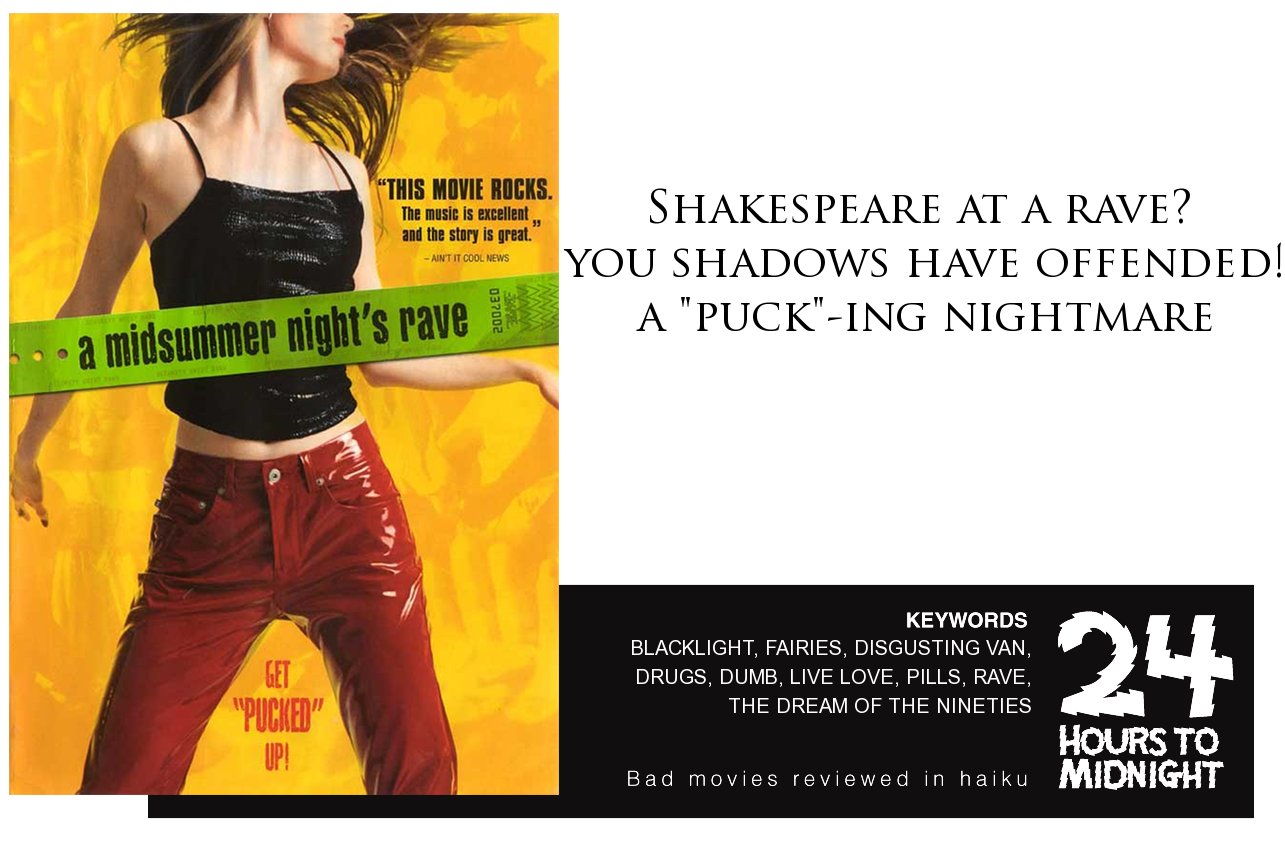
Starring everyone’s favourite Teenage Caveman and Shakespeare adaptation pro Andrew Keegan, we thought that A Midsummer Night’s Rave would be a great way to celebrate this sultry summer. Naturally, we were wrong.
Gil Cates Jr. directed this mess of a film, adapting Shakespeare’s A Midsummer Night’s Dream into an outdated love story revolving around ecstasy and and an ugly leather jacket. The majority of the cast, which includes the Sherminator and the less-sketchy London twin, seem as though they’ve all graduated from the Matthew Lillard School of Acting and it is effing terrible. Oh, Carrie Fisher is also roped into this mess, appearing for about 10 seconds as someone’s mom.
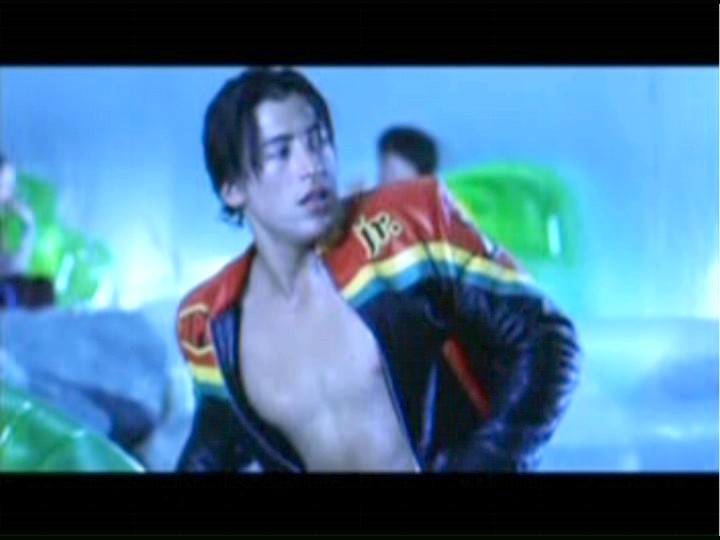
Affordable teen heartthrob (Andrew Keegan) wears this awful motorcycle jacket throughout the movie. It is central to the film's plot. For serious.
Despite being released in 2002, there’s a distinct air of 1990s-ness to the whole thing. We kept a list as we were watching, so you can play 1990′s blackout bingo:
- bucket hat
- choker
- Dr. Suess hat
- fairy wings
- faux fur top hat coat
- feather boa
- inflatable furniture
- Mapquest
- necklace, hemp
- necklace, puka shell
- plaid pants
- quilted vest
- tinted sunglasses
- white lady cornrows
In the interest of real film criticism, we checked out the DVD bonus features. There were definitely some choice trailers (and a few additions to the watch list), but somehow the terrible commentary track by the director was even better than the movie itself. The director frequently pipes up to note that some detail was “in the original movie version!” He raves about the soundtrack, and at one point, devolves into a piteous attempt at reproducing the sounds. Rewind/repeat for full effect. Loop it and rave on through the rest of this sultry St. John’s summer.
5 Reasons To Avoid The Total Recall Reboot
Tue, Aug 7, 2012
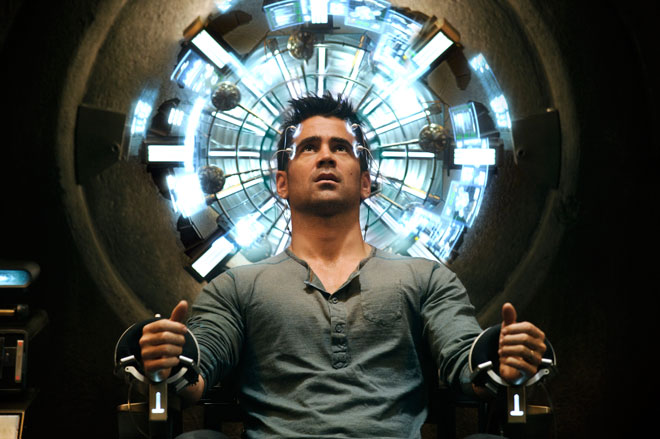
Oh man, remember when I used to do this? I barely do, having enjoyed the last month or so on vacation from my usual duties as The Scope’s resident Iron Chef of criticism. Is there anything worth seeing on the silver screen that isn’t about Batman or a young ginger archer?
Nope!
That said, I can tell you which film you should most avoid: the Total Recall remake/reboot/reimagining/homewrecker. Yup. Don’t see that. Ever.
Oh, you need more? Alright. Here’s 5 easy reasons to avoid this unsightly turnip…
Number 1
At no point in the remake does anyone say “get your ass to Mars!”
Number 2
It co-stars Jessica Biel, an actress with such limitations that she can only very charitably be described as the poor man’s Jennifer Love Hewitt.
Number 3
No part of the movie is as entertaining as this poster.
Number 4
Bryan Cranston gets more to do in a single scene of Breaking Bad than he does in the entire movie.
Number 5
Total Recall 2012 features a hacky, uninspiring score from the hacky, uninspiring Harry Gregson-Williams. Total Recall 1990 boasts music by Jerry Goldsmith, one of the greatest film composers of all time. Listening to that film’s expanded soundtrack works beautifully outside of the film, but demonstrates just how imaginative Goldsmith was at his peak. Ranging from bombastic, sombre, playful and comedic, Goldsmith creates a perfect through line for a chaotic, sometimes incoherent movie (that’s nonetheless an awesome action film). Hearing it on CD or in the context of the film, it’s easy to understand why the late Goldsmith considered the score to be one of his best.
Super-Special Back From Vacation Bonus Reason
Despite having a budget roughly equivalent to the gross national product of China, the & Total Recall remake has visuals on par with the average episode of Total Recall 2070.
It’s good to be back, friends. Next week: Community‘s third season.
The Caller (2011)
Mon, Aug 6, 2012
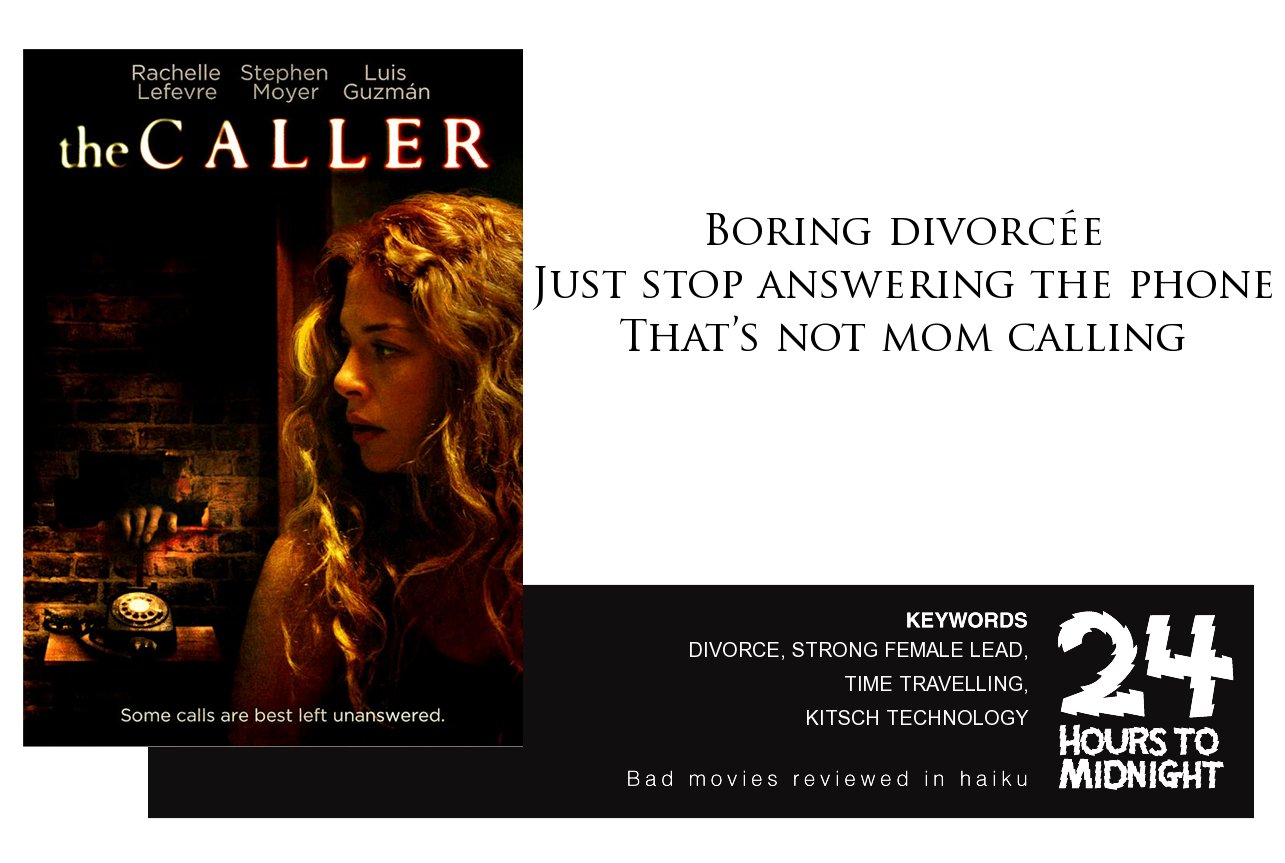
While trawling the local movie rental place, we stumbled upon this gem. We had a hankering for ANYTHING that might prove to be scary, but were surprised when this actually turned out to be quite unnerving. Once you get past the contrary face on the leading lady, it’s actually traumatizing, in a pleasant way.
Filmed entirely in Puerto Rico, the film centers on the totally depressing life of Mary Kee, a recently divorced young woman who is establishing herself in her equally depressing new apartment. She finds an old rotary phone there, and takes a liking to it. Too bad Mary doesn’t have any real friends to call her, and instead begins to get calls from a woman named Rose. Although Rose can only be described as a contrary old bag during their phone conversations, they do somehow manage to develop the semblance of a friendship.
As time goes on, Rose’s phone calls become more frequent, demanding, and threatening. During all of this, Mary’s ex-husband stalks and harasses her. Mary tries to cut ties with her ex and with Rose, and then we find out that ROSE IS FROM THE PAST! SHE IS TOTALLY STALKING HER FROM THE PAST! HARASSED FROM THE PAST! WHOA!
To find out how it ends, you’ll need to watch it. Although it may seem like a ridiculous premise to have a crazy old bat stalking you from the past, and you may be thinking, “girl, get yourself a cell phone and be done with it,” there are some really good scares in this movie. I wouldn’t go so far as to call it intelligent, but it’s not nearly as painful to endure as a lot of the other drivel we hold dear. So I would call it intelligent-esque.
Enjoy! Enjoy-esque!
Vampire at Midnight (1988)
Sun, Jul 29, 2012
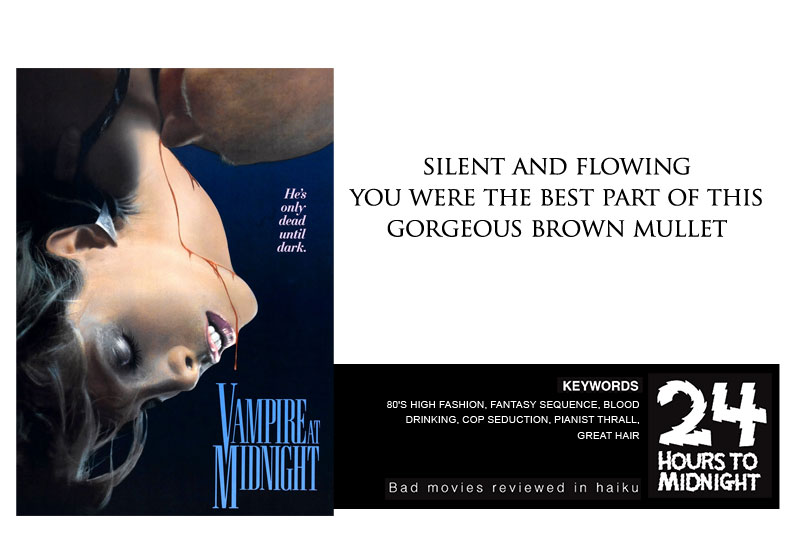
Vampire at Midnight is a classic piece of 80s vampire trash. Starring that mean guy from Madonna’s “Express Yourself” video (Gustav Vintas), Flesh Gordon (Jason Williams), and no one else of note, Vampire at Midnight tells the tale of a modern day (late 80s) hypnotherapist using his vampiric abilities to increase the skills of LA’s cultural up-and-comers until they either become his servants or his next meal. His killing-spree has earned him the nickname of “The Vampire Killer” and we follow Detective Roger Sutter (Williams) as he tries to track the villain down. Despite the amazing fashions, dance AND fantasy sequences, and a creepy villain, the very best part of the movie is this:

AMAZING.
Barely uttering a word and looking like someone who was kicked out of Duran Duran, Christopher Nee’s appearance as “Raoul” makes absolutely no sense and we kept watching in hopes that we would gain some insight into the life of this fascinating creature. All we learned is that he has really great hair and is good at beating people up. Like, REALLY BEAUTIFUL HAIR.
Anyway. Apparently no trailer exists so here is Madonna’s “Express Yourself” so you can see how mean that vampire guy is:



Mon, Sep 17, 2012
Adam Clarke