


“Writing is your genius, your life. Please don’t destroy it with drink”
Directed by Stuart Gordon. Teleplay by Gordon and Dennis Paoli. Based on the short story by E.A. Poe.
What kind of horror movie is it? Gothic historical.
In death, Edgar Allan Poe is known to this day as a first-class writer of the macabre whose influence is still felt in horror fiction. A genius.
In life, Edgar Allan Poe was a heavy drinker whose alcoholism soured his every success before it finally killed him. Stuart Gordon’s The Black Cat blurs reality and fiction, providing a thrilling account of how Poe’s life inspired the titular short story.
When we first meet Poe (Jeffrey Combs), he is a victim of his own success. Poetry is his true passion and he can sell poems to just about any publication, but at half-price. Since his poetry is so commonly found in the papers and he is so desperate for booze money, Poe reluctantly gives in to one publisher’s request for a “fantastic tale” along the lines of “The Tell-Tale Heart”. In a matter of moments, he will have spent the entirety of his advance at the local watering hole.
After staggering home, doubtlessly reeking of whiskey, Poe sees that his wife, Virginia (Elyse Levesque), is about to pawn off her piano just to keep the two of them out of debt. Before the humiliation of this predicament can register, Virginia begins coughing up blood. She has tuberculosis.
Virginia, now bed-ridden, urges her husband to write, but he cannot overcome his vice. As her condition worsens, Poe begins to lash out at everything around him, with the greatest source of frustration being Virginia’s mischievous cat, Pluto. By shedding all over their house, Poe thinks, Pluto must be worsening Virginia’s condition and causing the coughing fits. Eventually, Poe traps Pluto and hangs the cat in a noose until its body swings limp in the air.
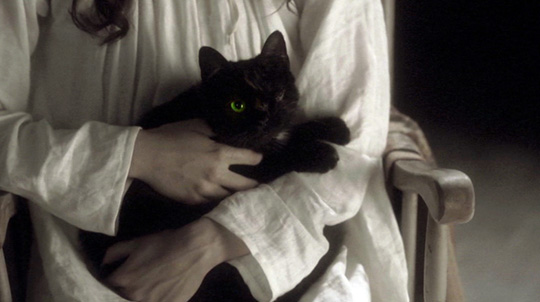
Surely, the cat’s death will give him the tranquility that he so desperately needs, so Poe goes out to celebrate with drink. When Poe returns home, he finds a one-eyed cat lying in Virginia’s arms, waiting for him…
When Masters of Horror was making its way to television screens across North America, I was excited. The idea of uniting many important names in the horror genre in a low-budget anthology program was great. The anthology series is still my favourite TV genre, though one hasn’t been successfully attempted in many years (if you think the Outer Limits revival was worthwhile, I may have to challenge you to a duel). Lining up 13 weeks of short films from noted genre directors seemed to seal the project’s quality. Old school horror veterans could return to their shoe-string budget roots, while offering greater exposure to more recent genre auteurs like Takashi Miike (Audition, Ichii The Killer) and Lucky McKee (May).
Masters of Horror lasted two seasons before being rejigged as a new series for NBC and retitled Fear Itself. The results were always the same. The old masters were mostly tired and burnt out. The once-brilliant John Carpenter’s first entry, “Cigarette Burns”, nearly saved his reputation before his follow-up episode in the following season, “Pro-Life”, promptly returned him to the gutter. Dario Argento’s two entries were abysmal, continuing his inexplicable de-evolultion from a director who relied on vibrant colour, unforgettable music and vibrant style for storytelling to just another gore-hound. Entries from John Landis (An American Werewolf In London), Don Coscarelli (Phantasm). Even McKee and Miike offered little more than boredom.
Stuart Gordon, whose The Pit & The Pendulum was one of the films featured last year on Blogowe’en, was the one exception to the rule.
His three Masters of Horror/Fear Itself episodes are not only the best of the series, they’re fantastic pieces of television and great horror in their own right. Gordon’s first entry (“Dreams of the Witch-House”) offered the creepiness, gore and black humour one would expect from the director of Re-Animator. His third, the straight-forward thriller, “Eater”, has been vaunted as the only highlight of Fear Itself. He was the only one who could work with a writer and make the anthology horror series work consistently, and he easily overshadowed his more famous peers.
While each of Stuart Gordon’s entries of Masters/Fear could be singled out for Blogowe’en, “The Black Cat” is undoubtedly the best of the three and is one of his finest hours in the director’s chair.
“The Black Cat” is one of the few installments of the series to have any sense of visual style and it is the most gorgeous to look at by far. Gordon strips his visuals of all but the barest hit of colour, save for the harsh, lustrous reds of the many glasses of port in Poe’s hand and (of course) blood. The sepia-toned world of “The Black Cat” is one of the most visually striking in modern horror. Granted, it loses some of its luster when you realize the beautiful shots of vintage Argento and Carpenter have largely given way to MTV-influenced, grimy-yet-polished look of Saw and countless Michael Bay horror film remakes. Those films spend so much time trying to look scary and ominous that they completely miss the mark when it comes to telling a story or building an atmosphere. Worse still, they look like crap.
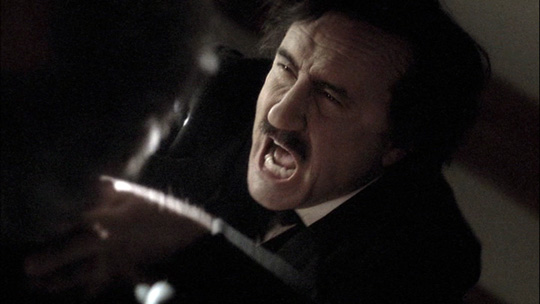
As much praise as the visuals deserve for their inventiveness, a great deal of the story’s success is dependent on Jeffrey Combs’ as Edgar Allan Poe. Combs is a chameleonic and intense actor who has always been unfairly marginalized in film and television. After breaking through with his sinister performance in Re-Animator, Combs has spent the bulk of his career playing countless aliens on Star Trek spin-offs and lending his dulcet tones to voice characters like Scarecrow and The Question in Batman: The Animated Series and Justice League Unlimited. He’s a “hey, it’s that guy!” character actor who, unfortunately, never got the cult following enjoyed by the likes of, say, Bruce Campbell. It’s a damn shame, because Combs is a brilliant actor and “The Black Cat” gives him ample material to deliver an unforgettable performance.
There was not a better piece of acting on film or television in 2007 than Combs’ tour-de-force here.
Yes, for all its clever cinematography and morbid goings-on, “The Black Cat” is rather restrained (well, restrained given Stuart Gordon’s track record) is an actor’s piece and Jeffrey Combs’s Edgar Allan Poe is beautifully well-rounded. Poe is not the most likeable character, but Combs makes you understand and empathize with him in every scene. Combs understands that Poe gifts as a writer would give him a certain charm and humour that could balance out his more disreputable qualities. Poe is just so charismatic and his devotion to Virginia is so fragile and real that when the episode draws to a close you can’t help but be moved when “The Black Cat” almost gives the character the happy ending he deserves.
Availability: “The Black Cat” is available as a stand-alone DVD or as part of the second season box set of Masters of Horror.


October 3rd, 2009 at 11:17 am
Here’s a trailer for the show…….
http://www.imdb.com/video/screenplay/vi3532980505/
October 3rd, 2009 at 11:35 am
The Once have infiltrated this review!
October 3rd, 2009 at 2:36 pm
They’re sneaky.
October 4th, 2009 at 4:26 pm
Great pick.
I don’t know if I’d go so far as to say that Jeffrey Combs had the standout performance of the year, but he was certainly the best thing about this film. And this film was indeed filled with wonderful.
See I was one of those people that never thought much of Combs. I didn’t dislike him, I just never saw him really let loose. I put this on the other night and he had me riveted. I love seeing actors ham it up in an old-school theatrical way. It’s one of the things I love about the British. In American productions actors usually go for a more naturalistic performance. Often to the point of non-acting.
Now Horror is usually not rooted in the rational world, and lends itself quite well to a more fanciful approach. see the filmography of Vincent Price for some fine examples.
You could also just watch this.
October 4th, 2009 at 5:01 pm
It’s not hard to see where fact meets fiction here, despite the claim that the line is blurred: this film is entirely fictitious. The article also has a fictitious line: Poe’s “heavy drinking” is heavily disputed, and it certainly did not “finally kill him.” As for the film, it’s not bad, but definitely hard to watch if you know a thing about Poe.
October 4th, 2009 at 8:03 pm
Rob: I was referring to the story of the black cat “blurring” with the “real life” of Poe depicted in the episode.
Rod: I love Combs and he is definitely a broad, theatrical actor with a great voice. I’m convinced that if he broke in to film and television in the US during the 50′s and 60′s, he would’ve been a huge success. Then again, I am no fan of naturalistic acting.
October 12th, 2009 at 9:19 pm
Right. I don’t mean to harp on this but, like I said: The film is entirely fictitious. Other than sharing similar names and a somewhat similar appearance, there is nothing of Poe’s “real life” blurred into the story of “The Black Cat” here. I do love Combs though (especially on “The 4400″).