


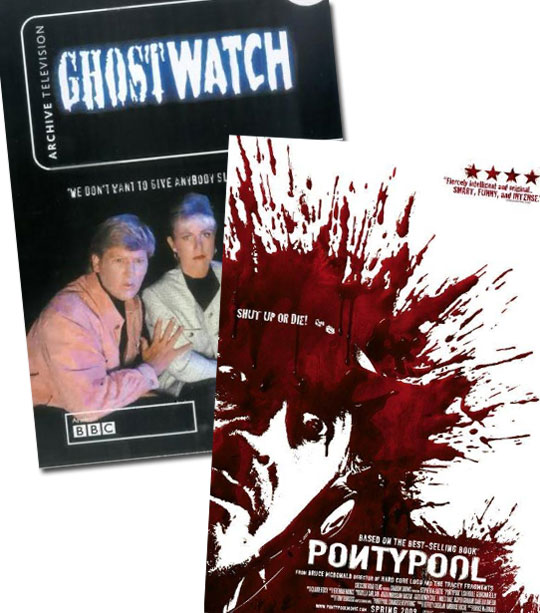
Ghostwatch: Written by Stephen Volk. Directed by Lesley Manning.
Pontypool: Written by Tony Burgess, based on his novel “Pontypool Changes Everything”. Directed by Bruce McDonald.
Much though we hate to admit it, mass media have an unshakable hold on us. Any form of communication is dominated by the influences of what we read, see and hear in various media. Our televisions, cinemas, radios, books and computers all present a funhouse mirror view of reality and it takes knowledge of one to understand the other.
I’ve been immersed in pop culture for as long as I can remember. As a result, I’ve been thinking in those terms since I was a kid. Whenever I saw Fox News during the Bush era, it was akin to watching Cliff Robertson’s character in John Carpenter’s Escape From L.A.
A lot of tele-journalism–especially the brand embodied in To Catch a Predator–is so overstated that it loses all touch with reality. In Predator Chris Hansen’s is either consciously or sub-consciously attempting to embody the stock character of the crusading journalist–as seen on the big screen with Darren McGavin’s Carl Kolchak or the Hildy Johnson character from The Front Page/His Girl Friday.
So how can we tell reality from fiction when reality is being remade into fiction?
Today’s two horror entries play around with the use of media and our perceptions of it. Each one is definitely a product of its particular era, so let’s jump in the WABAC Machine and set the dial for 1992 and the BBC1 TV special, Ghostwatch.
Yes, a TV special.
Ghostwatch captures the look of the “infotainment” programs of the 90s and wouldn’t look out of place next to Hard Copy or dubious TV specials like Alien Autopsy: Fact or Fiction. It must be said that Ghostwatch isn’t a telemovie, but is every bit as real as the aforementioned specials. When BBC kids show presenter Sarah Greene is threatened by a malevolent spirit, she’s every bit as terrified by its mind-bending presence as Jonathan Frakes was for Alien Autopsy.
Our host for the evening is Michael Parkinson, a very real presenter and journalist (he retired in 2007, after about 30 years of television work) best known for a long-running talk show. Joining him are Sarah Greene and Craig Charles (of Red Dwarf and Eastenders fame), who are out interviewing people about supernatural experiences while Parkinson remains in the studio. It’s all very cozy and twee until one of the hauntings reported on the program begins to manifest before our very eyes.
Throughout Sarah Greene’s reports from a London home, there are little glimpses of a figure that seems to be in the house with them. The children of the house, claim that they hear a ghost named “Pipes” banging on their water heater. Then, strange accidents begin to befall Sarah and the crew, accompanied by caterwauling and visual hiccups.
As the broadcast continues, more information is uncovered about Pipes, but things begin going awry in the BBC studio. The very act of searching for the ghost has become a kind of televised seance between the presenters and everyone watching at home.
Shortly after its first and only broadcast on Hallowe’en night in Britain, Ghostwatch became the subject of a multitude of complaints from irate BBC viewers. It was blamed for being a “malevolent” program designed to inflict harm on viewers and accused of causing a teen’s suicide.
The television special was subsequently banned from broadcast, though it was released on DVD in the UK in 2002 (its only home video release), Ghostwatch has never since been re-aired by the BBC. Eventually it finally made its way to Canada via the horror network, Scream (since renamed Dusk) and I caught it on April Fool’s Day in 2006.
I had had a fascination with Ghostwatch since I’d heard about the controversy that followed. When I read the plot synopses by people who had bootleg copies of it in the late nineties, I was determined to see it. The clips from the appallingly scanty official site on BBC Cult suggested a masterpiece.
And it’s true: Ghostwatch is one of the most eerie things I’ve ever seen.
Since that time, the relationship between viewers and television has changed a bit. There are still programs like the ones Ghostwatch was mimicking–Ghost Hunters being the most obvious example–but the bogus quality of these programs are glaring when compared to Family Jewels (a “reality show” that plays like a sitcom) or Glenn Beck (a news program that plays like a sitcom).
In Ghostwatch, television has unimaginable power in both its scripted conceit (mass-media seance) and the ridiculously outraged reaction that followed.
—
By contrast, Pontypool depicts a world where neither TV, nor any other media, could offer any help in a crisis.
We open as a middle-aged man is stopped in the road by a wide-eyed young woman. When he rolls down his window to ask her what’s wrong, she simply parrots his word and scarpers off. With no explanation forthcoming and no signs of trouble, the man continues his drive to work, arriving at a local radio station in Pontypool, Ontario.
This is Grant Mazzie (ubiquitous Canadian character-actor Stephen McHattie), a former bigshot radio personality who no longer calls Toronto his home. We won’t get much insight into his past beyond the fact that he was fired from his last job, but his mannerisms tell us everything we need to know about him. Mazzie isn’t content to do local news and whether, but wants to editorialize and antagonize his listeners. That’s what he considers “building a relationship” with the public.
So, Grant Mazzie is a jerk of the Don Imus variety. He’s not completely irredeemable, as he’s not above apologizing to his weary producer Sydney Briar (Lisa Houle) for his more outrageous slips of the tongue both on and off the air. Still, you get the sense that he might be too full of himself and too neurotic to change completely.
Not that we’re going to find out, of course! This is a horror movie, dammit! Bring on the monsters!
Courtesy of Ken Loney (Rick Roney) in the station’s “sunshine chopper” (which is amusingly just a Dodge Dart) there’s news of huge gatherings of people attacking a doctor’s office. As Loney struggles to find a safe refuge from the growing number of inexplicably violent people, he reports that the people seem to be afflicted with some shared disorder. All are phrases that they hear repeatedly as they engage in a violent frenzy.
Soon Mazzie is being phoned by BBC television for an interview, but they just seem to be making up details for all the ones they don’t have. Online searches prove useless for finding out any info on what’s happening. All Mazzy, Briar and fellow staffer Laurel Ann (Georgina Reilly) can do is continue broadcasting as they wait for more info.
When a French signal interrupts their broadcast, the three of them struggle to interpret the message, which Mazzy reads out to the listeners. Once translated, Mazzy hastily reads out the message, announcing that “a virus has infected the English language and only the English language. Do not translate this message” live on the air.
Canadian director Bruce McDonald (Highway 61, Hard Core Logo) has made a low-key, creepy masterpiece that instantly recalls John Carpenter’s The Fog and George A. Romero’s best work. Like Romero’s The Crazies, the mood is grim and the threat, though bizarre, is still human. These may be people who are driven to kill by outside factors, but they’re still people.
It is also reminiscent of Romero’s earlier Dead films, as the outbreak not only satirizes the pomposity of blowhards like Grant Mazzy, but the general impotence conveyed by all media. In Pontypool, nothing can save us without rethinking what we already know. Computers, radios and television only provide us with what we can see for ourselves, only glossed up through the miracle of exciting music and editing.
Fortunately, unlike Romero’s lazy later films or the dreadful remakes, Pontypool never forgets to thrill while delivering social commentary.
Availability: Pontypool is newly out on DVD. Ghostwatch is only available on Region 2 (UK) DVD, but is readily available on YouTube. So, too is a talk-back program, depicting the Ghostwatch controversy.



Wed, Oct 21, 2009
Adam Clarke