

Archive | Words in Edgewise RSS feed for this section
Words in Edgewise: Jesse Stewart – Hooked on Waterphonics
Each month Words in Edgewise brings together some of the most exciting and intriguing artists and academics performing, presenting and sharing their work in a variety of disciplines and media at Eastern Edge Gallery. “It’s like a good old fashioned variety show with equal parts sequins and tweed!” The Scope will be featuring a fresh video of past presentations each week.
Jesse Stewart: Hooked on Waterphonics
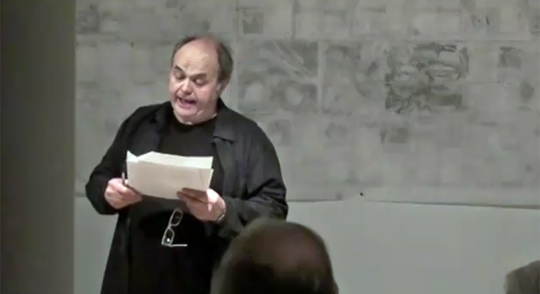
On Friday, April 22, Words in Edgewise teamed up with the inaugural Lawnya Vawnya Festival to present Jesse Stewart talking about and playing something called the waterphone–the most amazing instrument you have heard, but probably never seen.
Jesse Stewart is an award-winning percussionist, composer, improviser, artist, instrument builder, Carleton University educator, and writer.
Words in Edgewise: Iain McCurdy – “.blinking leaves.”
Fri, Jul 15, 2011
Each month Words in Edgewise brings together some of the most exciting and intriguing artists and academics performing, presenting and sharing their work in a variety of disciplines and media at Eastern Edge Gallery. “It’s like a good old fashioned variety show with equal parts sequins and tweed!” The Scope will be featuring a fresh video of past presentations each week.
Iain McCurdy: ‘.blinking leaves.’
‘.blinking leaves.’ is an autobiographical play tracing meaning through a collection of surreal memories.
Iain has a B.A. in Philosophy from Memorial, and is currently studying in the Humanities Department with a focus on mental health ethics.
Words in Edgewise: Joan Sullivan – “People Lose Their Way–And Their Belongings”
Thu, Jun 30, 2011
Each month Words in Edgewise brings together some of the most exciting and intriguing artists and academics performing, presenting and sharing their work in a variety of disciplines and media at Eastern Edge Gallery. “It’s like a good old fashioned variety show with equal parts sequins and tweed!” The Scope will be featuring a fresh video of past presentations each week.
“People Lose Their Way — And Their Belongings”
A new work for the stage by Joan Sullivan
Starring Neil Butler, Andrew Loman, Nicole Rousseau, Joan Sullivan
Words in Edgewise favourite, playwright Joan Sullivan, returns in February with another one of her amazing verbatim dramas examining dementia through the words of Nietzsche and others in People Lose Their Way — And Their Belongings, starring Neil Butler, Andrew Loman, Nicole Rousseau, and Joan Sullivan. Joan creates these compelling short plays, or performed texts with commentary, by re-mixing existing texts, her past work in the Graduate Program in Humanities has included “Science, Technology, and Pontius Pilate” (Words in Edgewise, September, 2010) Roland Barthes and Jean-Paul Sartre in a heated debate and Antoinin Artaud and Marshall McLuhan talking about language and theatre.
Joan Sullivan is the editor of the Newfoundland Quarterly and a freelance journalist whose work appears in The Globe and Mail, on CBC Radio’s Tapestry, and in The Telegram. She is also a playwright and director and her credits include Your Only Life, which she wrote and performed in St. John’s, Halifax and Montreal; an adaptation of Wayne Johnston’s The Story of Bobby O’Malley; and Cassie Brown: My Life in Non-Fiction, which premiered last summer at the Grand Bank Regional Theatre Festival and later toured provincial schools. Her theatre work in 2010 includes Rig, an adaptation of Mike Heffernan’s oral history of the Ocean Ranger, staged by Rising Tide theatre, and a gig as the first visiting director with the Grand Bank Regional Theatre Festival. Joan is also studying for a Master’s degree in the Graduate Program in Humanities at Memorial University. She lives in St. John’s with her daughter, Marianne.
Morgan Murray — Screw Everything: Make it Better
Thu, Jun 23, 2011
Each month Words in Edgewise brings together some of the most exciting and intriguing artists and academics performing, presenting and sharing their work in a variety of disciplines and media at Eastern Edge Gallery. “It’s like a good old fashioned variety show with equal parts sequins and tweed!” The Scope will be featuring a fresh video of past presentations each week.
Morgan Murray: Screw Everything, Make it Better
Screw Everything: Commentators and philosophers claim we live in a postmodern world where God has died, metaphysics have disappeared, and all that is left are particles of dust, connected by nothing to nothing. Slowly we, the dust, are being blown away by our own apathy, succumbing to our own cynicism, slipping away into nihilism, into nothing. Everything becomes nothing. Everything is lost.
Yet, things persist. Life goes on. We sit in traffic, sipping our Iced Capps as the ice caps melt, day-dream about who’s screwing who on As The World Turns as the world burns. What have we really lost? Have we lost everything, or have we just lost our way? Can something be made of all the nothing that’s seeped in and taken over? What is to be done? Can we make it better?
Make it Better: The apathy, cynicicism, and nihilism that characterize our postmodern world are the result of a crisis in value. This is a moral and ethical crisis. A crisis of trying to decide what is worthwhile and doing it in the face of immense pressure to give up, give in, and go on sitting in traffic sipping Iced Capps and day-dreaming about As The World Turns.
In this study of Václav Havel’s “living in truth”, Emmanuel Levinas’s ethics of reposnibility, Paul Ricoeur’s paving the way for the hermeneutic screw, and other revolutionary thinkers, a program of contemporary morals and ethics, a strategy for everyday life, emerges to highlight the persistance of hope, togetherness, and responsibility, which makes making it better make sense.
Descendent from lumber barons and homesteaders, Morgan Murray grew up on a farm in the foothills of the Rocky Mountains just down the road from four-time World Figure Skating Champion Kurt Browning. He graduated valedictorian from his tiny high school, with honours in Canadian Studies from the University of Calgary, and is now a Fellow of the School of Graduate Studies at Memorial University where he is working on mastering the humanities—all of them. In the meantime and in between time he has lived in the Czech Republic, Montreal, northern Quebec, and now St. John’s, where he writes for various publications, morganizes and hosts Words in Edgewise, and is the founding editor of Magpie magazine.
“Well, That’s Because He’s a BayGay”: Homosexuality and Isolation in Rural Newfoundland
Thu, Jun 16, 2011
Each month Words in Edgewise brings together some of the most exciting and intriguing artists and academics performing, presenting and sharing their work in a variety of disciplines and media at Eastern Edge Gallery. “It’s like a good old fashioned variety show with equal parts sequins and tweed!” The Scope will be featuring a fresh video of past presentations each week.
Walter Mackey – “Well, That’s Because He’s a BayGay”: Homosexuality and Isolation in Rural Newfoundland
A performance art piece using an analog cassette recorder to provide multiple voices which facilitate discussion on the topic of growing up as a homosexual in a settlement in rural Newfoundland & Labrador.
Walter Mackey is a 20 year old “self-proclaimed” artist living in downtown St John’s. Walter comes from a settlement of 33 people in Eastern NL. He has been interested in performance art after seeing Miranda July’s film that she directed and starred in called “Me and You and Everyone We Know” (2005). From there, Walter found such artists as Marina Abramović, Ulay, Vaginal Davis and locally, Anna Felaxos. Walter has lived in Eastern NL and he was most recently employed as a senior bilingual tourism representative but is now currently unemployed and looking for work. Walter is also an undergraduate student in his third year of studies at Memorial University of Newfoundland, with concentrations in Folklore and Socio-Cultural Anthropology. On February 28th 2011, Walter applied to Concordia University’s Liberal Arts College in hopes of specializing in Theatre Performance and Interdisciplinary Studies in Sexuality in the Fall of 2011. He is 20, he is queer, and he drinks local beer without fear.
The Future of Nostalgia
Thu, Jun 9, 2011
Each month Words in Edgewise brings together some of the most exciting and intriguing artists and academics performing, presenting and sharing their work in a variety of disciplines and media at Eastern Edge Gallery. “It’s like a good old fashioned variety show with equal parts sequins and tweed!” The Scope will be featuring a fresh video of past presentations each week.
Janna Rosales – Schmaltz or Sentinel? The Future of Nostalgia
Despite the return of vinyl records, skinny jeans, plaid shirts, and big glasses, is there really any room to long for “what was” in a forward-looking, wired-up society whose very essence is change? Vintage and retro might be “in”, but what really becomes of nostalgia, that longing for home and for what used to be? Once classified as a genuine medical ailment, and then recast as innocuous ambles down memory lane, nostalgia is now a prepackaged commodity, a fixture in the pop culture marketplace, from Mad Men to My Little Pony. This presentation will engage its audience in a conversation about the cultural aesthetic of nostalgia by asking, does the past have any value in a society whose eye seems so firmly set on the future?
St. John’s native Janna Rosales attended Memorial University where she studied both the arts and sciences, receiving a BA in religious studies and a minor in earth sciences. She followed that with a Master of Arts in environmental ethics, and then moved to Toronto to pursue a PhD with a dissertation that studied the social and ethical implications of nanotechnology. Among her other research interests are transhumanism, food security, cradle-to-cradle design, deliberative democracy models, and contemplative education. She is currently a Research Associate with the Faculty of Engineering at Memorial where she is doing research on integrative engineering education. When she’s not thinking and writing about the promise and perils of revolutionary technology she also likes to teach chocolate-tasting workshops, sing in three local choirs, hike the East Coast Trail and periodically launch herself off short ledges in pursuit of the perfect jump-shot photo.
Andy Jones at Words in Edgewise
Wed, Feb 16, 2011
Artist-in-residence at Eastern Edge Gallery, Andy Jones presented “The Abbie Table: Reflections on Life in the Salt Fishery” to a packed house at Words in Edgewise on January 20th. Joining him were Mark Ferguson, a salt fishery buff from The Rooms, and Derek Pelley of Figgy Duff fame, who spent his boyhood summers in the house that is centre piece of Andy’s project (and Andy’s current summer house).
Roll the tape…
Cue the commentary…
We are here because of the cod. Have you been out to the spot near Bonavista where Cabot is supposed to have landed? I am sure it was not the jagged rocks that convinced him to set up camp, but you already know the story about how the sea so thick with fish that they could be plucked out by the basketful. For hundreds of years, thousands of people made a living fishing off Newfoundland. At first they sailed from Europe, spent the summers fishing off of Newfoundland coasts, and went back home before the snow got too deep. Gradually they began to settle in outports along the coast, fishing in the summer, shivering in the winter. It was a way of life that went on for centuries and came to define this place its people.
Then it ended.
Things began to change slowly with Confederation in 1949 and Resettlement in the 1950s and 60s. Then it ended with a bang with the moratorium in 1992. Almost over night more than 30,000 people lost their jobs and the way of life that had created and sustained this place for centuries was gone more-or-less for good.
But you’ve heard this all before. This is old news. The province picked itself up, dusted itself off, and carried on. Now there are tourists and shrimp and crab to catch, oil in Alberta, and oil offshore. According to Republic of Doyle, the sun always shines in St. John’s these days.
But no matter how much we say we have heard it all before. No matter how many facts we can rhyme off about what happened to the cod and the fishers. No matter any of this, the details of the way of life are being lost. Replaced with myth, or forgotten all together. But, as Andy Jones said at Words in Edgewise:
“Any story, any human story about adaptation, and innovation, and creativity in whatever surroundings we are presented in is very important for us to hear.”
Important for us to hear not mere to know or remember or revel in the quaintness of how Grandma managed to grow up without a computer, but important for us to hear as a reminder of the courage and creativity that sustained people in a very difficult place to live. And while things may have gotten easier since then, this courage and creativity remains an important example of how we might make things better for ourselves not just by tapping into the spirit of our hardy ancestors, but into the details of their lives as well.
As Andy Jones pointed out, life at the Ellis house in Capelin Cove is both the quintessential Newfoundland story of life in the salt fishery, and the model for self-sufficiency that has become the defining feature of contemporary environmental and food movements. And for an island that survived quite well for several hundred years without roads or power lines to be knocked down by hurricanes, we might be well advised to look back at the secrets that kept them going so well for so long.
The next Words in Edgewise takes place Thursday, February 17, at 8pm at Eastern Edge Gallery. It will feature a dramatic reading of Joan Sullivan’s new documentary play “People lose their way — and their belongings” starring Neil Butler, Andrew Loman, Nicole Rousseau, and Joan Sullivan; and a performance and discussion by Ginny Ryan accompanied by Pamela Morgan. Find out more about More on Words in Edgewise at www.wordsinedgewisestjohns.wordpress.com
You can Join Andy Jones and friends for a reading of “Growing Up, Up in Cove” by Abbie (Ellis) Whiffen along with a Fish and Brewis dinner at Eastern Edge Gallery on Saturday, February 19, at 2:00 pm.


Thu, Jul 21, 2011
Morgan Murray