

Archive | Nooks & Crannies RSS feed for this section
Greg Stack’s law office window
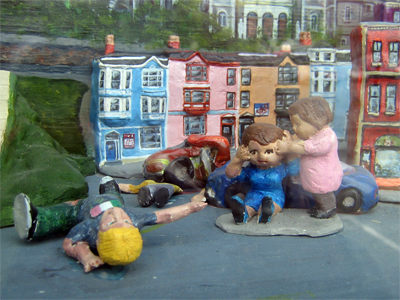
When lawyer Greg Stack approached painter, sculptor and friend Thomas Hutchings about creating a new window display for his Duckworth St. practice, he said he wanted something unusual. (more…)
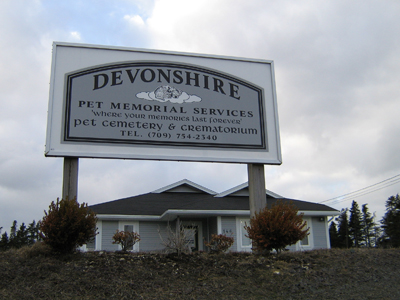
Devonshire Pet Memorial Services
Thu, Apr 12, 2007
When our cat Pearl died, the ground was frozen. So down she went into the deep freeze, nestled between the blueberries and the old plum puddings. When the ground thawed, Mom ceremoniously dug a small grave in the back yard and, while our other cats circled curiously, placed Pearl into the ground.
As most people know, the Ancient Egyptians mummified their much-revered cats, and the Romans also commerated their pets with dedicated burial grounds and stone monuments. The Parisian suburb of Asnière-sur-Seine has the Cimetière des Chiens, a pet cemetary established in 1899 where the famous Rin Tin Tin is buried.
St. John’s own pet necropolis turns 10 years old this month. Devonshire Pet Memorial Services is the business of Allan and Elizabeth Molloy, two pet lovers dedicated to helping provide closure to the family of the departed. (more…)
The Colonial Building
Thu, Mar 29, 2007
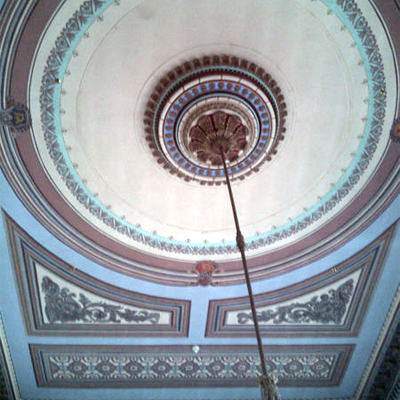
Though the Parkway’s sprawling and spired Confederation Building is the official symbol of our oft-questioned provincedom, it wasn’t until its completion in 1959, ten years after confederation, that the House of Assembly set up shop inside. Until that time, the Colonial Building on Military Road served as Newfoundland’s Legislature.
The neoclassical building, with its white Irish limestone exterior and its six authoritative columns, opened in 1850, but one of the building’s most noteworthy features came 30 years later. (more…)
Urinal headrests
Thu, Mar 15, 2007
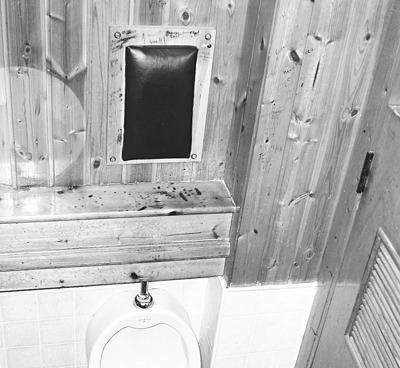
Erin’s Pub, 186 Water Street
Thanks to an ingenious toilet accessory, the male patrons of Erin’s Pub pee in comfort and maybe even with improved aim. Affixed above the washroom’s swishing urinals, two shamrock-green, padded-vinyl forehead rests beckon the weary pint-drinker to take a load off while unloading. (more…)
Sprung Greenhouse
Thu, Mar 1, 2007
The former Sprung Greenhouse property east of Commonwealth Avenue is at the centre of a small tug of war between the twin cities. Though the 104 acre piece of land is under St. John’s’ jurisdiction, both municipalities appear to have plans for it in 2007 – Mount Pearl to extend its boundaries to encompass it, and St. John’s to rezone it for residential development.
In early 1987, after a trip to the mainland, Premier Brian Peckford returned with promises that Philip Sprung would pave the way for Newfoundland to become a leading producer of English cucumbers. A feasibility study was never done, nor were inquiries made into Sprung’s other less than successful projects. Expecting to produce 135,000 pounds of hydroponic cucumbers a week, the province sunk over $13 million in public funds into the venture.
The greenhouse, however, yielded less than half of its quota at a production cost of more than twice the going rate. Eventually problems regulating the environment in the glowing dome led to regular crop failure.
Without ever turning a profit, the Sprung Greenhouse closed and Brian Peckford quickly resigned as Premier. Oddly, in the winter of 1989 the night sky Mount Pearl-way was still fluorescently aglow. The Sprung Greenhouse had already gone belly up, but was leaving its lights on at a cost of $7,000 a day, trying to melt the snow off the roof.
– Lesley Thompson
Chinese laundries
Thu, Feb 15, 2007
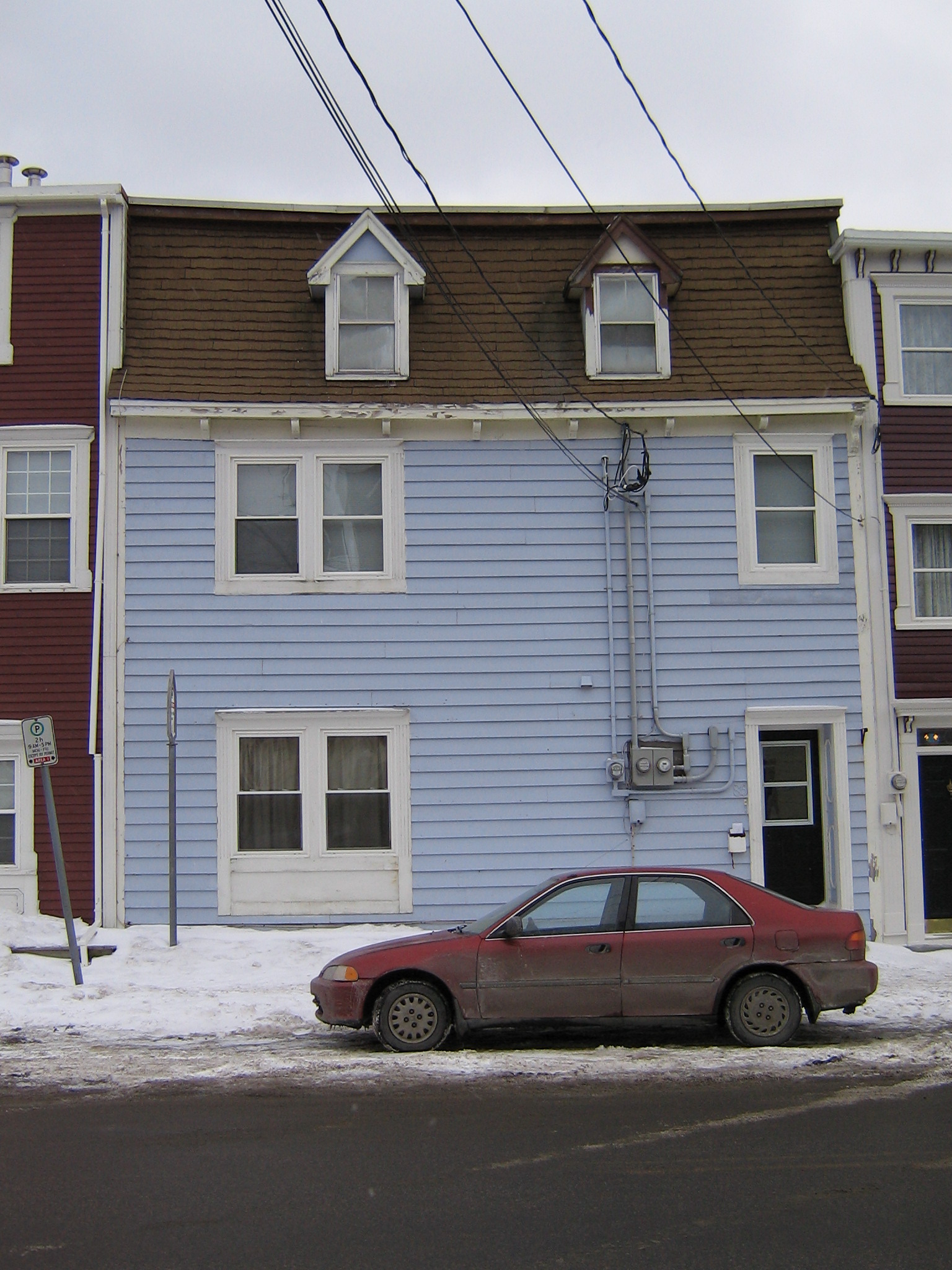
83 Gower, site of the John Lee Laundry until 1973
One hundred years ago, downtown’s business-scape was dotted with Chinese-owned and -run laundries, groceries and cafés. The hand laundries, in particular, represented a common source of employment for young men leaving China. The first two Chinese laundries – Sing Lee Laundry on New Gower St. and Jim Lee Laundry on Duckworth St. – were operating by 1900, with others to follow.
Ed loves Kelly
Thu, Feb 1, 2007
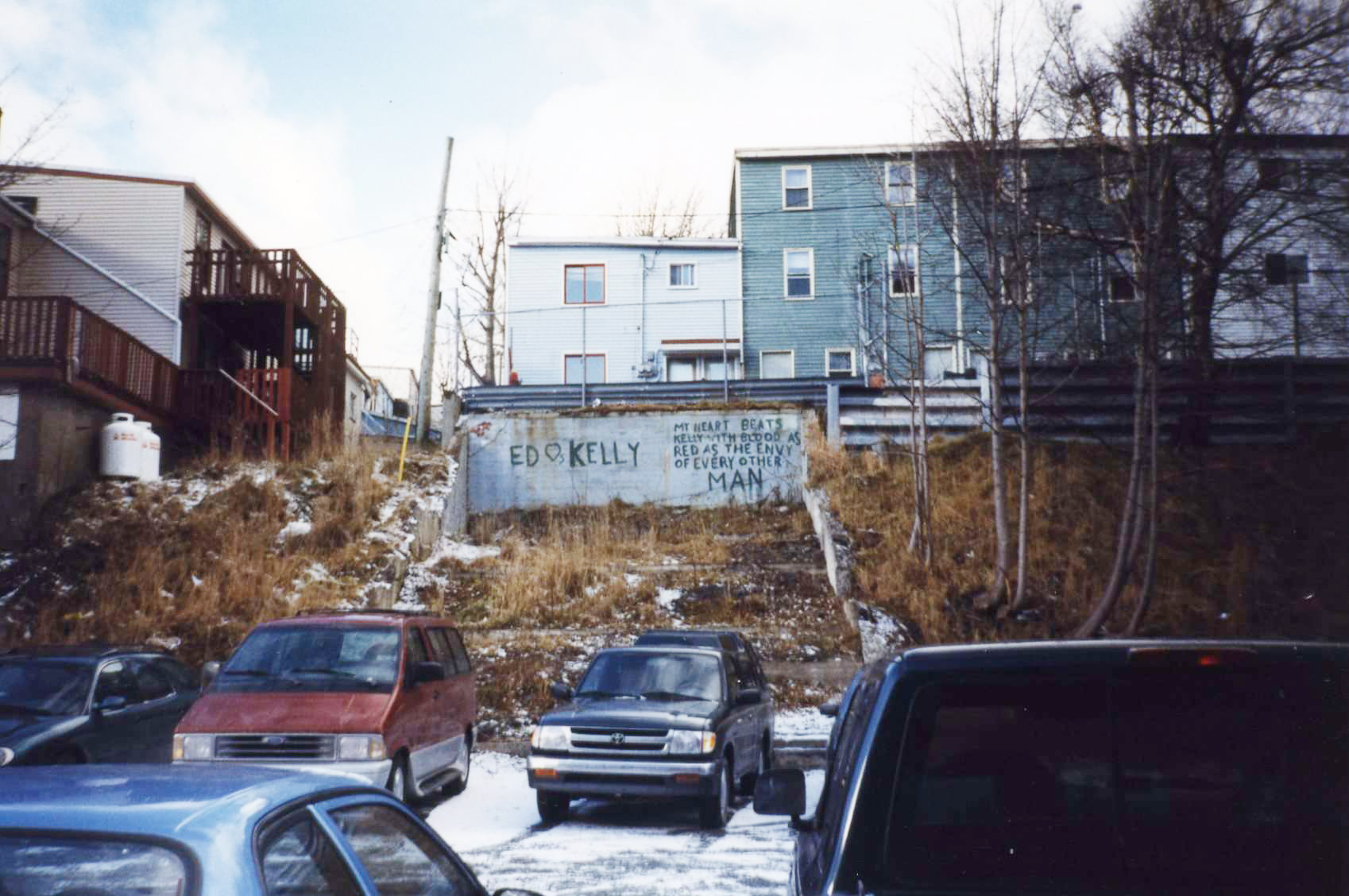
(Photo by Karmella Perez)
Of St. John’s’ many graffitied retaining walls, the most desperately romantic was sadly covered up some time ago. On the east end of Duckworth, hovering above the dirt lot across from the Sir Humphrey Gilbert Building, in thick, green, house-painted strokes, it spoke:
“Ed ♥’s Kelly “
“My heart beats Kelly with blood as red as the envy of every other man”
Incongruous punctuation and mixed metaphor suggested a relationship gone haywire. I guess we can assume the author’s heart didn’t actually beat Kelly with blood. But what was he trying to express? Was this a jealous, lovelorn apology? Did he want Kelly back? Or was it a chest-thumping declaration that he already had what every man wanted – Kelly?
When the scrawl was painted over, it seemed the puzzle would never be solved.
Just blocks from this wall, one of St. John’s’ long-lost murals was recently restored. In 2004 the City of St. John’s sought out photographs of the Golden Pheasant Tea ad that once decorated the side of the East End Club. That summer, $10,000 was spent restoring it.
In the spirit of Valentine’s Day and bitter sweetness of love, the City might consider the same undertaking, and restore the former glory of “My heart beats Kelly” – and at a fraction of the cost.
(Anyone have bucket of green paint?)
– Lesley Thompson
The harbour salt pile
Thu, Dec 21, 2006

As long as I can remember, a black-tarpaulined dune of salt has sat on the east end of the harbourfront secured with tires and rope. Before the post-9-11 tightening of port security, the giant heap was possibly more climbed-up than the onlooking South Side Hills. Despite the wild views it provides, the salt pile is not part of the east coast trail, but part of home heating providers Harvey’s Ltd.
(more…)
The Tin Man
Thu, Dec 7, 2006
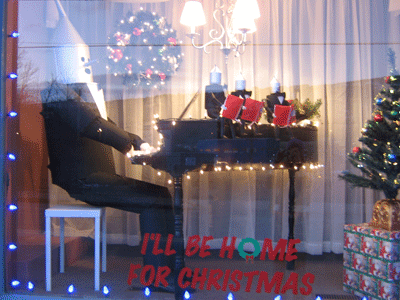
Almost 20 years ago, Bob Puddicombe of Jenkins and Puddicombe Sheet Metal Ltd. (12 Hamilton Ave) made himself a Tin Man suit to wear to St. John’s’ first ever George Street Mardi Gras. Bob and his costume won first prize.
Since then the Tin Man – minus Bob inside – has faithfully appeared each year in the Hamilton Avenue store’s Christmas window display. The mastermind behind the festive storefront scenes, however, is Janice Puddicombe, Bob’s ingenious wife. Each year Janice dreams up something new – anything from a toy shop to the millennium celebration.
(more…)
Sea City View
Thu, Nov 23, 2006

Walking along the Outer Battery on your way to or back from the Signal Hill trail you encounter a rickety wooden edifice painted bright yellow with a green sign posted out front that reads: “Never Confuse Education With Intelligence.” This structure is in fact the lower part of the Sea City View “observation tower,” built and formerly maintained by Mr. Albert Sparks, who was raised in a house on this spot throughout the 30s and 40s. In 1961, he tore down and rebuilt the house at 13 Outer Battery and constructed another observation tower directly adjacent.
(more…)
Pleasantville
Thu, Nov 9, 2006
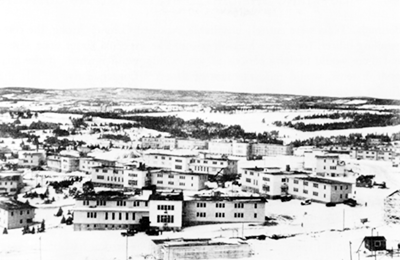
When I was kid, Pleasantville was a place for girl guide meetings, bingo nights and Janeway visits. But in 1943, it was a place for jeeps, guns and ammunition – the home of thousands of fighting Yankees!
Early in the Second World War, the United States struck a deal with Great Britain whereby it would lease land for bases in Newfoundland and the Carribean in exchange for American destroyers.
(more…)
The Dardanelles
Thu, Nov 2, 2006
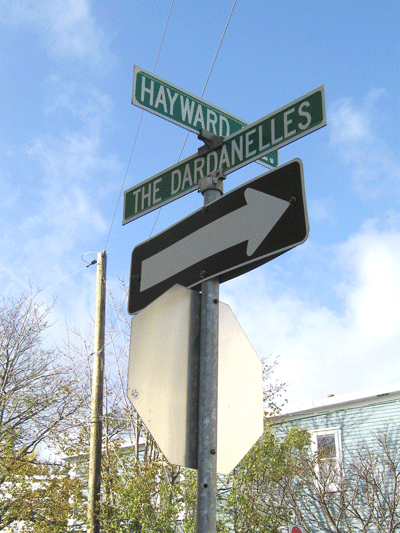
Not many street names in St. John’s begin with “The”. There’s The Parkway and The Boulevard, which both sound perfectly car-worthy…
And then there’s The Dardanelles. Connecting Barnes Rd. and where Hayward turns into Catherine, it’s name is uttered by many with a pirate-y snarl, “Arrrr, The Darrrrdanelles.” No pirates live there that I know, but the name’s history is certainly a dark and watery one.
The Strait of the Dardanelles is a stretch of water between the Marmara and Aegean Seas, and it has always been a site of strange and strategic crossings. Alexander the Great lead his army across it in 334 BC, beginning his campaign in the East. In myth, Hero guided her secret lover Leander across it nightly with a lamp from her tower. Her light was extinguished by a winter storm and Leander drowned. When his body washed ashore below her, Hero leapt to join him, and her death.
With Newfoundland being little invested in Greek myth, it’s likely that this short street is named after The Dardanelles Campaign. Though known here as the Battle of Gallipoli, it was the Allies’ attempt to take Constantinople during WWI. In 1915, a thousand Newfoundlanders landed on the shores of the Dardanelles to take part in the invasion which resulted in 180,000 Allied and 220,000 Turkish casualties.
Perhaps fittingly, not only do no pirates live there, but no residents either. Not a single house has an address on this Georgestown street.
– Lesley Thompson
Leon Trotsky? At Cochrane House?
Thu, Oct 19, 2006
The Newfoundland Historic Trust plaque at Cochrane House lists Leon Trotsky among its many famous former hotel guests.
Trotsky was a Bolshevik revolutionary and Marxist theorist. He helped create the Soviet Red Army, and lead them to victory in the Russian Revolution, only to be expelled from the Party and assassinated with an ice axe by Stalin’s agents.
In 1916, the year before the Russian Revolution, Trotsky was kicked out of France, deported to Spain, then traveled with his family to capitalist New York. Wishing to return to Russia to “push forward” the revolution, he was granted safe passage and an American passport in 1917 by US president Woodrow Wilson. But on April 3 Trotsky and his family were arrested in Halifax and interned at a station for German prisoners.
If Trotsky indeed stayed in St. John’s, it would have been after his release on April 29, on his way to join the Bolshevik uprising. But evidence confirming the visit to Newfoundland is spare to none, and his stay has entered the realm of myth and apocrypha. Rumor even has it that Joey Smallwood interviewed Trotsky for a St. John’s paper called The Plaindealer, but proof is yet to be found.
Cochrane House opened in 1870, and reopened again in 1893 as the Cochrane Hotel after it was destroyed by the great fire. Its revolutionary days long-past, it is now a senior’s complex.
– Lesley Thompson with thanks to Darren Hynes, Trotsky enthusiast
The Lord God Father Almighty Creator and King of Heaven and Earth Hospitality Inn
Thu, Oct 12, 2006
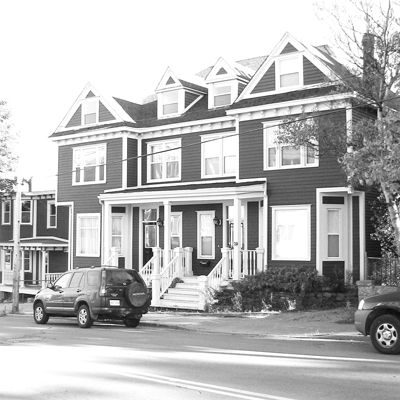
How many St. John’s boarding houses have been swallowed up and spit out gentrified in recent years?
I can’t exactly remember when The Lord God Father Almighty Creator and King of Heaven and Earth Hospitality Inn was renovated out of existence. But years ago, walking up Bonaventure across from Holy Heart, you might have noticed the carefully hand-painted sign struggling to contain its own name. Christmas lights and potted, plastic flowers hung on a porch that saw in and out some of this town’s more unusual souls. Part boarding house, part mission house, the Hospitality Inn aimed to care for “the young and old alike,” just like, presumably, the Lord God Father Almighty Creator and King of Heaven and Earth himself.
The Inn was owned by Pilar Riego-Hickey, known locally for a string of religious rooming houses (several of which were struck by fire) as well as for her forays into provincial politics. Originally from the Philippines, she came to Newfoundland to teach in Davis Inlet, Leading Tickles, and Ramea. In 2003 she ran as an independent against conservative Loyola Sullivan winning a full 11 votes. Sadly, Riego-Hickey passed away in June of 2004.
Like all-too many strange and interesting spots in this town, the LGFACKHEHI has since been gutted and red-clapboarded into something more palatable and upper-class.
– Lesley Thompson
Apples!
Thu, Oct 5, 2006
This isn’t the Okanagan, but every year in St. John’s’ public spaces there’s an accidental harvest that’s often overlooked. There are chuckly pears on MUN campus, mint leaves on the banks of Rennies Mill, blackberries on Virginia River. And it’s a myth that only fruit trees of the “crab” variety grow here, at least if “crab” means “no good to eat”.
(more…)


Thu, Apr 26, 2007
The Scope