

Archive | News & Views RSS feed for this section
Live Blog: North Atlantic Forum – Day 1
The North Atlantic Forum is in St. John’s this year, on the topic of Culture, Place, and Identity at the Heart of Regional Development. Morgan Murray checked out the proceedings on day one and here is a blow-by-blow Twitter account:

Concurrent Session A3: Farms, Food, and Identity
Hello twitterverse. Morgan Murray here at the North Atlantic Forum at the Delta in St. John’s tweeting you all the action.
Up first: Icelandic sheep!
Live from Iceland via skype no less. The person talking about the sheep, Myriam Dalstein, not the actual sheep… Yet.
I lied. Last minute lineup change. Natuuk Mund (???) live from Greenland via skype presenting kalaaimernit. About food & culture.
Kalaaimernit means “Greenlandic food.”
New born Greenlanders have a seal bone, or equivalent, in their mouths before their umbilical cord is even cut!!!
*put* in their mouths. Food is a major part of their culture.
“Transition from ‘natural’ to ‘cultural’ in Greenland is very short.” a lot of raw foods are eaten.
These days they are raising sheep and beef in southern Greenland. Sheepcicles?
The strong flavors of Greenland foods can cause ‘neqigunneq’, ‘tinmiagunneq’, or ‘quagunneq’. Which translates roughly to serious jonsein’.
Food in general is ‘nerisassat’. Greenland food is ‘kalaaimernit’ which translates directly to ‘a piece of a Greenlander’.
“the more Greenlanders eat kalaaimernit the more they become Greenlanders.”
What time is in Greenland?
Now it’s time for Icelandic sheep!
Myriam Dalstein was born in Berlin and was on her way to Canada. She had a stop over in Iceland and stayed. Now she owns a yarn farm.
She’s made a video of Iceland. Double rainbow over a waterfall!!!!! Be-ea-eautiful!
In this video a guy just walked through a geyser protected by only a handmade Icelandic sweater. I got to get me one of those.
At Yarns & Farms you get to learn and experience all sorts of Icelandic culture right up to making the yarn to make the sweaters
Not to mention you can stay in a sod hut on a triple decker bunk bed!
Video is over. Now Barbra Marshall from the Labrador Straits Development Corporation talking about the “Coastal Heritage Experience”
In response to Ms. Dalstein’s “yarns and farms” Ms. Marshall said they had “jam and jammin” in the Lab Straits.
They hired ‘collection agents’ #notwhatyouthink
The collection agents were old folks they hired and trained to go around the community and collect stories. They collected A LOT!
They are putting all these stories online. There’ll be some good yarns there! Zing!
This was a community development project, so how does this fit?
The made up some experiences for tourists (ie. A mug up), a cookbook, a CD, and posters.
Time for some food Q&A… What’s for dinner?
Global warming is affecting kalaaimernit availability.
The Pure Labrador cook book is selling like hot cakes in Costco & Sobeys. The CD is slowly selling locally. And the experiences are good but
…it’s hard to find people to work.
All this talk of food has got me hungry. Time for lunch.
If you want more follow the official proceedings @NAForum2011
Keynote 2: Dr. Elaine Stratford
About to be keynoted in the ballroom. Does that makes this keytweeting? pic.twitter.com/h4X1jlmo
The ballroom is filling up in eager anticipation for Dr. Elaine Stratford’s keynote address “Vantage Points”
Dr. Stratford is from Tasmania. Home of the 1990′s most popular after market vehicle decal Looney Toons characters: Tasmanian Devil
Dr. Tom Gordon, a MUN music prof, is introducing Dr. Stratford. He says Tasmania is to Australia, what Newfounland is to Canada.
Does that mean New Zealand is St. Pierre?
Dr. Stratford: “conflict need not be antagonistic.” tell that to my big sister #ouch
Heritage governing practices inevitably fail, says Dr Stratford, because they are met with resistance by locals and can’t have total control
In which case, failure us not only inevitable and potentially productive, but also a good thing.
RT: @NAForum2011: Elaine is such an eloquent speaker– it’s not every day you get an academic presentation with such great use of metaphor!
I love it when academics blast you with high theory and then say “in short…” and say things like arson and sabotage #allbetter
St Johns city council should be here to hear all about the trickiness of preserving heritage and promoting development
Golf courses are the enemy of heritage. What will they be in 500 years when they’re heritage?
Getting a crash course in development conundrums on islands all around the world. 10 in 10 minutes. Good to know we’re not alone.
I’m starting to sound like Andrew Harvey, The Scope’s City Hall guy.
Now we’re getting personal. Dr Stratford is telling us about her hometown Hobart, Tasmania. pic.twitter.com/tfJYCmoT
English word of the day (you got a Greenland one earlier) ‘antipedean’ (sp?) means someone who lives on the other side of the world
#moviesiwannasee The Human Antipedean
It’s kind of creepy the similarities bw Hobart, Tasmania and st john’s. It’s like bizzaro St Johns.
Not so much the look or its being a former penal colony, more of their hubbub over development of heritage space.
What I learned so far today: I want vacations to Greenland, Iceland, and Tasmania. Gonna need a second job.
Q&A: does tourism hurt? Some of it, sure. What it all comes down to: it’s about relations between & among us.
Thus concludes this momentary lapse into bizzaro land. Stay tuned for more shortly.
Concurrent Session B3: The Art of Regional Development
The Art of Regional Development, 3 talks in the ballroom, including one en francais. Let’s see how this goes. #dontholdyourbreath
Quelque ces femmes qui parle apropos de St Pierre parle trop vit. #toocheaptoborrowatranlationheadset
From what my pouvre francais can gather, 2 theatre groups in St Pierre & NB are working together to show the importance of theatre
And theyre going to be putting on a show at the 2014 World Acadian Conference.
Now, Dr Andrew Jennings’ “rocking the rock” about the Scotch island of Shetland. I hope my Scottish is better than my French.
In Shetland there are more sheep than people and they teach knitting in primary school.
The sheep don’t teach the knitting… I don’t think.
Other things about Shetland: fiddles, fish, wind, it’s called the rock, and they have ponies the size of NL dogs. #bizzaronl
The world is full of unique, windy, rocky islands just like newfoundland. #whatilearnedatnaf2011
Oh, wait. There is a multi-use art space in the heart of their big city. We don’t got that.
There are 23000 ppl in Shetland and a lot of them work in the arts and they’re using the arts to grow the pop #notwhatyouthink
Most arts funding in Shetland comes from a honking trust started with oil money in the 1970s. By Jove! #wouldntitbenice
Google up some “Shetland arts” and prepare to drool. A lot like NL, a lot different (better?). Not bad fir 23000.
Shetland has a billion festivals too! Including A FIRE FESTIVAL!!!!
Shetland is also building a Rooms on steroids, including studio space, a movie theatre, and a bunch o’ other craziness.
Let’s all go to Shetland!
Oh no! Last minute line up change. Un autre presentation francais! Quelle dommage!
Now ArtEx–visual arts in the Exploits Valley.
ArtEx came out of when the Abitibi mill closed in GFW. It was lead by the Ex Valley Econ Dev Corp.
Economics, visual art, nature (the river) working together to replace a pulp mill… Hmmm… Interesting.
Can art save a community? A region?
On the anniversary of the mill closing ArtEx held a paper making wrkshp: ” we can still be a paper making town, not a company town”
There are a lot of crazy great NL artists. Some in the Exploits Valley of all places!
Q&A time: will ArtEx be sustainable? Funding, volunteer burnout, etc are concerns. It won’t be easy.
Scottish tourism tried leading the branding of Shetland. It didn’t work. Not fans of thistles those Shetlandians. So they took over
Big Q: does differing perceptions of the importance of arts and culture make a difference in the art and culture?
I.e. Do the arts suffer by always having to justify themselves to funders?
Has all this great art business in Shetland kept the young ppl from leaving? You bet says Dr Jennings.
Funding’s a problem for everyone, everywhere #whatilearnedatnaf2011
Well, most places.
That’s it for now. Meet me in the ballroom in 3 hours (7:30) for Words in Edgewise!!!
What do you think of the new bike lanes?
Fri, Oct 7, 2011

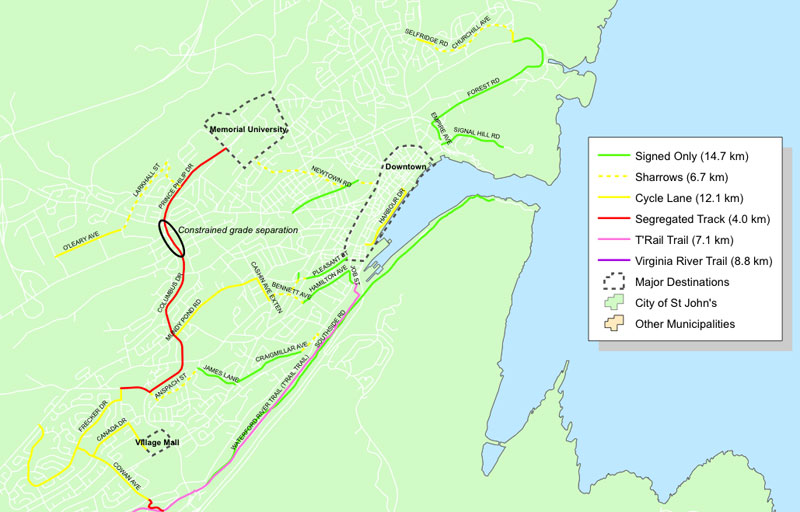
The new segments of the city of St. John’s cycling infrastructure were officially launched last month. How have the new bike lanes, sharrows, signed routes and expanded trails been treating you out there?
So! Cyclists, pedestrians and drivers: Do you think the changes have made cycling safer in the city? Are there any issues you’re coming up against? Problem spots? Tell us here.
UFO sighting near Swift Current
Tue, Oct 4, 2011
This just in.
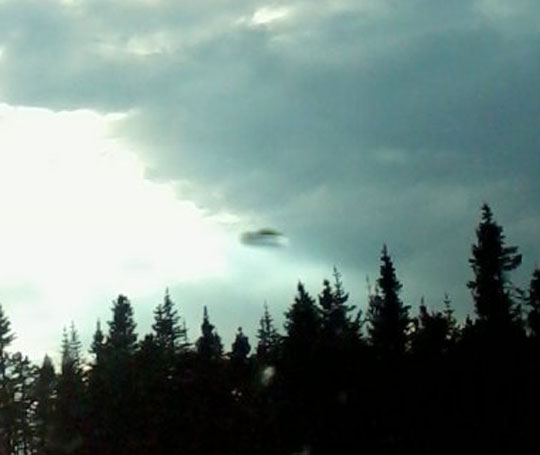
UFO Casebook, a website dedicated to UFO sightings around the world, is reporting a sighting of a UFO just off Highway 210 off the Trans-Canada Highway, just past Swift Current.
“The submitter states that he was driving on Highway 210 off the Trans-Canada Highway about 3:00 PM,” they say.
From the site:
“It was just past the town of Swift Current, heading toward Terrenceville. [The submitter] took some photographs, but did not notice anything unusual at that time. He only noticed the object when he was looking through his photographs later. Some people that he showed the photograph to believe the object is nothing more than a raindrop on the window, but the photographer says there was no rain at the time he took the photo.”
Using our in-house photo lab, The Scope has been able to enhance the resolution of the image, but are still unable to identify the object.

Polar Beers & Free Towel Service
Thu, Sep 29, 2011

Mayor of Reykjavik Jon Gnarr with Heiða Helgadottir. Both are with the Best Party.
Reykjavik’s Best Party general manager Heiða Helgadottir, who will be in St. John’s giving a keynote address at the North Atlantic Forum, spoke with Sarah Smellie about why politics should stop being so damn boring already.
On October 6th, 2008, television screens across Iceland lit up with an anxious message from then Prime Minister Geir Haarde. This was the end of a booming Iceland. The country’s three major banks were collapsing and the government was doing everything it could to save people’s money, he told them. Haarde concluded that speech by asking God to bless Iceland.
After his speech, Iceland erupted in protests, culminating in riots. Haarde and his government resigned. In 2011, Haarde would go to court for criminal negligence over his government’s role in the crisis.
One of Iceland’s most famous absurdist comedians, Jon Gnarr, was watching the address. “I hadn’t followed politics before,” Gnarr tells the host of Inside City Hall, a New York City TV show about municipal affairs. But when the Prime Minister asked God to bless them, he knew something was rotten in the state of Iceland.
“So I started following the news to try and figure out what happened, and I started to wonder if someone like me could step into this world and change it for the better.”
Gnarr gathered a group of friends and they started planning for the municipal election. One of those friends was Heiða Helgadottir.
“We talked about forming this political party,” says Helgadottir. “We’d base it on a satire of this politician that was very over the top, and promised everything that everybody wanted to hear.”
That politician was “played” by Gnarr, and they called his party the Best Party. In May of 2010, the Best Party ran in the Reykjavik municipal elections, with Helgadottir running the campaign. They released a music video, set to Tina Turner’s “Simply the Best” featuring Gnarr yelling promises of polar bears for every zoo from the top of a building. They called for a drug-free parliament by 2020 and free towels at public pools. “This is something that everyone should fall for,” says their statement.
Their slogan? “We’ll have more fun.”
They also said they’d increase transparency and stop corruption.
The bit about polar bears turned out to be reasonable: polar bears had been arriving on Iceland’s shores, by way of ice floes, and were typically shot. Even in the video, while Gnarr sings that Rejkavik should be a “city that’s cuddly and clean and cool, with topnotch stuff, as a general rule,” there’s a sense that he’s more than a joke: he comes off like an honest, trustworthy guy who might be worth a vote or two.
And so the Best Party won, with 34.7 per cent of the vote. The guy in the Tina Turner video parody is now mayor of Reykjavik.
“We managed to get through to people that we were capable of winning, even though we used different methods, like humour,” says Helgadottir, now general manager of the party. “It was a delicate balance of being very real and very surreal. When Gnarr was giving speeches, he was funny, but he didn’t put on this front of being this assured politician. You could really see that he wanted to change something and do good.”
“And plus,” she says, “it’s not like we were going to do any worse than the people before us.”
Since coming to power, the Best Party has made admission to all public pools free for those under 18, but they’ve also had to make some very unpopular and decidedly unfun decisions, like cutting bus and social services in the city, and lifting Reykjavik Energy out of an impending bankruptcy with a $104 million loan. The loan’s many stipulations include an eight percent increase in heating rates for everyone, and layoffs for 11 per cent of its employees.
“Of course that was disillusioning,” says Helgadottir. “But it’s still very important that we did it. With Reykjavik Energy, it was almost bankrupt because nobody wanted to make tough decisions about it. It was what was needed—we can’t have the same sort of politics that promises everything and keeps the ball rolling until it explodes.”
Those decision cost the Best Party a bit of their popularity. IceNews reports September poll results showing that 47 per cent of respondents were dissatisfied with Gnarr’s work. Helgadottir says that she can sympathize with the temptation to make decisions that will keep your numbers up—sort of.
“I don’t think most people go into this to become mean and corrupt, but I can understand how it happens,” she says. “There are a lot of temptations. You have to stay very, very aware of it all the time.”
Regardless of the polls, Gnarr and the Best Party are still in power, which is impressive—Reykjavik has gone through four different mayors since 2006, each holding on for an average of eight months before being ousted.
“We’re still in this and we’re still doing it every day, even though people tried to bore us to death,” says Helgadottir. “They still haven’t managed to do it!”
The Best Party is even planning to run candidates in the 2012 national elections.
“I think this is a very positive story about regular people coming together and organizing themselves. Even though we organized ourselves quite badly at times, it still happened. There didn’t have to be a time frame and Excel spreadsheets.”
Nor does there have to be endless boredom, she says.
“I think [the idea that politics must be serious in order to be legitimate] is harmful,” she says. “That way, the powerful elite can go about their business unchallenged and can tell us how things are and what is best for us. [Politics] isn’t boring and it is important that people know that. We should be able to talk about serious issues and reach decisions with out it being mind-blowingly boring.”
And you can always find a way to do it differently, she adds. “Change really isn’t that far away from you, it’s mostly to do with yourself and how you approach things like this. Politics is like a game, and if you decide to play it by their rules, I think all normal and good people will eventually die inside.”
Heiða Helgadottir will be in St. John’s to give a keynote address during the North Atlantic Forum Conference, held by the MUN Harris Centre October 13-15.
Cycling the Jack Layton Way
Tue, Sep 13, 2011
Jack Layton calls for Toronto cycling lanes in 1996
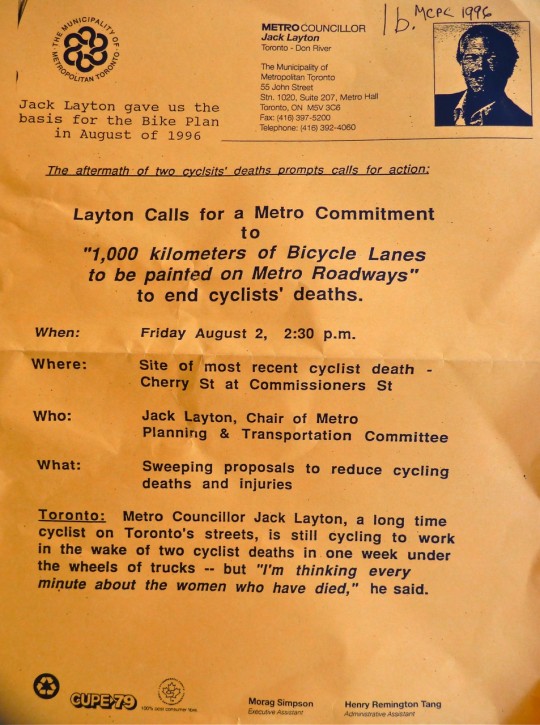
He began his campaign for a bike-friendly Toronto way back in the mid-nineties, and he traded in his car for good in 1983. What better way to honour Jack Layton than to name a portion of St. John’s new cycling paths after him?
That’s what Bill Brennan thought when he read about the new bike paths that the city’s been laying out, just after Layton passed away on August 22nd.
“I was living in Toronto when Jack was a city councillor,” says Brennan. “It was well known that he would bike to work all the time and that he was an ardent cyclist. So I thought it would be a nice idea to have part of this bike path named in his honour.”
Brennan thinks that the lane along Prince Philip Drive, running by MUN, would be ideal. A few city councillors agree with him.
“I emailed all the city councillors, and the mayor and deputy mayor,” says Brennan. “Four city officials [Shannie Duff, Sheilagh O’Leary, Frank Galgay and Debbie Hanlon] wrote back and said, ‘Oh, this is a lovely idea.’ The other folks haven’t responded.“
Shannie Duff took the idea to a meeting of the city’s Cycling Committee. Brennan says that all the partners in the Bike Plan, which include the Grand Concourse Authority, Pippy Park and MUN, would have to approve it. Then it’d make it to vote at a meeting of council.
The only snag so far? “I’ve since discovered that in order to call something a ‘way,’ it has to be a piece of road that’s travelled by vehicles,” says Brennan. “So, that won’t work out. But the Jack Layton Memorial Trail sounds fine, too.”
Check out the Facebook group for updates and information.
Car-Free Day Backs Up
Fri, Sep 9, 2011
Happy City St. John’s has put the breaks on Car-Free Day, originally scheduled for September 24th, 2011. They’re rescheduling the event for September 22nd of next year instead.
“There were so many people getting in touch with us saying we wanna do this we wanna do that and time was running out in terms of looking for funding, and it became clear that we needed more time,” explains Dave Lane, a director with Happy City St. John’s and the Downtown Development Commission. “September 22nd is International Car-Free Day, so we’ll be able to align our event with that, and we’ll be able to plan a much bigger event and include more businesses and organizations.”
“It’s sad,” he says “but it’s ultimately exciting news. We’re thrilled that so many people wanted to get on board.”
Cool plan, bro
Wed, Aug 31, 2011

The provincial government was pleased to announce the release of their 2011 Climate Change Action Plan in mid-August this year. It is the follow-up to the 2005 Climate Change Action Plan. Both plans include outlines of how the province could reduce greenhouse gas emissions and encourage sustainable development.
In honour of the release of Action Plan 2011, we took a look at Action Plan 2005 to see how its deliverables delivered.
First up is the Sustainable Development Initiative. That established the Sustainable Development Act, which then led to the Round Table on Sustainable Development, which finally led to the writing of the Strategic Environment Management Plan, in 2008.
Whew. The result of all that?
“Not much at all,” says Fred Winsor, Conservation Chair of the Sierra Club’s Atlantic Chapter. “The whole issue of sustainable development has been put on the back burner. Meanwhile, we continue to build car-reliant suburbs.”
Next, there’s the promise of the Natural Areas Systems Plan, which strives to create protected ecological areas that could be used as research sites to study climate change-related phenomena. That plan still doesn’t exist in any finalized version. In fact, it’s part of Kathy Dunderdale’s 2011 election campaign to get one on the go.
Action Plan 2005 also promised an Energy Plan, which was released in 2007. This was to outline, in part, how the energy sector could help the province grow a bit greener. Focusing mainly on the importance of developing the Lower Churchill hydroelectric project, the Energy Plan says the Newfoundland and Labrador government will work to reduce its level of greenhouse gas emissions to 10 per cent below that of 1990 by 2020. But according to Action Plan 2011, that goal will be impossible to meet. Greenhouse gas emissions have gone up since 2005 and, with projects like Hebron set to go ahead, the greenhouse gas emissions are only going to get worse.
“It’s hard to tell the difference between the 2005 plan and the 2011 plan,” says Winsor. “They’ve done so little. Especially in regards to greenhouse gas emissions, which are especially detrimental to Newfoundland because of all the ocean acidification that occurs because of it.”
Winsor would like to see a climate action plan with more concrete emphasis on renewable energy sources, sustainable development and energy conservation. That, he says, might result in some real action.
From 709 to Team Canada
Thu, Aug 25, 2011

Photo by Charlotte Morgan
“I was in Corner Brook, down in the cove for a family reunion and there was no cell phone reception,” says Jacinta Pittman, aka Rainbow Fight. “My boyfriend and my father were going salmon fishing on the Humber River so I made them take my phone and check my messages. They came back and said they had good news and bad news: the bad news was that they didn’t catch a fish and the good news was that I made Team Canada.”
Pittman has only been skating roller derby for a year and a half — she started with the 709 Derby Girls league, and plays on their Vaders Vixens team.
“All of the mainland has been skating derby for at least three years plus,” she says. “In Atlantic Canada, we’ve been skating for two years or less. The skills and experience just weren’t here for them to have Team Canada tryouts in Atlantic Canada, so I had to go to Toronto and try out there.”
It’s a big, big deal that she made this team.
She says that she decided to try out after discovering that she was pretty effin’ good at roller derby. “I was a figure skater my whole life,” she says. “So when I got on roller skates, it was a pretty natural transition.”
Of course, skating is just half the sport. In roller derby, two teams skate around a big oval, each player to keep members of the opposing team from lapping them. It’s seriously contact-oriented: noses get broken, ribs get cracked and fingers get mangled. You have to be totally fearless to be good at it.
Pittman attended a few derby boot camps around the country and she usually made their all-star teams and got great feedback from the coaches. So when she heard that Blood & Thunder Magazine was organizing a first-ever world cup tournament with teams from 13 different countries, she figured she might have a shot.
“I knew I wanted to be a part somehow,” she says. “Even if I wasn’t on the team or anything, I at least had to go watch it.”
The tryouts took place over the May 24th weekend, and Pittman was one of 12 women who made the Eastern regional longlist. From those regional lists, the Team Canada coach selected his 20 final players. She was one of them.
“The coach was looking for skating skills and physical fitness,” she says. “And he said that he also needed people who can come together and bond as a team pretty much instantly, because the funding isn’t there, and he knew we weren’t going to get a lot of practice time together.”
(I asked her if they had “those big tackling dummies, like in football,” at the tryouts. They didn’t.)
Pittman will be heading back to Toronto in mid November to start practicing with Team Canada. The World Cup tournament runs from December 2nd to December 4th and you can read more about it here. If you’d like to donate any cash to help Pittman pay for her trip and accommodations in Toronto, the 709 Derby Girls are all over that. Email them at 709derbygirls@gmail.com, check out more details on their website or head to Fishnets and Bruises, their upcoming bout at the Glacier Arena, in Mount Pearl, where they’ll be accepting donations for Pittman. It all goes down on August 27th at 7pm, and they’ve organized 5$ shuttle buses from the Rock House to get you there.
Second lifetime achievement award for Fergus O’Byrne
Mon, Aug 22, 2011

Despite being handed his second lifetime achievement award at this year’s Folk Festival, Fergus O’Byrne’s life in music isn’t finished yet.
“I’ve still not retired!” he laughs.
He was presented with the Folk Arts Society’s Lifetime Achievement Award during the Folk Festival’s opening ceremonies this year. In 2004, as part of legendary Newfoundland trad trio Ryan’s Fancy, he was awarded the Dr. Helen Creighton Lifetime Achievement Award by the East Coast Music Association.
“That award was really for the band Ryan’s Fancy,” he explains. “It was recognition for what the band did in promoting the local music back in the 70s, when things were just getting on the go in the folk scene.”
“The Folk Arts Society award is obviously for the work that I’ve done over my 42 years in the business,” he continues.
Yes, that’s 42 years of making his living as a musician. “I did a brief stint of teaching,” he says. “I have a degree in education, but I only taught for a year before I went back into music full time. It’s a lifestyle as much as it is a job; sometimes it’s precarious, sometimes it’s not.”
O’Byrne was born in Dublin and moved to Toronto in the late 1960s, where he played in O’Reilly’s Men, Sullivan’s Gypsies, and the Sons of Erin band. When the Sons of Erin parted ways, O’Byrne formed legendary trad trio Ryan’s Fancy with Dermot O’Rielly and Denis Ryan. The three moved to St. John’s in 1971. These days, he can be found playing solo, alongside Jim Payne, or as a member of A Crowd of Bold Sharemen. He’s also a founder of the 10-year-old Young Folk at The Hall program, which puts kids aged 7 to 17 together in their own bands to create and play folk music.
“I just saw the need to try and introduce young children to folk music at an earlier age,” he says. “In previous times, all these people would learn from the kitchen table and it’d be all around them. But I felt that a lot of young people who were playing folk music were playing in their bedroom in their homes, and weren’t exposed to other children playing that type of music. So, I manufactured a situation where we would put these young people together in bands and give them ownership over the project.”
“I wouldn’t want to second guess the Folk Arts Society honouring me with this award,” he chuckles, “but I would think that the work I’ve done in that direction led them to honour me.”
Maybe. But maybe not. Just have a look at his Wikipedia page (you know you’ve made it when…) and check out his 22-album-long discography. He’s had a busy 42 years.
Who’s Got the Mic?
Tue, Aug 16, 2011
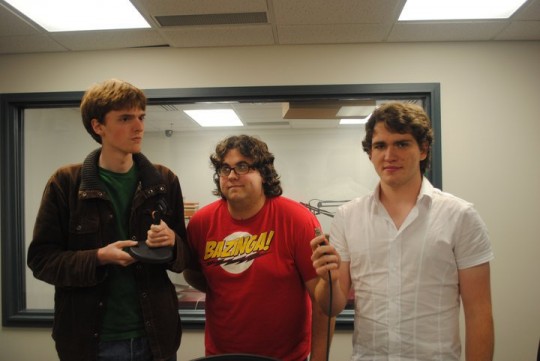
There was a time when entire families would gather around the warm hum of an old refrigerator-sized box in their living rooms and be entertained by radio. That’s right: radio. That thing they still put in cars so the dudes from Nickelback can be kept in hair gel money.
But John Michael Bennett and David Maher, co-creators of the new-ish Sunday night improv radio show on CHMR Who’s Got The Mic? are looking to make radio about more than classic rock and weather and traffic updates once again. And you can get involved.
The Scope caught up with show co-creator John Michael Bennett to get the skinny on their big fat idea.
What is your background? Does some of it include acting or radio?
I started radio in 2005 when my junior high had a DJ room that was called the radio room. From there, I joined Blue Kaffee Web radio in 2008, and then starting volunteering at CHMR in January 2010. I served as Programming Assistant at CHMR from Sept 2010 – May 2011.
My acting experience doesn’t go beyond grade school plays.
When did you first get into improv?
I always appreciated improv, but never performed it myself until this year. Growing up, my father and I watched Whose Line is it Anyway? all the time. For short form improv, it was extremely interesting and it lead to an appreciation for local improv.
When did you come up with the idea for an improv radio show?
On David and my Morning Show on CHMR, I had an NL improv games organizer on for an interview. During the interview, he explained there wasn’t much of an improv scene beyond the high school level. I thought that was really unfortunate, so I brought up an idea to David about Who’s Got The Mic? From there, we developed a show that would incorporate short form games, as well as medium form games (long form games, but not lasting like 30 minutes). The idea was to invite anybody who wanted to try improv or had done improv before on the show. We got in contact with a lot of improv performers in the city, and they were all really interested in the show. To date we have had over 40 different performers on the show.
Can you explain the concept of the show?
The show is an improv show. Each episode features four or five improvisers, and one host. Because we don’t have a live audience, it is the host’s job to come up with games and scenes to give the improvisers. All the scenes and games are not seen by the performers until they are told to act it out. From there, they make up scenes completely off the top of their head. Because the show is on radio, the scenes must rely more on dialog and sound effects, which puts a different spin on it.
Each week, the line-up usually changes. While some people have been on the show multiple times, they are usually on with a different crowd each time to help mix up the group dynamic. As well, more and more people are taking a shot at being the host of the show, so that it’s not always David or I now.
What are some of your favourite games?
We have a couple different games that would be our favourites. The two I’ll talk about is “Again” and “Half-Life.”
Again is a scene in which two performers are given something to act out, maybe something simple like “a walk in the park.” From there, two other performers who are not in the scene are given powers. One is given “genre power” and they may change the genre of the scene at any point, for example “genre change: romance.” The second power given is “again” power which can be used if they don’t like a line somebody said or would like them to say something different in it’s place. For example, someone might say “come with me to the cornfields” and then the person with the power says “again,” so the performer must change the line, maybe to “come with me and we can follow our dreams.”
Half-Life is a game in which performers are given a scene to act out in one minute. Then, they must act out the same scene or a resemblance of that scene in 30 seconds. Then again in 15 seconds, and after that, math goes out the window and they do it in 5 seconds. It is a fun game because you really get to see what the performers consider to be the main part of the story they created by the end of it.
Have you gotten much listener response? How has it been?
The response we have received so far is positive. Most people who have been on the show became interested after listening to the first couple episodes. We’ve had people tell us what we are doing is a great thing, and that we are helping the improv scene grow.
What are some of the challenges associated with doing improv on the radio?
I mentioned before, radio changes the dynamic. Performers must rely on dialog and sound effects on the radio. On stage improv is a completely different game, in which everything from how you raise your eyebrow, to how you walk affects your character. Radio is more limiting in a sense we can’t do that, but it is still very exciting and fun to do.
What have some of the highlights been for you so far?
The highlight has been all of it. Having many improvisors come in and have another venue to express themselves has been great. Everyone who comes in the studio wants to do it again, and we love that.
You try and get new guests on all the time, who are some of your dream guests?
David and I talk about this all the time. The what-ifs are endless. But off the top of my heads, I’d love to see some of Newfoundland’s funniest on the show. Mark Critch, Shaun Majumder, Cathy Jones, Rick Mercer, Trent Mcclellan, etc. It is really hard to list all the people we have “dreamed” about. Oh, and while he isn’t from Newfoundland, we would love to have Colin Mochrie!
Quick! Improv some word association: Radio
Waves
Spaghetti
Western
The Lion, The Witch, and The Wardrobe
Christianity
Snowball
Fights
California
Dreamin’
Stop light
Texting-Time
Thanks John!
Lastly, one big thing I’d like to add is a big thanks to Jeff Smyth. He is our official editor, part-time host, part-time performer, part-time doeseverything and is awesome at it.
Who’s Got The Mic? airs every Sunday night at 8 PM on any of the following:
93.5 CHMR FM in the St. John’s Area
Online at www.chmr.ca
Aliant Digital TV Channel 825
Rogers Digital Cable Channel 942
Find out more about Who’s Got The Mic? and how you can be on it on the show’s Facebook page.
Robberies in the St. John’s area — 2011 so far
Wed, Aug 10, 2011
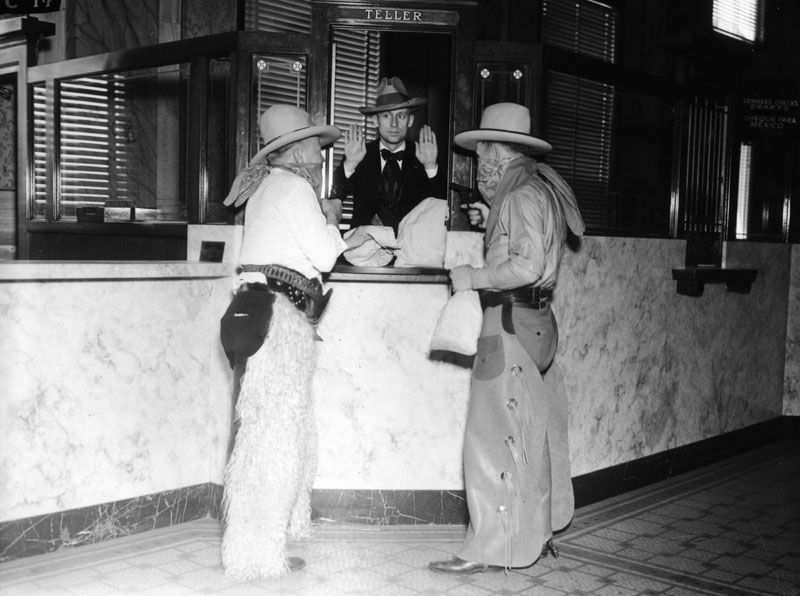
A few weeks back StatCan released the latest numbers that said crime across the country in 2010 was the lowest it has been since 1973. 1973! There were 12 million fewer of us, Trudeaumania hadn’t become completely creepy, and brown plaid slacks were all the rage. 1973! They didn’t even have the internet back then!
But these same peachy stats weren’t so peachy for Newfoundland and Labrador. Apparently here in 2010 the crime rates have soared.
Well, 2010 was last year. What about this year? What’s the crime climate like out there?
The numbers relative to previous decades are still being crunched, but here, to help you not sleep at night, we have compiled a list of all the armed robberies and significant break and enters in the metro area that have been reported by the RNC, or the mainstream media, thus far into 2011. Convenience stores and gas stations (particularly on Elizabeth Avenue)–the longstanding preferred targets of armed bandits–are still among the most frequently robbed. Add to this a couple of Subways, a double-dose of West Side Charlie’s on Torbay Road, and an increasing number of perscription drugs from pharmacies, and you’ve got yourself a crime wave.
This list might seem burglar alarmingly long, but most of these robberies, it comes out in the wash, are somehow drug related–stealing drugs or stealing money to buy drugs–and their victims are mostly businesses and their employees. So if you don’t work at a convenience store or gas station, you probably don’t have too much to worry about.
Some of the highlights include:
- - In something resembling Bonnie & Clyde or the opening scene of Pulp Fiction, a couple entered the the Brookfield Pharmachoice on Topsail Road on January 8. The man doused the two teen-aged clerks in gasoline and made his way to the pharmacy to steal a pile of pills, while his lovely lady held the clerks at knife and crowbar point, and threatened to light them on fire. The couple made off with a few thousand dollars worth of pills and a couple of hundred dollars cash. They were caught a few days later, holed up in the Captain’s Quarters Hotel on King’s Bridge Road, hours after robbing the Subway on Kelsey Drive.
- - There were three robberies in one day on February 6.
- - James Calvin Greenham robbed $110 from a Subway in Paradise with a crowbar. He was later sentenced to 21-months in jail when his “low IQ” defense didn’t pan out.
- - Other stories, as you might imagine, are even sadder. Jamie George Fitzpatrick, who had waited four years to get into a methadone rehab program, missed an appointment, got booted out, and was going through rough withdrawal a few days later when he went into Campbell Avenue Convenience to buy a pop. His debit card didn’t work so he asked the clerk to change a couple of quarters into nickels. When the clerk opened the till he grabbed about $100 and ran out of the store. He was caught not long afterwards and ended up with 29-months in jail.
- - Though, you have got to give it to St. John’s bandits, they are creative in how they arm themselves. In addition to the teens who robbed the Super 8 on Higgins Line with a musket (that later was found to be a fake) and the gasoline bandits from earlier in the year, a man held up Ches’s Fish & Chips on Freshwater Road with syringe on June 12
Here is a list of robberies so far this year (click on the date to go to the news story).
January
1: the Need’s on Topsail Road in Paradise
2: the Esso on Blackmarsh Road
8: the Brookfield Pharmachoice on Topsail Road
12: the Subway on Kelsey Drive
February
6: a house on Cookstown Road
6: Marie’s Mini Mart on Topsail Road
6: the Jackman & Greene on Cookstown Road
8: an unnamed convenience store in the East End
13: Marie’s Mini-Mart on Gleneyre Street
22: the Subway in Paradise
March
8: a jewelry store in the Village Mall
18: a house on Mullock Street
April
13: West Side Charlie’s on Torbay Road
27: a woman was robbed on Waldegrave Street at the Ultramar gas station
29 to May 9 five house B&Es in the St. John’s, Mt. Pearl and CBS
May
12: a bar on Water Street
18: a house on Primrose Place
20-21: four house B&Es in the Bally Haly area
June
2: Campbell Avenue Convenience
4: Craigmillar Avenue Convenience
10: the Ultramar on Elizabeth Avenue
11: a house in the MacDonald Drive–Kenny’s Pond Retirement Home area (Crimestoppers)
12: Ches’s Fish and Chips on Freshwater Road (With a syringe!)
17: the Irving on Elizabeth Avenue
21: West Side Charlies on Torbay Road–again.
27: a house on Larkhall Street (Crimestoppers)
29: a house on Dumbarton Place in Airport Heights
30: the Irving on Elizabeth Avenue–again (Crimestoppers)
July
7: a woman was robbed outside the Scotiabank on Cornwall Avenue after using an ATM
7: several B&Es into boats at the Foxtrap Marina
10: the Ultramar on Elizabeth Avenue–again
16: a convenience store in Torbay
19: a guy robbed another guy with a knife while they were both sitting in a car
20: prescription drugs from a house somewhere in St. John’s
21: a residential break and enter in Seal Cove, CBS
26: Octagon Pharmachoice on Topsail Road in Paradise
27: Queens Road Convenience
August
5: Green’s Drug Mart in Kelligrews
7: the Irving on Frecker Drive
WE’RE DOOOOOOOOOOMED!
Tue, Aug 9, 2011
At the beginning of the summer, a bunch of Canadian newspapers seemed to be forecasting doom and destruction for boats and oil rigs off Newfoundland as a giant ice island drifted down from Greenland. “Pffft,” we thought. “There’s a lot of other stuff waiting to destroy us all.”
Because it’s summer and we know you can handle it, we decided to take a look at some of the terrible, terrible possibilities.

CATASTROPHIC OIL SPILL
Possibility Rating: 2-out-of-5 skulls
Catastrophe Rating: 4-out-of-5 skulls
How Likely Is It?
It’s all in the unknowns.
“The BP spill in the Gulf of Mexico was not the world’s last oil spill,” says Brad DeYoung, MUN professor of Physical Oceanography. “Oil spills will continue. They’re not probable here, but they’re not probable anywhere. And though significant efforts are made to minimize their probability, when spills have occurred, they’ve largely occurred because of things that nobody’s anticipated.”
What’s the Worst-Case Scenario?
A deep water spill will kill lots of birds and fish, but it will also burst up to the surface in a large plume and disperse, allowing oil-eating bacteria to get at it, DeYoung says. It’s the shallow water and close-to-shore accidents that’ll do us in. If the wind is right, a tanker running aground or a leak in the shallow Hibernia field will have oil coating the coastline onshore in no time.
Another concern is ice and horrible conditions at sea, neither of which are rare in Newfoundland. Oil trapped under an iced-over area stays that way until the ice melts and clean-up crews can get to it.
Are We All Going to Die?
Poisoned fish stocks, hundreds of thousands of dead birds, polluted coastlines, belly-flopping tourism, and widespread illness due to exposure to oil and chemical dispersant for all those who come close? Utter and complete mayhem.
Or maybe not. “The bottom line is that oil spills are not the worst possible things that can happen,” says DeYoung. “Oil is actually a natural compound and bacteria are adapted to eat oil. So in the Gulf of Mexico the impact is surprisingly less than most people expected, given the scale of the release.”
What Might it Be Like?
“[The seabirds] die a horrible death,” says Stan Tobin. “The oil mats the feathers and kills their insulation so that they’re not waterproof anymore. They can’t dive for food anymore, so they’re starving to death, and they’re freezing to death.”
“They might ingest the oil,” he adds, “and mercifully, that might kill them quicker.”
Tobin has been tabulating the numbers of dead, oil-drenched sea birds that wash up on the beaches of the southern Avalon for over twenty years. As a consultant for the provincial government, he’s also been shipped all over to witness the immediate aftermath of many of the world’s oil spill disasters, including the Exxon Valdez spill along the coast of Alaska.
“You don’t ever want to see that,” he says. “Ever. In those situations, you see hundreds of volunteers on the beaches with buckets, and you can’t walk. It’s ankle-deep in oil. And then you’ve got the oiled birds to, let’s say, compliment the scene.”
With five oil fields burbling away offshore, three of them tapped and flowing, oil spills make easy candidates for destruction. The largest spill we’ve had so far oozed out of the Terra Nova field after a mechanical failure on the rig in November, 2004. It resulted in a 12 kilometer-wide slick and the loss of about 10,000 seabirds. Rough seas delayed clean-up efforts and, in the end, only a small percentage of the slick was sopped up.
“You just have to stand on Signal Hill on any given day and think about trying to take a little skim of oil from the surface of that water,” says Brad DeYoung. “It’s not going to be very effective.”

MEGA HURRICANE
Possibility Rating: 2-out-of-5 skulls
Catastrophe Rating: 4-out-of-5 skulls
How Likely Is It?
As confirmed by the near-almighty Ryan Snoddon, CBC’s weather expert and hurricane connoisseur, Hurricane Igor was a freak storm. “The Canadian Hurricane Centre was quoted as saying that Igor was a ‘once in a 100 years’ storm,” he says. “Could we get another one? Totally. But the likelihood of that is low. The way everything came together for Igor—it really was the perfect storm.”
That being said, Snoddon says this year’s hurricane season, which typically runs from late August into mid-September, is looking active. We can expect anywhere from 12 to 18 tropical storms and six to ten hurricanes out in the Atlantic this year, Snoddon says. “But that doesn’t mean that they’ll make it onshore.”
What’s the Worst-Case Scenario?
A lot has to come together to make an Igor-grade storm. First, we’ll need a good cluster of thunderstorms blowing in off the coast of West Africa, into the semi-permanent area of high pressure off Bermuda. That will spin them west towards Newfoundland. If the winds in the upper atmosphere aren’t strong enough to knock the tops off the storms and the water temperature stays warm enough, Igor 2.0 could be on its way.
Are We All Going to Die?
As it made its way up the coast, Igor did kill two people in the Caribean and one person in the U.S., via storm swells. Then it arrived on Newfoundland’s shores and took the life of a Random Island man. Fatalities aside, Igor washed out houses and roads, leaving almost 150 communities stranded. The total tally for the damage is estimated to be at $200 million.
Way back in 1775, there was the so-called Independence Hurricane, is believed to have killed 4,000 people, most of whom were British and Irish fishermen at sea.
What Might it Be Like?
“I was upstairs, looking at my wood pile, and it started to lift up and float up the path! I was living with my dad, who was 88,” says Loretta Weeks, in Duntara. “I told him we had to get out, but he wouldn’t leave ‘til he had a cup of tea. So I ran around and put our wallets and his medication together, and we left.”
Her road had already washed out by then, so they went up the back, to the main road. “A friend of mine next door had a stable, and the wind took out one of these walls, in one piece. It started coming down through the air, right at us,” she says. “You never seen anything like it in your life.”
“We had to go up over a hill and across two big gardens against the wind,” she said. “The rain was like someone driving sharp needles into you.”
The main road washed out and Duntara was cut off from the rest of the island, and had to rely on rations delivered by boat and helicopter. Weeks’ house was entirely flooded and her shed was picked up and spun around by the floodwaters.
“I was out of my house for two months,” she says. “I felt really isolated. It sure made me think hard about living in rural Newfoundland.”
She’s moving from Duntara in September.

DRAMATIC EROSION
Possibility Rating: 5-out-of-5 skulls
Catastrophe Rating: 2-out-of-5 skulls
How Likely Is It?
Remember those videos on the news showing houses in Daniel’s Harbour sliding into the ocean? That’s the work of the ongoing, unstoppable force of coastal erosion, happening right now at your nearest low-sloping, sandy coastline.
According to Norm Catto, a MUN Geographer who’s helping the provincial government identify communities that need shoring up, climate change is causing the erosion process to speed up. With less ice cover in the winter, the waves pound the shore all year round, and rising sea levels expose more land to those waves and more intense storms mean that the waves are even worse than before.
What’s the Worst-Case Scenario?
The biggest concern, says Catto, is fast, dramatic erosion that could occur during a violent storm, like a hurricane. As the coast crumbles, the waves will push further inland and could cause flooding and take out houses, roads, and whatever else lies in their way.
Are We All Going to Die?
If the storm-based worst-case scenario happens then, yes, things could get ugly. But chances are, in a storm that big, things are already pretty ugly.
A less obvious reason but still terrifying threat comes in the form of contaminated drinking water. Sea water can seep up disintegrating shores and render groundwater sources irreversibly poisoned.
What Might it Be Like?
“The waves came right in over the houses, hitting from both sides,” says Leo Moriarty, Mayor of Ferryland, of a storm that washed out the road to the Ferryland lighthouse and Colony of Avalon archaeological site in December of 2009. “It was a spectacular thing to see. You just can’t go out there in the height of the storm like that, it’s impossible. Anyone who’s out there is out there, and anyone who’s not is not.”
That road is a hotspot for erosion. As its flanking land slides into the water, storm swells crash up through the breakwaters and wash the road away. The continued repair costs are hefty: Moriarty says that they’re about to spend $900,000 to reinforce it; ten percent of which has to come from the Town of Ferryland. This comes after a $20,000 rock barrier didn’t work.
“This is getting to the limit of the town’s resources now,” says Moriarty. “The provincial and federal governments will have to decide whether the site is an important enough part of the heritage [for the road] to be saved.”
This January, the town of Beaches was evacuated after a storm caused massive flooding. Ice coverage along their shores has been declining, thus allowing for more erosion and heavier consequences when storms hit. As reported in the Western Star on January 12, 2011, some residents believe that the community’s only option is resettlement.

ICEQUAKE TSUNAMI
Possibility Rating: 1-out-of-5 skulls
Catastrophe Rating: 5-out-of-5 skulls
How Likely Is It?
Well, NASA thinks we could be in trouble.
Tony Song of NASA’s Jet Propulsion Labratory, is quoted in a 2009 Rueters article, as saying that Newfoundland is a “low-probability, high-risk” zone for tsunamis caused by something called “icequakes.”
Pierre Rouleau, an earthquake specialist at Grenfell, agrees with him. “When these chunks of ice detach themselves from the glacier, there’s a connection with the bed of the iceberg and the actual solid portion of the earth, so there’s a kind of scraping that causes the earthquake or icequake.”
Definitely low-probability, says Rouleau—“to get a humongous sea wave you need a huge chunk of ice to come off, and we don’t expect that at all,” he says—but definitely high-risk. “Anything is possible,” he says. “It’s a hypothesis, but it’s a workable hypothesis. It’s worth looking into that we could have tsunami here.”
What’s the Worst-Case Scenario?
“You would have to have an enormous chunk of ice falling off of Greenland,” says Rouleau. “If you matched that with a seven magnitude earthquake right next to the coast, you could imagine one of these big splashes here.”
The 1929 tsunami that took out villages from Point May to Port au Bras, along the Burin Penninsula, caused damage all the way into Nova Scotia. If conditions were right, a tsunami from Greenland could definitely level the east coast of Labrador and Newfoundland. It might even make it up Prescott Street in one sploosh.
Are We All Going to Die?
The death toll for the Burin Tsunami was 28. “That was mostly women and children,” says Maura Hanrahan, author of Tsunami: The Newfoundland Tidal Wave Disaster. “The men were in the woods because it was November, or at sea. A lot of them returned to find their entire families killed.”
On the other side of the world, over 20,000 people died in the earthquake and tsunami that hit Japan this March.
What Might it Be Like?
“My uncle Vince, he was eight at the time,” says Maura Hanrahan. “Before the wave hit, the harbour drained completely—all the water got sucked out. He remembers scrambling with his uncles to get the boats and the dories on land, because they were sitting on the bottom of the harbour.”
“I remember my grandmother, Angela Hanrahan,” she continues, “she always talked about holding the baby, my father, and the floor of the house starting to shake. She’s quite British, a stiff upper lip type of person, and she said, ‘Oh, there’ll be weather tonight’.”

GREAT FIRE
Possibility Rating: 2-out-of-5 skulls
Catastrophe Rating: 5-out-of-5 skulls
How Likely Is It?
Ever live in Rabbittown? Where backyard fireworks in the middle of a dense cluster of rickety, century-old houses are de rigueur on any night that’s not freezing? If so, you’ve probably given the threat of fire some thought.
But Mike Dwyer, Director of Regional Fire Services for the City of St. John’s, isn’t worried about another great fire. Though there seems to be a devastating fire once every fifty years at the top of Long’s Hill —The Great Fire of 1892, the Knights of Columbus Hostel fire in 1942, and the Harvey Road fire in 1992—Dwyer’s not too worried about 2042, or any other year for that matter.
“Every city has had their great fires and every city has its area of high risk,” he says. “The downtown area is obviously one of our higher risk areas, but a lot of the buildings, even the older buildings, are sprinklered. Our technology and equipment is state of the art, and a lot of pre-planning goes into areas of high risk. For example, we have a plan in place for George Street.”
What’s the Worst-Case Scenario?
It’s a dry, windy evening in 2042, in the middle of a drought and a city-wide water shortage. Rabbittown is ablaze with drunken backyard fireworks, everyone living in a heritage home has just knocked over a lit candle, every deep fryer in the city is spattering, and kids are setting dumpster fires from Shea Heights to the Avalon Mall. And the dumpsters were full of gasoline. Gasoline and paint thinner.
If the resulting fires were powerful enough to overwhelm the city’s firefighting resources—“We operate from seven stations, running with 40 firefighters on at any given time, and for every 40 people that we’ve got on staff, we’ve got another 120 that aren’t working,” says Dwyer—then maybe, just maybe, the entire city would be engulfed in flames.
Are We All Going to Die?
The Great Fire killed just three people, but the thousands left homeless had to camp in Bannerman Park for months. The big institutional fires, like the Knights of Columbus Hostel fire, killed everyone inside the buildings. “We now have plans in place for all the big institutions,” says Mike Dwyer. “Communications plans, escape, point of entry—we lay it all out.”
But sometimes the only way to stop a huge fire is to demolish everything in its path. “If it wasn’t for Dominion being made of brick and not wood, we would have lost our entire block,” says Dave d’Entremont, owner of Long’s Hill Convenience, at the top of Long’s Hill. He was the person who phoned the fire department when the 1992 Harvey Road fire started in the CLB Armoury. “If my block had caught fire, they were going to let everything go down Long’s Hill and they were going to make a stand down at the bottom, just bulldoze everything to the ground to make a fire stand, to stop the fires.”
What Might it Be Like?
“I can still see the firemen coming out of the main door of the CLB armoury,” says d’Entremont. “They walked in and ran out, because the thing imploded inside and a great big rush of flames came out after them.”
Jon Weir was living in an apartment on Tessiers Place the night of the Harvey Road Fire. “We were hunkered down in our apartment for the night, wondering if we were supposed to take all of our stuff and leave,” he says. “We kept expecting the fire department to bang on the door and say, ‘Get out! Everything’s going to catch fire!’ Little bits of buildings that were burning were filtering down and floating through the air, still glowing and burning, landing on rooftops.”
Later, after it seemed to be under control, Weir says he walked up to see what was happening. “It was really hot,” he says, “Even from a good ways away, it was palpable.”
“That fire changed this neighbourhood forever,” says D’Entremont. “Everything was lost; a lot of people’s dreams and aspirations just burned away.”

ICEBERG COLLISION
Possibility Rating: 1-out-of-5 skulls
Catastrophe Rating: 3-out-of-5 skulls
How Likely Is It?
It was looking likely for a while. At least, it was if you were reading the National Post in late June. “Bermudas-sized ‘ice island’ could threaten ships, oil rigs off coast of Newfoundland,” claimed the headline. Auuuugh!
Not likely, says Jim Bruce, the very scientific-sounding Director of Ice Engineering at C-Core, where they study the probability of things like that coming true.
C-Core sent two people out to plunk beacons into the ice island, which began as a 250 square kilometer slab that cracked off Greenland’s Petermann Glacier last August. It’s been slowly breaking into manageable bits—the biggest one as of our mid-July conversation with Bruce was 58 square kilometers and called, affectionately, PII-A—and Bruce expects that it will continue to crumble and melt as it makes its way to the Grand Banks this summer.
What’s the Worst-Case Scenario?
Troublesome icebergs are actually towed, says Bruce. A nightmare berg would have to be too big to tow, and it would have to be heading towards a Gravity-Based Structure, which can’t detach and move out of the way.
So, in this case, they’d blow it up… Right?
“To make any sort of hypothetical situation of a large piece of ice from up north interacting with something further south is not something that would be appropriate to comment on,” says Bruce.
According to an old National Geographic video, Marine Machines, towing vessels have uses water cannons to bust up bergs.
Are We All Going to Die?
Icebergs move pretty slowly—PII-A is travelling at 0.6 kilometers an hour—so the people on the oil rigs could be evacuated, but the ensuing oil spill wouldn’t bode well for our futures.
What Might it Be Like?
See Catastrophic Oil Spill.
Illustrations by Elling Lien.
Out of the Woods
Mon, Aug 1, 2011
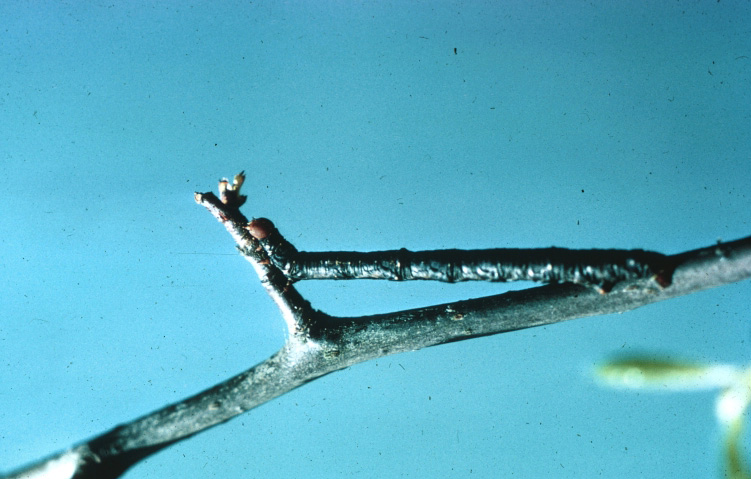
Photo from North Carolina Forest Service Archive, Bugwood.org
Unpack your suitcase. Cancel the movers. Spanworms—those disgusting black caterpillars that have plagued St. John’s lush maple trees and the people walking under them each of the past few summers—may finally be on their way out of town according to Entomologist, Dr. Peggy Dixon, a span worm expert at the Federal Government’s Cool Climate Crop Research Centre on Brookfield Road.
It was a perfect storm of spanworm-friendly conditions, according to Dixon, that allowed for the initial outbreak about ten years ago: the right climate, a lack of predators, and the maturation of their favourite food—the maple tree. Now their normal life span (8-10 years) has run its course, our miserable cold and wet June-uary may have killed off a lot of remaining young caterpillars, and the ongoing spraying of Btk—a bacteria-based pesticide—has left the spanworm population dwindling.
There may still be some spots around town with a few hangers on–like those Japanese submariners who didn’t know the War was over–but it will be nothing like the height of the outbreak from 2003-2009.
Are we out of the woods for good?
Not for good, says Dixon, but at least for a while. “The spanworm native to eastern North America, not introduced, and there have been outbreaks in New England since the 1800s,” she says. “They occur every 40 years or so.”
So it is safe to go outside for now, but will it be for our children’s children? We’ll have to wait a while and see.
Your Moose Update
Sun, Jul 31, 2011

An unnamed moose works on eating Gros Morne bare.
The population that began with four spindly New Brunswick moose introduced to Newfoundland in 1904 has grown out of control, according to many. Without predators or common moose diseases, moose outnumber townies on the island (numbers range from 100,000 to 200,000 moose, depending upon who you ask).
In the past few months alone they’ve been sued, hunted, fenced, tracked, and tweeted.
Here’s a refresher.
January: With over 700 moose-car collisions each year, many resulting in serious injuries, a class action lawsuit is launched against the provincial government for their alleged 107-year mismanagement of the moose population.
April: Parks Canada, fed up with moose overeating in Gros Morne and Terra Nova, announced that 80 per cent of the moose in the parks will be culled. A day later the provincial government announced they would be increasing the provincial moose hunt quota by over 5,000.
May: CBC launched an interactive moose sighting website. A few days later Conservative Senator Fabian Manning hit a moose near St. Brides and spent several days in hospital. Later in the month Newfoundland ex-pat James Oakley appeared on Dragon’s Den pitching his in-car “Moosedar” device.
June: Danny Williams delivers St. John’s an AHL hockey team, which happens to be already named the Moose. He has vowed to change their name.
After a rough first six-months of 2011 for moose, things don’t appear to be getting any easier.
July: On July 6 the provincial government announced a pilot project that will spend $5 million exploring ways to keep moose off roads, or at least off cars, using things like fences (a paltry 15km), high-tech sensing equipment, roadside brush clearing, and collecting more moose-car collision data.
The next day the Save Our People Action Committee—a two-year old moose collision prevention activist group—responded to the government’s announcement by demanding the immediate cull of 50,000 moose, and accused cull-shy bureaucrats of being no better than seal hunt protesters.
Then on July 12, Moose Watch, an Android and iPhone app that maps the locations of moose related Tweets is launched by local software developers. War on moose? There’s an app for that.
It should be clear to moose by now that we are coming after them with everything we’ve got, but the daft things are probably too busy playing chicken with motorists and eating rare foliage to notice.
Walking in Paradise
Wed, Jul 27, 2011
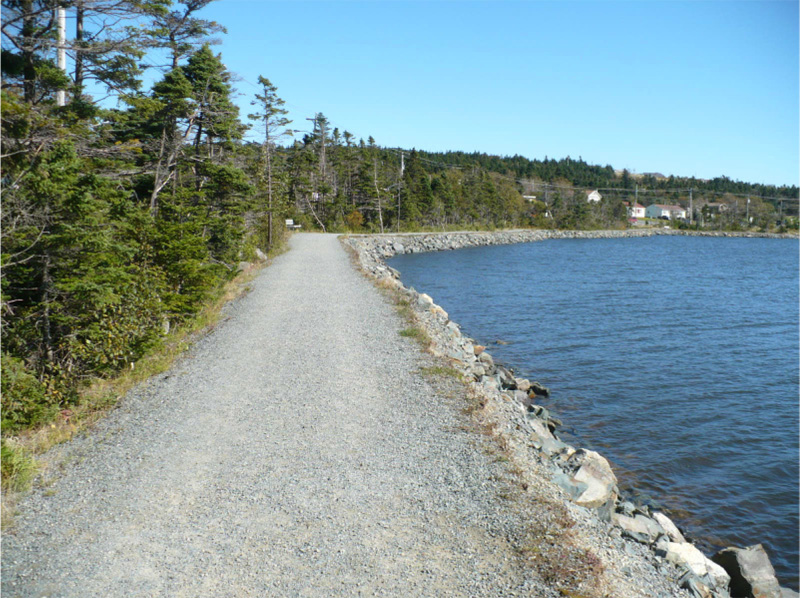
When walking in Paradise in the near future, be on the look out for new crosswalks or pedestrian underpasses on busy streets, and new walking and bike paths around the town—including a network of trails in a proposed 256-acre park around Octagon and Rocky Ponds and in the new Fairview Development near the park that Mayor Ralph Wiseman calls a “walking village.”
The Town recently released the Paradise Active Transportion Plan in conjunction with its Transportation Study, both prepared by the same engineering firm that concocted St. John’s Cycling Plan, Hatch Mott McDonald.
The plan recommends nearly $2.8 million worth of new paths, crosswalks, and underpasses on current or upcoming development projects, as well as recommendations to promote walking and biking, things the town can do to improve path maintenance, and ways to ensure active transportation is accounted for in future developments as the town continues to grow.
Plans to include walking and biking paths in development is a very good thing, but Wiseman points out that the commissioning of this report does not mean that Paradise is pushing to get people out of their cars anytime soon. Rather, the report will serve as a guide as the town grows, says Wiseman. “It’s what we do for the next five, 10, 20 years.”
While the town, according to Wiseman, agrees with the rest of Hatch Mott McDonald’s advice to promote active transportation with special campaigns and initiatives such as Bike to Work Week and walk to school programs, there is nothing concrete in the works at the moment.


Fri, Oct 14, 2011
Morgan Murray