

Archive | Features RSS feed for this section
$20 Summer Adventures
We gave four adventurous people 20 bucks and a disposable camera and told them to go do something interesting. Click below to read about what happened.
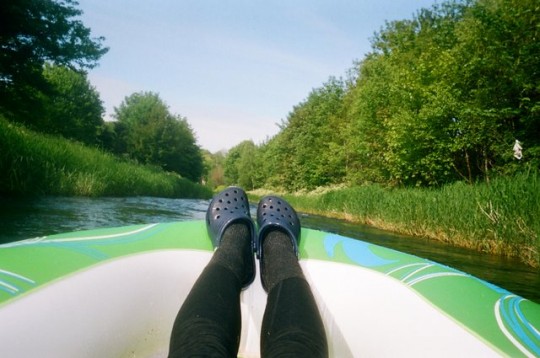
Emily Deming: Boating and fish fry
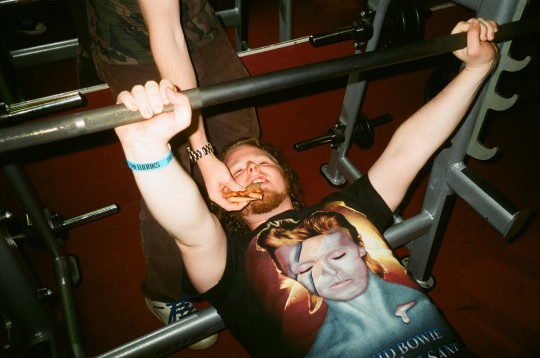
Jordan Brace: Extreme pizza eating
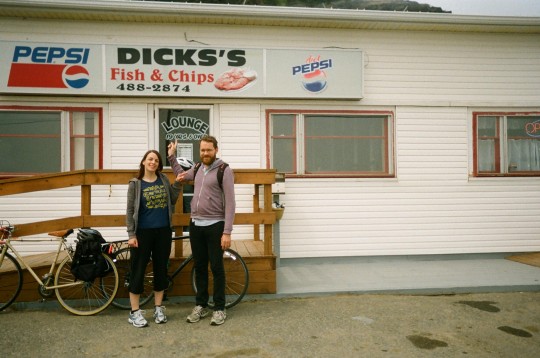
Dave Lander: Bike trip to Bell Island
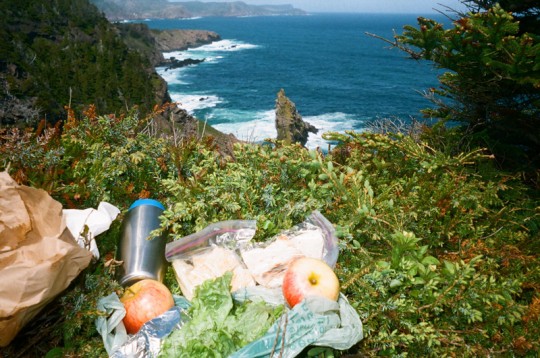
Bryhanna Greenough: Solo hike from Cape Spear to St. John’s
Four seasons on a spring afternoon
Wed, Apr 20, 2011
Last Friday afternoon, I took to the streets to see what the St. John’s core were up to on the bright April afternoon. Strolling downtown, coatless coffee drinkers and dog walkers passed local musicians, artists and jugglers practicing in the sun. Before long, it got dark, began raining, then snowing. Four seasons in one day!
Music by Johnny Hawaii – “The Lonely Smurfer”
Wha? of the Week: Sex & Relationships
Mon, Apr 18, 2011
Illustration by Inha Leex Hale
From April 18 to April 25 at www.thescope.ca/wha you can ask our guest experts any questions you have about sex and relationships. On deck this time is Memorial Human Sexuality professor Dr. Elena Hanna, former Biology of Sex teacher Emily Martin, and former sex columnist Nathan Downey.
Click here to submit a question.
Click here to read the submitted questions and answers.
Wha? of the Week: Gardening
Tue, Apr 5, 2011

This week at www.thescope.ca/wha you can ask organic farmer (and Scope mom!) Judy Lien any questions you have about what to plant when, companion planting, and tricks for growing vegetables without pesticides or herbicides.
Click here to submit a question.
Click here to read the submitted questions and answers.
Winter’s last gasp
Mon, Mar 14, 2011

Sure, you can huddle under a blanket in your apartment all you want but there’s still another month of real winter left to go. At this point, you might hardly be able to bring yourself to shovel the front walk, let alone jump into a pair of skis. But face it, although the worst of winter is over, it’s bound to snow some more, it’s probably going to stay cold, and pining for spring isn’t going to squeeze the tulips out of the ground any earlier. So if you haven’t already, you might as well embrace it. You may even find that once you set foot outside, winter in the city isn’t as bad as it seems.
By Bryhanna Greenough. Icons by Hemmo de Jonge.
Go on a winter storm walk
A blizzard outside? Don’t wait until the snow has stopped, go out in the worst of it. With few cars on the streets and the paths all blanketed in snow you may feel like the last person on Earth. You don’t have to be an outdoor ninja to do this. It’s not about breaking trail for three hours straight in an attempt to make up for all those nights spent on the couch with a bowl of chips. Go for a wander and test out your gear. Bundle up so warmly you could imagine surviving three days in the cold. Bring a video camera to film the snowmen you meet, headphones, lip balm and maybe some Fireball. Keep it fun.
Take a winter storm joy ride
This is pretty much a variation on the storm walk. Head to Cape Spear during a blizzard to experience an incredible amount of wild energy in the form of smashing waves and snow flying every direction. Bring some take out pizza to eat in the back seat, your arsenal of winter gear, plus flashlights and headlamps. If you’re the only car in the parking lot it can take on the creepiness of a vampire hunting ground. Your adrenalin may begin to surge just from the thrill of being there. Recommend all wheel-drive, winter tires, and go very slowly when the road conditions are bad.
Go downhill skiing or snowboarding at Clarenville
Throwing yourself down the side of a mountain and managing to make it down alive is an accomplishment best rewarded by going back up the chairlift with friends and doing it all over again. If you’re smart about it, it’s probably not as expensive as you think. Carpool with friends, split hotel rooms, and ask around for ski-and-stay deals. Bring cash to the hill to get into the fast line for rentals and lift tickets. White Hills resort is near Clarenville, and is about a two hour drive from town. There’s a single slow moving chairlift which services about 20 runs, and a Magic Carpet escalator for the bunny hill. After a day on the hill, Tai-Hong Restaurant offers a great Chinese buffet.

Build a booze fort
Back in 2007 The Scope did a feature on a fellow named Marty B and his famous creation, affectionately known as the Booze Fort. It consisted of a chamber dug out from a huge pile of snow measuring about 25 feet wide by 15 feet high, boasting an interior so spacious it could comfortably fit eight people on chairs. Built-in drink and candle holders made it Marty B’s “snowy island getaway,” perfect for partying through the storm. This year we’ve heard rumours of a completely independent “Fort Hammered” which was decorated with spray paint and became a successful address for pizza delivery. Maybe someone could dig out the snow pile in the Avalon Mall parking lot for a snow hotel. Let’s make it happen.
Go cross-country skiing
Whether the snow is gently falling, or the sun is shining high in the bluebird sky, gliding over winter’s white carpet on skis is possibly one of the most affirmative things you can do to get yourself through the season. Butter Pot and Pippy Park both have free groomed trails suitable for classic cross country skiing and skate skiing, plus several kilometers of wild trails. Head out for an hour after a lazy weekend brunch, or go for the day. Rentals are available. The Avalon Nordic Ski Club organizes guided tours into areas such as Bauline, Torbay, Pouch Cove, Avalon Wilderness Area on a regular basis.
Have a night adventure at Pippy Park
The lights are on all night, every night at Pippy Park, illuminating three kilometers of groomed snow suitable for cross-country skiing, skate skiing and snowshoeing. Although it may be covered in snow, there’s a picnic table area as well. Equipment rentals are only available on Fridays from 6pm-10pm, though, but think about the possibilities.
Go on a morning winter walk
Of course, there doesn’t have to be a storm to enjoy a walk. And it’s a totally different experience to roam around for fun in the morning instead of doing errands or commuting. Take in the hustle and bustle and not be a part of it. Set your alarm an hour early and meet a friend on the harbourfront or in a park for a walk. Get in a visit and some fresh air. Bring your travel mugs and grab a coffee to go. It doesn’t have to be long excursion, just enough to get the blood pumping. My friend and I have been doing this about once a week, and we try to climb a few hills.
Go snowshoeing
If you can walk, you can snowshoe. Although it lacks the grace of skis, you can access a greater variety of terrain, whether it be up the side of a mountain, or through a stumbly forest trail. A hike up Butter Pot Mountain is recommended. If using groomed trails be sure to stay to the side and not on the ski tracks.
The East Coast Trail is lovely, but also very exposed and windy in many parts. Stiles Cove the new trail which opened in 2009 linking Pouch Cove and Flatrock has been recommended as a good place to go. The Outfitters offers group expeditions to The Spout, which transforms into an ice cone in winter. The seven hour expedition is dependent on weather and conditions and costs $80 per person. Three hour guided twilight expeditions complete with hot chocolate are also available. I sometimes get sore from the wide stance forced by snowshoes but have been told using poles can help.
Go snow kiting
Snow kiting involves jumping into a pair of skis or snowboard and holding onto a kite string and letting the wind propel you over a snowy field or frozen pond. And it sounds awesome. These special kites can also be used in summer months with kayaks, rollerblades, or surfboard but the best time to learn the basics is in the winter. Every Monday, Tuesday and Wednesday night learn to snow kite at the Pippy Park golf course with My Newfoundland Adventures company. Group lessons including kite rental are available for $89. Bring your snowboard or downhill skis, or rent them for a bit extra.
Have an outdoor picnic
Bring a rug or wool blanket, and some tea lights set in jars. Combine with some activity like back country sledding so the blood flows warm and you work up an appetite. From your backpack unload a thermos of steaming hot chowder and crusty bread. A roast potato, or apple dumpling wrapped in foil then newspaper will stay warm for hours and can be eaten without even taking off your mitts. A paired down version might just be a themos of hot cider or gourmet coffee. Head somewhere with a view, whether it be a local park or pond.
Go camping
Sleeping overnight in a tent in the winter may not be for everyone, but its worth experiencing at least once in a lifetime, maybe even just to see the stars, which shine brighter in winter. By March the days are longer and weather less extreme so this is a good time to go.
Butter Pot Park is open for winter camping and provides firewood and outhouses. You will need some gear for this. A four season tent is best, but a good quality three season tent will do provided its strong enough to withstand the weight of falling snow. Bring multiple ground tarps, a substantial mattress to insulate your body from the cold below, warm sleeping bags and a broom to dust snow off before entering the tent. One of my favourite tricks learned while treeplanting is to stuff hot campfire rocks inside wool socks and bury them in the bottom of my sleeping bag. But as we all know nothing beats the body heat generated from zipping two bags together.
Beat up a snowman
Maybe all this activity has worn you down. Maybe you need to let out some pent-up aggression that comes from not being able to walk on the sidewalk without pulling a Brian Boitano. Let Mother Nature know you’ve had it up to here with her abuse and drop-kick every snowman, snow buddha or snow venus you encounter. Or you can pee on a snow angel or two.
Freeze some snowballs for summer
Finally, there’s nothing quite like stocking your freezer with snowballs for July. Put them in plastic baggies in case your freezer loses power, and you can sleep easy knowing you already have something special planned to do in July.
Any other suggestions or tips on staying active in March? Add yours below.
______________________________
GEAR
A day spent outside when you’re dressed properly will change your perception of winter completely. So it’s better to overdress than underdress. Here’s some stuff we recommend:
Waterproof pants
They’ll also be windproof and come in handy year-round given St. John’s wet and whirly climate. They’re less cumbersome and visually don’t stand out as much as padded snow pants.
Ski goggles
Imagine no wind, no cold, and the sensation of a television screen shielding eyes and face from the elements, with a supernatural tint. (Mine are pink.) You don’t have to be a skier to justify getting a pair and they’ll increase your ability to endure a hostile (or even mildly hostile) environment. Combined with a hat and scarf, your entire face will be protected from seething cold or stinging ice pellets!
Layers, layers, layers
They’ll extend your time outside on a cold, damp day. Avoid cotton socks, they’ll make your feet cold when you sweat.
RENTALS
Butter Pot Provincial Park
(Daily Rates for Non-Members)
Cross Country Skis $30
Skate Skis $30
The Outfitters 579-4453
(Daily Rates)
Cross Country Skis $25
Skate Skis $25
Snowshoes $15
Pippy Park 737-3651
(Hourly & Daily Rates)
Cross Country Skis $4/$12
Snowshoes $4/$12
Useful links and numbers
• Avalon Nordic Ski Club (Based out of Butter Pot): www.avalonnordic.ca
• Avalon Nordic Ski Tours: 722-2394
• Butter Pot Provincial Park: Winter camping hotline 1-709-685-1853
• My Newfoundland Adventures (Snow Kiting) 763-7433. www.snowkite.ca
LATER
Saunas, hot tubs, and steam rooms open to the public. Fees apply.
HGR Mews Centre
576-8499
Pool, steam room and sauna.
Sheraton Hotel Newfoundland
726-4980
Pool, hot-tub and sauna. $7.
The Aquarena
864-3798
Pool, waterslide, hot tub and saunas.
Delta Hotel
570-1614
Pool, hot-tub and sauna.
Spa at the Monastary
754-5800
Hot, warm mineral and cold plunge tubs, and sauna. $50.
Wedgewood Park Community Centre
576-8631
Pool
Waiting for Geoff
Fri, Feb 4, 2011
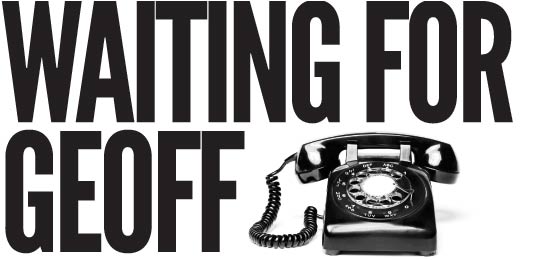
Geoff Stirling and the whole, entire universe.
By Sarah Smellie
My first encounter with the Stirling empire occurred in the Yukon, before I had set foot in Newfoundland. I was a bartender at a hotel in Dawson City. Some nights, after closing, I’d be given a room upstairs to guarantee my 9am arrival to open up the next morning. On those nights, I’d stay up watching this Newfoundland station, NTV, and marvel at this large-helmeted Captain Canada chap as he brought peace, serenity, and Seinfeld to the planet at large.
Years later, having actually moved here, I’d find myself staring at my television at 4am, utterly speechless, as lines about the way of the divine scrolled down the screen, guided by the wail of apocalyptic opera.
“Oh my God,” I thought. “It’s all true.”

You don’t live here long before you start hearing stories about Geoff Stirling, creator of Captain Canada and the Atlantis saga, and chairman of Stirling Communications International, the parent company that owns NTV, The Newfoundland Herald, Stirling Press and OZ-FM.
According to legend, he used to interrupt late-night NTV programing with live feed of lengthy interviews and monologues about politics and crop circles; his house has a secret wood-paneled room with cameras waiting for his next transmission; he’d interview prospective employees while throwing knives at the door; and he once called NTV and made them interrupt the newscast with an episode of Inspector Gadget.
Google him and you’ll find a Facebook group and a BlueKaffee forum dedicated to the NTV overnight videos. There are a few short bios from Wikipedia and the Canadian Association of Broadcasters Hall of Fame, into which he was inducted in 2001, and a 2004 piece from Report on Business that claims he was inspired to get into media when he came across the Miami Herald while hunting alligators in Honduras. You can see him doing headstands and talking about socialism with Joey Smallwood in the 1974 NFB documentary, Waiting for Fidel. And for a good round-up of his Eastern mysticism-inspired philosophy, you can check out the Captain Atlantis series, and read his treatise called In Search of a New Age, on the Captain Atlantis website.
Back in October, The Scope submitted a request for an interview with Stirling.
Then one mid-January afternoon, out of the blue, he finally phones.
“What’s on your mind, honey?” he begins.
He talks to me for about an hour, covering provincial and municipal politics, sound vibrations, energy, ABBA, the old streetcars in St. John’s, and the possibility of a casino on Bell Island. Segues from one subject to the next are loose — he stops me mid-sentence, for example, to ask if I’d ever been to Egypt. “I ask,” he says, “because sometimes in the middle of a great conversation, the person will suddenly say ‘and then, when I was meditating at the pyramids of Egypt…’ and I tend to think differently about them after.”
But no matter the subject, he’s fiercely intimidating. He has the laugh of a Very Powerful Person: a deep “huh huh huh,” each “huh” ragged at the edges and clear in the middle, ringing in a voice he doesn’t use when speaking. It’s startling, youthful, and hard to gauge; he might be laughing at what was said, or he might be laughing at the essence of being Geoff Stirling and the public persona that entails.
Freaking out appreciably, I chit-chat about provincial politics.
“Now that we’ve got three women running the parties,” he says, “we have the chance to provide exposure to in-depth discussion. We could have tremendous frankness. If they’re willing to have late-night discussions, that is.”
He laughs.
What he means by “late-night discussion” is best seen on NTV some nights, during the overnight hours.
They’re credited as the first television station in the country with 24-hour broadcasting, which started in 1972. While every other station in the country would simply go off-air, NTV blazed all night, showing syndicated programming, movies, continuous live feed of a fish tank, Scenes of Newfoundland, and the Stirling tapes: hours-long interviews with Joey Smallwood; conversations with conspiracy theorist David Icke spliced with images of horrible grey aliens; the “Computer Animation Festival,” featuring Atlantis characters and pulsating animation sequences from the Lawnmower Man; repeated showings of Pink Floyd’s The Wall; images of crop circles, UFOs and the Egyptian Pyramids layered on top of one another and/or images of Barack Obama; and the laws of God — “The Law of Energy – All is Energy” — scrolling over random stills.
“In order to go for 24 hours, you had to have all that additional programming,” he says. “Ted Turner bought up all the basketball to use, but we just made our own content. We used uninterrupted interviews; we used Smallwood and whoever else could tolerate six or seven hours straight. We would ask Smallwood, ‘Why can’t every Newfoundlander be given ten acres of farm land?’ and we’d take the tape and we’d have him explaining all through the night why we couldn’t have it!”
“We didn’t have commercials during the night, so we didn’t interrupt the intellectual discussion. It opened up a whole new world of transparency.”
I ask him about the videos like the Computer Animation Festival and The Laws of God.
“This all started because we were now into the crop circles,” he says. “So by trying to make all the words and everything we do late at night authentic, we would take some of the new crop circles coming in and we would use special effects — well we’re just learning how to use special effects. I sent over a group, I wanted to prove that they were there. We’re not taking anybody’s word for anything. So you get a helicopter and the pilot confirms that one morning it wasn’t there and the next it was, and you show the footage.”
“The complexity of the imagery is so beyond anything we had five years ago,” he says. “So, if it is a fake, it’s still a fantastic mandala.”
“We’re trying to raise the consciousness,” he continues. “It’s simply automatic if you’ve gone and researched the information you’re trying to make available.”
In order to maintain freedom over NTV’s overnight programming and keep broadcasting his message, he says that NTV will always remain an independent station.
“You can’t interfere with a commercial company,” he says. “It has to be an independent network. We couldn’t interrupt some big company to broadcast these discussions; we had to do it on our own.”
“You’ve got to be leading if you’re in this game, honey,” Stirling says to me. “And the game is communication. But you’ve got to give something more than just apple pie. You’ve got to give something that inspires the imagination, say ‘here’s what it was like to meditate in the pyramids.’ ”
His mission to widen the public consciousness has been a constant, in one guise or another.
In 1948, two years after Stirling began publishing the St. John’s Sunday Herald, now the Newfoundland Herald, he had a different message to broadcast. A founder of the anti-confederation Economic Union Party, which espoused the establishment of free trade agreements with America, he’d head to Washington to get statements from Senators about what they could do for Newfoundland. Many of them wound up transcribed in the Herald.
“There was a recording of one Senator, Senator Brookes, that was played on the radio stations here,” chuckles Philip Hiscock, a MUN folklorist, Newfoundland broadcasting aficionado, and Stirling mythology enthusiast. “But, of course, I’ve been told that it’s not Brookes on that recording, that it’s actually an actor that Stirling hired to read Brooke’s statement.”
In July of 1963, Stirling founded the Montreal-based radio station CKGM-FM, later known as CHOM-FM.
“When I got radio [in Newfoundland], there was no English FM in Quebec,” he tells me. “There was no FM in the cars, and because cars were the radio market then, FM wasn’t commercially viable. So I went on the air and gave myself the only English FM voice in Quebec.”
According to Mike Boone, a journalist for the Montreal Gazette who has written extensively about the early days of CHOM, anyone tuning into the station had an equal chance of hearing a live chanting session with Stirling’s guru, Swami Shyam, as they did a three-day-long Beatles marathon.
In 1969, Stirling, while vacationing in London, sent a telegram to John Lennon saying “I’ve heard your Come Together. So here I am. Geoff Stirling.” Lennon and Yoko Oko met up with Stirling and recorded an interview and a few station IDs that were later broadcast on CKGM, what they called “The Peace Station” in Montreal.
“He had a huge impact on radio in Montreal,” says Boone. “Geoff was really experimental with that station, he really pushed it, and he had the first station to really play good music. It was the first popular FM station in Montreal.”
“And didn’t he used to inject liquid gold into his veins?” he asks.
Stirling later sold that radio station to CHUM in 1985.
In the early 1980s, Captain Newfoundland arrived in the Sunday Herald. Shortly thereafter, the Atlantis graphic novel series emerged, in which Captain Newfoundland/Atlantis tutors Captain Canada, Yoda-style, to seek his superhero-hood within himself. Crystals, meditation, astral travel and UFOs are all paramount to his enlightenment.
By all accounts, Stirling has always been eccentric.
Ken Meeker was an editor at The Herald in the 1960s. Stirling, he says, was generous, gregarious and intelligent. “He was a great broadcaster,” he says.
“The videos, the politics, it’s all part of who he is. And I don’t think any one person has the full story of who he is.”
The Honourable Edward Roberts was executive assistant to Premier Joey Smallwood, and became leader of the Liberal Party after Smallwood’d defeat in 1972. He watched what he calls “a very unusual friendship” develop between Smallwood and Stirling. “[Stirling] has always,” he tells me, “danced to the beat of his own drummer.”
“He was a bit scary,” says Hiscock. “There was a spot my friends and I used to go to in the early seventies called Motion, and he fenced it off and started building this ashram. I think if he stopped the car when we were going into Motion and told us to get out, we would have clicked our heels and ran!”
“He was enormously confident,” says David Moores, editor at the Herald from 1984 to 1989. “He was tall, handsome, deeply tanned, he was an athlete when he was a kid, had a knuckle-breaking handshake, and he just beamed with self confidence. Always talking about free enterprise, but somehow a sentence would start with free enterprise and end with the Maharishi.”
He’s had a robust career as a businessman. Media empire aside, it’s widely believed (and perhaps legitimately known) that Stirling earned the bulk of his fortune with investments in gold, in the 1970s. Legend has it that a man in Tahiti told him to invest, and he did, telling anyone and everyone he knew to do the same (Roberts vouched for this, having been a recipient of the advice). A decade later, the price of gold had increased twenty-five times over.
From what he tells me, he began investing at a young age. In his early twenties, when St. John’s got rid of the street car system, he purchased all the cars.
“I sold them as cabins, people used them as little cabins beside lakes,” he says, chuckling. “I think I was paid $100 for them. I didn’t have any trouble getting rid of them!”
“It was a fantastic system,” he continues. “It was five or ten cents to ride the whole route, which ran from LeMarchant Road, over the hill, up Water Street and over to the Newfoundland Hotel. Those cars were cleverly designed. When you stopped the loop, you could reverse the chair to face the other way.”
“You’re a powerful man,” I say. “I bet if you got some people together, you could get the system back.”
He laughs, for a while. “Lead me not into temptation!”
At 90, he’s long since retired to Wickenburg, Arizona (“I’m trying to make it the solar energy capital of the world,” he says). If you dig a little, you can find a picture of him with a guy dressed up as Captain Canada on a website for the Wickenburg Legends and Ghosts tour. They’ve got a stop in the middle of town, at a building with a little plaque that reads: “March 22, 1984: At this location Captain Canada materialized for the first time in the United States of America.”
Apparently, on that date, Stirling busted through the door of that bar, boot first, and yelled, “I’m looking for someone to play a superhero!”
“All I really have to say is ‘have fun,’” he says. “You know, it’s about loosening up a bit. It’s about coming together.”
Big Ideas 2010 – Our ideas
Thu, Oct 28, 2010

Photo by Darrell Edwards
Our city is going through some big changes. It’s time to be thinking big.
Compiled and edited by Sarah Smellie, Andrew Harvey, Kerri Breen, Bryhanna Greenough and Elling Lien. Thought balloon photo by Darrell Edwards. Collages by Elling Lien.
Make public transit free
Kerri Breen
Metrobus has its problems – but would you ride more if it were free?
A recent Toronto Star online feature makes the argument that free public transit “Might be worth consideration for smaller communities that are struggling to grow transit ridership.” Cough.
Though the number of Metrobus riders has pretty much stabilized in the last 10 years, it has declined considerably from its former glory. Metrobus’ ridership peaked in 1985. Back then, there were almost a million more riders per year than there are now. A million.
And when you consider how much municipal governments are already funding Metrobus rides, offering free service is not really too much of a stretch.
Your $2.25 (or $1.75) covers a little more than half the costs. For every hour Metrobus was on the road in 2008, it cost about $84. Revenues, however, were about $50.
What it would actually take for this to happen: A lot. Those holding the purse strings aren’t going to spring for it unless they have evidence that offering free rides will increase ridership. And the results of the summer of 2009’s downtown Buddy Bus experiment were not exactly encouraging. Plus, they would need the money to do it, and the St. John’s Transportation Commission recently shelled out millions for a new bus depot.
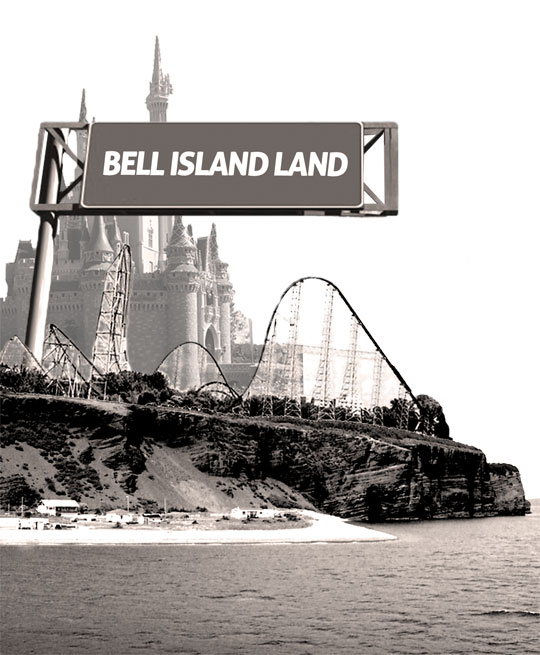
Convert Bell Island into a theme park
Kerri Breen, Bryhanna Greenough and Elling Lien
New Brunswick has Crystal Palace, Nova Scotia has Upper Clements Parks and Newfoundland has… a travelling fair that serves its purpose well enough.
But! What about a theme park with a roller coaster? A historical reenactment village, with salty Newfoundland pirates? Yar, tourists would be all over that like bright red paint on a row house. And it would have other benefits too. Upper Clements Parks, in Nova Scotia, for example, employs about 200 people and generates about $6 million in economic activity locally. It is run by a volunteer non-profit called group called the Hanse Society. But, of course, ours would be for profit.
But where would we build it? We can’t think of a better location than Bell Island. First of all, it’s enchanted. Second of all, they already have some of the infrastructure you would need: spooky mine shafts, mine carts, ice cream and fish and chips.
Sure, there are people living there now, but they could be relocated, and with minimal effort, a splash of paint and a little bit of imagination, we could convert the island, in its entirety, into a passable Disney World knock-off.
The ferry ride would only add to the experience. Can’t you already imagine the pirate costumes and sea shanties blaring through the sound system? I know we can imagine The Flanders with tattered sails and a gang plank, and the Beaumont Hamel with a crow’s nest and chests overflowing with plastic doubloons.
Sure, most people would see this as a slap in the face of history and good taste, but think of the local economy! Think of the children!
Now, to think of a mascot…
What it would actually take for this to happen: Canada’s Wonderland took nine years and $121 million to establish, and that was in the late ‘70s and early ‘80s. This year, Six Flags emerged from Chapter 11 bankruptcy after ditching a billion dollars of debt. But there have been ACOA grants for crazier things. We say give ‘er.
Start a city-funded community development position
Andrew Harvey
We already have some great community groups here in St. John’s like the Georgestown Neighbourhood Association, and the brand-spanking-new Outer Battery Neighbourhood Association, but imagine how many we could have if they had a little support to get themselves off the ground, and running effectively. The more you talk to your neighbours, the more you can work with them to identify and address mutual concerns. It might be something like deciding on a day to get the whole street out to sweep up the garbage you all complain about, or it may be putting together a letter to send to your ward councillor to make them aware of a parking issue which has been bugging everyone for a while.
The city of Toronto has five Community Development Officers, each responsible for a section of the city. Their role is to provide in-kind support for individuals and groups looking to build strong communities. They can assist with community planning. They can help organizations start, plan, and get their finances in order, and can point them in the right direction for programs.
What it would actually take for this to happen: About $50k and a desk in city hall. With a budget of over $200 million, anyone who is looking hard enough can find the money to fund a position like that. More important is having a council who is serious about community development, and willing to recognize that citizen engagement is worth it.
The City of Toronto’s Community Development web page: www.bit.ly/aULnuO
Start a CFA fostering program
Sarah Smellie
For some, these can be lonely shores to land on. It’s a bit alienating to have your hometown culture yanked out from under you and replaced with that of some homogeneous, sometimes hostile, place called “Away.” And then there’s all that boiled meat to get accustomed to.
So why not make the transition smoother for everyone? Let’s set up CFAs of all origin with welcoming Newfoundland families who’ll have them over for dinner and feed them through isolating times, like Sundays, Thanksgiving and Christmas, when they miss their families and friends back home in Away.
What it would actually take for this to happen: Maybe not much.
Yvonne Collett is the former coordinator of the Christmas Holiday Hosting Event, organized through MUN’s International Student Advising Office.
“We recruit families who are interested in hosting an international student, usually for a Christmas or holiday dinner,” she explains. “We get lots of students participating. For many, this is their first opportunity to go into a Canadian home.”
She doesn’t have much trouble recruiting families, either, saying that they’ve never had too few families, and many of them now approach her, instead of the other way around.
Coordinating the program, she says, isn’t all that much work. “The more people involved, the longer it’d take to organize,” she says. “But on a city-wide level, I think it’s do-able. Definitely.”
Find yourself some funding and call yourself Coordinator, and you could soon have one of the best jobs in town.
Make city-supported community gardens
Andrew Harvey
The City of St. John’s has supported the creation of several small community gardens, but with the rising interest and action on food-security here on this island of ours, many people would like to see the City get their hands dirty to help support community gardens, literally. In 2006, Vancouver City Council unanimously supported a motion by Councillor Peter Ladner to challenge the residents of Vancouver to create 2010 new community garden plots by January 1st, 2010. Residents responded in force, not only meeting the goal, but exceeding it, creating 2029 new community garden plots. This amazing feat was completed through a series of brilliantly simple programs such as the Sharing Backyard program, which is essentially a complex google map identifying individuals who have space in their backyard they are willing to share, and those who need space to garden in. Another fantastic initiative used was the Grow a Row, Share a Row, based off an initiative by the Canadian Association of Food Banks.
What it would actually take for this to happen: Council needs to identify food security as a priority, and issue a challenge similar to that of Vancouver. The real beauty of a challenge like this, and the means Vancouver used to achieve it, is that it requires little or no money to do. Fire up a Google Map and figure out how to put the right dots on it, and we are off to the races. This could even be rolled into the $80k city website redesign… Hmmm…
You can find details about the Vancouver project at bit.ly/atrRSU.
Offer free city-wide Wi-Fi
Kerri Breen
St. John’s and free public Wi-Fi — think it’s just a pipe, or tube, dream? Well, it’s happened before.
In 2004, the City of Fredericton launched Fred-eZone, a free city-wide Wi-Fi for visitors, residents and businesses. There are over 120 access points around the city, and according to Tony von Richter, who went to university in Fredericton, it’s decent.
“I can’t say how fast download speeds are or anything like that, but for basic web functionality it seemed to work fine,” von Richter said. He added that there are some dead areas.
Montreal, Toronto, Moncton, Regina, Saskatoon and several other cities have some form of municipal wireless service.
What it would actually take for this to happen: The bad news first: If Fredericton is any example, it will take a long time. According to a white paper on the topic, it took four years to “form a non-dominate carrier company, construct the fiber optic network, deploy the point to multi-point wireless network, and finally, to deploy over 120 Cisco Wi-Fi access points in the field.” (Glaven).
The good news is that it had been done using existing budgeted dollars by re-investing the city’s telecom savings back into the network and by accepting commercial subscribers on the network. The private sector also kicked in over $250,000.
St. John’s would have to think of a better name than “Fred-eZone” though.
Big Ideas 2010: Your ideas
Thu, Oct 28, 2010
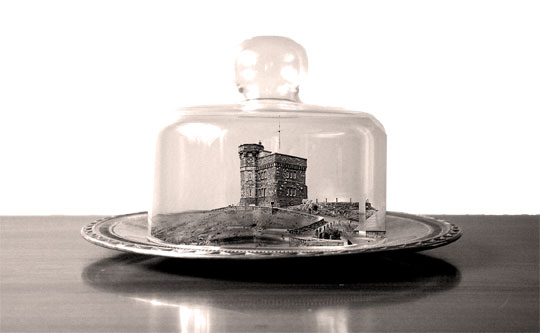
Collage by Elling Lien
Build a St. John’s Solarium
Leslie Vryenhoek
Writer and communications consultant
The St. John’s Solarium—Imagine: it’s mid-May, the 26th straight day of drizzle and fog after a long, dismal winter. You can’t bear to turn on the television or answer the phone and find out how the rest of the country is soaking up the warm spring sun, so you toss some summer duds in a bag, grab the sunscreen and head out. No, you’re not going to the airport—you’re just spending yet another day (after all, you have an annual pass) in the world’s only indoor tropical island, an underground mecca (change rooms on the second floor let you leave your boots behind!) with high-above sunlamps to offer a Vitamin D dose and take the edge off your pasty. Real tropical plants, constantly refreshed air (heated, of course, geothermally), a wave pool for the kids, street vendors, outdoor cafes… At night, the sun goes down, the moon and stars come out and local musicians take the stage at the patio bars.
God I wish somebody would build it. Sure, it would take massive private/public investment, but imagine the tourism potential—and the mental health rewards.
Move the provincial capital to the West Coast
Liam Herringshaw
Professor, MUN Dept. of Earth Sciences
It took me a while to notice, but Newfoundland faces the wrong way.
St. John’s harbour looks east, to Europe, to Britain, to the colonial powers, the fishermen and the settlers. No one returns its gaze. Influx comes from the airport or the Trans-Canada Highway.
Out west, behind Newfoundland’s back, Canada carries on regardless. With a new capital city on the Gulf of St Lawrence, St. John’s could return to its life as a harbour town – the jelly bean houses and Signal Hill bringing in the tourists, and the choppers and trawlers shipping out the petroleum workers. Its tedious western sprawl would be wiped happily off the face of the Earth.
A capital in western Newfoundland would connect the province to its country. Rather than a 600 kilometer drive from Port-aux-Basques to the Avalon, people could be off the ferry and into the city in no time. The other Atlantic provinces would suddenly be an island-hop away.
There would be no need for the preposterous food miles required to shift groceries all the way across the island, no need for the trans-Canada highway to be potholed into oblivion by a steady stream of juggernauts.
Memorial University could switch its campuses around, making Wilfred Grenfell College the main focus of attention and leaving St John’s as the satellite centre. For marine biology, geology, geography and other earth and life sciences, the west coast is far more suited to study than the barren, boggy terrain of the Avalon.
Then there’s the weather. The west coast gets warmer, drier summers and reliably snowy winters. The skiing around Marble Mountain could be a genuine centre of snow sports.
Build a Bus Rapid Transit (BRT) System
Walter Parsons,
Engineer
To make public transit attractive to St. John’s residents, we should build a BRT (bus rapid transit) system that would form the core of a redesigned Metrobus. Specific arterial transit routes should be identified and their roadways upgraded to enable the features of a rapid transit network. Like similar systems in Halifax and Saskatoon, these routes would include transit-priority traffic signals, bus stations with improved shelters at major destinations, access to park-and-ride facilities, less stops than traditional bus routes, and frequent continuous service that would allow users to use the rapid bus system without the need to consult a schedule (service intervals of ten minutes or less). Less frequent neighbourhood routes could connect to the BRT system at major stations – perhaps using smaller vehicles. The BRT busway could feature extended service hours and could even be designed to allow for the possibility to upgrade to light rail as the city grows.
Part of the BRT network could be built along the Columbus Drive-Prince Philip parkway to link St. John’s east to west, serving the Village and Avalon Malls, the Health Sciences complex, Memorial University, Confederation Building, and the College of the North Atlantic along the way. Bus stations (at intersections with transit-priority traffic lights) would need to be added to the parkway to allow buses to quickly merge in and out of traffic. Major thoroughfares into the downtown would also need to be upgraded with bus-only lanes where required. The new system, if implemented properly, could make a major difference to traffic and parking problems in the city core.
Send us your big idea!
Tue, Oct 19, 2010

Thanks to all who submitted!
The Scope is putting together our second Big Ideas issue. This year we’re opening up the floor and asking you to send in a 100-200 word response to this question:
What is your big idea for the future of the city?
If you get us your answer by THIS SATURDAY AT NOON (OCT 23rd), your idea could be featured in our upcoming print edition. E-mail your writing to bigideas@thescope.ca. Please include your name and occupation. Your writing may be edited for clarity or length.
How to write a good Big Idea:
- Please stick to one idea, and be specific. But you can submit more than once if you like.
- Describe why this idea is a good one, and how we could go about it.
- Be unique! We are more likely to run an idea we have never heard of.
- You don’t have to limit your thinking to just planning, roads, water, or public transit. Think big! Think little! Think in-between!
To get you going, you can read our previous feature, from 2008:
/cover/the-big-ideas-issue-2008
Here are some of the previously submitted Big Ideas:
“Integrate high school gyms with community recreation facilities.” – TA Loeffler
“Open up a downtown movie theatre.” – Roger Maunder
“Build the bigger buildings up the hill [and out of the downtown core]” – Geoff Meeker
“Put a moratorium on new suburban development.” – Robert Mellin
“Stretch a clothesline across the narrows.” – Ramona Dearing
See you in the future,
Elling Lien
Editor, The Scope
We Saw You
Fri, Oct 1, 2010
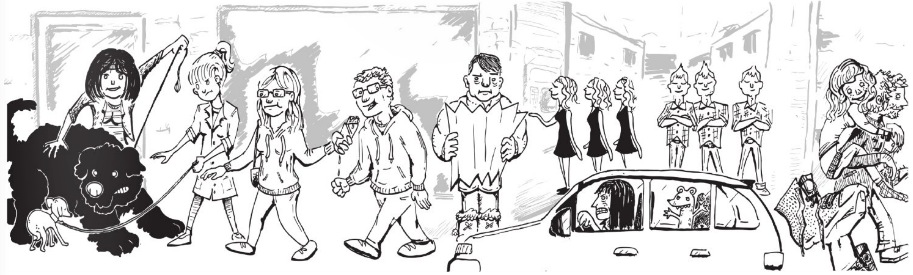
Illustration by Ricky King
Introducing a new section at thescope.ca: I Saw You.
With reporting by Adam Clarke, Amy Joy, Angus Woodman, Bryhanna Greenough, Elaine Pond, Elling Lien, Kerri Breen, Lisa Cook, Martin Connelly, Morgan Murray, Natrix Ma, and Ryan Davis.
I saw you as you drove past in your big Ford pick up truck, little lady, barely seeing over the steering wheel, foot heavy on the gas. And I saw you splash through the puddle, soaking a lady jogging by.
I saw you, white boy with dreads, go into a coffee shop asking if they had Fair Trade coffee, and when the server explained that it wasn’t certified, but was fairly traded, you performed a lecture about working conditions that seemed very rehearsed. Then you left a photocopied leaflet of your poetry in place of a tip.
I saw you picking out flowers, and when I said, “My, she’s a lucky girl,” you replied, “She gets flowers from me every day, so it’s not so special for her any more,” then continued to the cash.
I saw you picking your nose something fierce when they called on you to receive your lifetime achievement award. You kept picking as you walked up to the podium, trying to make it look as though it was the most natural thing in the world. But not even the Fonz could pull off the thumb and forefinger double dip up to the first knuckle. Nice try though.
I saw you giving a lecture at MUN, your eyelids fluttering every time you struggled to find the right word.
I saw you in your red car outside the Quidi Vidi Dominion as you pulled out of the parking spot, stopped, pulled back in, opened the door, and touched the pavement with your two fingers. You sniffed them cautiously, then tasted them, then closed the car door and drove away.
I saw you look at my nametag and say in a very snotty tone, “I don’t know you,” and walk on. You reminded me of the lady who threw a hot turkey sandwich at me when I worked at Buck Weaver’s. She made me realize that not all old people are sweet.
I saw you, lady in the bank line-up, as you watched two other ladies converse about this and that. You nodded and smiled and acted as though you were in the conversation, too, even though they had no idea you were there.
I saw you in your spiked collar at a gig, rocking out so hard that you banged your head against a pole.
I saw you chuck a wine bottle backwards, over your shoulder, into a shrub, in the middle of the day.
I saw you break up with your boyfriend on a payphone in Hamilton Convenience, then hang up the phone and buy a bag of Doritos and a Kit Kat.
I saw you on a cold Wednesday night, rocking out to what I believe was ABBA above Nautical Nellie’s with a mop.
I saw you, beardy man in jean jacket, circling around Sylvia’s Treasure Chest and getting ever so close to buying a book about fortune telling, but you kept putting it back.
I saw you delivering the mail as I was sitting on the front stoop, sneezing. You talked to me about lemon juice, fasting, blood-building, toxins, and the perils of eating sad chicken.
I saw you in the Convention Centre car park, bent over, pants down. When you saw me walk by, you laughed and you asked your boyfriend to spank you harder.
I saw you fight to control the pet ferret you brought along car for a ride and it seemed like your attention was 50 per cent for the road and 50 per cent for your squirming friend as you weaved and swerved about in the rain. We’re gonna crash, we’re gonna crash, we’re gonna crash, I thought. Suddenly, we arrived, and your beast promptly let out a wet fart and kunkeled.
I saw you in your AC/DC T-shirt walking headlong into a hurricane.
I saw you pull up in a white car behind the Dominion on Stavanger, window down, arm out, wearing a heavy silver watch, black felt hat, late 50s. I was alone and taking a photo, and you were blocking my car as you watched me stand on the cliff’s edge. When I turned around and took your photo, you drove away.
I saw your boyfriend giving you a piggyback on Holdsworth Street when your other friend ran up to you, took off your shoe, and threw it in the grass. Then you all went to get nachos together.
I saw you stick your head out of an open car window, and as it drove past you shouted “Your boyfriend gave me herpes!” We all laughed, but the car was long gone before I knew how to respond. (“No wonder your face looks like that!”)
I saw you in a harbourfront phone booth, waiting for the phone to ring. You were sitting cross-legged and in bare feet, drinking cans of beer with your friend, and it seemed like you had been waiting a while.
I saw you drive your tinted black SUV down a closed off road after a storm, and you squealed and skidded to a stop just before the fallen power lines. You lingered there before backing out slowly.
I saw you through my office window, you had on a bright orange vest with a big yellow X on the back. As you mowed the lawn with your protective ear muffs on, I wrote a poem about you and emailed it to my friends. You seem nice.
I saw you with your colorful silk scarves and dark eyes, bent over a deep freeze as you sang along to the east Indian music in the background.
I saw you, four gorgeous girls in short black dresses, standing by the bank machine on the end of George. When you left, three handsome guys in plaid shirts came and stood in the same spot.
I saw you in a striped shirt, French music drifting from your house and sun dripping from the sky — you were washing windows, and the only thing to complete this “I saw you” would be Bordeaux and croissants.
I saw you around 7am Saturday morning on Water Street when you pointed to a building and slurred out something that sounded like, “mrmrmrmmrrrr marley…mrmrmrrrpeter toshmrmrmrrr…cliffffffmmrrmrrr,” then you pointed your finger to the darkening clouds and sang “Redemption Song” to me from start to finish.
I saw you buy a big can at the liquor store and ask for a brown bag. A few minutes later I walked passed you on a bench in the sun, sipping as if there was nothing else you’d rather be doing.
I saw you at a store in the Village Mall, leaning over a clothing rack (I think it was a rack that had sequined bras on it.) You were coughing your lungs up and looked haggard, and when I asked if you were okay, you said “yes,” because you thought I worked there and was asking if you needed help finding clothes.
I saw you picking your nose something fierce when they called on you to receive your lifetime achievement award. You kept picking as you walked up to the podium, trying to make it look as though it was the most natural thing in the world. But not even the Fonz could pull off the thumb and forefinger double dip up to the first knuckle. Nice try though.
I saw you two, in your mid-thirties, wearing square glasses and hoodies, sharing an Extreme Pita sandwich in silence, looking everywhere but at each other.
I saw you and your little dog get jumped and bitten by a Newfoundland dog. You screamed at the owner that if she couldn’t control her pet she shouldn’t be out walking it. When the owner started walking away, you screamed after them, “Next time it will be a child that gets attacked!” I hope your dog is okay.
I saw you practicing karate by the hot dog cart.
I saw you kissing your boyfriend, who was pretty close to twice your height, and I couldn’t help but wonder, How would that even work?
I saw you yelling at your kid that if he didn’t stop throwing rocks, you would beat him to a pulp.
I saw you (and heard your tires screech), two little old ladies in the green Corolla, when you ran a red light on LeMarchant Road. Once you realized what you had done you laughed your heads off.
I saw you steal cheese from the Dominion on Blackmarsh, and when you saw me looking I hoped you’d invite me over for some wine and cheese. You were pretty cute for a cheese snaggler.
I saw you with the flocks of people trying to catch a cab after 3am on New Gower, and you were standing in front of a parked car.
I didn’t realize you were pissing on it until you shouted at me, “f@#king eyes down, f@#ker!”
I saw you, mole man, hairless and wearing activewear as you waved a metal detector along the side of the Manuels Access Road.
I saw you eating your chicken salad sandwich and you had mayonnaise all over your face and you didn’t know it. Or maybe you did and you didn’t care.
I saw you kick your beagle as I stared in disgust until I caught your eye. You winked at me and continued down Prospect Street.
I saw you in your work clothes with two other guys, your beat up ol’ truck screeching to a halt once you saw the redhead with the fuchsia stilettos.
I saw you walking with a cane in the orange light of the afternoon, wearing a yellow hat, carrying a green apple, and missing two front teeth.
I saw you, or rather, I didn’t — but you called my cell phone on Friday night and asked if I was ready to die. ‘Excuse me?’ I said. You repeated yourself, and then offered that you were standing outside my window. I looked out, but didn’t see you, so I called the cops.
I saw you, red sneakers, no socks, with your pony tail and frame pack, looking like a lost traveller at the illustrated map of Newfoundland in the window of what used to be Morrissey’s Store. It looked like you were searching for answers or St. Anthony.
I saw you just off Duckworth Street with your friends at 3am. When two dark-skinned guys walked by, you shouted, “Happy Eid! Hey! Happy Eid! Today is Eid, right?” One of the guys answered, “uh, we’re not Muslim,” and kept walking.
I saw you rolling pennies down Prescott Street on a warm Sunday night.
I saw you sniff your armpit as you walked across the parking lot.
I saw you with your Spiderman-colored sneakers and grey wool hoodie sweater when you told us a story about a man who went hunting hammer-head sharks. I like your stories and the fact you fixed my furnace.
I saw you and your family on Cuckold’s Head, all of you wandering around angry, not talking to each other. I found the keys to your rental car on a rock near the hardest part of the trail, and when I gave them to you, your mom gave me a bear hug.
Unsolicited Advice!
Wed, Sep 15, 2010

We recently put together a little “student guide” in which we doled out all kinds of sage advice about student life and how to live it. But who cares what we have to say? Here’s some advice, word for word, from real people, with, like, real jobs.
Reverend Jonathan Rowe
Parish priest, St. John’s Anglican church
Learn the difference between what needs to be done well, and what just needs to be done.
Kathy Jaeger
Chef, Hungry Heart Cafe
Cook your onions more and your garlic less!
Jody Richardson
Musician, writer, actor
My only advice is the advice I gave my daughter: When I was your age I did a lot of weed, acid, shrooms, and booze, but there were no cameras. Today you can have a damn good laugh, get a little fuzzy, and wake up a global Internet embarrassment. Girls want to be loved and guys want to be lusting, and it’s a dangerous equation when everyone has a two-four of Mike’s Hard and a digital documenter. And study hard because it’s a dog eat cat eat rat eat dog world out there, employment-wise.
Bonnie Leyton
Artist, owner of the Leyton Gallery of Fine Arts
Finding the good in life benefits everyone, seeing the negative only hurts yourself. Look both ways before making a decision.
Dennis O’Keefe
Mayor of St. John’s
My advice would be: don’t be shy, make as many friends as you can, have fun by all means but STUDY!!!!!!!!!!!!!!!!!!
Yvonne Jones
Leader, Liberal Party of Newfoundland and Labrador
Enjoy the next few years, the experiences and friends you meet now will have a dramatic impact on the rest of your life.
Joel Thomas Hynes
Famous writer
Keep an open mind about having sex with your professors. I had sex (regular sex, backdoor sex and face sex) with all my professors, both male and female. Once I even did the janitor. Now I’m a famous writer.
Dave Hopley
Owner, Living Planet
My advice is to take at least one course each year from a field you know nothing about. If you’re in Physics maybe take a Psych course. If you’re in History sign up for an Astronomy course. And make sure you take at least one Philosophy course before you graduate. Don’t be narrow-minded – you never know what can happen to your brain if you give it a chance.
Tony Murray
Manager, The Ship Inn and the Rockhouse
You will be known in life by the deals you make and the deals you break.
Kim Winsor
Owner, Johnny Ruth
Pajama bottoms are off limits!!
Denim leggings, tunic top, belt, kick-ass boots, a drop of gloss and you’ll be ready to study in style.
Siobhan Coady
MP, St. John’s South-Mount Pearl
Get started early so you don’t face that end of term crunch. Easy to say, hard to do. Look for opportunities to pursue your interests with volunteering or international study. And one more very important thing: never do a term paper after a night on the town
Robin Grant
Founder and Executive Director, For The Love of Learning
Plan for a dream. Dedicate time to learn both inside and outside the classroom. Strengthen your friendships: they’ll last a lifetime. Pace your workload so that you might actually enjoy it. And be brave enough to ask stupid questions.
Bruce Hollett
Interim President, College of the North Atlantic
Making wise choices as you start on your career path is very important. Make sure you explore what the world has to offer and keep in mind that the choices you make today will influence the rest of your life.
Jack Harris
MP, St. John’s East
Student life can be great; it is what you make of it.
Tennille Ashley
Co-owner, Twisted Sisters Boutique
You will never be happy if you continue to search for what happiness consists of. You will never live if you are looking for the meaning of life.
Lorraine Michael
Leader, Newfoundland and Labrador NDP
Have fun and meet new people, these friendships will be very important as you go through you program and will last a lifetime.
Party hard, but not too hard. Some morning classes may be rough but show up, pay attention and make friends with your professor. It will help you out in the long run.
Get involved in on campus societies; check out the MUN NDP!
And most important of all: you can make Kraft dinner a food group by adding extra cheddar!
The Scope’s Guide to Becoming
Wed, Sep 15, 2010
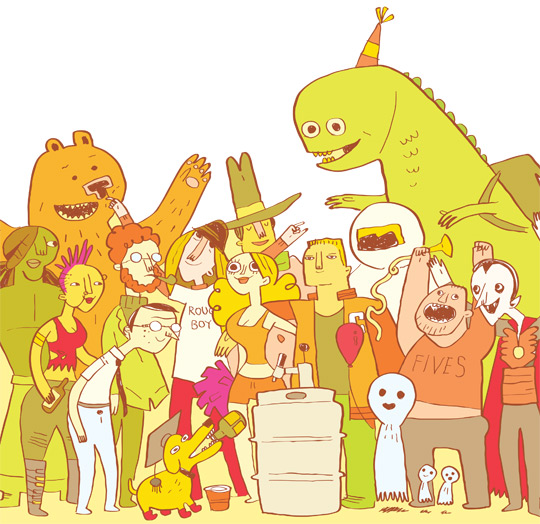
Greetings students! Today is your day! We’ve written this Student Guide to help you on your way!
*cough*
We at The Scope are wizened with knowledge—especially the kind acquired by making heinous mistakes. We have run into our share of walls, wandered down our share of dead ends, driven our share of metaphorical Honda Civics into our share of metaphorical telephone poles. For the love of all that is good, don’t be like us. Please follow this advice.
Written by The Scope Editorial Hive Mind.
Illustration by Michael Butler.
HOW TO HAVE AN AWESOME CONVERSATION
School is such a funny place—you’re supposed to learn, but you never want to ask a question because you don’t want to look dumb. What? How are you supposed to learn in that kind of a situation? Osmosis? Anyone who has been to school automatically suffers from question-phobia, even in social situations. As a result, most people are terrible conversationalists, because the secret to a good conversation is to ask questions. The other is to shut up and listen.
Ask short, open questions like: “What happened?” “When did you find out that…?” “What did he/she say?” Don’t make a statement and put a question mark on the end. Then ask follow up questions like: “Why?” “What was that like?” and “What were you thinking?”
The best part of learning this magical secret? Once you start asking people questions about themselves, they will immediately start to love you—because people love talking about themselves. It’s a fact. After a while they might even ask you a question or two.
…
HOW TO ACT LIKE A LOCAL IF YOU’RE FROM AWAY
Okay, so yer gonna wanna say yer “from town.” Not from “Sin Jahn’s” not from “da bay”—gentle Jesus in da garden, b’y, don’t say yer from around da bay, dey’ll know ye by yer accent.
Now ya don’t gots a “grandmother” or even a “grandmudder” ye gots a “nan.” Ye gots a nan, ye gots a pop, ye gots a mudder anna fadder, and you all drink tea. Tea, b’y, not coffee, not the Red Bull, none of it. Ye drinks tea and ye drinks Pepsi, not even water. And fer God’s sake, not Coke.
If you wanna go sees a show, you head to the Ship, where the writers go. When that lot all clears out, da bands come in, and ye loves it. Ron Hynes, now, ye loves a little Ron!
Now if ye gots a little shoppin ah’do, ye goes down to da mall. Ye gotta get that “a” sound right, it’s a long, flat one, none ah dis “awl” stuff. Da maaaaaaall.
For groceries ye goes to Sobey’s or Dominion, but ye hates what they done ah’dat old stadium there, now, ye saw Bob Dylan, yis BOB DYLLIN’ there, now, when was it, in the eighddies, I s’pose.
Now off ye goes!
…
HOW TO WING A TEST AND MAYBE PASS
Okay, so the first thing to get out of the way is that you shouldn’t do this often. If at all. But if you find yourself in a rare, it’ll-never-happen-again sort of pinch, here are a few things that might—might—help you get, like, a D.
You’ll need to stay calm. If you’ve got ten minutes or so, take out your notes and choose three consecutive days that look pretty important. Read over those three days, carefully. Read them over again. And again. Become as much of an expert in the material from those three days as you possibly can.
When you get the test, read the whole thing over. If there are answers you know, write them down. Underline or star things you might possibly know. Mark up your paper. A marked up paper makes it seem like you worked hard and the grader might think you’re super studious and unconsciously give you more points than you deserve. Psychology, man. It’s like that.
If there are multiple choice questions, look for grammatical issues. If the answer doesn’t line up with question in a grammarly way, it’s probably wrong. Answers that contain absolutes like “never” and “always” are not usually correct, either. If the answers are numerical, you can typically toss out the highest and lowest choices. If two answers are opposites to one another, the correct answer is probably one of those.
For longer answers and essays, try as hard as you possibly can to spit out what you learned in your ten minute pre-test cram. Whether you can relate the question to that information coherently doesn’t matter. “Write about X” when you only know Y? Well maybe X is like Y. Or not like Y. Or vaguely related to Y, possibly, maybe. You don’t even need to know. You just need to guess, write it down, and then write about Y. At least then you’ll have a glob of something that looks studied, and it’s hard to give legit knowledge a zero.
The point is to never write nothing. Is it a math question that may or may not require an integral using trig identities? Who knows? Maybe your first line can be an expansion of brackets. And the next one can be some addition. It doesn’t matter. Just write something.
When there’s nothing more you can write, go back and re-read the test a few more times. Sometimes a question will give you clues to other answers or jog your memory a bit. Never go back and change an answer, though, especially on a multiple choice, unless you’re 100 per cent certain. Don’t contradict your instinct. In this situation, it’s all you’ve got.
…
HOW TO BE A VEGAN OR VEGETARIAN IN ST. JOHN’S
First, the bad news: Produce is expensive and, come winter, the stuff you do find is pallid and flavourless.
More bad news: You are going to encounter lots of people—at restaurants or elsewhere—who will act as though you are making life difficult for everyone. Well, you are making life difficult, but you’re doing it for a good reason, presumably.
But papa, don’t preach. Our culture has a built in reaction to preaching which inverts the positive intent of any message. If you come across as a preachy vegetarian, all of a sudden people will be munching hamburgers in your face like imbeciles. Leading by example is a much nicer way. Try taking your friends to The Sprout, or cook them a vegetarian meal. They might even like it.
At the grocery stores, canned beans can be mystifyingly pricey. Armed with a slow cooker and a little forethought, you’ll be paying pennies a handful for your favorite legumes if you buy them dry at the Bulk Barn. The Barn also has all kinds of rice and grains, like cheap quinoa, and hippie flours and nut butters, and even stuff like chickpea flour and TVP and instant tabouleh salad mix.
Sobey’s in Howley Estates, on Elizabeth Avenue, has arguably the best produce section in town. It also has an incredible ethnic foods section, with lots of tasty condiments and spices, as well as delicious, additive-free, heat-and-serve packets of Indian food, both frozen and not.
Other great alternative grocery spots include Food For Thought, on Duckworth, which is always well-stocked. They sell local produce, too, when it’s available. There’s also Healthy Choices, out on Topsail Road.
Go to the Farmers’ Market on Saturdays. You can go stock up on local produce and then can it for the winter. Berry-picking is also a good idea, as they’re easy to freeze and store away for the colder months.
Read more tips from Scope readers online at http://bit.ly/9lxu5N
…
HOW TO PREVENT BEING SCREWED AROUND BY YOUR LANDLORD
Sure, most people are nice here, and there are plenty of great landlords, but you always want to protect yourself. Read the Residential Tenancies Act (http://bit.ly/b6hQ8T.) Read it many times. Especially if you’ve moved here from a city like Montreal or Toronto, where renters have a lot of rights. Things aren’t quite so civilized here.
First, know who you’re dealing with. The landlord must provide you with their name, phone number, and physical address (See: http://bit.ly/b6hQ8T.) No matter how nice someone seems when you move in, they may not seem so nice eight months later when a pipe bursts and they won’t reply to your frantic emails for help.
Next, get a copy of the lease. If you sign a lease, the landlord has ten days to provide you with a copy of it. If they don’t, you don’t have to pay them rent until they do! (See here: http://bit.ly/bIgvAF)
Next, fill out the Residential Premises Condition Report (http://bit.ly/9WHROt) and get your landlord to sign it. It’s the start of an important paper trail which can help get something fixed, or prove that something is not your responsibility down the line.
Carry out all official correspondence with your landlord in writing—not in email. If it ever comes down to it, e-mail is not admissible as evidence in a hearing.
Get proper notice. Under the Residential Tenancies Act, there is no limit to how much a landlord can raise the rent (!), provided they give adequate notice, usually three months, and not in the first 12 months of a rental agreement. If your landlord is terminating your lease or month-to-month arrangement, they have to give you three months of notice.
…
HOW TO GET YOUR LANDLORD TO FIX YOUR BROKEN DOOR KNOB
First off, note damage(s) or issues with your place, and then let the landlord know about them. A phone call will work, but putting it in writing doesn’t hurt. This notice starts what the Residential Tenancies Act calls a “reasonable time” for the issue to be addressed. Unfortunately, this is one of the many ambiguously-worded parts of the Act. It may be unreasonable for a tenant to wait two weeks for the stove to be replaced. On the other hand, it may be reasonable to wait two weeks to have a broken window replaced. But you probably should not have to wait longer than a month on anything.
File a formal claim for repairs (PDF here: http://bit.ly/a8MLdH) if your landlord fails to address something. From there, you can get an order from the RTD which says you can pay rent to them until the repairs are completed. Unfortunately, you can’t withhold rent without one of these orders, no matter the conditions in your rental.
…
HOW TO GET YOUR SECURITY DEPOSIT BACK
Pay the right amount in the first place. A landlord can take up to three quarters of a month’s rent as a security deposit. They can’t legally ask for the last month’s rent.
Be a little patient though—the landlord has fifteen days to return your security deposit once you’ve moved out. If they don’t return it in 15 days, you can file a claim for it. Then the landlord then has 10 days to make a counter-claim for some or all of the deposit.
…
HOW TO FIND A PLACE TO LIVE THAT DOESN’T SUCK
With the oil business booming, and the vacancy rate certain to be under 1 per cent again this fall, it is the wrong time to be looking for a place to rent. With such a low vacancy rate, and property values as high as they are, rents are through the roof. And while rents are increasing, quality is not necessarily so.
Look early, and look often. Start looking as soon as possible. New rentals crop up every day, so keep checking the listings. The best online places are Kijiji (http://stjohns.kijiji.ca), NlClassifieds (nlclassifieds.com), and, if you’re a MUN student, the off-campus housing office’s website (http://housing.mun.ca/och). The print edition of The Telegram also has many listing that don’t end up online, so check that every day.
Throw a wide net. Tell your friends what you are looking for, ask people on Facebook, ask your Aunt Nancy. Ask random people on the street. Ask everyone.
When you find a place, phone first, then email. Although landlords are inundated by phone calls when they put a property up for rent, they’re probably getting five times more more emails. If you’re one of ten calls, you have a much better chance of being contacted than if you’re one of fifty emails.
…
HOW TO RESOLVE AN ISSUE WITH YOUR ROOMMATE WITHOUT THEM WANTING TO HARM YOU
Roommate-hood is a relationship, just like any other. So even if you’re having an argument, try to be kind. Don’t yell, be clear about your intentions and always try to remember that no matter how pissed off you are at someone, you’re probably only half right. Of course, if you’re mad, you should say so, instead of walking around all pissed and closed off. Start you sentences with “I feel,” rather than “You.” Saying, “I feel terrible that you ate all my Kraft Dinner and then had really loud sex with my best friend,” is much better than saying, “You’re a @&#@!” The former fosters discussion, the latter will end up in yes/no, you did/I did battles that go nowhere.
On that note, take care of yourself. Pay attention to your mental health, maybe do some yoga, meditate, take up running, whatever. It’ll make you far easier to live with, and when things go wrong they won’t seem as bad.
$20 Adventure: Amy Joy
Thu, Jul 1, 2010
We gave a few people a 20 dollar bill and a disposable camera and told them to go away and have a Newfoundland adventure. The only rule was to not use your own car (bumming rides was okay.)
Amy Joy is one that that survived…
GO TROUTING
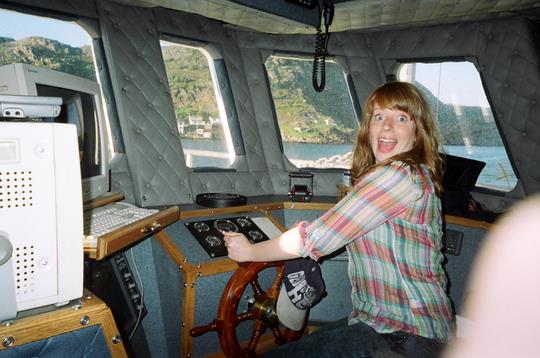
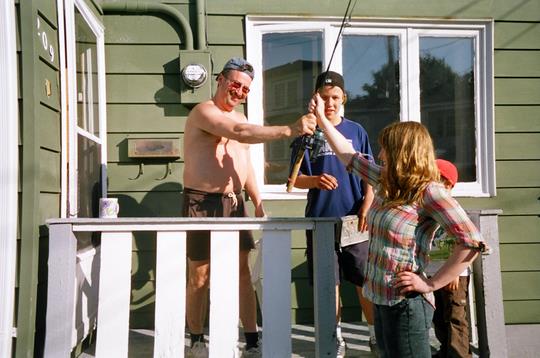
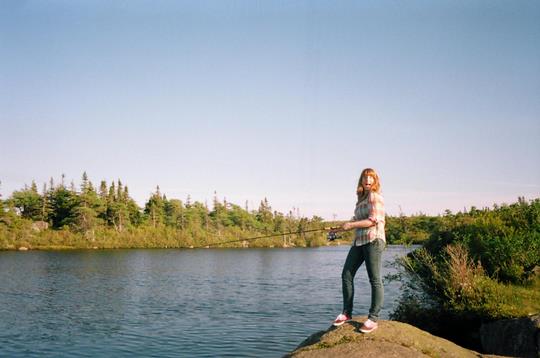
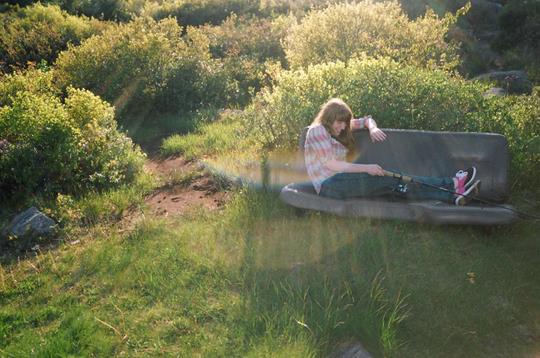
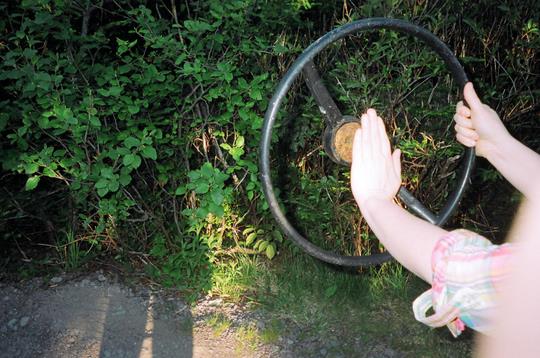
I really love to trout. For real. But I never catch anything. But that’s not going to stop me from trouting this summer. If you have never tried it, you should. The only thing I don’t like is putting the worm on the hook. So if you’re like me, you might want to have someone else hook your worm. All you need is a rod. And if you don’t have a rod you can just borrow one! You can go to pretty much any pond. You’re sure to find some neat but gross garbage along the way, too. I found an old steering wheel and a bus seat. Good to sit down for a spell. Good photo ops.
Tip: Be prepared for flies.
FOLLOW A JOGGER
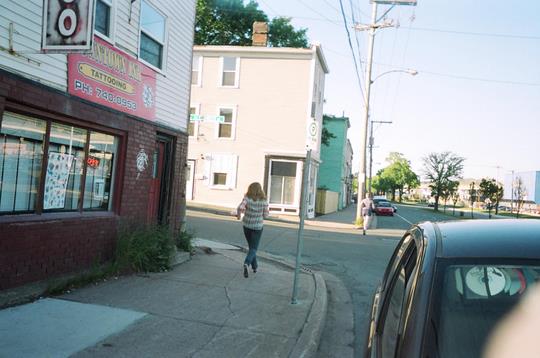
If you’re brave enough – here’s something to try out. Put on your sneakers and your favorite Northern Reflections jogging suit. Go out on your street. And wait for a jogger to jog past you. Follow them! You’ll get exercise, get a free jogging tour of the city, and have a laugh, too.
Tip: Stay far enough behind so you’re not creepy.
TAKE A FREE CLASS
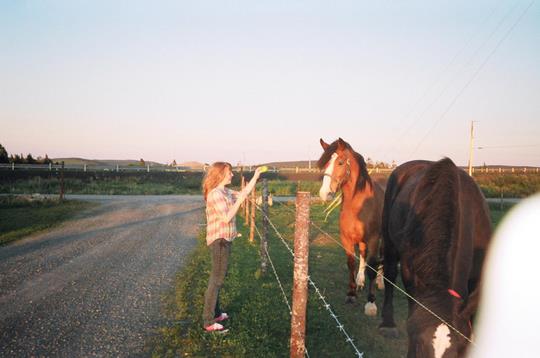
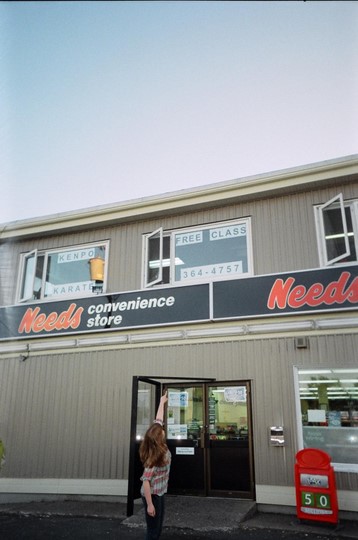
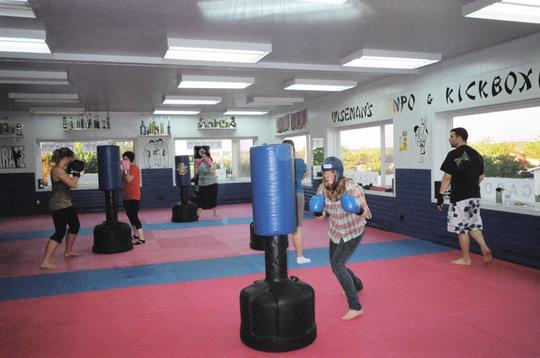
I lucked out. I’m not kidding. I went to a store to find some apples (for some horses) and upstairs I saw a sign that said “Free Class.” I went up and joined in. The pictures speak for themselves.
Tip: Maximum of three free classes. After that you’ll probably have to pay.
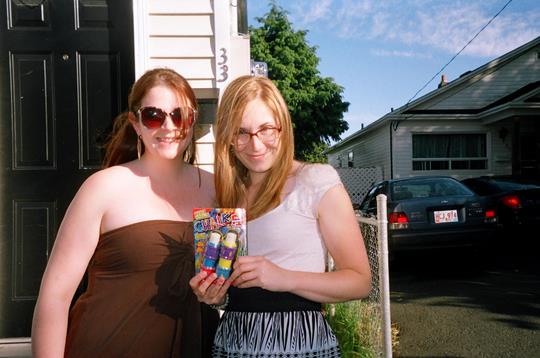
HOP SCOTCH
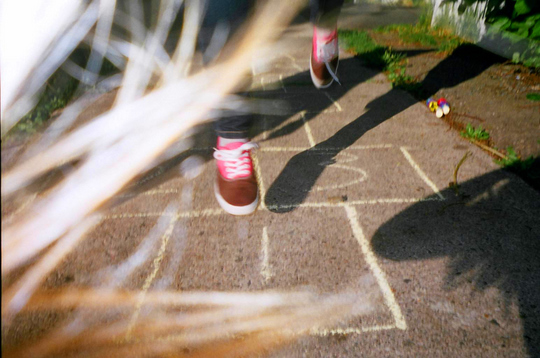
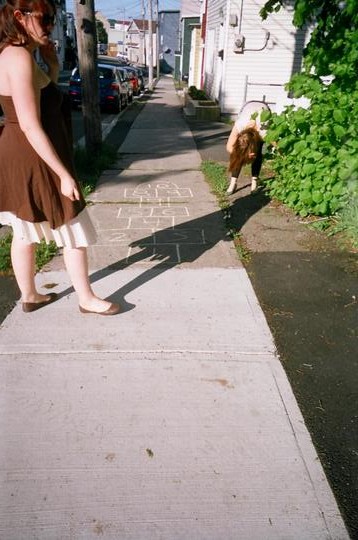
Chalk is cheap. So buy some and have a good old fashioned game of hop scotch. I’ve discovered though, that there’s a difference between townie hopscotch and a bay hopscotch.
Tip: Use chalk to also write messages to people on the street.
Sidenote: After we finished our game we looked out the window to find a little old man hopping along the grid. You never know who’ll play the game after you’ve finished!!
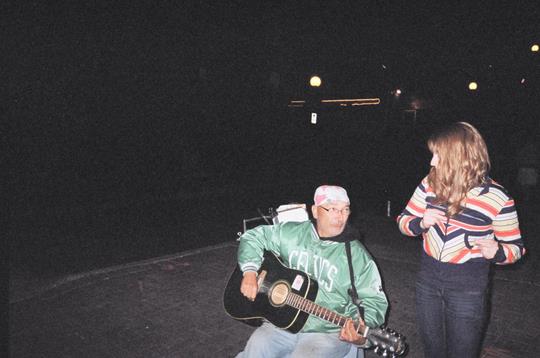
SING WITH STRANGERS
People (and animals and monsters) that you meet when you’re walking down the street. Richard – You’ll find Richard most nights of the week on the corner of George Street and Water Street. He sings a bit of Buddy Holly, some James Blunt, some Beatles. A lot of stuff actually. If you like to sing, you should sing a song with him. If you don’t like to sing, have a chat with him. He’s awesome.
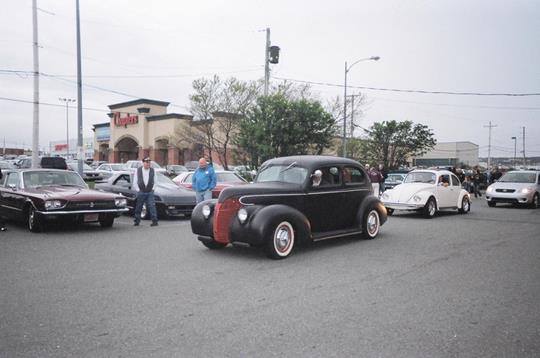
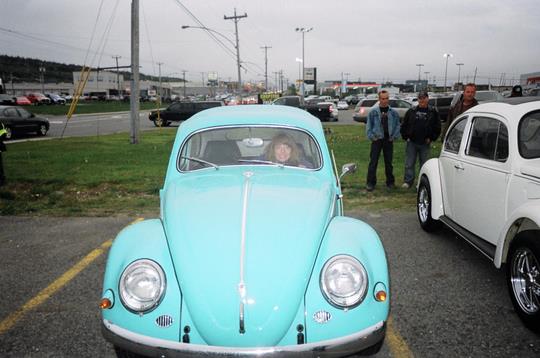
GO TO THE VINTAGE CAR NIGHT AT A&W
A&W gang – For free, I got to sit in my dream car. A volkswagon beetle. Aqua blue. It’s because on Thursday evenings at the A&W parking lot on Kenmount Road, they have a classic car night. It’s a great place to have a look at some old cars…and also chat it up with lovely car enthusiasts. I had some great chats about turning an old VW bug into an electric car. I was told it’d be easy. So that just may be my next project.
Tip: Buy a rootbeer! Yum.
GO TO GEORGE STREET
You don’t need cash to enjoy George Street. Not all the time anyway. All you need is to find yourself a seat, maybe on the steps across from the stage, and people watch!
My favorite quotes on a Friday night:
• As the police drove by with their lights flashing a guy says “I loves following the flashing lights.”
• “George is unforgettable”. This was said by George himself.
• Talking about what he’d do for a buddy: “I’d go to Jesus for him.”
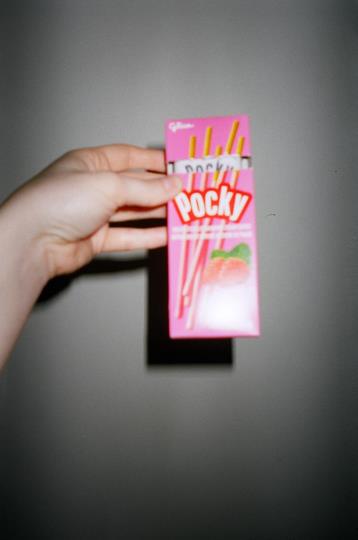
Tip: Buy Pocky for 2.00 and offer them to drunk people. You won’t believe how people react to Pocky.
SING KARAOKE
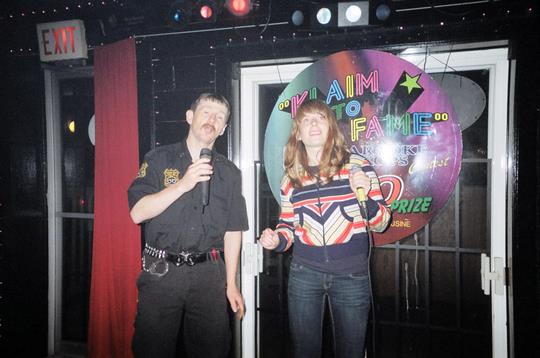
Karaoke Kops. Freeeeee karaoke. And The Kops are hilarious and look adorable in their uniforms. They’ll sing a duet with you. Or at least, they did with me.
GO SEE A GREAT SHOW
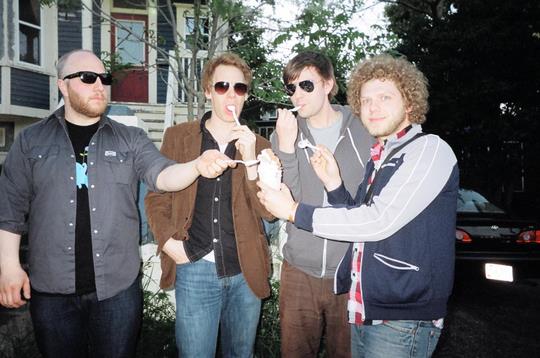
Go see a show!! Because there are TONS of GREAT bands in this city. TONS! Cover usually costs anywhere from $5 – $20. But maybe you can bribe your favorite band with a delicious soft serve ice cream from Jackman and Greene. I did.
HOW MUCH DID IT COST?
• Ice cream at Jackman and Greene $3.00
• Rootbeer at A&W $1.80
• Peasoup at the gov’nor – Deeee-lish! (I didn’t get a pic of this!) $5.73
• Pocky – $2.00
• Chalk – $1.13
Total: $13.66….which means I can buy a beer somewhere!!!!!!
Transportation provided by: Amy Stoodley, Grant King and Allison White.
$20 Adventure: Angus Woodman
Thu, Jul 1, 2010
We gave a few people a 20 dollar bill and a disposable camera and told them to go away and have a Newfoundland adventure. The only rule was to not use your own car (bumming rides was okay.)
Angus Woodman is one that that survived…
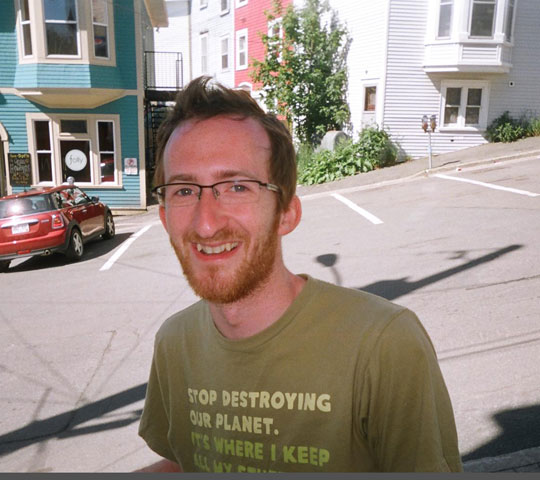
I like to walk. So for my adventure, I wanted to walk the length of the city. Right from Mount Pearl to Torbay.
Now to some it may sound a touch crazy, but I assure you it’s a very nice walk. Thanks to the Grand Concourse trails, you can cover most of the distance in wooded paths, largely forgetting that you’re in the middle of a city. And depending on your chosen path, you can pass through any number of nice spots and make a day of it.
This is how my day went.
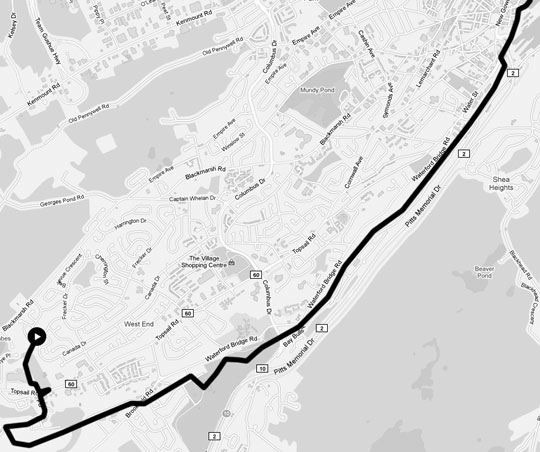
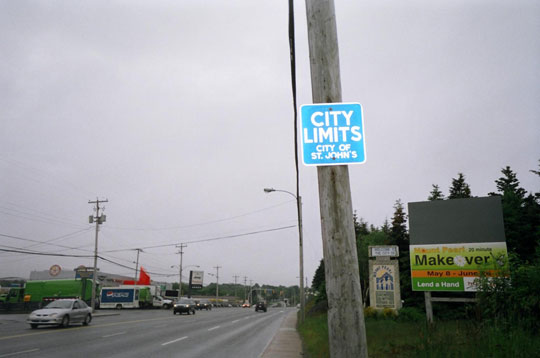
9:30am I leave the starting point — my brother’s house in Cowan Heights — and head for the Mount Pearl border. I soon find the city limit sign and give it a high-five.
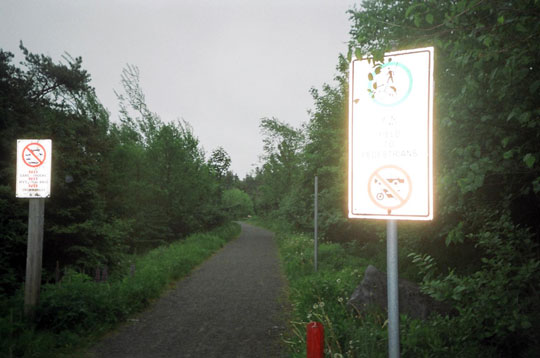
9:52am I wander back into Mount Pearl looking for an entrance to the first trail — the old train tracks. I think that perhaps I should’ve looked at a map before I left the house. Eventually, I find it.
This particular morning was a wet one. The forecast claimed 2-4mm of rain. Enough to be annoying but not enough for me to cancel. This was a Newfoundland adventure, after all. So when I left the house in the morning and there was a little light rain I thought nothing of it. But then the clouds got darker. And darker. And darker. By mid-morning it had gone from intermittent-wipers rain to super-fast-wipers rain.
Still, I kept walking. Surely it would stop.
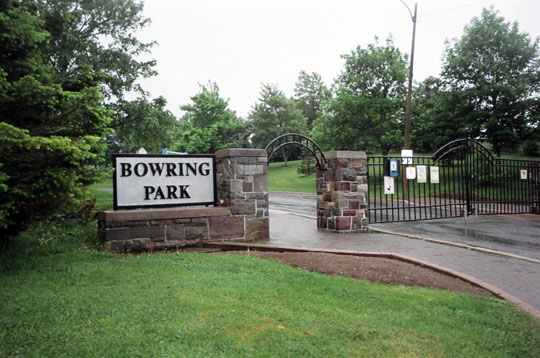
10:31am I arrive at the Bowring Park gates. As I’m getting out my camera, trying to keep it sheltered from the rain, I hear a loud thunderclap. Inside, the park is empty. It is nice to have the whole park to myself. Myself, and the ducks that is. They don’t seem to mind the rain.
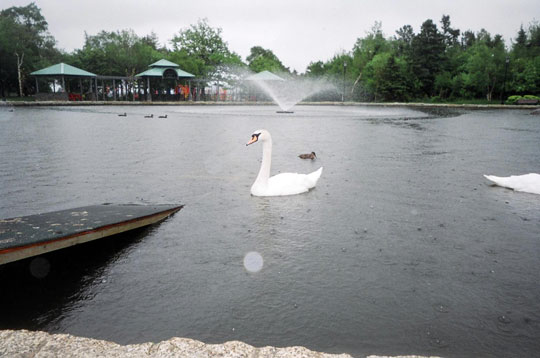
10:49am Walking the trail, my phone rings. I answer it, trying not to get it too wet, and hear the voice of my brother. He says, “You know it’s raining, right?” Thanks.
11:11am Just as I think the rain can’t get any worse, it gets turned up to 11. I am soaked completely from head to toe. And then the rain stops completely. It takes no more than a blink or two. Soon the trail is glistening.
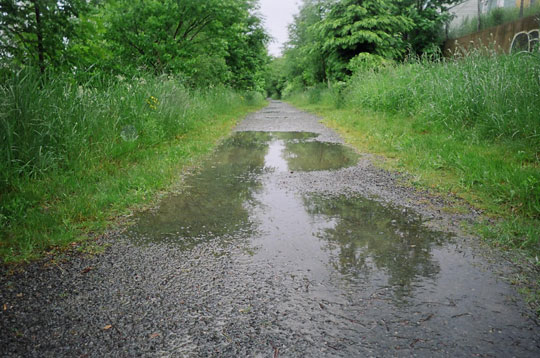
11:47am Downtown, I stop at Atlantic Place to see how much of myself I can dry off. I’m sure anyone who walked into the men’s room thought I was enjoying the hand dryers a little bit too much.

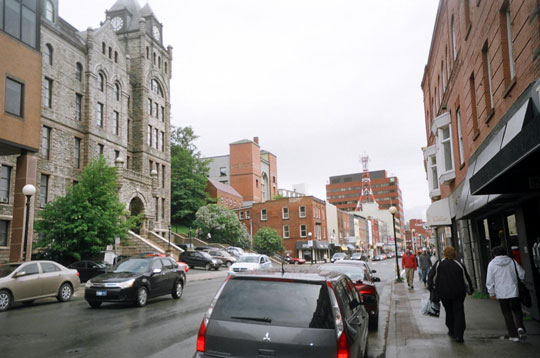
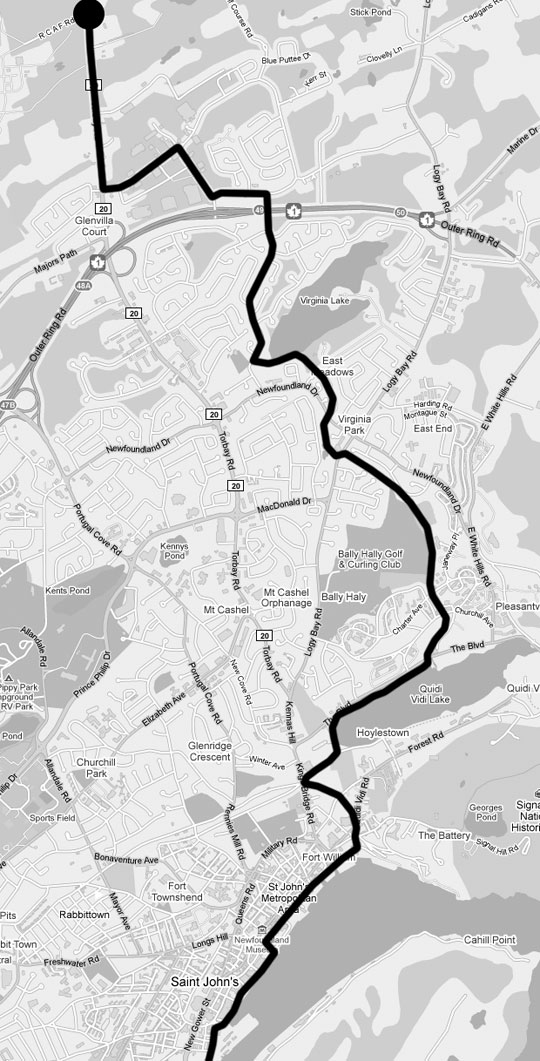
12:46pm After downtown, it head to Quidi Vidi Lake for lunch. I watch some rowing practise and eat my lunch. The Vienna Sausages go down smooth. (It’s just not a Newfoundland adventure without a tin of these!)
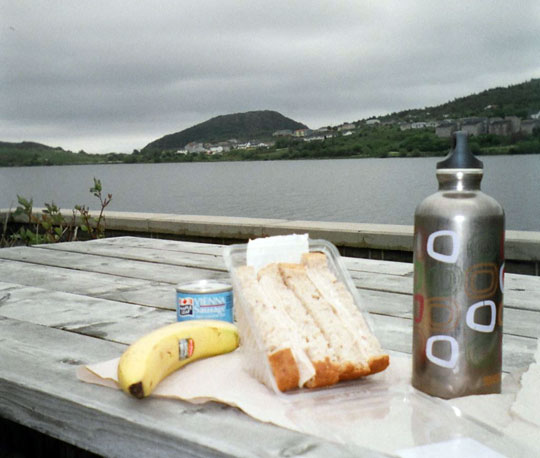
1:30pm From Quidi Vidi, I take the trail that runs along Virginia River. I veer off the trail for a bit and accidentally submerge both my feet just as they were getting dry again. Darn.
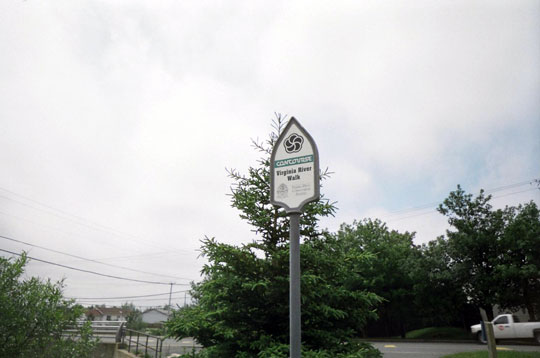
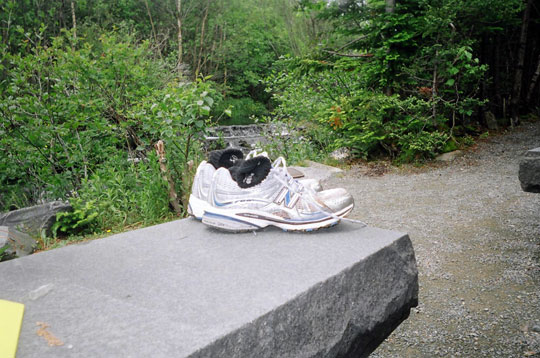
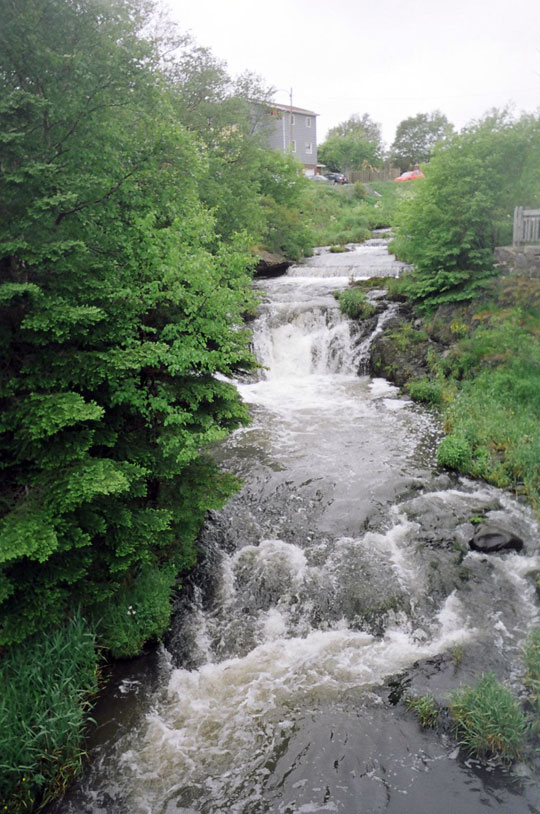
2:40pm The Virginia River trail ends and I head to Stavanger Drive. It is windy, busy, and I almost get hit by cars several times. This street was not made for walking.
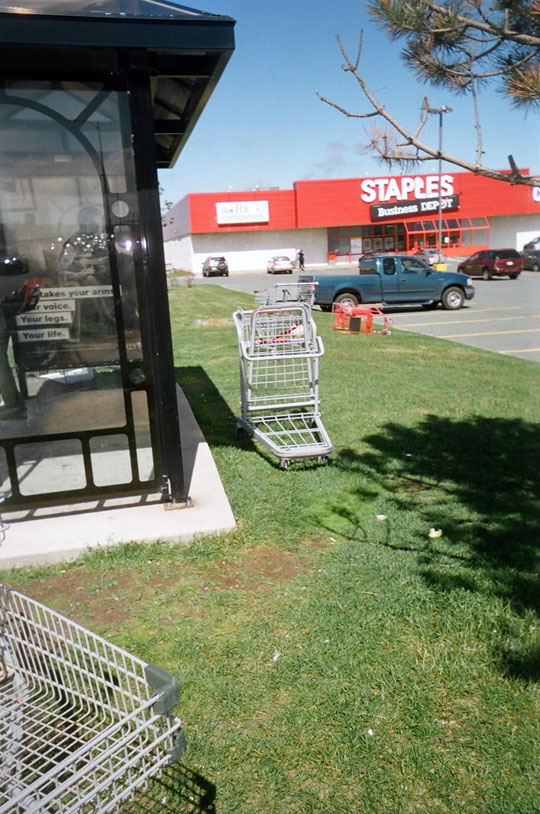
3:03pm Torbay! My task completed, I turn around and head for the closest bus.
In the morning I got soaked, and in the afternoon I got sunburnt, but overall it was a very good walk indeed. Turns out, in Newfoundland you don’t need $20 to have an adventure. All you have to do is go outside.
HOW MUCH DID IT COST?
• Sandwich 3.29
• Banana 0.43
• Tin of sausages 1.09
• Biscuits 1.67
• Fruit bar 1.09
• Bus fare: 2.25
• Potato chips at Irving so I didn’t feel like a mooch for using their bathroom: 1.46
Total: 11.84 – The remaining 8.16 will be put towards a new foot.
To the summit
Thu, Jan 14, 2010
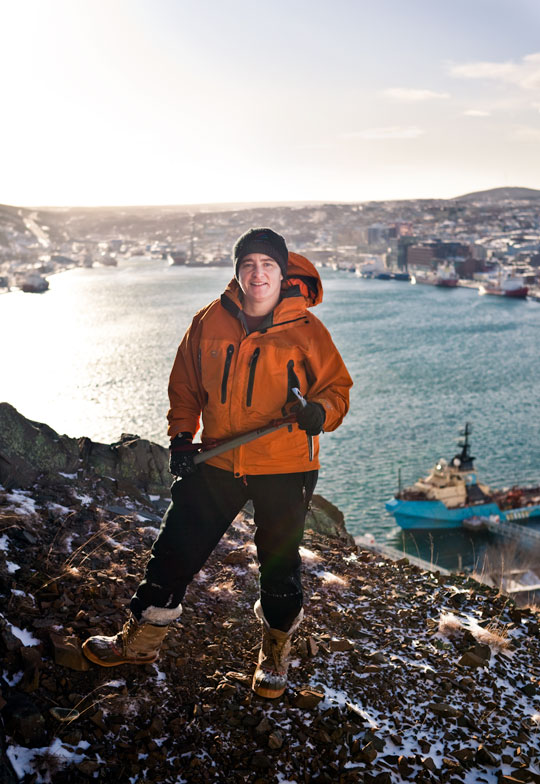
Photo by Kevin Coffey.
When you are looking for a challenge, you pick the biggest, meanest obstacle you can find and you focus on it. And you train. And you plan. And you plan and train some more.
This time, TA Loeffler is focusing on Everest.
Her attempt this March will be the second for the local educator and author. In 2005 an illness kept her grounded at Base Camp on the mountain, but now, in late March she and a team will be heading to Nepal to make another attempt at the summit.
It won’t be easy. The high altitude is a place where the body will no longer heal, where you have no appetite. The air is so thin it can take four to six breaths to power a single step. It’s cold, and dangerous.
Why would anyone put themselves through this, knowing how hard it will be?
Bryhanna Greenough caught up with Loeffler to ask about the expedition, her inspiration, and how she’s getting ready to climb the highest peak on the planet.
How did you get the idea to climb Everest?
I climbed Mount McKinley in 2005. It’s also known by its aboriginal name Denali. It’s the highest peak in North America, and I got it in my mind I wanted to climb it, so I trained and I climbed it in June of 2005. I was in that sort of quintessential midlife crisis space. So I finished that but realized I wasn’t finished looking, so I headed over to Nepal and biked from Lhasa to Kathmandu on a mountain bike. An amazing trip. I’d been in Tibet before, but in a Land Cruiser, and I wanted to actually be in the landscape so I thought I’d bike.
As part of that trip we visited the Mount Everest base camp, and it was there I had the sense I wanted to try to climb Mount Everest.
At that point I wasn’t scared about the climbing—as I should have been. I was scared about the fundraising. Contrary to my public teaching persona, I’m a very shy, phone-phobic human being. I had no idea how I was going to raise the $60,000 I needed to do the climb. But I took a picture of myself at base camp to remind myself when I got back that it was what I wanted to do.
Through various bake sales, T-shirt sales, and garage sales we came up with half of the money for the expedition. Mortgaged the house for the rest, then went off in 2007.
But it didn’t have the ending anybody really wanted.
I got sick two times on the expedition, and it wasn’t safe for me to keep climbing. So I came back and took a little while to just sit with it.
Then I got back with it at Ojos del Salado, the highest peak in Chile.The weather kept us from the top, but still, it got me going again. I kept working on the Seven Summits—the highest peaks on each of the seven continents.
Went to Kilimanjaro…
Pumori in Nepal… which is called “Daughter of Everest,” and it sits across the valley from Everest.
It’s easy to sit here now and say “yeah, I’m going to climb Mount Everest,” but when you’re actually in the same kind of high altitude environment—where you can hardly move; you’ve got the headache—that’s where I wanted to really see if I had it in me. Not only through the climbing phase again, but through the training and the fundraising again. It was there, climbing Pumori, which I climbed in honor of my mom, I said “yeah, okay, I got 12 or 16 more months in me to give to this thing.
And that’s when I decided.
That was fall of 2008.
How many of the Seven Summits have you climbed?
I’m five for seven now.
Last summer I went back to Elbrus, in Russia, after I went there in 2006 and got shut down by weather.
Suddenly I was at four for seven.
Then Marian and I went to Australia, which then made it five for seven.
Now, going back to Everest this year I would be six for seven. And if that comes to fruition, I’ll start looking for fundraising for Vinson, which is in Antarctica.
That must be a logistically tricky one.
The climbing is really straight forward, actually. Really cold, but the trick is the price tag is the same as Everest but it’s a mountain no one’s ever heard of. The flight to the ice is what makes that so expensive, because it’s a private company that charters a Hercules. It’s a very expensive proposition to get to the ice.
That’s how I got back to Everest. It was this sense that I wasn’t quite done, the mountain still had something to teach me, and I still had lots to learn. I wanted to go back and climb higher than I did before, and if it all comes together and I stand on top, that will be gravy, but to go back more confident, to go back stronger, to go back with all of the experiences I’ve had with climbing it the first time and other things I’ve done in the meantime to give myself the best shot of getting there… That’s all part of it.
Last time when you were on Everest, in 2007, what happened exactly?
I arrived at Base Camp with a pretty good case of bronchitis, which we know here, even at sea level, can be pretty hard to heal from. It required going on antibiotics, and I developed a high altitude wheeze. I was coughing so hard I was throwing up. It was a pretty rough way to get started. Eventually the docs were worried I could get what’s called ‘high altitude pulmonary edema’ which often comes with a respiratory infection. So they sent me down the hill a ways. Once you pass 4000 metres your body really stops healing.
So I went down, I rested, I got over the infection. I was doing pretty well, then I started throwing up and I was like “what’s going on?” You visit the medical folks and at first they said it’s altitude, but I didn’t think it was. I’d been up there for five or six weeks already.
By the time they actually said it was Giardia [an intestinal parasite], I had already lost 15-20 pounds. For a high altitude mountaineer that’s your reserve, that’s your resiliency. My strength had disappeared.
I went back down to try to heal to get strong enough to go back up, and I set myself a task, a peak at 5,200 metres. I said okay, here’s your test. Go climb that thing. I had to will every step, from the bottom of my being.
But I actually got myself to the summit of that thing, and I took a picture and that night, looking at it, I knew I didn’t look well. The next morning I threw up again and said to myself, “okay, you don’t have it. You don’t have the margin you need to be safe.”
I’ve done a lot of outreach with children, with schools, and I decided ahead of time it wouldn’t be good to scar an entire generation if I could help it. I was going in with conservative parameters. It wasn’t fair to my team or my sherpa to go up that high. You have to be at 100 per cent or at least as close to 100 percent as you can be.
I actually didn’t know how weak I was until I trekked out and got back to Kathmandu, where I had trouble climbing the stairs in my hotel.
The two illnesses so close together, close to eight weeks at altitude, I was levelled.
So, disappointing? Absolutely.
I had poured my heart, soul, everything, into it.
It was interesting though: When I first came back, one of my Buddhist mentors said, “I know you don’t want to hear this at the moment, but you may actually be of greater service having not summited than if you had.”
On reflection, I think she was actually very right. A decision I made fairly early on is I said to myself, you have to be as visible in the community if you have not summited as if you have summited. Because if you’re not, then those same kids you’ve been talking to get the idea there’s some shame in trying and ‘failing.’
I remember doing an interview with the CBC St. John’s Morning Show and Jeff Gilhooly asked me what was harder to recover from, the illnesses or the failed climb. I looked at him and said I don’t think of the climb as failed, I think of the climb as not climbing as high as I wanted to. The amount of energy and focus on the journey in the first place made it a success. Choosing to try to make that happen.
It’s important for us to risk disappointment. I think it can be tempting to stay where we are comfortable, to stay where we’re certain we can make something happen. But without the risk of disappointment, what good is it?
Did you know you would go back?
It took me two years to decide to go back.
As soon as I returned in 2007 people were asking me, “are you going back?” It would have been easy to say “yeah,” and it’d be easy to say “no,” but the real answer was I didn’t know.
I had a friend that always said, you have to do everything twice. The first time is often easier than the second because you don’t know what you’re getting into.
It was harder to choose to do Everest the second time than it was to choose the first.
You know what you’re in for.
I knew what I was in for in terms of the fundraising, the training, the everything. My life, beyond a certain amount of relationship maintenance, is training. That’s all I’m doing for the next three months. If it doesn’t help me climb Everest at this point, it’s out of my picture. You just have to ante up, which gets your hopes up.
But what I’m hoping for is a fun, safe, amazing experience. Ideally I will get to climb higher than I did before, but so many things need to come together to make that happen. You need health, weather, teammates to climb with… Sometimes I think it’s a miracle anyone gets to stand up there, just seeing how all these different things need to come together in the right combination.
It’s almost like you need the stars to align.
Going back the second time, you have the experience from the first time. Since then, last fall, I did a second Himalayan expedition, so some parts of it will be easier too. I know the lay of the land. I’m choosing to climb with the same operator as then, so the leadership of the team will be familiar to me. Four of my teammates will be the same, so that’s just a real gift. You’re not starting from scratch.
There are other women on the team this time, and it’s so rare for there to be. I’m a hockey player and hockey players are superstitious: I always put my left skate on first. Every time I’ve climbed one of the seven summits with another woman, I’ve summitted.
What’s the hardest thing about Everest?
It’s a long expedition, and it has a surprising amount of down time. Some expeditions, you have your three weeks… your four weeks…. You’re working hard just about every day. You can’t wait for a rest day and you can barely catch your breath. Everest, on the other hand, out of the two and a half months there are maybe 20 climbing days. There’s a lot of waiting for your body to acclimatize, and there’s waiting for the route to go in. So you can’t build up that same kind of momentum. You have to find peace in the relax. It’s a funny thing to do. You think about who gets themselves to Everest: You’ve got to have some amount of drive, some Type A in you to make the fundraising happen. You have to make room in your life so you can go away for that length of time, and you have to make yourself train hard.
So before you get there you’re going and going, and then you get to Nepal and you find there’s nowhere to go.
Actually, someone on our first climb couldn’t deal with the downtime and actually had to leave. I’ve gained some strategies. I have an iPod packed with podcasts and some movies and some e-books and all kinds of ways to do it. I’m actually very comfortable these days, sitting around. But the length of time just keeping yourself occupied living at altitude, it’s hard. Base Camp is at 5200 metres above sea level, which means there is half as much oxygen available to you as there is here in St. John’s. You can’t move very fast. You will yourself to eat. You do acclimatise, and you get better. Base Camp is this rocky, icy place. I call it gravel pit camping on steroids. You can’t even go for a nice walk there. If you’re going for a walk, it’s an ordeal. You’re living in this small, very intimate community and you can’t escape.
Everest is a strange place. When I was there last there was a bakery. Someone had carried up an oven. You could actually go to the bakery at Base Camp and by an apple turnover. And I did. It become a regular event, but it was a half hour walk over arduous terrain to get to the bakery. So I’d say it’s a long thing.
Another piece I might say about the difficulty is this: It’s a huge thing. It’s the world’s biggest mountain, it’s intensely dangerous and it’s a big deal. And that can magnify, and there can be an over-magnification of it it. A temptation to make it bigger than it really is. I’ve been trying to find the balance between giving it all of the respect needed, but on the other hand trying to keep it from getting too big in my mind. It’s big and it’s not that big.
Why do you want to do it?
I won’t go with Mallory [an English mountaineer] and say “because it’s there.”
I think it changes. I began this mountainous path because I was in a spot of confusion—midlife kind of stuff—and through that I discovered I could have impact on others. I would write my weekly blog and hear back from someone saying, “you know, my mom’s in the hospital and she read your blog and then she took extra steps at physio.”
I began to see by doing what I was doing and sharing it, that other people were taking on the obstacles in their lives. So that became quite a motivation.
So inspiring others is as strong a reason as doing it for yourself?
I climbed Denali (Mount McKinley) for me. It was only for me. But it was that that taught me to reach out and create this community of support around myself. Then it hit me: “Wow, if I’m taking on life and sharing it, then other people are taking on theirs.” That lent a middle piece to the story…
The tagline for this climb is “Mountain of Learning.” It’s about learning about myself, learning about my teammates, the people that train with me, and the stuff that people give back to me.
Our lives are like dropping pebbles on a pond, and the ripples go out. Most the time we don’t know where the ripples go, but sometimes the pond is small enough that ripples come back and we see them. It’s a privilege the get stuff back.
How are you preparing yourself? You mentioned pulling a tire up Signal Hill…
That one’s been getting a lot of attention lately. Basically I’m working with a 30 pound pack and a 45 pound tire—a tire plus a rim from my 1980 Chevy Corsica, known as the Oma-mobile, from my grandmother who gave it to me. The tire hangs about six feet behind me off the backpack. I start at the bottom of Temperance Street, by the Harbour Authority Building, and pull it up right from the harbour to the top of the hill.
So it’s dragging on the ground?
It’s dragging on the ground. You become very intimate with friction on different surfaces. The new sidewalk has more friction than asphalt, for instance.
I started training last year, before going up to Iqaluit for expedition training because you’re actually pulling sleds so its very sport specific. But because I’m training at sea level, at the moment the tire is the altitude. Until someone’s been at altitude, it’s hard to understand what it’s like to move yourself uphill without enough air. At 5000 metres, it’s one breath, one step. 6000 metres is two breaths, one step. 7000 metres is usually three. 8000 metres is four to six breaths just to take a step. How do you train for that at sea level? Also, at the school for Kinetics and Recreation at MUN we have a system called a hypoxicator which sucks oxygen from the air.
You wear a mask?
Yeah. I was walking at a 15 per cent grade on the treadmill with a pack on, with the mask on, as if I was at 3000 metres. That allows me to pre-acclimatise. I can create some extra red blood cells before I go. So that’s one piece of it. Then there’s that gall damned fatigue, which trains me as much mentally as it does physically. You can’t go fast. If you’re at altitude you instantly get dizzy, as if you have gotten up to fast. You have to develop this patience.
Pulling a tire up Signal Hill, everyone’s passing you and you’re just plodding. My goal is to be able to pull five hills before I go. I’m at one and a half so far, and two tomorrow. As the weeks go by, just inching it up so you can do five pulls up the hill in a row.
Well I hope you get a little ice!
Yes, once you get a little ice and snow the tire just slides. I have this great inner inclinometer—I know the slope profiles of every street between Wood Street and the top of the hill.
What does it feel like after you successfully climb a mountain?
People will often ask how long you get to spend up there. It depends on the mountain. I’ve spent as little as 10 minutes this summer on Elbrus. The weather was deteriorating, so we basically got up, it was miserable and we took a couple shots and we ran down. Sometimes 30 minutes, 40 minutes but there’s always this more hazardous portion waiting, so there is this momentary “wow, it all came together. I’m standing here where I can stand and go no higher.” It’s a huge thrill when it all comes together, because you can never assume it will.
Then there’s this recognition that I’m only halfway home. I’m truly successful on the mountain when I’m back home safe and the rest of the team is home safe. So that’s when the party can really happen.
What I find is true is it’s I think it’s magic to stand on any high point. I’ve climbed Signal Hill probably over 400 times now and I’m still excited every time I crest the hill, because I can’t go any higher. Or the Southside Hills. The hills I’m climbing are higher, for sure, and maybe the summit is more meaningful if it takes me six months to accomplish, versus 18 minutes or 32 minutes… But for me it’s pretty magical to go where you can’t go any higher.
Loeffler’s book More Than a Mountain: One Woman’s Everest is published by Creative Book Publishing. For more information click here.


Thu, Jul 7, 2011
The Scope