

Archive | Culture RSS feed for this section
Field Notes

New theatre company Ahrm’s Way to present Stephen Belber’s “Tape”.
Bryhanna Greenough stuffs it up the hole in your culture.
Hi all! Congratulations on choosing to read our brand-spankin’ new culture news column.
What’s that? You’re still reading? Well, I should get to the meat then, shouldn’t I?
Here comes Peter Cottontail…
Rabbittown Theatre is back at it after a winter break, but it’s been a tough year financially for the building owners, who say they’re heavily taxed. Rabbittown Theatre—the not-for-profit theatre company which is the sole tenant—is seriously considering a move to a smaller, more affordable home.
Trying to make the building work has been an uphill battle for years, says Aiden Flynn, founder of Rabbittown Theatre Company and part owner of the building. (more…)
Bard’s eye view
Thu, Mar 27, 2008
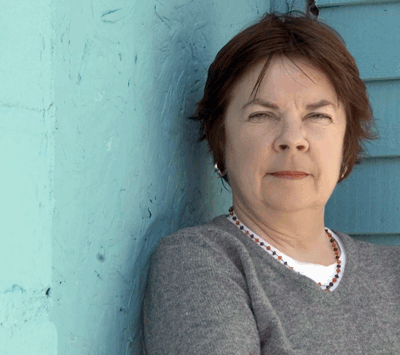
Since April is poetry month and all, Andreae Prozesky caught up with the extremely busy St. John’s poet laureate Agnes Walsh to find out her plans, and to ask how things are going halfway through her term as the city’s official scribe.
Once upon a time, a poet laureate would be expected to compose laudatory verse for the reigning monarch. Today, the role exists here and there to raise the profile of the arts in a community. Canada has nineteen poets laureate at the moment, working away for the poetic cause at the national, provincial, and municipal levels. (more…)
Joel Hynes
Thu, Mar 13, 2008

Writer
Teaching creative writing to prisoners.
What is the program at the Pen?
It’s not really a program. It’s not like some kind of program was set in place down there by the system. More or less, it’s something that I’ve been wanting to do for a while—just go down and teach creative writing. I’ve been down there for readings and such in the past couple of years and just thought that it would be nice to come down and have my own version of a creative writing class with that element of our society, you know?
When did you go there for readings?
I think I was down there twice. During Peg Norman’s municipal campaign and also for her federal campaign. [She was running for the NDP] (more…)
Mummer to mummer
Thu, Dec 20, 2007
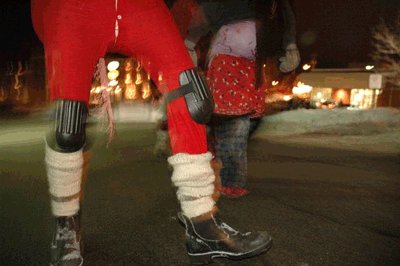
Newly mummered Elling Lien speaks with a long-time practitioner and enthusiast Chris Brookes.
So I hear you’re a mummering legend!
I don’t think so. I was doing it a long time ago. Usually these days a little crowd of us go out one night over Christmas—which is pretty lame.
Really? People did it more often than that?
Well in the 70s people used to go out religiously every night of the twelve nights of Christmas, just on principle. (more…)
Inter-where?
Thu, Aug 30, 2007
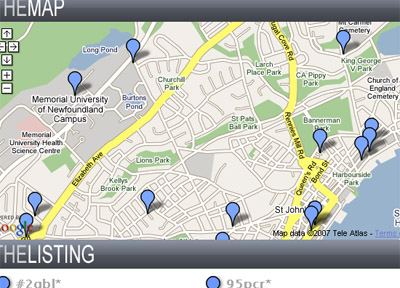
Wireless internet in the city.By Emilie Bourque and Elling Lien
You: A laptop user on the move.
The problem: It’s 2 in the morning, you don’t have internet access at home, the library’s closed, and you need to send an e-mail to your mom before the sun comes up.
Do you… go to a friend’s house? What if your friend lives across town? What if they don’t want you hanging around at 2 am?
Do you… go to a café? If you can find one open. Cafés are places you can jump online, and they’re great if you love lots of cups of coffee and the occasional scone, but if you’re not into the mugga, or the café is closed, you’re out of luck.
Do you… walk around your neighbourhood carrying your laptop like a fly-fishing rod, trying to pick up a free signal to piggyback on? (Actually, these days, if you live in a relatively dense neighbourhood, you’re pretty likely to find a number of unencrypted Wi-Fi wireless signals that reach inside your own house.) (more…)
Through The Straight
Thu, May 24, 2007
Cyclist Sarah Smellie takes you pedal-by-pedal through one of her favourite rides.
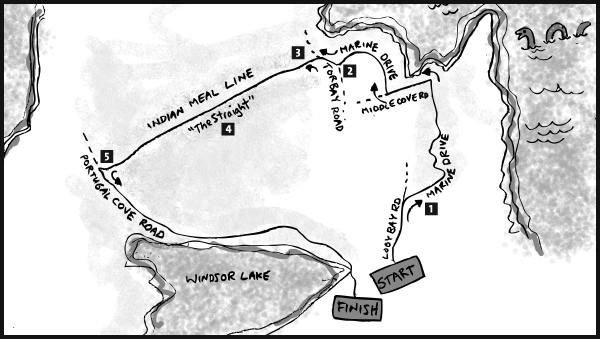
Distance 30km
Difficulty On a scale from “Trip to the Grocery Store” to “Ride Out to Cape Spear”, Moderate.
Time 2 – 2.5 hours. (more…)
Walkin’ the dog
Thu, Apr 12, 2007
Erin McKee investigates the popular social lubricant known as “walkies.”
If you’re looking for an excuse to chat with strangers about something other than the weather, try walking a dog. Social cues seem to change when there are animals about: passers-by may smile or strike up conversations if one of them has a dog in tow.
“The problem with owning a cat,” a friend of mine recently told me, “is that I never meet anyone. I should get a dog.” (more…)
Klingon with a Newfie accent
Thu, Mar 29, 2007
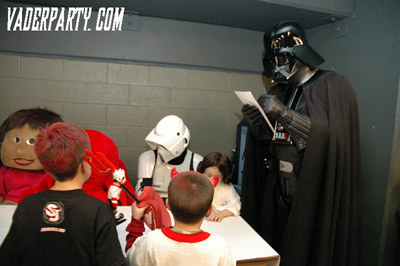
The operation to give Jonathan Adams Vulcan pinnae will be just in time for the upcoming Sci-Fi on the Rock convention.
In Jorge Luis Borges’ famous dystopian fable “Tlön, Uqbar, Orbis Tertius”, a cabal of scientists, artists, linguists, and mathematicians all working in secret under the direction of an eccentric and wealthy 19th-century atheist named Ezra Buckley conspire to produce a copiously detailed, multi-volume encyclopedia of the fictional planet Tlön. Years later, well into the 20th century, the eleventh volume of the secret encyclopedia falls into the hands of the bemused narrator who recounts, with some lament, his initial encounter and fascination with the encyclopedia of Tlön. He has since grown bitter and disillusioned, for once the discovery of the encyclopedia was publicized, everyone became obsessed by the intricate details of Tlön, its languages and history and people—to such an all-encompassing extent, in fact, that all human culture has effectively been forgotten, and Earth has itself become, for all intents and purposes, Tlön. (more…)
Buried puzzles
Thu, Mar 15, 2007
Curious about the history of his Georgestown house and the artifacts he found in his backyard, Andrew Draskoy set to researching the history of the house and the area. To explain how he did it, to help other Georgestown residents explore the history of their own houses, and to bring people together to help unravel the story of the past, he is holding a workshop this Thursday, March 15 entitled If Walls Could Talk.Elling Lien visited Andrew at his house on MacDougall street to talk to him about it.
Home to stay
Thu, Feb 15, 2007
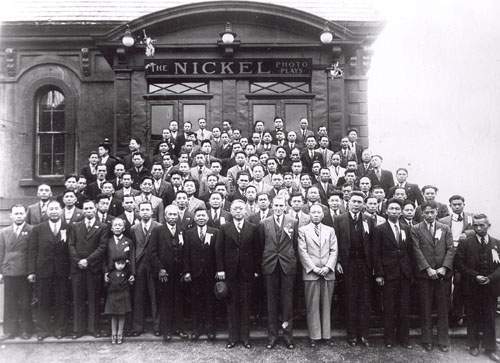
Members of the Newfoundland-Chinese community welcome the Chinese General Consul to Newfoundland outside the Nickel Theatre in St. John’s in 1938. Image courtesy of the Centre for Newfoundland Studies Archives.
“City or town or village, East or West, from British Columbia to Cape Breton, the heathen Chinee has invaded, and by him the washing industry throughout the continent is monopolized. And now two sons of the flowery kingdom have come by the Polino from Montreal to Newfoundland. …Have they come to stay?”
– The Daily News, Aug. 18, 1895.
“The first attempt to restrict Chinese nationals from immigrating to Newfoundland occurred during the 1904 session of the Newfoundland legislature, when the member for Bay St. George, W.R. Howley, introduced a bill to prohibit their entry. Referring to Chinese labour in the United States, Canada, Australia, and South Africa, Howley argued that the introduction of Chinese into these societies had created chaos… Howley’s proposal was defeated. However, two years later, government legislation imposed a $300.00 head tax on each Chinese immigrant entering Newfoundland.”
– “Newfoundland’s 1906 Chinese Head Tax”, Robert G Hong.
Historian and Co-Chair of the Newfoundland and Labrador Head Tax Redress Committee, Robert Hong was an Honours student at MUN’s Department of History when he wrote his thesis on the Newfoundland head tax, entitled “To take action without delay: Newfoundland’s Chinese Immigration Act of 1906.” Written in 1988, it remains the most detailed report on the subject to date.
Hong was born to a father from China and a mother from Trinity Bay. His father emigrated to Newfoundland in 1931, and was one of the hundreds of Chinese required to pay a $300 head tax to land here from 1906 to 1949.
Elling Lien spoke with Hong about the Newfoundland head tax, migration, and the meaning of “home.” (more…)
In heritage
Thu, Feb 15, 2007
By Shalon Butt
Picasso has said that we take inspiration for art “from the sky, from the earth, from a scrap of paper, from a passing shape, from a spider’s web.” And from our culture? In light of the coming Chinese New Year, I spoke with three prominent Chinese Newfoundland artists to discuss their own cultural experiences and sources of inspiration. (more…)
Come-by-Chance
Thu, Feb 1, 2007
Sara Tilley and the search for an aphrodisiac to call our own.
Since the human race first began recording its customs way back in the days of pictographs, there has been evidence of our use of aphrodisiacs. Loosely defined as any agent which arouses or is purported to arouse sexual desire, aphrodisiacs can include certain smells, foods, drugs, alcohol, music, items which resemble genitals, and so on.
My first forays into the topic turned up mountains of information on a wild variety of aphrodisiacs, but almost nothing originating in the province of Newfoundland and Labrador. Why were there no records of what our ancestors used to get themselves some action? (more…)
Death by chocolate
Thu, Feb 1, 2007
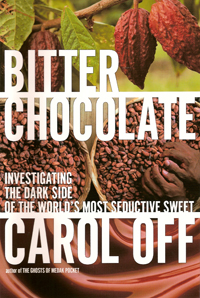
Following accounts of child labour, Carol Off headed straight to the heart of the world’s cocoa production, Côte d’Ivoire. The West African country supplies nearly half of the world’s cocoa beans, which are the principal ingredient in chocolate.
In the past few years, civil war and corruption have weighed heavily on farmers in the region already at the bottom end of a multi-billion dollar business. It left them forced to take drastic measures – including smuggling boys in from surrounding countries and keeping them as indentured servants.
Off’s book Bitter Chocolate is an investigative account of the dark side of this multi-billion dollar industry. Removing the innocent mask from the world’s favourite sweet, the investigative journalist and host of CBC radio’s As It Happens reveals a cycle of exploitation which originated in Central America with the Mayan and Aztec rulers and continues through to the multinational corporations of today.
“One thing is consistent,” the book reads, “then and now, chocolate is a luxury consumed by the privileged at the cost of those much less so. For thousands of years, the chocolate cravings of an elite have been satisfied by the hard labour of an underclass.”
I caught up with Off by phone…
Ten years ago I was a participant in a Canada World Youth exchange in Burkina Faso, in West Africa. I stayed with a family with boys who occasionally mentioned they might head off to Côte d’Ivoire for work. I had no idea they could eventually be heading into something like what you describe in the book…
I don’t think it was initially as drastic as it is. I think maybe ten years ago – maybe starting then because of the World Bank and IMF Structural Adjustment Programs, which forced the ideology that you tear down all the marketing boards, and you tear down all the programs, and people fend for themselves, and price finds its own place, and everyone gets rich. They collected less and less for the cocoa beans they grew.
And what happened is these cocoa farmers just collapsed into penury, because there was no way to defend themselves. So, initially, the labour was pretty mutually helpful. The farmers needed the labour and the labour needed the work. So then suddenly they couldn’t afford to pay for the labour. That’s when the farmers in Ivory Coast started to use their own children and other peoples’ children from outside the country who were desperate for work.
How do they get the kids to stay?
The kids, first of all, think they’re going to be paid eventually. They put up with a lot because they think they’re going to be paid. They’re going through all this shit and they have a moment when they try to get paid and they find out they’re not going to be paid. Then they realize that they’re hopeless, because the whole point of coming to the farms was to make money. When we’re kids and we do work and are treated badly we grin and bear it because we know we’ll get paid. The conditions are much worse there, but it’s the same idea. And then they have nowhere to go, because they were brought there. If you go to these farms and these farmlands, it’s just jungle. They’re not used to the geographic environment, because they come from a barren, prairie-like place. They get into the hills of Ivory Coast and it’s thick and dense jungle and it’s completely foreign to them. They don’t know how to get out and they have no place to go.
When did you first know you had to write this book?
I was going to do a documentary about it, about the children and how they were being treated.
I knew I had to do a book because I wanted to help explain the layers of how this can happen. When you take something like chocolate, which is so innocent and so childlike and central to so many great occasions in our lives, and you show that our pleasure – which is cheap – creates this chaos… Our needs cause all of this suffering. I wanted to show the layer that this suffering is historic. Chocolate has been a luxury that’s been enjoyed by elites at the cost of an underclass since it was first discovered. It shows us, the consumers of the chocolate today, as part of a continuity. We’re no different from Montezuma. We’re no different from Louis XIV. We’re no different from any other group that exploited others to enjoy ourselves. The fact that we think things are now democratic, that the industrial revolution has brought us all to the same place, that we’re all equal, it ignores the reality that a small part of the world is enjoying a democracy of pleasure and goods at the cost of others who have nothing and will have nothing.
I wanted to show the history of chocolate going from the Mayans and the Aztecs up through the issues that the World Bank and the International Monetary Fund introduced to it, and show the trend of slavery and exploitative labour which runs through that whole history. There was only one way to do that and that was a book. I thought I could really show an epic sweep of something this thing most people think of as quite innocent.
And what about the disconnect? How do you feel that people don’t know about this?
I think that people would like to do the right thing, but we want to have cheap goods. We don’t acknowledge, and for the most part don’t want to acknowledge that the price of our cheap goods is paid by somebody else, somewhere else. And that’s whether it’s gasoline you’re putting in your car or chocolate. We live in a fool’s paradise of pleasure and indulgence that someone else, someplace else, pays for.
People know about all the other horrible things that we enjoy that someone else pays for, but I thought chocolate was so strikingly innocent, and so childish, that it was really startling to show people how much we enjoy of life at someone’s expense. Because these are children who are cultivating the beans for us! They are providing the beans to make the chocolate for the children who enjoy it.
I thought nothing – nothing – could be more simple. It’s a perfect example of how unequal and completely unjust things can be.
What has been the public reaction to the book?
It’s been overwhelmingly “Oh my god, what can we do?” Which actually was encouraging for me, because my final moments are completely pessimistic.
That was going to be my next question. Your final sentence in the book was “For as far as anyone can see into the future, there is little likelihood that this ancient and enduring injustice will be corrected.” How did it feel to write that sentence?
I felt absolute despair.
Even as I was telling people I was writing this book they would say, “Oh no, another thing we have to worry about,” or, “Oh great, now I can’t eat chocolate any more.” All kinds of cynical messages, even among people I thought would care. I thought if that’s the reaction to my writing this book, I don’t give up much hope for change.
What also gave me despair was to realize people can’t fight this on a consumer level. I don’t think fair trade products are a solution.
A lot of people would be surprised that you’d say that.
Yeah, I think so. And I don’t want to disparage people who are really trying to do something like that, but fair trade is such a small part of the product.
It also removes the consumers who are conscientious and who put pressure on things, who have something to say, from the game.
They say, “All right, I can’t deal with the whole bloody mess, so I’m going to eat this fair trade stuff and feel okay, so I can get through my day.”
Fair trade removes all the people who could put up a really good fight, and it leaves the people who don’t care making the decisions.
So I concluded that my despair came from realizing there was no consumer solution to the issue of child labour and chocolate. We don’t have much power as consumers. We have far more power as citizens. It’s far more important to insist that we cannot have products coming into the country that have exploitative labour as an ingredient.
The giant corporations are not going to suddenly say, “Well, fine, we’re not going to make chocolate any more if you do that.” They’ll be forced into fixing things. That’s where the pressure comes from.
That’s what gave me a lot of hope. People who are contacting me and who are mobilizing politically.
How are they mobilizing?
They’re pressuring government. I’ve heard from a lot of people in Ottawa, NDP people, I’ve read some blogs where people were saying, “We have to make this one of our issues.” That’s in Canada.
In the United States there’s this fantastic group, the International Labour Rights Fund, who are mounting a challenge against the chocolate companies in court. I think challenging corporations in court is really useful.
But that’s the kind of aggressive political action you have to take. Use the courts, use the political system, use committees.
I think we’ll see, now that the Democrats have Congress again that we’re going to start seeing some mobilization again on the cocoa trade. And you sort of feel, “yeah, maybe the world’s waking up.”
Is there a particular image that sticks with you after finishing your book?
Yeah, the kids in Côte d’Ivoire on the cocoa farm, and hearing them say they said they didn’t know what the cocoa beans were used for. And these were the third generation of kids up there, you know? Plucking those beans. They didn’t know what we did with them. Their parents and their grandparents didn’t even know what we did with the beans. They send the beans here, and they don’t know what we do with them.
And this is the world’s chocolate.
At that moment I wasn’t thinking, “Those poor children, they need some chocolate.” I was thinking, “Those children need some shoes. They need something to eat. They need inoculation against diseases. They need a place to go to school.”
Carol Off’s Bitter Chocolate: Investigating the Dark Side of the World’s Most Seductive Sweet is published by Random House.
10 Bestestest
Thu, Jan 4, 2007

We asked a bunch of folks we know to make a list of their favourite things from 2006. Here’s what they gave us…
Get on the bus
Thu, Jan 4, 2007
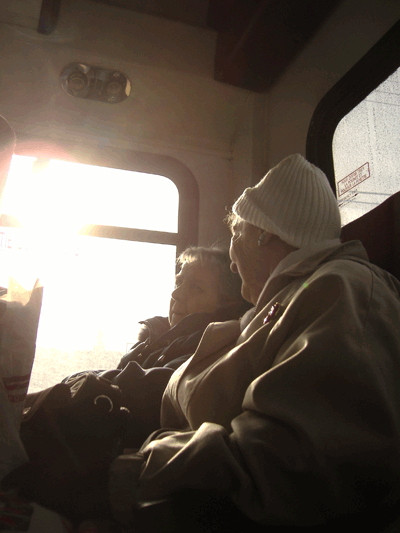
Jonathan Adams hitches a ride on the Seniors Resource Centre’s Grocery Bus.
Every Wednesday morning in St. John’s, a little white bus goes chugging through the city. It sets out from Torbay Road, ducking briefly into Kenny’s Park, then neatly bisects downtown, plunging down Garrison Hill and sailing along New Gower before it swoops to climb to the West End. Maybe you’ve seen it and wondered what business does a little white bus have seeming so intent and glad of purpose every week.
(more…)


Thu, Apr 24, 2008
Bryhanna Greenough